GDMonkey

DNOOO blank theme is active for local preview.

How to Set Up Church Stage Lighting Without Blinding the Congregation or Wasting Budget

What bad church lighting actually costs you

The most common church stage lighting setup problem we see isn't darkness — it's glare. Front wash fixtures aimed too low blast the first three to five rows directly in the eyes. Congregants shift seats, complain to the facilities committee, or just stop sitting up front. The stage looks fine from behind the sound booth. Nobody notices the problem from where the tech team stands.

The second failure is invisible until you check the livestream. Without proper back light, your pastor appears flat against the background — a talking head pasted onto a wall. Media teams troubleshoot cameras, adjust white balance, and buy new lenses. The actual problem is a $200 fixture that was never installed behind the stage.

Then there's the budget drain. We've visited churches that spent $15,000–$20,000 on moving heads because someone saw them at a conference. Those fixtures now sit in static mode 95% of the time. The volunteer running the board on Sunday morning doesn't know how to program cues, and nobody on staff has time to learn. That money could have covered a complete LED par system with proper placement, a spare parts inventory, and a year of utility savings.

These mistakes compound. Glare complaints lead to awkward workarounds (tilting fixtures upward until they hit the ceiling instead). Bad video leads to expensive camera upgrades that don't fix the root cause. Overcomplicated systems lead to volunteer turnover. This guide covers how to prevent all of it with fixture placement physics, selection logic tied to room dimensions, and a DMX approach your rotating volunteer team can actually operate.

Front wash, back light, and side fill — beam angles and placement that prevent glare

The single rule that eliminates congregation glare: mount your front wash fixtures at a minimum 45° vertical angle relative to the stage floor. When light strikes downward at 45° or steeper, the beam terminates on the stage surface and the people standing on it — not on the seats beyond. Anything shallower than 40° sends light directly into audience sight lines.

Mounting height calculation: Take your stage depth (front edge to back wall) and multiply by 1.5. That's your minimum mounting height above stage floor level. A stage 4 meters deep needs front wash fixtures at least 6 meters above the stage. This ensures the 45° angle geometry works even for fixtures positioned directly above the front edge.

(We've seen churches try to cheat this by hanging fixtures lower and pointing them more steeply downward. It creates harsh shadows under eyebrows and chins — terrible on camera. The height matters.)

Beam angle selection by throw distance:

  • 15° beam — throw distances over 12 meters (large auditoriums with high ceilings)
  • 25° beam — throw distances of 6–12 meters (most mid-size sanctuaries)
  • 36° or wider — throw distances under 6 meters (low-ceiling rooms, fellowship halls)

Choosing the wrong beam angle is the second most common church stage lighting design failure. A 15° spot on a 5-meter throw creates a small bright circle surrounded by darkness. A 60° flood on a 15-meter throw wastes 70% of its output on walls and ceiling. Match the optic to the distance.

Back light positioning: Mount behind and above the stage at 60–70° vertical angle. The job of back light is to create a visible edge of brightness along the speaker's shoulders and head — this separates them from the background on camera. Intensity should run roughly half of your front wash level for worship moments (2:1 front-to-back ratio), rising to equal intensity during high-energy segments.

Side fill: Position at 30–45° horizontal from the stage centerline. Side fill adds dimension to faces — without it, your livestream produces flat, shadowless video that looks like a passport photo. Two to four fixtures, one from each side, running at about 50–60% of front wash intensity.
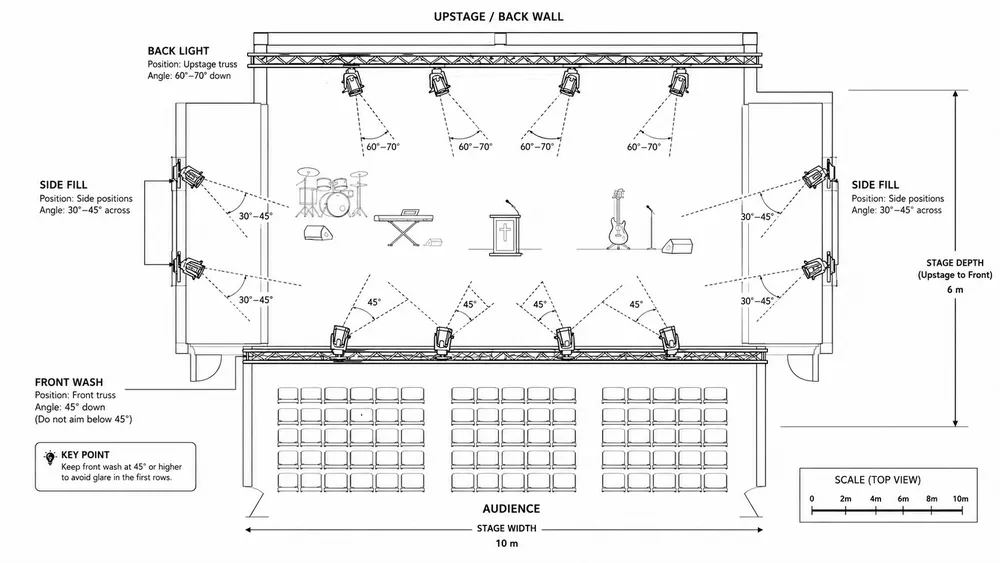
Top-down diagram showing front wash, back light, and side fill positions with beam angles for a church stage

Front wash coverage math: For even illumination across a 10-meter-wide stage, you typically need 4–6 fixtures with overlapping coverage zones. Each 25° beam at an 8-meter throw covers roughly a 3.5-meter diameter circle on stage. Overlap adjacent fixtures by 30% to eliminate dark gaps between pools. This is the math that most worship stage lighting guides skip — and the reason many churches end up with bright spots and dead zones instead of even coverage.

Fixture selection by sanctuary size and ceiling height

The right fixture type depends on three things: your ceiling height, your stage width, and whether you broadcast video. Everything else — color mixing modes, gobo capability, movement features — is secondary to getting these basics matched.

Factor LED par can Ellipsoidal (profile spot) Moving head
Best ceiling height Under 7 m 4–12 m Over 7 m
Stage width coverage Wide flood, overlapping Sharp-edged beams, precise Variable, motorized
DMX complexity 4–8 channels 4–6 channels 16–24 channels
Volunteer operability Simple Moderate Complex
5-year maintenance Near zero Near zero Motor/belt service
Typical unit cost (FOB) $80–$200 $150–$400 $300–$1,200+
Livestream quality Good with CRI 90+ Excellent edge control Excellent (if used correctly)

LED par cans handle 80% of church stage lighting needs. Fixed front wash in rooms with ceilings under 7 meters, wide beam coverage, simple 4–8 channel DMX operation, and essentially zero maintenance beyond cleaning the lens every few months. For churches on a budget that still need broadcast-quality results, a set of high-CRI LED stage lights for church applications delivers the best cost-per-lux value.

Ellipsoidals (also called profile spots or ERS fixtures) earn their place when you need hard-edged beams — for example, to light the pulpit area without spilling onto a projection screen 2 meters behind it. They cost 2–3× more per unit than a par can but solve a specific problem that pars physically cannot. Don't buy them for general wash — that's overspending for a job a par does better and cheaper.

Moving heads are the most common overbuys in church lighting. Unless your facility doubles as a concert venue or conference center with a dedicated production staff, moving heads collect dust. They require complex programming, regular maintenance on pan/tilt motors and belts, and 16–24 DMX channels per fixture. A volunteer running presets on Sunday doesn't need motorized pan/tilt. (We manufacture both — and we tell church buyers this honestly. Moving heads make sense for multi-use auditoriums that host events and concerts outside of worship services. For Sunday-only sanctuaries, the money goes further on pars and ellipsoidals.)

CRI matters more than you think. LED stage lights for church worship need a Color Rendering Index of 90 or higher. Fixtures with CRI below 80 produce light that looks acceptable to the naked eye in the room — but on camera, skin tones go greenish or grey. Your media team will fight this endlessly with camera settings and never fully fix it because the problem is the light source, not the lens.

Fan noise is a spec, not an afterthought. Any fixture mounted within 6 meters of a live microphone needs a fanless or silent-fan design (≤30 dB at 1 meter). This is a purchase-time decision. You cannot silence a fixture designed for forced-air cooling after installation. We run convection-cooled thermal designs on several PAR models specifically for worship installations where a quiet moment shouldn't compete with fan whine.
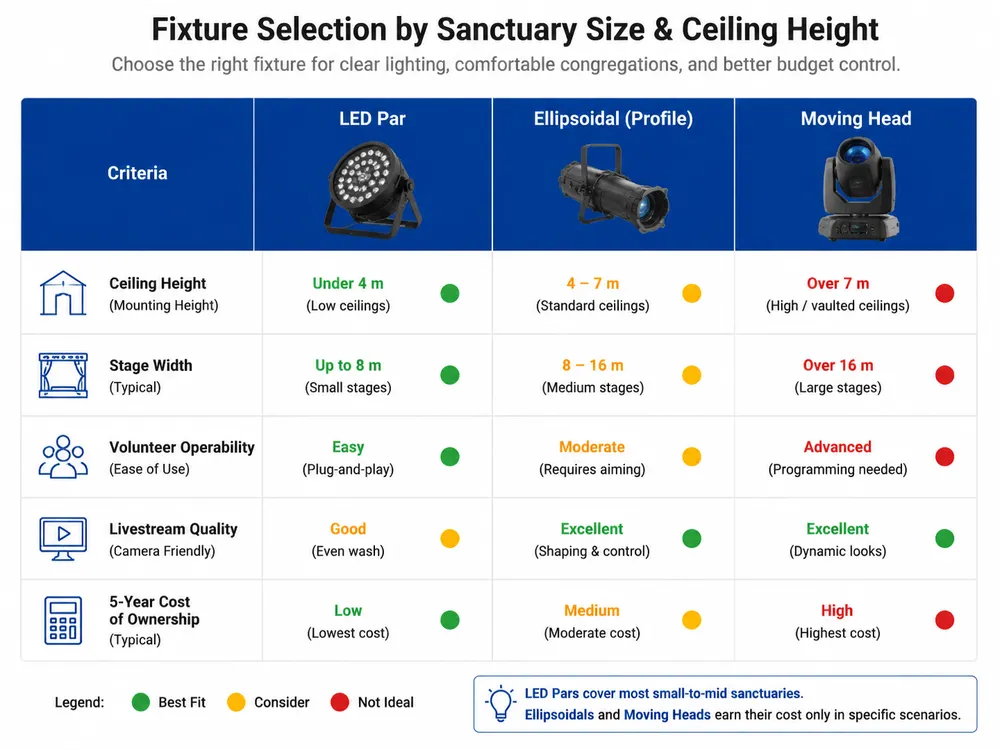
Decision matrix comparing LED par, ellipsoidal, and moving head fixtures by ceiling height and church room size

DMX channel plan that volunteers can run without training

The goal for a volunteer-operated church stage lighting setup is one-button scene recall. Your Sunday morning operator should walk up to the board, press "Sermon," and the stage looks correct. No fader adjustments, no channel hunting, no guessing.

Group fixtures by position, not by type. Assign all front wash fixtures to one control group. All back lights to a second group. All side fills to a third. This means the volunteer thinks in terms of "brighter stage" or "more back light" — not "fixture #7 needs channel 4 at 180."

Starter patch list for a 12-fixture setup:

DMX Channel Assignment Fixtures
1–2 Front wash (left 3 pars) Master dimmer + color temp
3–4 Front wash (right 3 pars) Master dimmer + color temp
5–6 Back light (2–3 fixtures) Master dimmer + color
7 Side fill left Master dimmer
8 Side fill right Master dimmer

Program 4–6 preset scenes:

  1. Sermon — front wash at 80%, back light at 40%, sides at 50%. Neutral white (3200–4000K).
  2. Worship — front wash at 60%, back light at 70%, sides at 40%. Warmer tone, optional color accent.
  3. Prayer/dim — front wash at 30%, back light at 20%, sides off. Warm amber.
  4. Video roll — all stage lights at 10% or off. House lights remain.
  5. Transition — front wash at 50%, back at 50%. Quick crossfade between segments.
  6. Special — full intensity all positions, configured for baptisms, presentations, or guest speakers.

Physical labeling is mandatory. Write "SERMON," "WORSHIP," "PRAYER" directly on the board with label tape or a printed overlay. Volunteers rotate every few weeks — nobody memorizes button numbers.

The 15-minute test: if you can't explain the entire board operation to a new volunteer in 15 minutes, the system is too complex. Either simplify the patch, reduce the scene count, or upgrade to a controller with touchscreen preset recall. A small church stage lighting setup guide should never require a 40-page manual.

Budget tiers — fixture counts, expected results, and 5-year cost

Tier 1 — Starter: $1,500–$3,000

  • Fixtures: 6–8 LED pars (200W, CRI 90+, 25° beam)
  • Controller: Basic 192-channel DMX board with 8 scene presets
  • Coverage: Front wash only, even stage illumination
  • Result: No glare, adequate single-camera livestream, clean stage presentation
  • Room size: 50–150 seats, ceiling 3–5 meters

Good enough for a community church that wants to look professional on video without any complexity. No back light at this tier — the trade-off is slightly flat video, acceptable when camera quality and room acoustics are your bigger constraints.

Tier 2 — Standard: $4,000–$8,000

  • Fixtures: 10–14 LED pars + 2–4 ellipsoidals
  • Controller: Scene-capable board with 12+ presets and crossfade
  • Coverage: Front wash + back light + basic side fill
  • Result: Broadcast-quality video separation, color accent capability, multi-scene worship
  • Room size: 150–500 seats, ceiling 4–7 meters

This is where most churches should land. The back light alone transforms video quality. Ellipsoidals handle pulpit isolation or gobo texturing on the back wall. LED stage lights for church in this configuration give you 90% of a production-level result at 40% of the cost.

Tier 3 — Production: $10,000–$20,000

  • Fixtures: Moving heads + LED wash + profile spots + pixel bars
  • Controller: Multi-zone DMX with show programming
  • Coverage: Full multi-zone rig with effects capability
  • Result: Concert-level flexibility, event hosting, conference production
  • Room size: 500+ seats or multi-use auditoriums

Only justified if your facility hosts concerts, conferences, or events beyond Sunday worship. Requires a dedicated operator or pre-programmed show files.

5-year total cost comparison: An LED par rated at 50,000 hours of LED life needs zero re-lamping over a decade of Sunday services (roughly 2,000 operating hours over 5 years). A traditional halogen par running the same schedule needs new lamps every 1,000–2,000 hours — multiply lamp cost × fixture count × replacement frequency. For a 12-fixture rig, that's often $1,500–$3,000 in lamp replacement costs that LED eliminates entirely.

Power consumption: 12 LED pars at 200W each draw 2.4 kW total. Equivalent halogen coverage needs 12–15 kW. At typical US commercial electricity rates ($0.12–$0.15/kWh), the difference saves $400–$600 annually in a church running services three times per week. LED fixtures typically pay back their premium over halogen within 18–24 months on energy savings alone.

Five common church lighting mistakes and how each one wastes money

  • Aiming front wash too low. Light hits the congregation's eyes instead of the stage. Fix: re-aim to maintain 45° vertical angle minimum, raise mounting height if necessary.
  • Buying moving heads for a volunteer-run room. Complex fixtures that require programming expertise sit in static white mode permanently. Fix: buy LED pars, put the saved budget into proper positioning and a good controller.
  • Ignoring CRI when purchasing fixtures. Cheap LED pars with CRI 70–75 look fine to the eye in the room but produce grey, lifeless skin tones on camera. Fix: specify CRI 90+ at purchase. The price difference is typically 15–25% — far less than the cost of living with bad video or replacing fixtures later.
  • No back light. The single cheapest upgrade that produces the biggest on-camera improvement, and the one most churches skip because it isn't visible from the audience's perspective. Fix: add 2–3 fixtures behind and above the stage at 60–70° angle, running at 40–50% of front wash intensity.
  • Running all fixtures at 100% in one static scene. Church stage lighting design requires at least 4 distinct scenes because sermon, worship, prayer, and announcements have completely different visual needs. One setting for every moment is the wrong setting for most moments. Fix: program presets, give the volunteer one-button access to each scene.

How to spec fixtures before purchase — preventing returns and regrets

Before placing an order for church lighting fixtures, confirm these specifications in writing from your supplier:

Minimum spec checklist:

  • CRI ≥ 90 (verified with integrating sphere test data, not just catalog claims)
  • Beam angle matched to your actual throw distance
  • Fan noise ≤ 30 dB at 1 meter (or confirmed fanless thermal design)
  • DMX channel mode compatible with your controller's universe capacity
  • Power draw per fixture × fixture count stays within your circuit breaker capacity
  • Color temperature consistency: ±200K unit-to-unit variation maximum

Request photometric data. A reputable manufacturer provides IES files or at minimum a lux-at-distance table. If your supplier can't provide measured photometric output for the fixture you're quoting, that's a red flag — you won't know whether 6 fixtures or 12 fixtures will cover your stage until they arrive.

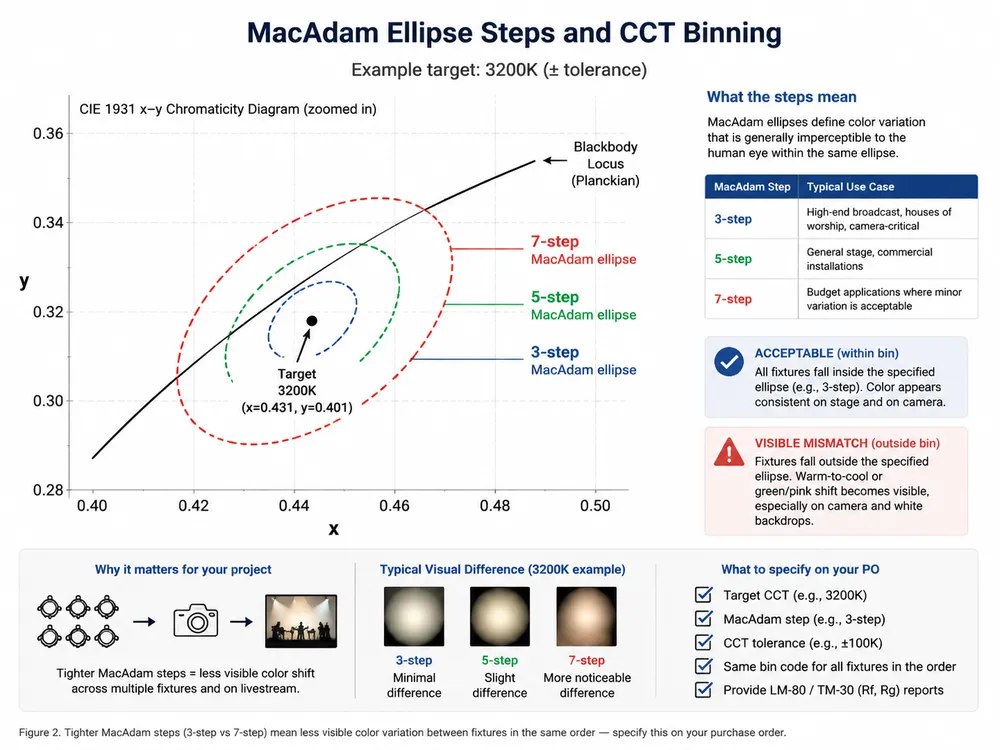
Color temperature consistency matters across a batch. When you order 12 pars, they need to match. We bin LEDs on our SMT line and hold color temperature within ±150K across a production run. A supplier with wider drift (±500K or more) will deliver a batch where some fixtures look warm-white and others look cool-white on the same stage. Visible mismatch. No fix except replacement.

For overseas orders: confirm CE/FCC compliance documentation is ready before the container ships. We've seen churches discover at customs clearance that their supplier's "CE certified" claim was self-declared without a test report. Get the actual EMC test report number and the responsible lab name before you pay the balance. (We provide full compliance documentation with every shipment — test lab name, report number, and copies of the certificates. This should be standard, not a special request.)

If you're speccing a system from scratch and need help matching fixture types to your specific room dimensions, send your sanctuary floor plan with ceiling heights and seating count to request a custom lighting quote — we'll return a fixture package recommendation with a layout diagram and DMX patch plan at no charge.
How to Source Church Stage Lighting Systems as an Integrator or AV Contractor

Why church projects keep catching integrators off guard

You've done concert installs. You've wired corporate boardrooms. Then a 400-seat Baptist church in suburban Texas calls with a $35,000 budget and a building committee that meets once a month, and suddenly nothing in your workflow applies cleanly.

Church stage lighting guides written for end-user congregations won't help you here. The constraints are different at every level: volunteer operators who rotate every quarter, fixed architectural ceilings with no fly system, donation-funded budgets that can't absorb a change order, and livestream cameras running at the same time as in-room worship. Spec the wrong fixtures and you'll end up with a rig that overheats behind a closed soffit, or a DMX system so deep that the church's volunteer team stops touching half the channels within six months.

This article walks through the sourcing workflow from a church lighting system integrator's perspective — fixture categories, ceiling and rigging realities, the step-by-step path from site survey to bulk order, and the channel decision between distributor stock and manufacturer-direct purchasing.

Fixture categories that matter for house of worship lighting design

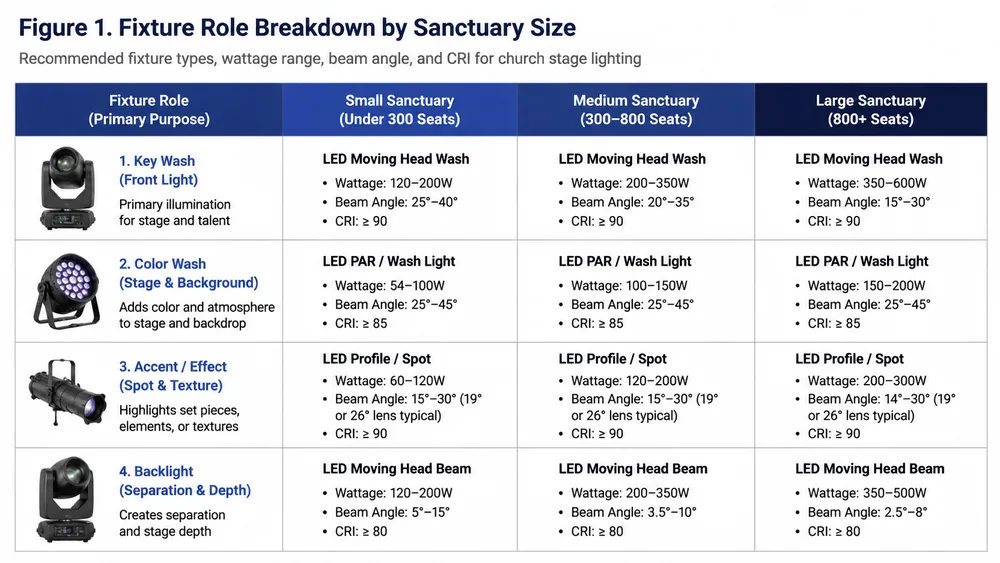
Not every fixture category earns its rigging weight in a sanctuary. We've shipped church stage LED fixtures into 200+ worship projects across North America, Brazil, and Nigeria, and the installations that hold up long-term almost always fill four functional roles — no more, no less.

Key/front wash — LED pars or Fresnels. These carry 80% of the visual workload during a service. The specs that matter: lumen output per fixture, beam angle (typically 25°–45° depending on throw distance), CRI 90+ for camera-friendly skin tones, and tunable white capability in the 3000K–5600K range. Tunable white is non-negotiable for worship because you need to match house lights during service transitions without a hard color shift on the livestream feed.

Color wash — RGBW LED pars or battens. Used for song sets, seasonal themes, and mood transitions. Here you care about color mixing smoothness (no visible color shadows at short throw), dimming curve quality (smooth fade to black without stepping), and wattage-to-coverage ratio. Most 300-seat sanctuaries need 8–12 color wash units across two battens.

Accent/effect — Moving heads, spot or beam. This is where integrators over-spec most often. A 200W LED moving head covers the vast majority of 500-seat sanctuaries with room to spare. Specifying 300W+ concert-grade units adds fixture weight (12–18 kg versus 8–12 kg), more heat output at the ceiling, higher noise floor from cooling fans, and cost your client doesn't need. (We see this pattern constantly — integrators pulling from concert rental inventory lists instead of sizing to the room.)

Backlight/silhouette — LED strips or profile spots. These separate the speaker from the background on camera. Lower wattage, tighter beam control, and warm white or amber options. Often the cheapest fixtures in the rig but the most visible on livestream.

For each role, pull these specs from the data sheet before you specify anything: lumen output, beam angle range, CRI/TLCI, CCT range (fixed vs tunable), DMX channel modes, fixture weight with clamp, and rated ambient operating temperature. That last one matters more in churches than in concert rigs because of ceiling constraints — which brings us to the next section.

Table showing four fixture roles for church stage lighting with recommended specs per sanctuary size

Browse the full Church Stage Lighting category for fixture specs segmented by worship application.

Ceiling height and rigging load — the specs that kill projects

Most worship spaces have fixed architectural ceilings. No fly system, no motorized battens, no road crew to re-rig between services. The ceiling structure you see during the site survey is what you're working with for the next 10–15 years.

Ceiling height tiers and what they mean for fixture selection:

Sanctuary type Typical ceiling height Throw distance to stage Fixture implication
Small chapel 4–6 m 3–5 m Wider beam angles (40°+), lower wattage (60–100W pars), fixture body visible to congregation
Mid-size sanctuary 6–10 m 5–8 m Standard beam angles (25°–40°), medium wattage (100–200W), moderate heat management needed
Large auditorium 10–15 m 8–12 m Narrower beams (15°–25°), higher wattage (200–300W), weight becomes the constraint

Lower ceilings trap more heat at fixture level, require wider beam angles for coverage, and make fixture bodies visible to the congregation — so aesthetics matter in a way they don't for truss-mounted concert rigs.

Rigging load reality: Typical church ceiling structures support 15–30 kg per linear meter on pipe or truss battens. A 200W LED moving head weighs 10–15 kg with clamp and safety cable. Before ordering, calculate total rig weight per batten position and confirm with a structural engineer — especially in older buildings where the ceiling was designed for speakers and banners, not lighting rigs.

Thermal management in enclosed ceilings: When fixtures mount above a false ceiling or inside a soffit with limited airflow, ambient temperature at fixture level can exceed 35°C. LED driver life degrades above that threshold. Passive aluminum heat sinks handle most open-ceiling installs, but enclosed environments may need lower-wattage fixtures, forced-air pathways, or fixtures rated for higher ambient operation (check the data sheet for "Ta max" — if it says 40°C or 45°C, you have more margin for enclosed mounting).

The sourcing mistake here: specifying fixtures by output alone without confirming throw distance. A 150W LED par at 5m throw delivers similar stage-level lux to a 300W par at 12m throw. The difference? Weight, cost, heat load on your rigging, and fan noise that a 300-seat chapel will actually hear during a quiet prayer.

Sourcing workflow — site survey to bulk order

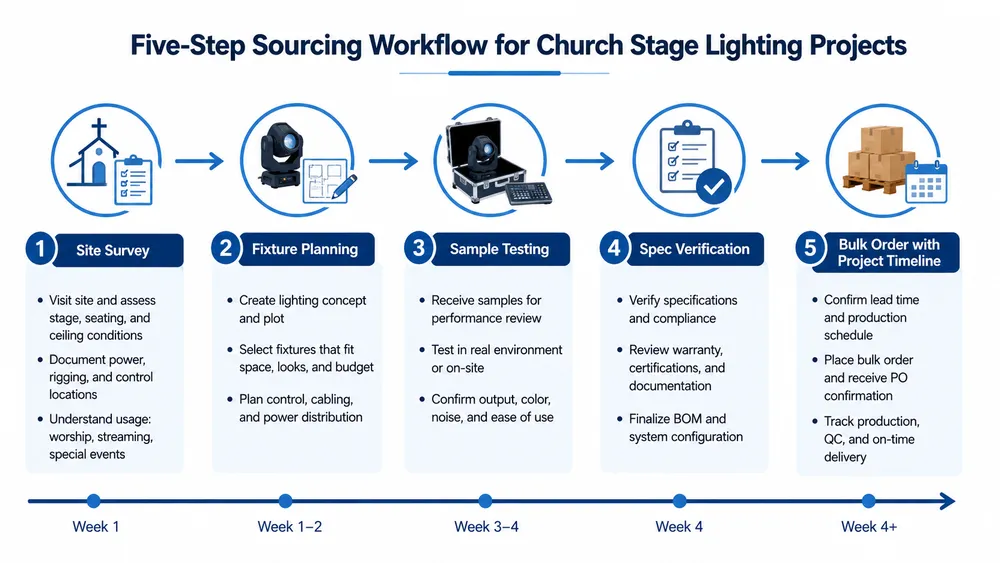
This church stage lighting sourcing checklist breaks the purchasing process into five steps. Every step has a deliverable that protects your margin and prevents callbacks.

Step 1: Site survey data collection

Collect before you open a single manufacturer catalog:

  • Sanctuary dimensions (L × W × ceiling height at stage, at seating, at rear)
  • Ceiling structure type (exposed steel, drywall soffit, wood beam, concrete)
  • Existing electrical capacity — amps per circuit, number of available circuits, panel location
  • Current fixture positions and cable run paths
  • Livestream camera positions, lens focal lengths, and current white balance settings
  • HVAC vent locations relative to planned fixture positions

Step 2: Fixture quantity planning

Calculate positions per role based on stage width and coverage angle. Rule of thumb for front wash: one LED par per 1.5–2m of stage width at a 5m throw distance with 30% beam overlap between adjacent fixtures. A 10m-wide stage at 5m throw with 40° beam angle pars needs roughly 6–8 units for even key light coverage.

For color wash, plan one fixture per 1.5m of batten length. For moving heads, 2–4 units cover most sanctuaries under 800 seats — resist the impulse to spec more.

Step 3: Sample testing

Request 2–3 sample fixtures per category from your shortlisted manufacturer. Bench-test for:

  • Measured lumen output versus data sheet claims
  • Color temperature consistency across sample units (measure with a spectrometer, not your eyes)
  • DMX compatibility with the church's existing console or your planned console
  • Fan noise at full output — measure at 2m distance in a quiet room
  • Dimming curve smoothness from 100% to 0%

(We run a 48-hour aging test on every unit before shipment, but I still recommend bench-testing your samples independently. It confirms performance under your specific power conditions and gives you documented baseline data for the client handoff.)

Step 4: Spec sheet verification

Before committing to the bulk order, verify that the factory can provide:

  • Photometric data files (IES format) for your lighting design software
  • Thermal test reports showing junction temperature at rated ambient
  • Safety certifications matching the installation jurisdiction — CE for general export, UL/ETL if the church's insurance carrier requires it for North American installs
  • EMC compliance documentation (FCC Part 15 for US installations)

If the manufacturer can't provide IES files or thermal data on request, that's a signal. You can request a project quote with your fixture list and ask for engineering documentation as part of the quotation package — any factory that actually runs their own testing lab will send this without hesitation.

Step 5: Bulk order with project timeline

Align lead time with your install schedule:

  • Standard models (catalog SKUs): 2–4 weeks production
  • Custom color temperature bins or OEM branding: 4–6 weeks production
  • Sea freight to North America: 3–5 weeks
  • Air freight: 7–10 days

Plan to receive fixtures at least 2 weeks before install date. That buffer gives you time to pre-program DMX addresses, verify consistency across the batch, and catch any shipping damage before you're on-site with a crew.

MOQ reality for project purchasing: You're buying 20–80 fixtures per order, not container loads. Confirm that your manufacturer supports project-quantity MOQs — we start at 30 units per SKU for standard models, which fits most mid-size sanctuary projects in a single order.

Flowchart showing the five-step sourcing workflow for church stage lighting projects from site survey to bulk order

Manufacturer-direct vs. distributor — cost and control trade-offs for church stage LED fixtures

Both channels serve a purpose. The question is which one fits your project economics.

Distributor channel: Local stock ships in 2–5 days. Returns are straightforward. But you're limited to catalog SKUs with fixed color temperatures and standard configurations. Typical distributor markup runs 30–50% over factory price, and you won't get photometric files or thermal test data unless you specifically chase them down. For a church lighting system integrator doing repeat installs, that markup compounds across every project.

Manufacturer-direct channel: Longer lead time (2–6 weeks door-to-door depending on shipping mode), but you get access to engineering data — IES files, thermal reports, EMC test certificates — as part of the quotation process. You also unlock custom color temperature bins (useful when a church's existing house lights are an unusual CCT and you need front wash to match), OEM branding on fixtures if you're building your own installation brand, and lower unit cost at project volumes.

When to use each:

  • Distributor: emergency replacements, small add-on orders under 10 units, or when the church needs a fixture next week and can't wait for production.
  • Manufacturer-direct: planned projects over 20 units where you need specific specs, documentation for the church's insurance or building code review, or custom CCT matching.

The practical hybrid approach: maintain a distributor account for service and warranty replacement stock, but source your initial project orders direct from factory. That structure maximizes your project margin while keeping service response fast for post-install support.

What integrators get wrong in worship lighting — and where it costs margin

After supporting 200+ church sanctuary projects, the failure patterns are consistent. Every one of these mistakes costs you a truck roll, a re-spec, or a margin-eating concession.

Over-speccing wattage for the ceiling height. A 300W moving head in a 6m-ceiling sanctuary is 150W more than you need, 4–6 kg heavier per fixture than necessary, louder from the cooling fans, and harder on the church's electrical budget. The congregation notices fan noise during quiet moments. Spec to the room, not to the product catalog.

Ignoring LED bin matching across batches. Ordering front wash fixtures from two different production batches — or worse, two different suppliers — without confirming LED color bin consistency. The result: adjacent fixtures that look visibly different when set to the same CCT. On camera, it's obvious. Callbacks and re-lamping come out of your margin. (We bin-match within ±100K across production batches specifically for this reason, but not every manufacturer does. Ask for the binning tolerance before you order.)

Forgetting the volunteer factor. A 48-channel DMX rig with 200+ parameters looks impressive in your design software. Six months later, the church's volunteer tech team — typically 2–4 people who rotate monthly — has stopped using anything beyond the first three scenes because the system is too complex to operate without training. Specify simpler preset-based control (8–12 scenes) with optional full DMX override accessible to trained operators. Your post-install support calls drop by half.

No documentation handoff. The install looks great on commissioning day. Six months later, nobody at the church can replicate the settings because no one documented DMX addresses, scene programming, fixture positions, or cable routing. Include a laminated one-page rig sheet as part of your deliverable. It costs you 30 minutes and prevents the majority of "can you come back and fix this" requests that eat into your profit on the project.

Frequently asked questions — church stage lighting sourcing

What CRI/TLCI rating do church stage lights need for livestream quality?

90+ CRI and 85+ TLCI for competent livestream reproduction. Below 85 CRI, skin tones shift green or magenta under camera auto white balance, and the media team starts fighting color correction in post rather than trusting the lighting. Most professional church stage LED fixtures from reputable manufacturers hit 92–95 CRI. TLCI is the camera-specific metric — ask for it separately if the data sheet only lists CRI.

How many LED pars do I need for a 12m-wide church stage?

At 40° beam angle with 5m throw distance and 30% overlap between adjacent fixtures, roughly 6–8 LED pars for even front wash coverage. For narrower 25° beam angles (common at longer throw distances), increase to 10–12 units. Always calculate based on beam width at the throw distance, not fixture count alone.

Can I mix fixture brands on the same DMX universe?

Technically, any DMX-512 compliant fixture works on the same universe. Practically, color temperature drift between brands creates visible inconsistency when adjacent fixtures are set to the same CCT value. Source all fixtures within the same functional role (front wash, color wash) from a single manufacturer to guarantee bin-matched LED output. Mix brands across roles if needed — front wash from one manufacturer, LED moving heads from another — but not within the same visual layer.

What's the realistic lead time for a 50-fixture church project order from China?

Standard catalog models: 2–4 weeks production plus 3–5 weeks ocean freight to North American ports (total 5–9 weeks). Air freight cuts transit to 7–10 days but adds $3–5/kg to your landed cost. Custom CCT bins or OEM branding: add 2 weeks to production. Plan 8–10 weeks total for sea delivery, 4–6 weeks for air. Build in a 2-week receiving buffer before your scheduled install date.

Do I need IP-rated fixtures for indoor church installations?

IP20 (standard indoor rating — protected against solid objects over 12mm, no water protection) is fine for open-ceiling installations with adequate ventilation. If fixtures mount inside enclosed soffits, near HVAC supply vents where condensation forms, or in any position where cleaning crews might spray near them, specify IP44 minimum. Outdoor worship spaces or covered pavilions need IP65 or higher.

Top 10 Church Stage Lighting Suppliers in the USA That Offer Factory-Direct Pricing for Houses of Worship

Why Churches Overpay for Stage Lighting

Most houses of worship buy stage lighting the same way they buy office supplies — through whatever channel is most convenient. The problem is that "convenient" in the US lighting supply chain means two or three margin layers between the factory floor and your sanctuary ceiling.

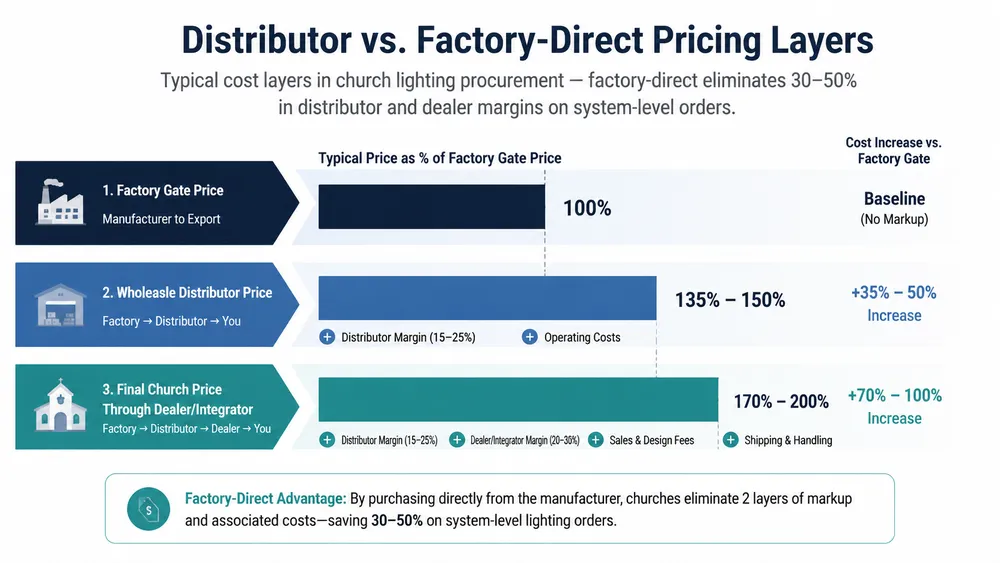
Here's the typical path: a Chinese or US-headquartered manufacturer produces the fixture, sells it to a national distributor at 30–40% markup, and that distributor sells it to a regional dealer or AV integrator who adds another 20–30% before quoting your church. By the time a 200-seat congregation receives a proposal for 12 LED par washes, the per-fixture price is 60–100% above what the factory originally charged.

Churches feel this more than commercial venues because the budget is fixed, the procurement team is often volunteers, and the purchasing decision goes through committee approval that rewards "safe" choices over cost-efficient ones. The result: worship lighting suppliers that serve this market know price sensitivity is high but purchasing sophistication is low — and they price accordingly.

This article breaks down 10 established suppliers serving the US church lighting market, organized by business model so you can see exactly how each one sources and prices product. The goal is not to rank them 1–10 — it's to help you choose the sourcing route that fits your budget, timeline, and technical needs.

Supplier Evaluation Criteria That Actually Matter for Worship Venues

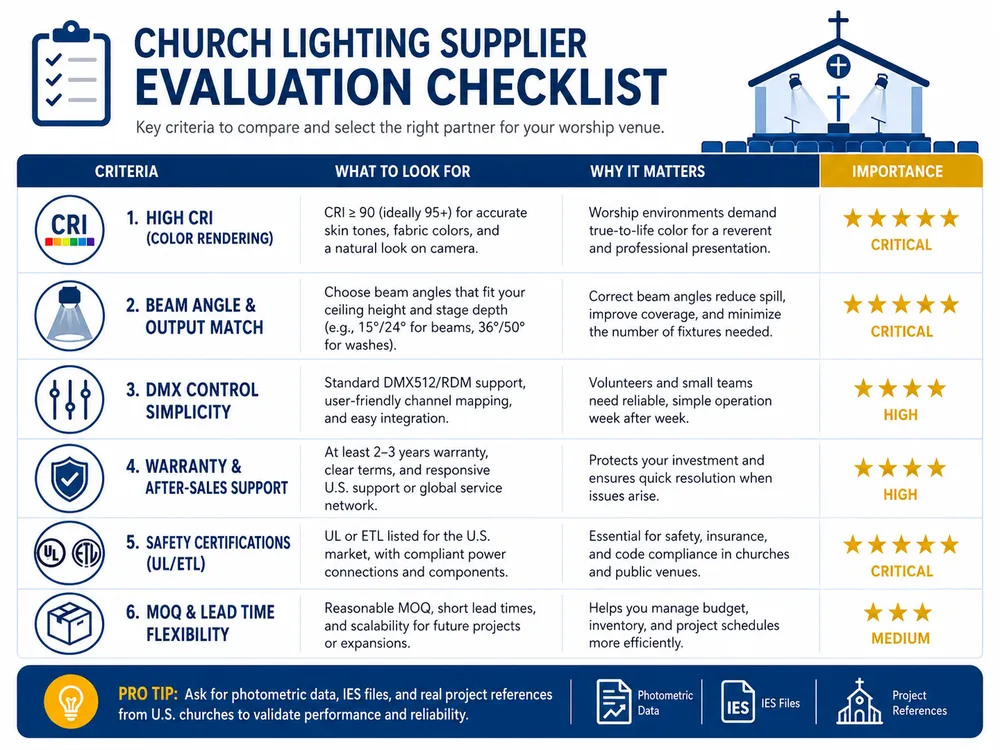
Before comparing specific church lighting companies in the USA, you need a framework. These six criteria separate suppliers who serve worship venues well from those who simply sell lighting products:

CRI (Color Rendering Index) and color temperature range. If you livestream services — and most churches do now — you need 90+ CRI fixtures. Many budget LED pars deliver 70–80 CRI, which looks fine in person but washes out skin tones on camera. Ask for CRI data sheets, not marketing claims. For color temperature, worship environments typically need variable CCT capability: 3200K warm white for traditional services, 5600K daylight for broadcast-quality video.

Beam angle matched to ceiling height. A 25° narrow beam that works beautifully with a 30-foot ceiling will create harsh hot spots in a 12-foot fellowship hall. Your supplier should ask about your ceiling height before recommending fixtures — if they don't, they're selling product, not solving your lighting problem.

DMX control complexity. Your tech team is volunteers. A 40-channel DMX fixture with 15 operating modes will overwhelm them. Look for suppliers who offer scene-preset fixtures or simplified DMX profiles — 4–8 channels max — so a volunteer can run Sunday morning lighting after one training session.

Warranty terms that cover commercial use cycles. Churches run fixtures 3–5 times per week, 52 weeks a year. That's 150–250 power cycles annually. A consumer warranty written for "home use" won't cover this duty cycle. Confirm the warranty explicitly includes commercial/institutional use.

UL/ETL certification and RoHS compliance. Your insurance carrier likely requires UL or ETL listing for permanently installed electrical fixtures. If a supplier can't provide the UL file number for a specific fixture, it's not listed — regardless of what the product page claims.

MOQ flexibility and lead time. Most churches need 8–30 fixtures for a full system. Some suppliers have minimums that start at 50–100 units, which pushes smaller churches toward retail pricing. Evaluate whether the supplier's MOQ structure fits your actual project scope.

Evaluation checklist for church stage lighting suppliers showing CRI, beam angle, DMX complexity, warranty, and certification criteria

US-Based Manufacturers Serving the Church Lighting Market

These six companies design and manufacture (or contract-manufacture) lighting fixtures with US-based headquarters. They control product development and set wholesale pricing — though most churches still purchase their products through dealer networks at marked-up prices.

Chauvet (chauvet.com) — Headquartered in Hollywood, Florida. Chauvet maintains a dedicated House of Worship product line with fixtures specifically positioned for sanctuary use. Their Ovation and COLORdash series are common in mid-size church installs. Pricing sits mid-to-premium, and their dealer network is extensive — which means most churches buy Chauvet products through a local integrator at dealer markup rather than at wholesale. Strength: worship-specific product development and wide parts availability. Limitation: the dealer model means you rarely see factory economics unless you're ordering 50+ units through an authorized reseller.

ADJ (American DJ) (adj.com) — Los Angeles headquarters. ADJ offers the broadest range of budget-to-mid-grade LED pars, wash lights, and moving heads in the US market. Their Mega series and 5P Hex fixtures show up frequently in small church installs due to accessible price points. (We've seen churches start with ADJ, then come to us two years later when the output degradation becomes noticeable on livestream — the LED chip quality at that price tier has a shorter CRI stability window.) Strength: low entry cost, immediate availability through dozens of retailers. Limitation: primarily DJ/entertainment positioning; CRI consistency and thermal management are less rigorous than worship-specific brands.

ETC (Electronic Theatre Controls) (etcconnect.com) — Middleton, Wisconsin. ETC is the premium standard in theatrical and architectural lighting, and their ColorSource and Desire series have strong adoption in churches with $50K+ lighting budgets. CRI performance is excellent (typically 92–96 across color temperatures), and build quality supports 20,000+ hour duty cycles without measurable degradation. Strength: unmatched reliability, outstanding CRI, deep theatrical expertise. Limitation: premium pricing puts ETC beyond reach for most church budgets under $30K.

Elation Professional (elationlighting.com) — Los Angeles. Elation occupies the professional tier used by larger churches and touring worship productions. Their Fuze and KL series deliver concert-grade output with high CRI. If your sanctuary seats 1,500+ and you're running IMAG (image magnification) with broadcast cameras, Elation's color science holds up under scrutiny. Strength: broadcast-quality color rendering, robust touring-grade construction. Limitation: pricing reflects concert-grade engineering — oversized for a 200-seat sanctuary.

Mega-Lite (mega-lite.com) — Houston, Texas. Mega-Lite positions specifically as a value-competitive alternative to Chauvet and ADJ, with growing church market share. Their Enlighten series targets worship venues with higher CRI than typical budget fixtures at price points 15–20% below comparable Chauvet models. Strength: competitive pricing with worship-relevant specs, US-based support. Limitation: smaller dealer network means less immediate local availability.

Blizzard Lighting (blizzardlighting.com) — Waukesha, Wisconsin. Blizzard targets the mid-range professional market with aggressive pricing versus premium brands. Their Toughpar and LB-Par series give churches pro-grade features (high CRI, IP-rated options, quiet fans) at price points between ADJ and Chauvet. Strength: pro specs without premium pricing, solid warranty terms. Limitation: brand recognition is lower, which can make committee purchasing approval harder when decision-makers haven't heard the name.

The common thread: all six manufacturers sell through dealer networks. The price you pay depends heavily on which channel you buy through — and most churches default to whatever their local AV integrator stocks, which adds 20–35% above what a direct relationship would cost.

US Multi-Brand Distributors and Online Retailers

These four suppliers don't manufacture fixtures — they aggregate brands and sell through retail, institutional accounts, or bundled packages. They add convenience, advisory services, and stock availability at the cost of an additional margin layer.

Full Compass Systems (fullcompass.com) — Madison, Wisconsin. Full Compass carries every major lighting brand (Chauvet, ADJ, ETC, Elation, Blizzard, and more) under one institutional purchasing account. Churches with established vendor relationships appreciate single-invoice convenience and net-30 terms. Strength: brand breadth, institutional purchasing structure, technical sales staff. Limitation: pricing reflects wholesale-plus-dealer economics — you're paying for the convenience of one-stop shopping.

B&H Photo (bhphotovideo.com) — New York City. B&H maintains a large pro lighting department with competitive retail pricing and institutional/education account options. Their catalog depth is excellent for comparison shopping, and tax-exempt purchasing is straightforward for 501(c)(3) organizations. Strength: competitive retail pricing, tax-exempt processing, massive inventory. Limitation: no worship-specific technical consultation — you need to know exactly what you want before ordering.

Sweetwater (sweetwater.com) — Fort Wayne, Indiana. Sweetwater stands out among worship lighting suppliers because they maintain a dedicated House of Worship advisory team with personal sales engineers who understand sanctuary lighting needs. For non-technical procurement teams, Sweetwater's guidance has real value — they'll ask about your room dimensions, camera setup, and volunteer capability before recommending fixtures. Strength: expert guidance for churches without in-house technical staff, personal relationship model. Limitation: pricing holds at MAP (minimum advertised price) — you won't find discount pricing here.

Stage Lighting Store (stagelightingstore.com) — Online retailer focused specifically on church and event lighting packages. They bundle fixtures, DMX controllers, and cabling into ready-to-install kits sized for small-to-mid worship venues. Strength: church-focused package bundles reduce decision complexity. Limitation: limited custom configuration, narrower brand selection, less suitable for sanctuaries over 500 seats.

How the distributor model affects your cost: Manufacturer sells to distributor at 30–40% above factory cost. Distributor sells to you at 20–30% above their acquisition cost. By the time a fixture reaches your sanctuary, you've absorbed 50–70% in cumulative markup above the production cost. That margin pays for inventory carrying, local support, easier returns, and no import logistics — all of which have legitimate value. But for system-level purchases (12+ fixtures), that convenience premium adds up fast.

What Distributor Markup Actually Costs on a Church System Order

Let's put real structure around the cost difference. Take a typical church LED stage lights wholesale scenario: a 12-fixture RGBW LED par wash system for a 300-seat sanctuary with 18-foot ceilings.

Cost Layer Price as % of Factory Gate What It Pays For
Factory gate price 100% Manufacturing, QC, packaging
US brand wholesale 130–150% Brand development, US warehousing, warranty reserve
Distributor/dealer to church 165–200% Local inventory, sales staff, return logistics, credit terms

On a $150/fixture factory gate cost (realistic for a quality RGBW LED par with 90+ CRI), that 12-unit system looks like:

  • Factory-direct: ~$1,800 for 12 units + shipping/duty
  • Through US brand at MAP: ~$2,400–$2,700
  • Through distributor/dealer: ~$3,000–$3,600

The $1,200–$1,800 difference on a 12-fixture order funds either additional fixtures, DMX control upgrades, or simply stays in the church's operating budget.

Cost comparison diagram showing distributor markup layers versus factory-direct pricing for church stage lighting

When the distributor premium is worth paying:

  • Emergency replacement — a fixture dies Thursday before Easter Sunday, and you need one shipped overnight
  • Single-fixture additions to an existing system where brand matching matters
  • Projects under 8 units where the absolute dollar savings don't justify a new supplier relationship
  • Zero tolerance for import paperwork or any delivery timeline beyond 5 business days

When factory-direct makes financial sense:

  • Full sanctuary installations of 12–30+ fixtures — the per-unit savings compound meaningfully
  • Multi-campus churches standardizing fixture packages across 3–5 locations
  • Annual procurement budgets where you can plan 6–8 weeks ahead for production and shipping
  • Projects requiring custom specifications (specific CCT presets, simplified DMX profiles, branded housings)

One objection I hear constantly: "We're a church — we can't handle importing." Factory-direct doesn't mean you're filing customs paperwork yourself. Manufacturers who serve institutional buyers ship DDP (Delivered Duty Paid) — the fixture arrives at your loading dock with all duties and logistics handled, same as receiving a domestic shipment. The only difference is lead time.

Certification and Compliance Requirements for Worship Installations

Before you commit to any supplier — domestic or factory-direct — verify these compliance basics:

UL or ETL listing is non-negotiable for permanently installed fixtures in most US jurisdictions. Your church insurance carrier almost certainly requires it for electrical equipment mounted to building structure. The test: ask the supplier for the specific UL or ETL file number (not a certificate image — the actual file number you can verify on UL's database). If they can't provide it, the fixture isn't listed regardless of what their product page suggests.

FCC Part 15 compliance prevents electromagnetic interference with wireless microphone systems, in-ear monitors, and streaming equipment. A non-compliant LED driver can introduce buzz into your audio chain that's nearly impossible to diagnose. (We spent three weeks helping a church in Texas troubleshoot audio interference that turned out to be uncertified LED par fixtures running on the same circuit as their wireless mic receivers.)

RoHS compliance matters if your denomination or congregation has environmental stewardship policies — and increasingly, if you're applying for green building credits on renovation projects.

IP rating becomes relevant for outdoor worship stages, multi-use venues with splash exposure, or fixtures installed above baptistry areas. IP65 handles rain and spray; IP67 handles temporary submersion. Indoor-only sanctuaries typically don't need IP ratings, but verify if your stage lighting will ever move outdoors for Easter sunrise services or community events.

How Factory-Direct Sourcing Works for Houses of Worship

Factory-direct purchasing for church stage lighting follows a different procurement sequence than retail — but it's simpler than most church tech teams expect.

Step 1: Specify your space. You provide sanctuary dimensions (length, width, ceiling height), seating capacity, stage depth, and whether you livestream or record services. This determines fixture quantity, beam angles, and output requirements — not a one-size-fits-all package.

Step 2: Receive a fixture recommendation with real photometric data. A factory engineering team matches fixtures to your space using actual lumen-output and beam-spread calculations. You see CRI values, color temperature range, power consumption, and DMX channel counts before committing to anything. (This is where factory-direct differs most from retail — you get application engineering, not product catalog links.)

Step 3: Customize for your volunteer team. Factory-direct means you can request simplified DMX profiles (4–6 channels instead of 15+), preset scene modes that volunteers activate with one button, specific CCT defaults (3200K warm for your traditional service, 5600K daylight for your broadcast-focused contemporary service), and even custom gobo patterns for your church logo or cross motif.

Step 4: Production and delivery. Typical timeline is 4–6 weeks from order confirmation to DDP delivery at your facility. For churches planning a renovation or seasonal upgrade, this timeline fits comfortably within a typical committee approval → installation window. Urgent needs (Easter, Christmas production upgrades) require planning 8–10 weeks ahead.

MOQ reality for churches: Flexible manufacturers — including us at GDmonkey — start OEM/ODM orders at 30 units. A full sanctuary lighting system for a 300-seat church typically runs 12–24 fixtures. That means two or three churches pooling an order, or one church ordering its full system plus spares, clears the minimum easily. Smaller orders (8–12 units) are often accommodated on a case-by-case basis, particularly for LED church lighting fixtures with existing tooling.

The honest trade-off: you gain 30–50% cost savings and custom specification capability. You give up next-day availability and the ability to return individual fixtures to a local store. For system-level purchases where you're planning weeks ahead anyway, that trade-off lands in your favor.

Which Sourcing Route Fits Your Church

The right answer depends on four variables: order size, budget pressure, timeline, and whether you need customization. Here's how each scenario maps to a sourcing model:

Urgent single-fixture replacement (1–3 units, needed this week): Buy from a US retailer — Sweetwater, B&H, or Full Compass. Pay the retail premium for speed. This is exactly what distributors exist for, and the convenience is worth the markup on small emergency orders.

Small system upgrade (4–8 fixtures, 2–4 week timeline): Contact US manufacturers direct (Chauvet, Mega-Lite, Blizzard) for dealer pricing, or work with Sweetwater's worship advisory team if you need guidance selecting fixtures. At this volume, savings from factory-direct don't overcome the convenience gap — but get quotes from both channels so you understand your pricing baseline.

Full sanctuary installation (12–30+ fixtures, 6–8 week timeline): Factory-direct OEM delivers the strongest cost advantage at this volume. You save 30–50% versus dealer pricing, gain access to custom specifications (CCT presets, simplified DMX, branded housings), and receive application engineering support that matches fixtures to your specific space. Plan procurement 6–8 weeks ahead of your install date.

Multi-campus standardization (30–100+ fixtures annually): Factory-direct with an annual supply agreement. Lock pricing for the year, standardize fixtures across all campuses so volunteer training is consistent, and schedule quarterly shipments aligned with your maintenance and expansion calendar. This is where the cost structure difference becomes most significant — at 50+ units annually, you're operating at a cost level that local distributors physically cannot match while maintaining their own margins.

The honest framework: local worship lighting suppliers have real strengths — speed, familiarity, immediate support. Factory-direct has real cost and customization advantages at volume. Most churches benefit from using both channels strategically: local for emergencies and small adds, factory-direct for system builds and planned expansions. If you're evaluating a full system install, request a factory-direct quote with your sanctuary specs — at minimum, it establishes your true pricing baseline so you can negotiate more effectively with any channel.

Procurement Questions Church Tech Teams Actually Ask

What CRI rating do I need for church stage lighting with livestream?

90+ CRI minimum for services you broadcast or record. Below 90, skin tones shift toward green or magenta on camera — especially under LED fixtures with phosphor-converted white. For churches producing broadcast-quality content (multi-camera IMAG, YouTube/streaming), target 95+ TLCI (Television Lighting Consistency Index), which specifically measures how light renders on camera sensors rather than to the human eye. Most budget fixtures under $80/unit retail deliver 70–82 CRI — adequate for in-person but visibly poor on stream.

How many LED par fixtures do I need for a 300-seat sanctuary?

Depends on ceiling height and desired coverage overlap. General formula: divide your stage width by the beam spread diameter at mounting height. For a 40-foot-wide stage with 18-foot ceilings using 25° beam-angle fixtures, each fixture covers approximately 8 feet of stage width at floor level. That's 5 fixtures for front wash. Add a second row for back/top light and 2–4 color wash fixtures, and you're at 12–16 total LED pars for full coverage with redundancy. Lower ceilings (12 feet) need wider beam angles (40–60°) and fewer fixtures. Higher ceilings (25+ feet) need narrower beams and more fixtures spaced closer together.

Do church stage lights need UL certification for insurance?

Yes — in most cases, your property insurance policy requires permanently installed electrical fixtures to carry UL or ETL listing. Check your policy's "electrical equipment" clause. The critical distinction: UL certification applies to the specific product model, not the brand. A company may have some fixtures UL-listed and others that aren't. Ask for the UL file number for the exact SKU you're purchasing, then verify it at ul.com/database.

What is the typical lead time for factory-direct church lighting orders?

4–6 weeks from order confirmation to delivery at your facility, assuming standard fixture models with existing tooling. Custom specifications (specific CCT presets, modified DMX profiles, OEM branding) may add 1–2 weeks for engineering samples and approval. Fully custom optical designs requiring new tooling: 8–12 weeks. For comparison, US retailers ship stock items in 1–5 business days, and manufacturer back-orders typically run 2–4 weeks.

What color temperature is best for worship stage lighting?

No single CCT is "best" — the right answer depends on your service style and whether you broadcast. 3200K warm white creates the intimate, traditional ambiance that works well for acoustic worship, prayer segments, and services that prioritize in-room atmosphere. 5600K daylight renders skin tones cleanly on camera and matches natural light from windows, making it ideal for broadcast-focused contemporary services. Variable CCT fixtures (2700K–6500K) give you both in one fixture, controlled per-scene. If you only buy one type, variable CCT with a minimum 90 CRI covers every scenario without requiring separate fixture inventories for traditional vs. contemporary services.

Can a church buy stage lighting directly from a manufacturer?

Yes — and more churches do this than most people realize, particularly for system-level purchases. The practical barrier isn't legal or logistical — it's awareness. Most churches don't know factory-direct is an option because their entire supplier exposure comes from retail channels and AV integrators. The process: you specify your needs, the manufacturer quotes DDP (Delivered Duty Paid) pricing to your address, and the shipment arrives at your door with all customs and logistics handled. MOQ requirements vary — some factories require container loads (500+ units), but flexible OEM manufacturers start at 30 units, which covers a single sanctuary system. The trade-off is lead time (4–6 weeks vs. next-day retail) and the absence of local return logistics for individual fixtures.

Top 10 Church Stage Lighting Suppliers in Brazil for Growing Evangelical Venues

Brazil's Evangelical Lighting Demand — Why Sourcing Is Getting Harder

Brazil's evangelical community has crossed 60 million people and continues expanding. New church constructions, sanctuary renovations, and multi-campus expansions are generating steady demand for professional stage lighting equipment — and the local supply chain is struggling to keep pace.

The growth segment is mid-size venues seating 200 to 1,500 people. These churches need real stage lighting — LED wash fixtures, focused spotlights for the pastor, moving heads for worship sets, color-accurate front light for livestream cameras — but they don't carry megachurch budgets. They need professional-grade evangelical church lighting equipment at landed costs that leave room for the rest of the AV build.

Here's where it gets complicated. Brazil's dual-voltage power grid runs 127V in São Paulo, Rio de Janeiro, and much of the northeast, while Brasília, the southern states, and parts of Minas Gerais use 220V. Generic imported fixtures often arrive configured for a single voltage. Plug a 220V-only fixture into a 127V outlet and you get dim, flickering output. Reverse that mismatch and you get burned drivers. Every church stage lighting supplier serving Brazil needs to answer the voltage question before anything else.

Local distributor inventory for church-specific fixtures — silent cooling for worship environments, warm-white wash for camera-friendly sermon lighting, narrow-beam spots for stage isolation — is thin. Most local AV suppliers stock event and concert gear, then try to sell it into churches. The mismatch shows up in noise complaints, bad color temperatures on livestream, and overpowered fixtures washing out intimate sanctuary spaces.

This article maps 10 real suppliers across four sourcing models — local manufacturers, distributors, international brands, and factory-direct import — so you can make a sourcing decision based on your actual church size, budget, and procurement timeline.

Evaluation Criteria for Church Lighting Suppliers in Brazil

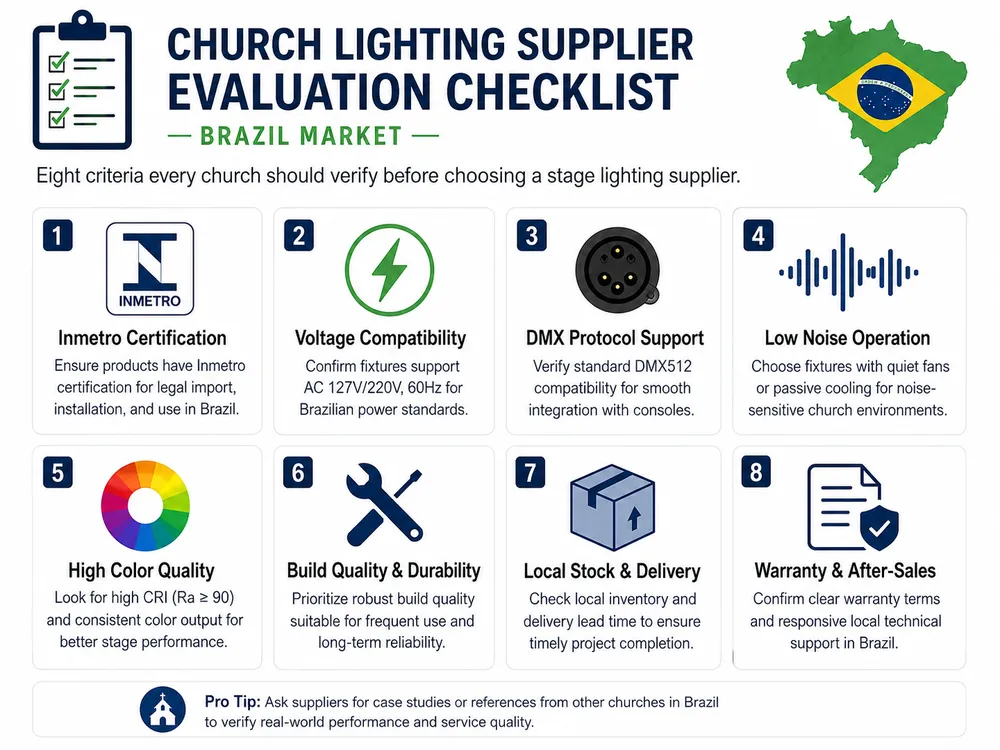
Before comparing individual companies, you need a framework. The criteria below separate suppliers who understand church applications from those just selling generic event gear into the worship market. Use this as a checklist when evaluating any church stage lighting supplier in Brazil — whether local or imported.

Inmetro compliance. Electrical equipment sold commercially in Brazil requires Inmetro certification. Ask any supplier for their certificate number or the registered number on the product label. If they can't produce it, you're taking on compliance risk — especially if your church is part of a denomination with institutional procurement policies. (Many smaller importers skip this step. The fixture works, but you have no legal cover if there's an electrical incident.)

Voltage range. Confirm whether fixtures operate on 127V, 220V, or both. Universal-input power supplies (100–240V auto-sensing) are the safest option for churches that may relocate equipment between campuses in different voltage regions. Single-voltage fixtures are cheaper but lock you to one grid standard.

DMX512 and sACN protocol support. If your tech team runs ProPresenter, EasyWorship, or a standalone DMX console, every fixture must respond to the same control protocol. Ask for confirmed DMX512 compliance and check whether sACN (streaming ACN over Ethernet) is supported for larger installations with network-based control. Protocol mismatch is one of the most common post-installation frustrations we see in church LED stage lights Brazil deployments — fixtures that "support DMX" but address incorrectly or drop frames under heavy scene changes.

Noise level. Worship environments are not concerts. A 200-seat sanctuary with spoken-word sermons, quiet prayer moments, and acoustic worship sets demands fixtures under 30dB. Forced-air fans on concert-grade moving heads can hit 40–50dB — audible from the first three rows. Specify convection-cooled or fan-silent modes for any fixture mounted within 10 meters of the congregation. This is the single most overlooked spec in iluminação de palco para igrejas — lighting that sounds like a computer server room ruins the worship experience.

Color temperature accuracy and CRI. Livestream cameras are unforgiving. If your front wash runs below CRI 90, skin tones go muddy on camera. If color temperature drifts between fixtures (some reading 3400K, others 3800K), your video team spends hours in post correcting it. Ask for measured CCT and CRI data, not just catalog claims. Consistent LED church stage lighting starts with consistent LED binning at the factory level.

After-sales and spare parts access. LED drivers fail. Power supplies burn out after voltage surges. Ask whether your supplier stocks replacement drivers in-country or whether you're waiting 45 days for a shipment from overseas. For churches running 3–5 services per week, a dead fixture that stays dead for six weeks means renting a replacement or leaving a dark spot on stage.

Minimum order flexibility. Churches buy 10–50 fixtures for a typical upgrade. If a supplier's minimum is 100 or 200 units, they're an event rental supplier, not a church partner. Confirm MOQ before requesting a quote.

Import documentation support. For factory-direct purchases, does the supplier provide commercial invoices with correct NCM tariff codes (typically 9405.42 for LED luminaires), packing lists formatted for Brazilian customs clearance, and CE/RoHS documentation that supports Inmetro registration applications?

Evaluation checklist for church stage lighting suppliers in Brazil covering Inmetro certification, voltage compatibility, DMX protocol, and noise level

Local Brazilian Suppliers — Distributors, Integrators, and National Brands

The Brazilian church stage lighting market is served by three distinct supplier models. Understanding which type you're dealing with tells you more about pricing, lead times, and product depth than any brand name alone. These are the fornecedores de iluminação cênica igreja that most buyers encounter first.

National Manufacturers and Assemblers

Arclite Iluminação Cênica (arclite.com.br) manufactures stage wash lights and LED PAR fixtures domestically with Inmetro-registered products. Their strength is that everything ships from Brazilian soil — no customs delays, no import duty surprises, and warranty service happens locally. The product range is narrower than what you'll find from importers, focusing on wash and PAR fixtures rather than full-system solutions including moving heads and effects. Best fit for smaller churches that need basic stage wash and front fill without the complexity of imported gear.

PLS Professional Light & Sound (plspro.com.br) is one of Brazil's more established domestic manufacturers of LED PARs, moving heads, and DMX controllers. PLS has a meaningful installed base in evangelical churches across the southeast region. Their products are designed for Brazilian voltage standards from the start, eliminating compatibility questions. Product development cycles are slower than you'd see from Chinese OEMs — the catalog updates less frequently — but what they ship is field-proven in Brazilian worship environments. Best fit for churches wanting a domestic brand with local tech support and a track record in the worship segment.

Distributors and Importers

Audiolux Iluminação Profissional (audiolux.com.br) operates out of São Paulo as a professional AV distributor serving churches, theatres, and event venues. They carry multiple imported fixture brands and can provide system design consultation — not just product sales. For churches without in-house AV expertise, the design support adds genuine value. The trade-off is pricing: distributor margins plus import costs mean you're paying a premium over factory-direct for the same fixture specifications.

LedTec Iluminação (ledtec.com.br) specializes in LED stage and architectural lighting, supplying churches across southern Brazil. Their focus on LED specifically means deeper product knowledge in that category — they can advise on CRI requirements for video, beam angles for different sanctuary geometries, and dimming protocols. Coverage is strongest in the south (Paraná, Santa Catarina, Rio Grande do Sul), more limited in the northeast.

Hayonik (hayonik.com.br) imports and brands stage lighting and DJ equipment under their own label, distributing through a dealer network covering most of Brazil. The Hayonik brand has broad penetration in churches through its competitive pricing at the entry and mid-tier level. The product comes from Chinese factories (as do most global lighting brands at this price point) but arrives with Brazilian-market warranty and local spare parts availability. Best fit for churches needing quick access to affordable fixtures through a familiar purchasing channel.

Music Pro Áudio e Iluminação (musicpro.com.br) is a multi-branch retail and wholesale operation carrying both imported and national lighting brands. Churches with wholesale accounts can access volume pricing, and the multi-branch presence means physical product inspection before purchase — relevant when you're standardizing across a fixture type. Their church-specific product knowledge varies by branch and staff experience.

Project-Based Integrators

Skypix Iluminação (skypix.com.br) operates as a project-based supplier specializing in church and theatre installations across São Paulo and Minas Gerais. They sell fixtures as part of turnkey packages including system design, rigging, wiring, DMX programming, and commissioning. Per-unit fixture cost is higher than buying direct from a distributor because you're paying for design and installation labor rolled into the package. The value proposition is clear for churches without AV volunteer teams — you get a working system, not a pile of boxes. Less relevant for churches that already have capable tech teams.

Croma Efeto Visual (cromaefeto.com.br) supplies LED wash lights, moving heads, and effects for evangelical venues, combining product sales with installation services. They serve the mid-market: churches large enough to need professional-grade fixtures but small enough that they don't have dedicated AV departments. Similar model to Skypix — the convenience premium is justified when you need someone else to do the system design and hanging.

What Local Suppliers Do Well

Be honest about the advantages: local church stage lighting suppliers in Brazil offer faster emergency replacement, communication in Portuguese during business hours, physical showrooms where you can evaluate beam quality in person, and warranty service without international shipping. For urgent single-fixture replacements or churches with zero import experience, local supply is the practical choice.

The limitation across all local models: product range is constrained to what's already been imported and certified. If you need specific beam angles, custom color temperature profiles, or fixtures configured for your particular sanctuary geometry, you're limited to what's in stock or in the current catalog. Custom work means a factory relationship.

International Brands with Brazilian Presence

Chauvet (chauvet.com) represents the dominant international brand model in the Brazilian church LED stage lights market. As a US-headquartered manufacturer with authorized distributors in Brazil, Chauvet offers a catalog of professional stage lighting fixtures with global brand recognition, extensive documentation, and well-established DMX profiles for common lighting consoles.

The premium is real: expect 2–3× the per-unit cost of equivalent-specification Chinese-manufactured fixtures when purchasing Chauvet through Brazilian distributors. That price includes the brand's established R&D investment, global support infrastructure, and the local distributor's margin on top. For megachurches with institutional procurement committees, brand recognition can simplify the approval process — specifying "Chauvet" in a purchase request requires less justification than explaining a lesser-known manufacturer.

For the growing segment of mid-size evangelical venues (200–800 seats) where professional stage lighting for mega churches in Brazil isn't the relevant benchmark and budget constraints are real, the international brand premium often exceeds what the procurement committee can justify. The fixture performs identically to a factory-direct equivalent — the same LED chips, similar optical design, comparable build quality — but the landed cost difference funds additional fixtures, DMX controllers, or rigging hardware.

Worth noting: Chauvet's authorized Brazilian distributors typically carry a fraction of the full international product catalog. Church-specific SKUs (worship-optimized color profiles, ultra-silent fixtures, narrow-beam pastor spots) may not be available locally through the brand's distribution network even when they exist in the global lineup.

The Convenience Premium — What Local Sourcing Actually Costs

Every layer between the factory and your church adds cost. Understanding the actual markup chain helps you decide where convenience is worth paying for and where it's compressing your project budget unnecessarily.

A typical cost chain for wholesale church lighting equipment in Brazil through import:

  • Factory FOB price: base manufacturing cost (e.g., $120 for a quality 18×10W RGBW LED PAR)
  • Ocean freight + insurance: $8–15 per fixture in a consolidated shipment to Santos
  • Import duty (II): approximately 18% on NCM 9405.42 (LED luminaires)
  • ICMS: varies by state — 7% for intra-state in São Paulo, up to 18% for interstate transactions
  • PIS/COFINS: combined ~9.25% on the CIF + duty value
  • Distributor margin: 30–60% markup over their landed cost
  • Integrator markup (if project-based): additional 20–40% for design and installation services

The result: that $120 FOB fixture can land on your church stage at $350–$500 when purchased through a local distributor, or $450–$650 through a project integrator. The convenience layers nearly triple the factory price.

When the premium makes sense: you need one replacement fixture this week; the church has no member with import experience; the project includes system design you can't do in-house; the order is small enough (under 10 fixtures) that import logistics overhead exceeds the savings.

When the premium compresses your budget unnecessarily: you're upgrading a sanctuary with 20–50 fixtures; you're standardizing fixture types across a multi-campus organization; your AV team is technically capable and only needs the hardware; you're planning repeat procurement over 2–3 years as the church grows.

The question isn't whether local suppliers charge too much — they carry real costs and provide real convenience. The question is whether your specific situation justifies the convenience premium or whether a different sourcing model gives you more fixtures, better specifications, or deeper reserves for the same budget.

Factory-Direct Import as a Strategic Alternative

GDmonkey enters this list as the factory-direct alternative — not a local supplier and not positioning as one. We're a Chinese manufacturer with 12 years of stage lighting production shipping CIF to Santos and Paranaguá for Brazilian church projects. The sourcing model is different, and the trade-offs are different.

The economics: factory-direct eliminates the distributor and integrator margin layers described above. You're purchasing at factory pricing plus freight, with import duties and taxes as the only markups beyond our invoice. For a 30-fixture sanctuary upgrade, the per-unit savings typically fund an additional 8–12 fixtures at the same total project budget — or let you spec higher-quality optics and build quality without exceeding the original ceiling.

Voltage compatibility: we produce church stage lighting fixtures with universal-input power supplies (100–240V, 50/60Hz auto-sensing) as standard for Brazilian orders. No voltage mismatch risk, no field modifications, no separate SKUs for São Paulo versus Brasília installations.

Worship-appropriate noise levels: our LED PAR and wash fixtures use passive convection cooling rather than forced-air fans — measured at <25dB during operation. Moving heads use low-RPM fans with PWM speed control that ramp down during static scenes. We've shipped over 200 church projects globally, and noise complaints are the #1 issue we hear about from churches that bought event-grade gear designed for concert venues. (Our R&D team actually tests fixture noise with a calibrated SPL meter at 1 meter distance in our semi-anechoic chamber — the published spec matches the real-world reading.)

DMX512 and sACN: confirmed compatibility with DMX512 on all fixtures, with sACN available on our network-enabled moving heads and wash bars. ProPresenter, EasyWorship, Lightkey, and standard DMX consoles all address our fixtures correctly — we maintain a fixture library for GDTF/MVR integration.

OEM/ODM from 30 units: realistic for a single mid-size church upgrade. You can brand fixtures with your ministry name, specify custom default color temperature (we see many Brazilian churches requesting 3200K warm white as the default power-on state), and configure DMX channel layouts to match your console programming.

Import documentation for Brazilian customs: commercial invoices formatted with correct NCM codes (9405.42.10 for fixed LED luminaires, 9405.42.90 for other LED fixtures), detailed packing lists with individual carton dimensions and weights for cargo manifest filing, and CE/RoHS/FCC test reports that support your Inmetro registration application. We've shipped enough containers to Brazil to know what your despachante aduaneiro needs — the paperwork arrives clean.

Portuguese-language technical documentation: user manuals, DMX channel maps, and wiring diagrams available in Portuguese. Your volunteer tech team doesn't need to translate spec sheets.

For affordable LED moving heads for Brazilian churches in the 150W–300W range, factory-direct pricing typically comes in at 40–55% below what the same specification costs through a local distributor. The trade-off: you wait 25–35 days for production and shipping instead of buying from stock. For planned upgrades (not emergency replacements), that timeline is acceptable.

Sourcing Decision Matrix — Which Route Fits Your Church

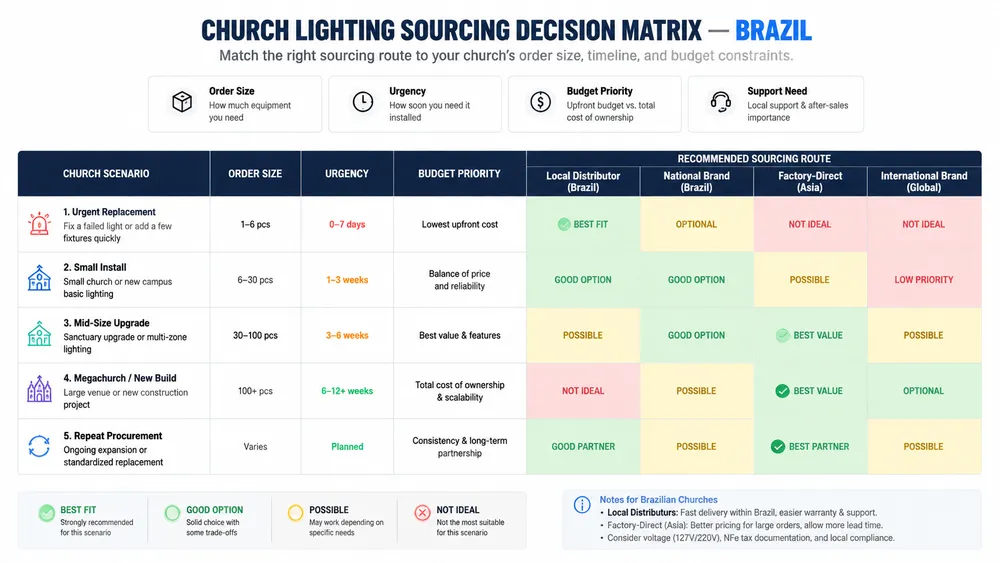
No single sourcing model works for every situation. The right choice depends on order size, urgency, budget sensitivity, and your team's technical capability. Here's how to match the best church stage lighting suppliers in São Paulo and beyond to your actual scenario:

Scenario Recommended Route Best-Fit Suppliers Why
Urgent single-fixture replacement Local distributor Hayonik, Music Pro In-stock availability, same-week delivery, no import wait
Small church first install (5–15 fixtures) National brand / marketplace PLS, Arclite Pre-certified for Brazil, simple procurement, no customs process
Mid-size sanctuary upgrade (20–50 fixtures) Factory-direct import GDmonkey Best unit economics, custom configuration, voltage-matched from factory
Megachurch institutional procurement International brand or factory-direct OEM Chauvet, GDmonkey Brand approval compliance or custom branding with institutional-grade documentation
Multi-campus / repeat procurement Factory-direct with annual agreement GDmonkey Volume pricing, consistent SKUs across campuses, predictable delivery schedule

For the urgent replacement buyer: keep a relationship with Hayonik or Music Pro for emergency stock access. One fixture failure before Sunday service is not the time for a 30-day import process. Local supply exists to solve this exact problem — pay the premium willingly for genuine urgency.

For the planned upgrade buyer: if you're specifying 20+ fixtures for a sanctuary renovation with a 60–90 day project timeline, factory-direct changes your budget math entirely. Request a factory-direct quote with your venue dimensions, ceiling height, and desired fixture types — CIF pricing to your nearest port arrives within 48 hours, giving you a concrete comparison against local quotes.

For the multi-campus organization: standardizing evangelical church lighting equipment across locations means consistent appearance on camera, interchangeable spare inventory, and simplified volunteer training. Factory-direct with an annual supply agreement locks in pricing and ensures identical fixtures ship to each campus as expansions happen.

The sourcing landscape isn't about which supplier is "best" in absolute terms. It's about which model fits where you are right now — and knowing when to switch models as your needs change.

Decision matrix showing which church lighting sourcing route fits based on order size, urgency, and budget in the Brazilian market

Why Color Temperature Matters When Sourcing Church Stage Lighting Fixtures

The cost of getting church stage lighting color temperature wrong

You order 60 LED pars for a sanctuary upgrade. They arrive, your installer hangs them, and the livestream camera picks up a visible warm-to-cool shift across the stage — half the fixtures read slightly amber, the other half lean pink-white. The church AV committee calls your office the next morning.

This is a CCT selection problem, and it's one of the fastest ways to lose a reorder. Color temperature — measured in Kelvin (K) — describes where a fixture sits on the warm-white to cool-daylight spectrum. Get the number right but ignore consistency across a batch, and you still end up with a patchy stage that shows up on every livestream frame.

The rest of this article covers what you actually need to specify on a purchase order, how to evaluate whether a supplier can deliver batch-to-batch consistency, and where the cost tradeoffs sit between fixed CCT and tunable white fixtures for worship spaces.

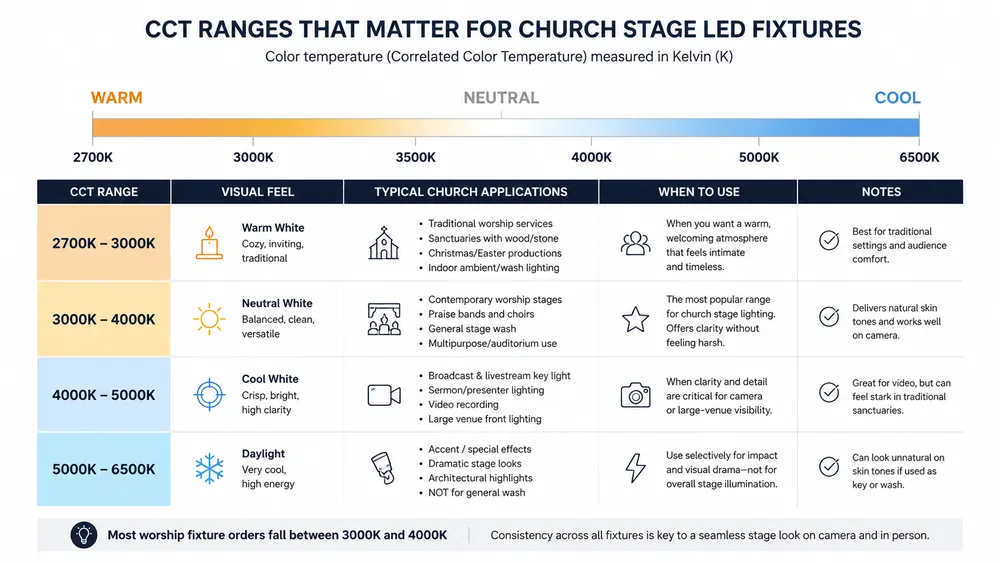
CCT ranges that matter for church stage LED fixtures

Not every Kelvin number has a real market behind it. Here's how the church stage LED color temperature range breaks down by buyer segment:

CCT Range Visual Character Church Application Segment Typical Fixture Types
2700–3200 K Warm white, amber undertone Traditional/liturgical (Catholic, Anglican, mainline Protestant) — sermon close-ups, intimate worship Fixed-CCT LED pars, warm-white ellipsoidals
3500–4000 K Neutral white, balanced Contemporary worship, multi-use auditoriums, hybrid services LED wash panels, tunable-white pars
4500–5600 K Daylight white Broadcast-priority venues, livestream key lighting Fresnel LEDs, high-CRI panel lights
6000–6500 K Cool daylight, blue undertone Accent/effect only — rarely used as primary worship wash Color-mixing fixtures, not standalone wash

Most church integrators we work with land their orders between 3000 K and 4000 K. The warm white vs daylight church lighting split depends on whether the congregation prioritizes in-person atmosphere or camera quality — and increasingly, they want both.

The 3500–4000 K range has grown as a compromise: it reads warm enough for congregants in the room while sitting close enough to broadcast daylight that cameras white-balance without extreme correction. If you're building a fixture catalog for the worship segment, that neutral band should be your core offering.

Chart comparing color temperature ranges from 2700K to 6500K with typical church stage lighting applications for each range

How CRI and CCT interact for broadcast-quality worship lighting

Churches livestream by default now. Even a 200-seat congregation in a mid-size town runs a PTZ camera and pushes to YouTube every Sunday. That camera's auto white-balance responds differently depending on the CCT and CRI combination hitting the stage.

High CRI (90+) at 3200 K produces the richest skin tones on camera. Skin looks natural, the pastor's face separates from the background cleanly, and the color grading in post-production stays minimal. But achieving CRI 95 at 3200 K requires a precise phosphor formulation on the LED chip — not every chip supplier holds that spec consistently.

High CRI at 5600 K matches the broadcast daylight standard, which makes multi-camera setups easier. The trade-off: in-person congregants perceive the light as clinical or cold. Some churches solve this by using 5600 K only as a key light on the speaker while running 3200 K wash fixtures on the rest of the stage.

Here's the sourcing implication that most spec sheets don't make obvious: when you see "CRI 95" listed without a stated CCT measurement point, ask which Kelvin value that number was tested at. Some manufacturers measure CRI at the CCT where their phosphor performs best, then print that number on the datasheet for the entire tunable range — but CRI often drops 5–8 points at the ends of the range. If your church buyer chose the fixture for best color temperature for live streaming church services at 3200 K, but the CRI spec was measured at 4000 K, you have a gap.

Browse our full Church Stage Lighting fixture catalog to compare CRI and CCT specs across LED pars, washes, and fresnels designed for worship applications.

Tunable white vs fixed CCT — the procurement math

A tunable white fixture adjusts continuously between roughly 2700 K and 6500 K using either dual-phosphor LED arrays or separate warm and cool LED banks driven independently. A fixed CCT fixture outputs one Kelvin value — period.

The cost difference for bulk orders:

Fixed CCT fixtures run lower per-unit cost (simpler driver topology, single LED array, fewer DMX channels). For a single-venue project where the lighting designer has already locked the CCT requirement, this is the straightforward buy. No flexibility needed, no flexibility paid for.

Tunable white fixtures carry a 15–30% unit-cost premium depending on the LED configuration and driver complexity. But for integrators who serve multiple venues — or church networks with 5+ campuses — one tunable SKU replaces three or four fixed-CCT SKUs in your inventory. You ship the same fixture to a traditional sanctuary requesting 3000 K and a contemporary auditorium requesting 4000 K. Your warehouse holds one part number instead of four.

(We've shipped both configurations to church projects in Brazil and Nigeria — the tunable white reorder rate is higher because one fixture fits the main auditorium and the youth hall without separate SKUs.)

The honest trade-off: tunable white adds 1–2 DMX channels per fixture. For a church with a professional production team, that's nothing. For a church running their light board with Sunday-morning volunteers who learned DMX last month, those extra channels add programming confusion. When you're speccing for volunteer-operated venues, weigh whether the CCT flexibility actually gets used — or whether it just creates more scenes that nobody touches after install week.

CCT selection for worship spaces always comes back to this question: does your buyer need flexibility across venues, or simplicity within one venue? Match the fixture type to that answer.

CCT binning and batch consistency — what to check before signing a PO

LED chips coming off the same wafer don't all land on exactly the same Kelvin point. A chip specified as 3200 K might actually measure anywhere from 3050 K to 3350 K depending on the phosphor application uniformity and the specific wafer position. This variation range is the "bin."

For general architectural lighting, a wide bin is tolerable — nobody notices a 200 K spread across recessed downlights in a hallway. On a church stage with 40 identical fixtures pointed at the same cyclorama, a 200 K spread is immediately visible. The camera compresses the difference and makes it worse.

What to demand on your purchase order for church stage lighting color temperature consistency:

  • MacAdam ellipse step: request 3-step or tighter. A 3-step MacAdam ellipse means color difference between any two fixtures is imperceptible to the human eye. 5-step is noticeable side-by-side. 7-step is obvious on camera.
  • Single-bin guarantee per shipment: all fixtures in your order should use LEDs from the same binning group — not mixed across whatever the factory had in stock.
  • LED chip manufacturer and specific series: "Cree" or "Osram" alone is not a spec. You need the chip series (e.g., Cree XLamp XP-G3, Osram Osconiq P 3030) because binning tightness varies by product line.

We specify the LED chip series at the component-sourcing stage and run incoming inspection on CCT binning before chips reach our SMT line. Reels that fall outside the stated bin get returned to the chip supplier, not mixed into your order. After assembly, every fixture goes through our photometric test lab — we verify actual CCT output against the bin spec before the fixture enters aging test. (This catches the occasional reel where the supplier's own bin labeling was off — it happens maybe once in 20 incoming shipments, but catching it saves you from fielding complaints.)

Ready to spec your next church lighting order with these binning requirements? Request a Quote and include your target CCT and MacAdam step tolerance — we'll confirm chip availability and lead time against your specific requirement.

Diagram showing MacAdam ellipse steps around a target CCT point explaining LED color consistency binning for stage lighting fixtures

Specification checklist for church lighting procurement

When you're evaluating fixture quotes for a church stage LED project — or handing a spec sheet to your purchasing department — these are the CCT-related line items that separate a professional quote from a vague one:

  • Nominal CCT or tunable range: e.g., "3200 K fixed" or "2700–6500 K tunable white." If tunable, confirm the step resolution (smooth vs preset stops).
  • MacAdam step tolerance: 3-step minimum for worship stage applications. If the supplier quotes 5-step or doesn't answer, you'll see variation on camera.
  • CRI at specified CCT: not just "CRI 90+" — ask for the CRI value measured at the exact Kelvin point your project needs. If tunable, request CRI at both ends of the range plus midpoint.
  • LED chip manufacturer and series number: confirms the fixture uses a defined, repeatable component — not whatever's cheapest on the spot market that month.
  • 48-hour aging test confirmation: verifies the fixture's CCT output remains stable after thermal cycling, not just at initial power-on. Ask whether the factory's aging test measures CCT drift or only checks for dead LEDs.
  • DMX channel count (if tunable): directly affects your programming budget and volunteer-operator complexity. A tunable fixture using 2 extra channels across 60 fixtures means 120 additional DMX addresses to configure.

(If a supplier can't answer the MacAdam step question, that tells you something about their incoming QC process — specifically that they probably don't run one for LED binning.)

This checklist works for LED pars, wash panels, fresnels, and ellipsoidals. Copy it into your next RFQ for how to choose color temperature for church stage LED fixtures without relying on guesswork.

Market segments where CCT drives reorder volume

If you're building or expanding a church lighting distribution business, the CCT spec you stock determines which segments you can serve without custom-ordering every project:

Traditional and liturgical congregations (Catholic, Anglican, mainline Protestant) strongly prefer 2700–3200 K. Order sizes tend to be smaller — 20 to 40 fixtures per project — but reorder loyalty is high once you establish the right CCT. These churches rarely change their lighting look, so your first order often sets a 10-year purchasing relationship. Warm white vs daylight church lighting is not a real debate in this segment; warm wins every time.

Contemporary megachurch and multi-site networks lean toward tunable white. Order sizes are larger — 60 to 200 fixtures per campus — and standardization across campuses drives volume. A church network that opens a new location every 18 months wants the same fixture in every room. Tunable white lets them adjust CCT per service style without different hardware in each venue.

Broadcast-first churches (online ministry focus, large production budgets) specify 4000–5600 K for key and fill positions. Fixture counts are smaller, but these buyers tolerate premium pricing for high CRI and tight binning. Their reorder pattern is driven by content quality requirements, not building expansion — they upgrade fixtures when camera technology improves.

Which segment is your primary market? Your church stage lighting color temperature catalog should cover the dominant CCT for that segment. If you serve multiple segments, tunable white reduces your stocking risk. Browse our Church Stage Lighting lineup to see which configurations align with your target market.

How to Plan a Church Stage Lighting Budget That Avoids Costly Mid-Project Change Orders

What triggers change orders in church lighting projects

Change orders on church lighting projects rarely come from the building committee deciding they want fancier fixtures halfway through. They come from costs that were always there but never made it into the original budget.

We see three triggers repeatedly in the RFQ stage:

  • Rigging and structural costs discovered after fixture selection. The committee picks fixtures, gets pricing, approves the budget — then the installer shows up and finds wood joists rated for 15 kg where the fixture package needs 40 kg of hanging weight per truss point. Structural reinforcement was never line-itemed.
  • DMX infrastructure underscoped. Volunteers assume new LED fixtures are plug-and-play like the old par cans. They are not. DMX cabling, signal distribution, and a control console need their own budget line, and the runs are often longer than anyone estimates until someone walks the ceiling with a tape measure.
  • Electrical circuit capacity missed. A 200-seat sanctuary with a 1990s-era 100A panel may not have enough spare circuits for 20 new LED wash fixtures at 150W each. The electrician scope grows mid-project.

A typical change order on a 200–500 seat sanctuary adds 15–30% to the original lighting line item. Schedule slips 2–4 weeks while someone re-quotes the structural work or rewires a subpanel.

We see this from the factory side every month: churches send us fixture wishlists without ceiling heights, circuit maps, or rigging load data. That information gap is where the budget gap starts. The fixtures are actually the easy part to price — everything attached to the ceiling and running behind the walls is where projects go sideways.

The five budget categories most churches undercount

A realistic church stage lighting budget is not a fixture shopping list. It is five separate line items, and most committees only price the first one before seeking approval.

1. Fixtures — The LED pars, wash lights, spot fixtures, and any moving heads. This is what everyone budgets for.

2. DMX control and cabling — Console or software controller, DMX cables (3-pin or 5-pin runs), signal splitters, and potentially wireless DMX transmitters if your sound booth is far from stage. (We have churches that budget $0 for this line and then discover they need $3,000–$6,000 in control infrastructure the week fixtures arrive.)

3. Rigging and mounting hardware — Truss, pipe clamps, safety cables, ceiling anchors, and structural engineering review if the ceiling was not built for suspended loads.

4. Installation labor — Electrician hours, rigging crew time, and programming labor to build DMX scenes and presets for your services.

5. Contingency reserve — The money set aside for what you did not know you did not know.

Here is how these percentages typically distribute by sanctuary size:

Budget category Under 200 seats 200–500 seats 500+ seats
Fixtures 45–50% 40–45% 35–40%
DMX control & cabling 15% 15–18% 18–20%
Rigging & mounting 10–12% 12–15% 15–18%
Installation labor 18–20% 15–18% 15%
Contingency 8–10% 10–12% 12–15%

Notice the pattern: fixture percentage drops as sanctuary size grows. Control complexity and rigging requirements scale faster than fixture count. A 500-seat room might only need 30% more fixtures than a 300-seat room, but the DMX universe count, cable runs, and structural engineering scope can double.

One cost most committees forget entirely: halogen lamp replacement. If you are comparing LED church stage lighting cost against keeping existing halogen, factor in $2,000–$5,000 per year in relamping labor and bulbs for a typical 300-seat install. LED eliminates that line item permanently, which changes the break-even math on total system cost.

Budget allocation chart showing fixture, control, rigging, labor, and contingency percentages for church lighting projects by sanctuary seating capacity

Scoping requirements before you price fixtures

Every line item in the budget above maps to a scoping question. Skip the question, and the cost shows up later as a change order. Here is the sequence we walk through with every church buyer before we quote a fixture package:

1. Ceiling height and structural material

Steel truss, wood joist, or poured concrete — each determines mounting method, load capacity, and whether you need a structural engineer's signoff. Get the answer in writing from whoever built the building or from a licensed inspector.

Red flag: if your AV committee cannot provide ceiling load ratings, your rigging budget estimate is fiction until a structural engineer weighs in. Budget $1,500–$3,000 for that assessment before committing to anything else.

2. Stage dimensions and platform configuration

Fixed stage vs modular risers changes throw distance calculations. A 6-meter-deep stage with a 4-meter proscenium needs different fixture angles than a 3-meter platform against a back wall.

3. Service styles served

Traditional services with a choir and podium need even front wash. Contemporary worship with a band needs backlight, side wash, and color. Blended programs need both, which means more fixture positions and a more capable control system.

4. Livestream and broadcast requirements

If you broadcast services, camera positions dictate minimum CRI (color rendering index) requirements — typically 90+ CRI for skin tones on video. Color temperature must stay consistent at 3200K or 5600K, not drift between fixtures. This affects which church stage lighting fixtures qualify and which do not.

5. Existing electrical capacity

Panel amperage, number of open breaker slots, and distance from panel to stage. A 30-meter cable run from the electrical room to the stage has voltage drop implications above 20A. Get an electrician to survey before you finalize fixture wattage totals.

6. Volunteer operator skill level

A volunteer team that runs sound on Sundays should not be handed a 2-universe DMX board with 40 fixture profiles. Match control complexity to who will actually operate it weekly. Simpler control costs less upfront and produces fewer support calls to your installer afterward.

Each of these six items takes 30 minutes to document properly. Skipping any one of them can generate a $2,000–$8,000 change order.

Specification mistakes that force mid-project upgrades

Even with a complete scope, specification errors create the same budget damage. These are the four mistakes we see most often from church lighting system planning documents that arrive with RFQs:

Specifying fixture count by aesthetics instead of lux-per-seat

"We want 12 par cans because that looks like enough" is not a specification. If you need 300 lux at platform level for video broadcast, calculate backwards from throw distance and fixture output. Under-specifying means ordering 4–6 additional fixtures mid-install when the camera operator reports the stage is dark on playback. That is a change order for fixtures, additional rigging points, and reprogramming.

Choosing DMX fixtures without confirming wiring supports the universe count

A standard DMX universe handles 512 channels. A 24-fixture LED par system with 6 channels per fixture uses 144 channels — fine on one universe. Add 8 moving heads at 16 channels each and you are at 272. Still fine. But if the existing wiring only has one DMX run from booth to stage, and you now need two separate universe outputs, someone has to pull new cable through the ceiling.

We ask every church buyer for circuit amperage and existing DMX infrastructure before we quote fixtures, because the wrong answer means either the fixture package changes or the electrician scope grows. Better to discover that in the quoting phase than after delivery.

Ignoring thermal load in the stage area

LED fixtures run cooler than halogen, but "cooler" is not "cold." Twenty 150W LED wash lights generate 3,000W of heat in a concentrated area. If your stage zone lacks adequate HVAC return, that heat accumulates and shortens fixture life. Worse, the building committee notices the stage is uncomfortable during summer services, and now HVAC modification enters the project scope mid-install.

Not accounting for control surface distance

If your sound booth is 30+ meters from the stage, a standard DMX cable run needs signal boosters or you risk data dropouts — flickering fixtures during service. The alternative is wireless DMX, which adds $800–$2,000 to the control budget. Either way, it needs to be in the original number.

Flowchart showing how specification gaps in church lighting projects lead to mid-project change orders

Phased rollout vs single-phase: which actually saves money

Churches with rigid annual budgets often ask about splitting the project across two or three fiscal years. It can work, but only under specific conditions.

Single-phase advantages:

  • One mobilization fee (rigging crew, electrician, programmer all come once)
  • One programming session builds all scenes and presets together
  • Lower total church stage lighting cost — typically 10–15% less than the same system deployed in phases

Phased approach works when:

  • Your annual lighting allocation is capped and cannot absorb the full project in one cycle
  • The sanctuary renovation itself is staged (ceiling work in year one, platform expansion in year two)
  • Your volunteer team needs time between phases to learn the control system before more fixtures are added

Phased approach fails when:

  • Phases are not designed together upfront. If phase 2 fixtures require a different DMX universe, heavier rigging, or a relocated control position, the integration cost erases the "savings" of spreading payments.

The fix: even on a phased install, pay for the full system design upfront. Get the entire fixture package, rigging plan, and DMX architecture specified in one document. Deploy in stages, but design once. This prevents phase 2 from becoming a change order on phase 1.

(Our MOQ starts at 30 units, so you can order phase 1 fixtures without committing to full-project volume. But we still recommend getting the complete system quoted so rigging and control architecture are designed as one coherent system — not two incompatible halves bolted together later.)

If you are ready to get the full system quoted upfront, send your sanctuary dimensions and budget ceiling for a fixture package quote.

FAQ

What is a realistic contingency percentage for a church lighting project?

10–15% if your structural survey and electrical audit are both complete before budgeting. 20% if either assessment is still outstanding. Contingency is not a slush fund for upgrades — it covers the unknown costs that proper scoping did not catch because every building has surprises behind the drywall.

Should the church hire a separate designer or get design from the fixture supplier?

Get design and supply from the same source when possible. Fixture selection and rigging are interdependent — a designer who does not know the fixture weights, mounting options, and DMX channel requirements will spec something that needs modification at install. When design and supply are separate, change orders create finger-pointing between parties. A supplier who handles both owns the outcome. See our church stage lighting fixture range and system design support.

How do we budget for DMX programming and scene creation?

Allocate 8–12 hours of programming labor for a typical 200–500 seat contemporary worship setup. That covers building scene presets for each service type (sermon, worship set, communion, special events), setting dimmer curves, and training one or two volunteers on recall. Some suppliers include basic programming in the installation quote; confirm that explicitly rather than assuming.

Can we reuse existing halogen dimmer racks with new LED fixtures?

Usually not without significant modification. Halogen dimmers use phase-cut (leading edge or trailing edge) dimming. LED fixtures with built-in drivers need constant-power circuits and accept dimming commands via DMX, not through voltage reduction at the wall. Budget for dimmer rack bypass or full replacement — typically $1,500–$4,000 depending on channel count.

What is the typical lead time from budget approval to completed installation?

8–14 weeks for a full system. That breaks down roughly as: fixture manufacturing and QC (3–5 weeks), international shipping (2–4 weeks), rigging and electrical installation (1–2 weeks), programming and handoff (2–3 days). Phased installs add 2–3 weeks per subsequent phase for crew re-mobilization and system re-programming.