

Professional Church Stage Lighting Auditorium-Grade Fixtures
Engineered for 500+ seat auditoriums, multi-campus deployments, and broadcast worship environments.
Moving head spots, profile fixtures with framing shutters, and high-output wash lights — built for sACN/Art-Net integration and multi-camera production. Your orders run on dedicated production lines with 48-hour aging on every unit.
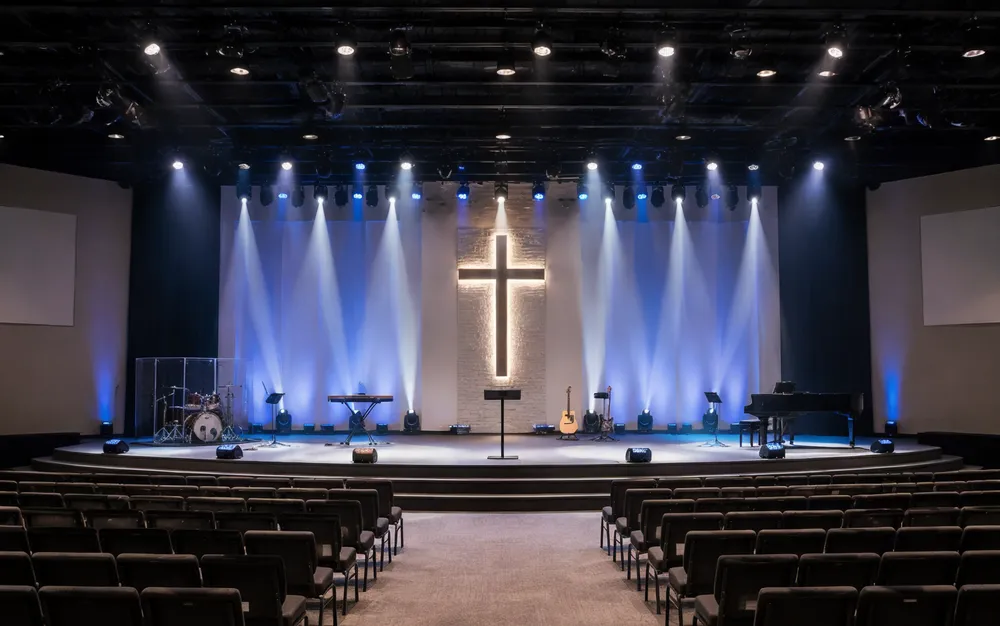
What This Product Line Is — and Who It's For
Professional church stage lighting is our top-tier worship fixture range: moving head spots (150W–350W), LED profile fixtures with motorized framing shutters, and high-output zoom wash lights designed for large church auditoriums, touring worship productions, and broadcast-grade environments. These are not scaled-up versions of our LED par cans. They're a different product architecture — precision motorized optics, advanced thermal management for sustained high-output operation, and control protocol stacks (DMX512, sACN, Art-Net) that integrate into the networked lighting infrastructure professional production teams expect.
Your buyers are churches with 500+ seats, full-time production staff, multi-camera broadcast setups, and budgets that reflect the performance requirements. The contractors and integrators who serve these churches need fixtures that match the specification rigor of concert and theatre touring gear but configured for the worship use pattern: long static holds, camera-critical color accuracy, and noise floors that don't fight the program audio.
If your market is smaller congregations or volunteer-operated systems, our LED church stage lighting and simple church stage lighting tiers are purpose-built for those segments. This page covers the professional tier — fixtures that compete with brands charging 3–5× our FOB price, giving you margin room that makes this segment worth pursuing.
Different Architecture
Precision motorized optics, not scaled-up par cans. Advanced thermal management for sustained high-output.
Full Protocol Stack
DMX512, sACN (E1.31), Art-Net integration for networked lighting infrastructure.
3–5× Price Advantage
Competes with major brands at a fraction of the FOB price. Margin room that makes this segment worth pursuing.
Target Buyer Profile
500+ Seat Churches
Large auditoriums with full-time production staff
Broadcast Environments
Multi-camera setups demanding camera-critical color accuracy
Contractors & Integrators
Professional teams needing concert/theatre spec rigor
Multi-Campus Deployments
Touring worship productions and expanding church networks
Configured for the Worship Use Pattern
Long static holds, camera-critical color accuracy, and noise floors that don't fight the program audio. These fixtures deliver concert-grade output shaped for the operational realities of weekly worship production — not one-night touring rigs.
Technical Specifications — What Goes on Your Comparison Sheet
These specs are designed to land directly in your project proposal or comparison matrix. The R9 value matters — we spec and test it because broadcast environments expose weak reds immediately on camera. Most competitors quote CRI without R9 breakdown, which hides the one metric that professional worship production teams actually check.
| Parameter | Moving Head Spot | LED Profile / Ellipsoidal | High-Output Wash |
|---|---|---|---|
| Light Source | 200W–350W single-source LED engine | 200W–300W LED with color mixing | RGBW quad-LED array, 150W–350W total |
| CRI | ≥92 (R9 ≥85) | ≥92 (R9 ≥85) | ≥90 |
| Color Temperature | 2700K–8000K variable | 2700K–8000K variable | Full RGBW + variable white 2700K–8000K |
| Beam Angle | 8°–50° motorized zoom | 15°–35° (barrel zoom) + framing shutters | 10°–60° motorized zoom |
| Control Protocols | DMX512, sACN (E1.31), Art-Net | DMX512, sACN, Art-Net | DMX512, sACN, Art-Net |
| DMX Channels | 16/24/32 channel modes | 14/20/26 channel modes | 10/14/18 channel modes |
| Pan/Tilt | 540°/270° | Fixed mount (yoke or clamp) | Fixed mount or 540°/270° (moving head wash variant) |
| Noise Level | <28dB at typical operating temp | <25dB (convection + low-speed fan hybrid) | <30dB variable-speed |
| IP Rating | IP20 standard / IP65 available | IP20 | IP20 standard / IP65 available |
| Housing | Die-cast aluminum, powder-coated | Extruded aluminum barrel, steel yoke | Die-cast aluminum |
| Weight (typical) | 18–25kg depending on model | 8–14kg | 10–20kg |
| Dimming | 16-bit linear dimming, 4 selectable curves | 16-bit, high-frequency PWM (>20kHz) | 16-bit per color channel |
| Flicker | Flicker-free at all frame rates (>20kHz PWM) | Flicker-free | Flicker-free |
Specifications represent industry-standard values for this fixture class. Exact parameters vary by model. Contact us for detailed product data sheets per SKU.
Why R9 ≥85 Matters for Your Proposals
The R9 value matters — we spec and test it because broadcast environments expose weak reds immediately on camera. Most competitors quote CRI without R9 breakdown, which hides the one metric that professional worship production teams actually check. When your client's tech director asks for the R9 number, you'll have it documented.
≥92
CRI Standard
≥85
R9 Value
<25dB
Noise Floor
16-bit
Dimming Depth
>20kHz
PWM Frequency
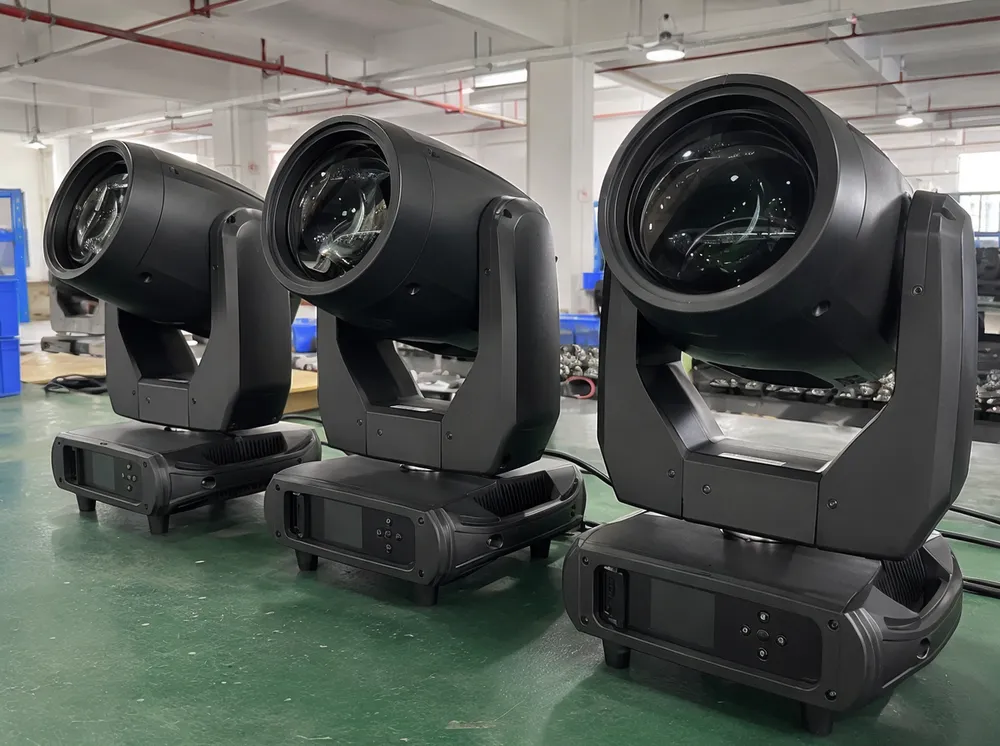
Moving Head Spot
200W–350W · 8°–50° zoom · 540°/270° pan/tilt
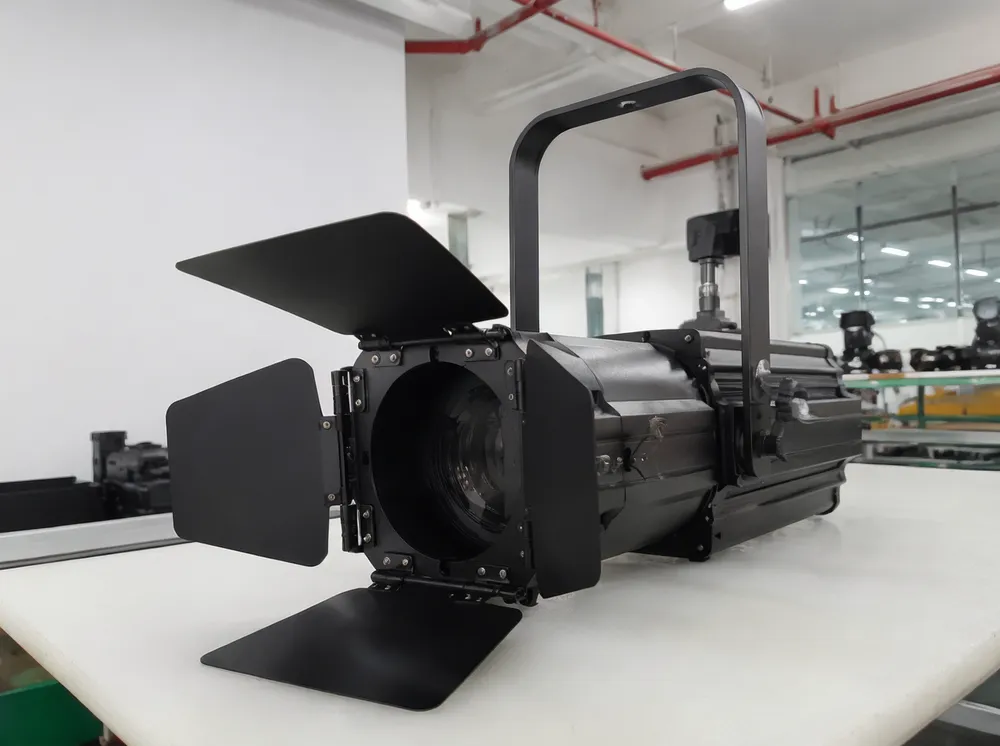
LED Profile / Ellipsoidal
200W–300W · Framing shutters · <25dB
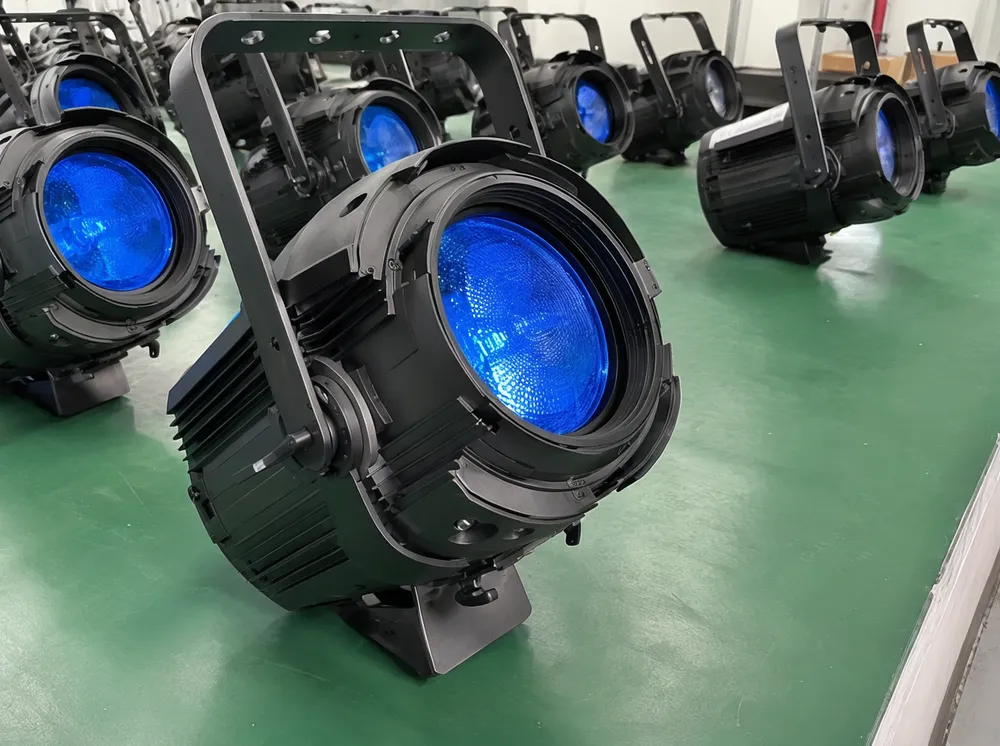
High-Output Wash
RGBW 150W–350W · 10°–60° zoom · IP65 available
Broadcast-Ready Optical Performance — Your Margin Differentiator
Here's what separates professional church stage lighting from general-purpose fixtures in commercial terms: broadcast worship environments expose every shortcoming on camera. Flicker, color inconsistency, poor CRI, visible beam artifacts — these create support calls and returns for your customer. The fixtures that survive in this segment earn reorders. The ones that don't earn warranty claims.
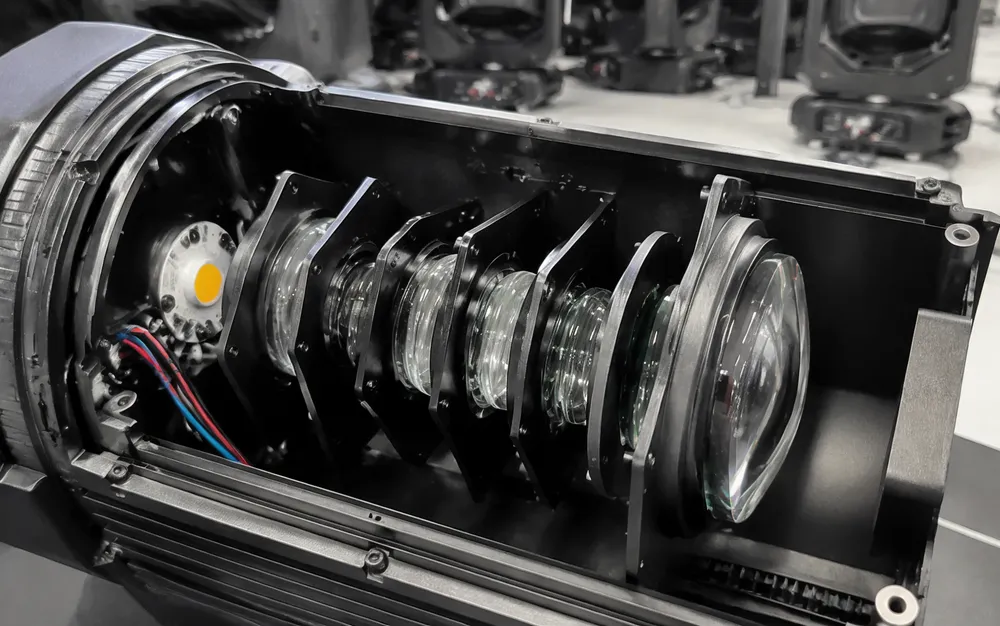
LED Engine Selection — CRI-First Binning
We engineer our professional worship tier from the optical path outward. The LED engine selection starts with color rendering — we bin specifically for CRI ≥92 with R9 ≥85, which delivers faithful skin tone reproduction under close-up camera work. We procure LEDs in single-bin lots per production run, so when your customer installs 24 fixtures as a front wash array, color matching is tight enough that their camera operator doesn't fight white balance shifts across the stage.
≥92
≥85
Multi-Element Glass Zoom Optics
The zoom optics use multi-element glass lens assemblies rather than single-element plastic. The cost difference per fixture is meaningful, but glass holds alignment under thermal cycling. We've seen plastic lens fixtures lose beam uniformity within 6 months of installation in churches that run 15+ hours per week. Glass costs more upfront but eliminates the service call in year two — which protects both your customer relationship and your warranty exposure.
Flicker-Free Dimming at >20kHz PWM
Dimming runs at >20kHz PWM across all professional models. We test at 24fps, 25fps, 30fps, 50fps, and 60fps during QC. Zero visible banding at any frame rate, any dim level. We added 50fps testing in 2021 after a European broadcast church flagged an issue with a competitor's fixtures at their standard frame rate. Now it's part of our standard protocol.
Individual Photometric Test Reports
Every fixture ships with a photometric test report — lux output at rated distances, beam profile uniformity, and color temperature accuracy. Your customers get verification data, not just a spec claim on a product page.
QC Frame Rate Coverage
Every professional fixture is tested at all standard broadcast frame rates during production QC — ensuring zero visible banding regardless of your customer's camera system configuration.
Thermal Engineering for Sustained Output — Why Your Installs Don't Degrade
Church auditorium fixtures run differently than concert or club lighting. A concert rig cycles through dynamic scenes — fixtures rarely sustain peak output for more than 10-15 minutes continuously. A church service runs front wash at 80% output for 60-90 minutes without interruption. That sustained thermal load is what kills cheap fixtures within 18 months: LED junction temperature creeps up, lumen output drops, and the church calls your customer asking why their stage looks dimmer than last year.
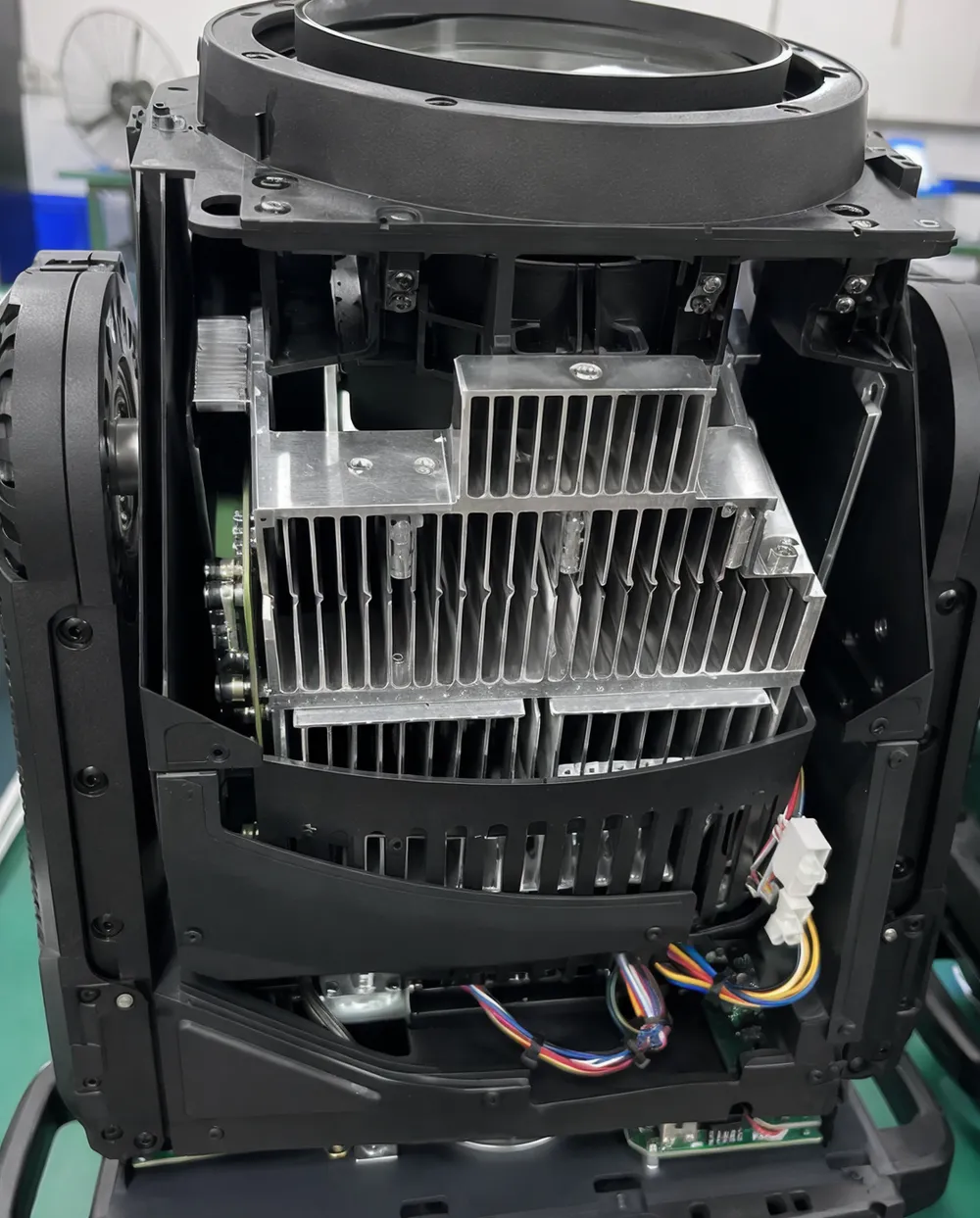
We oversize thermal management relative to rated wattage on every professional church model. The moving head spots use a finned aluminum heat sink assembly with forced-air cooling channels that maintain LED junction temperature below 85°C at continuous full output in 35°C ambient. Most venues run cooler than that, but we design to 35°C because we ship to the Middle East and Southeast Asia where HVAC in a 1,000-seat church doesn't always keep up.
<85°C
at continuous full output
35°C
worst-case scenario
48hrs
continuous full power
<28dB
typical operation
Die-Cast Aluminum Housing as Thermal Path
The die-cast aluminum housings aren't just structure — they're part of the thermal path. We use aluminum-core PCBs that transfer heat directly into the housing body, which acts as a secondary radiator. This dual-path thermal design means our 48-hour aging test at full power is a genuine stress test, not a formality.
Built for 15+ Hours/Week Worship Use
Fixtures that pass 48 continuous hours at rated output in our aging room will handle 15 hours per week of worship use for years without measurable lumen depreciation. The dual-path thermal management — finned heat sink plus housing radiator — ensures sustained performance regardless of service schedule intensity.
Variable-Speed Fan Control — Near-Silent
Variable-speed fan control keeps noise below 28dB during typical operation. The fans spin up only when junction temperature demands it — in a climate-controlled sanctuary running fixtures at 70-80% output, the fans rarely exceed minimum speed. Your customers get near-silent operation without sacrificing thermal protection during peak demand moments.
Why Church Thermal Demands Are Different
Dynamic scenes cycle continuously. Fixtures rarely sustain peak output for more than 10-15 minutes. Thermal load fluctuates — stress is intermittent.
Runs at 80% output for 60-90 minutes without interruption. Sustained thermal load is constant. Under-engineered fixtures degrade within 18 months — LED junction temperature creeps up, lumen output drops visibly.
Control Integration for Networked Church Production Systems
Large church auditorium stage lighting doesn't run on standalone DMX daisy chains. Professional production teams use sACN (E1.31) or Art-Net over Ethernet infrastructure — networked control that routes through the same switches running video, audio, and intercom. Our professional tier speaks all three protocols natively: DMX512 for legacy compatibility, sACN for modern Ethernet-based systems, Art-Net for facilities that standardized on that ecosystem.
What this means for your project quotes and your distribution business:
Your fixtures integrate without protocol converters or adapters. When an integrator specs a system using ETC, MA Lighting, ChamSys, or Vista consoles, our fixtures respond correctly because we implement the full protocol stack — not just basic DMX in an Ethernet wrapper. We test against the major console platforms during firmware development, so your customer doesn't discover compatibility issues during commissioning.
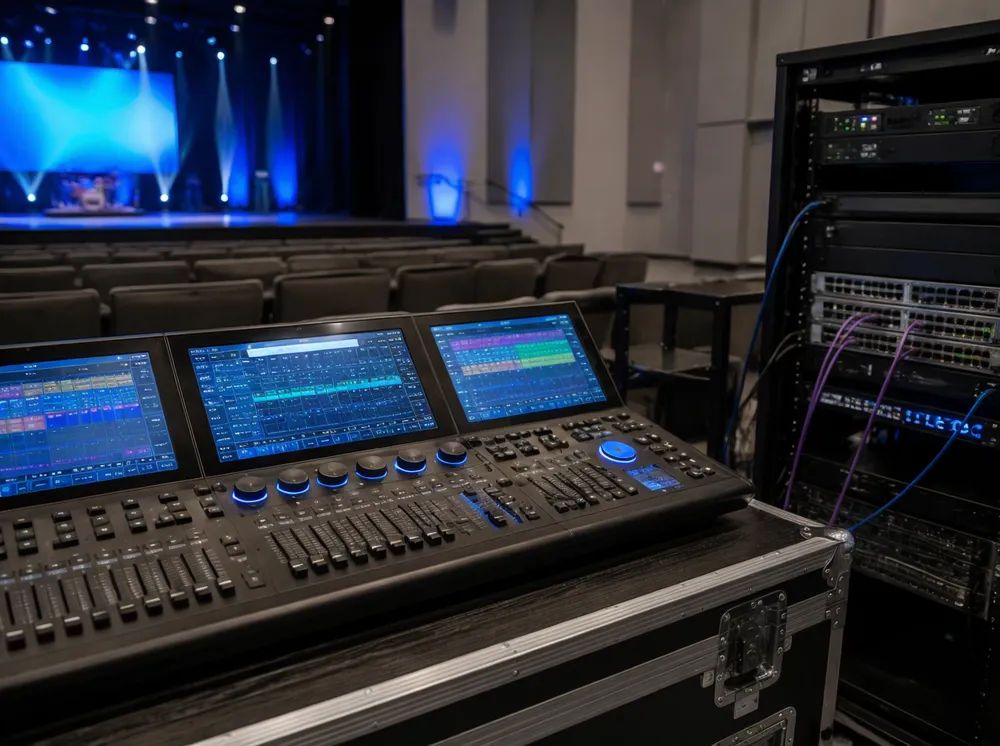
Multi-Channel Mode Options
16/24/32 channels on moving heads let production teams choose between simple operation and granular per-parameter control. A church with a volunteer running a preset-based console uses 16-channel mode. A professional LD programming complex broadcast looks uses 32 channels for full access to color mixing, gobo indexing, prism control, and fine pan/tilt.
RDM Device Management
RDM (Remote Device Management) support means the fixtures report status data back to the console — lamp hours, thermal state, error flags. For churches running 20-40 professional fixtures across multiple positions, this eliminates the need for a technician to physically inspect each unit. Your customer's production team monitors everything from the lighting desk.
sACN Priority Handling
Added in our 2024 firmware revision after feedback from two US integrators who needed clean failover between primary and backup consoles. If your projects involve redundant control systems, ask about our priority merge behavior.
Native Protocol Support — No Converters Required
Legacy compatibility for existing infrastructure and smaller venues
Modern Ethernet-based control for networked church production systems
Full support for facilities standardized on the Art-Net ecosystem
Large Church Stage Lighting — Where This Tier Fits Your Project Business
Professional church stage lighting targets specific deployment scenarios. Each represents a market segment with predictable order volume and reorder patterns.
Multi-Campus Megachurches
1,000–5,000+ seats per campusThese organizations build identical or near-identical production systems across 3-10 campuses. One specification cycle generates repeat orders as new campuses open.
Touring Worship Productions
Conference circuits & arena showsLarge church organizations run touring worship events — arena shows, multi-day conferences, outdoor festivals. The fixtures travel, take stage abuse, and need to be serviced in the field.
Church Auditorium Renovations
Aging halogen/early-LED upgradesEstablished churches with aging halogen or early-LED systems upgrading to modern infrastructure. The integrator quotes a complete fixture package — often 30-60 units mixing profiles, wash, and moving heads.
Broadcast & Streaming-First Churches
Post-2020 permanent broadcast infrastructureA growing segment of churches that invested in permanent broadcast infrastructure. These buyers evaluate lighting with the same rigor as their camera and video switching investment.
Which Segment Matches Your Current Pipeline?
Each segment has different lead times, sample requirements, and pricing expectations. Tell us where your opportunities sit and we'll tailor the conversation — product selection, sample scheduling, and volume pricing — to match.
Thermal Management — Why Your Church Fixtures Need to Survive Ceiling Installations
The number one reliability failure in church lighting is thermal. Fixtures mounted at ceiling height in enclosed architectural spaces run hotter and longer than rental fixtures that get powered down between gigs. Our thermal engineering addresses this directly.
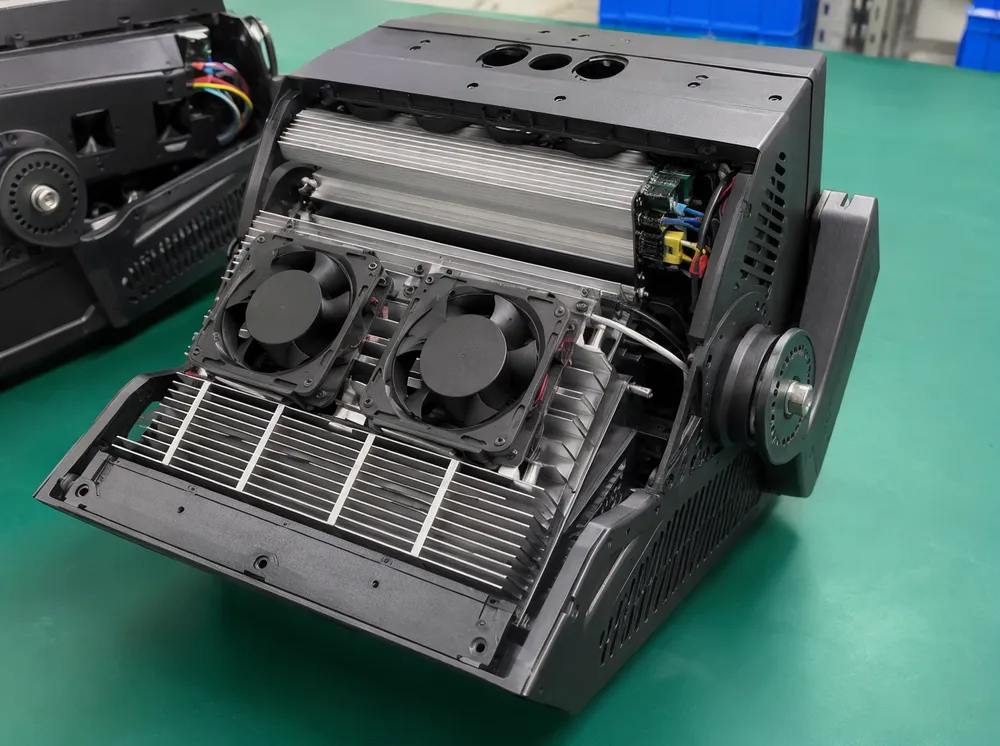
Active Cooling with Intelligent Fan Curves
Dual ball-bearing fans with temperature-responsive speed curves. At lower output levels (typical for worship services that aren't running full-intensity haze-heavy looks), fans run at minimum speed — reducing audible noise to below 28dB at 1 meter. Under full thermal load, the system steps up progressively rather than jumping to maximum speed.
Die-Cast Aluminum Heat Sink Bodies
The fixture housing itself acts as a heatsink. Die-cast aluminum dissipates heat across the entire body surface rather than concentrating it at the LED board. This matters enormously for ceiling-mounted fixtures where natural convection is limited by proximity to the ceiling plane. Sheet-metal housings in competitor products trap heat at the LED junction — exactly where you don't want it.
Over-Temperature Protection with Graceful Degradation
If ambient conditions push junction temperatures beyond safe limits, the firmware reduces output gradually rather than hard-cutting to black. Your customer's service doesn't suddenly go dark. The fixture protects itself while maintaining some output until conditions normalize. This behavior is configurable via the on-board menu.
LED source rated life at L70 (70% lumen maintenance)
Acoustic noise at 1m during typical worship output levels
Maximum rated ambient operating temperature at full output
Indoor and outdoor variants for every installation environment
Real-World Thermal Test Data
We test at 40°C ambient in an enclosed chamber simulating ceiling-mount conditions — not the 25°C open-air bench tests that produce impressive but unrealistic specifications. The numbers we publish reflect the conditions your fixtures will actually operate in.
Continuous 12-hour run tests at rated output before shipment
Junction temperature logging during QC identifies units that run outside tolerance
Thermal paste application is machine-controlled, not hand-applied
Fan failure detection triggers RDM alert to the control console
Working With Us — What the Distribution Relationship Looks Like
We work with a limited number of distribution partners per region. This isn't artificial scarcity — it's how we maintain service quality and protect your margins.
What You Get
Logistics & Lead Times
Ready to Evaluate?
The fastest path is a 20-minute call where we learn about your current church market business, discuss which product lines match your pipeline, and determine if the territory and volume fit makes sense for both sides. No pitch deck — just a direct conversation about whether we're the right manufacturing partner for your distribution business.
Response time on all distribution inquiries
OEM/ODM for Church Auditorium Stage Lighting
If you're building a branded professional worship lighting line or need project-specific configurations, we manufacture to your specifications. Professional-tier customization goes deeper than logo placement.
Optical Customization
- Specific LED color arrays (RGBW+Lime for extended color gamut, dedicated amber for warm stage looks)
- Custom gobo sets etched or laser-cut to your specs
- Modified zoom ranges for specific throw distances common in your target venue sizes
Control Firmware
- Custom DMX channel layouts
- Proprietary wireless control integration (your app, your ecosystem)
- Pre-programmed worship scene libraries branded to your product
- Modified RDM reporting fields for your monitoring software
Mechanical & Thermal
- Modified housing colors (any RAL or Pantone on runs over 100 units)
- Custom yoke lengths for specific mounting scenarios
- Alternative connector configurations (powerCON TRUE1 vs standard Edison vs CEE)
- Integrated power/data pass-through for daisy-chain installations
Certification Paths
- UL listing for US market access
- ETL marks
- Specific regional safety marks your distribution channel requires
- We handle the testing and documentation — you get the certificate under your brand
MOQ Structure
200
units per model — first production run for full-custom OEM/ODM
100
units per reorder once tooling and firmware are established
10–15
working days for engineering samples from specification sign-off
We currently produce professional church fixtures under 4 private-label brands for North American and European distributors. The product architecture is proven — customization means configuring within a validated platform, not starting from zero.
Manufacturing Specifics — How We Build Professional Worship Fixtures Differently
The professional church tier runs through a different production sequence than our standard LED pars. The complexity of motorized optics, multi-protocol control, and higher thermal demands means additional process steps that affect your product reliability.
Motorized Assembly Calibration
Every pan/tilt mechanism gets calibrated against reference positions using optical encoders. We verify positional repeatability to ±0.3° — when a production team programs a fixture to hit the same mark night after night, it hits the mark.
Why it matters: The alternative (stepper motors without encoder feedback) drifts over time and costs your customer a service call to recalibrate.
Multi-Stage Optical Alignment
After the LED engine mounts to the heat sink assembly and the lens train installs, each fixture goes through a collimation and focus verification step using our photometric bench. The golden sample for each model sets the reference.
Rejection criteria: If beam profile or center intensity deviates beyond tolerance, the fixture returns to assembly for correction. This catches misaligned lenses or slightly off-center LED placement that would show up as hot-spots or uneven field distribution in the venue.
Driver Burn-In Separate from Final Assembly
The constant-current LED drivers go through their own 24-hour burn-in cycle before they're installed into fixtures. Drivers that show voltage drift, ripple exceedance, or thermal shutdown under sustained load get rejected at this stage.
Dual validation: By the time the driver enters the final fixture, it's already proven stable — the fixture-level 48-hour aging test then validates the complete thermal system working together.
Protocol Testing Against Reference Consoles
Before a production batch ships, sample units connect to ETC, MA, and ChamSys consoles to verify protocol response — DMX timing, sACN universe handling, Art-Net node discovery, RDM parameter reporting. We maintain a reference console rack in our test lab specifically for this purpose.
Lesson learned: We added this step after a 2020 incident where a firmware revision broke Art-Net discovery on a specific console platform. One batch had to be re-flashed. Now we catch it before shipping.
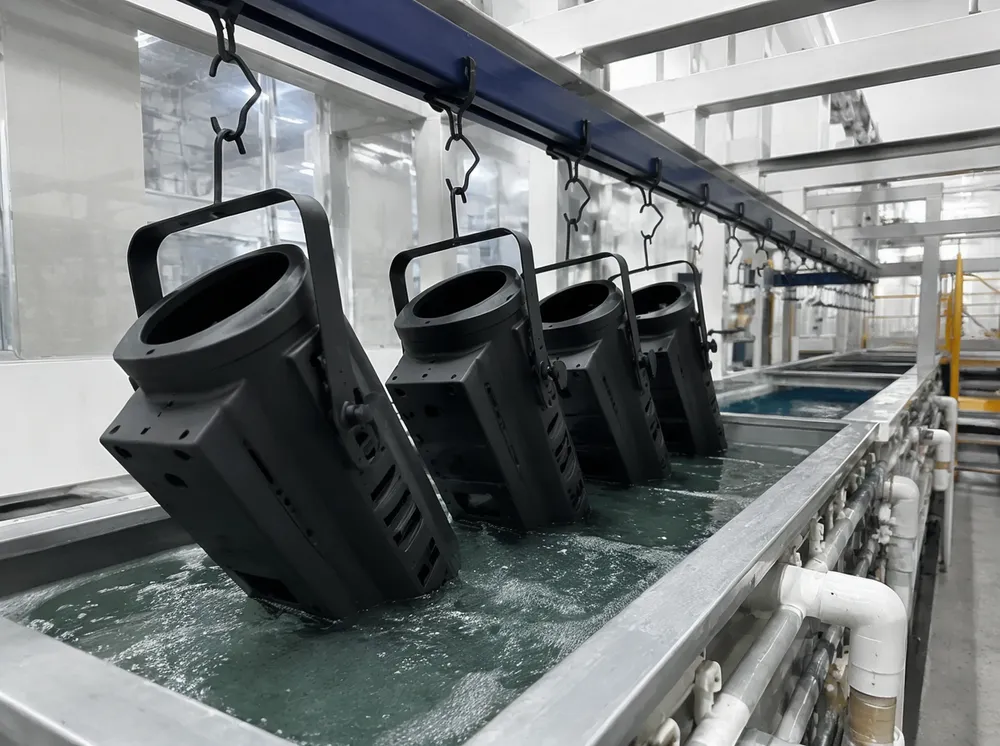
Powder Coating for Stage Heat Cycling
The housings go through phosphate pre-treatment before powder application. Standard stage lighting housings see 50–70°C surface temperatures during operation. Without proper adhesion pre-treatment, powder coat can bubble or chip at heat transition zones after 12–18 months of thermal cycling.
60–80μm
coating thickness on phosphated aluminum
500hr
salt spray test pass
∞
repeated heat cycles without degradation
Container Loading and Packaging for Professional Fixtures
Professional church lighting is heavier and more mechanically complex than par cans — motors, gears, glass optics. Packaging engineering matters more here because the damage cost per unit is higher.
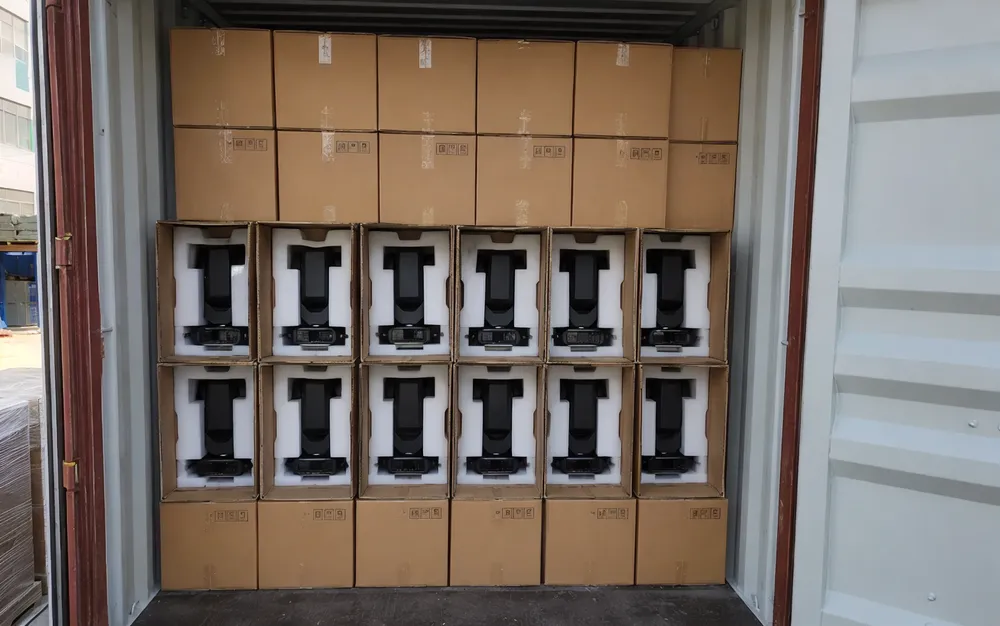
Custom Molded EPE Foam Cradles
Each professional fixture type has its own foam insert geometry, designed to immobilize the pan/tilt head in a locked position during transit. Moving head fixtures travel with the head locked in a specific orientation that minimizes stress on the tilt mechanism bearings.
Individual Inner Cartons with Suspension Packaging
The fixture-plus-foam assembly sits inside an inner carton, which then sits inside the master carton with additional shock-absorbing material. This double-box approach protects against the concentrated point impacts that occur during container stuffing and unstuffing.
Palletization Available
For LCL or warehouse-direct deliveries, we palletize to your specification. Standard Euro-pallet or US-standard configurations, stretch-wrapped and corner-protected. Pallet labeling per your warehouse management system.
Loading Density — Professional Fixtures
| Fixture Type | 20GP Container | 40HQ Container |
|---|---|---|
| Moving Head Spots | 180–250 units | 400–550 units |
| Profile Fixtures (lighter) | 300–450 units | — |
| Wash Fixtures | 250–400 units | — |
These numbers vary by model dimensions. We confirm exact loading quantities during order planning so your freight calculation is accurate before you commit.
Shipping Terms & Documentation
We work FOB Shenzhen/Guangzhou, CIF to your port, or DDP. Transit documentation, compliance certificates, and test reports ship digitally before the container arrives, so your customs clearance isn't waiting on paperwork.
Certification and Compliance — Pre-Qualified for Your Target Markets
Professional church stage lighting ships into regulated markets. Your compliance team needs documentation, not promises.
Held Certifications (Standard Across Professional Tier)
-
CE
CE (EMC + LVD)
European market access
-
FCC
FCC Part 15 Class B
US electromagnetic compatibility
-
Ro
RoHS 2011/65/EU
Restricted substance compliance
-
IP
IP65 Rated (Outdoor Variants)
Tested per IEC 60529
Available on Request / Per Project
-
UL
UL/ETL Listing
For US market distribution channels requiring NRTL marks
-
CB
CB Scheme Test Reports
For accelerated national certification in destination markets
-
REACH Compliance Documentation
EU chemical safety regulation
-
65
California Proposition 65 Compliance
State-level consumer protection requirement
What This Means for Your Business
Fixtures arrive with the documentation your import process requires. CE and FCC test reports carry our lab's ILAC-accredited mark. You don't hold containers at port waiting for compliance paperwork, and your downstream customers don't ask questions you can't answer about safety certifications.
US Church Market — UL/ETL Requirement
Many institutional buyers (mega-churches, church building committees) now require UL or ETL listing in their procurement specifications. We can produce UL-listed versions with dedicated compliance packaging and labeling.
If your project pipeline requires NRTL marks, discuss this at the quoting stage — it affects model selection and lead time.
Learn more about our testing and certification infrastructure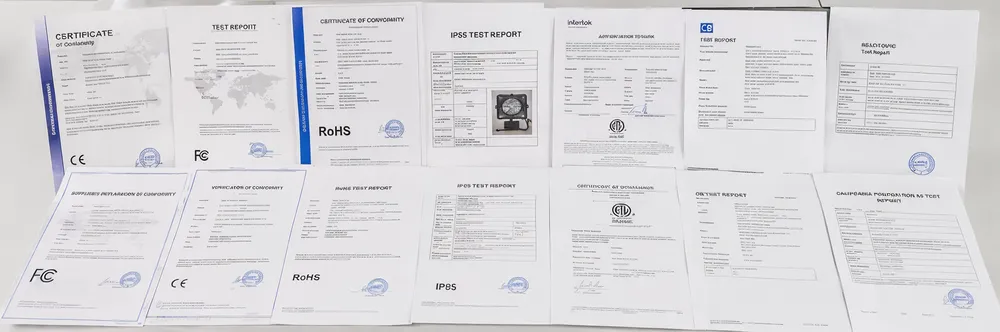
How Professional Church Lighting Compares to Our Other Worship Tiers
Not every project needs professional-tier fixtures. Here's how to position the right product for your buyer:
| Decision Factor | LED Church Lighting | Simple Church Lighting | Professional Church Lighting |
|---|---|---|---|
| Venue size | 200–500 seats | Under 200 seats | 500+ seats |
| Operator skill | Volunteer with basic training | Zero-training volunteer | Professional production team |
| Camera / broadcast | Livestream-capable | Not broadcast-critical | Broadcast-grade |
| Control infrastructure | DMX512 basic | Master-slave / auto | DMX/sACN/Art-Net networked |
| Fixture types | Par cans, wash lights | Compact pars, mini wash | Moving heads, profiles, high-output wash |
| Typical project size | 12–30 fixtures | 6–15 fixtures | 30–80+ fixtures |
| Your margin opportunity | Volume play (higher unit count, lower unit price) | Entry-level (price-driven) | Premium segment (higher unit value, specification-driven) |
| Reorder pattern | 2–3 year replacement cycle | Budget-driven, irregular | Campus expansion + touring replenishment |
Venue Size
Operator Skill
Camera / Broadcast
Control Infrastructure
Fixture Types
Typical Project Size
Your Margin Opportunity
Reorder Pattern
Need simpler operation or lower price points?
Our LED church stage lighting tier covers mid-size churches with DMX control and camera-ready output at a lower per-unit cost. For volunteer-operated small churches, our simple church stage lighting eliminates complexity entirely.
Need professional but unsure which models?
Send us the venue specs — seating capacity, throw distances, control console brand, and whether broadcast is involved. We'll recommend the exact model configuration and quantities.
Frequently Asked Questions — Professional Church Stage Lighting
What throw distance can professional church stage lighting cover effectively?
Our moving head spots deliver usable output at 15–25 meter throws depending on model wattage. The 350W variant maintains 800+ lux at 20m with a 15° beam — sufficient for key lighting a pulpit from a mid-auditorium truss position.
For longer throws (balcony positions in arena-style churches), we recommend the 500W profile series which holds 600+ lux at 30m. We'll specify the right combination based on your venue CAD or seating chart.
How quiet are these fixtures for worship environments?
Fan noise is a legitimate concern in worship settings where quiet moments matter. Our professional moving heads include a "theater mode" or "silent fan" setting that reduces cooling fan speed during low-output operation, bringing noise below 35dB at 1m.
During full-output musical worship segments, ambient audio easily masks fixture fan noise. For sermon-only moments where fixtures dim to low levels, the reduced thermal load allows near-silent operation. We can provide dB spec sheets for each model on request.
What control protocols do your professional fixtures support?
All professional-tier fixtures support DMX512 (5-pin XLR), sACN (streaming ACN over Ethernet), and Art-Net. This means they integrate with any major lighting console — MA Lighting, ETC Eos, ChamSys, Hog, or Vista — without compatibility issues.
For churches running networked infrastructure, sACN and Art-Net eliminate long DMX cable runs by allowing fixture control over standard Cat6 Ethernet with network switches. We provide RDM-compatible models that allow remote fixture addressing and diagnostics from the console position.
What CRI and color temperature should we specify for broadcast?
For broadcast and livestream, aim for CRI 90+ and TLCI 85+ (Television Lighting Consistency Index). Our professional LED profiles and wash fixtures exceed these thresholds, delivering accurate skin tones without the green/magenta shift that cheaper fixtures introduce on camera.
Color temperature for key lighting should be 3200K (tungsten match) or 5600K (daylight match) depending on your camera white balance workflow. Our fixtures offer continuously variable CCT from 2700K–6500K, so your broadcast engineer can dial in the exact kelvin without gels.
How do you handle rigging and weight load for moving heads?
Professional moving heads range from 15kg to 35kg depending on wattage and feature set. Every fixture ships with dual safety attachment points and we provide load calculations for standard truss configurations (12" box truss, pre-rig truss, and pipe grid).
We recommend churches work with a certified rigger for initial installation. We can connect you with rigging partners in your region, or provide the mechanical drawings and weight data your structural engineer needs to sign off on the installation plan.
What warranty and support do you provide on professional fixtures?
Professional-tier fixtures carry a 2-year manufacturer warranty covering LED engine, power supply, and stepper motors. We stock common replacement parts (gobos, color wheels, lamp modules) for fast turnaround if maintenance is needed.
For large installations (30+ fixtures), we offer extended service agreements that include priority replacement shipping and remote diagnostic support. Your production team can reach our technical support directly for DMX addressing, firmware updates, or programming assistance.
Can we phase the installation over multiple budget cycles?
Absolutely. Many large churches phase their lighting upgrades across 2–3 fiscal years. We'll design the full system architecture upfront so each phase builds logically — typically starting with front-of-house key/fill lighting (immediate broadcast improvement), then adding effects and stage wash in subsequent phases.
Because we lock pricing on the full project scope, you get volume pricing even when ordering in phases. Each delivery is a complete, functional upgrade — not a half-finished system waiting for the next budget approval.
Ready to Specify Professional Lighting for Your Venue?
Send us your venue details — seating capacity, throw distances, control console, and broadcast requirements. We'll return a complete fixture specification with quantities, pricing, and rigging recommendations within 48 hours.
No minimum order. Volume pricing available for 30+ fixture projects.
Start Your Professional Church Lighting Order
You're evaluating fixtures for 500+ seat churches, multi-campus deployments, or broadcast worship environments. We build exactly this category of product — and we build it at factory pricing that gives you margin room to compete.
Send us your project specifications, venue details, or even a competitor fixture you're currently sourcing against. Our engineering team will recommend the model configuration, provide detailed spec sheets and photometric data, and quote based on your volume. Response within 24 hours.