

Stage Lighting Background Panels Modular LED Backdrop Systems
Factory-direct stage lighting background panels engineered for high-utilization rental fleets and permanent installations.
Modular LED backdrop system with die-cast aluminum frames, front/rear serviceability, and batch-matched color consistency — built for buyers who need panels that survive 3,000+ hours of touring without pixel failures or color drift.
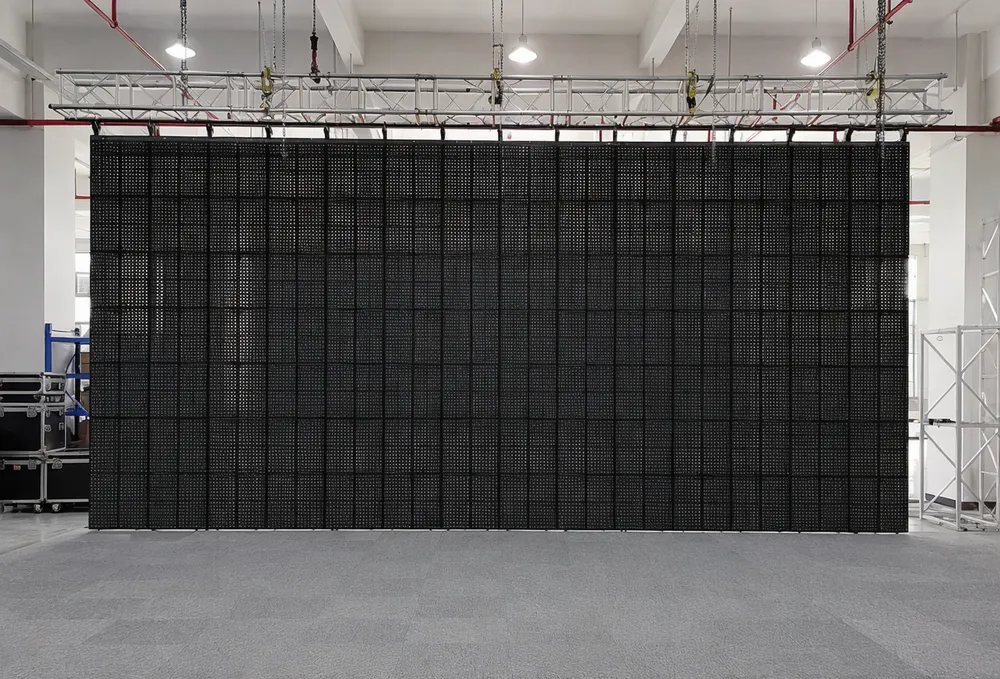
What This Product Is and Who It's Built For
Our stage lighting background panel is a modular LED video surface designed to tile into large-format backdrops for concert stages, festival main stages, house of worship campuses, corporate event productions, and broadcast studios. Each module locks mechanically and electrically to adjacent modules — you build whatever wall size the gig requires, break it down, truck it, and rebuild it at the next venue.
This is the product page for our backdrop panel system specifically. The parent category page covers our stage lighting background product line at the category level — manufacturing philosophy, general capability ranges, and segment overview. Here, we go deeper into the panel itself: exact specifications, the engineering decisions that affect your warranty rate, customization parameters, and commercial logic for different deployment scenarios.
What separates this panel from what you'll find on Alibaba at a lower price point: we engineer from the thermal architecture outward, not from the LED board inward. The heatsink geometry, airflow channels, and conformal-coated driver boards are designed before the pixel layout gets finalized. That sequencing means your panels hold full brightness at hour 3,000 the same as hour 1 — no thermal throttling, no gradual dimming that forces you to retire inventory early.
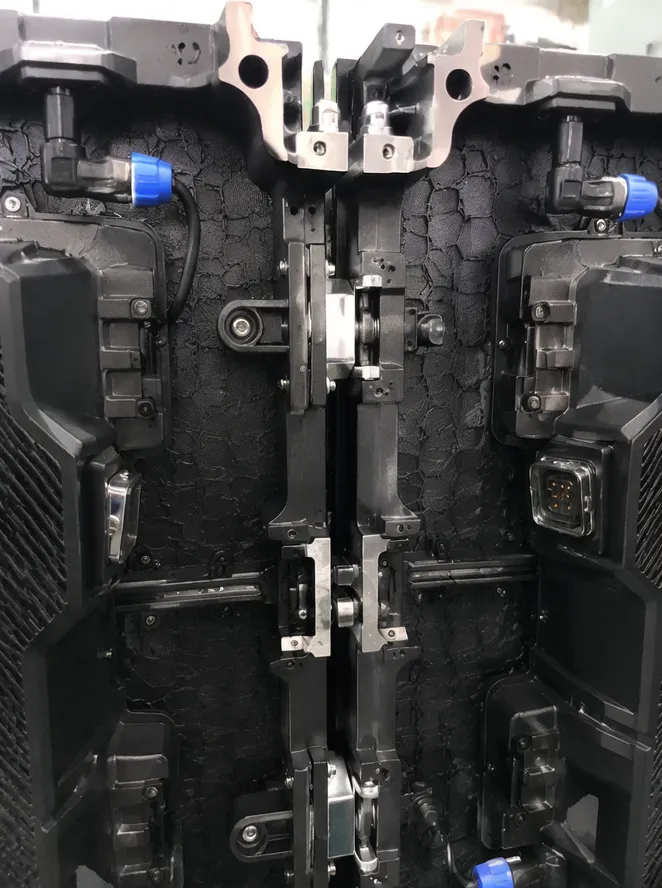
Engineering Lesson — Why Thermal-First Design Matters
We learned this priority the hard way. Our first-generation backdrop panel in 2017 had a beautiful pixel board mounted on an inadequate heatsink. Sixty panels came back from a Middle Eastern tour with brightness degradation after one summer festival season. We redesigned from scratch — thermal architecture first, pixel board second. That redesign is the foundation of every backdrop panel we ship today.
Primary Deployment Scenarios
Technical Specifications — The Numbers Your Comparison Sheet Needs
These are production-standard values across our backdrop panel range. Exact parameters depend on the pixel pitch and IP configuration you select.
| Parameter | Indoor Model (IP43) | Outdoor Model (IP65) |
|---|---|---|
| Pixel Pitch Options | 3.9mm, 6mm, 9mm, 12mm | 9mm, 12mm, 20mm, 50mm |
| Panel Dimensions (standard) | 500×500mm, 500×1000mm | 500×500mm, 500×1000mm, 1000×1000mm |
| Brightness | 1,200 – 2,500 nits | 4,500 – 5,500 nits |
| Refresh Rate | 3,840 Hz | 3,840 Hz |
| Color Depth | 16-bit per channel | 16-bit per channel |
| Viewing Angle | 140° H / 140° V | 140° H / 140° V |
| Frame Material | Die-cast aluminum, powder coated | Die-cast aluminum, powder coated |
| Serviceability | Front and rear accessible | Front and rear accessible |
| Module Weight | 5.8 – 7.2 kg | 7.5 – 9.2 kg |
| Power Input | 110–240V AC, auto-sensing | 110–240V AC, auto-sensing |
| Max Power Consumption | 180–320W/m² (pitch-dependent) | 280–450W/m² (pitch-dependent) |
| Control Protocol | DMX512, Art-Net, sACN | DMX512, Art-Net, sACN |
| Operating Temperature | -10°C to +45°C | -20°C to +50°C |
| Lifespan (to 70% brightness) | >50,000 hours | >50,000 hours |
| Connector Type | Aviation-grade, 5,000+ mate cycles | Aviation-grade, 5,000+ mate cycles |
| Latch Mechanism | CNC aluminum with hardened steel pins | CNC aluminum with hardened steel pins |
Specifications represent typical production values. Contact us with your target application for a detailed spec sheet matching your requirements.
Why 3,840 Hz Refresh Rate Matters for Your Clients
The 3,840 Hz refresh rate matters specifically for broadcast and camera-facing applications — it eliminates scan-line artifacts in video recordings. If your clients shoot content in front of the backdrop (corporate events, music videos, live TV broadcasts), this refresh rate protects their footage quality and protects your reputation as a rental provider.
Thermal Engineering That Protects Your Rental Fleet's Lifespan
This is the section most suppliers skip, and it's the section that determines whether your panels are still earning revenue at year five or sitting in a warehouse with diminished brightness.
LED backdrop panels run at sustained high output for hours — a concert backdrop at full white for a 3-hour show, a church installation at 80% brightness for 6 hours every Sunday, a festival wall running 12-hour days for a weekend. Under these conditions, junction temperature is the single biggest factor in LED lifespan. Every 10°C above optimal operating temperature cuts LED life expectancy roughly in half.
We size our heatsink fins to dissipate the full thermal load at 100% white output in a 45°C ambient environment (outdoor summer festival conditions). Most factories size for 70% average output in a 25°C environment — which means their panels throttle or degrade faster the moment real-world conditions exceed that comfortable assumption. Our panels don't throttle because the thermal budget was calculated for worst-case, not best-case.
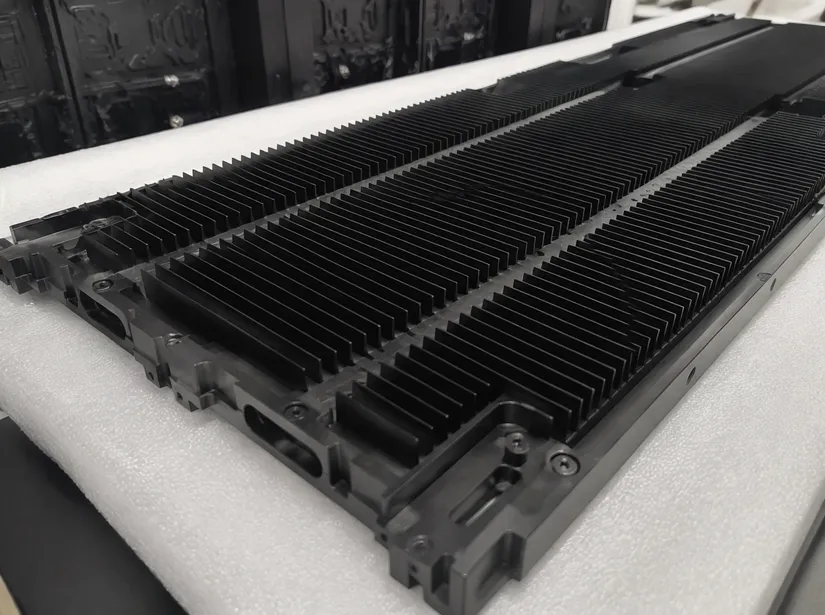
48-Hour Aging Test — Every Panel, Before It Ships
Every panel runs a 48-hour aging test at full white output before it ships. We monitor junction temperatures throughout. Any panel that exceeds 85°C at the LED junction during this test gets pulled for thermal investigation. Your delivered panels have already proven they handle sustained full-load operation without exceeding thermal limits.
Commercial Impact
Your rental panels maintain rated brightness across their service life. You don't get the call from a client saying "the backdrop looks dimmer than last time we rented it." You don't retire panels early due to visible brightness inconsistency when tiled next to newer inventory. Your capital amortizes over 50,000+ hours of actual use, not 20,000 hours of degraded output.
Infant-Mortality Screening
The 48-hour test also catches infant-mortality failures — capacitor blowouts, driver IC faults, LED die-attach defects. These fail in the first 24–72 hours of continuous operation. Better they fail on our aging rack than during your client's headline show.
Die-Cast Frames and Rigging Hardware Setup Speed as a Cost Factor
Your crew's rigging time is a direct cost per show. Every minute spent fighting panel alignment, forcing latches, or troubleshooting mechanical connections adds labor cost to your rental operation.
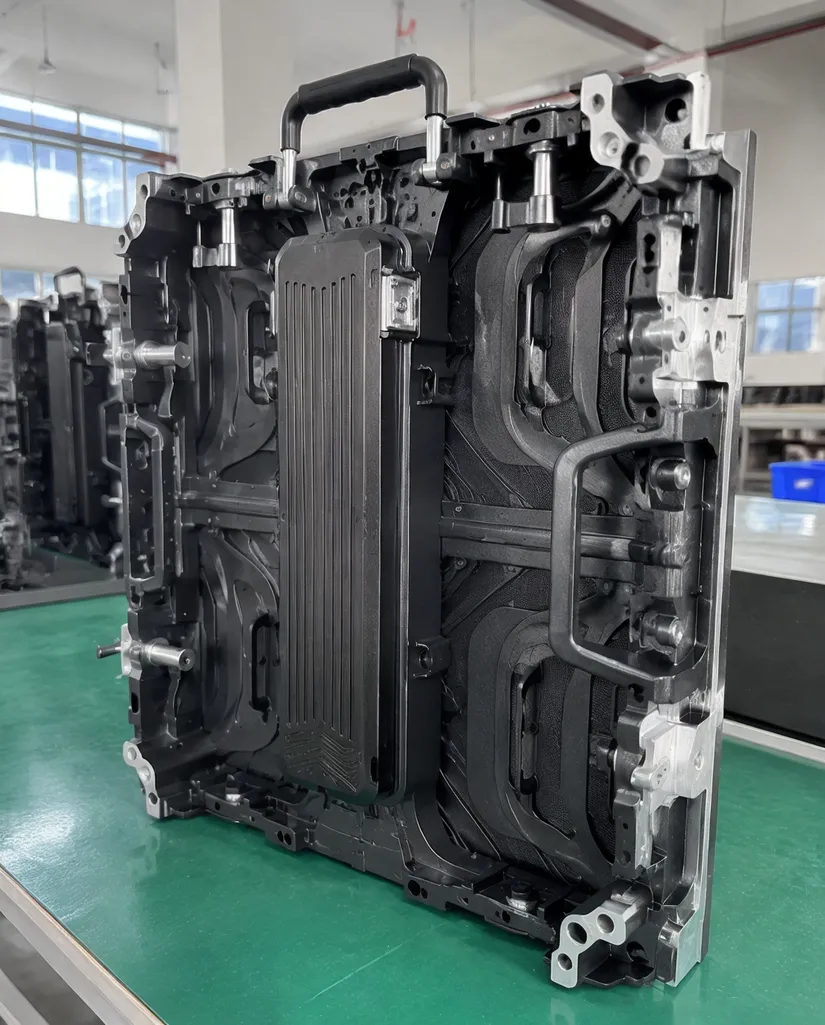
Die-Cast Aluminum — Not Welded, Not Stamped
Our panel frames are die-cast aluminum — not welded from extruded profiles, not stamped sheet metal. Die-casting produces dimensional tolerances of ±0.15mm on mating surfaces. When your crew connects two panels, they align flush without shimming or force-fitting.
Latch Hardware — Built for Touring Life
The latch pins are hardened steel in CNC-machined aluminum housings, rated for 5,000+ connect/disconnect cycles. At one show per week with setup and teardown, that's nearly 100 years of service life on the mechanical connection alone.
Front and Rear Serviceability
Front and rear serviceability means a failed LED module or driver board gets swapped on-site in under 5 minutes without removing the panel from the rigging structure. Your crew carries a few spare modules in the truck and handles field repairs between sets — no need to pull an entire panel out of the wall, ship it back, and wait for depot repair.
Aviation-Grade Signal & Power Connectors
The aviation-grade signal and power connectors maintain reliable contact through vibration (truck transport), thermal cycling (outdoor temperature swings), and repeated mating cycles. We test connector resistance stability across 1,000 rapid mate/de-mate cycles with vibration applied — simulating the cumulative stress of a touring season. No intermittent signal drops mid-show.
Market Segments Where Backdrop Panels Generate Revenue
Each segment below represents a repeatable commercial opportunity. The deployment characteristics differ — understanding them helps you configure your inventory and sales approach.
Concert Touring and Festival Production
Highest Volume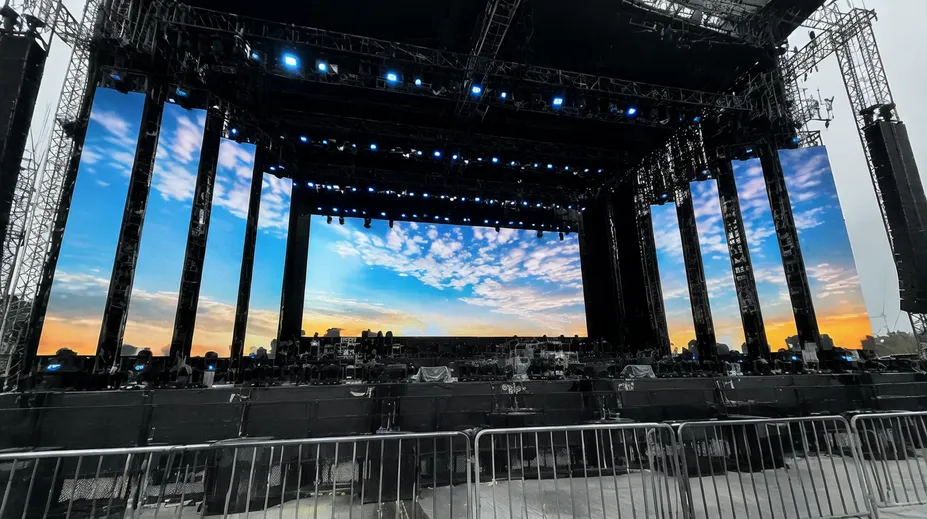
The highest-volume segment for backdrop panels. A mid-size touring production carries 80–200 modules per show. Rental companies typically maintain 2–3 complete sets to cover overlapping tour schedules.
Commercial Pattern
- Initial order of 150–300 panels, annual reorders of 40–100 units replacing road-damaged modules and expanding for new client contracts.
- Festival season (Q1–Q2 ordering for Northern Hemisphere) drives predictable demand peaks.
- IP65 panels at 5,500 nits dominate because you need one inventory that works both indoor arenas and outdoor festival stages — carrying separate indoor and outdoor fleets doubles your capital tied up in panels that sit idle half the year.
Corporate AV and Event Production
Premium Rental Rates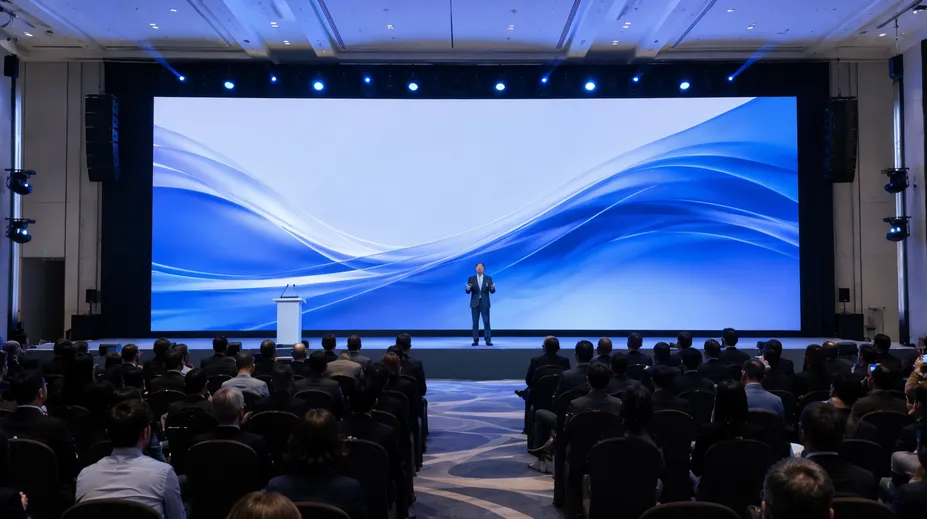
Product launches, trade shows, shareholder meetings, broadcast studios. These clients demand fine-pitch panels (3.9–6mm) for camera-ready imagery at close viewing distances. Higher unit cost per panel, but these bookings command premium rental rates and the panels experience gentler handling than concert touring.
Commercial Pattern
- Smaller panel counts per gig (20–60 modules typical), but higher daily rental rates.
- Event production companies often book 6–12 months ahead — predictable scheduling, high fleet utilization.
- The same 3.9mm panels rotate between corporate events without dead-stock gaps.
House of Worship Permanent Installation
High Margin Per Transaction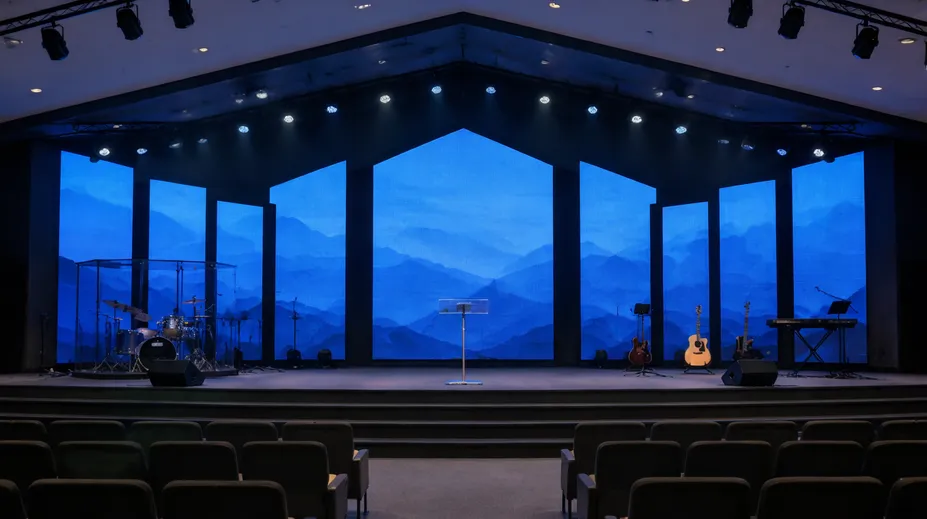
Churches and megachurch campuses install 40–120 panels as permanent stage lighting backgrounds. This segment buys once, then reorders for campus expansions or technology upgrades on 5–7 year cycles.
Commercial Pattern
- Project-based sales through AV integrators. Lower reorder frequency, but higher margin per transaction because installation labor is billed separately.
- Integrators prefer a manufacturer who provides custom panel dimensions to fit specific stage geometries without visible gaps or filler panels.
- This segment has grown steadily for us — roughly 25% of our backdrop panel output now ships to AV integrators serving worship projects. Worth building into your product line if you serve that vertical.
Architectural and Permanent Outdoor Installation
Harshest Duty Cycle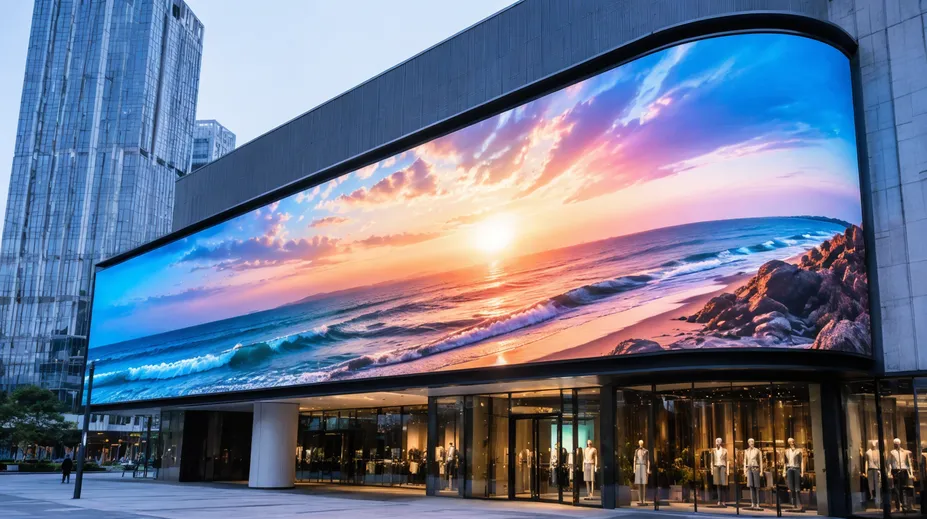
Building facades, urban plazas, sports venue perimeters, shopping center displays. These deployments run 12–18 hours daily, 365 days a year — the harshest duty cycle for any backdrop panel application.
Commercial Pattern
- Large project orders (200–1,000+ modules), long sales cycles (6–18 months from specification to order), and ongoing maintenance contracts.
- IP65 with 5,500-nit output is minimum. Pixel pitch is typically 20–50mm due to long viewing distances.
- These projects justify full ODM development if the architect requires custom panel geometry or non-standard aspect ratios.
Color Consistency Across Orders — The Problem That Costs Rental Companies Clients
This deserves its own section because it's the single most common complaint we hear from rental companies switching suppliers.
The Problem
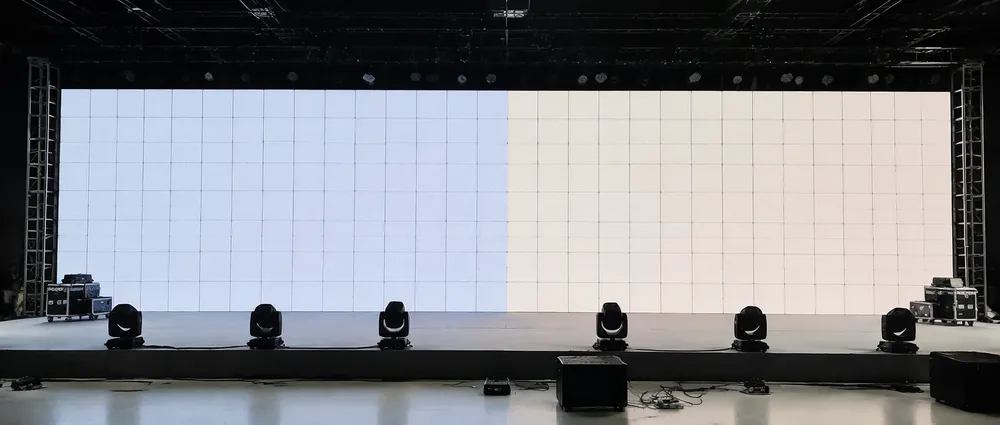
You order 200 panels today, add 50 replacement panels six months later, and the two batches display noticeably different white points when tiled together on stage. The audience doesn't see it. The camera absolutely sees it. Your client's lighting director sees it. And your reputation as a professional rental house takes the hit.
The Cause
LED binning variation. LED manufacturers produce chips in batches with slight color temperature variation — a bin rated at 6500K might range from 6300K to 6700K within the bin tolerance.
Across 200 panels from one batch, the variation stays within the bin range and appears uniform. But a second order pulled from a different production batch may land at a different point within that tolerance — 6350K vs 6550K — creating visible mismatch when panels from different orders sit side by side.
Industry typical tolerance: ±150K
GDMonkey tolerance: ±50K
Our Solution Operates at Three Levels
Incoming LED Procurement
We source LEDs from the same supplier lot for each production run and require tighter-than-standard binning: ±50K color temperature tolerance, versus the ±150K industry typical.
Batch Archiving
We record and archive the LED bin data, driver calibration parameters, and color measurement results for every production order. When you reorder, provide your original order number — we pull the batch records and match your new panels to the original color point.
If an Exact Match Isn't Available
We inform you before production begins. You decide whether to accept the closest available bin (we'll send measurement data so you can evaluate the delta) or wait for a matching batch from our LED supplier. No surprises after production.
This system costs us more in procurement planning and LED inventory management. It saves you the cost of fielding a call from a LD at 4 PM on show day saying your backdrop looks patchy.
Customization Parameters and Limitations
Simple OEM
30 Unit MOQWhat you can customize on our proven platform without engineering changes:
- Logo placement on panel rear housing (laser-engraved or silkscreen)
- Firmware splash screen (your brand displayed on power-up)
- Packaging design (your branding, your documentation)
- Carton labeling and barcode format
Modified OEM
50 Unit MOQWhat you can modify within existing engineering platforms:
- Pixel pitch selection from available options
- Panel dimensions within existing die-cast frame tooling (500×500, 500×1000, 1000×1000)
- Brightness calibration to your target nit level
- Custom connector pinout or type (within same form factor)
- Specific color temperature tuning on white calibration
- Custom DMX channel mapping or control protocol behavior
- IP rating selection (IP43 or IP65 on same frame platform)
Full ODM Development
200+ Unit MOQWhat requires new tooling investment and dedicated engineering cycles:
- Non-standard panel dimensions requiring new die-cast molds
- Custom frame geometry (curved panels, triangular modules, irregular shapes)
- Proprietary pixel layouts or non-uniform pixel density
- Integrated mounting hardware specific to your rigging system
- New control protocol development (proprietary wireless, custom API)
- Panel-to-panel mechanical interfaces unique to your system
Engineering Timelines
- Modified OEM review: 3–5 days
- Full ODM development: 3–4 iteration cycles from concept to production-ready sample
In-House Engineering
Our 15-person engineering team handles optical, electrical, thermal, and mechanical design in-house — no subcontracted PCB layout or firmware development.
Our Recommendation for Market Entry
For most distributors entering the backdrop panel market, we recommend starting with Simple OEM on our 9mm IP65 panel. Test your market's response with your branding on a proven platform. Move to Modified OEM once your client feedback identifies specific spec adjustments that would win more bookings.
Discuss your custom backdrop panel requirements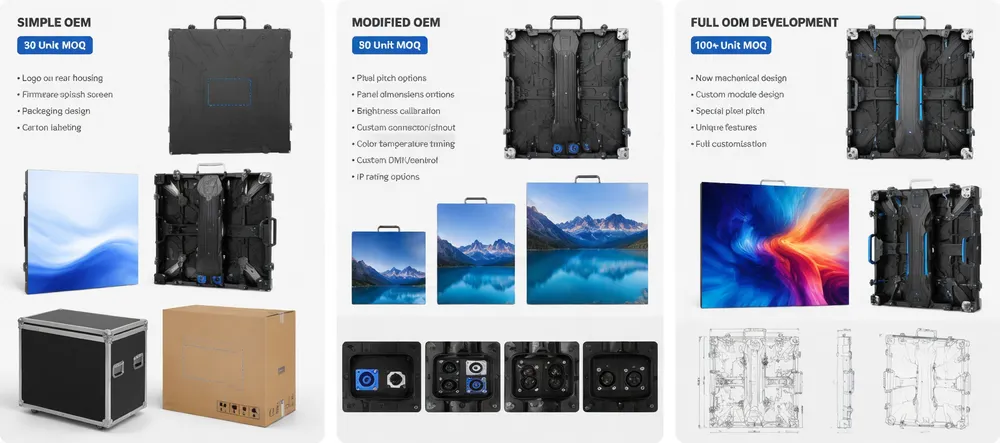
Packaging, Container Loading, and Landed Cost Factors
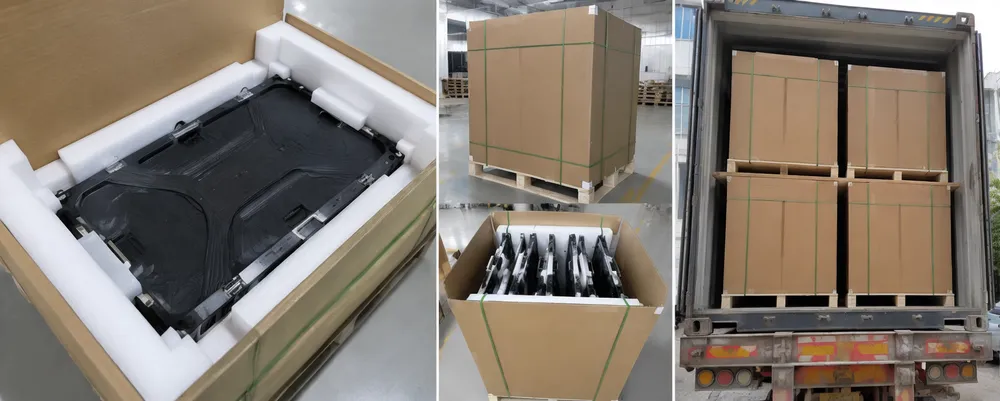
Backdrop panels are expensive per unit and the LED face is the most vulnerable surface. Our packaging engineering targets zero transit damage on the component you can't repair in the field.
Individual Panel Packaging
- • Molded EPE foam cradle, LED-face-down (foam contacts the aluminum frame perimeter, never the pixel surface)
- • Corner protectors absorb impact
- • Double-wall corrugated inner carton rated for 3× stacking weight
Master Carton
- • 4 panels per master carton in vertical orientation
- • Under 45 kg per master carton for manual warehouse handling
- • Strap-reinforced for forklift/pallet jack handling
Container Loading Capacity
| Container | Modules (approx.) | Palletization |
|---|---|---|
| 20' GP | 280–320 | Palletized, 2-tier |
| 40' HQ | 600–680 | Palletized, 2-tier, dunnage between tiers |
Transit Damage Rate
Below 0.3% across all shipments in the past 12 months.
The few cases that occur trace to port handling on non-palletized LCL shipments. We strongly recommend full palletization for FCL sea freight.
Landed Cost Advantage
At 600+ panels per 40' HQ, your per-unit sea freight component is minimal relative to unit value.
Factory-direct pricing without a trading company's margin layer, combined with efficient container utilization, keeps your total landed cost 15–20% below comparable panels sourced through intermediaries.
Urgent Replacement Panels
For urgent replacement panels needed before a tour date, we pack individual units in ATA-style flight case foam at a per-panel surcharge. Most buyers use this for samples and emergency replacements only — production orders ship standard packaging by sea.
Compliance Documentation Ready for Your Customs Broker
Every panel ships with the documentation package your destination market requires. No post-production certification scramble — documentation ships with the goods, not weeks after.
CE + EMC
EN 55032 / EN 55035 — EU import clearance without holds.
FCC Part 15 Class A
US market entry documentation included with every shipment.
RoHS 2.0
Lead-free solder, halogen-free PCB substrates, full restricted-substance declaration.
IP65 Certification
Outdoor models third-party tested, jet-spray validated — not just drip-test rated.
ISO 9001:2015
Quality management system covering full production process.
UKCA (Post-Brexit)
Technical file and declaration of conformity provided for your UK importer of record.
All certificates and test reports are provided in digital format, ready for your customs broker. Documentation ships with the goods — no weeks-long post-production certification scramble.
Frequently Asked Questions
What pixel pitch gives the best ROI for a concert backdrop rental fleet?
9mm or 12mm pitch covers roughly 70% of concert touring and live event applications. At typical audience viewing distances of 10–30 meters, 9mm delivers sharp imagery at a cost-per-square-meter that pays back faster than fine-pitch alternatives.
If your client base includes broadcast or corporate work with cameras 3–5 meters from the backdrop, add a smaller inventory of 3.9mm or 6mm panels for those specific contracts.
Start your fleet with 9mm IP65 — it's the fastest path to positive ROI because it serves both indoor and outdoor gigs without separate inventories.
How do I avoid color mismatch between my original order and reorder panels?
Reference your original order number when placing a reorder. We archive LED binning data and color calibration parameters for every production run. We match reorders to your original batch's color point.
If an exact bin match isn't available from our LED supplier, we notify you before production with measurement data on the closest available option — you decide whether to accept or wait for a matching batch.
Why do some LED panels lose brightness after one touring season?
Thermal management failure. LED chips degrade when junction temperatures consistently exceed 90°C — which happens during sustained full-white output on panels with undersized heatsinks.
Our panels are thermally engineered for 100% white output in 45°C ambient (outdoor summer conditions), validated during 48-hour aging. Junction temperatures stay below 85°C.
Result: >90% brightness retention at 30,000 hours. Your rental fleet holds consistent visual quality across its commercial lifespan without early retirement.
What's the actual difference between IP43 and IP65 in field conditions?
IP43 handles light condensation and incidental splash — suitable for climate-controlled indoor venues only.
IP65 means full protection against pressurized water jets from any direction — rain, fog machines, stage wash water, humid outdoor environments.
The cost delta is typically 15–20% per panel. If any percentage of your rental business touches outdoor events, IP65 pays for itself the first time your panels survive weather that would destroy IP43 units.
One rainstorm killing 50 indoor-rated panels at a festival is a five-figure loss.
What happens after I send an inquiry for backdrop panels?
Within 48 hours: confirmation of specifications, FOB pricing based on your quantity and configuration, production lead time, and a packaging/logistics plan.
If you want samples before committing to volume, we ship 2–4 evaluation panels (typically within 7–10 days) so you can assess build quality, rigging mechanics, color uniformity, and brightness in your own environment before placing a production order.
Can I get curved or custom-shaped backdrop panels?
Yes — as a full ODM project. Custom panel geometry requires new die-cast mold tooling. We've produced curved modules for architectural installations and triangular panels for set designers with specific creative requirements.
Tooling investment is amortized across the production run (typically 200+ units minimum for custom geometry).
Engineering review for feasibility and tooling quote takes 5–7 days from your design brief.
Next Step: Sample Evaluation or Direct Quote
Two paths depending on where you are in your sourcing process.
You Have Specifications Ready
Send your target pixel pitch, panel dimensions, IP rating, quantity, and delivery timeline. We'll return a full quotation with confirmed specs, lead time, and container loading plan within 48 hours.
Teresa@gdmonkey.com
+86-135 3966 9939
Building a New Rental Fleet or Product Line
Tell us your target market segments and annual volume expectations. We'll recommend a panel configuration based on what's performing for our existing distributors in your region — and ship 2–4 sample panels so you can evaluate build quality, rigging speed, and visual performance before committing to production volume.