

RGB Laser Projector DJ Lights Full-Color Output, Factory-Direct
Full-spectrum RGB laser projector DJ lights with galvanometer scanning, built for buyers who need consistent color mixing across volume orders.
The highest visual impact per unit in our DJ laser range — and the widest margin gap between your landed cost and downstream resale value.
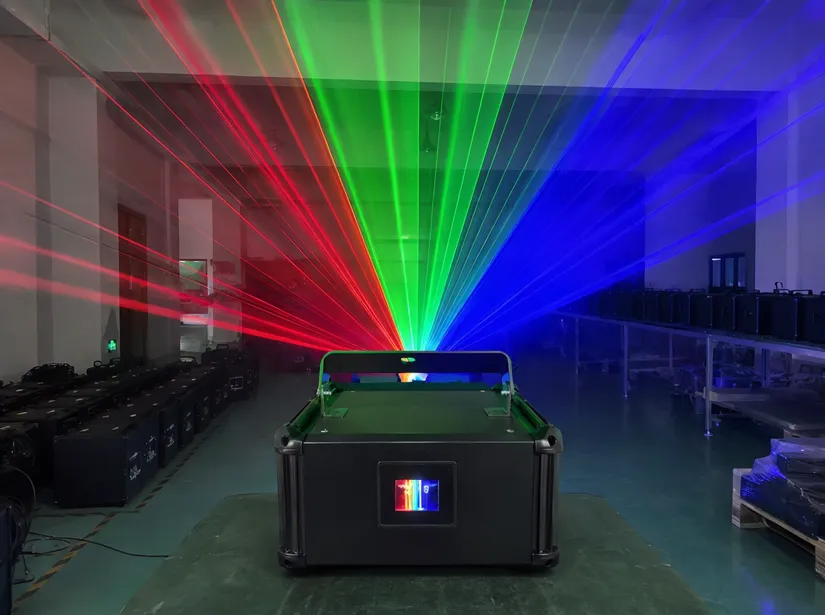
What This Product Is and Why It Commands Premium Margins
RGB laser projector DJ lights combine red (650nm), green (532nm), and blue (450nm) laser diodes through a single galvanometer scanning system to produce full-color pattern projection. Unlike single-color or dual-color lasers that project fixed-wavelength patterns, the RGB configuration mixes any color the DMX signal requests — whites, cyans, magentas, warm tones — across the full visible spectrum. That color range is what lets your downstream buyers charge a premium on rental rates and installation quotes.
The commercial positioning is straightforward: RGB laser projectors sit at the top of the DJ laser light category in perceived value. End users see full-color laser effects as high-end, which supports retail pricing 40–60% above single-color equivalents — while manufacturing cost difference is moderate once you have the three-diode optical path engineered correctly. We've manufactured this configuration since 2016, refining the color balance and thermal management through seven production iterations. Your margin per unit is highest on this SKU within our laser range.
Where this product differs from our Professional DJ Laser Lights: the professional line prioritizes raw output power in single or dual-color configurations for maximum beam visibility in haze. The RGB projector prioritizes color range and pattern complexity — it's the artistic tool versus the impact tool. Both have their buyers, and many distributors stock both. If your market leans toward raw beam power over color variety, the professional line is the better lead SKU.
Margin Position
Retail pricing supports 40–60% markup above single-color units with moderate manufacturing cost increase.
Full Spectrum
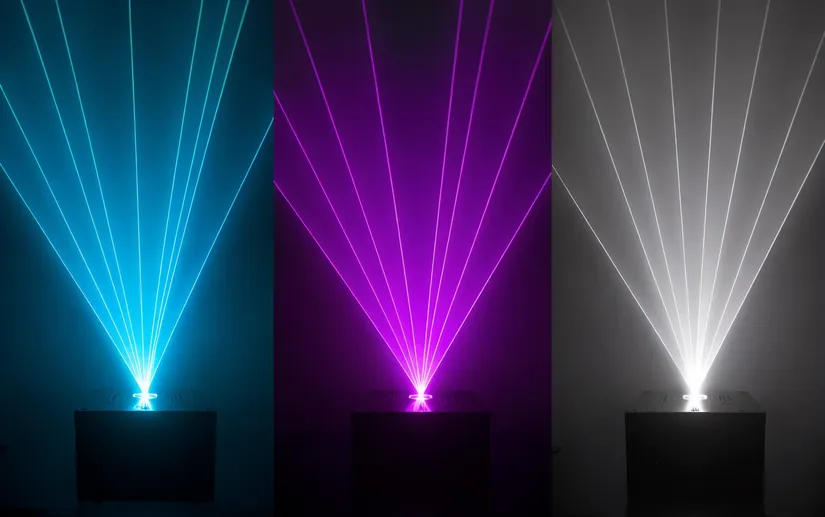
16.7 million addressable colors via analog modulation — whites, cyans, magentas, warm tones, not just fixed-wavelength patterns.
7 Production Iterations
Manufactured since 2016 with continuous refinement to color balance and thermal management across each production revision.
Technical Specifications — What Goes Into Your Comparison Sheet
Specifications shown are standard values across our RGB laser projector range. Exact values vary by model configuration. Contact us for detailed spec sheets on specific models.
| Parameter | Specification |
|---|---|
| Laser Source | Red 650nm + Green 532nm + Blue 450nm (independent diode modules) |
| Total Output Power | 200–500 mW (model dependent) |
| Color Mixing | Full RGB analog modulation — 16.7 million addressable colors |
| Scanning System | Galvanometer-driven, 15–25 KPPS @ 8° ILDA standard |
| Control Modes | DMX-512 (12CH), ILDA DB-25 (select models), Auto, Sound-Active, Master/Slave |
| Beam Divergence | < 1.5 mrad (collimated output) |
| Scan Angle | ±40° horizontal, ±30° vertical (adjustable via DMX) |
| Housing | Extruded aluminum, black anodized, integrated heatsink fins |
| Operating Voltage | AC 100–240V, 50/60Hz universal input |
| Power Consumption | 15–35W (model dependent) |
| Operating Temperature | 0°C to 40°C |
| Weight | 2.5–4.2 kg (model dependent) |
| Dimensions | Typical 230 × 180 × 120 mm (varies by model) |
| Laser Safety Class | Class 3B / Class 4 (model dependent) |
| IP Rating | IP20 (standard) / IP54 (outdoor-rated variant available) |
| Certifications | CE FCC RoHS |
ILDA Interface — Professional Show Control
The ILDA interface on upper-tier models means your buyers running professional laser shows can connect these directly to Pangolin, Phoenix, or other ILDA software — no protocol converter needed. That's a selling point for the rental and installation segment where DMX alone isn't enough for custom graphic projection.
RGB Color Mixing: The Optical Assembly That Protects Your Batch Consistency
Full-color laser projection is only as good as the color balance between the three diodes. If your red runs 5% hot relative to green, every "white" pattern skews pink. Multiply that across 200 units in a distribution order and you have visible unit-to-unit inconsistency — the kind that generates support tickets from your buyers.
Three-Stage Color Matching Process
Diode Binning & Triplet Matching
Each wavelength is incoming-inspected for actual output power against its rated value. We match red, green, and blue diodes into triplet sets with power ratios within ±3% of the target balance point. A 200 mW green paired with a proportionally matched red and blue ensures that when the DMX signal calls for white, you get neutral white — not pinkish white or greenish white.
Analog Modulation & 5-Point Calibration
The analog modulation driver boards use individual current control per diode with 256-step resolution per channel. The calibration fixture measures each unit's actual color output at five programmed coordinates (pure red, pure green, pure blue, white, and 50% cyan) and adjusts driver trim values before firmware lock.
Engineering history: We added this calibration step in 2021 after a batch of 300 units for a European distributor showed slight green dominance in white mode — acceptable on paper but visible when units ran side by side in a nightclub ceiling array. That order triggered an engineering change that added 4 minutes per unit to production time but eliminated the color-matching complaints entirely.
Galvanometer Lot Matching
The galvanometer assembly uses matched pairs — both X and Y axis mirrors sourced from the same production lot to ensure identical response characteristics. Scan geometry stays consistent across units, so your buyer's laser show programming translates identically whether they're running unit #1 or unit #500 from the same order.
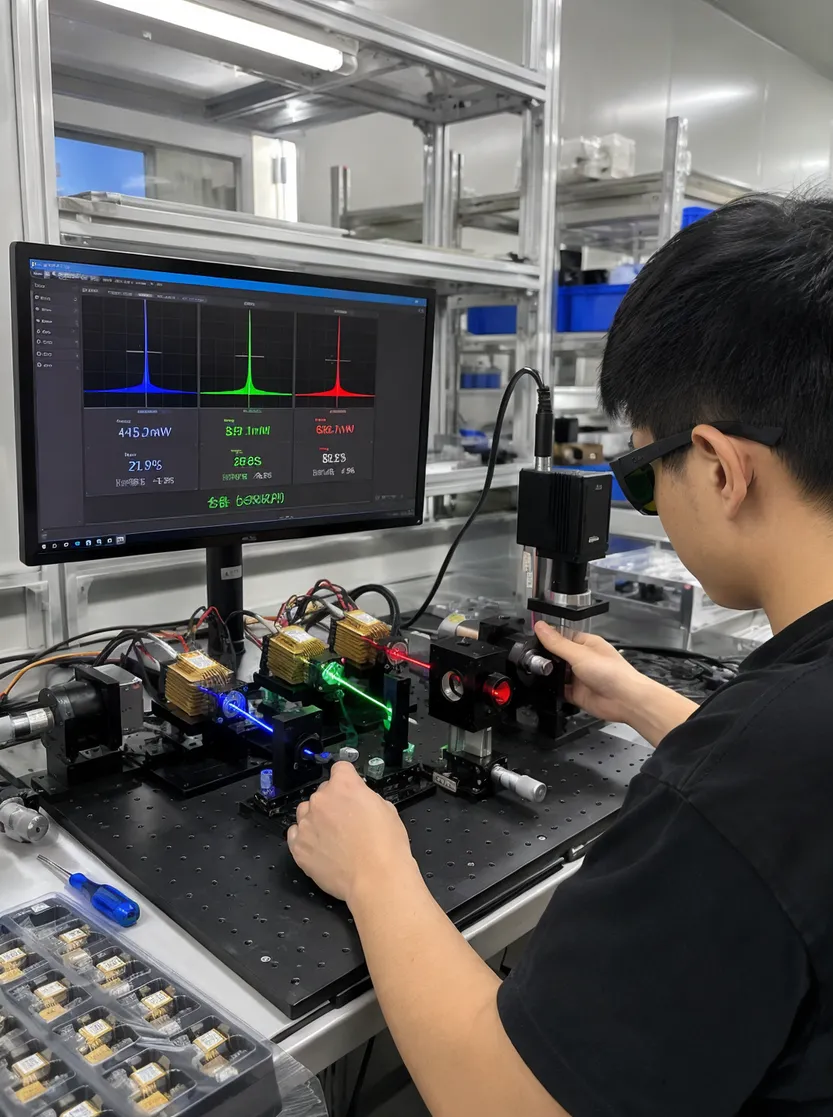
Diode triplet matching station — power ratios verified within ±3% before assembly
Result: Every unit in your order produces visually identical color output. No side-by-side variation when your buyers install multiple units in the same venue.
Market Segments Where RGB Laser Projectors Drive Revenue
Each application below represents a commercial channel you can sell into — with typical volume patterns and margin characteristics.
Nightclub and Venue Installation
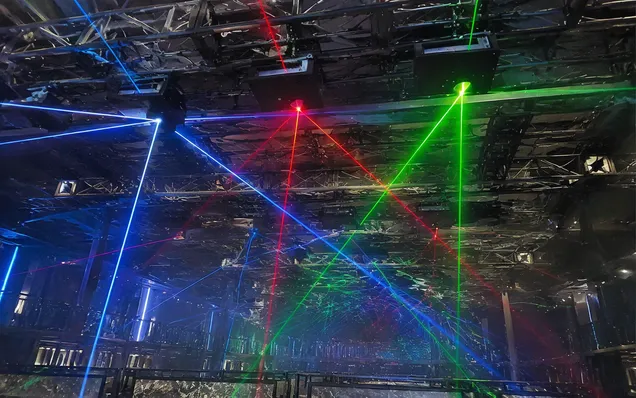
Fixed ceiling or truss-mounted installations, 5–30 units per venue. RGB projectors are the centerpiece of laser-based venue lighting because DMX integration lets the house lighting designer incorporate laser effects into programmed shows rather than running them standalone. Venue operators budget for these during build-out or renovation — your sales cycle aligns with construction timelines and club refurbishment schedules.
Event Rental Companies
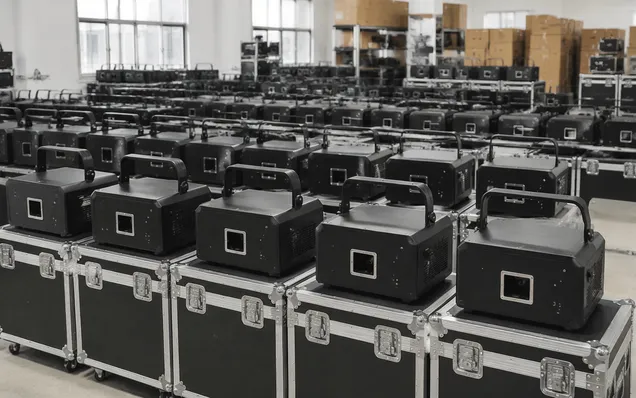
Fleet inventory purchases of 20–100+ units. Rental companies charge premium rates for full-color laser — a single RGB projector rents at 3-5× the rate of a single-color unit for a weekend event. Your distribution margin is solid on initial purchase, and the rental company's ROI drives fast reorder cycles when they scale fleet size. ILDA-compatible models win here because rental houses serve corporate clients who want custom logo projection.
Mobile DJ and Touring
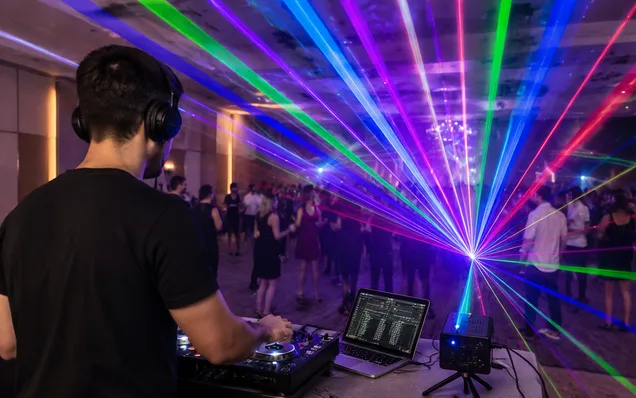
Working DJs upgrading from single-color to RGB for competitive differentiation in their local market. Purchase pattern: 2-4 units per DJ, typically through online retail or local distributors. These buyers value compact housing, fast setup, and DMX patch simplicity. The sound-active and auto modes serve DJs who don't run a dedicated lighting console — they want impressive effects without programming effort.
House of Worship and Auditoriums
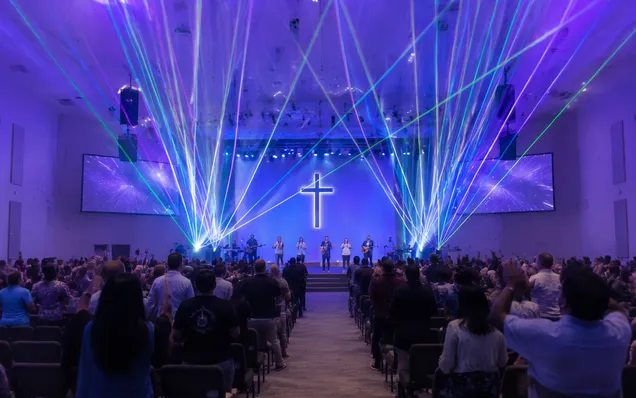
Growing segment. Churches and performance venues adding visual impact to services, conferences, and concerts. Moderate output models (200-300 mW) fit here — visible and impressive without triggering laser safety officer requirements in most jurisdictions. Volunteer-friendly auto and sound-active modes reduce training burden.
Architectural and Themed Entertainment
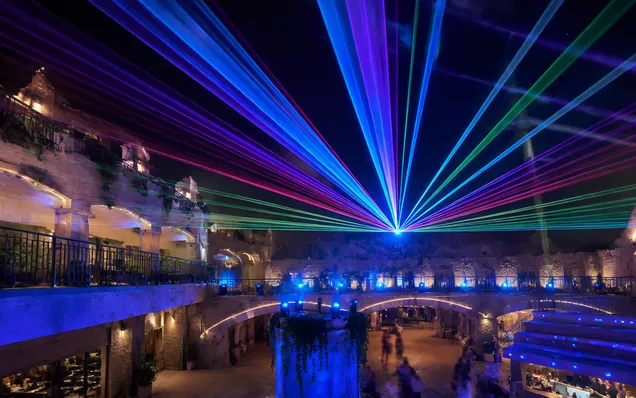
Permanent installations in hotels, themed restaurants, experience centers, and retail environments. This segment values ILDA controllability and IP54-rated variants for semi-outdoor use. Project-based orders of 10-50 units with specific color programming requirements. Higher per-unit value due to customization — and these buyers often need documentation for building permits and safety inspections.
Tell us which segments you're targeting and your typical order volumes — we'll recommend the specific RGB projector models and configurations that match your channel.
Get a Segment-Specific QuoteCustomization Options and Engineering Limits
OEM Level Customization
30-unit minimum- Your brand logo laser-etched on the housing
- Custom packaging with your brand identity, language, and regulatory labeling
- Firmware splash screen showing your brand on power-up
- Custom DMX channel mapping for compatibility with your buyers' existing lighting consoles
- Power cord and plug type configured for your destination market (US, EU, UK, AU)
- Custom pattern libraries programmed into auto-run and sound-active modes
Lead time: 25–30 days
ODM Level Customization
200-unit minimum after tooling- Modified housing geometry — reduced depth for flush ceiling mount, extended bracket for truss clamp integration, custom color anodizing
- Custom wavelength combinations — want 520nm green instead of 532nm for a slightly cooler tone? Different red wavelength for deeper saturated red? We can source alternative diode specifications
- Adjusted scan angle ranges and default scan speed for specific application profiles
- ILDA interface added to models that ship DMX-only in standard configuration
- IP54 sealing for semi-outdoor rated variants (adds gasket, conformal coating, and ventilation redesign)
Lead time: 35–50 days including sample approval cycle
What We Can't Do
- Output power above 500 mW per unit within our current thermal management design — above that threshold, the heatsink geometry requires a housing redesign (possible as ODM, but not a spec-change-level modification)
- Single-unit or sub-30-unit customization — changeover costs make it impractical for both parties below minimum quantities
Not sure whether your requirement falls into OEM or ODM territory? Send us the brief — our engineers will route it correctly and quote accordingly within 48 hours.
Why Your Units Hold Output Power for Years, Not Months
The parent category page covers our general approach to thermal management across all DJ laser lights. On the RGB projector specifically, the challenge is more complex: three independent diode modules generating heat in close proximity within the same enclosure, each with different thermal characteristics. The red diode is least sensitive. The green (DPSS at 532nm) is most temperature-sensitive — its output drops measurably above 40°C junction temperature and can suffer permanent degradation above 50°C.
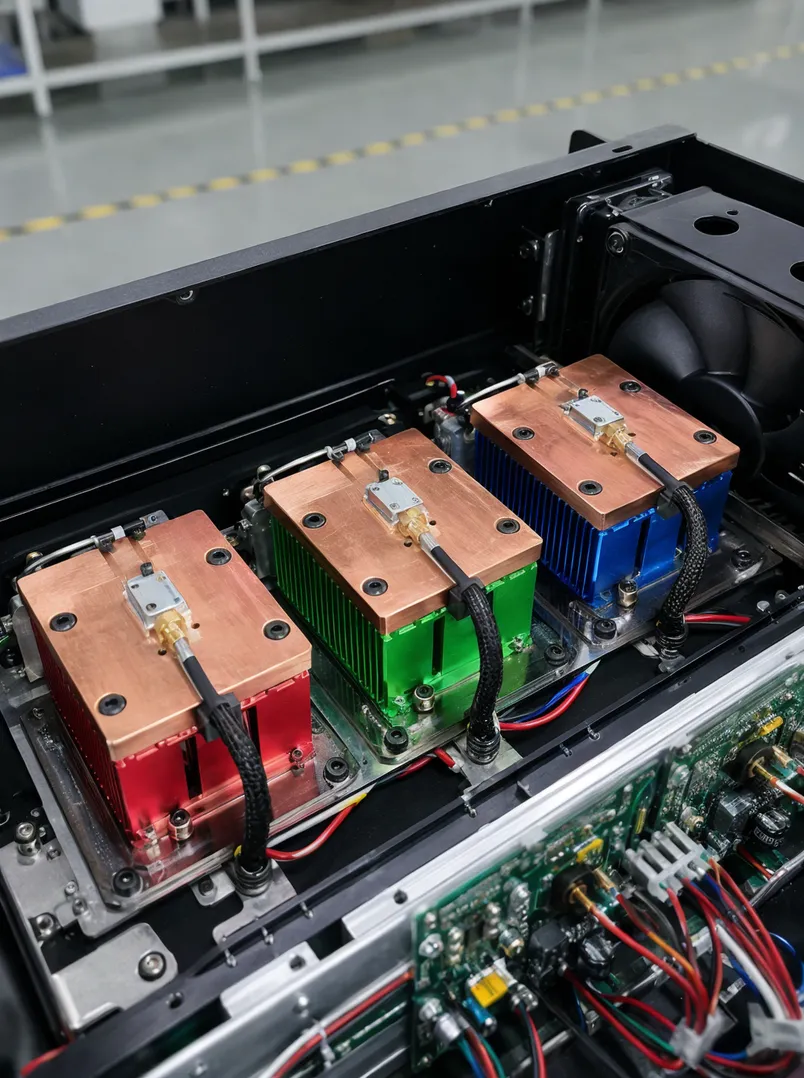
We solve this with separated thermal paths. Each diode module sits on its own copper heat spreader, thermally isolated from the adjacent modules, with individual heatsink fin stacks connected to the aluminum housing. The green diode's thermal path is oversized by 30% relative to its wattage — deliberate over-engineering because 532nm DPSS lasers have a steep degradation curve above their comfort zone. We'd rather spend $0.80 on extra heatsink mass than deal with green diode warranty returns that cost $15 each in replacement labor plus diode cost.
The practical result: junction temperature stays below 38°C on all three diodes at continuous full-power output in 30°C ambient. That 12°C margin below the green diode's rated maximum means the output power curve stays flat for 8,000–10,000 operating hours before measurable depreciation begins. Your rental and installation buyers get multi-year performance consistency — which means steady reorder cycles rather than warranty frustration.
<38°C
Junction temp at full power
12°C
Safety margin below max
30%
Oversized green thermal path
8–10K
Operating hours before depreciation
The Cost Logic
We'd rather spend $0.80 on extra heatsink mass than deal with green diode warranty returns that cost $15 each in replacement labor plus diode cost. Over-engineering the thermal path at production time eliminates the most expensive failure mode in RGB laser projectors — gradual green output degradation that triggers complaints 6–12 months after delivery.
Certifications and Regulatory Compliance for Your Import Markets
Every RGB laser projector DJ light ships with:
CE
Low Voltage Directive + EMC Directive — EU market entry
FCC Part 15
US electromagnetic compatibility
RoHS
Hazardous substance restriction for EU and global compliance
EN 60825-1
Laser safety classification labeling
North American Import — FDA/CDRH
FDA/CDRH requires laser product reporting under 21 CFR 1040. We handle manufacturer reporting and provide the documentation you need for customs clearance.
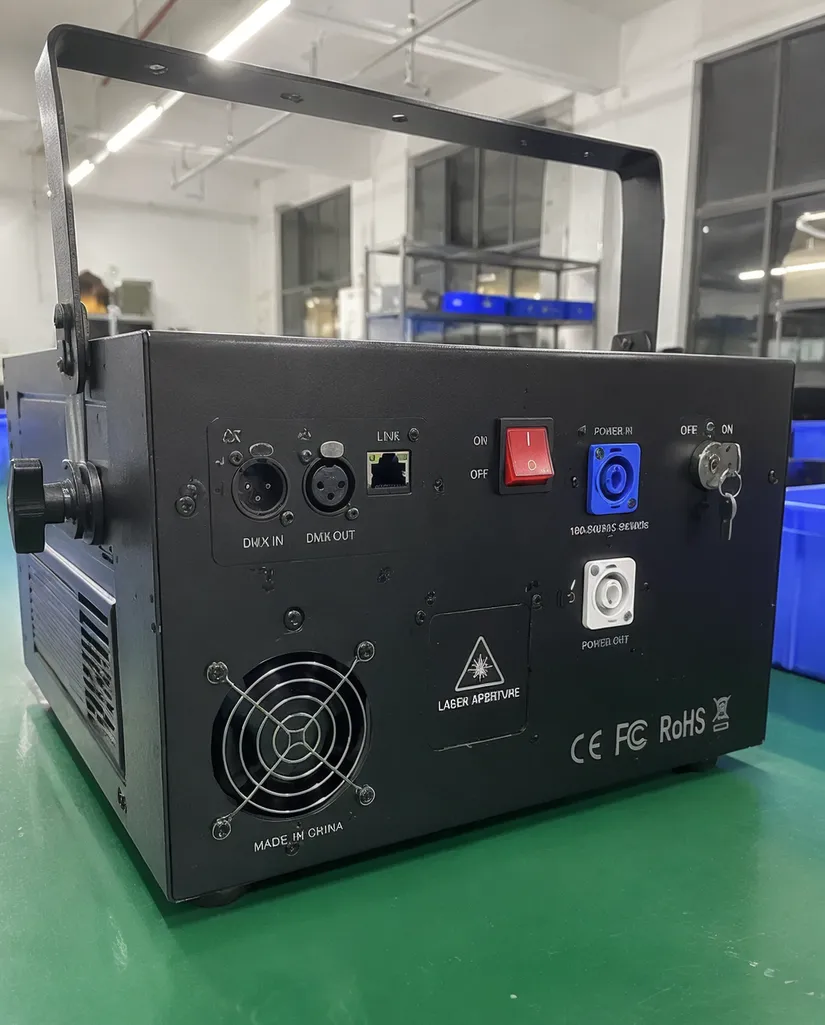
Units ship with appropriate laser hazard classification labels and safety interlock features (key switch, emission indicator, beam shutter) per CDRH requirements.
Downstream Compliance Support
If you sell into markets requiring specific national certifications beyond CE/FCC (Australia's RCM, UK's UKCA, Middle East's SASO), we provide test reports and technical files that your local certification body needs to issue the mark.
Pre-qualification shortens your time-to-market in regulated territories.
Certification Support
- Manufacturer reporting handled
- Customs clearance documentation
- Technical files for local certification
- Safety interlock features included
Packaging and Container Loading
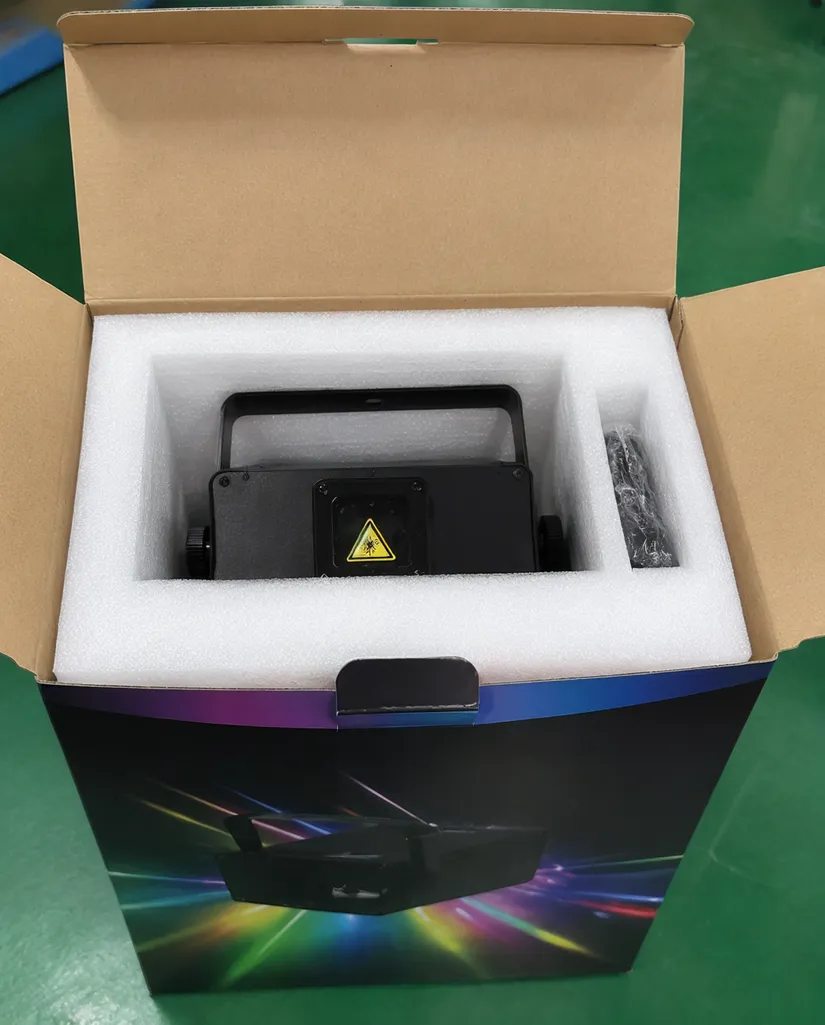
RGB laser projectors ship in individual molded EPE foam inserts inside printed color boxes. The foam is dual-density — firm inner layer locks the fixture position, soft outer layer absorbs transit shock.
Galvo mirrors get mechanically locked during packaging with our transit locking mechanism to prevent scan-head displacement during ocean freight.
Container Loading Estimates — RGB Laser Projector Models
| Container | Approximate Units |
|---|---|
| 20GP | ~800 |
| 40HQ | ~1,800 |
Master cartons hold 8–12 units depending on model, with reinforced corners and anti-compression stacking. Carton markings, SKU barcodes, and packing list format follow your warehouse template — provide your requirements and we match them.
E-Commerce Sellers
Retail-Ready Packaging
User manual, power cord, mounting bracket, and safety key included
Blind Drop-Shipping
No factory identification visible to your end customer
FBA-Ready
Labeling and case pack configuration available on request
Frequently Asked Questions RGB Laser Projector DJ Lights
What's the practical difference between 200 mW and 500 mW RGB laser projectors for a buyer's stock?
The 200 mW units cover small to mid-size venues (under 200 m²) — bars, KTV rooms, mobile DJ setups. The 500 mW units serve large clubs, event halls, and outdoor applications where beam visibility needs to cut through 15+ meters of ambient light and haze. Most distributors stock both: the 200 mW for volume sales at accessible price points, the 500 mW for premium rental and installation accounts where higher margins justify the per-unit cost. If you're entering the category, start with 200 mW — it covers 70% of DJ laser projector demand.
Can RGB laser projectors project custom logos and text, or only geometric patterns?
With ILDA interface and compatible software (Pangolin Beyond, Phoenix), yes — custom graphics, logos, text, and animations. DMX-only models are limited to pre-programmed geometric and abstract patterns stored in firmware. For your rental buyers serving corporate events where logo projection is standard, ILDA-compatible models are worth the price premium. We can also program custom pattern sets into the firmware at OEM level for buyers who need specific effects without ILDA hardware.
How do I choose between your RGB Laser Projector and the Professional DJ Laser for my product line?
Different positioning. The RGB projector sells on color variety and visual richness — full-spectrum patterns, color chases, artistic effects. The Professional DJ Laser sells on raw beam power and visibility — cutting through venue atmospherics with maximum impact per milliwatt. Stock both if your buyers span installation (RGB) and mobile DJ/rental (Professional). If you must choose one, the RGB projector has broader market appeal because the color capability serves both artistic and high-impact use cases.
What IP rating is available for outdoor or semi-outdoor RGB laser installations?
Standard configuration is IP20 (indoor). We produce an IP54-rated variant with gasket sealing, conformal-coated PCBs, and redesigned ventilation for semi-outdoor applications — covered patios, festival stages with roofing, themed entertainment environments exposed to humidity. Fully outdoor (rain-exposed) laser installations require IP65 enclosures — possible as ODM custom but not in standard range. The IP54 variant starts at 200-unit MOQ.
What causes RGB laser projectors to show uneven color between units?
Three root causes: inconsistent diode power ratios between wavelengths, uncalibrated modulation drivers, and thermal drift differences between units.
We eliminate this through binned diode matching (±3% power ratio per triplet set), individual unit color calibration at five reference points, and thermal management that keeps all three diodes at consistent operating temperatures. The result is unit-to-unit color consistency that allows side-by-side installation without visible variation.
Your Next Step
If you're evaluating RGB laser projectors for distribution, rental fleet, or installation projects — send us your target market, volume expectations, and any customization needs. We'll respond within 24 hours with model recommendations, unit pricing at your quantity level, and lead time to your port.
Most new buyers start with a 2–4 unit sample order to verify beam quality, color consistency, and build quality firsthand before committing to volume. Samples ship within 5–7 days.
Explore More DJ Laser Lights