

Disco Ball Lights Motor-Driven Mirror Ball Fixtures
The fixture type that anchors your retail DJ lighting catalog and supplies rental fleets with the one effect every venue expects. Produced on our dedicated motor assembly cells in Meizhou.
Ceiling-mount, portable, and custom configurations — built on the motor platform we've been iterating since 2012.
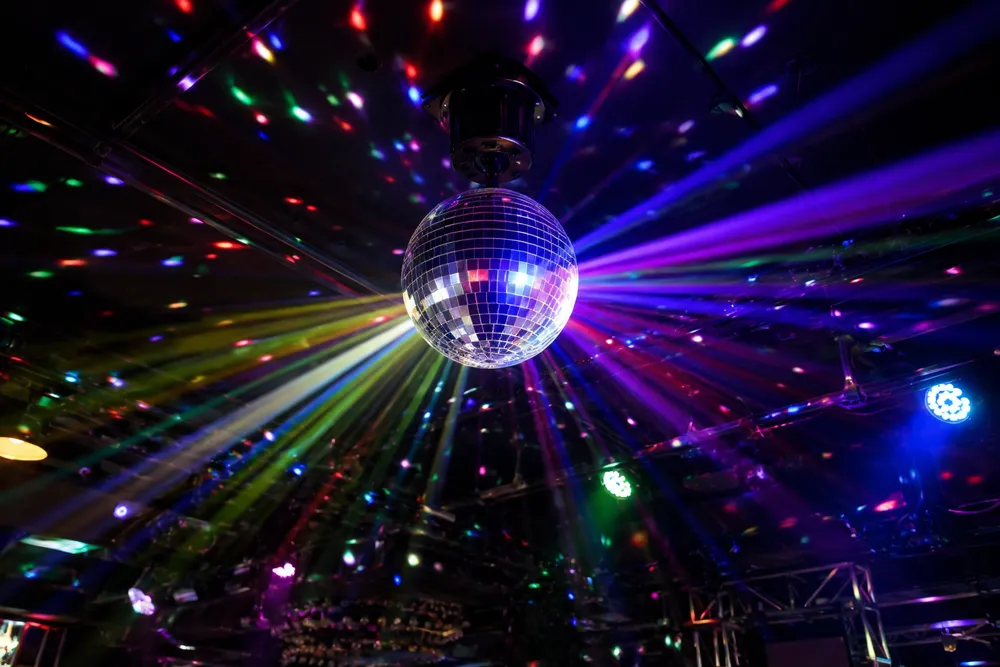
What Disco Ball Lights Are — And What Sets Ours Apart
Disco ball lights are motor-driven rotating fixtures that project multi-color light beams off a faceted mirror sphere, scattering moving dots of light across a room. They're the most recognizable fixture in the DJ and party lighting category — every rental inventory includes them, every retail buyer expects them in a supplier's lineup, and every KTV room in Southeast Asia has at least one mounted on the ceiling.
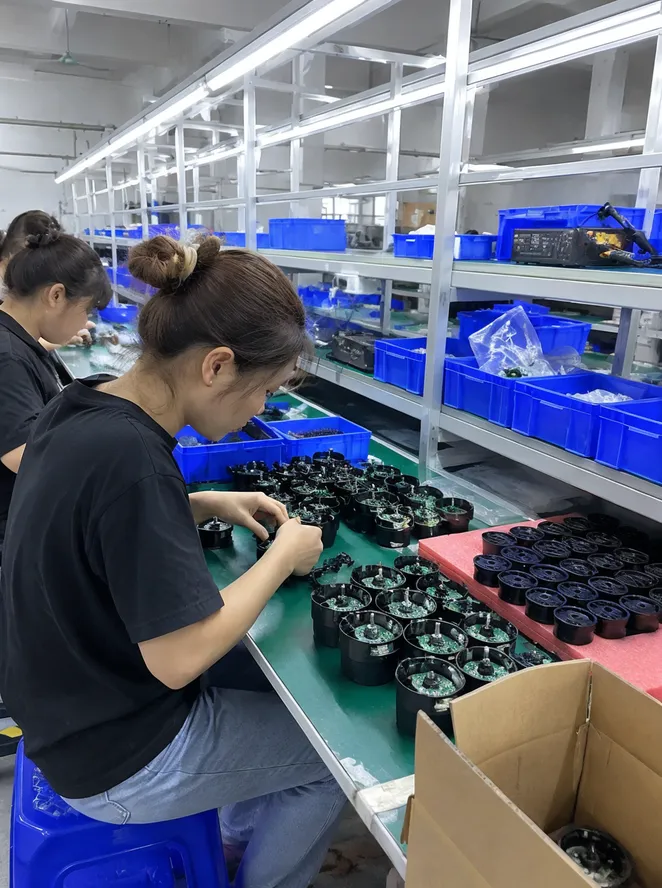
What differentiates our disco ball lights from the category norm: we come from a motor and electromechanical background. GDMonkey started in 2012 building rotation mechanisms and compact motor-driven lighting effects. The mirror ball fixture was our first product — not something we added to a catalog later. That heritage shows up in the motor selection, the bearing quality, and the rotational consistency you get across a 5,000-unit batch.
Where competitors source generic DC motors from the lowest bidder and assemble around whatever arrives that week, we spec and qualify our motors in-house with a 72-hour run-in before assembly. We've been iterating on this motor platform for over a decade — the failure data from our first three years of production informed every design revision since.
What This Means for Your Business
Lower warranty exposure. The motor is the single most common failure point in any rotating disco light. Our field return rate on motor failure sits below 0.3% across the last 24 months of shipments. Your customer support queue stays quiet.
Technical Specifications — Disco Ball Lights Range
Your procurement comparison sheet needs exact parameters. Here's what we produce across the disco ball lights product family:
| Parameter | Standard Models | Pro Series |
|---|---|---|
| Mirror Ball Diameter | 10 cm / 15 cm / 20 cm | 25 cm / 30 cm |
| LED Source | 3W RGBW (4-in-1) × 3 LEDs | 5W RGBW × 6 LEDs |
| Beam Coverage | 120°–150° scattered projection | 180°+ full-room coverage |
| Motor Type | Rated-life DC motor, 3–6 RPM | Stepper motor, 1–12 RPM adjustable |
| Motor Rated Life | 8,000+ hours continuous | 15,000+ hours continuous |
| Control Modes | Sound-active, auto-run, remote | Sound-active, auto, DMX-512 (4ch) |
| Power Input | AC100–240V 50/60Hz | AC100–240V 50/60Hz |
| Housing Material | ABS engineering plastic | ABS + aluminum base plate |
| Mounting | Ceiling bracket, flat-surface stand | Ceiling bracket, truss clamp, T-bar |
| Weight | 0.4–0.9 kg | 1.2–2.1 kg |
| IP Rating | IP20 (indoor) | IP20 standard, IP44 on request |
| Operating Temp | 0°C to +40°C | -10°C to +45°C |
Specifications shown are standard production values. Custom configurations (LED wattage, mirror diameter, motor speed range) available on OEM orders — contact us with your target spec.
Pro Series — Installed Systems Channel
The Pro Series adds DMX control, which opens the installed-systems channel for you — club contractors and integrators spec DMX-addressable fixtures because they need programming control from a central console. Stepper motor with adjustable 1–12 RPM gives installers the precision they require.
Standard Models — Retail & Mobile DJ
Standard models target retail and mobile DJ channels where plug-and-play simplicity drives purchasing decisions. Sound-active and auto-run modes mean zero configuration for the end user — unbox, plug in, perform.
The Motor Problem — And How We Solved It at the Production Level
Every experienced buyer who has sourced rotating disco fixtures has dealt with motor failures. It's the number-one warranty headache in this product type, and it's the reason buyers switch suppliers. We've spent 12 years engineering this problem down to near-zero.
The issue with most disco ball lights on the market: manufacturers treat the motor as a commodity component. They source the cheapest DC motor available, mount it with two screws, and let the fixture ship. That motor was designed for intermittent use — a toy car, a small fan — not for 8–12 hours of continuous rotation under thermal load inside a sealed housing. Six months later, the brushes wear, the winding overheats, and your customer's fixture goes dark mid-event.
We approach this differently.
Standard-Tier DC Motors
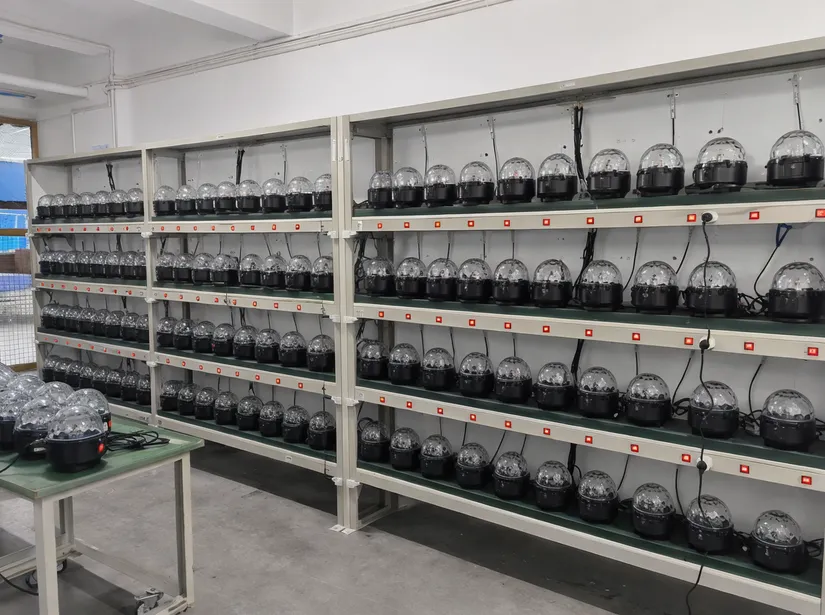
Our standard-tier disco ball lights use DC motors specifically rated for continuous rotation duty — selected from our approved motor supplier list (we dual-source to avoid supply disruption) and incoming-inspected for winding resistance consistency and free-run current draw.
Every motor gets a 72-hour run-in at 120% rated voltage on our motor test bench before it enters the assembly line. The run-in screens out infant mortality: weak windings, eccentric shafts, bearing defects. What survives that test runs reliably in the field.
Pro Series — Stepper Motors
Our Pro Series uses stepper motors — fundamentally different technology. No brushes to wear, no commutator arcing, and precise speed control via microstepping. The stepper platform costs more per unit, but for your rental fleet customers who run fixtures 200+ nights per year, the total cost of ownership drops because replacements approach zero.
We made the switch to stepper on our pro tier in 2018 after analyzing three years of field return data. The price increase was 22% per unit; the warranty claim reduction was 85%.
Bearing Assembly — As Critical as the Motor
We use sealed ball bearings with pre-applied synthetic grease rated for 20,000 hours at operating temperature. The bearing mount is machined to tolerance rather than press-fit into a plastic housing — this eliminates the wobble and noise that develop over time on budget fixtures when the plastic deforms from motor heat.
Your commercial outcome: disco ball lights that survive rental abuse, continuous venue use, and container transit vibration. Your reorder cycle is driven by your customers' growth, not by replacement demand from failures.
Revenue Channels for Disco Ball Lights — Where Your Margin Lives
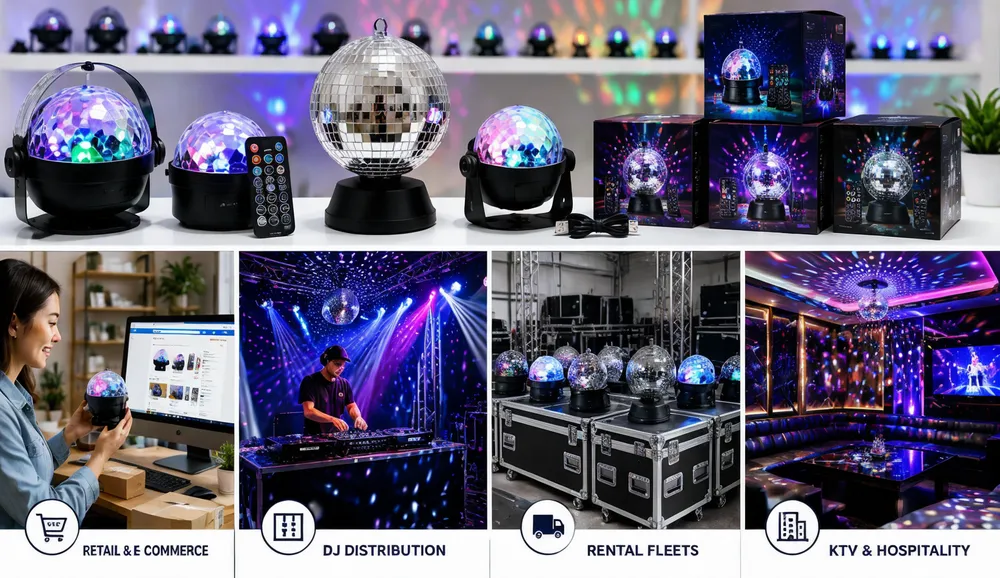
Disco ball lights serve specific market segments with different order patterns, price sensitivities, and reorder frequencies. Understanding which channel you're supplying determines which models and configurations make commercial sense.
Retail & E-Commerce
Volume DriverThis is where disco ball lights move the most units. Amazon sellers, regional e-commerce platforms, and party supply retailers stock compact mirror ball fixtures at the $12–$25 retail price point. The buyer profile: impulse purchase for a birthday party, dorm room, holiday gathering. Sound-activated, no setup required, impressive visual effect relative to the price.
For your margin: the unit cost from us on catalog models allows 3–4× retail markup at typical e-commerce pricing. We produce retail-ready packaging — color box with product photography, multilingual safety markings, UPC barcode applied per your specifications. Carton dimensions optimized for Amazon FBA standard-size tier, so you're not paying oversized fulfillment fees.
500–3,000 units per SKU, monthly or bi-monthly reorders following seasonal demand spikes (Halloween, Christmas, New Year, wedding season).
DJ Equipment Distributors
Steady ReorderDistributors supplying mobile DJs and small event companies stock disco ball lights as a staple catalog item. Mobile DJs buy in sets of 2–4 for their portable rigs. The fixture type is expected — it's part of the standard DJ light show package alongside a laser and a wash light.
For your margin: sell as individual units or pre-configured bundles. Our Pro Series with DMX control positions in the $40–$80 wholesale tier and commands higher distributor markup because the feature set (DMX addressing, variable speed, truss mounting) justifies the premium to professional buyers.
200–800 units per order, quarterly reorders matching your downstream dealer restocking cycles.
Rental & Event Companies
Replacement + FleetRental houses maintain inventories of 20–100 identical disco ball fixtures for event deployment. They buy for fleet consistency — every unit needs to match in output, color, and beam pattern so a 10-fixture setup looks uniform. They replace annually as rental wear accumulates.
Your value proposition: our production consistency across batches means unit #1 and unit #500 produce identical output. The 48-hour aging test eliminates infant-mortality units from reaching rental service. Sealed bearings and motor run-in mean the fixture handles transport vibration without developing wobble mid-season.
50–200 units per order, annual replacement cycle.
KTV & Hospitality Installers
Project-BasedKTV chains across Southeast Asia and the Middle East specify disco ball lights per room. A 50-room KTV venue orders 50–100 units in a single project PO. They need ceiling-mount fixtures, uniform appearance, and reliability over 10,000+ hours of daily use because replacement means ceiling access and labor cost.
For your margin: project orders accept slightly higher unit prices in exchange for specified performance and consistent supply. Repeat business comes when the KTV chain expands to new locations.
50–500 units per project, irregular but high-value per order.
Tell us your target channel — we'll recommend the right configuration and quote accordingly.
Discuss Your ChannelCustomization on Disco Ball Lights What You Can Spec, What You Can't
Clear customization parameters lower your inquiry threshold. Here's exactly what we can modify on disco ball light production runs, and where the limitations sit.
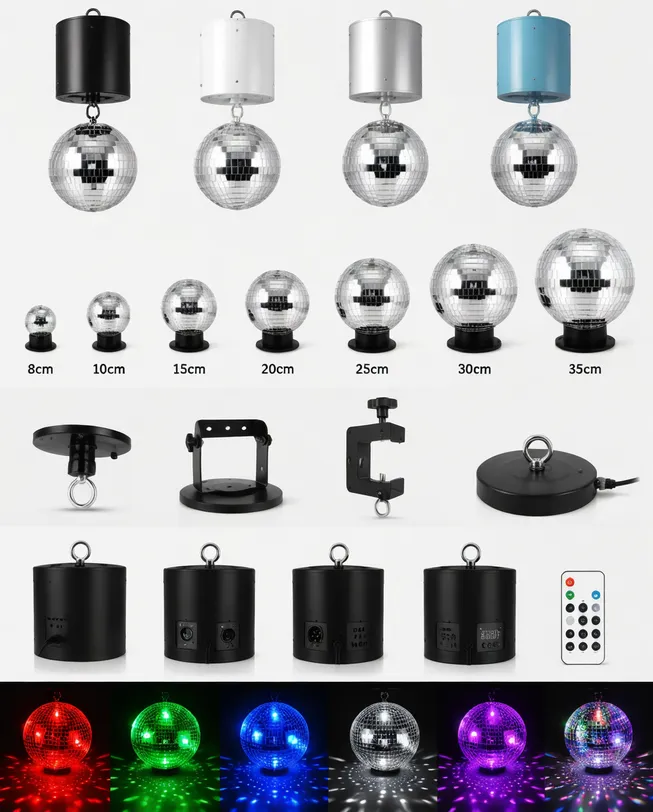
Fully Customizable (OEM Standard)
| Customization | Options | MOQ Impact |
|---|---|---|
| Mirror ball diameter | 8 cm – 35 cm (increments of 5 cm) | No MOQ change on standard sizes |
| LED color configuration | RGB, RGBW, RGBUV, single-color white/warm white | No MOQ change |
| Motor speed range | Fixed 3 RPM, fixed 6 RPM, or variable 1–12 RPM | Variable requires stepper motor — Pro tier pricing |
| Housing color | Black (standard), white, silver, custom RAL color | Custom RAL: 500-unit minimum |
| Mounting type | Ceiling bracket, flat stand, T-bar clamp, magnetic base | Magnetic base: 300-unit minimum (custom tooling) |
| Packaging | Your brand box, plain brown carton, retail blister | Brand packaging: 200-unit minimum first run |
| Logo application | Pad printing, laser engraving, adhesive label | 200-unit minimum |
| Control mode | Sound-only, sound + remote, sound + remote + DMX | DMX adds ~$2–3/unit to BOM |
| Voltage variant | 100–120V, 220–240V, universal 100–240V | No MOQ change |
| Certification | CE, FCC, UL (on request), CB scheme | UL testing adds 4–6 weeks to first order |
Limitations (Be Aware)
Oversized mirror balls (>35 cm)
Require new motor mounting tooling — adds 20–30 days to first order and $1,500–2,500 tooling fee.
Outdoor-rated (IP65)
Requires gasket mold modification — available but adds 8–12% to unit cost and 15-day tooling lead time.
Custom LED chip brands (Cree, Osram, etc.)
Possible but require 500-unit MOQ due to chip sourcing minimums.
Battery-powered variants
Limited to mirror balls under 15 cm diameter due to motor current draw vs. battery capacity.
We're straightforward about limitations because discovering them mid-order is worse for both sides. If your spec pushes against these boundaries, send it anyway — we'll engineer a solution or explain the trade-off clearly.
We'll confirm feasibility within 48 hours.
Manufacturing the Mirror Assembly Why Mirror Quality Varies Between Suppliers
The mirror ball itself — the faceted sphere that creates the light scatter pattern — is where you see the biggest quality variation between suppliers. And your end customers notice it immediately: uneven facets create dead spots in the light pattern, poorly adhered mirrors fall off within months, and inconsistent facet sizing produces irregular beam scatter that looks cheap.
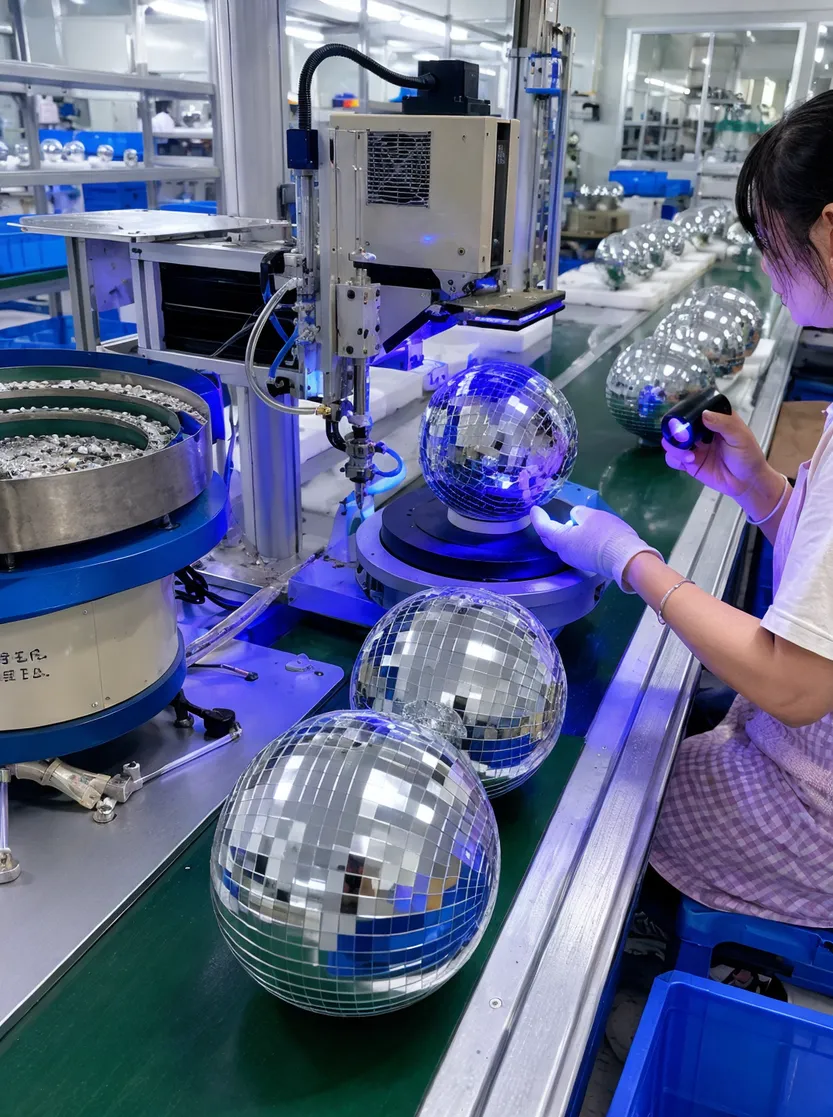
We produce our mirror balls using injection-molded ABS cores with vacuum-metallized acrylic mirror facets applied on a temperature-controlled adhesive line. The process specifics:
Core Molding
The ABS sphere is injection-molded in matched halves and ultrasonically welded along the equator. We check sphericity on every batch with a go/no-go gauge — out-of-round cores create visible rotation wobble when the ball spins. Tolerance on diameter: ±0.3mm.
Facet Production
Mirror facets are die-cut from acrylic sheet with vacuum-deposited aluminum coating. The coating thickness sits at 80–100nm for optimal reflectivity without brittleness. We cut facets in controlled sizes per ball diameter — a 20 cm ball uses 8mm × 8mm facets; a 30 cm ball uses 10mm × 10mm. Consistent facet size means consistent beam scatter angle.
Adhesive Application
We use a heat-activated adhesive film rather than liquid glue. Liquid glue creates thickness variation and squeeze-out between facets that looks sloppy up close. The film adhesive gives a uniform bond line and clean facet edges. We heat-cure at 65°C for 40 minutes — long enough for full crosslinking, short enough for production throughput.
Post-Assembly Inspection
Every mirror ball gets a spin test under UV inspection light. The UV light catches any adhesive contamination on facet surfaces and reveals unbonded facet edges that would fail in field. We reject at approximately 2–3% at this stage — those balls get reworked rather than shipped.
Why This Matters Commercially
Your downstream buyers judge disco ball light quality by the visual effect it produces in a dark room. Uneven facets, missing mirrors, and irregular scatter patterns look budget-grade regardless of the housing and motor quality. Our mirror assembly process keeps the visual quality consistent across 10,000-unit runs, so your product reviews don't mention "cheap looking mirror ball" six months after listing.
Disco DJ Light Show Integration Selling Systems, Not Singles
The phrase "disco DJ light show" captures how your professional buyers think about purchases. They don't buy a single disco ball — they build a light show package. Your margin expands when you sell disco ball lights as part of a system rather than as standalone units.
Common configurations that move well for our distributors:
Starter DJ Kit
3-pieceContents: 1× disco ball light + 1× LED wash effect + 1× mini laser
Target buyer: Mobile DJs entering the market.
Fulfillment advantage: Pre-packed as a single SKU with one master carton, one PO line item. Your warehouse handles one product, not three.
Venue Atmosphere Package
6-pieceContents: 2× disco ball lights (ceiling mount) + 2× LED par cans + 2× gobo effect lights
Target buyer: Small venue owners and event planners who want a complete ceiling rig.
Value proposition: Higher order value per customer, better freight efficiency per unit.
Rental Fleet Bundle
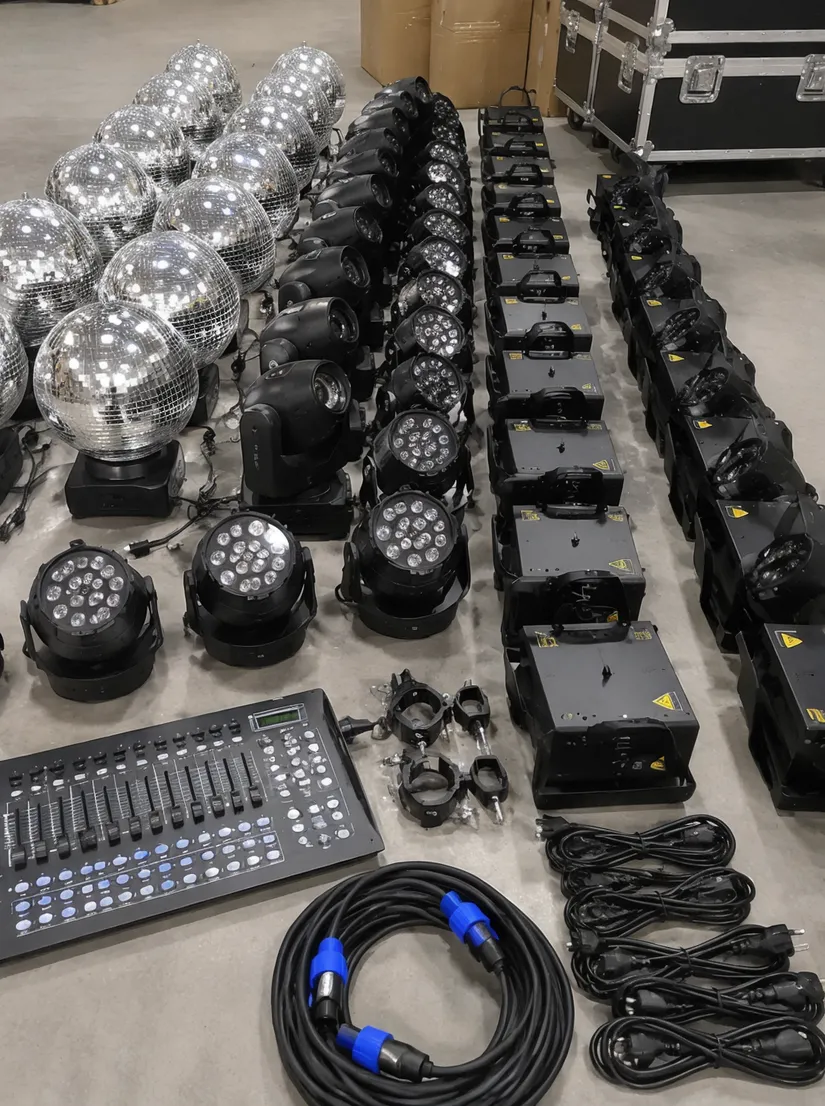
20-pieceContents: 8× disco ball lights + 6× LED effects + 4× lasers + 2× DMX controllers
Target buyer: Rental companies stocking a new category.
Production advantage: Entire bundle on a single PO. We test for inter-fixture compatibility (DMX addressing, power draw calculations) and ship as a coordinated set.
Custom Bundle Configuration
We can create any bundle configuration you specify and pack it as a single product. Since all fixtures come off our lines, we guarantee:
- Electrical compatibility — same power spec, same connector type within a bundle
- Visual consistency — color temperature matched across fixture types
- Unified documentation — covers the complete kit, not individual units
Packaging and Container Loading Your Freight Cost Per Unit
Disco ball lights are lightweight but geometrically challenging for container optimization — the spherical mirror assembly creates dead air space in rectangular cartons. We've iterated on packaging geometry across three design cycles to minimize your per-unit shipping cost.
Current Packaging Approach
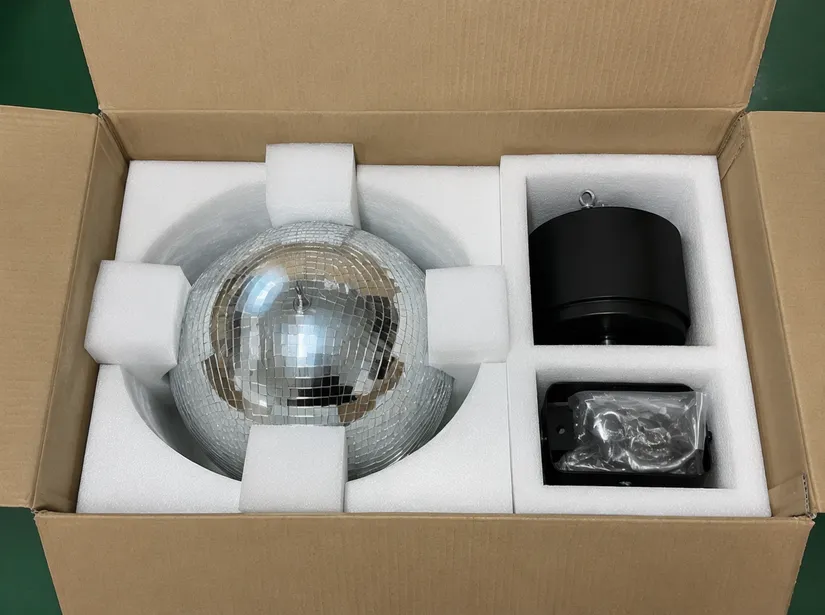
Individual units packed in molded EPE foam cradles inside corrugated cartons. The foam cradle grips the mirror ball at 6 contact points without touching the facet surface (fingerprint and adhesive contamination prevention). Inner carton nests the motor housing and mounting hardware in separate foam compartments.
No facet surface contact — prevents fingerprint and adhesive contamination
Motor housing and mounting hardware in separate foam compartments
Container Loading Capacity
| Model Type | Individual Carton | Master Carton (6-pack) | 20GP Loading | 40HQ Loading |
|---|---|---|---|---|
| Mini (10–15 cm ball) | 16×16×18 cm | 50×34×38 cm | ~2,800 units | ~6,100 units |
| Standard (20 cm ball) | 24×24×28 cm | 50×50×30 cm | ~1,200 units | ~2,600 units |
| Large (25–30 cm ball) | 32×32×35 cm | 66×66×37 cm | ~580 units | ~1,250 units |
| Pro DMX (20 cm ball) | 28×28×32 cm | 58×58×34 cm | ~900 units | ~1,950 units |
Actual loading depends on palletization requirements and whether you need slip-sheet or wooden pallet base. We provide exact loading plans with your proforma.
E-commerce Packaging Option
For FBA and direct-to-consumer sellers, we produce a retail-ready mailer carton that eliminates the need for re-boxing at your warehouse.
The product ships in the same box it displays on shelf — color printing, product window, hang-tab, and protective insert all integrated. This saves your fulfillment team one handling step per unit.
Damage Rate: Below 0.1%
On sea freight shipments since we moved to molded EPE in 2019. Prior to that, cut-foam inserts allowed mirror ball rotation during transit, causing facet-to-carton contact.
The molded cradle eliminated that failure mode — the 6-point contact system locks the sphere in place regardless of orientation during shipping.
Shipping Terms & Documentation
FOB Shenzhen/Guangzhou. CIF and DDP terms available. Export documentation (CE, FCC, commercial invoice, packing list) included with every shipment.
Compliance and Certification — Pre-Qualified for Your Import Market
Disco ball lights entering North America and Europe need proper documentation to clear customs without holds. Our standard models ship with the following compliance package:
CE Marking
EU Low Voltage Directive + EMC Directive
Full test reports from accredited lab. Applied to all models.
FCC Part 15
US electromagnetic compatibility
Verified compliant. Documentation included per shipment.
RoHS
EU Restriction of Hazardous Substances
Material declarations from component suppliers, compiled compliance certificate per batch.
IP20 Rating
Standard indoor models — IEC 60529
Verified per IEC 60529. IP44 available on custom weather-resistant models.
Market-Specific Certification Status
| Market | Common Requirement | Our Status |
|---|---|---|
| United States | FCC Part 15, UL (optional) | FCC standard; UL available on request (6–8 week testing lead time) |
| European Union | CE (LVD + EMC), RoHS, WEEE registration | CE + RoHS standard on all models |
| UK | UKCA marking | Available on request; testing through same accredited lab as CE |
| Australia | RCM (SAA) | Available on request; electrical safety testing required per model |
| Middle East | SASO (Saudi), ESMA (UAE) | Available on request; we have experience with Gulf certification processes |
Documentation Ships With Your Order — Not Three Weeks Later
Your compliance risk goes to near-zero on standard markets because we handle the testing and documentation as part of our production process — not as an afterthought bolted on when the buyer asks. The test reports travel with your shipment, not in a follow-up email three weeks later.
Entering a market with specific certification requirements not listed here? Send us the standard reference and we'll confirm testing timeline and cost. We've handled 40+ export markets — it's rarely a new situation for us.
View our full certifications and factory credentials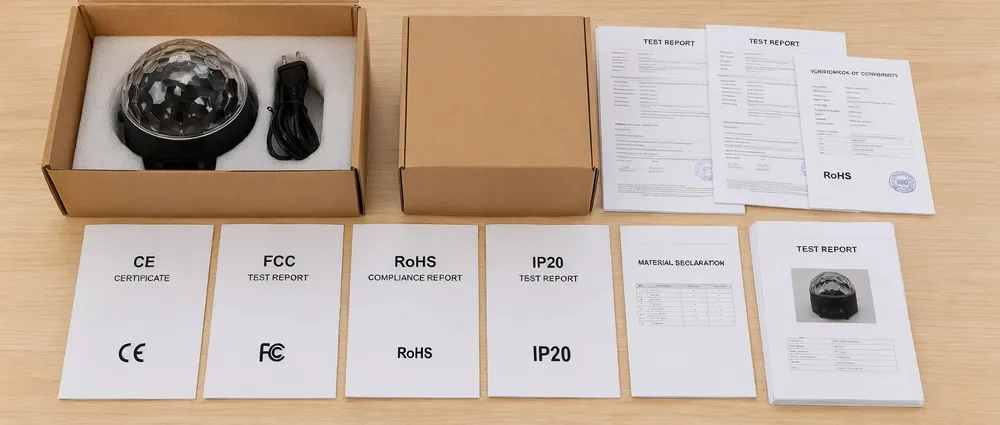
Frequently Asked Questions — Disco Ball Lights Sourcing
How long do the motors in disco ball lights actually last under continuous use?
Our standard DC motors are rated for 8,000+ hours of continuous rotation. At 6 hours per day of use (typical for a venue or rental deployment), that's over 3.5 years before end-of-rated-life. Our Pro Series stepper motors are rated at 15,000+ hours — roughly 7 years at the same duty cycle.
We validate these ratings through accelerated life testing on our motor test bench, running sample units at elevated temperature and voltage until failure, then extrapolating to normal operating conditions. Real-world field data from our warranty tracking confirms the 8,000-hour figure: our 12-month warranty claim rate on motor failure is below 0.3%.
What's the difference between a cheap $5 disco ball light and a properly manufactured one?
Three things: motor quality, mirror adhesion, and thermal management. The $5 unit uses an unscreened motor with 1,000–2,000 hour life, liquid-glued mirror facets that start dropping after 6 months of heat cycling, and no thermal consideration for the LED array.
At the $5 price point, there's no margin for QC screening, motor run-in testing, or adhesive quality. Our standard models invest that margin into component screening and process control — the 72-hour motor run-in alone adds production time that budget manufacturers skip.
For your business: a 5% cost increase per unit eliminates the warranty returns, negative reviews, and customer support tickets that erode your actual margin far more than the cost difference.
Can I get disco ball lights with both sound-activation and DMX control in the same unit?
Yes — our Pro Series includes dual-mode operation. The fixture responds to its internal microphone in standalone mode, and switches to DMX-slave mode when it detects a DMX signal on the input connector. Your customers get plug-and-play convenience for casual use and full programming control when they connect to a lighting console.
This dual-mode capability is standard on Pro Series, not available on Standard tier (the Standard tier firmware doesn't include the DMX decoder to keep BOM cost down for retail price targets).
What mirror ball size should I stock for maximum market coverage?
The 20 cm diameter is the market sweet spot — large enough to produce impressive beam scatter in a medium room, small enough to keep the unit compact and lightweight for shipping. Our sales data across distributor partners shows 20 cm outselling 15 cm by 3:1 and 25 cm by 5:1.
If you're starting with a single SKU to test the market, stock the 20 cm. If you want a two-SKU approach, add the 15 cm for the budget/compact market segment. The 25–30 cm sizes sell in lower volume but at higher per-unit margins — suitable if your channel serves venues and rental companies rather than retail.
How do your disco ball lights handle voltage differences across export markets?
All our models use universal-input switching power supplies rated for AC100–240V, 50/60Hz. A single SKU covers North America (120V/60Hz), Europe (230V/50Hz), and Asia-Pacific (220V/50Hz) without any hardware change.
Plug type is the only regional variable — we supply appropriate plug or IEC C8 inlet (for use with local cord sets) depending on your market configuration. One SKU for your global inventory means simpler warehousing and no risk of shipping wrong-voltage stock to the wrong region.
If This Isn't the Right Fixture — Related Products Under Disco DJ Lights
Disco ball lights fit specific market segments, but your catalog might need adjacent fixture types to cover the full buyer spectrum.
Gobo Disco DJ Lights
Need pattern projection instead of scattered dots? Project shapes, logos, and abstract patterns — commands higher rental fees per event and differentiates your offering from the disco ball commodity tier.
View Gobo LightsLED Disco DJ Lights
Need broader LED color effects without the mirror ball format? Multi-color wash and strobe effects in compact housings — your highest-volume retail SKU potential.
View LED LightsDisco Laser Lights
Need precise beam effects and aerial patterns? Sharp laser beam shows — higher margin per unit, laser compliance documentation included.
View Laser LightsDance Floor DJ Lights
Building complete DJ light show packages? Downward projection effects that complement ceiling-mounted disco balls for full-room coverage.
View Dance Floor LightsClub DJ Lights
Supplying permanent nightclub installations? Engineered for 8–12 hour nightly continuous use — different durability tier than rental-grade disco ball fixtures.
View Club LightsMost of our distributor partners carry 3–5 fixture types from this category. We ship mixed POs (minimum 30 units per SKU) as standard — no need to split into separate orders per product line.
Browse the full Disco DJ Lights categoryGet a Quote for Disco Ball Lights — Next Steps
Send your requirements and we'll come back with pricing, lead time, and a production recommendation within 48 hours.
What's helpful to include:
-
Target model(s) and quantity per SKU
-
Your destination market (helps us configure voltage, plug type, and certifications)
-
Any customization needs (logo, packaging, color, mounting type)
-
Target landed cost if you have one — we'll engineer to your price point
Start With a Sample Order
Most new buyers start with a sample order: 2–5 units of each model you're evaluating, shipped within 5–7 days from our warehouse.
You test, your team evaluates, and we proceed to production only after you've confirmed the fixture meets your standards.