

LED DJ Pixel Bar Individually Addressable
Per-segment RGB control, built for rental fleets, nightclub installs, and mobile DJ distributors.
Each pixel section runs independently via DMX or Art-Net, so your customers get chase effects, color washes, and mapping capability from a single linear fixture — fewer SKUs for you to stock, more creative options for your end users.
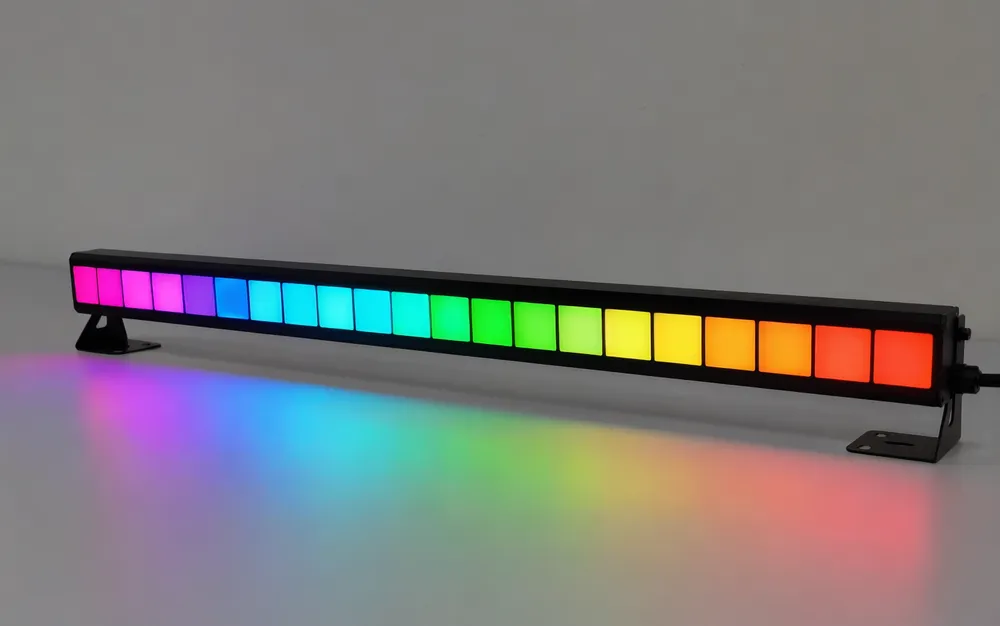
What This Fixture Is and Where It Sits in Your Product Line
The LED DJ pixel bar is a linear LED fixture with individually addressable pixel segments — typically 8 to 16 sections per bar — each capable of independent RGB or RGBW color output. Unlike a standard LED wash bar that produces one color across its full length, each pixel section responds to its own DMX channel. That gives your customers pixel-mapping capability, scrolling chases, and color gradient effects from a single fixture.
We build this as a workhorse, not a novelty. Die-cast aluminum housing with passive heatsink fins, IEC power-through daisy-chaining, and locking DMX connectors. The target is rental companies running 20–40 units per rig and nightclub installers spec'ing permanent ceiling arrays — applications where fixtures run 6–10 hours nightly and need to survive transport between gigs without failure.
For your business, the pixel bar fills the gap between basic PAR cans (limited visual interest) and full LED video panels (high cost per square meter). It gives your DJ and nightclub customers a visually impressive, mappable fixture at a price point that keeps your margins healthy on volume orders.
Per-Pixel DMX
8–16 independently addressable segments per bar. Each pixel responds to its own DMX channel for full mapping capability.
Built for Rental Abuse
Die-cast aluminum, passive heatsink fins, locking connectors. Designed for 6–10 hour nightly runs and frequent transport.
Margin-Friendly Position
Fills the gap between basic PARs and costly video panels — impressive visuals at a price that protects your volume margins.
Product Line Positioning
Technical Specifications — What You're Quoting to Your Customers
Specifications shown are standard values for this product type. Exact values vary by model configuration — contact us for the specific data sheet matching your requirements.
| Parameter | Typical Specification |
|---|---|
| LED Source | SMD5050 RGB or RGBW, individually addressable segments |
| Pixel Segments | 8 12 16 (model-dependent) |
| Total Power | 40W–120W (varies by segment count and LED density) |
| Beam Angle | 25° × 25° (standard) / 40° × 40° (wide-angle option) |
| Control Protocols | DMX512, Art-Net, sound-active, auto-run, master/slave |
| DMX Channels | 3ch / 4ch / 24ch / 48ch (selectable by mode) |
| Housing | Die-cast aluminum, black powder-coated |
| Dimensions (typical) | 1,000mm × 65mm × 90mm (1-meter model) |
| Weight | Approx. 3.2–4.5 kg depending on configuration |
| IP Rating | IP20 (indoor) / IP65 available for outdoor-rated models |
| Power Input | AC 100–240V, 50/60Hz (universal voltage) |
| Connectors | PowerCon in/out, 3-pin + 5-pin XLR DMX |
| Operating Temperature | -10°C to +40°C |
| LED Lifespan | 50,000 hours typical |
| Certifications | CE FCC RoHS |
1-Meter Bar — Volume Seller
Covers more stage area per fixture. Your customers buy fewer units to fill the same rig. The standard choice for most distributors.
0.5-Meter Bar — Compact Fit
Built for DJ booth setups and tight truss configurations where the full-length bar won't fit. Same pixel architecture, half the footprint.
Per-Pixel Addressability — The Margin Advantage Over Standard Wash Bars
This is the commercial reason the pixel bar exists in your catalog: it commands a higher retail price than single-zone wash bars while costing you roughly 30–40% more at FOB. The margin spread is better because your customers perceive — correctly — that pixel-level control is a different product category. A basic 1-meter LED wash bar is a commodity; an individually addressable pixel bar is a creative tool.
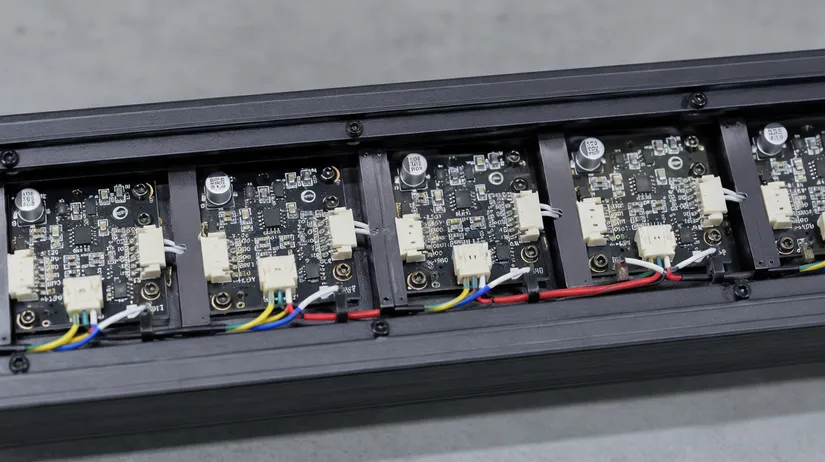
We mount each pixel section on its own PCB sub-board with independent current regulation. That means if one segment develops a fault (rare after aging, but it happens in the field), your customer can continue using the fixture — the remaining pixels still respond normally. From a warranty perspective, you're replacing a segment board, not scrapping a whole fixture. We keep replacement boards in stock for exactly this reason.
The addressing system supports both standard DMX512 and Art-Net over Ethernet. For your rental company customers running large rigs with 50+ fixtures, Art-Net eliminates the DMX universe limitations and simplifies cable runs. For your mobile DJ customers, standard 3-pin XLR keeps things familiar. Both audiences are served from the same hardware — you stock one SKU that sells into two segments.
Why This Matters for Your P&L
Higher Retail Price Point
Pixel-level control positions the fixture as a creative tool, not a commodity wash bar — different category, different pricing expectations.
Segment-Level Serviceability
Independent PCB sub-boards mean field faults don't scrap the whole unit. Replace one segment board under warranty, not the fixture.
One SKU, Two Markets
DMX512 via 3-pin XLR for mobile DJs. Art-Net over Ethernet for rental rigs with 50+ fixtures. Same hardware, same inventory line.
Market Segments Where This Fixture Sells
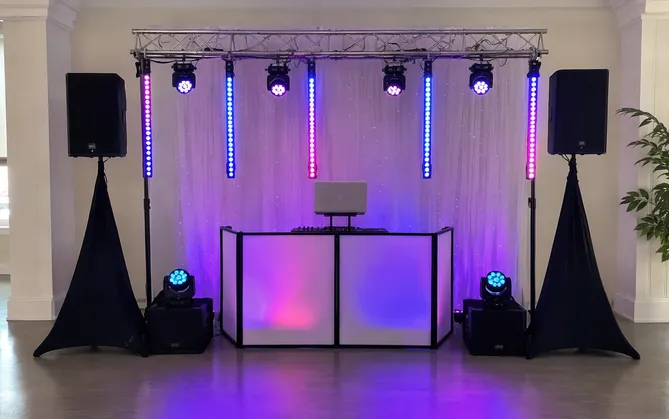
Mobile DJ & Entertainment Contractors
Mobile DJs buy pixel bars in sets of 4–8 for truss-mounted stage backdrops. They need compact, lightweight fixtures that set up fast and produce visual variety without complex programming. Our auto-run and sound-active modes cover that market — the DJ unpacks, powers on, and has an instant light show. But the DMX capability is there when they graduate to a controller.
For your distribution business, this means a single SKU that serves both entry-level and advanced DJ markets. Typical order pattern from our existing distributors: initial stock of 50–100 units, reorders of 30–50 units quarterly once the SKU establishes.
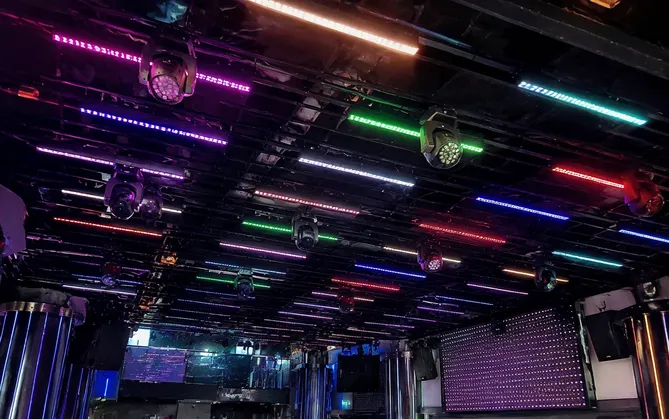
Nightclub & Bar Permanent Installations
Club installers mount pixel bars in arrays — 10–30 units across a ceiling grid or dance floor perimeter, all running off a central Art-Net controller. The fixture's slim profile and daisy-chain power make installation straightforward: one power drop per 6–8 fixtures in a chain, one DMX line per universe.
This is a high-value segment because installations are project-based: your customer (the integrator) buys 20–30 units per venue, and new venues open regularly. Contract pricing with a guaranteed supply timeline is what wins this business. We can hold production slots for your quarterly project schedules.
Event Production & Rental Houses
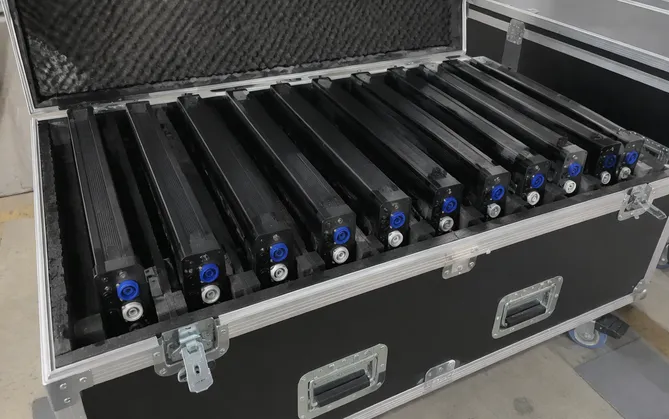
Rental companies treat pixel bars as expendable fleet inventory — they buy in bulk, rent them hundreds of times, and replace units that accumulate too much road damage. This creates recurring demand. Our aluminum housing and locking connectors are built for rental abuse: no plastic latches that snap off in transit, no flimsy XLR sockets that loosen after 50 connect cycles.
The locking PowerCon connectors aren't a premium add-on here — they're standard on every unit. We learned this from our rental company buyers in Europe. Their techs were losing power mid-show from gravity-pull on standard IEC cables hanging from truss. One locked connector eliminated the callback.
Individual Pixel Control via SMD5050 LED Selection and Color Consistency
We use SMD5050 LED packages because the die size provides adequate lumen output per pixel section without requiring excessive current drive — which means less thermal stress and longer actual lifespan in the field. Each LED chip is binned to a 3-step MacAdam ellipse tolerance before entering our SMT line, so color consistency across a 100-unit batch is tight enough that your customers can mix fixtures from different production runs without visible color mismatch.
The automated SMT placement runs at ±0.05mm accuracy. That precision matters for pixel bars specifically because LED position directly affects the pixel boundary visibility — a misaligned chip creates uneven brightness at segment edges, which shows up immediately when running chase effects. We check pixel-edge uniformity during optical QC with the array running a single-pixel chase pattern at full brightness. Any unit showing visible bleed or dead zones gets pulled and reworked.
For RGBW models, the additional white chip gives your customers a clean, high-CRI white output without the color-mixed "pastel" look that pure RGB white produces. Rental companies prefer RGBW because it doubles the fixture's utility — pixel effects for dance segments, clean white wash for speeches and presentations. One fixture, two jobs. That's inventory efficiency your buyer can feel.
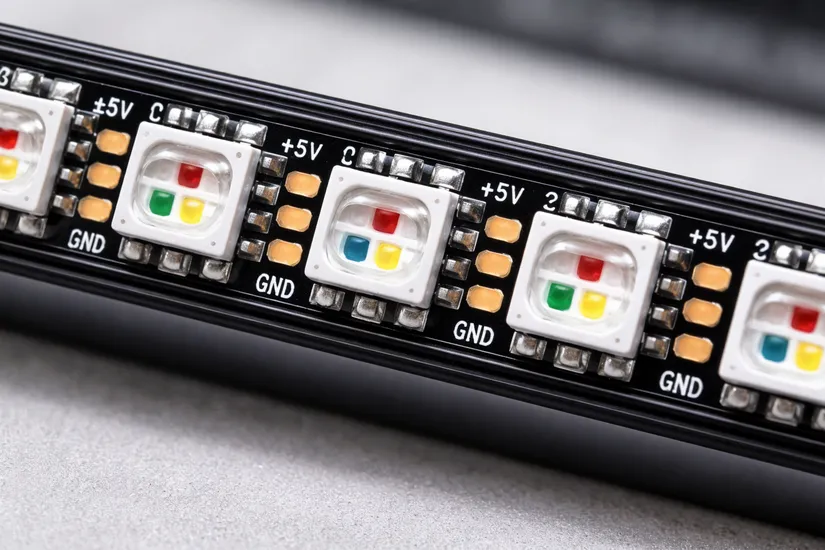
3-Step MacAdam Binning
Color consistency tight enough to mix fixtures across production runs without visible mismatch
±0.05mm SMT Placement
Eliminates pixel boundary bleed and uneven segment brightness during chase effects
RGBW Dual Utility
Pixel effects + clean high-CRI white wash from one fixture — inventory efficiency for rental fleets
Customization What We Can Build to Your Spec
| Customization Dimension | Available Options | Impact on MOQ / Lead Time |
|---|---|---|
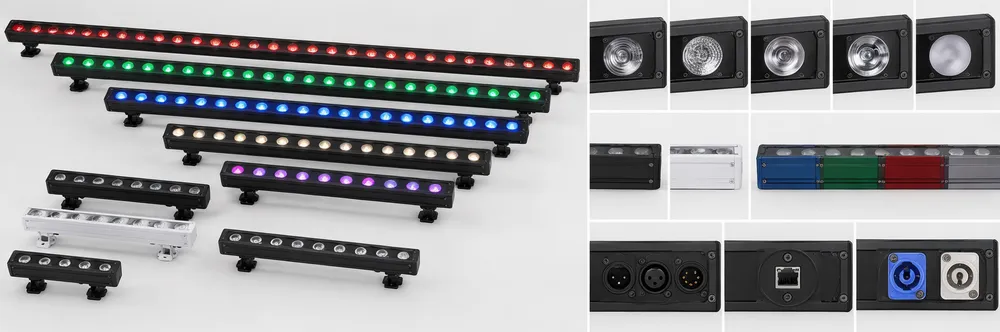
| Pixel count per bar | 4 / 8 / 12 / 16 / 24 segments | Standard configs ship faster; custom segment counts add 5–7 days |
| Bar length | 0.25m, 0.5m, 1.0m, custom lengths up to 1.5m | Custom lengths require modified housing extrusion (MOQ 100+) |
| LED color type | RGB, RGBW, RGBA, RGBWA+UV | All standard; no MOQ increase |
| Beam angle lens | 15° / 25° / 40° / 60° / frost diffuser | Lens swap only — available on any order size |
| Housing color | Black (standard), white, custom RAL | Custom RAL on orders 100+ units |
| Control protocol | DMX only, DMX + Art-Net, DMX + Wireless (2.4GHz) | Wireless adds a receiver module; MOQ 30+ |
| Connector type | 3-pin XLR / 5-pin XLR / RJ45 (Art-Net) / PowerCon | Standard options, no lead time impact |
| Branding | Your logo on housing, custom boot screen, custom packaging | OEM branding available from 30 units |
| IP rating | IP20 (indoor standard) / IP65 (outdoor rated) | IP65 version has sealed housing + cable glands |
Pixel Count Per Bar
4 / 8 / 12 / 16 / 24 segments
Standard configs ship faster; custom segment counts add 5–7 days
Bar Length
0.25m, 0.5m, 1.0m, custom lengths up to 1.5m
Custom lengths require modified housing extrusion (MOQ 100+)
LED Color Type
RGB, RGBW, RGBA, RGBWA+UV
All standard; no MOQ increase
Beam Angle Lens
15° / 25° / 40° / 60° / frost diffuser
Lens swap only — available on any order size
Housing Color
Black (standard), white, custom RAL
Custom RAL on orders 100+ units
Control Protocol
DMX only, DMX + Art-Net, DMX + Wireless (2.4GHz)
Wireless adds a receiver module; MOQ 30+
Connector Type
3-pin XLR / 5-pin XLR / RJ45 (Art-Net) / PowerCon
Standard options, no lead time impact
Branding
Your logo on housing, custom boot screen, custom packaging
OEM branding available from 30 units
IP Rating
IP20 (indoor standard) / IP65 (outdoor rated)
IP65 version has sealed housing + cable glands
Standard Configurations
We keep the common configurations — 8-segment and 16-segment, RGB and RGBW, 25° and 40° lens, black housing — in rolling production.
Full Custom Builds
Modified lengths, special pixel counts, wireless integration — these run longer because the engineering team validates the modified BOM before production starts.
Building a branded product line? We can customize the DMX menu display to show your brand name on power-up. Small detail, but it matters for your rental customers who see that screen at every gig.
We'll confirm feasibility and lead time within 48 hours
Thermal Management and Housing Construction Reliability That Protects Your Warranty Budget
Stage lighting fixtures fail for three reasons in the field: thermal degradation of LEDs, connector failure from vibration, and power supply faults. We address all three in the pixel bar's design.
Die-Cast Aluminum Heatsink
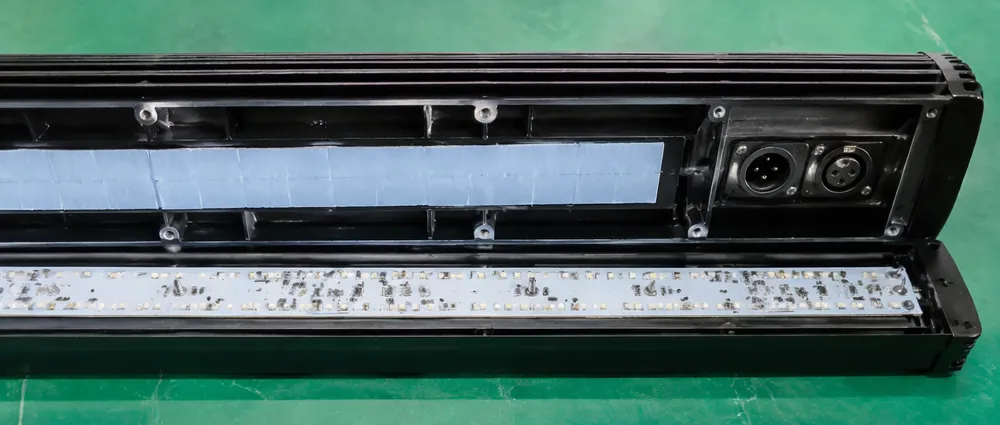
The housing isn't cosmetic — it's an active heatsink. LED PCB strips mount directly to the aluminum chassis with thermal interface material rated at 3.5 W/mK conductivity. No air gap between the LED board and the heatsink body.
Verified Result
Junction temperature on the 1-meter RGBW model stays below 75°C at full continuous output in a 35°C ambient environment — verified with thermocouple logging over a full 48-hour aging cycle.
Panel-Mount Locking Connectors
Neutrik-compatible locking XLR sockets sit in machined recesses so the connector shell can't lever against the housing during cable pulls — a common failure mode on cheaper fixtures where the socket eventually cracks the ABS rear panel.
Design Detail
Our rear panel is aluminum, not plastic. The recessed mount eliminates mechanical stress on the socket PCB joints.
Smart Thermal Derating Driver
The internal LED driver is a constant-current switching supply with built-in thermal derating. If the fixture reaches its thermal limit — such as a blocked-fan scenario in an enclosed truss box — the driver reduces current smoothly rather than shutting off abruptly.
Field Benefit
Your customer sees a slight dim instead of a blackout — the show continues, and the fixture protects itself.
Iteration That Doesn't Show on a Spec Sheet
The first prototype revision ran 12°C hotter because we used a thinner thermal pad. That correction — moving from a generic 1.5 W/mK pad to the 3.5 W/mK interface material — reduced junction temperatures by over 15% and directly impacts your year-two failure rate. It's the kind of engineering decision that separates fixtures with a 3% field return rate from fixtures with a 12% field return rate.
Quality Process From Component to Container
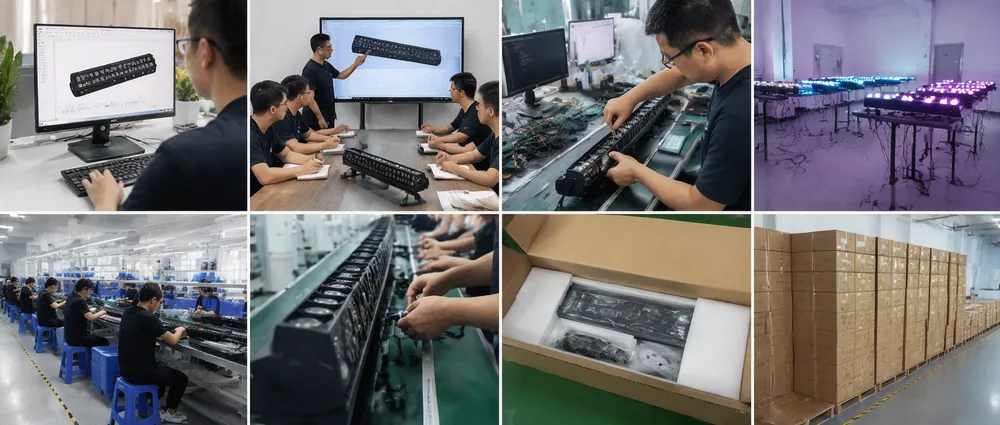
Every LED DJ pixel bar we produce goes through the same quality gates that apply to our full product range: IQC on incoming components, IPQC during assembly, and 100% OQC before packing. The pixel bar adds process-specific steps designed to catch the exact failure modes this fixture category is prone to.
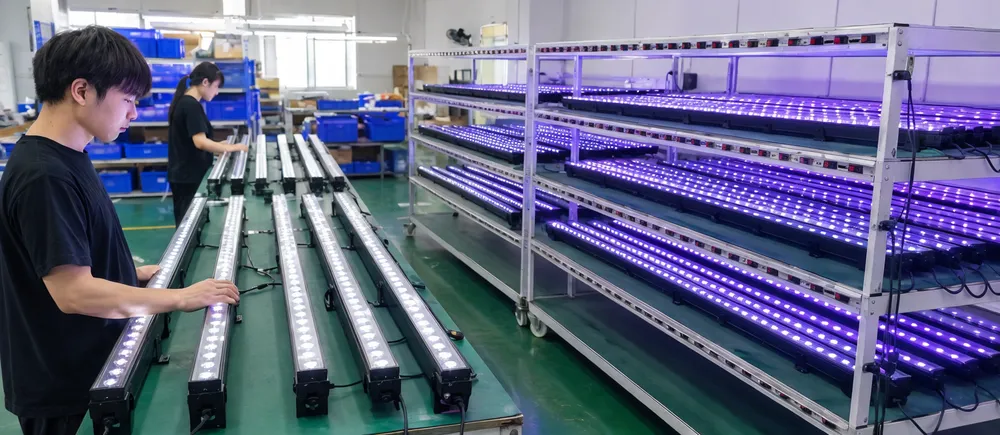
Standard Quality Gates
Incoming Quality Control
Component-level inspection on all incoming LED chips, drivers, connectors, and housings before they enter production.
In-Process Quality Control
Assembly-stage checks at each production station — solder quality, mechanical fitment, wiring continuity, and thermal pad placement.
Outgoing Quality Control
100% final inspection before packing — every unit verified, no sampling. Full electrical and functional test on each fixture.
Pixel Bar–Specific QC Steps
Visual Uniformity Inspection
Human Check — Not Automated
After final assembly, each fixture runs a full pixel-chase sequence at maximum brightness. An operator watches the chase at a 3-meter viewing distance and flags any visible inconsistency.
Flagged Defects
- Dead pixels
- Color deviation between segments
- Segment-edge bleed
- Flicker at any chase speed
This is a human check because the human eye catches pattern-break issues that machine vision sometimes misses at this fixture scale.
48-Hour Full-Load Burn-In
Maximum Thermal & Electrical Stress
The pixel bar runs all segments at 100% white output — the maximum thermal and electrical stress condition — for the full 48-hour duration. This aging cycle is designed to trigger infant-mortality failures before shipping.
Failure Protocol
Any fixture that develops a fault — flickering pixel, driver instability, color shift after thermal soak — gets pulled, diagnosed, and reworked before a second aging run. Your container arrives with units that have already survived their most likely failure window.
DMX Response Verification — Every Unit
After aging, we run DMX response verification on every unit. The last thing your customer needs is a batch where half the fixtures have inverted channel assignments or non-linear dimming.
Verified Parameters
- Correct channel mapping across all modes
- Smooth dimming curve from 0–100%
- Accurate color mixing at specified DMX values
Packaging & Container Loading
Individual Molded Foam Packaging
Each pixel bar ships in individual molded foam packaging inside a corrugated master carton. The foam eliminates transit damage claims and protects lens covers from carton stacking pressure during ocean freight.
Lesson learned: We tried lighter cardboard dividers on an early shipment to a European distributor — two units per case arrived with cracked lens covers from carton stacking pressure during ocean transit. Switched back to molded foam immediately. The per-unit packaging cost is roughly $0.80 more, but a single damage claim costs your customer relationship far more.
4
Units / Master Carton
(1-meter model)
8
Units / Master Carton
(0.5-meter model)
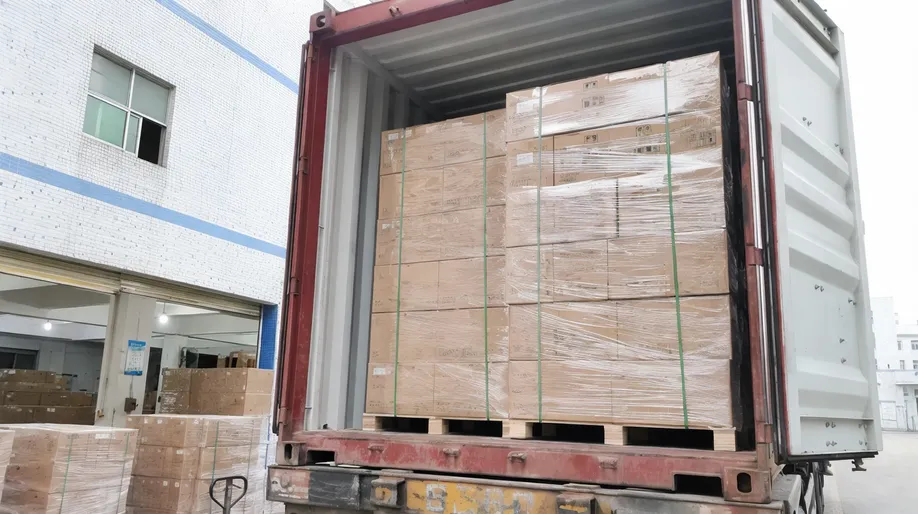
Container Loading (1-Meter Version)
20GP Container
Standard 20-foot
~600 units
40HQ Container
High-cube 40-foot
~1,400 units
What's in Each Master Carton
Custom insert cards — your brand, your contact info, your warranty terms — printed at no additional charge on orders over 100 units.
Barcode labeling, packing lists, and carton marks formatted to your warehouse spec. Tell us your system and we match it.
Compliance Documentation
CE Marking
European Union
Covers both the LVD safety directive and the EMC directive. Full compliance documentation included with every shipment to EU markets.
FCC Part 15
North America
Electromagnetic emissions testing covers the switching LED driver — the main EMI source. Shielded driver housings and filtered input stages keep emissions well under FCC limits.
RoHS Compliant
Component-Level
Lead-free solder, RoHS-declared LED packages, compliant PCB substrates. Material declarations available per fixture if your downstream buyers require them for their own compliance files.
EMI Engineering Approach
The switching LED driver is the main electromagnetic interference source in any LED fixture. Our compliance approach is engineered at the hardware level:
Shielded Driver Housings
Metal enclosure around switching circuitry blocks radiated emissions at source
Filtered Input Stages
EMI filters on power input suppress conducted noise well under regulatory limits
IP65-Rated Versions Available
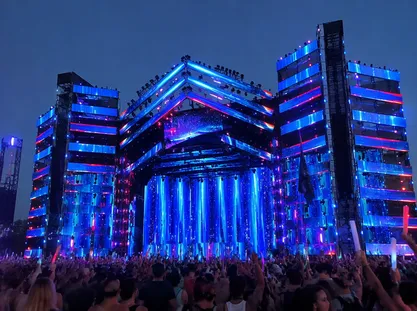
Festival stages, outdoor venue facades
IP65-rated versions include additional ingress protection test documentation. Testing is performed in-house with our own IP test chamber. If your project requires outdoor-rated pixel bars, the IP65 documentation is included with shipment.
Applications: festival stages, outdoor venue facades, permanent architectural installations exposed to weather.
Additional Market Certifications
If you're selling into markets that require specific local certifications beyond CE/FCC — such as SAA for Australia or KC for Korea — we arrange third-party testing through our existing lab partnerships.
SAA
Australia
KC
Korea
Other
Ask us
Lead time for additional certifications: Typically 3–4 weeks on top of production time.
OEM & ODM Development — Your Brand, Our Production
Two paths, depending on where you are in your product strategy.
OEM — Your Brand on Our Proven Design
You pick an existing pixel bar configuration from our standard range, we apply your logo on the housing, your brand name on the LCD menu, and your packaging design on the cartons.
- MOQ starts at 30 units — enough to test market response without committing to a full production run
- Sample lead time: 7–10 days
- Logo laser-engraved or silk-screened on housing
- Custom firmware boot screen and LCD branding
- Custom packaging design on cartons
ODM — Custom Development to Your Specification
You send us a brief — could be a competitor sample, a sketch, a detailed spec, or just a market gap you want to fill. Our 15-engineer R&D team develops the optical layout, electronics, housing, and firmware from scratch.
- You own the product design — we manufacture exclusively for you
- Development cycle: 3–4 revision cycles from concept to production-ready sample
- MOQ for custom-tooled products: typically 200+ units for new extrusion profiles
- Lower MOQ for configurations using existing housing with modified internals
- 15-engineer R&D team covers optical, electronics, housing, and firmware
The Low-Risk Path Most Buyers Take
Most of our pixel bar buyers start OEM: they take an existing configuration, brand it, test it in their market for one or two order cycles, then come back with modification requests based on customer feedback. That's the low-risk path — validated market demand before engineering investment.
Frequently Asked Questions
How many DMX channels does an LED DJ pixel bar use?
Depends on the control mode. In full pixel mode, a 16-segment RGBW bar uses 64 channels (16 segments × 4 channels each). In compact modes:
- • 4-channel mode: master RGBW control over the entire bar as a single fixture
- • 24-channel mode on a 12-segment RGB model: individual pixel control at 3 channels per segment
We offer selectable modes via the onboard LCD menu, so your customers choose their channel count based on their controller's universe availability.
What's the difference between an LED DJ pixel bar and a standard LED wash bar?
A standard wash bar outputs one color across its entire length — the whole bar is one zone. A pixel bar splits into individually addressable sections, each producing independent color.
Practically, that means your customers can run scrolling effects, rainbow chases, and video-mapped content across the bar's length.
This distinction directly affects retail price positioning: pixel bars typically sell at 2–3× the price of equivalent-length wash bars in the rental and retail market because of the added creative control.
What IP rating do I need for outdoor festival and stage use?
IP20 is indoor-only — no moisture protection. For outdoor stages with roof cover but open sides (typical festival setup), IP54 is technically sufficient but IP65 gives you full rain protection if the weather turns.
We recommend stocking IP65 for any buyer serving the festival or outdoor event market. The IP65 version uses sealed cable glands and a gasketed lens cover, which adds approximately 0.4 kg per fixture and 8–10% to the unit cost.
Most of our European festival rental customers spec IP65 as standard — the cost of a single rain-damaged fixture exceeds the upcharge across an entire order.
Can pixel bars be linked end-to-end for seamless continuous runs?
Yes — the housing design includes alignment pins at each end so multiple bars butt together with minimal visible gap (typically 8–12mm between active LED areas).
- • Power: daisy-chains through IEC/PowerCon connections
- • DMX: daisy-chains through XLR
- • Maximum recommended chain: 8 fixtures on power (depending on total wattage), unlimited on DMX signal
For long continuous runs (nightclub ceilings, architectural installations), we can produce custom end-caps that minimize the inter-fixture gap to under 5mm.
What is the MOQ for custom-branded LED DJ pixel bars?
30 units for OEM branding on an existing configuration — your logo laser-engraved or silk-screened on the housing, custom packaging, custom firmware boot screen.
For ODM custom designs requiring new tooling or modified housing profiles, MOQ depends on the engineering scope — typically 200+ units for custom extrusions, but configurations using existing housing with modified internals can start lower.
We recommend starting with a 30-unit OEM test order to validate demand in your market before committing to custom tooling investment.
How do pixel bars handle failure of individual segments in the field?
Each pixel section operates on its own sub-board with independent current regulation. If one segment fails (LED burnout, driver IC fault), the remaining segments continue operating normally — the show doesn't stop.
For field repair, the end-plate removes with 4 screws, and the segment board slides out for replacement. We stock replacement boards and can ship them separately to your service team.
This modular approach means your warranty cost per incident is a $15 board swap, not a $200 full-fixture replacement.
Next Step — Get Your LED DJ Pixel Bar Configuration Quoted
Send us your requirements: target market, preferred pixel count, RGB or RGBW, beam angle, quantity, and whether you need OEM branding. Our engineering team will confirm the exact specification, provide FOB pricing at your volume level, and ship samples within 7–10 days for your evaluation.
Start With a Sample Order
Most new buyers start with a 2–4 unit sample order to verify build quality, color consistency, and DMX response with their own controllers before committing to production volume. We encourage it — the sample confirms everything a spec sheet can't.
What to Include in Your Inquiry
- Target market and application
- Preferred pixel count
- RGB or RGBW preference
- Beam angle requirements
- Order quantity
- OEM branding needs
Contact Our Team
We typically respond with a preliminary quote within 48 hours.
Explore More LED DJ Lights