

Simple Church Stage Lighting Built for Small Venues
Compact, silent, and ready for low-ceiling installs. 30–80W LED fixtures with plug-and-play operation, passive convection cooling, and CRI ≥85 for basic livestream.
Your customers get worship-ready lighting without a learning curve or a noise problem. No DMX console. No lighting tech. One button, service runs.
The Product and Who It's For
A specific product tier — not a stripped-down version of something else.
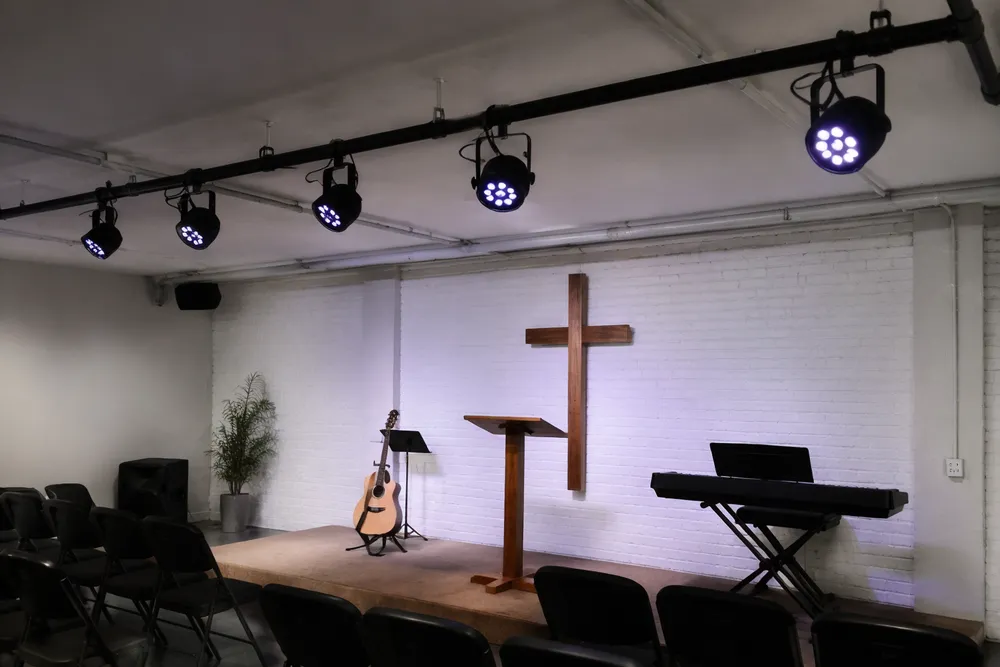
Simple church stage lighting is a specific product tier — not a stripped-down version of something else. We designed this line around a venue profile that accounts for a massive segment of the global church market: congregations under 300 seats, ceiling heights under 3.5 meters, no dedicated lighting operator, and modest budgets that still need to look professional on a livestream camera.
The fixtures in this range sit between 30W and 80W output, use RGB or tunable warm/cool white LED arrays, and operate in master-slave daisy-chain, auto-run, or sound-active modes. No DMX console required. A volunteer plugs them in, selects a preset scene, and the service runs. That simplicity is the product — because in this segment, complexity is the failure mode.
For your business, this tier opens a market segment that higher-end fixtures can't reach. A 200-seat church with a $2,000 lighting budget won't buy professional moving heads. They will buy 8–12 compact LED pars that mount on their existing pipe or T-bar stands and work out of the box. That's the order you're quoting — and it repeats every time a new church plant opens, a fellowship hall gets its first stage, or a rural congregation upgrades from clip-on work lights.
Target Venue Profile
-
Under 300 seats Small to mid-size congregations
-
Ceiling under 3.5m Compact fixtures fit above head height
-
No lighting operator Volunteer-run, one-button operation
-
Budget-conscious Professional look at modest cost
-
Livestream-ready CRI ≥85 for camera quality
Typical Order
8–12 compact LED pars per venue. Mounts on existing pipe or T-bar stands. Works out of the box — no console, no training.
This order repeats with every new church plant, fellowship hall upgrade, or rural congregation replacing clip-on work lights.
Technical Specifications — What You're Quoting
Standard values across this product tier. Exact specs vary by model — contact us for detailed data sheets on specific SKUs.
| Parameter | Typical Value |
|---|---|
| Light Source | RGB LED array or warm white / cool white dual-array |
| Output Range | 30–80W |
| CRI | ≥85 (standard) · ≥90 available on select models |
| Beam Angle | 25°–45° fixed lens |
| Control Modes | Master-slave, auto-run, sound-active, basic 4-channel DMX |
| Noise Level | Silent — passive convection cooling, no fan |
| Color Temperature | 3200K / 5600K preset (tunable white) · Full RGB on color models |
| IP Rating | IP20 (indoor use) |
| Housing | Compact aluminum, black powder-coated, standard pipe clamp or T-bar mount |
| Power Input | AC 100–240V, 50/60Hz |
| Weight | 1.2–2.8 kg depending on model |
| Dimensions | Compact profile under 200mm depth — fits between ceiling and truss in low-ceiling installs |
Engineering Note: Fixed Optics Philosophy
We keep the beam angle at 25°–45° fixed rather than offering motorized zoom on this tier. Zoom mechanisms add cost, weight, and a potential failure point that volunteers won't troubleshoot. Fixed optics, simple operation — that's the engineering philosophy here.
Install Questions — Answered
Will it fit on a 2.7m ceiling with a pipe clamp?
Yes — the compact depth keeps the fixture well above head height.
Will it hum during the sermon?
No — no fan, no noise. Passive convection cooling throughout.
Can a volunteer run it?
Auto-run mode, one button. No console, no training required.
Need exact specs for your target models?
Get Exact SpecsLow-Ceiling Installs — The Engineering Constraint That Shapes This Product
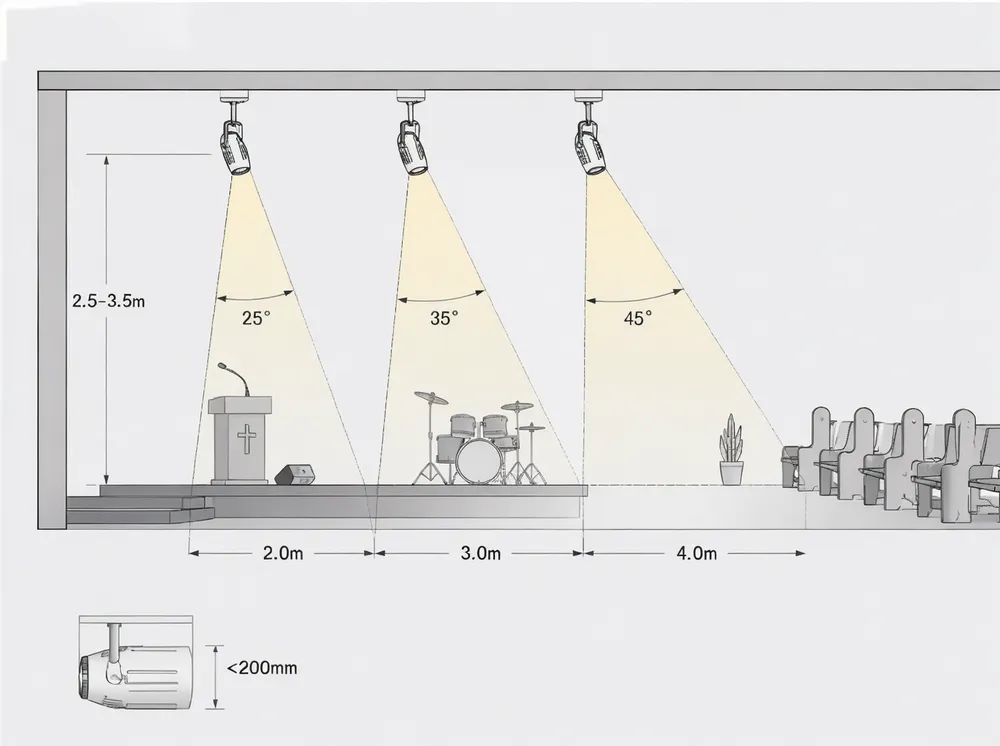
Church stage lighting for low ceilings isn't just about making the fixture smaller. It's about solving the geometry problem: when your mounting point is 2.5–3.5 meters above the stage, the beam angle, throw distance, and heat dissipation all behave differently than they do at 5+ meters.
We engineer this tier with a specific optical path for short-throw applications. The 25°–45° beam angles are calculated for 2–4 meter throw distances, so your customer gets even wash coverage across a small stage without hot spots at center or dark edges. Wider angles at short distance would over-spill beyond the stage; tighter angles would create pools. The fixed lens selection for each model is optimized for the ceiling height it's designed to serve.
Why This Geometry Matters
Wider angles at short distance over-spill beyond the stage. Tighter angles create pools. The fixed lens selection for each model is optimized for the ceiling height it's designed to serve — eliminating trial-and-error for your install contractors.
Oversized Heat Sink
At 3 meters, a fixture's thermal output is closer to the congregation. We oversize the aluminum heat sink relative to the LED wattage — a 50W fixture gets the thermal mass typically used for 80W — so surface temperature stays comfortable even when the fixture runs continuously for 90-minute services.
Passive Convection — No Fan
The passive convection design means no fan directing warm air downward toward seated congregants. We tested this specific scenario in our thermal lab after a distributor in Texas reported complaints about warm air from a competitor's fan-cooled pars mounted at 2.8m. Silent convection at these wattages is the correct solution.
Compact Clearance Profile
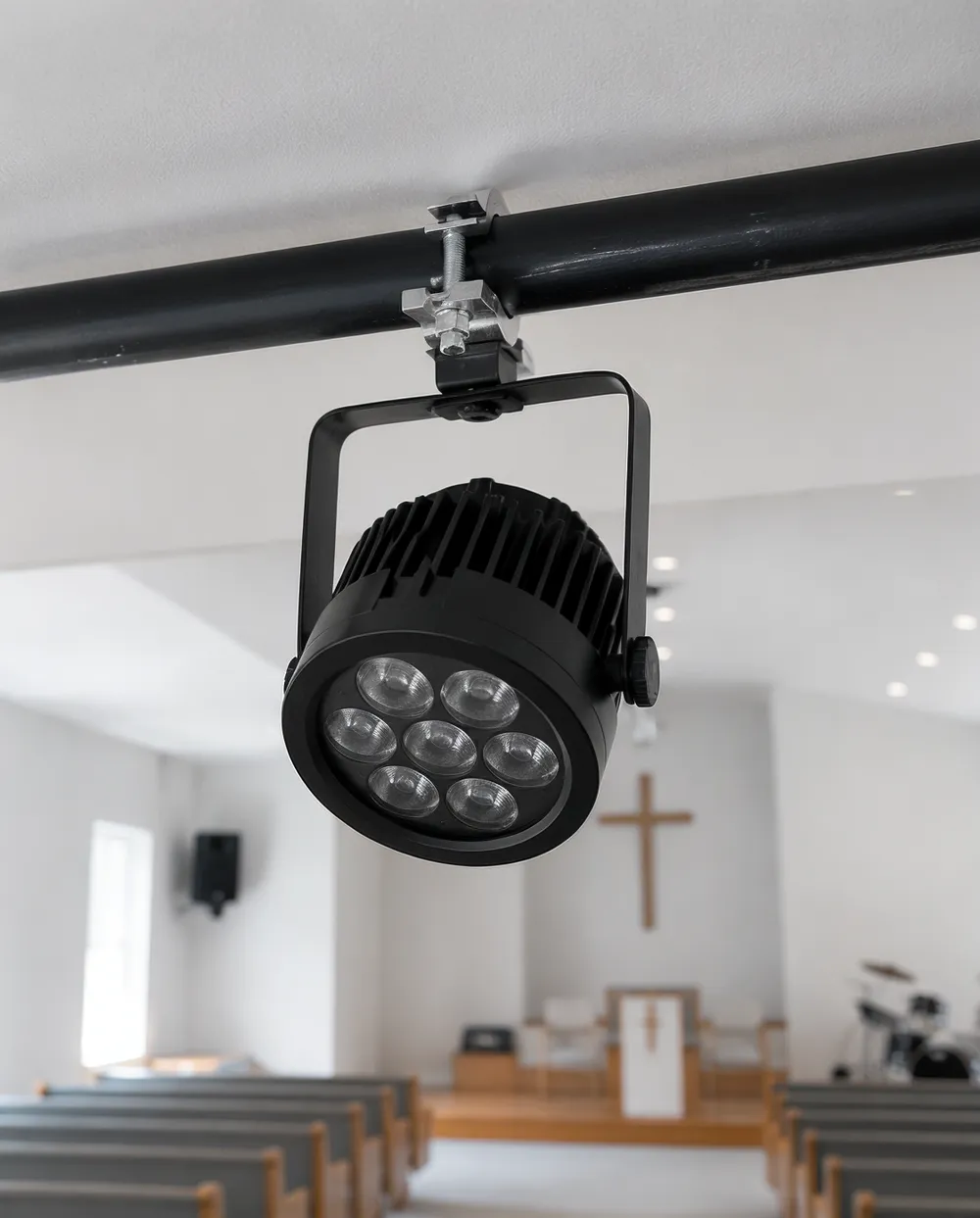
The compact housing depth — under 200mm from clamp point to lens face — gives adequate clearance between the fixture and both ceiling and head height. Your install contractors can mount these on standard 48mm pipe clamps or T-bar drop stands without custom rigging.
Plug-and-Play Operation Eliminates Your After-Sale Support Cost
The biggest hidden cost in the small church lighting segment isn't the fixture — it's the support call. When a volunteer operator can't figure out the controls, that call goes to your sales team, not to us. We designed this tier to eliminate that entirely.
Master-Slave Operation
Connect 2–12 fixtures with standard DMX cables. The first fixture controls all others. No console, no addressing, no menu navigation. Plug in, daisy-chain, power on. The fixtures sync automatically.
Auto-Run Mode
Each fixture cycles through pre-programmed scenes — color washes, slow fades, static warm white — without any external control. Suitable for churches that want ambient stage color during worship without touching a controller.
Sound-Active Mode
Built-in microphone triggers color changes and intensity shifts in response to music. Not precise enough for professional productions, but perfect for youth services and contemporary worship bands in small venues.
4-Channel DMX
For churches that graduate to a basic console or DMX app, each fixture responds on 4 channels (R, G, B, dimmer or warm white, cool white, dimmer, strobe). Simple enough for a volunteer to learn in 20 minutes from a YouTube tutorial.
Commercial Value
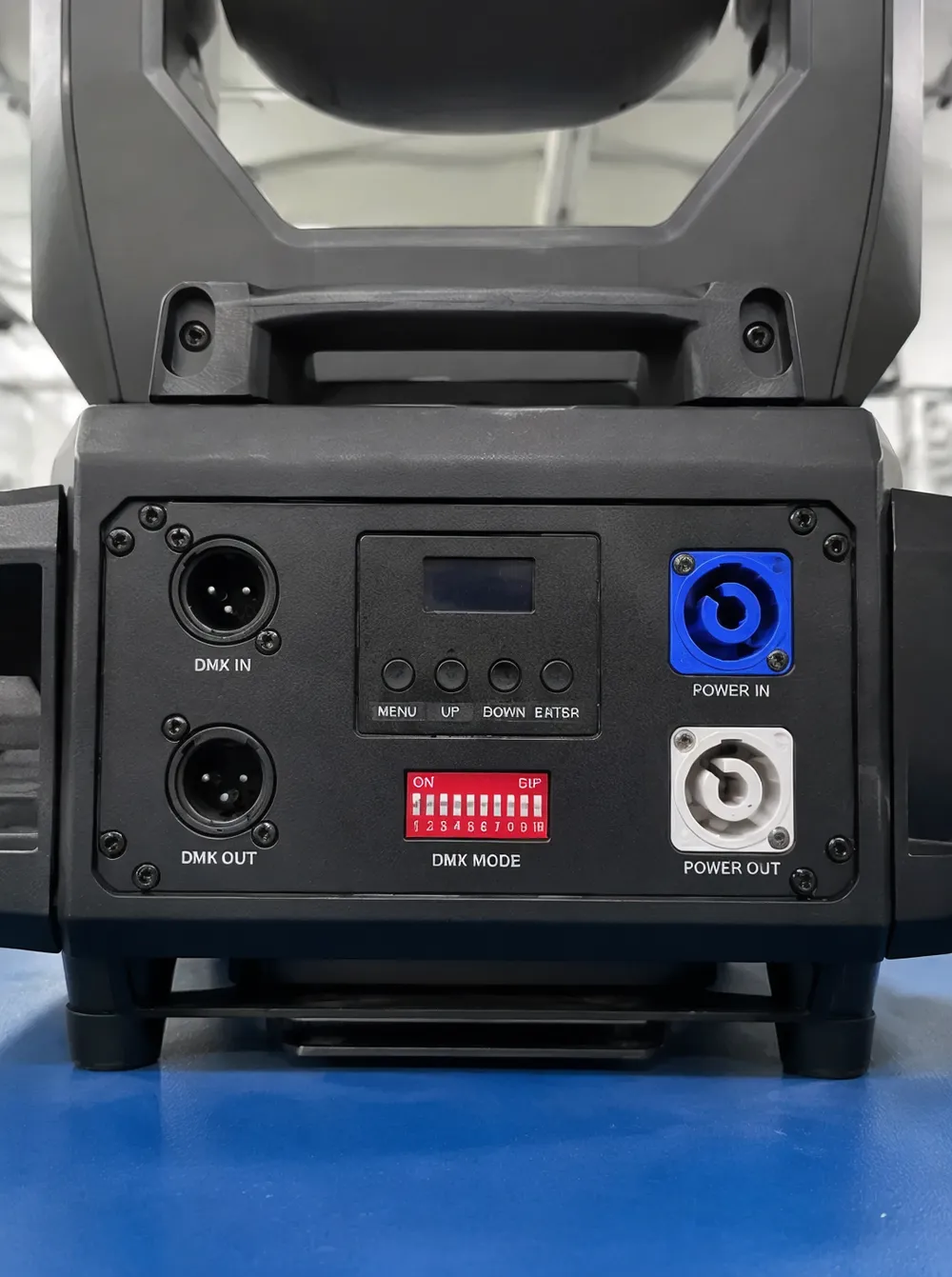
Your customer never calls you with a programming question. The fixture works out of the box in any of these modes, and mode selection is a DIP switch or 3-button menu on the rear panel.
That means zero post-sale support load on your team — a direct margin benefit on every unit you move in this segment.
Market Segments Where This Tier Moves Volume
Each application scenario below represents a repeatable commercial opportunity — not a one-off sale.
Startup and Church-Plant Congregations
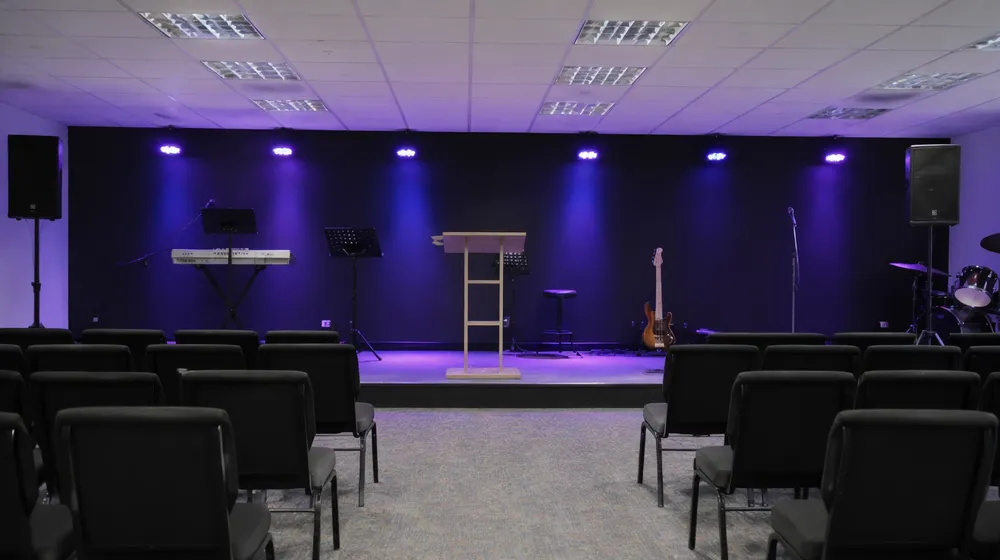
New church plants launch every week across North America, Africa, Southeast Asia, and Latin America. They rent commercial spaces, school auditoriums, or strip-mall units. Their lighting budget is typically $1,500–$4,000 for the entire stage.
A package of 8–12 simple LED pars at this price point lands squarely in their range, and the plug-and-play operation means they don't need to hire an AV consultant for setup.
If you serve the church-plant market, this is a repeatable 8–12 unit order every time a new congregation launches.
One distributor in the southeastern US moves 40–60 units per month purely on church-plant business — it's a steady, predictable segment.
Small Established Churches Upgrading from Halogen
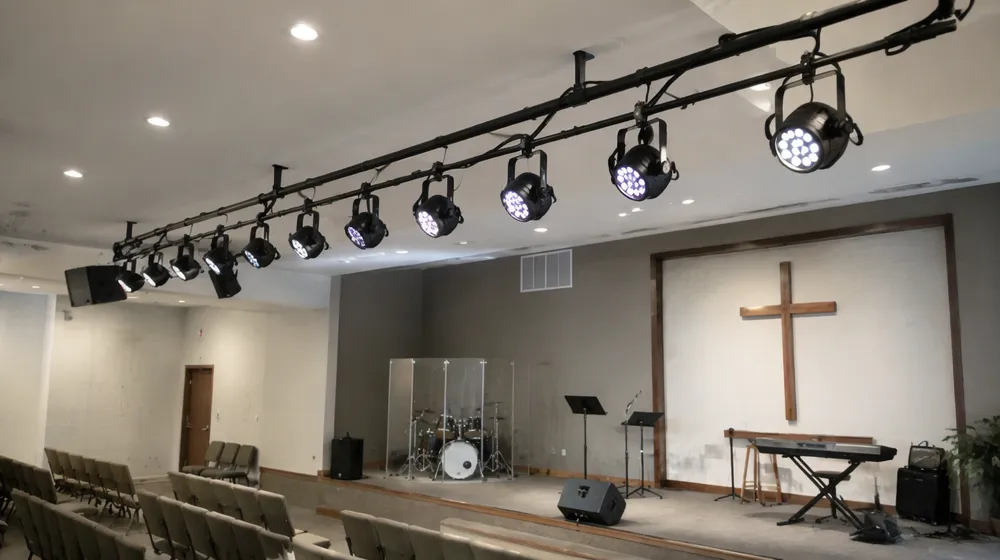
Thousands of congregations under 300 seats still run PAR56 or PAR64 halogen cans from the 1990s. The heat output, energy cost, and lamp replacement cycle make LED upgrades inevitable.
Your value proposition:
- Same mounting hardware (standard pipe clamp)
- Dramatically lower power draw
- Zero lamp replacement
- Silent operation
A retrofit kit of 6–10 fixtures replaces the entire halogen rig. These are budget-approved annual expenditures for facility committees, so the purchasing cycle is predictable.
Fellowship Halls and Multi-Purpose Rooms
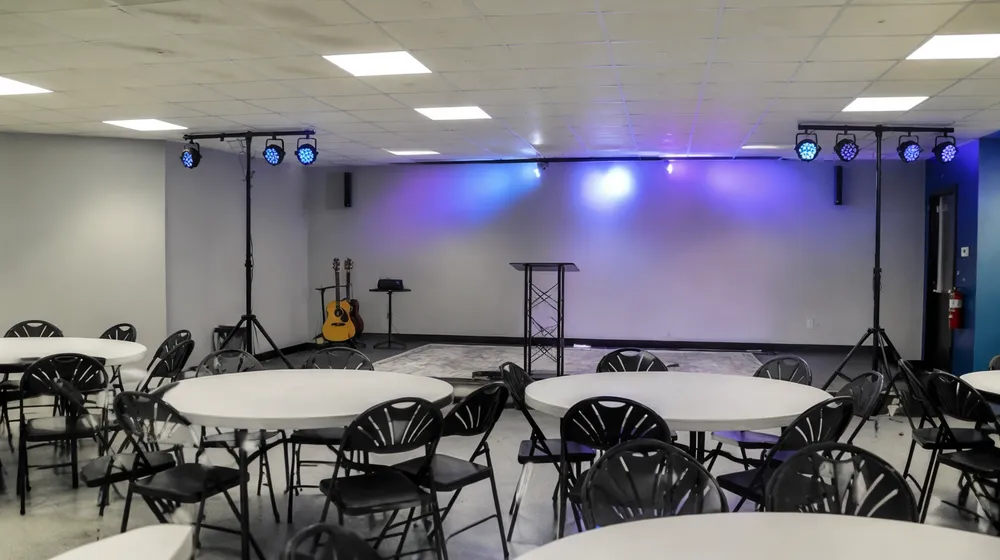
Churches use secondary spaces — fellowship halls, youth rooms, activity centers — for worship overflow, youth services, and community events. These rooms have the lowest ceilings (often 2.5–2.8m), the smallest budgets, and the least technical oversight.
Simple fixtures on T-bar stands solve the problem without permanent installation. Your order volume here is typically 4–6 fixtures per room, but churches with multiple auxiliary spaces order 2–3 rooms at once.
Rural and Budget-Constrained International Markets
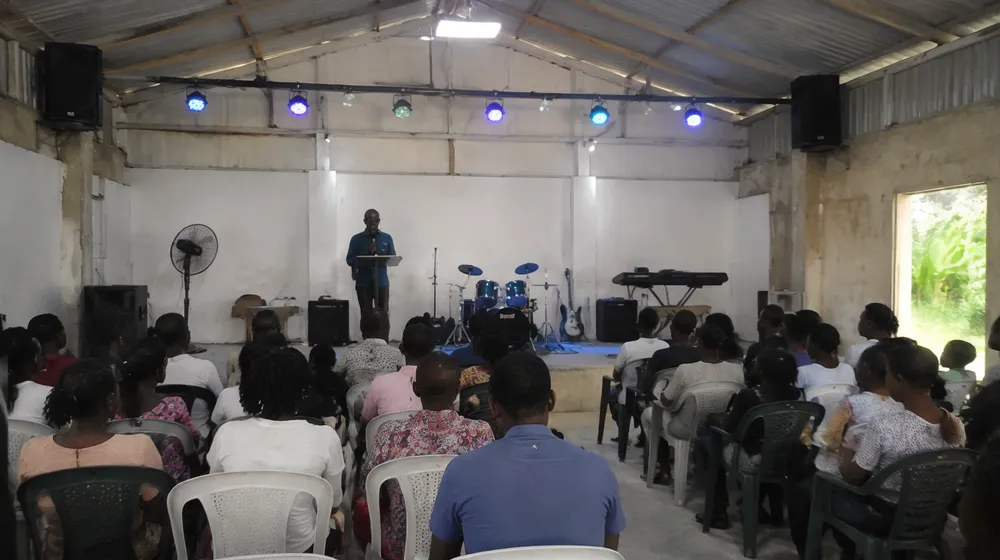
In developing markets — Sub-Saharan Africa, South and Southeast Asia, Central America — the majority of congregations fall into the small-church profile. Price sensitivity is extreme, and technical support infrastructure is minimal.
This tier is engineered for exactly that combination: lowest landed cost per fixture, and operation that requires no training. If you distribute into these markets, this is your volume product.
Which market segment do you serve?
Tell us your target market — we'll recommend a starter SKU mix.
What Separates This From Generic LED Pars on Alibaba
Your buyer can find $15 LED pars from dozens of factories. Here's what they get for that price — and what we do differently.
LED Binning and Color Consistency
We procure LEDs in single-bin lots per production run. When your customer lines up 8 fixtures as front wash, the color matches fixture-to-fixture.
A $15 par uses whatever bin is cheapest that week — your customer sees three shades of "warm white" across the stage and blames your brand.
Driver Quality and Flicker
Our constant-current drivers run high-frequency PWM dimming (>20kHz). At 50% dim, the fixture produces zero flicker on camera — critical since even small churches now livestream.
Budget fixtures running low-frequency PWM produce visible banding on phone cameras.
We test every unit with a flicker meter at 25%, 50%, and 75% dim before packing. That test alone separates our product from most of what ships out of Guangdong.
Thermal Design for Continuous Operation
Worship services run static output for 60–90 minutes. We dimension our heat sinks for continuous duty at full rated power — verified through our 48-hour aging test at 100% output.
Cheap pars are designed for DJ use where effects cycle and thermal load fluctuates. Run them static for 90 minutes in a church and LED degradation begins within the first year.
Connector and Housing Durability
Brass-core PowerCon or locking IEC connectors, not the sheet-metal IEC inlets that loosen after 50 plug cycles.
Powder-coated aluminum housing at 60–80μm thickness — not painted plastic. The fixture survives years of volunteer handling, transport between rooms, and storage in closets. Zero cosmetic complaints from your downstream customers.
The pricing gap between what we build and those $15 pars is real — we're not the cheapest option in this segment. But your per-unit margin is protected because there are no warranty returns eroding it. Your brand reputation stays intact because the fixtures perform as described.
That's the trade-off calculation your procurement team should run.
OEM/ODM — Your Brand on Our Production Floor
If you sell worship lighting under your own label, this product tier is the easiest entry point into OEM manufacturing.
Logo & Branding
Your logo printed or laser-engraved on the housing, custom retail packaging with your branding, user manuals under your brand identity.
Available from 30 units
Color Options
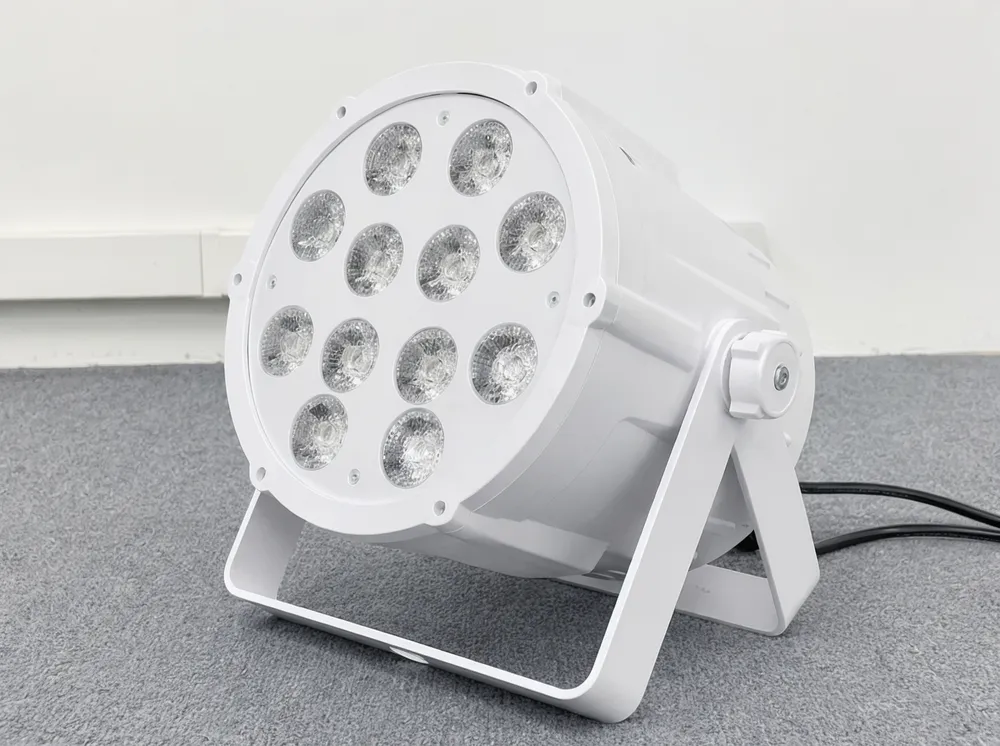
Standard black housing ships from stock. Custom powder-coat colors (white is the most common request for church aesthetics) available from 100 units per color — specify your RAL or Pantone code.
100 units per color MOQ
Optical Modification
Fixed lens swaps to adjust beam angle for your target ceiling height range. If your market is predominantly 3m ceilings, we can optimize the standard 25° fixture to a wider 35° spread for better short-throw coverage.
Control Firmware
Custom preset scenes pre-loaded for worship environments (warm white wash, slow blue fade, amber accent). Your customer selects scene 1–5 on the rear menu — no programming required. This turns a generic fixture into a "worship-ready" product your marketing can sell against.
Packaging for Retail or E-Commerce
If you sell on Amazon or through online worship supply stores, we configure packaging for individual sale — barcode labeling, mail-order-durable inner box, included quick-start card. Drop-ship ready.
MOQ & Lead Times
30 units
Per SKU — standard models with your logo
200 units
Full-custom configurations (modified optics, firmware, housing color)
10–15 days
First samples ship from spec confirmation
OEM Success Story
The most successful OEM project we've run in this tier was a US worship supply brand that added a white-housing version with 5 pre-loaded worship scenes. They positioned it as "designed for churches" — same fixture, differentiated positioning, 30% higher retail price than generic black pars. Sold 4,000 units in the first year.
Quality That Protects Your Margin on Budget-Tier Products
Budget products get the most warranty scrutiny — customers buying at lower price points have less tolerance for defects. Our QC process on this tier is identical to our professional line.
48-Hour Aging Test
Every unit runs at 100% rated power for 48 continuous hours before packing. This catches infant mortality failures — marginal solder joints, weak capacitors, thermal design issues — before they leave our factory.
Roughly 0.3–0.5% of units fail this test and get pulled. That's the percentage that would have failed in your customer's venue within the first month.
100% Functional Inspection
After aging, every fixture gets a final test — all color channels verified, all control modes cycled, connector integrity checked, flicker meter reading recorded.
No sampling — every single unit.
LED Batch Calibration
Each production run is calibrated against a golden sample for color consistency. The sample stays locked in our QC lab for the duration of your order's production window, so mid-batch drift gets caught immediately.
Packaging Integrity
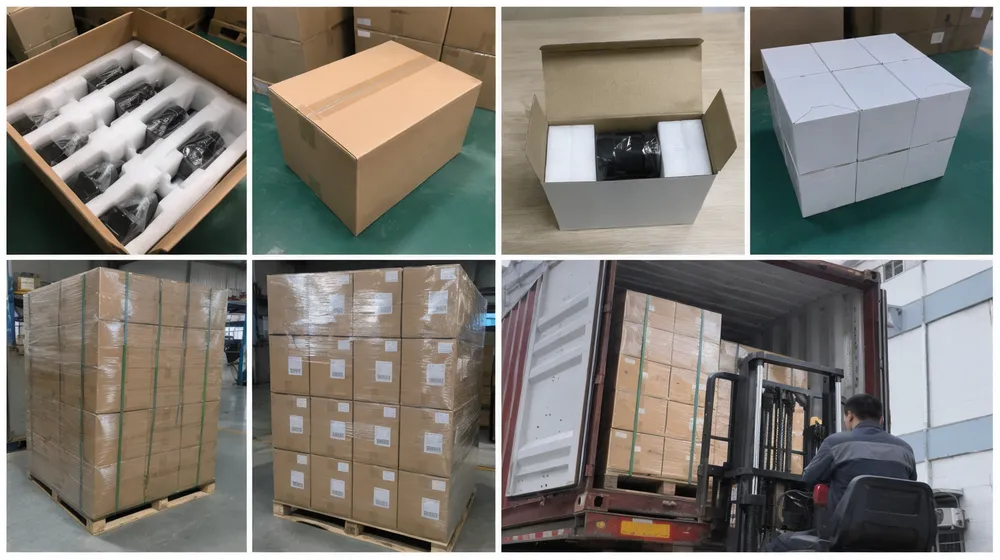
EPE foam inserts molded to this fixture's exact profile. Drop-tested at 60cm onto concrete (simulating real-world warehouse handling). The lens and housing arrive without marks.
Certifications
We hold CE, RoHS, and FCC on this product tier. If your market requires additional certifications (UL, ETL, specific EU directives), we can facilitate testing through our partner labs — typical lead time is 4–6 weeks for a new certification.
Ordering, Packaging, and Container Loading
MOQ
30 units per model for catalog configurations. Mixed-model orders welcome — combine simple church fixtures with LED church stage lighting or professional church stage lighting on a single PO.
Lead Time
Standard models ship within 20–25 days from order confirmation. OEM configurations (custom branding, modified specs) add 5–7 days for first-run sample approval.
Trade Terms
EXW, FOB Meizhou, CIF, or DDP. Full documentation — commercial invoice, packing list, certificate of origin, test reports per SKU — included with every shipment.
Container Loading Density
These are compact, lightweight fixtures. Typical loading density:
1,800–2,400 units
Depending on model and packaging type
4,000–5,200 units
Depending on model and packaging type
That density means your per-unit freight cost is low relative to the product value — an advantage over larger fixture categories when calculating landed cost.
Packaging Options
Standard Export Carton
EPE foam insert, 4–6 units per outer carton. Optimized for bulk distribution.
Retail-Ready Boxes
Individual packaging for e-commerce fulfillment. Ready for shelf or direct-to-customer shipping.
Bulk Palletized
For warehouse distribution. Barcode and SKU labeling per your specifications.
If This Tier Doesn't Match — What Else We Make for Churches
This product fits a specific need: small venue, low budget, volunteer operation. If your project or market demands more, our other tiers under church stage lighting cover the full range:
LED Church Stage Lighting
200–500 seat sanctuaries
Need higher output and DMX control for 200–500 seat sanctuaries? This tier delivers 80–200W RGBW fixtures with full DMX512, CRI ≥90, and both convection and low-noise fan cooling options.
Professional Church Stage Lighting
500+ seat auditoriums
Need moving heads, zoom profiles, or sACN/Art-Net for 500+ seat auditoriums? This tier handles large-venue production with broadcast-grade color rendering and enterprise control protocols.
Single-Supplier Consolidation
Most established distributors in the worship segment stock 2–3 SKUs from each tier and cover the full market from a single supplier. Your purchasing consolidates to one factory, one set of payment terms, one quality standard.
Frequently Asked Questions — Simple Church Stage Lighting
What beam angle do I need for church stage lighting on low ceilings?
For mounting heights of 2.5–3.5 meters, a 25°–40° fixed beam angle provides the best coverage-to-spill ratio. Below 25°, you get tight spots that require more fixtures to fill the stage. Above 45°, light spills onto walls and into the congregation's eyes. We configure specific beam angles per model based on target throw distance — tell us your ceiling height and stage width, and we'll recommend the correct optic.
Can simple church lighting fixtures work with a DMX console if the church upgrades later?
Yes. Every fixture in this tier includes a 4-channel DMX mode accessible via DIP switch. When a church graduates from auto-run to a basic console or DMX app, the fixtures respond without replacement. The upgrade path is built in — your customer doesn't outgrow the fixture in year one.
How many simple LED pars do I need to light a small church stage?
For a stage 4–6 meters wide at 2.5–3m ceiling height: typically 6–8 fixtures for front wash coverage, plus 2–4 for stage color/accent. A 10-fixture package is our most common order configuration for this segment. We can spec the exact count and placement based on your customer's stage dimensions.
What's the power draw for a full simple church lighting setup?
A typical 10-fixture setup using 50W models draws 500W total — less than a single halogen PAR64 from the old rig. Your customer runs the entire stage lighting system on a single 15A residential circuit. No electrician required, no panel upgrade, no additional installation cost.
Do these fixtures produce flicker on livestream cameras?
No. We drive all fixtures at >20kHz PWM frequency, which is well above the threshold for visible flicker at any frame rate (24fps, 30fps, 60fps). Every unit is flicker-tested at partial dim levels before shipping. If your customer streams on a phone camera or budget DSLR, the image stays clean.
Get a Quote for Simple Church Stage Lighting
Tell us your target market, approximate order volume, and whether you need standard catalog models or OEM branding. If you have a competitor sample or a spec sheet from a project bid, send it — we'll match or improve on it and quote within 24 hours.
Most buyers in this tier start with a 30–50 unit trial order to test with their customers before scaling. We ship trial quantities on the same 20–25 day timeline as full production orders.