

Spider Moving DJ Lights Independently Controlled RGBW Heads
Multi-head spider fixtures that reduce your customers' rigging count and cabling cost while filling stages with geometric beam effects. Factory-manufactured, 48-hour aged, OEM-ready from 30 units.
Maximum visual coverage from a single fixture point.
What Spider Moving DJ Lights Are — and Why They Sell Differently Than Standard Moving Heads
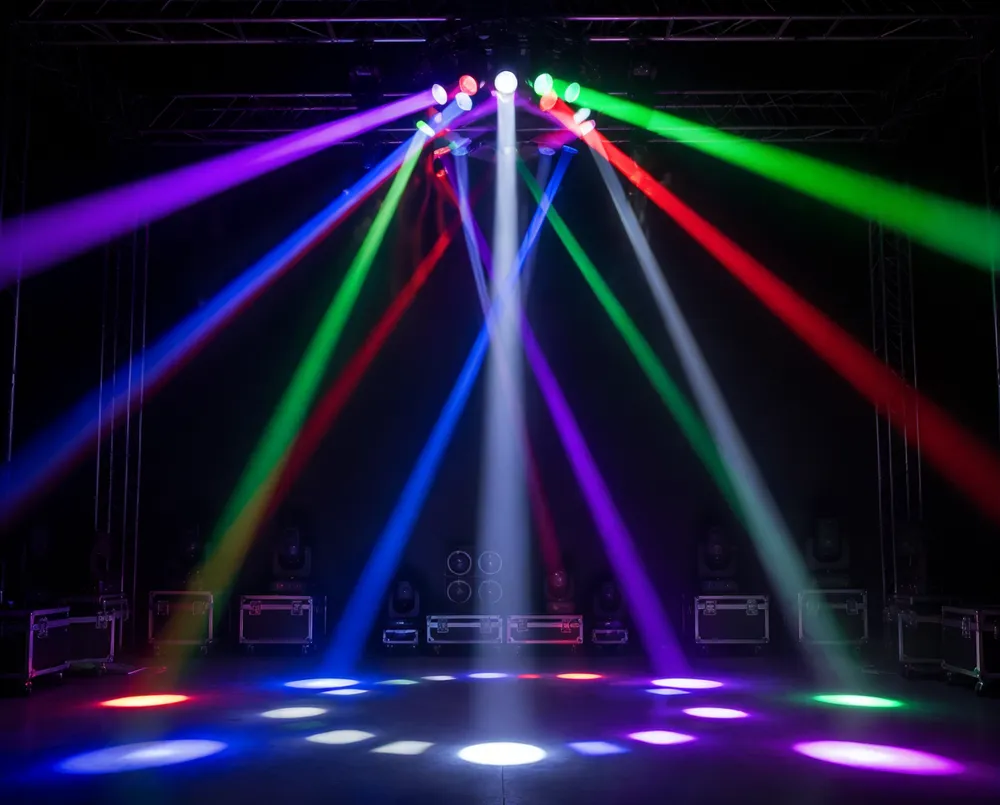
Spider moving DJ lights are multi-head fixtures — typically 8 LED heads mounted on a rotating bar or dual-bar frame — where each head operates independently while the entire assembly pans, tilts, and rotates as a unit. One spider fixture produces the visual equivalent of 4–8 individual beam fixtures working in formation. That's the core commercial proposition for your business: your customers get maximum coverage from minimum rig points, and you sell a higher-value single SKU instead of 8 lower-margin individual fixtures.
The category sits in a different competitive space than standard moving heads. Beam and spot fixtures compete on raw output power and optics precision — commoditized specs that invite price wars. Spider moving DJ lights compete on effect density and visual complexity, which means fewer direct comparisons on a spec sheet and more room for margin protection in your pricing. Your competitors either carry spiders or they don't — and the ones who don't leave an entire segment underserved.
Our spider fixtures use 8-head and 12-head configurations with RGBW LEDs ranging from 10W to 40W per head. The bar assembly rotates 360° continuously while pan/tilt drives position the entire fixture, producing compound geometric patterns that a single-head moving light physically cannot replicate. We've been manufacturing this fixture type since 2015, and it remains one of our highest-reorder-rate products across mobile DJ distributors.
View the full moving DJ lights range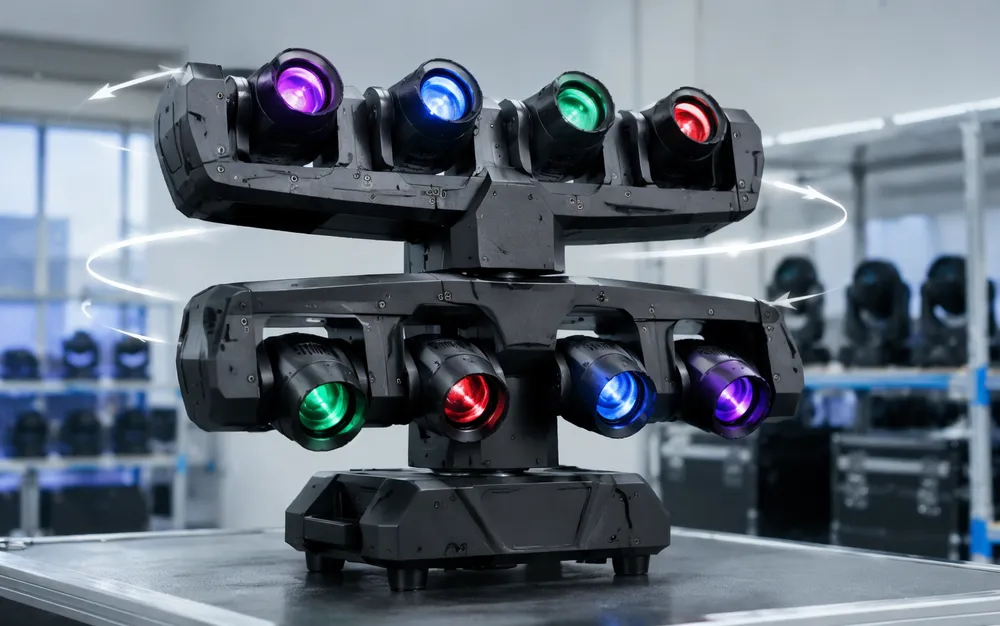
Effect Density Over Raw Power
Spiders compete on visual complexity, not output specs — fewer direct spec-sheet comparisons mean more room for margin protection.
Fewer Rig Points, Higher Value
One spider replaces 4–8 individual beam fixtures. Your customers reduce rigging count and cabling cost while you sell a single higher-value SKU.
Highest Reorder Rate Since 2015
Continuous 360° bar rotation + independent heads = compound geometric patterns a single-head moving light physically cannot replicate.
Independent Head Control — The Feature That Justifies Your Price Point
The difference between a spider fixture your buyers can mark up and one they'll have to discount: independent head control.
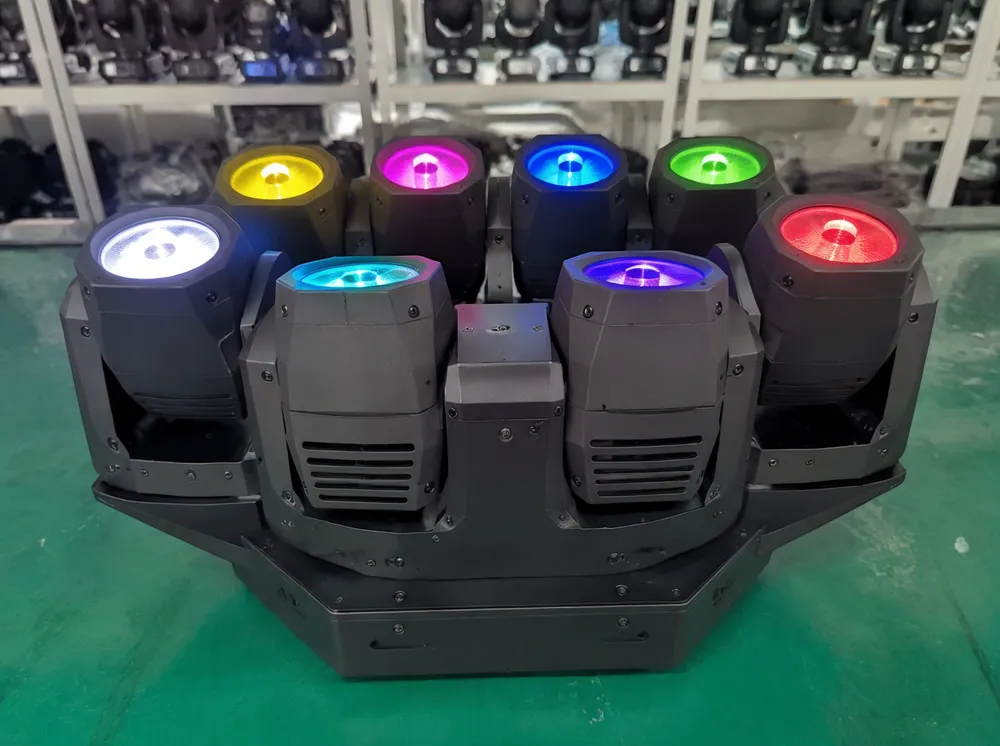
Budget spiders from other factories run all heads in sync — same color, same dimming, same everything — which makes them glorified beam bars. Our spider moving DJ lights give your customers per-head DMX addressing: each of the 8 or 12 heads accepts independent RGBW color mixing, dimming, and strobe commands. That turns one fixture into a programmable multi-beam system.
We run dedicated DMX channel modes for different use cases: a full-control mode (typically 45–90 channels depending on head count) for professional lighting designers who want per-head pixel mapping, and a simplified mode (12–18 channels) for mobile DJs running sound-active or auto programs. Your catalog covers both buyer types from a single SKU — the professional installer who programs everything and the weekend DJ who wants impressive looks out of the box.
Full-Control Mode
Per-head pixel mapping for professional lighting designers. Full independent control of RGBW color, dimming, and strobe on every head.
Target buyer: professional installer, show programmer
Simplified Mode
Impressive looks out of the box for mobile DJs running sound-active modes. No deep programming required — plug in and go.
Target buyer: weekend DJ, rental house quick-deploy
Engineering Detail: Staggered Driver Architecture
Design-Level Fix · Not Firmware
The DMX decoder board uses optically isolated inputs with filtered power rails. We caught a recurring issue early in our spider production — when 8 LED heads ramp simultaneously on a single driver bus, the inrush current spike creates noise that corrupts DMX frames. We redesigned the driver architecture to stagger head ramp-up by 2ms per head. Invisible to the audience, but it eliminated the random flicker complaints our early-generation spiders occasionally produced under certain DMX controllers.
If you've had customers report spider lights "not responding cleanly" with specific controllers, this is usually the root cause — and it's a design-level fix, not firmware. Budget spiders that don't address this will keep generating support tickets for your team.
Isolation
Optically Isolated DMX Input
Ramp Stagger
2ms Per Head Sequential
Power Rails
Filtered Bus Architecture
Typical Technical Specifications
| Parameter | 8-Head Configuration | 12-Head Configuration |
|---|---|---|
| LED source per head | 10W RGBW (4-in-1) | 12W RGBW (4-in-1) |
| Total fixture power | Typical 100–120W | Typical 160–200W |
| Beam angle per head | 4.5° | 4.5° |
| Bar rotation | 360° continuous, variable speed | 360° continuous, variable speed |
| Pan range | 540° | 540° |
| Tilt range | 270° | 270° |
| DMX channels | 15 / 46 / 91 CH modes | 15 / 69 / 135 CH modes |
| Control modes | DMX512, sound-active, auto, master/slave | DMX512, sound-active, auto, master/slave |
| Housing material | Die-cast aluminum + ABS panels | Die-cast aluminum + ABS panels |
| Net weight | Typical 5–7 kg | Typical 8–11 kg |
| Dimensions (L×W×H) | Approx. 530×280×190 mm | Approx. 700×320×220 mm |
| Power input | AC 100–240V, 50/60Hz | AC 100–240V, 50/60Hz |
| Operating temperature | -10°C to 40°C | -10°C to 40°C |
| Cooling | Forced-air convection | Forced-air convection |
LED source per head
Total fixture power
Beam angle per head
4.5° (both configurations)
Bar rotation
360° continuous, variable speed
Pan / Tilt range
540° pan / 270° tilt
DMX channels
Control modes
DMX512, sound-active, auto, master/slave
Housing material
Die-cast aluminum + ABS panels
Net weight
Dimensions (L×W×H)
Power input
AC 100–240V, 50/60Hz
Operating temperature
-10°C to 40°C
Cooling
Forced-air convection
Specifications shown are industry-standard values for this product type. Actual specifications may vary by model. Contact us for detailed product data sheets and model-specific dimensions.
Universal Voltage — One SKU, Every Market
The universal voltage input (100–240V) means your single SKU ships to any market without regional power variants. We've shipped the same spider model to North American 120V distributors and European 230V installers on the same production run — no BOM changes, no separate model codes.
Bar Rotation Mechanism — What Separates Reliable Spiders from Warranty Problems
The rotating bar is the defining mechanical element of a spider fixture — and it's where most quality problems originate. The bar carries 5–11 kg of LED head assemblies (depending on head count) spinning at variable speeds, sometimes reversing direction mid-cycle. That's serious rotational inertia on a mechanism that needs to run 4–6 hours nightly in a club install without developing play.
Slip-Ring Power Transfer
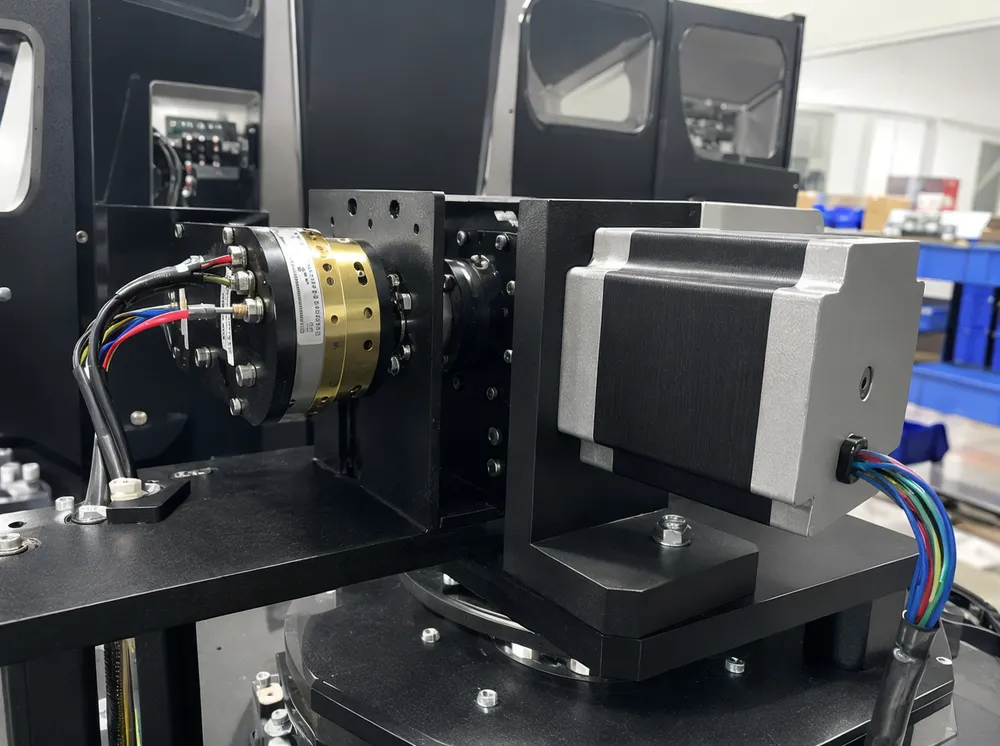
We use a slip-ring power transfer system for the bar rotation rather than flexible cable wraps. Cable-wrap designs (common on budget spiders) have a defined rotation limit before the internal power cables twist and fatigue — typically 10–20 full rotations before the wrap forces a direction reversal, and eventual cable failure at the flex point within 6–12 months of nightly use.
Our slip ring allows true infinite rotation with zero cable stress. The slip ring contacts are gold-plated copper for reliable power and signal transfer across 20,000+ hours of continuous rotation.
Oversized Stepper Motor — 40% Torque Headroom
The bar drive motor is an oversized stepper relative to the load — we spec 40% torque headroom above the calculated dynamic load. This keeps the motor operating in its linear range rather than near stall torque, which drops operating temperature and extends winding life.
Field Lesson — Why We Over-Spec the Motor
We tried running the exact-match motor size on our first-gen spider in 2015. Motor overheating on summer gigs in Southeast Asian markets — ambient 35°C plus motor heat meant winding temperatures exceeded insulation class limits. We up-spec'd the motor and the thermal problem disappeared. The 40% headroom isn't over-engineering; it's the margin that lets the fixture survive real-world thermal conditions your customers will encounter.
Dynamic Balancing — Every Bar Assembly
Every bar assembly is dynamically balanced before installation — we spin-test the loaded bar and add balance weights as needed to eliminate vibration at full speed. An unbalanced bar creates audible resonance in the fixture housing and accelerates bearing wear.
This is a 3-minute step in production that saves your customers from premature bearing failure at month 8. It's the difference between a fixture that stays silent at full rotation speed and one that develops a rattle after the first summer season.
Budget Spider
Cable-wrap rotation
10–20 rotations before forced reversal
Cable failure at 6–12 months
GDMonkey Spider
Slip-ring infinite rotation
Gold-plated copper contacts
20,000+ hours continuous
Result
Zero cable stress failures
No direction-reversal limitations
Reduced warranty claims
Where Spider Moving DJ Lights Generate Revenue for Your Business
Mobile DJ Distribution
The Volume Segment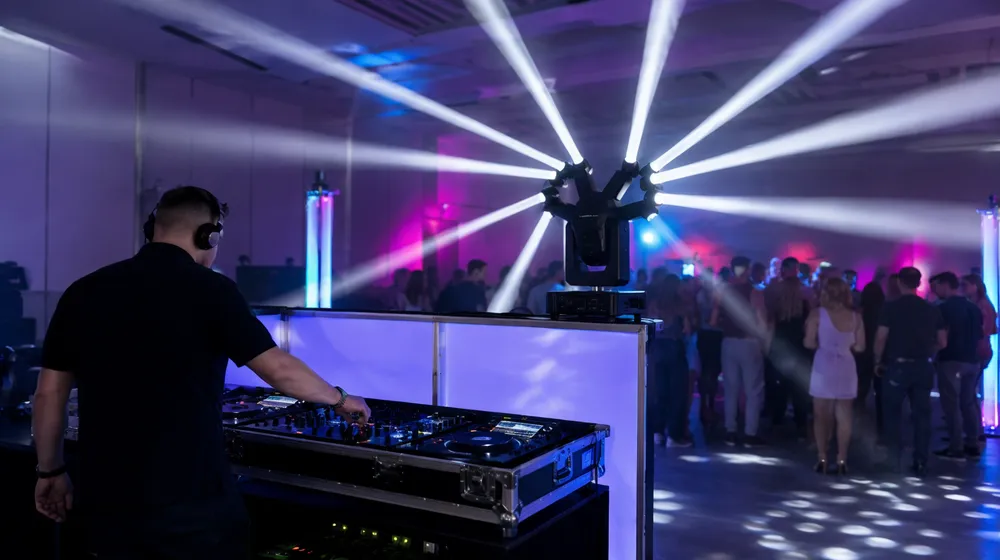
Mobile DJs want maximum visual impact from minimum gear. A spider fixture replaces 4–8 individual beam lights in terms of visual coverage, fits in a single road case, and requires one DMX universe address instead of eight.
For your distribution business, this translates to a higher average order value per transaction — a DJ buying one spider at your wholesale price is more profitable than selling them a single mini moving head at a fraction of the cost.
Mobile DJ distributors typically reorder spiders every 8–12 months as their DJ customers expand gear inventories.
Nightclub Installation
The Margin Segment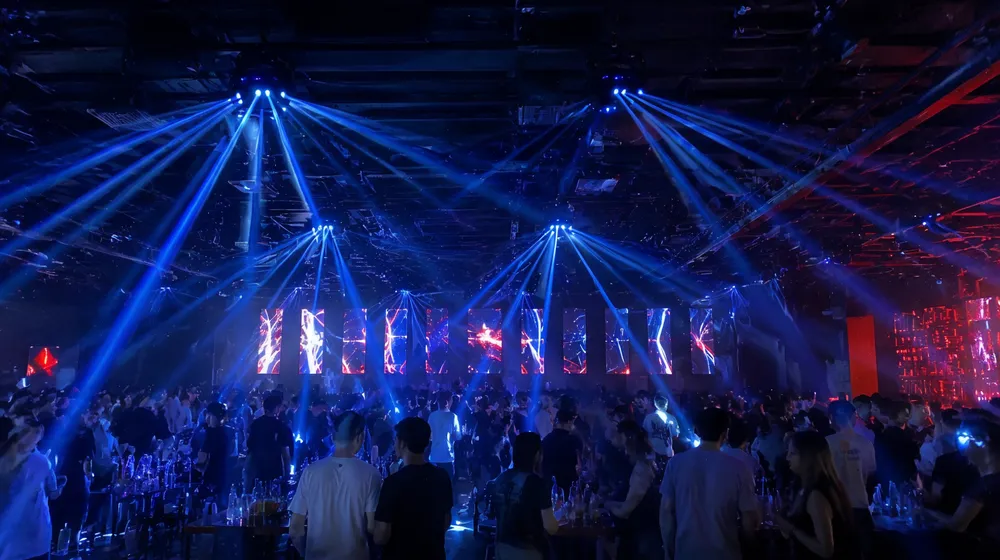
Club designers spec spider fixtures for dance floor coverage — the multi-beam sweep patterns fill the room from fewer mounting points. Fewer fixtures per install means lower installation labor for your contractor customers, which makes your spider a cost-saving recommendation rather than a premium upsell.
Clubs typically install 2–6 spiders per venue depending on floor size, and fixture refresh cycles run 3–4 years for high-use venues.
Rental & Production Companies
The Repeat Segment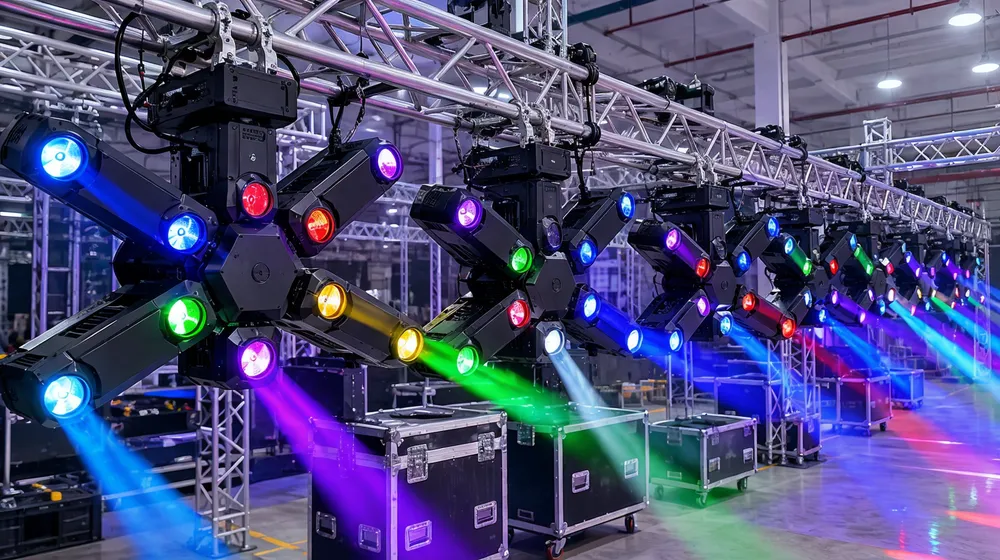
Rental houses buy spiders in matched sets (4, 8, or 16 units) for touring packages and event production. They care about batch uniformity above all — every unit in a rig must produce identical beam patterns, colors, and movement speeds.
Our LED binning and motor calibration processes guarantee unit-to-unit consistency within a production batch, which is why rental companies become repeat buyers once they've integrated a matched set into their inventory.
Rental companies are also the buyers most sensitive to bar rotation mechanism quality — their fixtures see 200+ gig cycles per year.
Event & AV Companies
The Specification Segment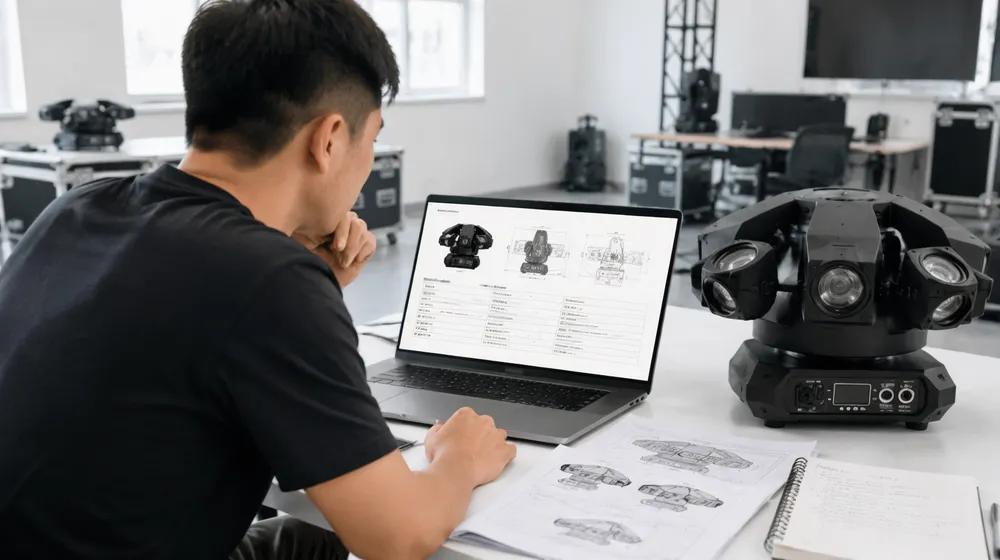
AV integrators and event production firms specify spiders for corporate events, product launches, and concert touring. They need fixture data — photometric numbers, DMX channel maps, rigging weight with clamp, power draw at full output — for technical riders and venue load calculations.
We provide full technical documentation packages for each model, so your sales team can respond to spec requests without engineering back-and-forth.
OEM Spider Fixtures — Your Brand on a Proven Platform
Spider moving DJ lights are one of our most-requested OEM platforms. The fixture's visual distinctiveness means your branded version stands out in distributor catalogs — it doesn't look like every other moving head on the market, so brand attribution is stronger.
Standard OEM Options
30-unit minimum · Sample in 7–10 days
- Logo printing or laser engraving on housing panels
- Custom boot screen / startup logo on the DMX display
- Branded packaging with your color scheme and product photography
- Model number and product naming to match your catalog system
- Private-label user manual and spec sheets in your format
ODM Development
Custom engineering · 3–4 development cycles
- Modified head count (6, 8, 10, or 12 heads per configuration)
- Custom LED wattage per head (10W, 15W, 20W, 40W RGBW options)
- Alternative beam angles via lens swap (3°, 4.5°, 6°, 8°)
- Wireless DMX integration (W-DMX, CRMX compatible modules)
- Custom housing color or finish (powder coat, anodized, textured black)
- Modified frame geometry (straight bar, triangle, curved) — requires new tooling
ODM Project Examples
We've completed full ODM spiders for rental companies that wanted specific beam angles optimized for their standard throw distances, and for branded entertainment firms that needed a unique frame silhouette for visual identity.
Your IP stays in-house — our 15-engineer R&D team handles optical, electrical, and mechanical development without subcontracting.
Packaging and Container Loading — Your Landed Cost Math
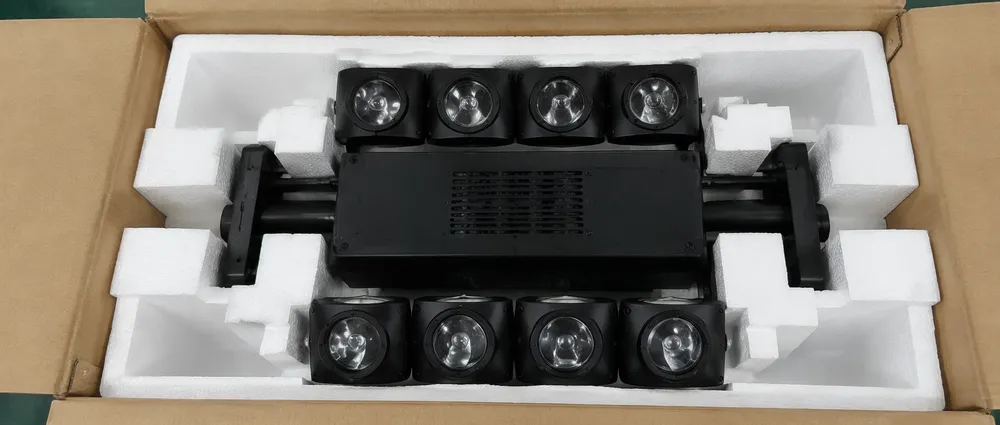
Spider fixtures are geometrically awkward for packing — the bar arms extend beyond the main body, and the LED heads need individual protection against impact. We've designed a model-specific molded foam cradle for each spider configuration that secures the fixture in its natural position without compressing the bar assembly or pressing against head optics.
8-Head Spider
12-Head Spider
Transit Damage Rate
< 0.4%
Across all spider fixture shipments
Molded Foam Cradle Engineering
The molded foam cradle absorbs shock forces at the bar pivot points and head mounting brackets — the two areas most vulnerable to impact damage during container transport.
We redesigned the foam mold twice in 2018 after seeing cracked bar pivot housings on ocean shipments through rough weather — the current foam geometry includes lateral bracing that wasn't in the original design.
Mixed-Model Container Optimization
For mixed-model orders — spiders combined with beam heads, mini fixtures, or LED wash lights — we can build a combined loading plan that maximizes your container cubic utilization. Spider cartons stack well under heavier beam head cases due to the foam structure's compressive strength.
Compliance Documentation Your Import Clears On
| Certification | What It Covers | Your Import Benefit |
|---|---|---|
| CE (EMC + LVD) | EU electromagnetic and safety compliance | Direct import into EU member states |
| FCC Part 15 | US/Canada electromagnetic emissions | No FCC holds at US ports |
| RoHS | EU restricted substances directive | Meets WEEE/RoHS requirements for EU resale |
| ISO 9001:2015 | Quality management system | Audit documentation for your vendor qualification |
Documentation Ships Standard
All test reports and declarations of conformity ship with your order as standard. The universal input voltage (100–240V, 50/60Hz) means the same fixture model clears both 120V North American and 230V European/Asian electrical safety requirements without product variants — one test report covers all markets.
Additional Market Certifications
If your downstream market requires additional certifications beyond CE/FCC — ETL listing for certain US commercial venues, specific Australian RCM marking — our engineering team coordinates with accredited test labs to complete the documentation on your production batch.
Learn more about our certification capabilitiesOne SKU, global clearance. Universal voltage input eliminates the need for market-specific product variants — simplifying your inventory and reducing per-market certification costs.
Frequently Asked Questions Spider Moving DJ Lights
How many DMX channels do spider moving DJ lights actually need?
How many DMX channels do spider moving DJ lights actually need?
Depends on the control depth your customer requires. Our 8-head spiders run three modes:
Bar rotation, master dimming, macro effects — suitable for sound-active DJ use
Per-head RGBW + strobe + bar speed + pan/tilt
Per-head individual dimming curves, fine positioning, per-head strobe rates
Most mobile DJ distributors promote the 15-channel mode in marketing materials because it's plug-and-play. Rental companies and programmers use the 46 or 91-channel modes. Make sure your product listing mentions all available modes — it expands your addressable customer base.
What's the typical failure point on spider moving DJ lights, and how do you prevent it?
What's the typical failure point on spider moving DJ lights, and how do you prevent it?
The bar rotation mechanism — specifically the power transfer from the stationary body to the spinning bar. Cable-wrap designs fail at the flex point after 6–12 months of nightly use. We use gold-plated slip rings for infinite rotation without cable fatigue.
Second most common failure: LED head misalignment from bar vibration. We dynamically balance every bar assembly and use locking fasteners on head mounting hardware.
Our 48-hour aging test runs continuous bar rotation at variable speeds to catch any mechanical defect before shipment.
Can I mix spider fixtures with other moving heads on the same DMX universe?
Can I mix spider fixtures with other moving heads on the same DMX universe?
Yes — standard DMX512 protocol. Spider fixtures address the same way as any other DMX fixture. The only consideration is channel count: a full-control 8-head spider at 91 channels consumes significant universe space if you're running many units.
For large spider rigs (8+ fixtures on full control), recommend your customers plan for two DMX universes or use the extended mode (46 channels) which still provides per-head color control while halving the channel footprint.
What's the MOQ for custom-branded spider moving DJ lights?
What's the MOQ for custom-branded spider moving DJ lights?
30 units
Your logo, packaging, boot screen on our existing platform. Samples on existing models ship in 3–7 days.
30 units
Custom head count, modified frame, proprietary beam angle. Add 3–4 engineering cycles before production.
Most buyers start with a 30-unit OEM order to test market response, then move to ODM customization once they've validated demand.
Spider moving DJ lights vs. LED beam bar: which should I stock?
Spider moving DJ lights vs. LED beam bar: which should I stock?
Different market positions. Beam bars (linear LED arrays without individual head movement) are lower-cost, lower-margin, and compete on price in the budget segment. Spiders command 3–5× the unit price because of independent head control, continuous bar rotation, and the effect complexity that creates.
If your catalog already covers the budget segment with beam bars, spiders fill the mid-to-premium tier without cannibalizing your existing line.
If you're building from scratch, spiders are the higher-margin entry point — the mobile DJ who buys a spider won't downgrade to a beam bar.
Sibling Products If This Fixture Isn't the Right Fit
Your moving head catalog likely needs more than one fixture type. Here's how spiders sit relative to our other moving DJ light categories:
Beam Moving DJ Lights
Concentrated single-beam punch — tighter beam angles and higher per-head lumen output for mid-air effects and gobo projection. The classic moving head form factor.
LED Moving DJ Lights
Full-stage wash coverage — wide-angle color wash with RGBW mixing from high-wattage single-source heads. Designed for stage wash duties where even coverage matters more than beam effects.
Laser Moving DJ Lights
Laser-based aerial effects — razor-sharp aerial patterns in haze that LED-based fixtures can't replicate. A growing premium segment especially in Southeast Asian and Middle Eastern nightclub projects.
Mini Moving DJ Lights
Budget-friendly entry point for mobile DJs — under 4 kg with lower price points. Your high-volume, low-unit-cost SKU for e-commerce and DJ starter kits.
Next Step — Get Spider Fixture Pricing for Your Market
Most buyers in this category start one of two ways:
Testing the Fixture
Order 30 units of the 8-head or 12-head configuration. Run them at full output for a weekend. Demo them for your top accounts.
We ship standard-model samples within 3–7 days.
Building a Branded Spider Line
Send us your target retail price point, preferred head count, and any beam angle or color requirements.
Our engineering team will spec the configuration that protects your margin and send back a detailed quote with DMX channel maps and photometric data.
Contact Engineering
Engineering review and pricing back within 48 hours.