

Professional DJ Lights Systems Complete Fixture Packages for Commercial Deployment
Factory-direct system packages designed around venue requirements, not individual fixture specs. Your entire lighting rig arrives tested, addressed, and matched — ready to install or resell as a complete solution.
CE/FCC/RoHS compliant · 48-hour aging on every unit
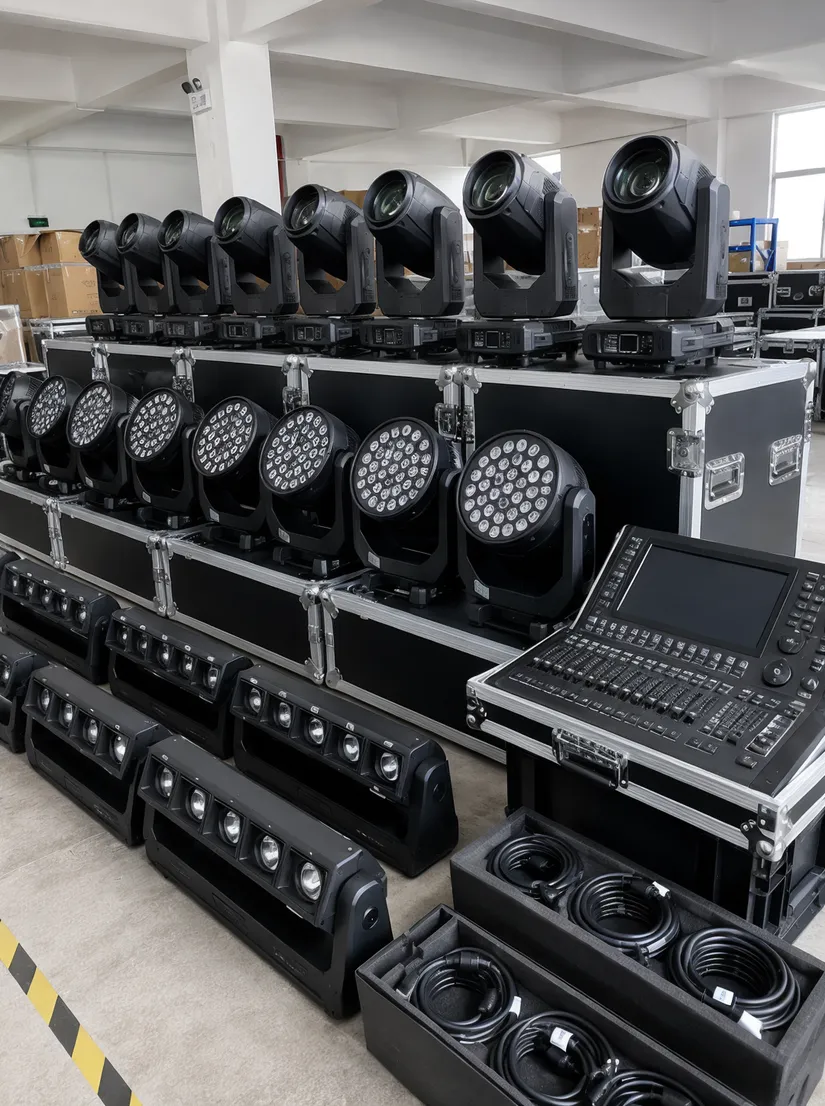
What a Professional DJ Lights System Actually Includes
A professional DJ lights system isn't a single fixture — it's a coordinated package of moving heads, wash pars, beam effects, strobes, and DMX control hardware configured to cover a specific venue size or application type. We build these as matched kits: optical outputs balanced, DMX addressing pre-configured, power draws calculated against standard circuit capacities, and fixture weights matched to common truss loading limits.
When you stock or deploy complete systems rather than individual fixtures, your value proposition to downstream buyers changes fundamentally. Instead of selling components that require a lighting designer to spec and integrate, you sell solutions. The installer opens boxes, mounts fixtures at marked positions, connects DMX and power, and the system runs. That completeness commands premium pricing — typically 25-35% above the sum of individual fixture costs — because you're selling reduced installation time and eliminated compatibility risk.
We package systems in several standard configurations based on venue capacity: small-format (clubs, bars, private event spaces under 200 capacity), mid-format (live venues, banquet halls, houses of worship 200-800 capacity), and large-format (touring rigs, arena sub-systems, festival stages). Each tier uses different fixture combinations, throw distances, and power architectures. You can stock our standard configurations or work with our engineering team to define custom packages for your specific market.
Most of our distributors start with 2-3 standard configurations, then request custom variations once they see which venue types drive repeat orders in their region.
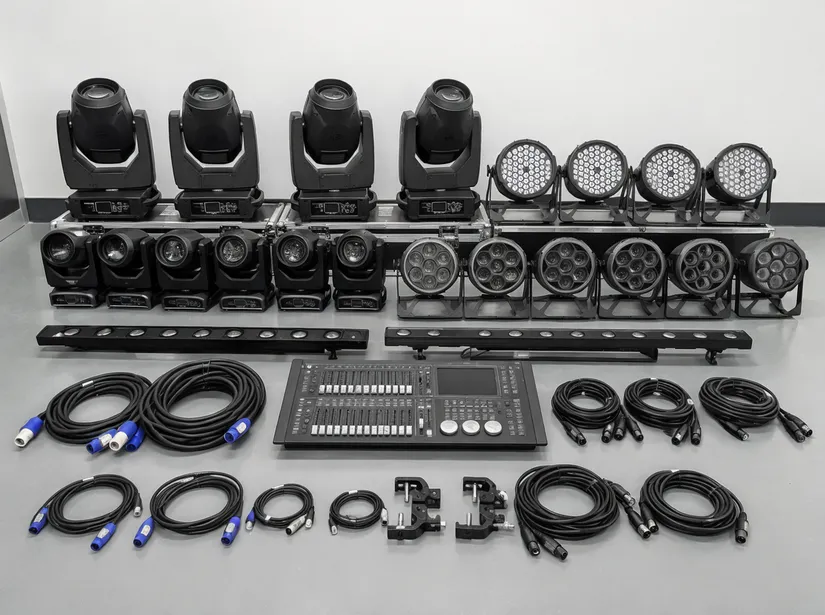
Pre-Configured DMX
Addressing set at factory — no field programming required for standard deployment.
Matched Loads
Power draws and weights calculated against standard circuits and truss ratings.
Technical Specifications for Standard System Configurations
The specifications below represent our standard system tiers. These are industry-typical values for professional DJ lighting deployment — exact specifications vary by configuration and can be confirmed for your specific order.
Small-Format System (Under 200 Capacity)
| Parameter | Specification |
|---|---|
| Moving heads | 2-4 units, 150W LED, 14° beam angle |
| Wash PARs | 4-8 units, 18×10W RGBW, 25° standard / 15° narrow lens |
| Effect fixtures | 2 units (derby/laser/strobe combination) |
| DMX controller | 192-channel console or wireless tablet interface |
| Total system power | 1,200-2,000W (single 20A circuit capable) |
| Typical throw distance | 3-6 meters |
| Max truss span supported | 6-8 meters |
| Fixture total weight | 45-65 kg (within standard portable truss rating) |
| DMX channels per system | 80-120 channels |
Mid-Format System (200-800 Capacity)
| Parameter | Specification |
|---|---|
| Moving heads | 4-8 units, 230W-350W, beam/spot/wash hybrid |
| Wash fixtures | 8-12 units, 36×10W RGBW, motorized zoom 15°-60° |
| Beam effects | 4 units, 260W+ prism beam with gobo wheel |
| Strobes | 2-4 units, high-output LED strobe/blinder |
| DMX controller | 512+ channel console with artnet/sACN output |
| Total system power | 4,000-8,000W (dedicated lighting circuit) |
| Typical throw distance | 6-15 meters |
| Max truss span supported | 10-14 meters |
| Fixture total weight | 150-280 kg |
Large-Format System (Touring / Festival)
| Parameter | Specification |
|---|---|
| Moving heads | 12-24 units, 380W-500W, full CMY color mixing |
| Wash fixtures | 16-32 units, 36×15W RGBWA+UV, IP65 rated for outdoor |
| Beam arrays | 8-12 units, high-power beam with dual prism rotation |
| Effect/strobe | 8+ units, combination pixel-mapped strobe/wash |
| Control infrastructure | Dual-redundant DMX/artnet with network switch |
| Total system power | 15,000-35,000W (three-phase power distribution) |
| IP rating (outdoor units) | IP65/IP67 |
| Fixture total weight | 600-1,200 kg |
Specifications shown are industry-standard values for these system tiers. Contact us for detailed data sheets and exact configurations matching your venue requirements.
Revenue Segments Where Complete Systems Outsell Individual Fixtures
Each application below represents a market segment where your buyers expect — and will pay for — complete system solutions rather than fixture-by-fixture purchasing.
Mobile DJ and Event Rental Companies
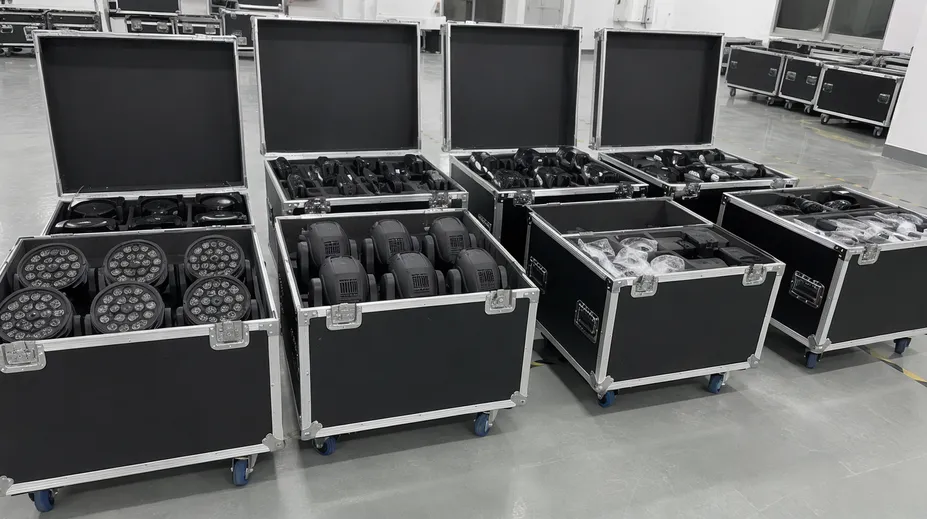
Mobile DJs and event rental operators need systems that set up fast, survive transport, and cover the most common gig types without carrying excess inventory. They buy complete packages because integration time is money — every hour spent on compatibility troubleshooting is an hour not generating rental revenue.
Order Patterns
5–20 systems per buyer, reorders every 12–18 months as fixtures reach end of rental life. Rental fixtures take more abuse than installed fixtures, so the 48-hour aging test and 100% outgoing inspection translate directly into fewer mid-rental failures — a dead fixture at a wedding costs your customer a client, and costs you a warranty claim plus a reputation hit.
Nightclubs and Entertainment Venues (New Build and Refit)
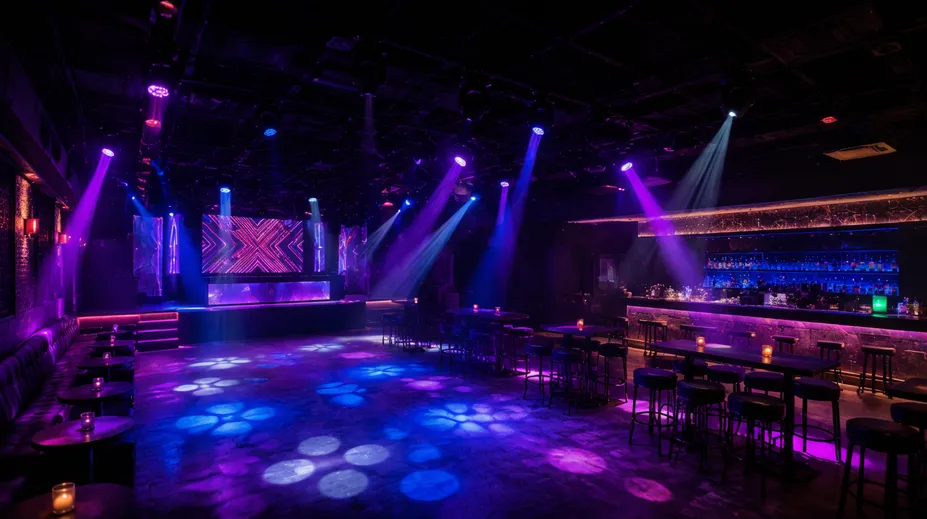
Venue owners doing a lighting refit typically hire a lighting designer who specs individual fixtures. But for the mid-market — bars, small clubs, lounges — the owner just wants "a good lighting system" without the consultant fee. Your opportunity: sell pre-configured systems by venue size, eliminating the design step.
Sales Tool Available
We can provide suggested fixture layout drawings for common venue geometries — a selling tool you can hand to your venue-owner customers to close the deal faster.
Houses of Worship
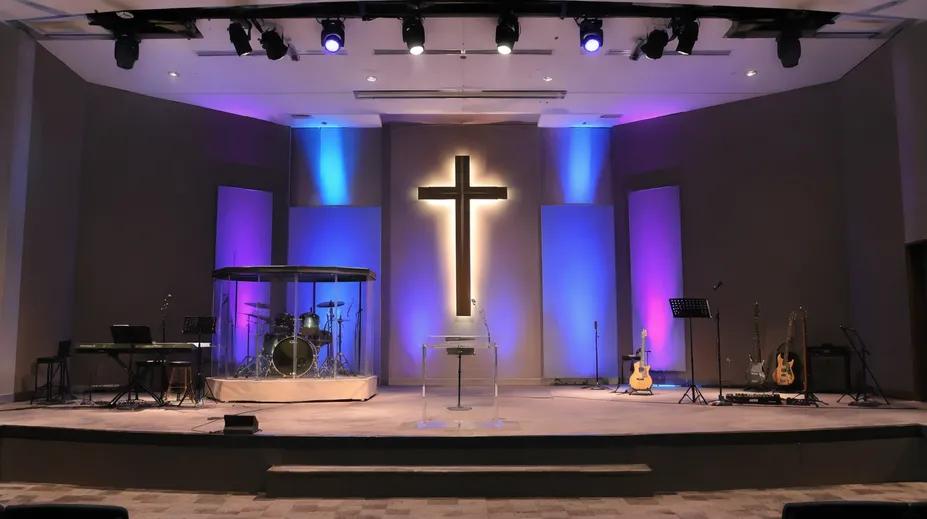
Churches and worship spaces represent a specific and growing segment. They need stage lighting that handles both subdued worship settings and high-energy contemporary services, controlled by volunteers with minimal technical training.
Growth Trend
This segment has grown steadily over the past four years — many congregations are upgrading from basic PAR cans to proper moving-head systems as their production values increase.
Contractors and System Integrators
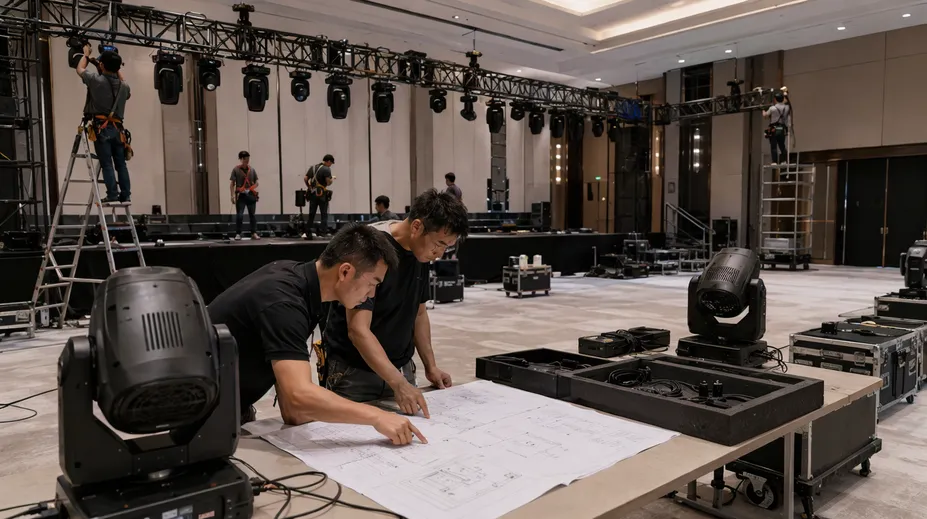
AV integration firms deploying permanent installations for hotels, corporate event spaces, cruise ships, and theme parks need fixture packages that arrive pre-addressed with full DMX maps, wiring diagrams, and integration documentation.
Your Margin Opportunity
Selling a complete pre-engineered system — rather than a parts list the customer assembles — justifies a project management markup and reduces your on-site commissioning time.
What You Can Customize — And What's Fixed
Fully Customizable
| Dimension | Options |
|---|---|
| System composition | Any combination of our fixture models; add/remove fixtures to match venue type |
| Fixture color/finish | Black, white, custom RAL colors on housings |
| Branding (OEM) | Your logo on fixtures, controllers, packaging, firmware splash screen |
| DMX addressing | Pre-addressed to your channel map; custom starting addresses per fixture |
| Beam angle / lens | Multiple lens options per fixture (narrow, medium, wide, elliptical) |
| Voltage configuration | 100–120V / 220–240V / Universal input |
| Control protocol | Standard DMX512, Art-Net, sACN, wireless DMX (W-DMX compatible) |
| Packaging configuration | Individual boxes, system kits in flight cases, bulk palletized |
MOQ / Lead Time Notes
- • Custom RAL colors: 100+ units, adds 5–7 days
- • OEM branding: from 30 units, adds 3–5 days
- • Custom optical assemblies: 200+ unit MOQ
- • DMX pre-addressing and voltage config: no extra cost or time
- • Proprietary protocol: requires engineering review
- • Flight case packaging: adds per-unit cost, no MOQ impact
Fixed Parameters (Engineering Constraints)
Wattage within each fixture model is fixed — it determines thermal design and cannot be changed without new heatsink tooling.
Die-cast tooling is fixed per model; dimensional changes require new mold ($8,000–15,000 tooling investment, 45–60 day lead time).
Upgrading a non-IP-rated fixture to IP65 requires housing redesign, not just gasket addition.
Mechanical limits set by motor and gear assembly; cannot be extended without safety risk.
Need a parameter listed as "fixed"?
We can discuss a full ODM development. Our engineering team has done 30+ custom fixture developments — the tooling investment is real, but the per-unit cost amortizes quickly at volumes above 500 units.
How Professional DJ Lights Systems Get Built in Our Factory
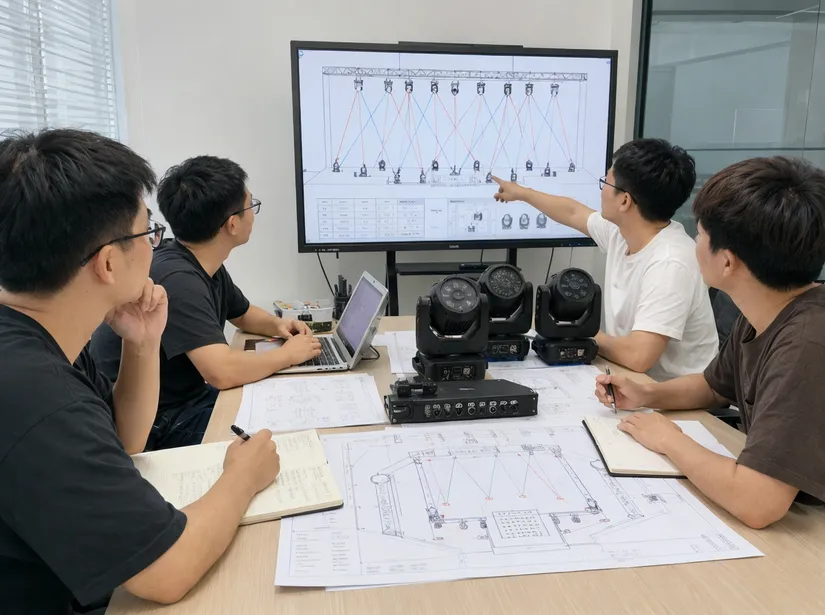
System packaging starts well before the production line. Our engineering team defines the system architecture: fixture selection, power budget, DMX channel allocation, physical layout recommendations, and thermal headroom calculations. This system-level engineering ensures that the 8 fixtures in your "mid-venue package" actually play well together — beam angles complement rather than overlap, color mixing produces consistent washes when fixtures are positioned at different throw distances, and total power draw doesn't exceed standard venue circuit capacity.
On the production floor, system orders run differently from individual fixture orders. We batch-produce all fixtures for a system configuration on the same line run, which means LED bins are identical across your wash fixtures (no color temperature mismatch between unit 1 and unit 12), mechanical components come from the same machining batch, and firmware versions are uniform. We then pre-address DMX channels, run system-level integration testing (all fixtures responding to a master controller simultaneously), and verify output consistency across the set before individual aging tests begin.
48-Hour Full-Load Aging Test — Every Unit, Not a Sample
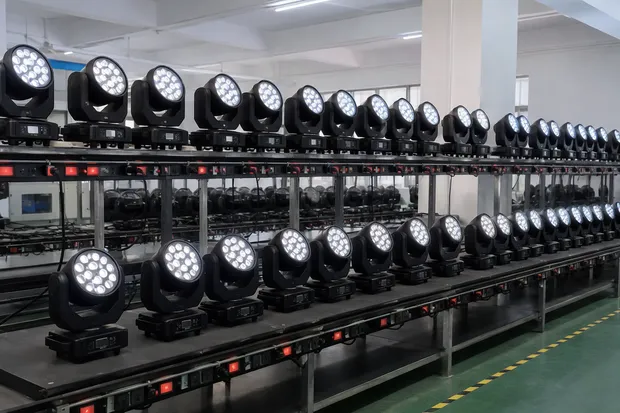
The 48-hour aging test runs at full electrical load on every unit — not a sample. We originally implemented this because stage fixtures run 4–8 hours continuously at near-maximum output. A fixture that passes a 10-minute bench test but develops thermal throttling at hour 3 creates a field failure.
After aging, any unit showing lumen depreciation beyond 3% or color shift beyond ±150K from the target CCT gets pulled and reworked. Your system ships with matched output across every fixture in the kit.
System-Level Final QC
Final QC on system orders adds a step individual fixtures don't get: we power up the complete system package on a test rig, run it through the programmed scene presets, and verify that all fixtures respond correctly to the controller included in the kit. When you or your customer opens the boxes, the system works as a unit on first power-up.
Compliance Documentation That Clears Your Import Path
Professional DJ lights systems ship with full documentation packages for major import markets. Your container clears customs without documentation holds.
CE Marking
LVD + EMCMandatory for European market entry. Test reports from accredited labs included with every shipment. Your European distributors get the CE paperwork they need for downstream resale without chasing test reports after the fact.
FCC Part 15
Class A DigitalRequired for US distribution. All fixtures pass conducted and radiated emissions testing for Class A digital devices. North American accounts get FCC declarations formatted for their compliance files.
RoHS 2.0 / REACH
EU Material ComplianceMaterial compliance declarations confirming restricted substance limits for EU market. Lead-free solder, halogen-free PCBs.
IP65 / IP67
Outdoor-Rated OnlyIngress protection certification for fixtures marketed for outdoor festival or architectural use.
ISO 9001:2015
QMS CertifiedQuality management system certification covering design, production, and inspection processes.
Additional Markets
ETL · SAA · KCETL/cETL for Canadian retail, SAA for Australia, KC for South Korea. We maintain relationships with accredited testing labs and can add certification to specific fixture models as part of an ODM project.
Additional Certification Timeline
For markets requiring additional certifications (ETL/cETL for Canadian retail, SAA for Australia, KC for South Korea), we maintain relationships with accredited testing labs and can add certification to specific fixture models as part of an ODM project. Typical timeline: 4–6 weeks from sample submission to certificate issuance, depending on the certification body's queue.
Container Loading and Landed Cost Considerations
How your order ships affects your per-unit landed cost as much as the FOB price does. We design packaging to maximize container utilization:
| System Tier | Units per 20GP | Units per 40HQ | Packaging Method |
|---|---|---|---|
| Small-format systems | 80–100 complete systems | 180–220 complete systems | Individual fixture cartons, palletized |
| Mid-format systems | 30–45 complete systems | 70–100 complete systems | Individual fixture cartons or optional flight cases |
| Large-format systems | 10–15 complete systems | 25–35 complete systems | Foam-insert cartons, heavy-duty palletized |
Packaging That Protects
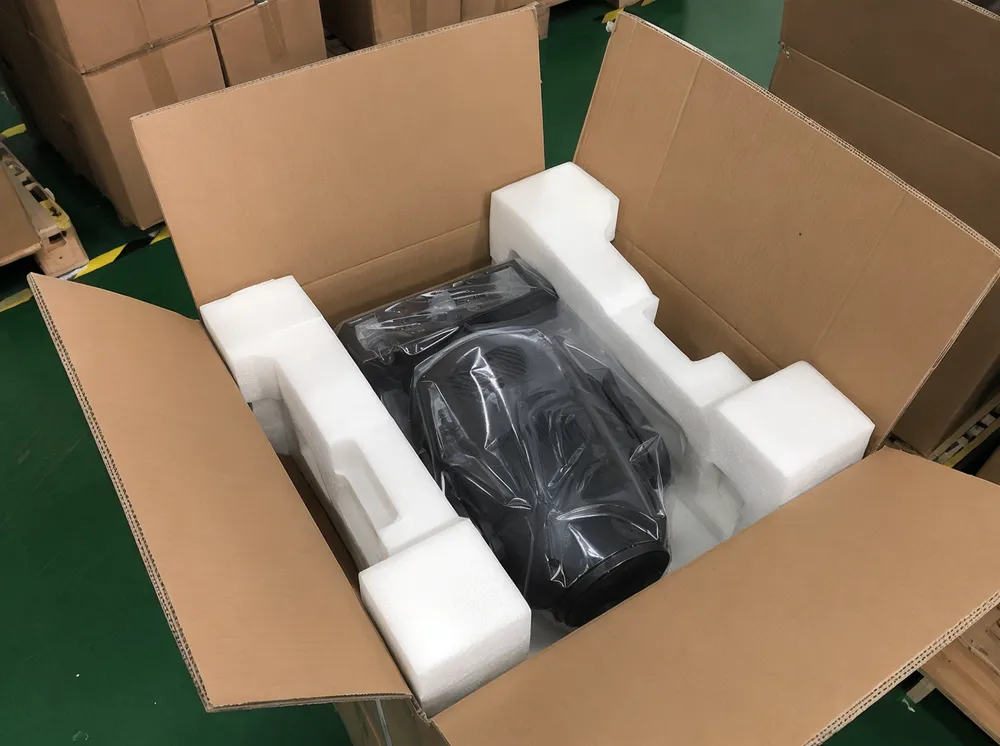
Each fixture ships in a molded foam insert inside a reinforced master carton — stacking strength tested for container transport. We've seen competitors use minimal packaging to quote lower shipping volume, and then 5% of the container arrives with cracked housings or bent yokes.
Our packaging adds roughly 8–12% to the shipping volume per unit but effectively eliminates transit damage claims. The math works in your favor: replacing one damaged 350W moving head costs more than the incremental shipping cost on the entire pallet.
Amazon FBA / Warehouse Ready
For distributors running Amazon FBA or warehouse fulfillment: we ship fixtures in retail-ready individual packaging with your branding, UPC barcodes, and FBA-compliant labeling applied at our facility. No repackaging needed at your warehouse — straight from our container to your fulfillment center shelves.
Blind Drop-Shipping
Supported for distributors who sell online without holding inventory. We ship directly to your end customer under your branding with no GDMonkey identification on the packaging or documentation.
Custom Branding at Source
Your logo, your packaging, your barcodes — all applied at our facility before the container ships. Eliminates an entire step from your supply chain and reduces handling damage from repack operations.
Frequently Asked Questions — Professional DJ Lights Systems
What IP rating do I need for outdoor DJ lighting installations?
+
IP65 minimum for any fixture exposed to weather — that covers rain, dust, and pressure washing between events. For permanent outdoor installations or festival stages where fixtures stay rigged through multi-day events including potential storms, specify IP67.
We rate our outdoor fixtures through actual immersion and spray testing, not theoretical calculations. Indoor-only systems don't require IP rating, so if your market is primarily clubs and indoor venues, you can save the cost premium of sealed housings.
How many DMX channels does a typical professional DJ system require?
+
A small-venue system (4 moving heads + 8 wash pars + effects) consumes 80–120 DMX channels in full-feature mode. A mid-venue system runs 200–350 channels.
If you're deploying systems with basic operator training (volunteers at churches, bar staff), we configure simplified DMX modes — each fixture runs on 6–8 channels instead of 16–24 — which brings a full system under 192 channels and compatible with entry-level controllers.
What's the typical LED lifespan in professional DJ fixtures, and how does it affect reorder cycles?
+
Quality LED sources (Epistar, CREE, Osram chips — which we use across our professional lines) rate at 50,000 hours to L70, meaning 70% of original output at the 50,000-hour mark. For a nightclub running lights 6 hours nightly, 6 days per week, that's over 26 years of theoretical LED life.
In practice, other components (capacitors in drivers, motor bearings in moving heads, cooling fans) limit fixture life to 15,000–25,000 hours of heavy use.
For rental companies running fixtures hard, expect 3–5 year replacement cycles — which means predictable reorder revenue for your distribution business.
What's the minimum order for a custom-branded DJ lighting system?
+
30 units for OEM branding on standard system configurations — your logo, your packaging, your firmware splash screen applied to our existing fixture models.
For custom system compositions (specific fixture combinations not in our standard lineup), no minimum beyond standard production batch sizing.
Full ODM development (new fixture design, custom tooling) typically requires 500+ unit commitment to justify tooling investment, though we can discuss lower volumes if the product has clear market demand.
LED beam fixtures vs. LED wash fixtures — when does a system need both?
+
Beam fixtures produce tight, defined shafts of light (typically 1°–5° beam angle) that create dramatic aerial effects — they look impressive but illuminate almost nothing on stage.
Wash fixtures produce broad, even coverage (15°–60° beam angle) that actually lights performers and sets.
Any system for a venue that hosts both performances and DJ events needs both: washes for functional stage lighting during live acts, beams and effects for high-energy DJ sets. We configure our mid-format and large-format systems with both fixture types at a ratio matched to the venue's primary use case.
Expand Your Inventory
Related Products Under Professional DJ Lights
If complete systems don't match your purchasing model, or you need to supplement existing inventory with specific fixture types:
DJ Lights Effect
Individual effect fixtures — derbies, lasers, strobes, moonflowers — for buyers who stock components rather than systems, or need to add specific effects to an existing rig. Effect fixtures are also popular as impulse-purchase items for smaller entertainment retailers.
Browse the Full Professional DJ Lights Range
View the complete category — all fixture types, system packages, and individual components available for wholesale and OEM/ODM sourcing.
Start With Your Venue Type — We'll Handle the System Engineering
You know your market — the venue types your customers operate, the budgets they work with, the technical sophistication of their operators. Tell us those parameters and we'll come back with a system specification: fixture selection, quantities, DMX architecture, power requirements, and a packaged quote.
How Most New Accounts Start
Most new accounts start with a sample system — 1 complete kit at the target configuration — to evaluate build quality, light output, and ease of setup before committing to volume. We ship samples within 7–10 days for standard configurations.
Send us your target venue type, approximate budget range per system, and annual volume estimate — our engineering team responds with a full system proposal within 48 hours.
Get a System Proposal for Your Market