

Professional DJ Laser Lights Factory-Direct from GDMonkey
7 product configurations — from compact mini lasers to full-spectrum RGB projectors — covering the segments where your buyers actually spend money.
Engineered and manufactured in our 16,700 m² facility in Guangdong, China. 350,000-unit annual capacity exported to 30+ countries across 5 continents.
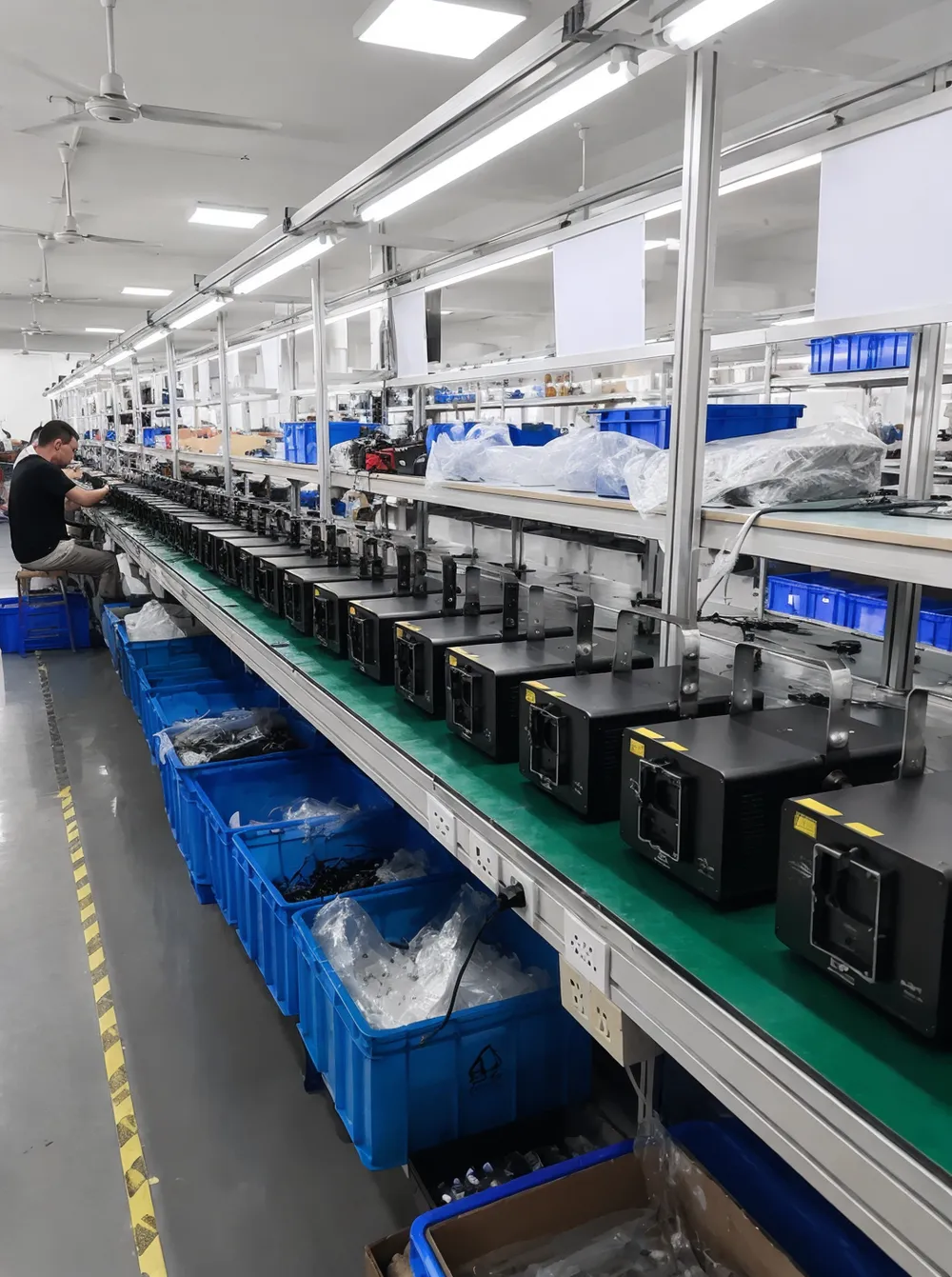
What We Manufacture and Where It Fits Your Catalog
We produce DJ laser lights — the category that sits between decorative LED effects and high-end concert laser systems. Our output covers the 50 mW to 500 mW range across single-color, dual-color, and full RGB configurations, all built for sound-reactive or DMX-controlled operation. Every unit ships with CE, FCC, and RoHS documentation, so your import clearance in North America and Europe is straightforward.
This category exists because the DJ and mobile entertainment market demands laser effects that ship in volume, hit consistent power output across a batch, and survive the reality of rental abuse — heat cycling, vibration in transit cases, hours of continuous duty in unventilated venues. We build for that duty cycle, not for a single demo in a showroom.
Your Commercial Position
DJ laser lights carry strong retail margins because end users perceive them as high-tech, but the manufacturing cost is moderate once you control the diode sourcing and optical alignment process. We control both. That margin gap is what makes this category worth stocking — and why buying from the manufacturer rather than a trading company protects your pricing power downstream.
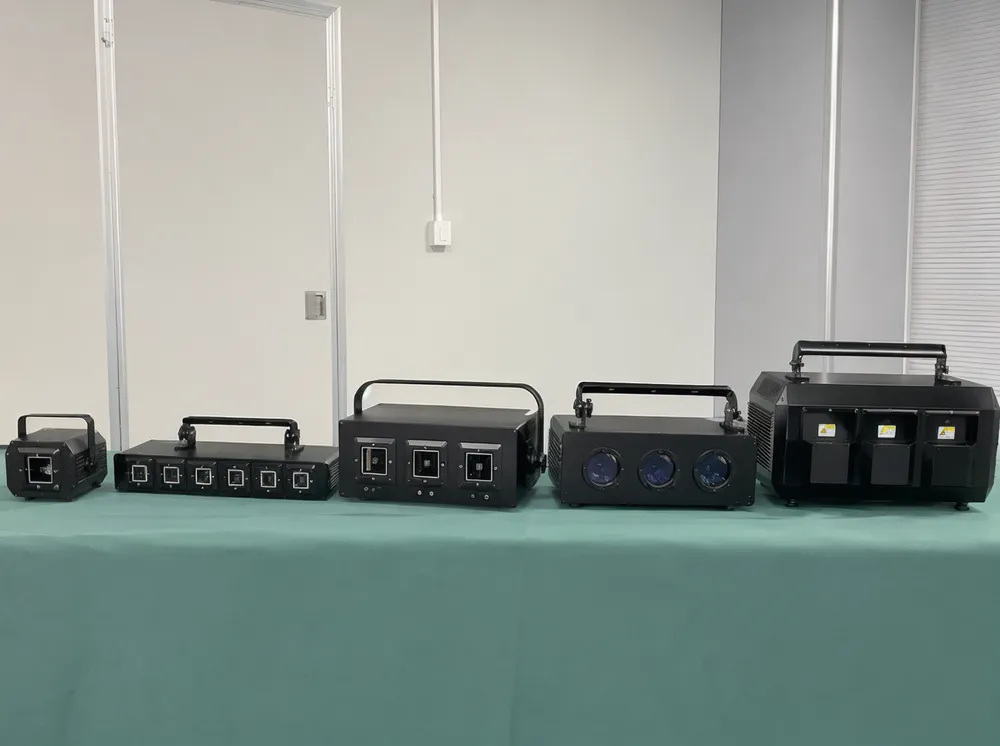
Category Positioning
Product Line Overview
Seven distinct product lines, each targeting a different price point and application segment in your market.
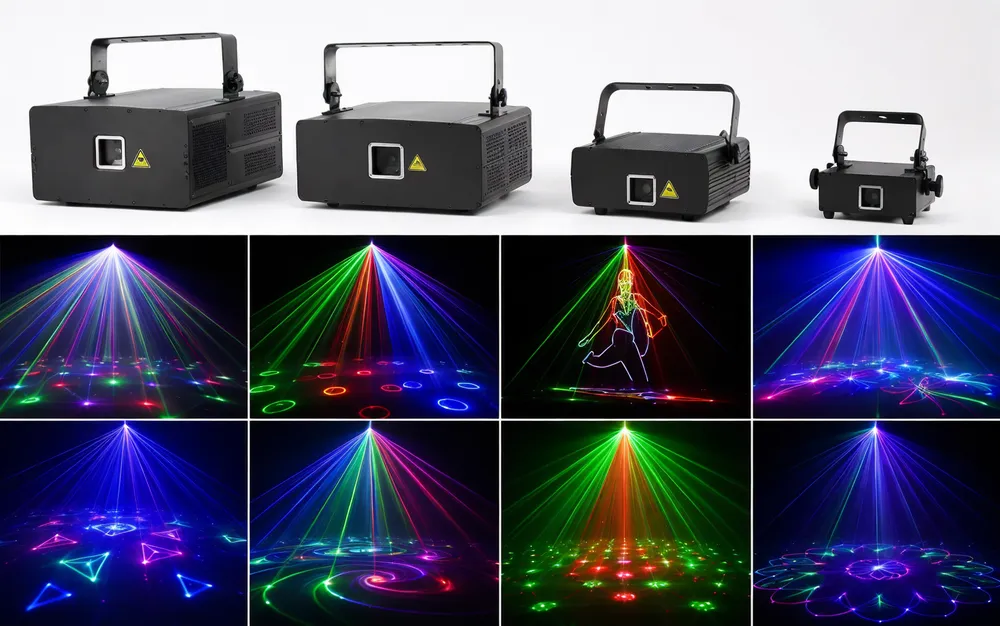
Professional DJ Laser Lights
High-output laser systems for working DJs and rental companies. Multi-pattern, DMX-addressable, built for nightly use in clubs, wedding venues, and touring rigs. Your anchor SKU for buyers who need reliability over novelty.
View Product Line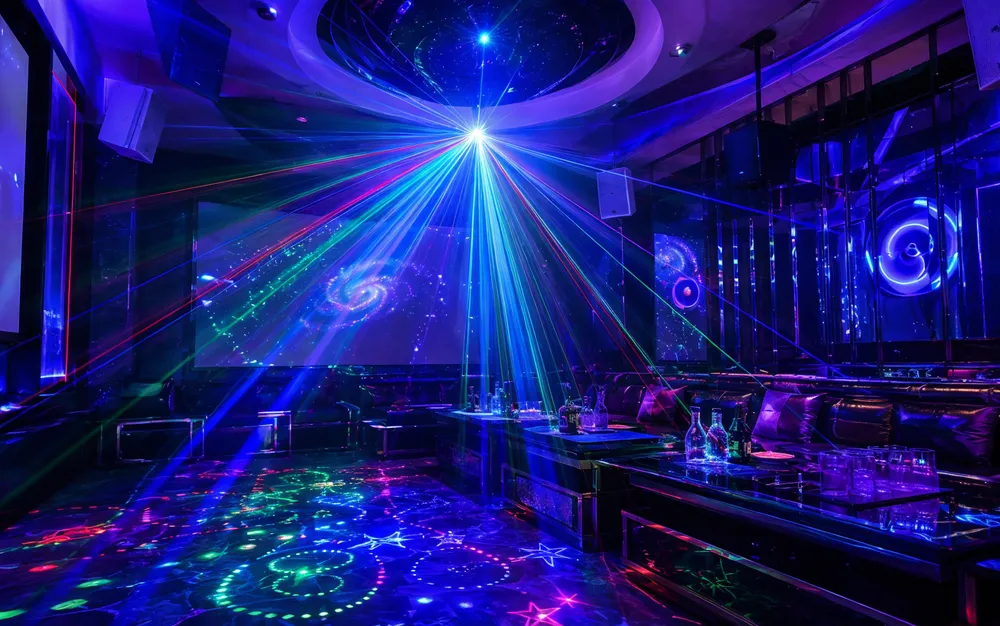
Disco DJ Laser Lights
Music-reactive multi-pattern lasers for entertainment venues, KTV rooms, and party rental operators. Auto-run and sound-active modes reduce setup complexity — your end users don't need a lighting console to get full effect.
View Product Line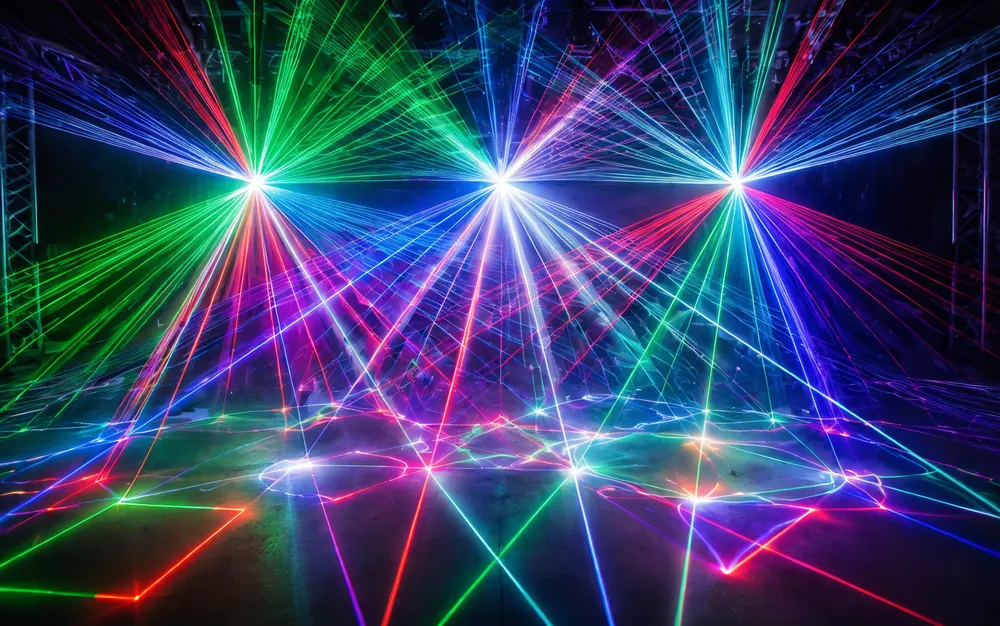
RGB Laser Projector DJ Lights
Full-color RGB combining red, green, and blue diodes for wide-gamut pattern projection. The highest visual impact per unit — and the highest margin per SKU in this category. DMX + ILDA compatible on upper-tier models.
View Product Line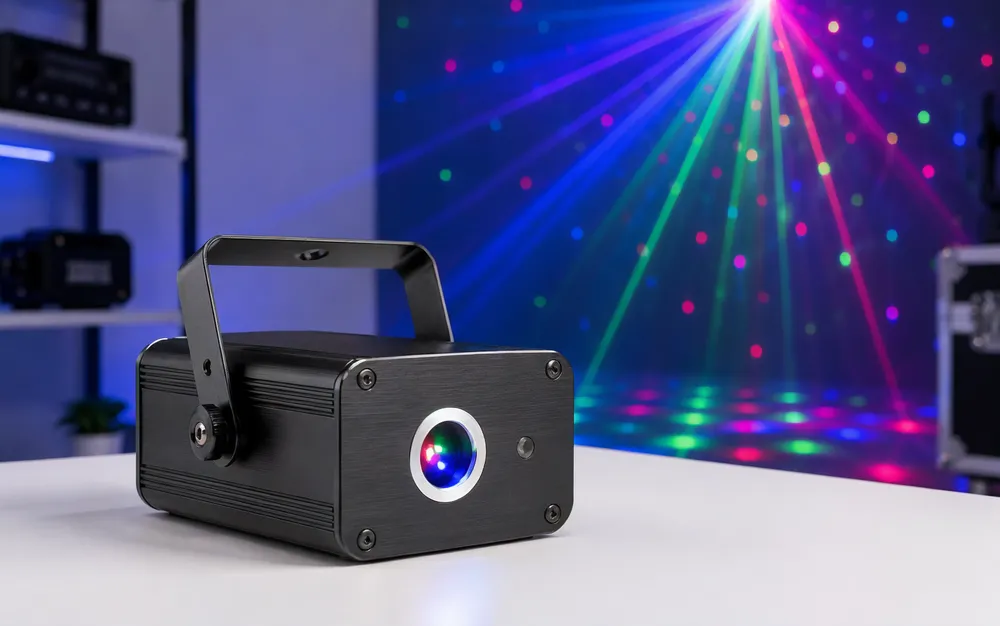
Mini DJ Laser Lights
Compact form factor for mobile DJs, home party use, and entry-level retail. Small package, low MOQ per SKU, and strong impulse-buy appeal for your e-commerce channels. These move in volume.
View Product Line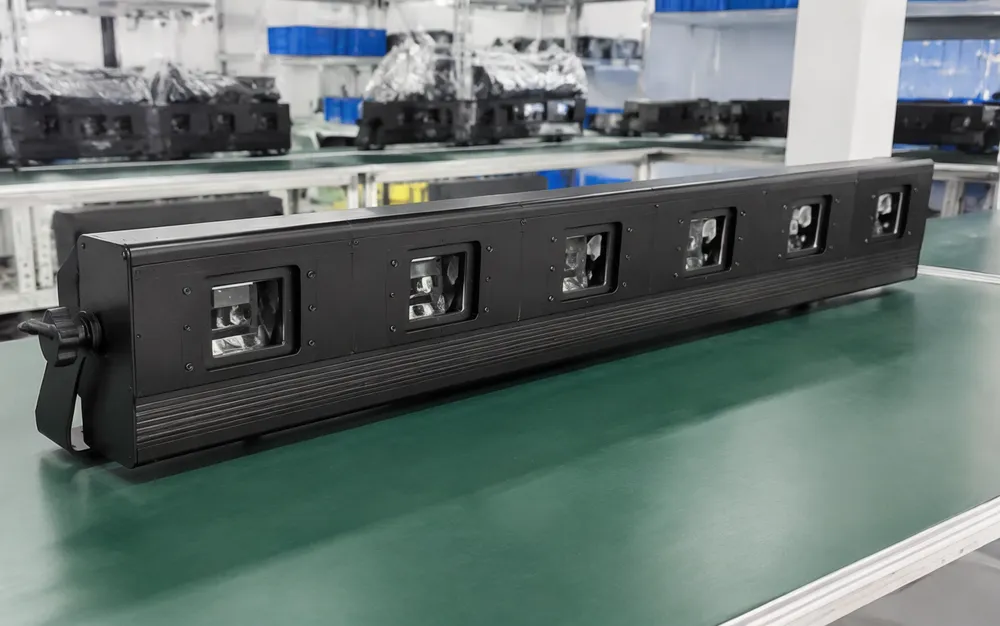
DJ Laser Bar Lights
Multi-head laser arrays in a linear housing — one fixture covers what three individual units would. Rental companies and installers buy these for fast setup and even coverage across wide stages.
View Product Line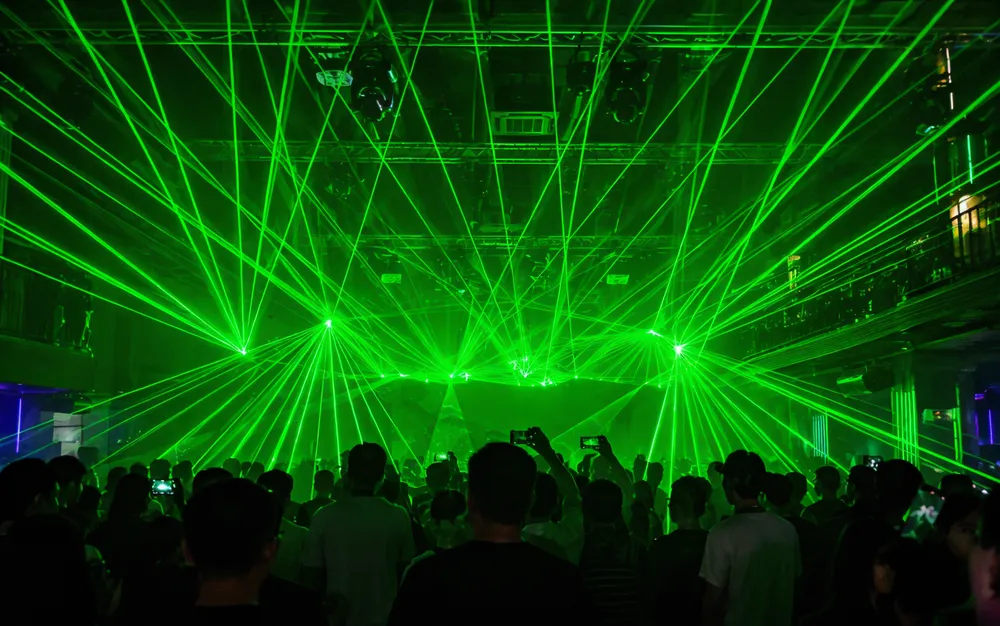
Green Laser DJ Lights
Single-color green at 532nm — the wavelength human eyes perceive as brightest. Maximum visibility per milliwatt. A strong seller in markets where regulations restrict total laser power but buyers still want impactful beam shows.
View Product Line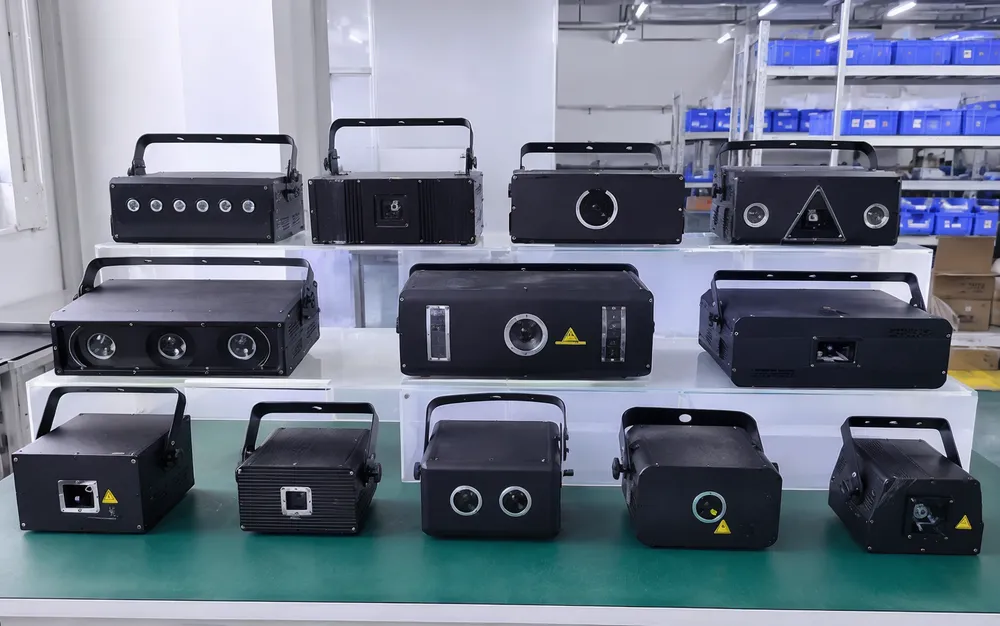
LED Laser DJ Lights
Hybrid fixtures combining LED wash/effect lighting with laser diodes in one housing. Reduces your buyer's fixture count and cabling — one unit, two effects. Growing fast in the mobile DJ and small venue segment.
View Product LineLaser Diode Sourcing and Optical Assembly — What Determines Your Batch Consistency
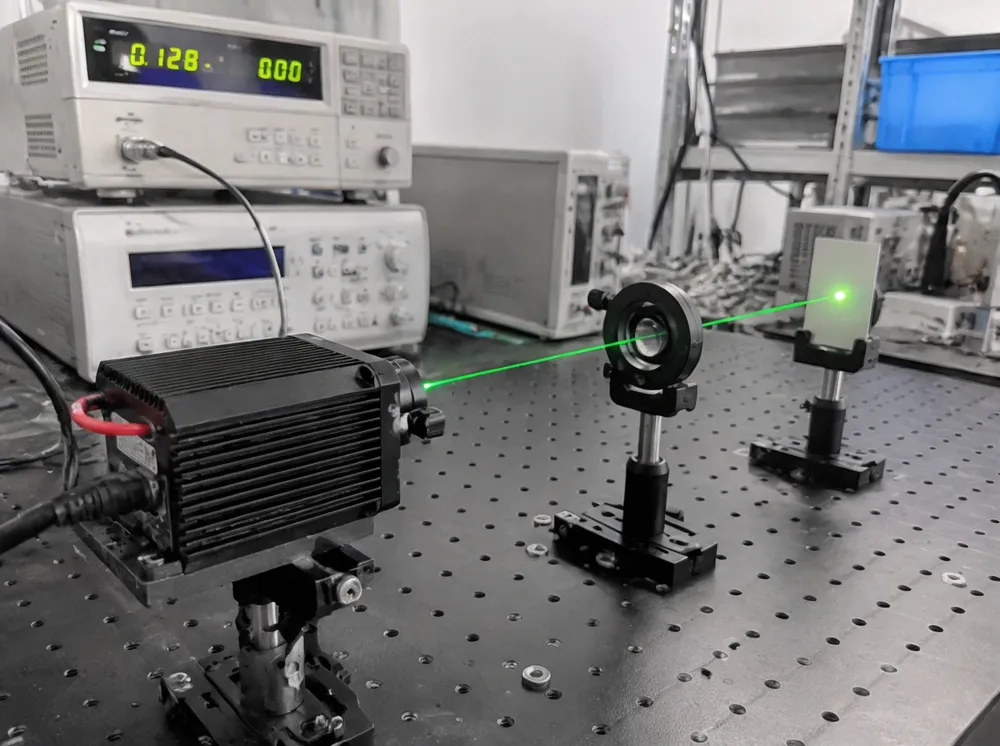
The difference between a DJ laser light that impresses at a trade show and one that survives 12 months in rental rotation comes down to two things: diode quality and optical alignment precision. We handle both in-house.
We source laser diodes from qualified suppliers with binned output tolerance within ±5% of rated power. When a 200 mW green diode arrives at our incoming inspection, we verify actual output on an optical bench before it enters assembly. Bins that fall outside our acceptance window get returned — not downgraded into your units.
We rejected about 8% of a green diode shipment last quarter because the 532nm wavelength drifted toward 530nm at operating temperature. You wouldn't see it in a spec sheet, but your end user would see uneven color when running multiple units side by side.
Optical alignment uses fixed jig positioning with laser-etched reference points on the galvo mounting plate. The scanning mirrors — galvanometer-driven on our professional and RGB lines, stepper-motor on the entry-level units — get calibrated against a test grid at 3-meter throw distance. Pattern geometry tolerance is ±0.5° across the scan field.
This means when you order 500 units for a distribution deal, every unit projects the same pattern at the same size and position. No unit-to-unit variation visible during a side-by-side demo.
Thermal Management
Housing is extruded aluminum with black anodized finish — thermal conductivity matters because laser diodes derate when junction temperature climbs above 45°C.
That translates directly to longer diode life and stable output power over years of use — fewer warranty returns in your service pipeline.
±5% Power Binning
Diodes verified on optical bench before entering assembly. Out-of-spec bins returned, never downgraded.
±0.5° Pattern Tolerance
Fixed-jig alignment with laser-etched references. Calibrated at 3m throw distance for batch uniformity.
Heatsink Below 40°C
Extruded aluminum housing keeps diode junction cool for stable output and reduced warranty returns.
Segments Where Your Buyers Profit from DJ Laser Lights
This category sells into specific commercial segments. Understanding where the volume sits helps you stock the right SKU mix.
Mobile DJ & Entertainment Services
Working DJs replacing aging halogen scanners with compact laser effects. They buy 2–4 units per rig upgrade cycle, typically every 18–24 months. Professional and RGB projector models dominate here.
Top SKUs: Professional, RGB Projector
KTV & Nightclub Installation
Fixed installations purchasing 10–50 units per venue buildout. These buyers value DMX addressability and long-duty-cycle reliability because a dead fixture in a ceiling mount means a service call, not a quick swap.
Top SKUs: Disco, RGB Projector
Event Rental Companies
Volume buyers stocking 50–200 units across their inventory, deploying for weddings, corporate events, festivals. They care about transit durability and fast DMX patching across large fixture counts.
Top SKUs: Laser Bar, Professional
Retail & E-commerce Distribution
Online sellers moving mini and disco lasers as impulse-buy entertainment products. High volume, price-sensitive, packaging appearance matters. Your margin lives in container-load pricing and minimal return rates.
House of Worship & Community Venues
Churches and auditoriums adding visual impact to services and events. Moderate output, easy setup, non-intimidating form factor for volunteer operators.
Top SKUs: LED Laser, Green Laser
Not Sure Which Mix?
Each segment has different pricing sensitivity, volume patterns, and feature priorities. Tell us which segments you serve and we'll recommend a starter SKU mix with quantity breaks that make commercial sense for your channel.
Get SKU RecommendationCategory-Wide Technical Parameters
These are category-level ranges covering our full DJ laser light product line. Each product page carries the exact specifications for that model.
Power & Optics
Performance & Control
Build & Compliance
Need a specific power class or wavelength combination not shown here? Our engineering team configures custom diode arrays — 30-unit minimum on custom optical configurations.
Why Rapid Lumen Depreciation Happens — and How We Prevent It on Your Stock
The Slow Failure Mode Nobody Warns You About
The most common failure in DJ laser lights isn't dramatic. The unit doesn't die — it slowly loses output power over 6-12 months until beams that once cut through haze become dim washes barely visible past 5 meters. Your end users blame the product. Your warranty queue grows. Your reorder rate drops.
The root cause is almost always thermal. Laser diodes degrade permanently when junction temperature exceeds rated limits, and cheap laser lights manage heat poorly — undersized heatsinks, no thermal paste between the diode module and housing, insufficient airflow in sealed enclosures. The diode's output drops 1-2% per thousand hours at rated temperature, but that rate doubles for every 10°C above the rated junction limit.
Three-Point Thermal Prevention System
How we address lumen depreciation at design and production level
Thermal Interface
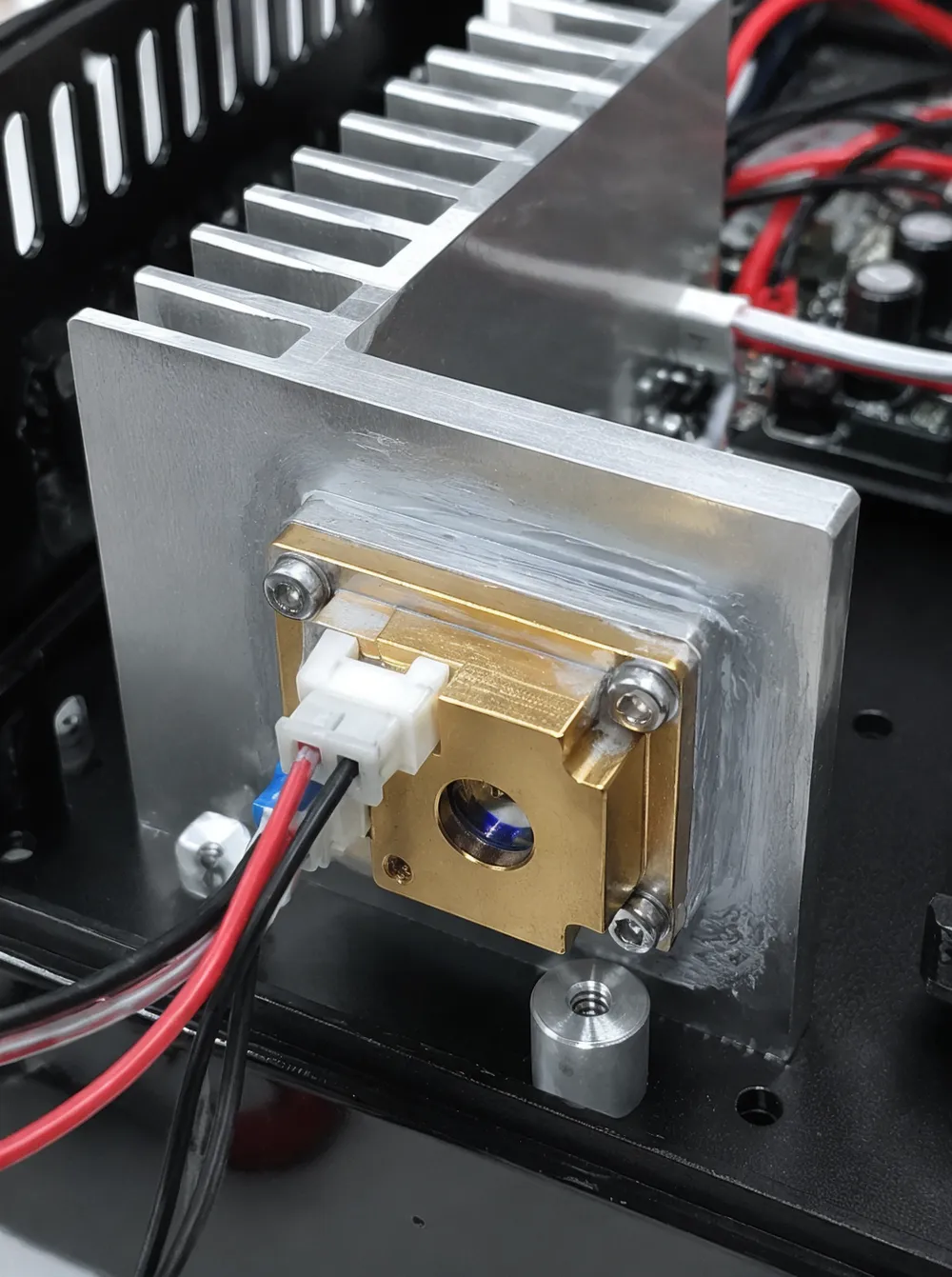
Every diode module is mounted with measured thermal compound application — 0.15mm layer thickness verified during assembly.
We switched from thermal pads to direct-applied compound in 2020 because pad thickness inconsistency was causing a 4-6°C spread in junction temperatures across a production batch.
Thermal pads are easier for assembly workers, but compound with controlled application gives consistent results.
Oversized Heatsink Mass
Our professional and RGB models use oversized heatsink fins relative to the thermal load. The goal: keeping diode junction temperature 10°C below the manufacturer's rated maximum even at sustained full output in a 35°C venue.
That safety margin means the diode operates in the flat part of its depreciation curve, not the steep part.
48-Hour Aging Test
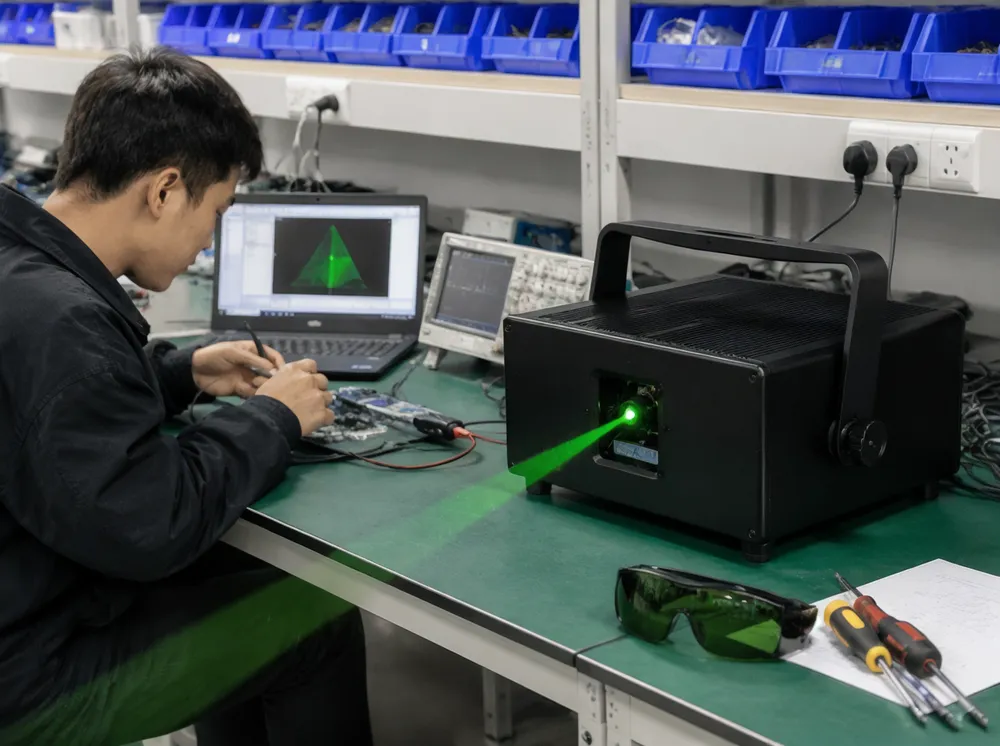
Every DJ laser light we produce runs at full power output for 48 continuous hours in our aging test racks. We measure output power at hour 0, hour 24, and hour 48.
Any unit showing more than 3% power drop gets pulled for inspection. Infant mortality — diodes that will fail early — reveals itself during burn-in, not six months into your customer's ownership.
Your Commercial Benefit
- Fewer warranty returns — thermal failures are caught at factory, not at your customer's venue
- Stable output across your installed fleet — units deployed 12 months apart still match in brightness
- Higher reorder rates — end users who see consistent performance after a year of weekly use come back for the same model
OEM/ODM on DJ Laser Lights — Custom Configurations from 30 Units
Most DJ laser light buyers start with our standard configurations, but the margin opportunity often sits in customized versions that your competitors can't source from the same catalog.
Branding & Packaging Customization (OEM)
Your logo on the unit, your brand on the packaging, your firmware splash screen on power-up. Standard for any order above 30 units.
Lead time adds 3–5 days versus stock configuration.
Custom Optical Configurations (ODM)
Different pattern sets in the galvo programming, specific wavelength combinations, adjusted scan angles for architectural or installation applications.
Our optical engineers program custom scan patterns from your concept sketches — 15–20 business days from approved concept to production sample.
Custom Housing & Mounting
Need a specific bracket pattern for a venue installation chain? A different housing color for your brand identity? A reduced-depth enclosure for ceiling-flush mounting?
Tooling modification runs 20–30 days for first samples, then production as normal.
Private-Label Product Development
If you're building a DJ laser light line from scratch for your brand, we handle the full development cycle — optical design, electronic design, housing tooling, packaging design, regulatory certification. You own the design.
MOQ on fully custom products starts at 200 units after tooling investment.
Typical Partner Path
Most of our distribution partners started with a 50-unit trial of a standard model, then moved to OEM branding on reorder, then eventually commissioned a custom variant. The path from generic to exclusive happens naturally once you see how your market responds.
Container Loading and Export Packaging for DJ Laser Lights
DJ laser lights are compact and relatively lightweight, which means container efficiency is high — but the optical components are alignment-sensitive, so packaging engineering matters.
Standard Packaging
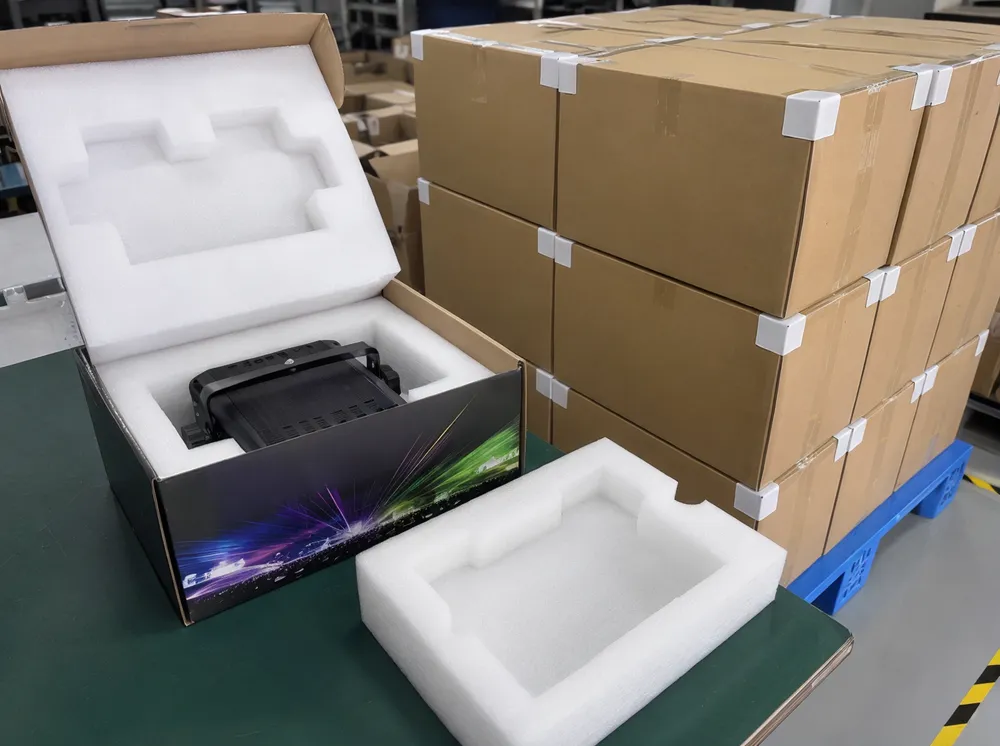
Individual unit in molded EPE foam insert, placed in printed color box. Master carton holds 10–20 units depending on model size, with corner protection and anti-compression stacking design.
Packaging Protection
Galvanometer assemblies and optical mirrors are the vibration-sensitive components. Our packaging positions the fixture with optics facing inward (protected by the aluminum housing mass) and uses dual-density foam:
- Soft outer layer — shock absorption during transit
- Firm inner layer — position retention and alignment protection
We test packaging against ISTA 2A transit simulation standards.
Loading Efficiency
| Model Category | 20GP Container | 40HQ Container |
|---|---|---|
| Mini DJ Laser | ~2,400 units | ~5,200 units |
| Professional DJ Laser | ~1,200 units | ~2,600 units |
| RGB Projector / Laser Bar | ~800 units | ~1,800 units |
Documentation Included
- CE/FCC declaration of conformity
- RoHS certificate
- User manual in your specified language (English standard, other languages on request)
- Carton labeling with your SKU numbers, barcodes, and warehouse receiving format — provide your label template and we match it
Production Lead Time
Choosing the Right DJ Laser Light Configuration for Your Market
The seven product lines exist because different buyer segments have different purchase triggers. Here's the decision logic based on what we see from our active distribution partners.
Professional DJs & Rental Companies
Stock the Professional DJ Laser and RGB Laser Projector lines. These buyers prioritize output power, DMX integration, and build quality. They'll pay a premium for reliable, high-output units — your margin per unit is highest here.
E-Commerce & Retail Channels
Mini DJ Lasers and Disco DJ Lasers. Price point drives conversion. Package appearance matters. These sell on visual appeal and impulse — keep your MOQ low per SKU but stock multiple color/pattern variants to fill catalog pages.
Fixed Installations (Clubs, KTV, Venues)
RGB Projectors and Laser Bars. DMX addressability, scan speed, and multi-pattern programming are the selling points. Buyers order in project quantities (10–50 per venue) and expect consistency across units.
Power-Regulated Markets
Green Laser DJ Lights at lower power classes (50–100 mW) still deliver impressive beam visibility due to the 532nm wavelength sensitivity peak. You can offer eye-catching laser effects within regulatory limits — a product story that resonates in safety-conscious markets like the EU and Australia.
Reduce Fixture Count
LED Laser DJ hybrid units. One fixture, two effects. Mobile DJs and small venues love reduced setup time and cabling. Growing segment — worth testing with a small initial order.
Not sure which models match your buyer base? Send us your target market and typical order quantities — we'll recommend a SKU mix based on what's moving for our distributors in that region.
Frequently Asked Questions About DJ Laser Lights
What laser power class do I need for different venue sizes?
What laser power class do I need for different venue sizes?
For small venues under 100 m² (bars, private parties, KTV rooms), 50–150 mW total output creates visible beams in light haze without overwhelming the space.
Mid-size venues (100–400 m² clubs, wedding halls, churches) need 200–300 mW for beams that read clearly from the back of the room.
Large venues and outdoor use above 400 m² call for 400–500 mW units.
We can spec the right power class based on your target venue profile — the goal is visible impact without exceeding the laser safety classification your market requires.
Why do cheap DJ laser lights lose power after a few months?
Why do cheap DJ laser lights lose power after a few months?
Thermal management. Laser diodes permanently degrade when operating above their rated junction temperature. Low-cost units use undersized heatsinks, skip thermal interface material between the diode and housing, and have no aging test to catch marginal units before shipment.
After 500–1,000 hours of cumulative use, output drops 20–40% — visible to the naked eye.
Our thermal design holds junction temperatures 10°C below rated maximums, and the 48-hour burn-in catches any unit that doesn't hold stable output.
What's the difference between galvanometer and stepper motor scanning in DJ lasers?
What's the difference between galvanometer and stepper motor scanning in DJ lasers?
Galvo Scanning
- Electromagnetic mirror drives
- 10–25 KPPS scan speed
- Smooth, detailed patterns
- Text capability
- Professional & rental use
Stepper Scanning
- Simpler mechanics
- 5–12 KPPS scan speed
- Basic geometric patterns
- Lower cost
- Entry-level retail
For professional and rental use, galvo units justify the price premium through pattern complexity and smooth animation. For entry-level retail products where basic beam effects are sufficient, stepper units hit the right price point with acceptable visual quality.
What certifications do DJ laser lights need for North American and European import?
What certifications do DJ laser lights need for North American and European import?
United States
- FCC Part 15 — electromagnetic compatibility
- FDA/CDRH laser product reporting (21 CFR 1040)
European Union
- CE marking — Low Voltage & EMC Directives
- EN 60825-1 — laser safety classification labeling
- RoHS — mandatory for EU market entry
All GDMonkey DJ laser lights ship with CE, FCC, and RoHS documentation. FDA variance or accession numbers for US laser products require manufacturer filing — we handle this as part of our compliance process for North American-bound orders.
What's the MOQ for DJ laser lights, and can I mix models in one order?
What's the MOQ for DJ laser lights, and can I mix models in one order?
Minimum 30 units per model for standard configurations. You can mix models within a single shipment — most buyers combine 2–4 SKUs per order to test market response across segments.
OEM branding (your logo, custom packaging) applies at the same 30-unit minimum per SKU. Fully custom optical configurations start at 200 units after sample approval.
First-time buyers typically start with 50–100 units across 2–3 models, then consolidate into higher-volume reorders on the SKUs that perform.
How do I prevent galvo mirror misalignment during shipping?
How do I prevent galvo mirror misalignment during shipping?
Galvo assemblies are the most shipping-sensitive component in a DJ laser light. Our packaging uses dual-density EPE foam that immobilizes the fixture with optics oriented inward — the aluminum housing mass acts as a natural shock buffer.
We additionally apply a galvo locking mechanism during packaging that prevents mirror movement during transit. Combined with ISTA 2A transit simulation testing on our packaging design, galvo misalignment on arrival runs below 0.3% across our shipping history.
If a unit does arrive misaligned, recalibration takes under 5 minutes with our included alignment tool.
Next Step: Tell Us What You're Building
Whether you're adding DJ laser lights to an existing lighting distribution catalog, building a rental fleet, or launching a new product line under your brand — the fastest path is a conversation about your specific market, volume expectations, and timeline.
Send us your target models, quantities, and any branding or customization requirements. Our team reviews feasibility within 24 hours and responds with a detailed quotation including unit pricing, lead time, packaging specs, and shipping estimates to your port.
Most new accounts receive samples within 7 days of order confirmation. If you need to evaluate beam quality and build before committing to volume, start there.