

Portable DJ Lights Engineered for Commercial Rental Cycles
Rechargeable lithium power, reinforced housings, and 500+ charge-cycle longevity built on our production floor. Grab-and-go fixtures that stay in your rental fleet for years, not months. Factory-direct from GDMonkey with OEM branding from 30 units.
What Portable DJ Lights Are and Where They Sit in Your Product Mix
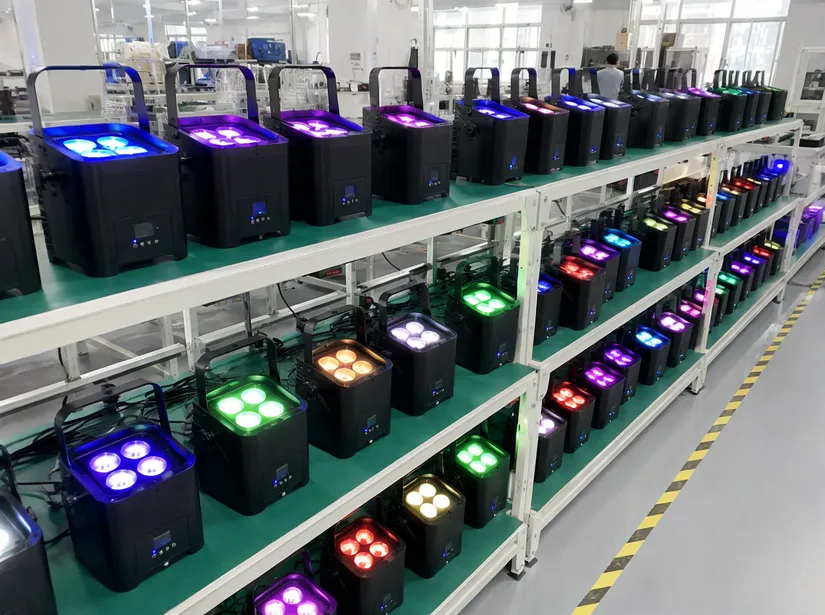
Portable DJ lights are battery-powered, self-contained LED party fixtures that operate without AC power or DMX cabling. They charge via USB-C or barrel connector, run 10–20 hours per charge depending on the model, and produce multi-color rotating effects through auto-program modes that require zero operator training. Your end customer — a mobile DJ, a wedding planner, a venue manager — pulls them out of a case, powers on, and has immediate visual impact.
For your business, portable DJ lights occupy the highest-velocity position in the party lighting category. They're the units that leave your warehouse most frequently, cycle through rental fleets fastest, and generate the most reorders. They also take the most physical abuse — dropped off tables, tossed into vans, forgotten in hot cars — which is exactly why manufacturing quality determines whether this SKU prints money or generates returns.
12 Years of Battery-First Engineering
We've been building compact battery-powered effects since 2012. It's literally where GDMonkey started. The engineering lessons from those first-generation products — thermal behavior in sealed enclosures, motor bearing life under continuous rotation, lithium cell protection — are twelve years deep. These portable DJ lights aren't adapted from a wired product with a battery bolted on. They're ground-up battery-first designs.
Engineering Note
Our early prototypes had thermal throttling issues at hour three. We redesigned the internal airflow path twice before the LED board temperature stayed flat through a full discharge cycle.
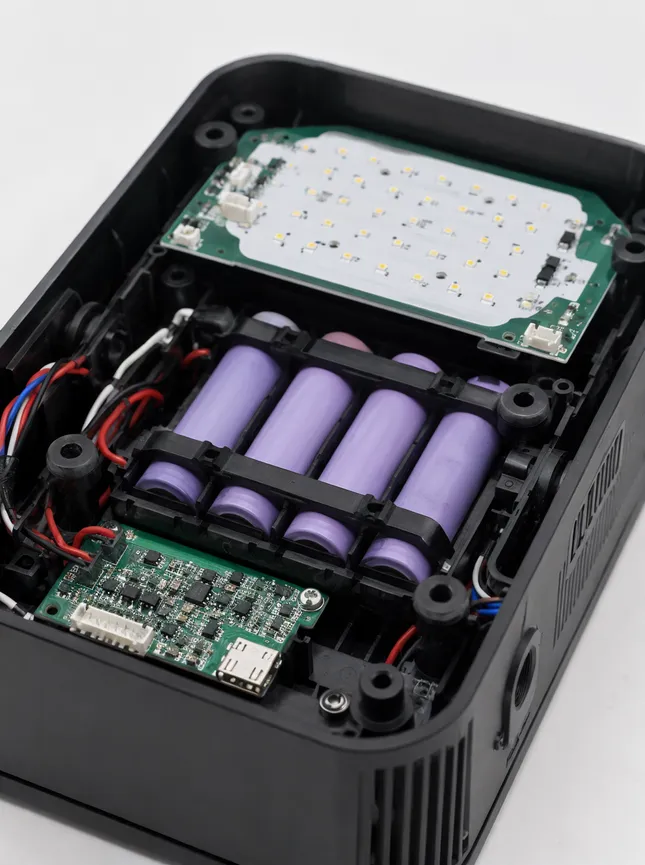
What separates our portable DJ lights from what you'll find on Alibaba at half the price: protected 18650 cells with individual cell balancing, reinforced ABS housings with internal shock mounts, and a 48-hour aging test that catches infant failures before the unit ever reaches your inventory. The cheap alternatives work fine for the first 50 cycles. Ours work fine for 500.
Key Differentiators
-
Protected 18650 Cells
Individual cell balancing for longevity
-
Reinforced ABS Housing
Internal rubber shock mounts
-
48-Hour Aging Test
Catches infant failures before shipping
-
500+ Charge Cycles
vs. 50 cycles from budget alternatives
-
Battery-First Thermal Design
Flat LED board temp through full discharge
Technical Specifications — What You're Evaluating
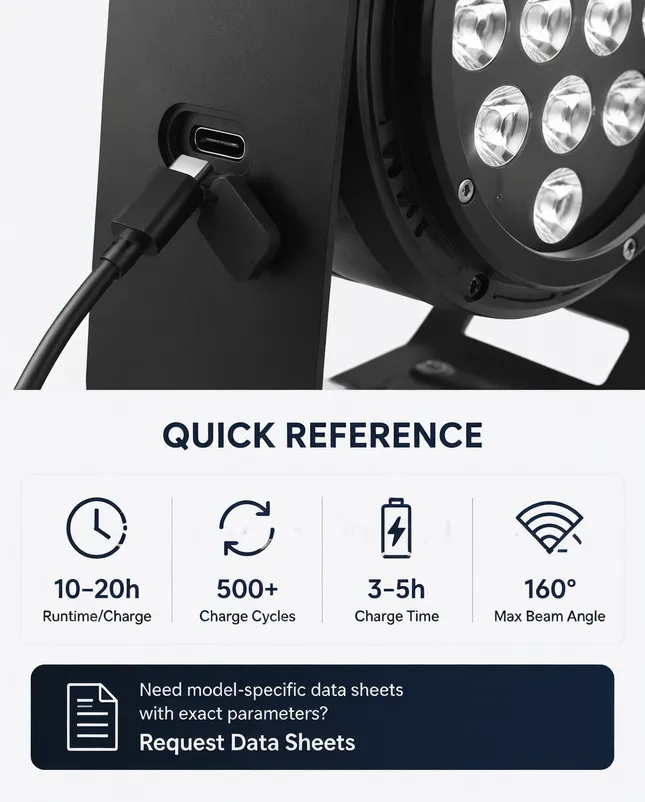
Specifications shown are typical values across our portable DJ lights range. Exact parameters depend on model selection. Contact us for detailed product data sheets.
Quick Reference
10–20h
Runtime/Charge
500+
Charge Cycles
3–5h
Charge Time
160°
Max Beam Angle
Need model-specific data sheets with exact parameters?
Request Data SheetsBattery Engineering — The Component That Determines Your Warranty Claim Rate
This deserves dedicated attention because the battery is where portable DJ lights either succeed or fail commercially. A fixture with a dead battery at month four is a warranty return that costs you the unit margin plus shipping plus customer goodwill. We've seen buyers switch suppliers entirely over battery reliability — it's that central to the economics of this product.
18650 Lithium Cells with Individual Protection
We use 18650 lithium cells with individual protection circuits on every cell. The protection handles three failure scenarios:
- Over-discharge: Cuts output before voltage drops below 2.7V, preventing permanent capacity loss
- Over-charge: Terminates at 4.2V to prevent thermal runaway
- Thermal cutoff: Disconnects if cell temperature exceeds 65°C during charge or discharge
That $0.40 per-cell protection circuit is the difference between a 500-cycle product and a 100-cycle product.
Cell Matching — ±10mΩ Internal Resistance
We bin incoming 18650 cells and match internal resistance within ±10mΩ per pack. Mismatched cells in a multi-cell pack develop imbalance — the weakest cell gets over-discharged while the others still have capacity, and it degrades exponentially from there. Matched cells age at the same rate, so the pack maintains consistent runtime across its lifecycle.
Real-World Test Result
We tested unmatched cells from a cheaper supplier early on. By cycle 80, the weakest cell had lost 35% capacity while its neighbors were still at 92%. The unit's runtime dropped from 12 hours to 7. Not acceptable for a rental fleet.
48-Hour Aging Test Protocol
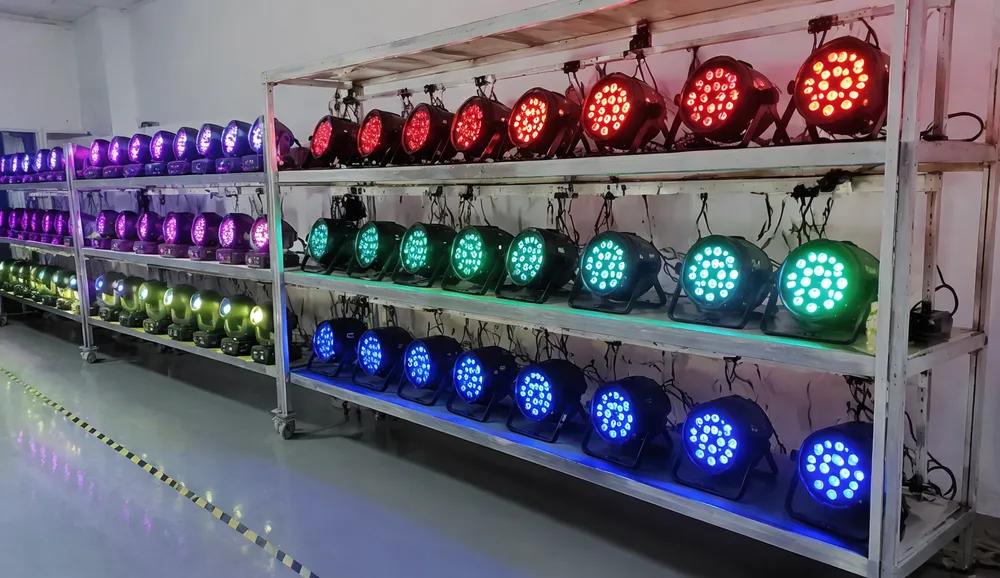
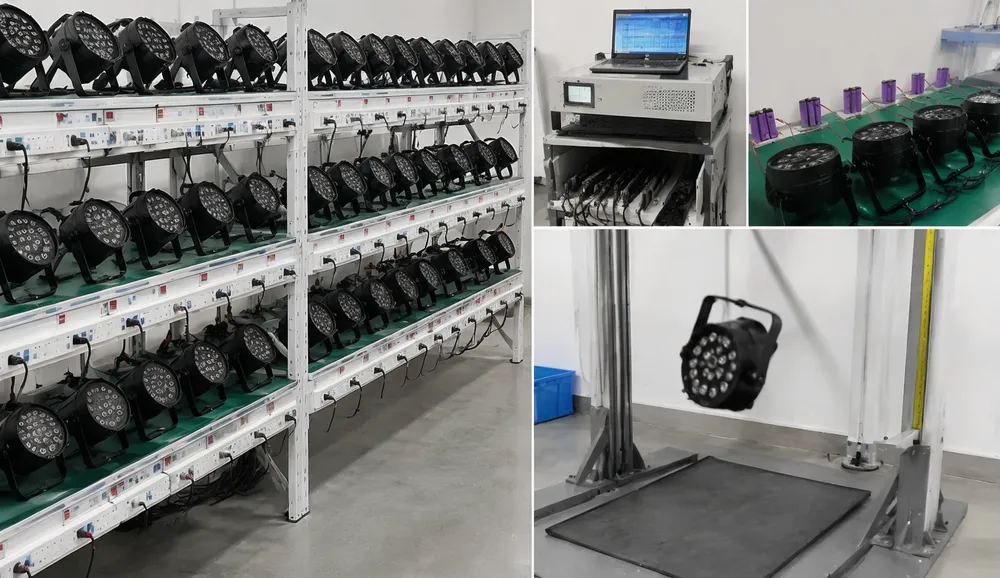
Our 48-hour aging test runs portable units through full charge-discharge cycles at maximum LED output — simulating the equivalent of 15-20 real-world rental deployments. Any cell that shows abnormal voltage drop or thermal behavior gets flagged and replaced before the unit ships. You won't discover battery defects three months into deployment.
Fleet Lifecycle Economics
500 cycles at one rental per week means roughly 10 years of service life before the battery degrades noticeably.
Field-Serviceable Design
When replacement is eventually needed, your technician swaps cells with a Phillips screwdriver in five minutes — no soldering, no board removal.
LED Moving Party DJ Lights — Effect Diversity and Optical Design
The "LED moving party DJ lights" category covers fixtures with motorized rotation mechanisms — crystal ball effects, moonflower projections, and multi-pattern rotating heads. The motion is what creates visual impact in a venue without any operator involvement. Your end customer turns it on, sound-active mode engages, and the room fills with moving color patterns synchronized to bass frequencies.
DC Gear Motors — 30,000+ Hours Continuous Rotation
We use DC gear motors rated for 30,000+ hours of continuous rotation. That figure isn't theoretical — it comes from our electromechanical background. GDMonkey's original product line was low-voltage motor assemblies before we moved into lighting. We understand bearing selection, gear reduction ratios, and motor thermal management in ways that a pure-LED company doesn't.
Our gobo rotation motors run at 1-15 RPM with speed variation for visual diversity, and the gear meshes are precision-cut to eliminate the stuttering rotation you see in budget alternatives.
Optical Design by Effect Type
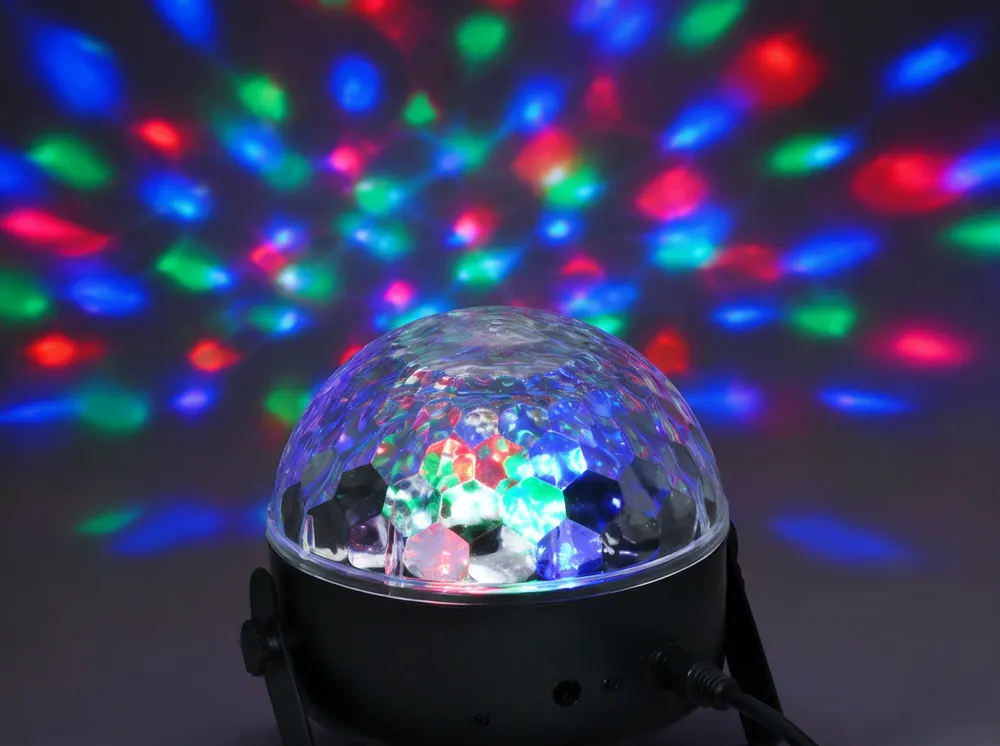
Crystal Ball / Disco Effect
Multi-faceted lens dome with internal RGB LEDs. We use 6-facet minimum geometry for smooth light distribution — fewer facets create visible dark spots between beams.
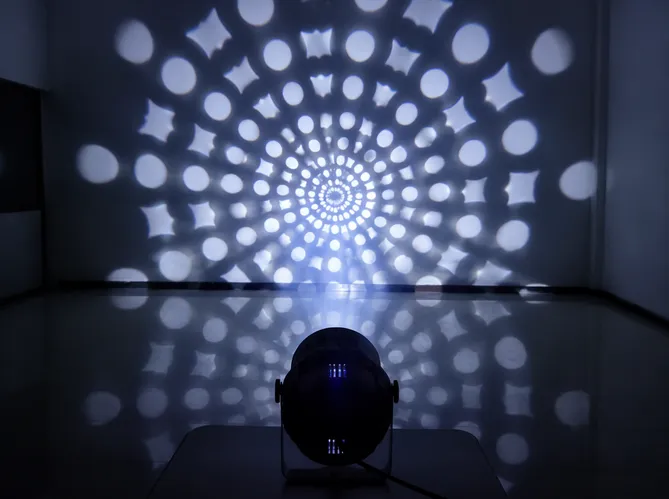
Moonflower
Single-source LED behind a rotating gobo wheel. Lens focal length determines pattern sharpness at throw distances of 3-8 meters (typical room coverage).
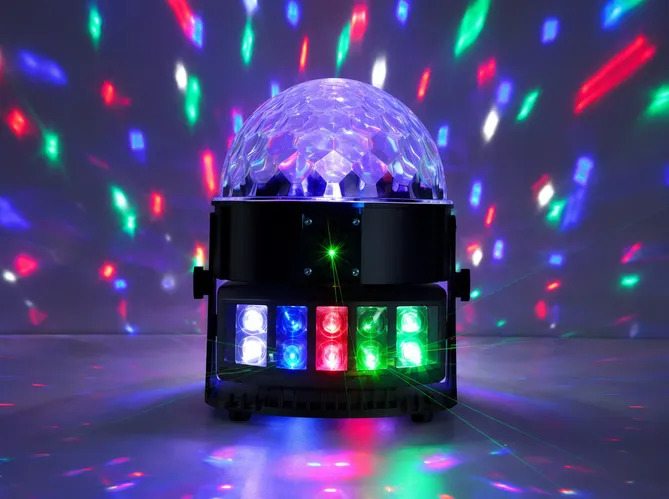
Multi-Effect Hybrid
Combination units with rotating crystal ball on top, static color wash below, and sometimes a laser diode for star field overlay. These are the highest-margin SKU for rental companies because they replace three separate fixtures.
Batch Color Consistency
LED color consistency across your batch comes from our automated SMT mounting at ±0.05mm placement accuracy and pre-binned LED chips. When you order 200 units, every unit produces the same blue, the same warm white, the same UV.
Your rental customer deploying 15 identical fixtures on banquet tables gets uniform color across the room — not the "close enough" variation you see from hand-mounted chips.
Rental Fleet Durability — Designed for How Portable DJ Lights Actually Get Used
A portable DJ light in a rental fleet lives a different life than one sitting on a shelf. It gets packed into a van at 6 AM, set up on a table at noon, knocked over by a guest at 10 PM, tossed back into a crate at midnight, and charged for the next event. That cycle repeats weekly. The fixture either survives this reality or it doesn't — and your return rate tells you which.
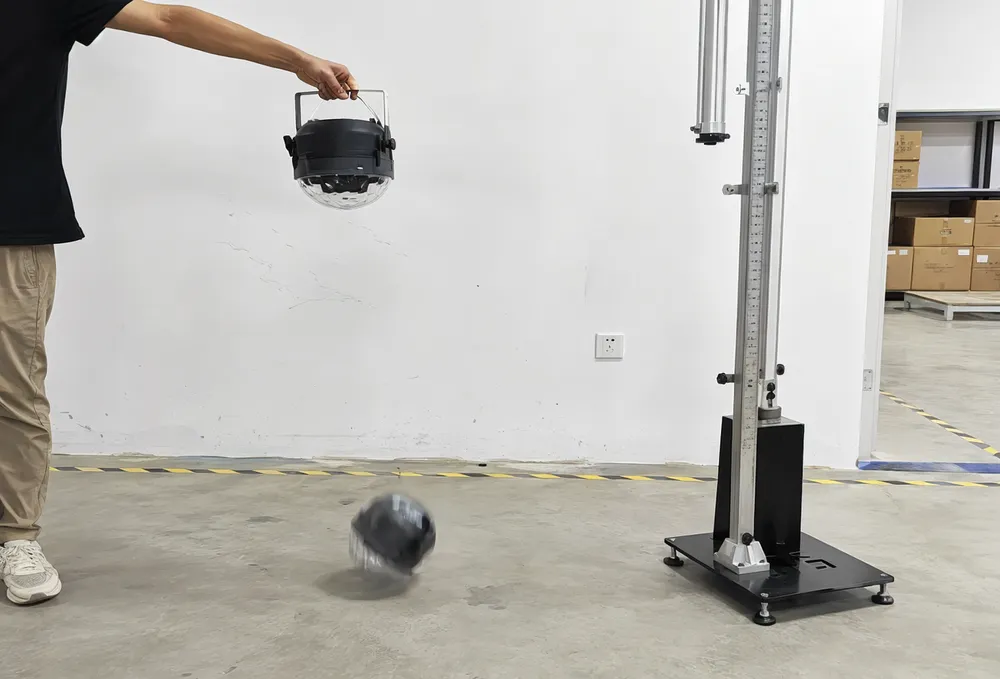
Housing Construction
Reinforced ABS with thickened wall sections at all stress concentrators — screw bosses, tripod mount points, battery compartment latches. Internal ribs at the housing parting line prevent flex-induced cracking. Drop-tested at 1.2m onto concrete during design validation.
Standard ABS without reinforcement cracks at mounting points after 20-30 drops from table height. Ours handles 100+ without structural failure.
Internal Shock Isolation
The LED PCB and driver board mount on rubber standoffs that absorb impact energy. A direct drop transmits shock through the housing to the internals — without isolation, solder joints crack, LED chips de-bond from the PCB, and driver capacitors develop microfractures that cause intermittent flickering weeks later.
Sealed Optics
The lens dome uses ultrasonic welding to the housing rather than adhesive bonding. Adhesive fails over time — thermal cycling, UV exposure, and cleaning solvents break it down. Ultrasonic weld is a permanent molecular bond. No lens separation, no dust ingress into the optical chamber, no cleaning-related delamination.
Cable Strain Relief
The charging port uses a molded TPU boot with 15mm flex relief. Rental units get plugged and unplugged hundreds of times — a rigid-mounted USB port eventually develops cold solder joints from lateral force. The flex boot absorbs bending stress before it reaches the PCB connection.
These details don't show up on a spec sheet. They show up in your warranty claim rate at month six vs. month one. If you're evaluating portable DJ lights for fleet deployment, the difference between a housing that cracks at drop 25 and one that survives past drop 100 is the difference between a profitable rental SKU and a write-off.
Market Segments Where Portable DJ Lights Generate Reorders
Each deployment scenario represents a channel your distribution business can serve profitably. We're not describing where the lights look nice — we're describing where they move in volume with reliable reorder cycles.
Event Rental Companies
Core Channel
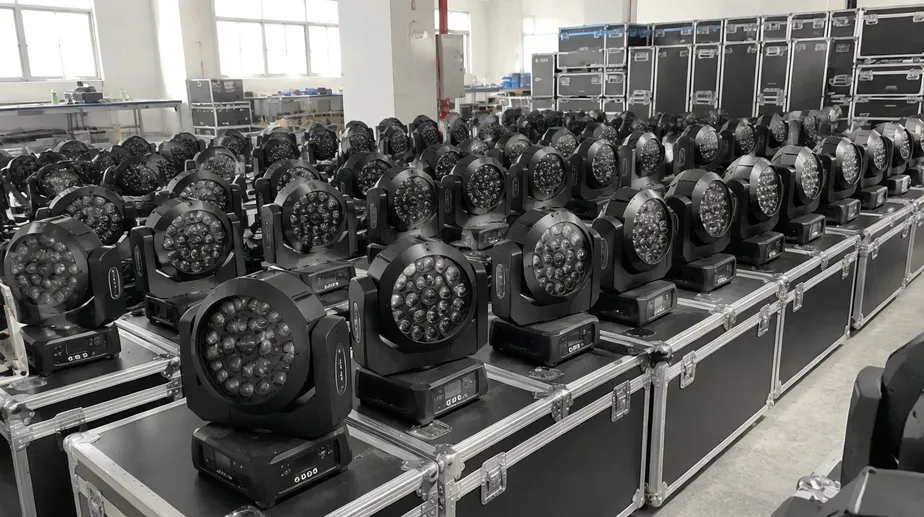
Rental companies maintain fleets of 20-200 portable units that cycle out weekly for weddings, corporate events, birthday parties, and holiday gatherings. Unit utilization runs 2-4 events per week in peak season.
Reorder triggers: Battery degradation beyond acceptable runtime, housing damage from transit abuse, and fleet expansion to meet growing demand.
Typical reorder: 30-50 units annually per mid-size rental operation.
Mobile DJ Distributors
Gear Package Channel
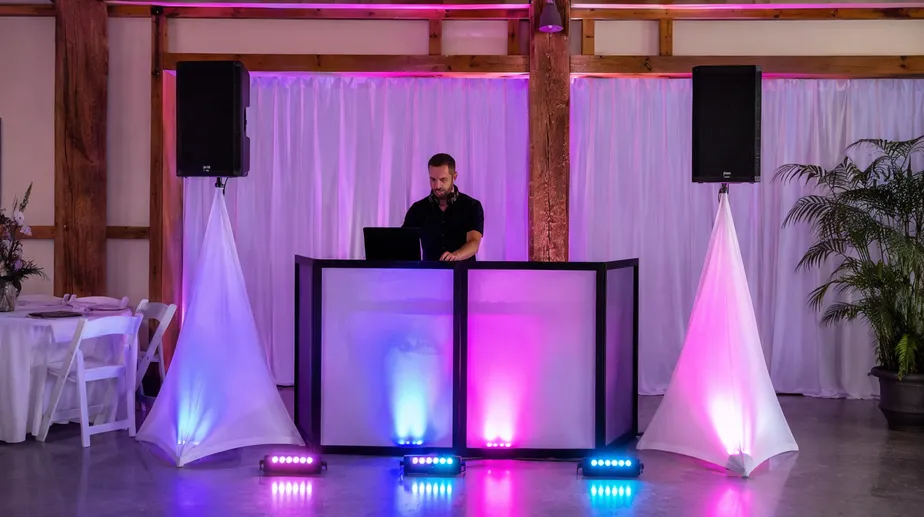
DJs buy 4-12 portable units as part of their gear package. They want effects that deploy in under 60 seconds — no cables, no DMX programming, no stands required. Sound-active mode is the primary operating mode. This market values compact size and visual punch over sophisticated control.
High sell-through: 4-pack and 8-pack price point. Sound-active mode as primary operating mode.
Hospitality and Venue Supply
In-House Inventory
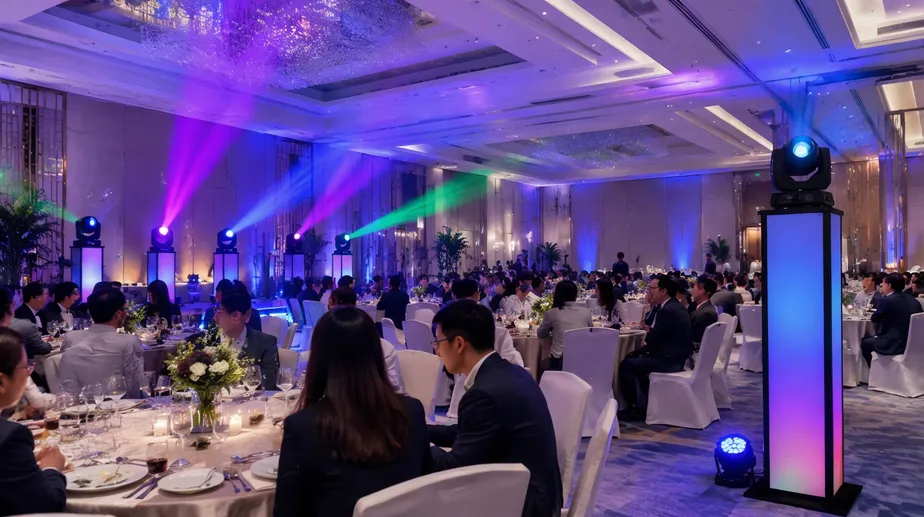
Hotels, restaurants, and event spaces buying 10-40 units for permanent inventory. These buyers deploy portable DJ lights for in-house events without hiring external lighting — birthday packages, corporate dinners, holiday celebrations. Runtime and charge speed matter most: the unit needs to run a full 5-hour event and be recharged before the next day's booking.
Reorder cycle: Annual replacement of damaged/degraded units — typically 15-20% of fleet.
E-Commerce and Amazon Sellers
Marketplace Volume
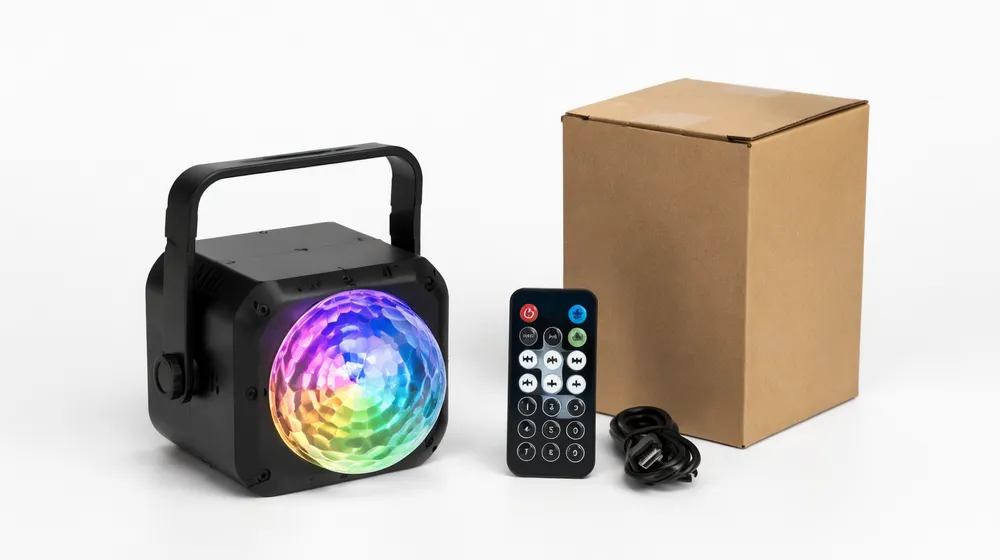
Compact portable DJ lights are strong performers on marketplaces — they photograph well, ship inexpensively, and hit the impulse-buy price point for semi-pro DJs and party hosts. If you sell through Amazon FBA or your own e-commerce channel, these are volume-movers with 4-star-minimum review potential when the battery actually lasts as advertised.
The single biggest source of 1-star reviews on marketplace DJ lights: "battery died after 2 months." Our protection circuits eliminate that failure mode.
We'll recommend the models and pack configurations that match your channel.
OEM Customization for Portable DJ Lights — Your Brand, Our Production Line
The portable DJ lights market is fragmented. Brand loyalty is minimal — buyers purchase on features, price, and availability. That makes this category ideal for private-label: your branded product with the right specs competes immediately without overcoming brand inertia.
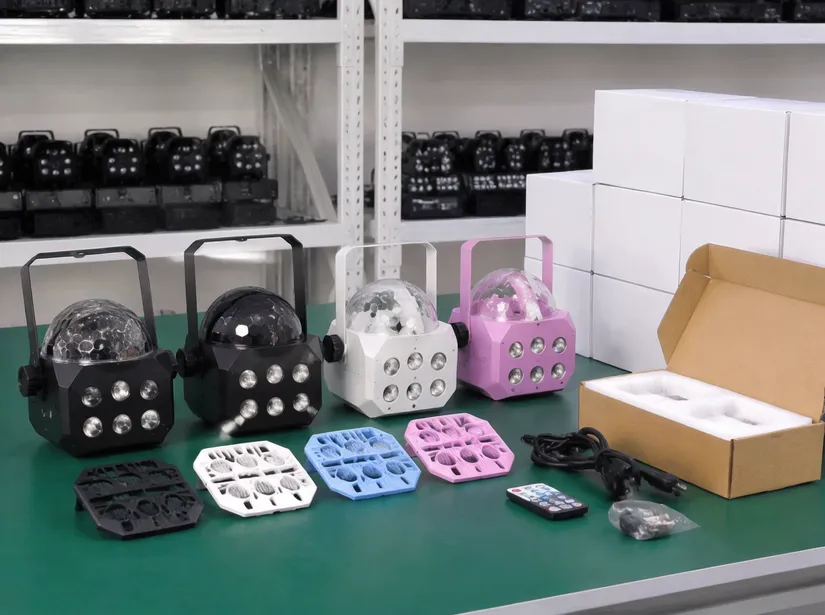
What we customize on portable DJ lights specifically:
| Customization Type | Options | MOQ |
|---|---|---|
| Logo placement | Pad printing or laser engraving on housing top/side | 30 units |
| Housing color | Any RAL or Pantone reference (injection-molded in color, not sprayed) | 100 units |
| Packaging | Retail box with your design, foam insert configuration, multi-pack bundles | 30 units |
| Boot animation | Your logo/brand displayed when unit powers on (LED matrix models) | 30 units |
| Effect programs | Custom auto-run sequences, specific color palettes, adjusted speed ranges | 50 units |
| Battery capacity | Upgraded cells for extended runtime (12hr → 20hr variants) | 100 units |
| Charging connector | USB-C, micro-USB, or proprietary barrel connector per your market | 100 units |
| IP upgrade | IP44 splash-resistant variant with sealed USB port cover | 200 units |
Branding Variants
Existing fixture + your logo/packaging: 7–10 days to sample.
Custom Color / Electrical
Custom color or electrical modifications: 15–20 days to sample.
Full ODM Development
New product with new tooling: 3–4 development cycles from approved concept.
Channel Exclusivity & IP Protection
We've signed non-compete agreements with buyers developing exclusive portable DJ lights SKUs. If channel exclusivity matters for your distribution model, ask about our IP protection structure.
Quality Verification — What Happens Before a Portable DJ Light Ships
The parent category page covers our overall production process and QC system. Here's what's specific to portable DJ lights:
Battery Cycling During Aging
Standard fixtures run 48 hours at full load. Portable DJ lights also undergo charge-discharge cycling during aging — a minimum of 3 full cycles that verify cell balance, protection circuit function, and charge termination accuracy.
Fail criteria: Any unit showing more than 5% capacity deviation between cycles gets pulled from the production batch.
Drop Simulation
Random sampling (AQL Level II) from each production batch goes through a 1.2m drop test sequence — one drop per face, six drops total.
Pass criteria: No housing crack, no optical lens displacement, no electrical fault on power-up after the sequence.
This isn't design validation (which happens during development); it's ongoing production verification that the injection mold hasn't drifted and the assembly torque specs are being maintained on the line.
Motor Life Verification
For LED moving party DJ lights with rotating mechanisms, we run continuous rotation tests on samples — 72 hours non-stop at maximum RPM.
We're checking for motor bearing noise development, gear wear patterns, and current draw increases that indicate developing friction.
A motor that passes 72 hours at full speed will handle 5+ years of real-world intermittent use.
Color Consistency Check
Every unit gets measured against a reference standard after aging. Color coordinates (CIE x,y) must fall within a 3-step MacAdam ellipse of the target — meaning adjacent units deployed in the same venue will appear visually identical to the human eye.
This matters more than most suppliers realize. Your rental customer putting 15 lights on 15 tables notices when three of them produce a different shade of blue.
Packaging and Container Loading Protecting Margins on High-Volume Shipments
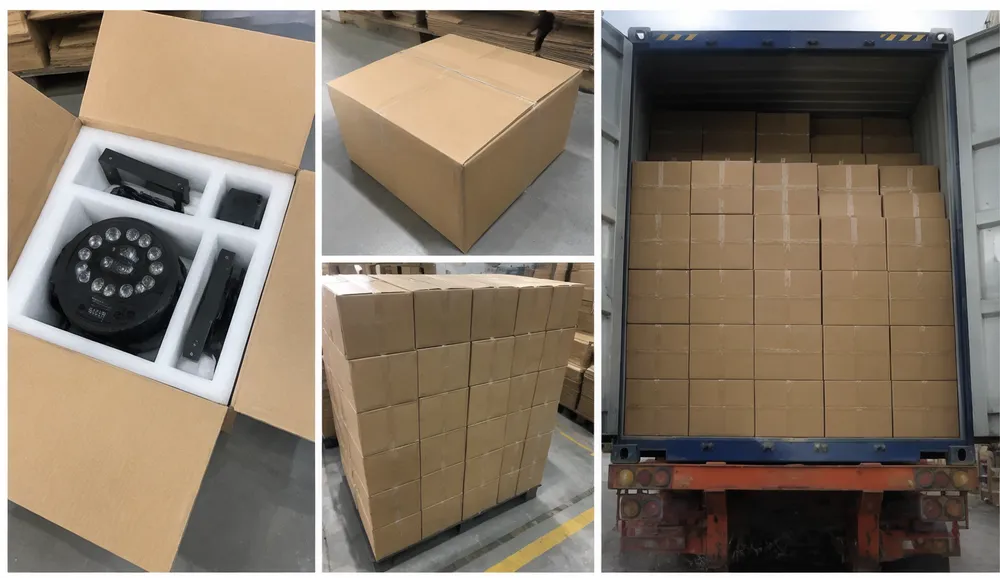
Portable DJ lights ship in large quantities — your container utilization directly affects per-unit landed cost. We design packaging to maximize loading density while surviving export logistics.
Standard Packaging Configuration
| Model Category | Carton Size (cm) | Units per Carton | Cartons per 20GP | Units per 20GP |
|---|---|---|---|---|
| Compact portable (< 0.8 kg) | 32 × 28 × 18 | 10 | 1,800 | 18,000 |
| Mid-size rotating effect (1.0–1.5 kg) | 38 × 32 × 20 | 6 | 1,200 | 7,200 |
| Multi-effect hybrid (1.5–1.8 kg) | 42 × 36 × 22 | 4 | 850 | 3,400 |
In-Box Protection
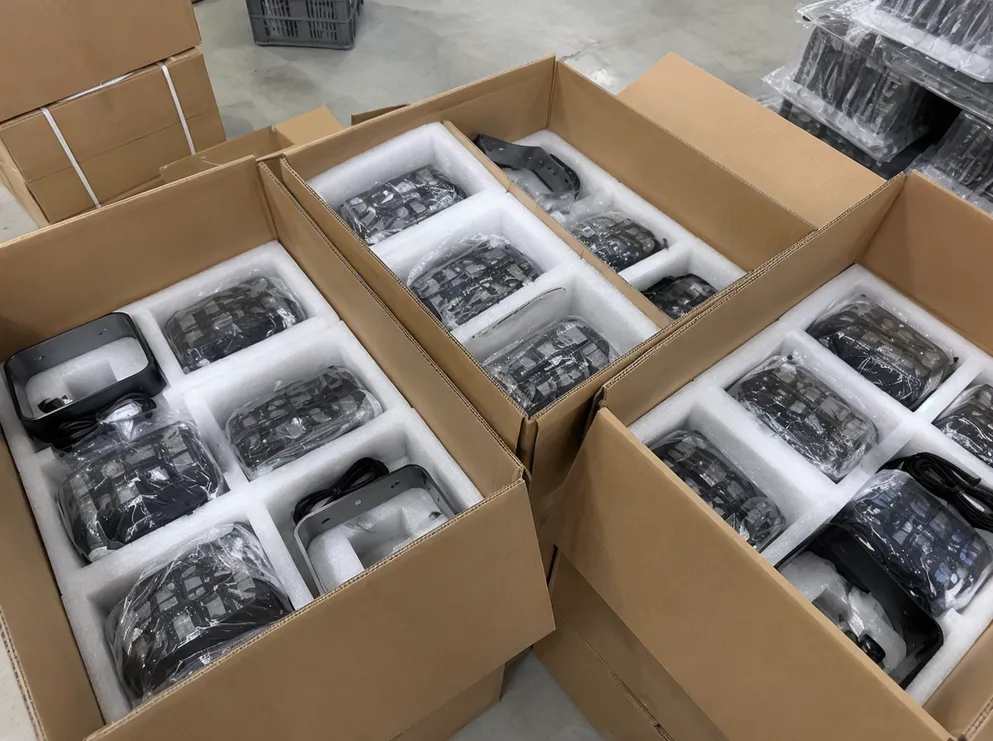
Each unit sits in a molded EPE foam insert shaped to the fixture geometry. Master cartons use K=K double-wall corrugated rated for 5-high palletization.
Lithium Battery Documentation
UN38.3 test report included with every shipment — no freight delays due to missing dangerous goods paperwork.
Amazon FBA Ready
FBA-compliant labeling, poly-bag individual units, and FNSKU-ready packaging configured at the factory. One less handling step between our dock and your fulfillment center.
Custom Multi-Pack Configurations
If you need custom multi-pack configurations (4-packs, 8-packs with retail shelf-ready outer carton), we tool the foam inserts and carton design as part of the OEM process.
How Portable DJ Lights Compare to Other Products in This Category
If portable isn't quite the right fit for your market, here's how the sibling products differentiate:
Need wireless control from a single transmitter over 20+ units
RF or Bluetooth control protocol; portable units are standalone sound-active only.
Wireless DJ LightsNeed DMX-512 integration with professional controllers
Addressable channels for synchronized programming; portable units run auto-programs.
DMX Party DJ LightsNeed laser effects and star field projections
Diode laser source for high-impact patterns; portable units use LED through optics.
Laser Projector Party DJ LightsNeed a complete stand + lights + transport package
All-in-one deployable system; portable units are fixture-only.
Party DJ Lights TripodNeed higher output for event stages and corporate functions
15W–30W output class with wider coverage; portable units are 3W–9W compact format.
Event Stage LightingMost of our distributors carry portable DJ lights alongside 2–3 sibling products to cover the full buyer spectrum.
Frequently Asked Questions
How long do portable DJ lights actually run per charge in real-world conditions?
How long do portable DJ lights actually run per charge in real-world conditions?
It depends on the operating mode. Sound-active mode (LEDs trigger on bass hits, dark between beats) typically extends runtime 40–60% beyond the continuous-on rating because the LEDs aren't running constantly. A unit rated at 12 hours continuous will run 16–20 hours in sound-active at a typical event.
Auto-run mode with all colors cycling continuously draws the most power and hits the rated figure.
We publish conservative ratings based on full-continuous mode — your actual event runtime will exceed the spec sheet number.
What happens when the battery eventually degrades — is the unit disposable?
What happens when the battery eventually degrades — is the unit disposable?
No. We design the battery compartment for field replacement. Phillips-head screws (no proprietary fasteners), accessible battery bay, standard 18650 cells. Your technician swaps the cells in five minutes with zero soldering.
Replacement 18650 cells with protection circuits cost $2–4 per cell depending on capacity. A fleet unit that cost you $15–30 wholesale gets another 500 cycles for under $10 in parts.
That maintenance model keeps your fleet ROI high over a 5–8 year lifecycle.
Can I mix portable DJ lights with wireless or DMX units in the same venue setup?
Can I mix portable DJ lights with wireless or DMX units in the same venue setup?
Portable units operate in standalone mode — sound-active or auto-program. They don't accept DMX or wireless RF commands. However, they work alongside wireless and DMX fixtures aesthetically because you can set them to complementary color programs.
For customers who need a few units on tables (portable, no control needed) plus main fixtures on stands (wireless or DMX controlled), the combination covers both needs without over-investing in addressable units for every fixture position.
What's the realistic lifespan of a portable DJ light in a weekly rental fleet?
What's the realistic lifespan of a portable DJ light in a weekly rental fleet?
At one rental per week: 500 charge cycles gives you roughly 10 years before battery replacement is needed. The housing and electronics typically outlast the battery by a wide margin — we see units still in service 5+ years later with only a cell swap.
Motor life on rotating models exceeds 30,000 hours. At 5 hours per event, once per week, that's 115 years of theoretical motor life.
The battery is the only consumable component.
Do portable DJ lights need any certifications for e-commerce sale in North America?
Do portable DJ lights need any certifications for e-commerce sale in North America?
FCC Part 15 for EMC (already certified on all our units) and UN38.3 for lithium battery transport (test reports provided with every shipment). No FDA/CDRH variance needed because these are LED-only — no laser components.
For Amazon specifically, your listings need the FCC compliance declaration, which we provide as a ready-to-upload document.
UL listing isn't mandatory for marketplace sale but some brick-and-mortar retailers require it — we handle UL applications as part of OEM projects if your channel needs it.
What IP rating should I specify for portable DJ lights used at outdoor events?
What IP rating should I specify for portable DJ lights used at outdoor events?
For events under tents or covered patios, our standard IP20 units are fine — they're protected from direct contact but not from water.
For venues where rain spray or spilled drinks are realistic risks, specify our IP44 variant with sealed USB port covers and gasketed lens mounts.
True outdoor exposed conditions (uncovered) need IP54 minimum — we offer this as a custom modification on runs of 200+ units.
Most portable DJ light deployment is indoor or covered outdoor, so IP20/IP44 covers 95% of use cases.
Start with Samples — Verify Before You Commit Volume
If you're evaluating portable DJ lights for your catalog, rental fleet, or distribution channel, the path is straightforward: order 2–5 sample units, run them through your own rental cycle or quality inspection, and confirm they outperform what you're currently sourcing.
Ship within 3–7 days
Ready in 7–10 days
No minimum on evaluation orders. Tell us what you need: your target market, your current sourcing pain points, or a competitor unit you want us to match. Our engineering team will recommend models, provide data sheets, and quote within 48 hours.
Direct Contact
Explore More Party DJ Lights
Related products in the Party DJ Lights category