

Mini LED DJ Lights Compact Effect Fixtures That Move Volume
Derby effects, moonflowers, and retro rotating projectors built under 2kg per unit for high-volume party lighting distribution.
The lowest price-per-unit in our LED DJ lights range, designed to ship in quantity and sell fast through retail, rental, and mobile DJ channels.
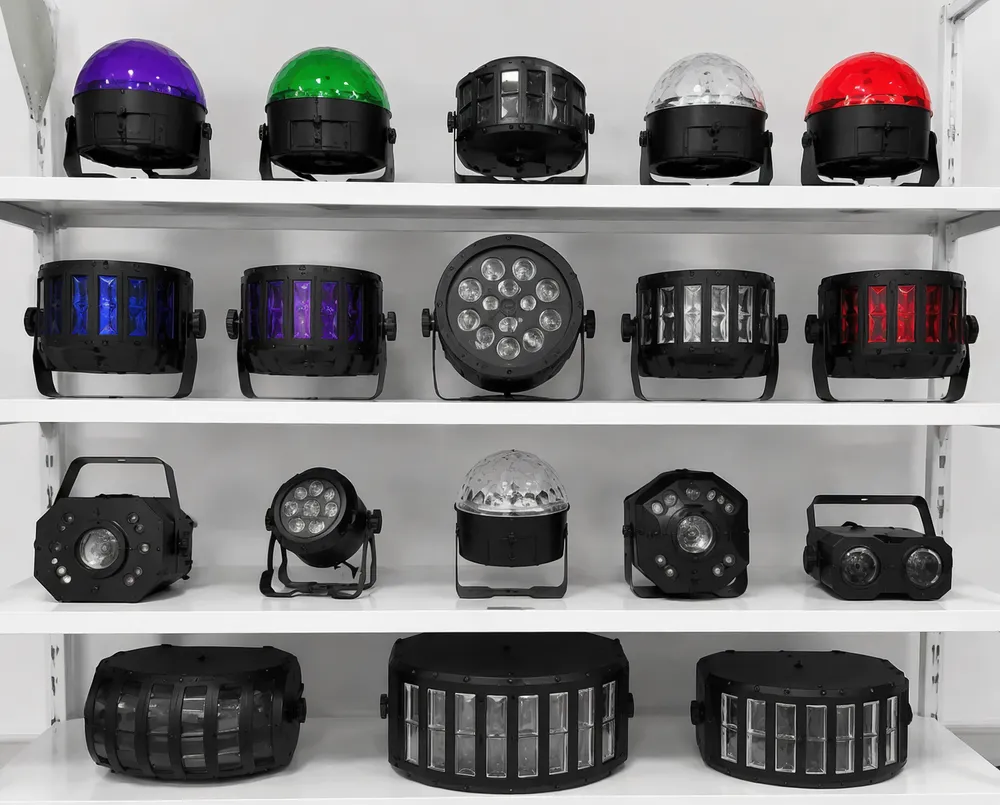
What Mini LED DJ Lights Are — and Where They Sit in Your Product Mix
Mini LED DJ lights are compact, self-contained effect fixtures — derby projectors, moonflower pattern generators, retro-styled rotating lens units, and multi-beam crystal balls — typically drawing 18W–50W and weighing 0.8–1.8kg per unit. They're the entry-level effect category in a DJ lighting product line, priced below par cans and pixel bars but sold in higher unit quantities.
For your business, these are velocity products. Mobile DJs buy them 4–8 at a time to fill out party lighting packs. Rental houses stock them 20–50 deep for weekend event inventory because replacement cost is low and utilization rate is high. Amazon and e-commerce sellers move them year-round as impulse-add lighting products with healthy margins at retail price points between $25–$80.
What separates our mini LED DJ lights from the commodity versions flooding online marketplaces: we build them on the same production lines and with the same QC process as our professional stage fixtures. The LED driver isn't a no-name board sourced from the cheapest PCB house — it's designed in-house by the same team that builds our 200W moving head drivers, scaled down to this wattage class. That means your warranty return rate stays flat even though the unit price is low.
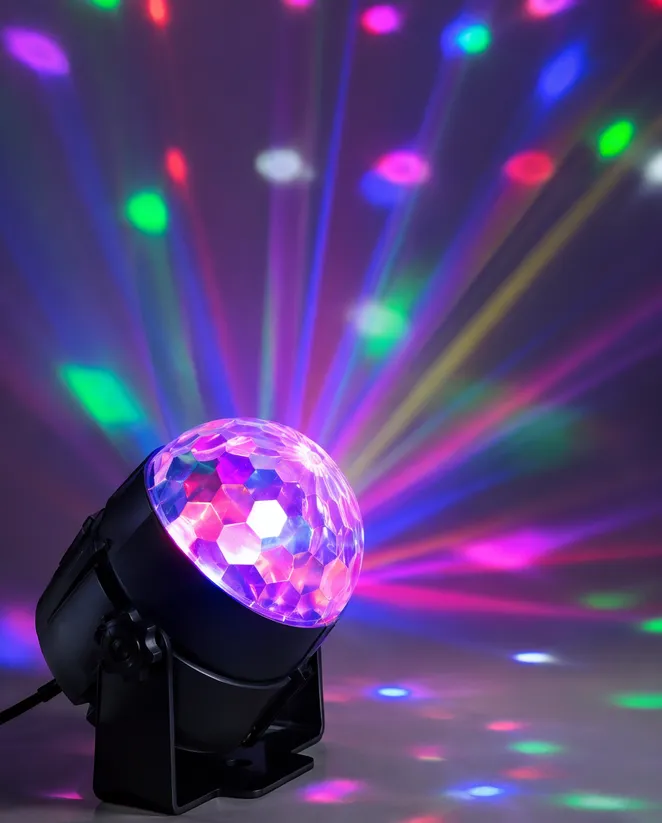
Driver Reliability — The Hidden Margin Killer
We've seen competitors in this category running 8–12% field failure rates because they cost-cut the driver below reliability threshold. Our target is under 2%. Same in-house driver design team that builds our 200W moving head boards, scaled down to this wattage class. Your warranty exposure drops while unit cost stays competitive.
Who Buys These — and How They Buy
Mobile DJs
Buy 4–8 units at a time to fill out party lighting packs. Low unit cost means easy upsell and fast ROI per gig.
Rental Houses
Stock 20–50 deep for weekend event inventory. Replacement cost is low and utilization rate is high — pure volume economics.
E-Commerce Sellers
Move them year-round as impulse-add lighting products with healthy margins at retail price points between $25–$80.
Retro LED DJ Lights — Growing Sub-Segment
The "retro LED DJ lights" segment — units styled with vintage chrome housings, colored lens arrays, and visible rotating mechanisms — has grown steadily over the past three years as event aesthetics cycle back toward visible-hardware lighting design. If you're building or refreshing a party lighting catalog, this sub-category carries higher perceived value per unit than plain-housing effects at similar production cost.
Technical Specifications — What You're Sourcing
Standard production values across our mini LED DJ lights range. Custom configurations available on OEM orders.
| Parameter | Typical Range |
|---|---|
| LED Source | 3W RGBW LEDs × 4–12 per fixture; Epistar chips standard, CREE available on premium SKUs |
| Total Fixture Wattage | 18W – 50W |
| Color System | RGBW (4-color), RGB (3-color), RGBWAL (6-color on select retro models) |
| Effect Types | Derby multi-beam, moonflower, rotating gobo, crystal ball, laser-simulated pattern |
| Beam Coverage | 120°–150° room-fill projection |
| Control Modes | DMX512 (up to 9 channels), sound-active, master/slave, auto-run |
| Housing Material | ABS+PC composite (standard), die-cast aluminum (premium retro models) |
| Unit Weight | 0.8kg – 1.8kg |
| Dimensions | Typically 18×18×20cm to 24×24×28cm |
| Operating Voltage | AC 100-240V, 50/60Hz universal input |
| IP Rating | IP20 (indoor use) |
| Certifications | CE, FCC, RoHS |
| Lifespan (LED) | 50,000 hours rated |
| Noise Level | Convection-cooled, no fan — silent operation |
Two Details Worth Noting for Your Purchasing Decisions
Silent Operation — No Internal Fans
All mini LED DJ lights in our range use convection cooling (no internal fans), so they're genuinely silent. This matters for small-venue DJs who operate in rooms where fan noise would be audible.
Universal Voltage — One SKU Worldwide
Universal voltage input (AC 100-240V, 50/60Hz) is standard — you ship the same SKU to North America, Europe, or Southeast Asia without stocking voltage variants.
Custom configurations available: different LED counts, modified wattage, alternate color systems — all feasible on OEM orders. Contact us with your target spec and we'll confirm feasibility.
Volume Economics — Why Mini Effects Drive Your Catalog Revenue
The commercial logic of mini LED DJ lights is different from professional fixtures. You're not selling them on technical superiority — you're selling them on volume throughput and low landed cost per unit.
Container Efficiency Is the Margin Story
~4,440
units per 40HQ container
Box: 22×22×24cm · 6 units/master carton
~2,320
units per 40HQ container
52% fewer units at same freight cost
~680
units per 40HQ container
85% fewer units at same freight cost
Your freight cost per unit drops to a fraction of what you'd pay on larger fixtures, which means your landed cost supports aggressive retail pricing while preserving margin.
Reorder Velocity Is High
These aren't fixtures that sit in a warehouse for 18 months waiting for a project. Mobile DJs lose them, break them at gigs, or simply want the latest effect pattern. Event rental companies cycle them out after 12–18 months of weekend use. E-commerce sellers move consistent weekly units year-round with spikes around holiday seasons and wedding seasons.
Mini Effects Reorder
60–90 days
Pro Stage Fixtures
6–12 months
The Entry Point for New Accounts
We've seen this pattern repeatedly over 12 years: a new buyer starts with mini LED DJ lights because the unit cost and MOQ risk are low. They test your QC, your packaging, your delivery reliability. Once confirmed, they add par cans, tube lights, and higher-value fixtures to subsequent orders.
Customer Acquisition Product
Mini effects are the first order that leads to a long-term account — your lowest-risk entry into new distribution relationships.
Retro LED DJ Lights — The Premium Sub-Segment in This Category
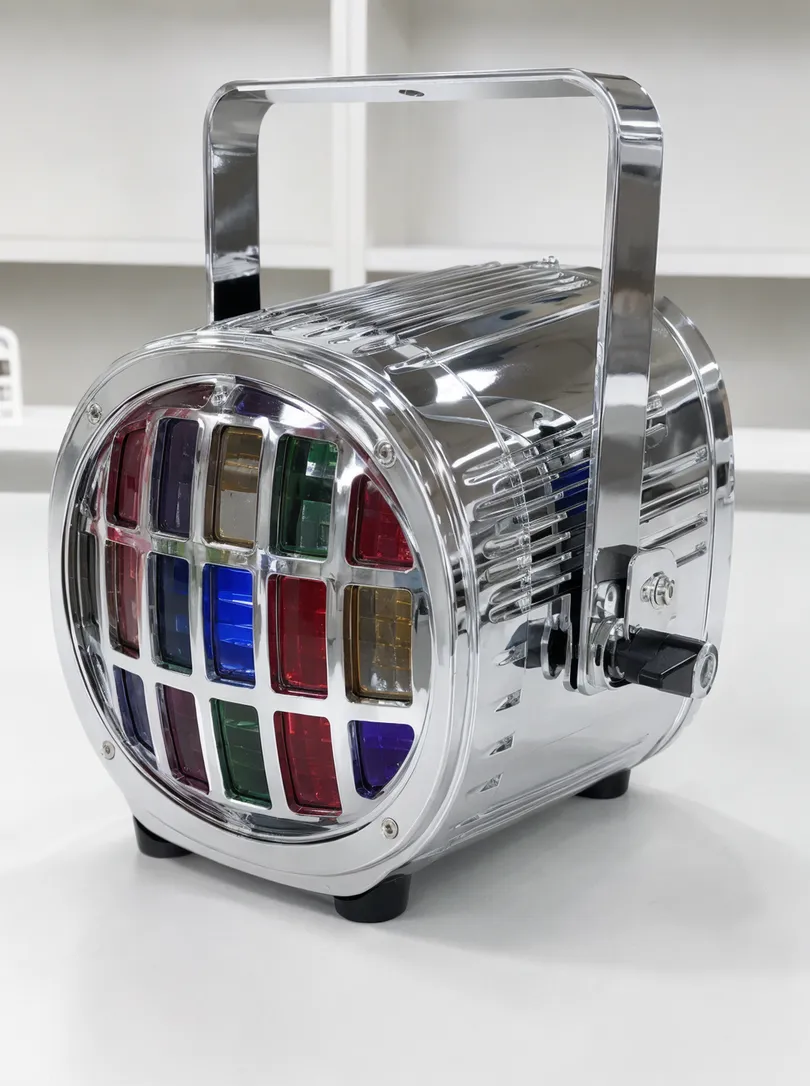
Retro LED DJ lights deserve separate attention because they carry a different margin profile than standard mini effects. These units use chrome or brushed-metal housings, visible colored lens arrays (the "disco ball" aesthetic), and exposed rotating mechanisms that create visual interest even when powered off.
Retail Price Premium Over Standard Mini Effects
30–50%
At comparable production cost — the styling commands the premium, not the BOM.
Die-Cast Aluminum Housings
We build retro LED DJ lights with die-cast aluminum housings rather than the ABS+PC used on standard mini effects. The material choice is partly aesthetic — metal catches light, feels premium in-hand — and partly thermal. Aluminum dissipates heat from the motor and LED array without needing a fan, keeping the unit silent and extending motor life.
Motor Heritage Since 2012
Our motor heritage — when we started with electromechanical entertainment devices — shows up directly in these products. The rotation mechanisms use brass bushings and sealed bearings rated for 10,000+ hours of continuous operation, not the plastic-on-plastic sleeve bearings that seize after 2,000 hours in humid environments.
GDMonkey Retro
- Die-cast aluminum housing
- Brass bushings + sealed bearings
- Fanless thermal design
- 10,000+ hour motor life
Typical Competitor
- ABS plastic housing
- Plastic sleeve bearings
- Fan-dependent cooling
- ~2,000 hours before seizure
OEM Customization for Retro SKUs
The retro segment is where we see the most OEM customization requests — buyers want unique lens colors, proprietary rotation patterns, or exclusive housing finishes to differentiate their branded SKU from what's already on Amazon. If you're targeting this niche, talk to us early about cosmetic differentiation options.
Adjacent Market: Wedding & Event Decor
For your distribution, retro LED DJ lights sell into wedding and event decor segments that standard DJ effects don't reach — event planners and venue decorators who'd never buy a "DJ light" will purchase a "vintage LED projector" for $60–$90 retail. That's an adjacent market segment your existing DJ lighting catalog doesn't capture without this sub-category.
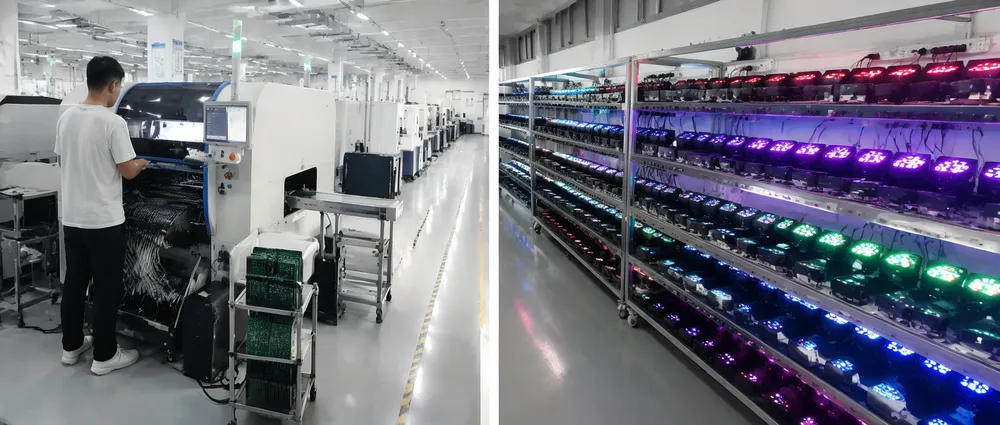
How We Build Mini LED DJ Lights Production Decisions That Protect Your Margin
Mini effects are high-volume, low-price-point products. The temptation in manufacturing is to cut everything to hit the lowest possible unit cost. We've seen the result of that approach in warranty data from buyers who switch to us after a bad run with another supplier: 10%+ failure rates, LED color drift across batches, motors dying after a few months. Your support costs on those units erase whatever you saved on purchase price.
Our approach is to build mini LED DJ lights on the same production discipline as professional fixtures, but optimized for the form factor and duty cycle.
LED Mounting
Same automated SMT line, same ±0.05mm placement accuracy, same incoming LED bin testing as our par lights and stage fixtures. The per-chip cost difference between binned and unbinned LEDs is negligible at production volume — maybe $0.03 per chip — but the quality difference in batch color consistency is immediately visible when your customer mounts four units on a T-bar.
Motor Assemblies
For rotating effects and retro models, we assemble motors in-house using our own winding specifications rather than buying pre-assembled commodity motors. Motor speed consistency, noise level, and longevity are controlled from the winding stage.
Every motor is run-tested for 4 hours before installation — checking for bearing noise, speed stability, and current draw uniformity. Generic pre-assembled motors skip this step entirely, which is why you hear rattling from cheap disco lights after 500 hours.
48-Hour Aging Test
Yes, even on an 18W mini effect light. Every unit runs full electrical load for 48 hours before packing. On a $15–$30 FOB product, that's an expensive QC step relative to unit price — it ties up rack space and adds labor.
But the math works out: catching 1–2% of units that would fail in the field saves your customer relationship and your RMA processing cost, which on a $40 retail product is often more expensive than the product itself.
Driver PCB Design
In-house, not outsourced. The LED driver on a mini effect handles lower wattage than a par light driver, but it faces the same stress factors — voltage spikes, thermal cycling, capacitor aging.
We use the same rated-MTBF component sourcing standards regardless of fixture price tier. Film capacitors where it matters, name-brand MOSFETs, and proper thermal relief on PCB copper pours.
Market Segments That Buy Mini LED DJ Lights Your Revenue Channels
Each segment below represents a repeatable ordering pattern for your distribution business.
Mobile DJ Supply
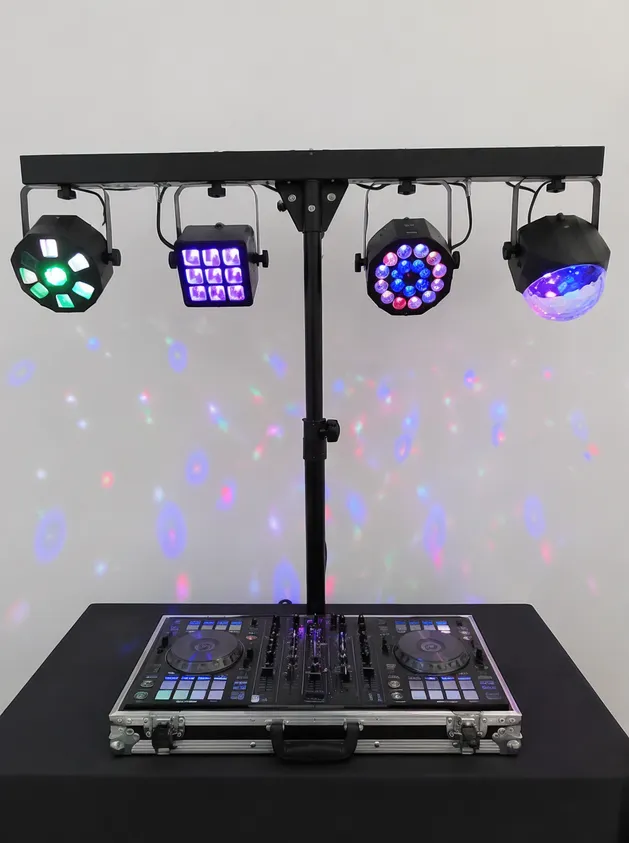
Mobile DJs are the core buyer of mini LED DJ lights. They build "party packs" — typically 4–8 compact effects combined with a few par cans and a controller — that they transport in a single vehicle to weekend gigs.
Your positioning: Stock 3–4 distinct effect types (derby, moonflower, retro, crystal ball) so each DJ can build a varied pack from your catalog. The DJ who buys one type from you and a different type from a competitor is a DJ you're sharing margin with.
E-Commerce and Amazon Sellers
Mini LED DJ lights are a proven category on Amazon, Walmart Marketplace, and independent e-commerce stores. Typical retail price points: $25–$80 depending on effect complexity and housing quality.
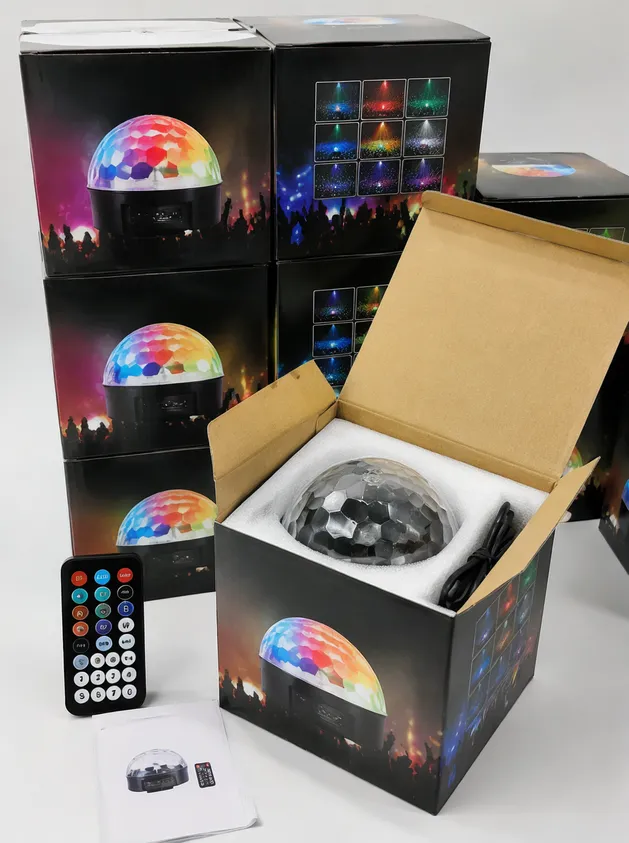
We support this channel fully: Shelf-ready retail packaging with your brand artwork, barcode labeling to your spec, and blind drop-ship capability if you're running a lean inventory model. Unit dimensions and weight keep shipping costs in Amazon's "standard size" tier for most models — a meaningful margin factor for FBA sellers.
Event Rental Companies
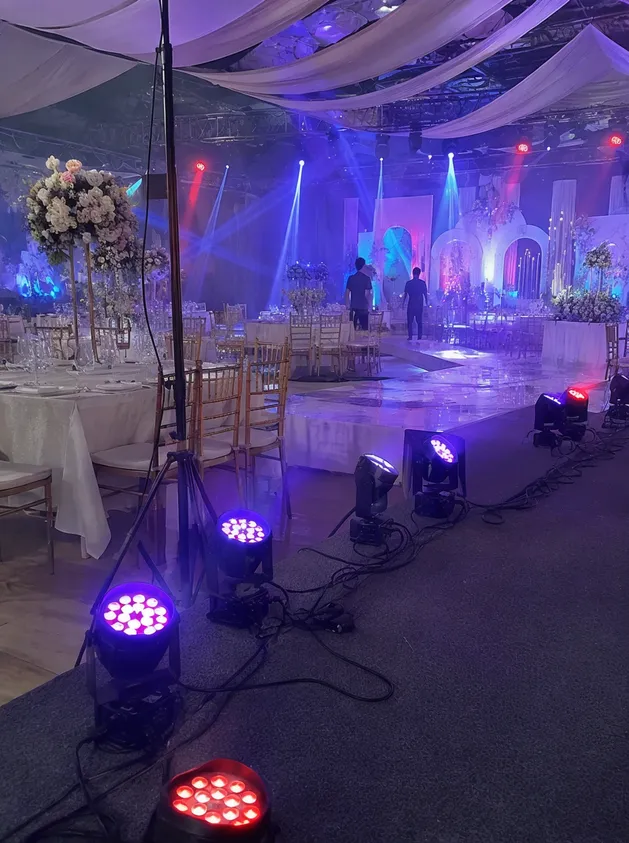
Rental houses stock mini LED DJ lights as their most-deployed, least-expensive effect inventory. They send 10–20 units to every birthday party, wedding reception, and corporate mixer.
Hospitality and Venue Installations
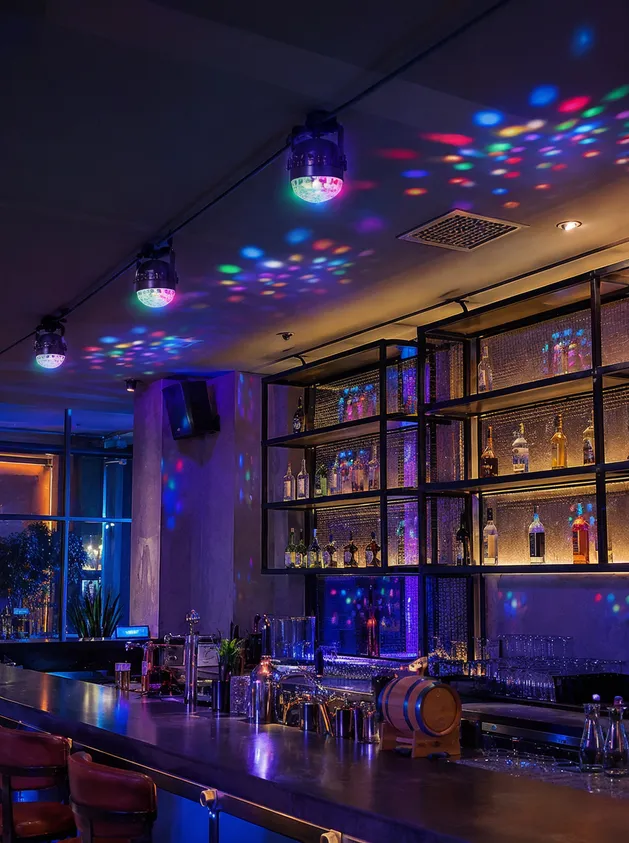
Bars, karaoke rooms, bowling alleys, and restaurants with entertainment zones install mini LED DJ lights as permanent ambient effects. Lower per-venue quantities (4–12 units) but consistent project flow for distributors serving the commercial interior market.
The retro LED DJ lights sub-segment performs especially well here — venue owners want fixtures that contribute to decor aesthetics, not just functional lighting.
Houses of Worship
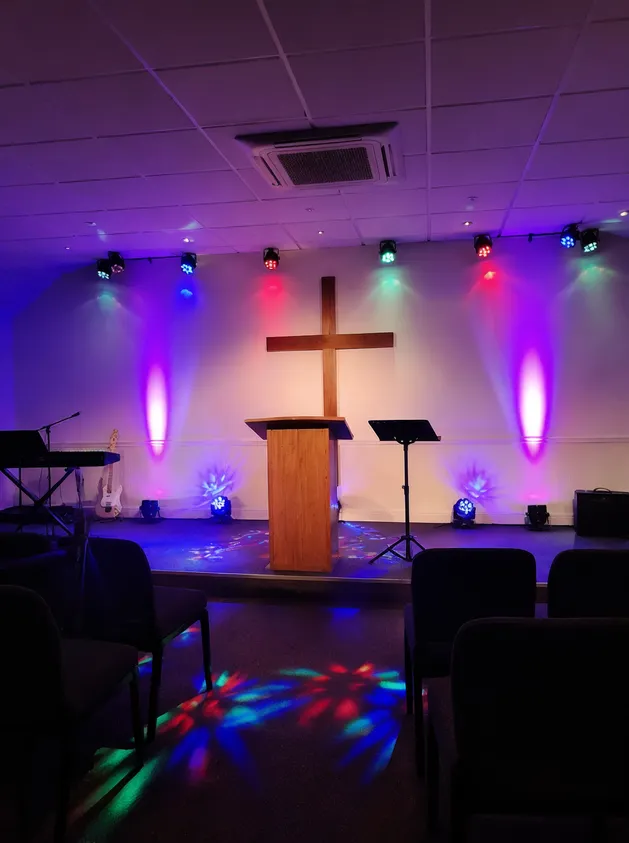
Smaller churches and community worship spaces use mini LED DJ lights as budget-friendly stage effects for services and youth events. Typical orders: 6–12 units per venue.
Customization Options for Mini LED DJ Lights
Mini effects support both cosmetic OEM branding and functional ODM modifications. Here's what you can specify:
OEM Branding
30-unit MOQ • No tooling cost- Logo laser-engraved or pad-printed on housing
- Custom retail packaging — your brand, your artwork, your UPC
- Custom user manual and warranty card
- Firmware startup screen with your logo (on DMX-equipped models)
- Private-labeled CE/FCC compliance documentation
ODM Modifications
30-unit MOQ • Tooling may apply- LED array changes: different chip count, color system (e.g., add UV or warm white to RGBW)
- Custom effect patterns: modified gobo designs, proprietary beam patterns
- Housing color: any RAL color on runs over 100 units; standard black, white, or chrome on smaller runs
- Modified rotation speed or pattern sequencing
- Custom DMX channel mapping
- Wireless remote control integration (IR or RF)
- Battery-powered variants for cable-free installations (adds internal Li-ion pack, 4–6 hour runtime at full output)
What We Can't Customize Without New Tooling
- Housing shape/form factor (tied to existing mold geometry)
- Fundamental fixture size (optical throw distance is fixed by the housing depth)
7–10 Days
OEM Branding Samples
20–30 Days
ODM Engineering Changes
+25 Days
New Injection Mold Tooling (rare)
For Amazon Sellers
We can produce your custom-branded mini LED DJ lights with FBA-ready case packing and pre-applied FNSKU labels. One less step in your prep workflow, and it eliminates the labeling-error risk that causes intake rejections at Amazon fulfillment centers.
Packaging and Shipping — Landed Cost Optimization
Mini LED DJ lights have the best container utilization of any fixture type in our LED DJ lights range. The compact form factor and low unit weight translate directly into lower freight cost per unit — which is where your margin advantage starts.
Packaging & Container Utilization
| Packaging Detail | Specification |
|---|---|
| Individual box dimensions | 22 × 22 × 24 cm (typical) |
| Individual box weight | 1.2–2.2 kg gross (model-dependent) |
| Units per master carton | 6 |
| Master carton dimensions | 48 × 36 × 52 cm |
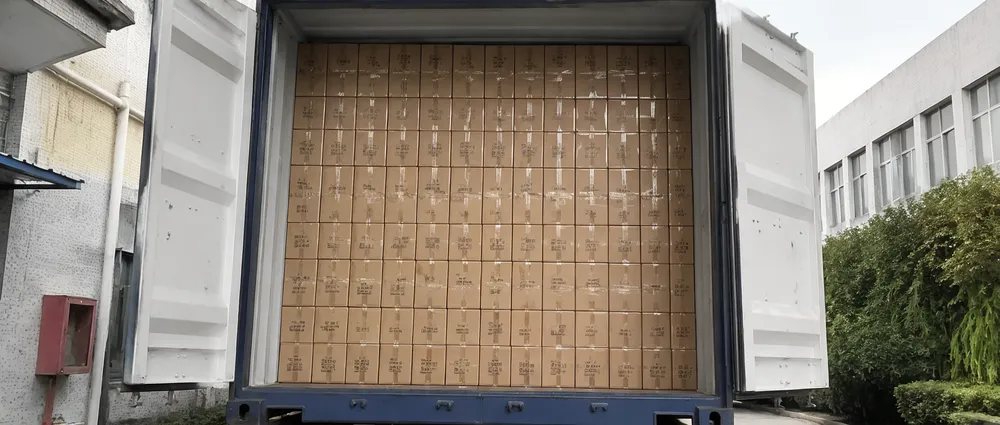
| Master cartons per 20GP | ~360 (2,160 units) |
| Master cartons per 40HQ | ~740 (4,440 units) |
| Pallet configuration | 8 cartons per layer, 5 layers (40 cartons/pallet) |
Inner Packaging Protection
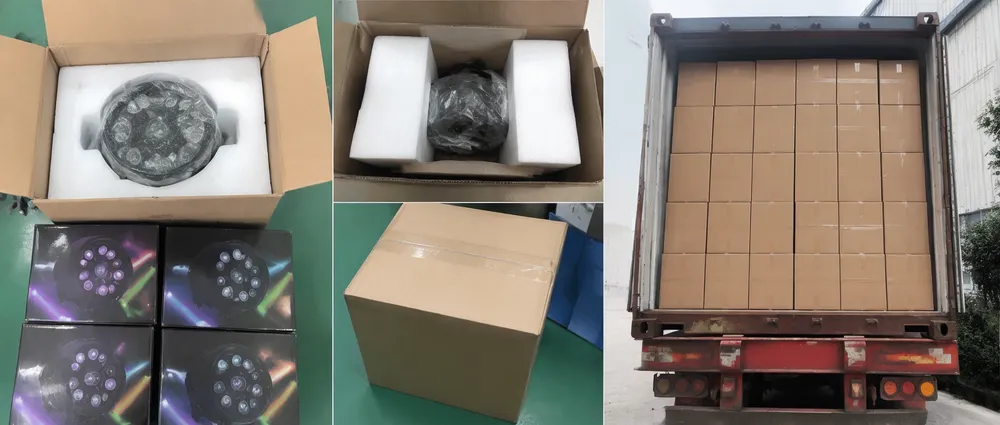
Inner packaging uses custom-molded EPE foam inserts shaped to each model's geometry — no generic bubble wrap. Individual retail color boxes have full product imagery, feature callouts, and barcode on all standard SKUs.
For private-label orders, we produce your custom retail box with your artwork, printed on 350gsm coated cardboard with matte or gloss lamination.
Master Carton Durability
Master cartons are double-wall corrugated, K=K grade, tested to ISTA 3A transport simulation standards:
- Drop test from 76 cm
- Random vibration for 60 minutes
- Compression stack test
Zero Transit-Damage Claims
We haven't had a transit-damage claim on mini LED DJ lights in over 2,000 containers shipped. The product is inherently resilient due to low weight and the custom EPE foam insert doing its job.
Mixed-Product Container Optimization
For mixed-product containers (common when you're ordering mini effects alongside par lights and other fixtures), our logistics team calculates optimal stacking plans to maximize cube utilization. Mini effects typically fill gaps above heavier fixtures because they're light and stackable.
Certifications — Pre-Cleared for Your Import Markets
All mini LED DJ lights carry CE, FCC Part 15 Class B, and RoHS compliance documentation as standard.
CE
Tested to EN 60598-1 (luminaire safety) and EN 55015 (electromagnetic compatibility).
Test reports from accredited labs available for your import clearance file.
FCC
Part 15 Class B verified — emissions within limits for residential and commercial environments.
Applicable for US and Canadian market entry without additional testing.
RoHS
Full material declarations available. Lead-free solder process, halogen-free PCB substrates, no restricted substances above threshold values.
Additional Market Certifications
For additional market certifications — ETL/UL listing for North American buyers who require it, SAA mark for Australia, or specific country marks — we've completed the underlying safety and EMC testing that these certifications build upon.
The certification itself is typically a documentation and application process rather than a redesign. We'll confirm timeline and cost for any specific mark you need.
Private-Label Compliance Documentation
All compliance documentation is available private-labeled with your brand as the importer of record, so your downstream customers see your brand on the certification, not ours.
Frequently Asked Questions — Mini LED DJ Lights Sourcing
How long do mini LED DJ lights actually last under rental-house duty cycles?
Under weekend-every-weekend usage (approximately 8–12 hours per week), our rated LED lifespan of 50,000 hours translates to 10+ years of operation before meaningful lumen depreciation.
The practical life limiter is usually the motor mechanism on rotating models — our brass-bushing assemblies are rated for 10,000+ continuous hours, which covers roughly 4–5 years of rental duty.
Static LED effects (no motor) have no mechanical wear component and typically outlast market relevance.
What's the failure rate I should expect on a production batch?
Our target out-of-box failure rate on mini LED DJ lights is under 0.5% — that's after the 48-hour aging test catches infant mortality units before packing.
Field failure rate within the first 12 months of normal use is typically under 2%.
For comparison, industry average on sub-$30 FOB LED effects from non-QC-controlled sources runs 8–12%.
The difference is the aging test and driver component selection, which add roughly $0.80–$1.20 to unit production cost but eliminate the majority of early-life failures.
Can I mix mini LED DJ lights with your par cans and tube lights on the same DMX chain?
Yes. All fixtures in our LED DJ lights range use standard DMX512 protocol with consistent signal handling — optically isolated input, proper termination, and stable address retention through power cycles.
You can daisy-chain mini effects, par lights, tube lights, and pixel bars on a single DMX universe.
We validate cross-model DMX compatibility during production testing specifically because mixed-product rental rigs are the normal deployment scenario.
What's the MOQ for a custom-branded mini LED DJ light with retail packaging?
30 units per model. That covers your logo on the housing, your retail box artwork, custom user manual, and firmware splash screen. No tooling costs for standard OEM branding on existing models.
First-order lead time is 15–20 days (includes packaging printing and branding application).
Reorders of the same SKU ship in 10–15 days because your artwork and branding specs are on file.
Do mini LED DJ lights work reliably on sound-active mode without a DMX controller?
Sound-active mode uses an internal microphone to trigger effect changes on bass hits. Sensitivity is adjustable via a rear-panel knob on all models.
For mobile DJs and venue installations where no DMX controller is present, sound-active is the primary operating mode — and reliability here means consistent triggering without false-firing in quiet moments or failing to respond during music.
We calibrate microphone sensitivity and threshold during production testing to ensure responsive, predictable triggering across the typical dynamic range of DJ and event music (85–110 dB SPL at source).
If Mini Effects Aren't the Right Fit
Mini LED DJ lights are the compact, high-volume, entry-price category. If your market requires different capabilities, other products in our LED DJ lights range may be a better match:
LED DJ Par Lights
Need wash lighting with color mixing control?
RGBW color mixing, 54W–200W, designed for uplighting and stage wash applications.
View Par LightsLED DJ Tube Lights
Need linear accent and architectural effects?
Individual pixel control, battery-powered options, for ceiling installations and DJ booth framing.
View Tube LightsLED DJ Pixel Bar
Need high-impact visual spectacle?
Matrix arrays and chase patterns with ArtNet/sACN support for media server integration.
View Pixel BarsLED DJ Spotlight
Need focused beam and gobo projection?
Tight 8°–15° beam angles for pin-spot and follow-spot applications.
View SpotlightsLED DJ Stage Lights
Need professional touring-grade fixtures?
150W–280W, heavy-duty housing, designed for 12+ hour continuous operation.
View Stage LightsLineup Strategy
Most distributors carry mini effects alongside par lights as a minimum two-category lineup — the par lights handle functional lighting while the mini effects handle visual spectacle, covering both needs in a single supplier relationship.
Start Your Mini LED DJ Lights Order
Most buyers in this category start with a 50–100 unit sample order across 2–3 effect types to test sell-through in their channel. We can ship samples within 3–5 days from our standard range, or 7–10 days for OEM-branded units.
Send Us Your Requirements
Send us your target product mix, branding requirements, and volume estimate. If you're building a party lighting line from scratch, tell us your target retail price points and market — we'll recommend the effect types that are moving best for our existing distributors in your region.
- Target product mix & effect types
- Branding / OEM requirements
- Volume estimate
- Target retail price points & market region
Contact Our Sales Team
Sample Lead Times
Standard range: 3–5 days
OEM-branded units: 7–10 days