

Club DJ Lights Commercial-Grade Fixtures for Venue Installations
High-output LED fixtures with DMX, sound-active, and neon DJ lights configurations built on our production floor since 2015. Full OEM/ODM capability from 30 units, so you can test a venue project or build a private-label line without container-quantity commitments.
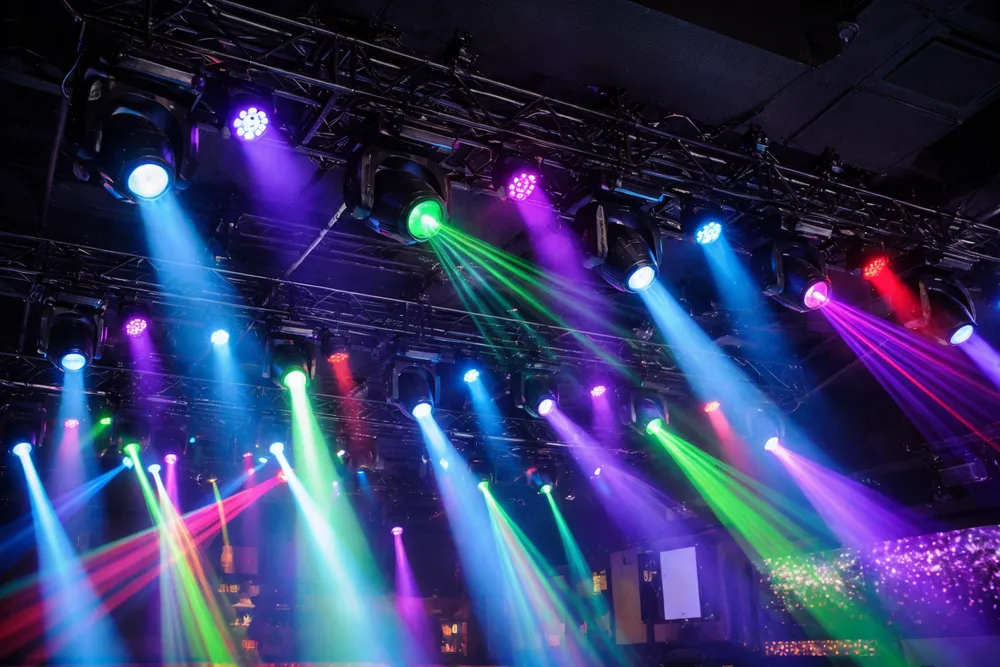
What Separates Club DJ Lights from General Disco Fixtures
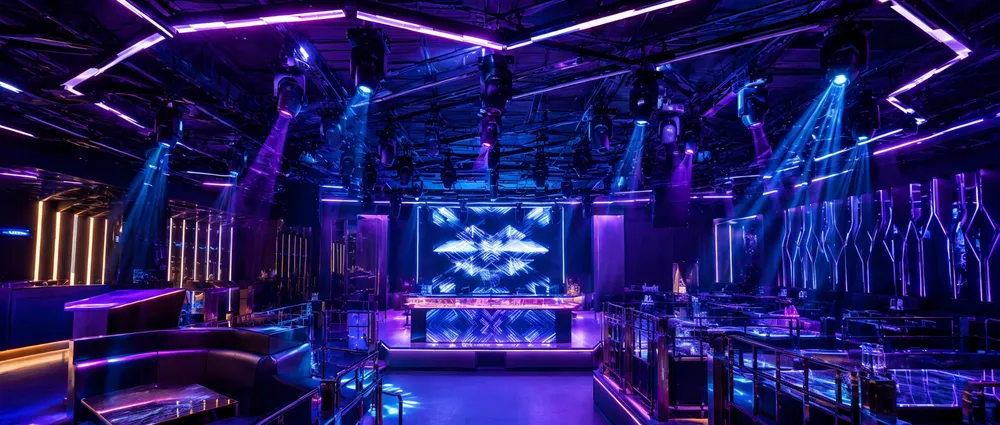
Club environments present a specific engineering problem: fixtures run 6–8 hours nightly, 5–7 nights a week, in hot ceiling spaces with smoke machine residue and vibration from subwoofer systems. General disco or party lights — designed for weekend house parties or occasional events — don't survive that duty cycle. Motors burn out, LED drivers overheat, plastic housings warp.
Our club DJ lights are the fixtures we developed specifically for permanent venue installations and commercial resale into the nightclub channel. The key differences from our standard disco DJ range:
Heavy-Gauge Aluminum Housings
Engineered for heat dissipation under continuous operation — no plastic warping, no thermal throttling during 8-hour sets.
Sealed Optical Assemblies
Resist haze fluid buildup that coats and degrades optics in venues running fog and haze machines nightly.
High-Cycle Stepper Motors
Rated for 50,000+ hours — built for continuous pan/tilt duty cycles that destroy consumer-grade motors within months.
Thermally Stable Driver Boards
Designed for thermal stability at sustained full-output — no mid-show dimming, no driver failures from heat soak.
We also build in DMX-512 as standard on every club-grade unit — sound-active mode is there for convenience, but professional venue installers expect addressable control.
What This Means for Your Business
You can sell into the commercial venue market — nightclubs, lounges, entertainment complexes — without worrying about field failure rates destroying your margin. We've been shipping these configurations to installers in North America, Europe, and the Middle East since 2015, and the 48-hour aging test catches the infant mortality failures before they become your warranty claims.
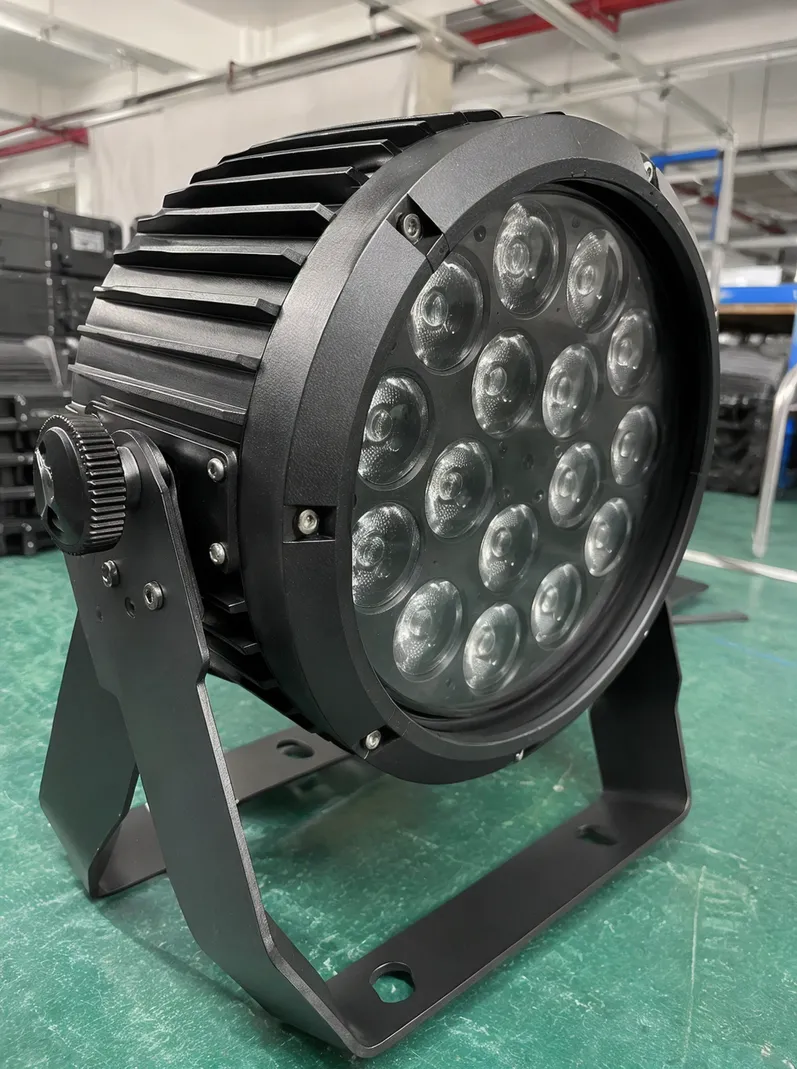
Duty Cycle Comparison
Neon DJ Lights Configurations — The High-Margin Visual Trend
Neon DJ lights (UV-reactive LED strip arrays and neon-tube-effect fixtures) have become one of the fastest-moving segments in club lighting over the past three years. Venues want that saturated, cyberpunk-aesthetic glow — and it's a segment where your downstream buyers will pay a premium because the visual impact is immediately obvious.
We produce neon DJ lights in two main form factors:
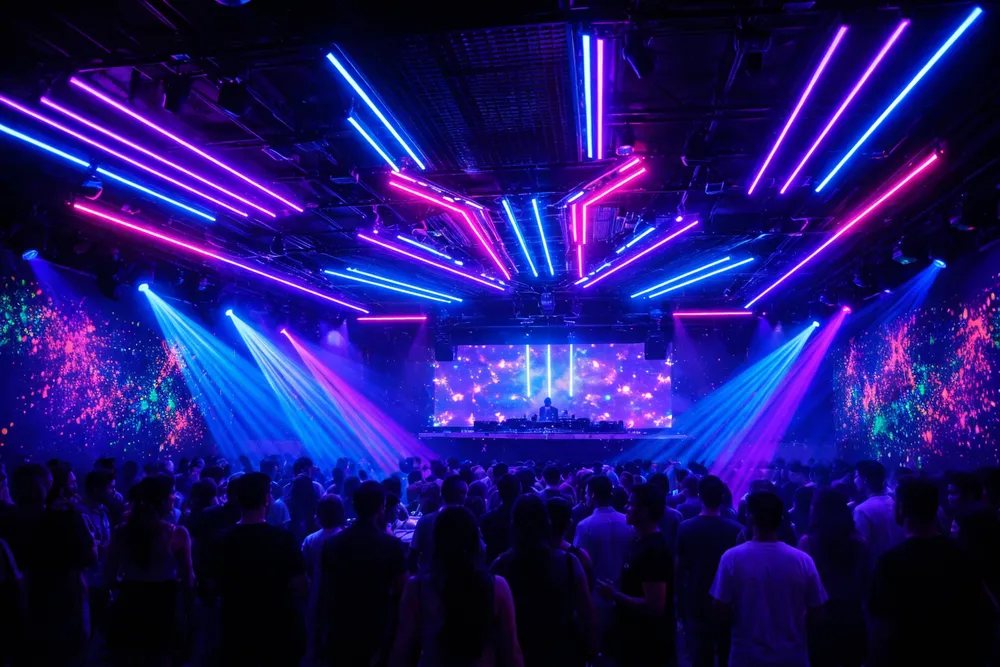
Linear Tube-Style Fixtures
Typically 1m and 1.2m lengths for bar and ceiling mounting. Clean lines, high-output RGB+UV LED arrays with continuous dimming curves.
Compact Pixel-Mapped Arrays
Designed for wall installations. Individual pixel addressability enables programmable color sequences, chases, and reactive patterns via DMX.
Why UV Is the Key Component
Both form factors run full RGB+UV LED configurations, so you get true UV-reactive effects alongside programmable color sequences. The UV component is what makes white clothing and painted surfaces glow — that's the "neon" effect venues are chasing, and it's been responsible for roughly 30% of our new club lighting orders this year.
The Commercial Logic for Stocking Neon DJ Lights
They retail at higher per-unit prices than standard wash fixtures because the visual result is distinctive. Your venue clients see immediate patron engagement — social media content, longer dwell times, drink revenue — and your margin on a neon fixture typically runs 15–25% higher than on a comparable-output standard wash.
We can produce these in your brand packaging with custom DMX profiles, so you're not competing on the same SKU as everyone else importing generic product.
Typical Margin Uplift
15–25%
Higher than comparable-output standard wash fixtures
Venue ROI Drivers
- Social media content generation
- Longer patron dwell times
- Increased drink revenue per visit
- Distinctive SKU positioning
Technical Specifications — What Goes Into Your Comparison Sheet
| Parameter | Standard Club DJ Light | Neon DJ Light (Tube) | Neon DJ Light (Array) |
|---|---|---|---|
| LED Configuration | 18×10W RGBW (4-in-1) | 144 LEDs/m RGB+UV SMD5050 | 256-pixel RGBW matrix |
| Total Output | 150–200W per fixture | 30–45W per meter | 80–120W per panel |
| Beam Angle | 15° / 25° / 45° (lens-selectable) | 120° wash | 60° directional |
| Control | DMX-512, sound-active, auto, master/slave | DMX-512, Art-Net, sound-active | DMX-512, Art-Net, SPI pixel control |
| Housing | Die-cast aluminum, black or custom powder coat | Extruded aluminum + PC diffuser | Aluminum frame, tempered glass face |
| IP Rating | IP20 (indoor) / IP65 (outdoor option) | IP20 standard / IP65 available | IP20 indoor |
| Operating Temp | -20°C to +45°C | -10°C to +40°C | -10°C to +40°C |
| Lifespan (LED) | 50,000 hours typical | 50,000 hours typical | 50,000 hours typical |
| Weight | 4.5–7.2 kg depending on model | 0.8–1.2 kg per meter | 3.5–5.0 kg per panel |
| DMX Channels | 4/6/10 channel modes | 3/6/12+ channel modes | Up to 768 channels (pixel) |
Specifications reflect industry-standard values for professional-grade club fixtures. Exact parameters vary by model and customization. Contact us for detailed product data sheets with photometric reports.
Magnetic Lens Swap — One SKU, Three Applications
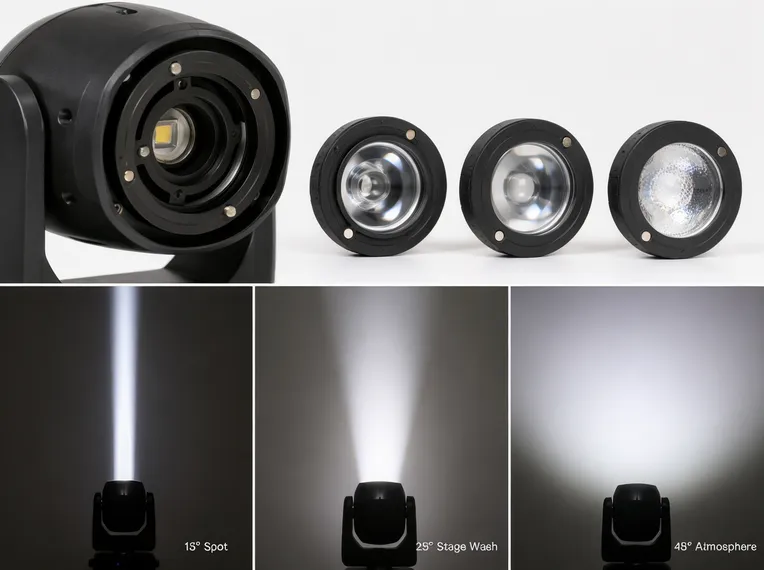
The lens-selectable beam angle on the standard club fixture deserves a note: we use a magnetic lens swap system on our current generation. Your installer can switch between 15°, 25°, and 45° optics in the field without tools.
For distributors, this means you stock one SKU that covers multiple installation scenarios — tight beam for spot effects, medium for stage wash, wide for general atmosphere. One part number, three applications.
Where Club DJ Lights Generate Revenue — Market Segments Worth Your Inventory
Nightclubs and Lounges
The core market. A typical mid-size nightclub installs 20–40 overhead fixtures plus 10–20 linear neon accents. Venues refit lighting every 3–5 years as trends shift and LEDs reach end-of-useful-life.
If you're selling into this segment, you're looking at recurring project orders in the 30–80 unit range with good margin because installers specify by brand, not by lowest price.
Entertainment Complexes & Hotel Venues
Casino resorts, hotel bars, bowling alleys with DJ nights, rooftop lounges. These accounts order through AV integrators or hospitality procurement teams. Order volumes run higher (50–200 fixtures per property) and they value consistency — same fixture across 12 venues in a hotel chain means one DMX profile, one spare parts inventory, one training protocol.
We can guarantee production consistency across multi-site rollouts because every unit references the same golden sample during QC.
Rental and Production Companies
Event rental firms stock club-grade fixtures for club nights, corporate events, and festival stages. Rental gear takes a beating — transport, rigging, de-rigging — so the aluminum housing and sealed optics we use aren't luxury features; they're the minimum spec for gear that needs to survive 200+ deployments per year.
Rental companies reorder in quarterly cycles, so this is a repeat-revenue segment for your distribution business.
Retail and E-Commerce (DJ Equipment Brands)
If you're building or distributing a DJ equipment brand online, club DJ lights are a margin anchor in your catalog. Professional-grade fixtures command higher prices than party lights, and the buyer (a working DJ or small venue owner) is less price-sensitive than a consumer buying a disco ball for their living room.
We support retail packaging, individual unit boxing with your branding, and barcode/FNSKU labeling for FBA fulfillment. This channel has grown significantly for us — roughly a third of our club lighting goes into branded e-commerce packaging now.
OEM/ODM Customization What You Can Specify, What We'll Advise Against
We do full OEM and ODM on club DJ lights. Here's what that means in practical terms for your product line.
What You Can Customize Freely
- Housing color — any RAL code or custom powder coat finish. Black, white, and metallic are standard; custom colors add 5–7 days for powder line changeover on runs over 100 units
- Your logo, branding, and model numbers on housing and packaging — pad printing, laser engraving, or adhesive label depending on your preference and budget
- LED color configuration — RGBW, RGBA, pure white (warm/cool/daylight), UV, or single-color variants
- Beam angle optics — lens tooling for 10°, 15°, 25°, 35°, and 45°; custom angles require new lens molds (typical tooling: 15–20 days)
- Control protocol — DMX-512 standard; add Bluetooth, Wi-Fi app control, or Art-Net connectivity based on your firmware requirements
- Packaging — retail box, plain brown carton, flight-case compatible foam insert, or bulk pallet packing
Requires Engineering Review
MOQ typically 200+ units
- Modified housing dimensions or mounting systems
- Custom thermal management (different heat sink profiles for specific installation environments)
- Proprietary DMX profiles or custom firmware behavior
- New LED array configurations outside standard layouts
- IP65/IP67 upgrade on models not currently rated for outdoor use
What We'll Advise Against
And why — learned from field deployment
Reducing housing wall thickness below 2.0mm on club fixtures
The thermal load at 6+ hours nightly operation requires the mass for heat dissipation. We've tested thinner walls, and LED junction temperature rises past safe thresholds within 3 hours of continuous use.
Using commodity-grade capacitors on the driver board to hit a lower price point
We tried this in 2016 and saw failure rates triple within 8 months of field deployment. The cost savings per unit doesn't justify the warranty exposure.
If you're unsure whether your customization idea is feasible, send us a rough spec. Our engineering team responds within 48 hours with a feasibility assessment and any recommended modifications.
30 units
MOQ for catalog models with your branding
200–500 units
Full ODM with new tooling — initial production run
20–35 days
Lead time standard configs; +10–15 days for new tooling or firmware
Manufacturing Process How Club-Grade Durability Gets Built In
Club DJ lights fail in predictable ways when they're built to consumer-grade standards. We've been shipping into the commercial venue channel long enough to know where the failure modes are, and our production process addresses each one.
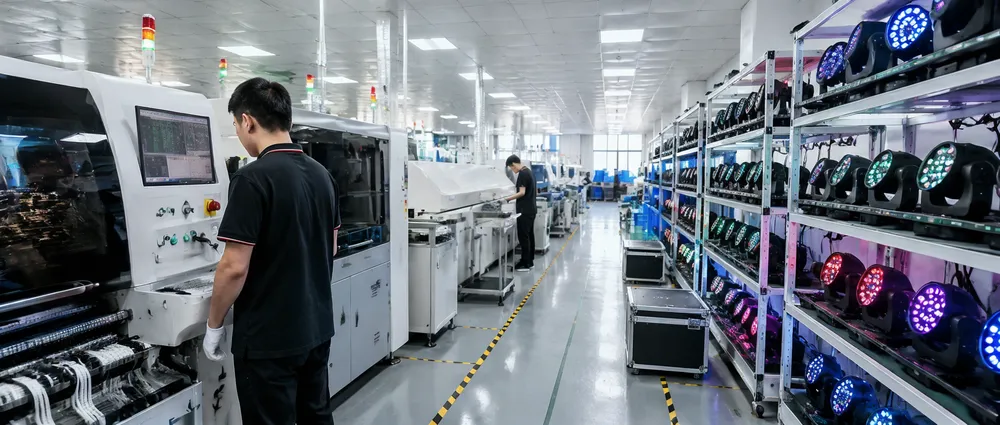
LED Board Assembly
Automated SMT lines with solder paste inspection and AOI (automated optical inspection) on every board. Chip placement accuracy at ±0.05mm keeps the optical pattern uniform across your batch.
We run 100% reflow profile monitoring — temperature curves are logged per panel, so if a batch shows marginal soldering, we catch it before assembly.
The most common field failure in cheap club lights is cold solder joints on LED chips that crack under thermal cycling. Our AOI rejection catches these at the board level.
Driver Board Production
Wave soldering for through-hole components, followed by AOI and functional testing at rated load.
We specify 105°C-rated electrolytic capacitors on all club-grade drivers — standard consumer drivers use 85°C caps that degrade fast in hot ceiling installations.
Each driver board gets a 2-hour burn-in at 110% rated load before it moves to final assembly.
105°C
Cap rating (vs. 85°C consumer)
110%
Burn-in load stress test
Housing & Thermal Management
Die-cast aluminum housings with integrated heat sink fins. Fin geometry designed in-house using thermal simulation, targeting LED junction temperatures below 85°C at maximum output in a 45°C ambient environment.
After casting, housings go through CNC machining for mounting surfaces — flatness within 0.1mm for proper thermal pad contact — then powder coating at 60–80μm thickness.
Final Assembly & Calibration
Each unit assembled with thermal compound on LED-to-heatsink interfaces, torqued to spec. Optical output verified against the golden sample:
- Color temperature measured
- Lux output at 1m recorded
- Beam angle confirmed to spec
Then the full unit enters our 48-hour aging rack at rated power. We run roughly 350 fixtures simultaneously in the aging test area, monitoring for any unit that dims, flickers, or shows abnormal current draw.
The End Result for You
Product that arrives at your warehouse ready to ship to end customers or install in venues, with batch traceability documentation that you can pass to your own customers as proof of QC process.
Compliance and Certifications Pre-Qualified for Your Target Markets
Every club DJ light ships with CE, FCC, and RoHS compliance. For outdoor-rated models, IP65 and IP67 certifications are available with test reports per SKU. Here's what that means in practical import terms:
CE Marking
EN 60598, EN 55015
Required for European market entry. Our test reports are issued by accredited labs, so your EU importer clears customs without additional testing requirements.
FCC Part 15
EMC Compliance
Required for North American distribution. Covers conducted and radiated emissions, ensuring your club lights don't interfere with venue audio or wireless systems.
RoHS Compliance
Restriction of Hazardous Substances
Required for EU, increasingly expected in other markets. Full material declaration available on request.
IP65 / IP67
Ingress Protection (Applicable Models)
Ingress protection testing for outdoor/wet venue installations — rooftop bars, pool parties, outdoor festival stages.
Additional Market Certifications
We maintain the test reports and can issue them per-SKU for your compliance documentation. If your market requires additional certifications (UL listing for North America, SAA for Australia, or others), we can guide you through the process and provide the necessary test samples and documentation support.
For EU distributors specifically: our RoHS and REACH material declarations are current and auditable. Your compliance team gets material test certificates per component category, not just a blanket statement.
Packaging and Logistics Protecting Margin from Factory Floor to Your Warehouse
Club DJ lights are optical and mechanical assemblies — lenses, motors, electronic boards. Shipping damage is margin erosion. We've invested in packaging engineering specifically because we've seen what happens to product after three weeks in a container on the Pacific.
Individual Unit Packaging
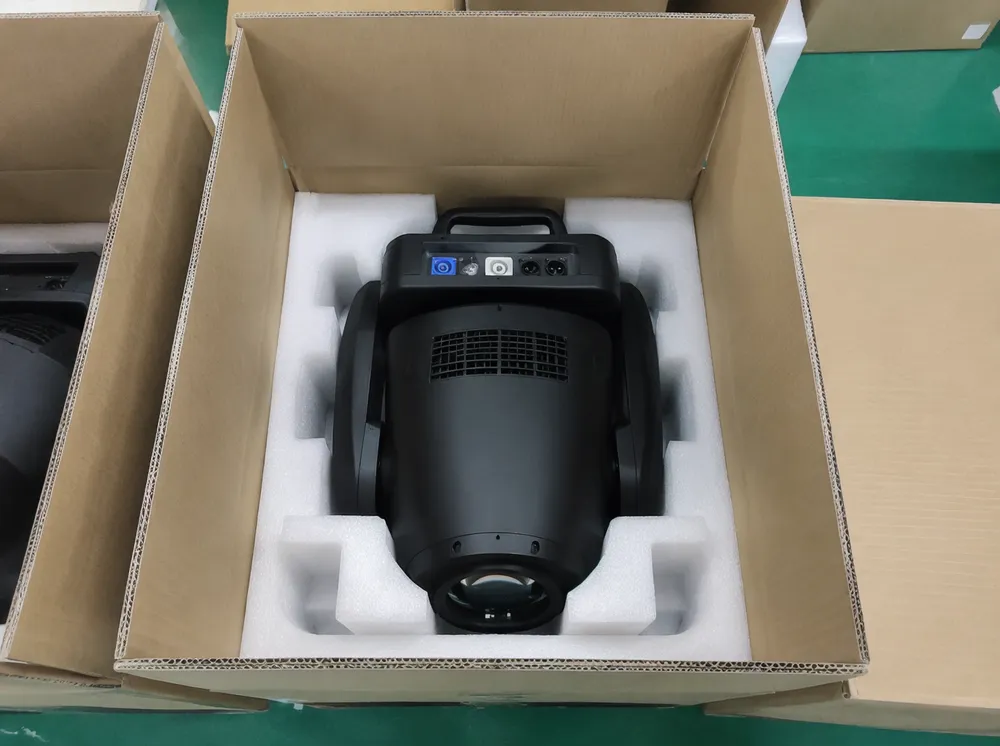
Each fixture sits in a molded EPE foam insert (custom-profiled per model) inside a corrugated carton. The foam absorbs impact at all critical points — lens face, motor assembly, power connector.
We switched from generic cut-foam to molded inserts in 2019 after tracking damage claims on our moving head line, and applied the same standard to club DJ lights.
Container Loading Efficiency
We design carton outer dimensions against 20GP and 40HQ container dimensions during the product engineering phase. Current club DJ light carton configurations:
| Model Type | Carton Dimensions | Units per 20GP | Units per 40HQ |
|---|---|---|---|
| Standard club fixture (par-style) | 380×380×420mm | ~280 units | ~580 units |
| Neon tube (1m) | 1100×120×100mm | ~450 units | ~950 units |
| Neon array panel | 520×520×150mm | ~320 units | ~680 units |
Loading quantities are approximate and depend on final configuration. We provide confirmed loading plans with your order confirmation.
Labeling & Fulfillment Support
- Your SKU barcodes applied at factory
- FNSKU labels for Amazon FBA
- Warehouse bin codes directly on cartons
- Retail-ready packaging with your brand identity, hang tabs, or display configurations
- Drop-shipping: plain/neutral packaging without any GDMonkey branding
Palletization
- Standard export pallets: 1200×1000mm
- Euro pallets: 1200×800mm
- Stretch wrapping and corner protectors
- Pallet configuration drawings provided with order confirmation
If This Isn't Quite Right — Other Fixtures in Our Disco DJ Range
We make seven product families under the disco DJ lights category. If club DJ lights aren't the exact fit for your project or market, one of these might be closer:
Disco Ball Lights
Rotating mirror ball fixtures with built-in LED illumination. Lower price point, consumer and light-commercial market. Strong retail/e-commerce seller.
LED Disco DJ Lights
General-purpose LED effect fixtures spanning consumer through semi-professional. Broader range, lower per-unit cost.
DMX Disco DJ Lights
DMX-controlled effect fixtures for buyers who need addressable control without full club-grade durability requirements.
Dance Floor DJ Lights
Floor-mounted and uplighting fixtures designed specifically for dance floor installations.
Gobo Disco DJ Lights
Pattern-projection fixtures with interchangeable gobos for logo projection and decorative effects.
Disco Laser Lights
Laser-based effect systems for aerial beam shows and scanning effects.
Not sure which product family fits your market? Tell us your target customer and venue type — we'll recommend the right models.
Frequently Asked Questions — Club DJ Lights
What IP rating do I need for club DJ lights in venues with smoke machines and haze?
For standard indoor nightclubs with haze machines, IP20 fixtures work fine — haze fluid residue accumulates on surfaces over time but doesn't penetrate sealed optical assemblies the way liquid water would. The real concern with haze is optical clarity degradation over months.
We seal our lens assemblies with gaskets at the optical output, which keeps the internal reflector and LED array clean.
For rooftop or semi-outdoor venues where rain exposure is possible, specify IP65. We produce both configurations on the same platform.
How many DMX channels should I specify for club installations?
It depends on your installation control architecture:
- For venues running a dedicated lighting console (GrandMA, ChamSys, etc.), 10-channel mode gives full individual parameter control — dimmer, RGB, strobe rate, and motor position.
- For simpler setups running a basic DMX controller or sound-active with DMX override, 4-channel mode covers the essentials.
We build all three modes (4/6/10) into every unit's firmware — your installer selects via DIP switch or DMX addressing. No separate SKUs needed.
What's the realistic lifespan of LED club fixtures under nightly commercial use?
At 6-8 hours nightly operation (typical for a nightclub running Thursday-Sunday), quality LED fixtures deliver full-rated output for 3-4 years before noticeable lumen depreciation.
The LEDs themselves are rated 50,000 hours, but in practice, thermal management is what determines real-world lifespan. Our 105°C-rated capacitors and aluminum housing thermal design maintain junction temperatures in the safe range, which keeps LED degradation linear rather than accelerated.
Budget for replacement at the 4-5 year mark for continuous-operation venues — but you'll still have functional fixtures at that point, just slightly reduced output.
Can I mix club DJ lights with your neon fixtures on one DMX universe?
Yes. All our club-grade fixtures — standard par-style, neon tubes, and pixel arrays — use standard DMX-512 protocol and can share a DMX universe (512 channels).
The neon tube fixtures in 12-channel mode and club pars in 10-channel mode address independently on the same daisy chain.
For pixel-mapped arrays requiring higher channel counts, we recommend Art-Net over Ethernet, which we build into those units as standard.
What's the minimum order to test club DJ lights for my market?
30 units for catalog models with your branding (logo, packaging, retail box design). This lets you test market reception without container-quantity commitments.
If the initial run sells through, we can scale to 500-5,000 unit production runs within 20-35 days.
Full ODM projects (new tooling, custom housing, proprietary firmware) start at 200 units for the first run — but many buyers begin with 30 catalog units to validate demand, then invest in ODM for the second order.
Final Step
Next Steps — From Here to Product in Your Warehouse
You've read the specs, you understand the configurations. The quickest path forward:
Send Us Your Requirements
Target market, volume estimate, any customization needs, and your timeline. Even a rough outline works.
We Respond Within 24 Hours
Pricing, MOQ confirmation, lead time, and any technical recommendations based on your target application.
Sample Confirmation
Most buyers start with 2–5 unit samples to verify quality and test with their own customers. Samples ship within 7–10 days.
Production Run
Once you approve the sample, bulk production starts within 7 days of order confirmation.
Whether you're a distributor building a club lighting catalog, a contractor speccing a venue project, or a brand owner launching a new product line — the process is the same.