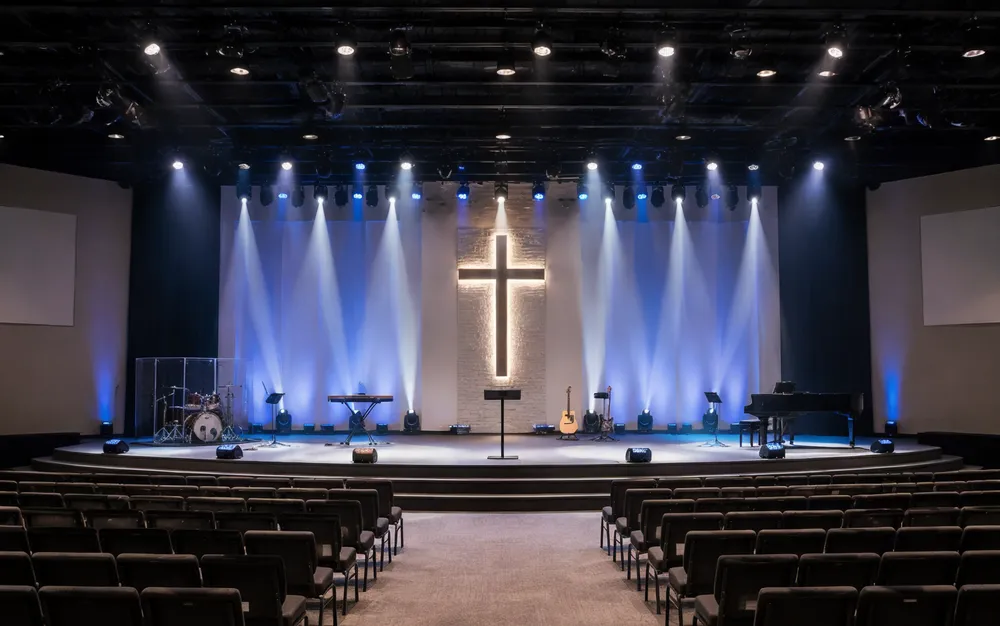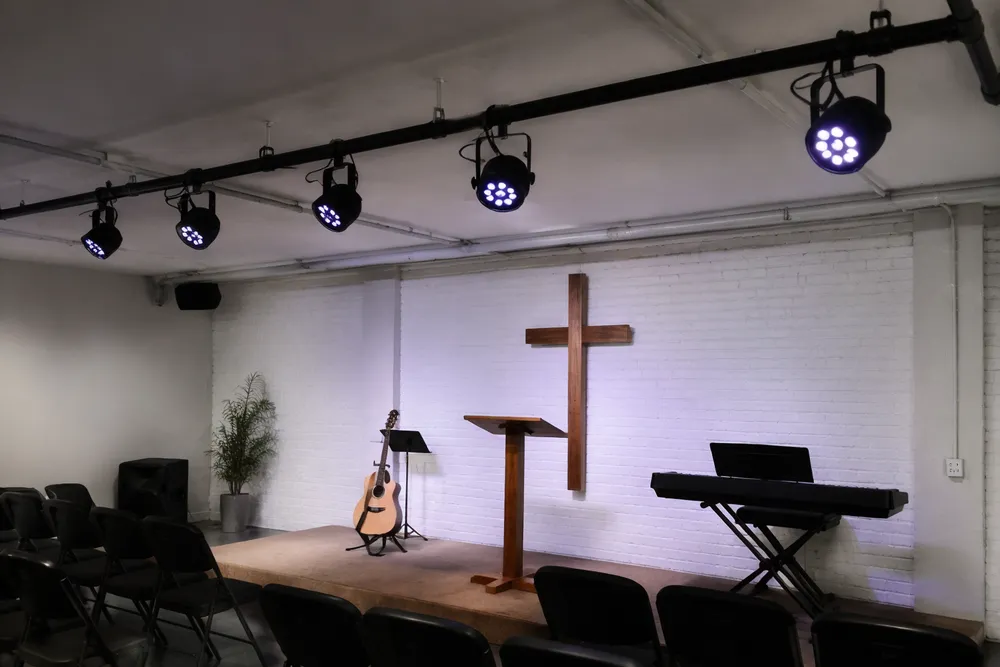

The cost of getting church stage lighting color temperature wrong
You order 60 LED pars for a sanctuary upgrade. They arrive, your installer hangs them, and the livestream camera picks up a visible warm-to-cool shift across the stage — half the fixtures read slightly amber, the other half lean pink-white. The church AV committee calls your office the next morning.
This is a CCT selection problem, and it's one of the fastest ways to lose a reorder. Color temperature — measured in Kelvin (K) — describes where a fixture sits on the warm-white to cool-daylight spectrum. Get the number right but ignore consistency across a batch, and you still end up with a patchy stage that shows up on every livestream frame.
The rest of this article covers what you actually need to specify on a purchase order, how to evaluate whether a supplier can deliver batch-to-batch consistency, and where the cost tradeoffs sit between fixed CCT and tunable white fixtures for worship spaces.
CCT ranges that matter for church stage LED fixtures
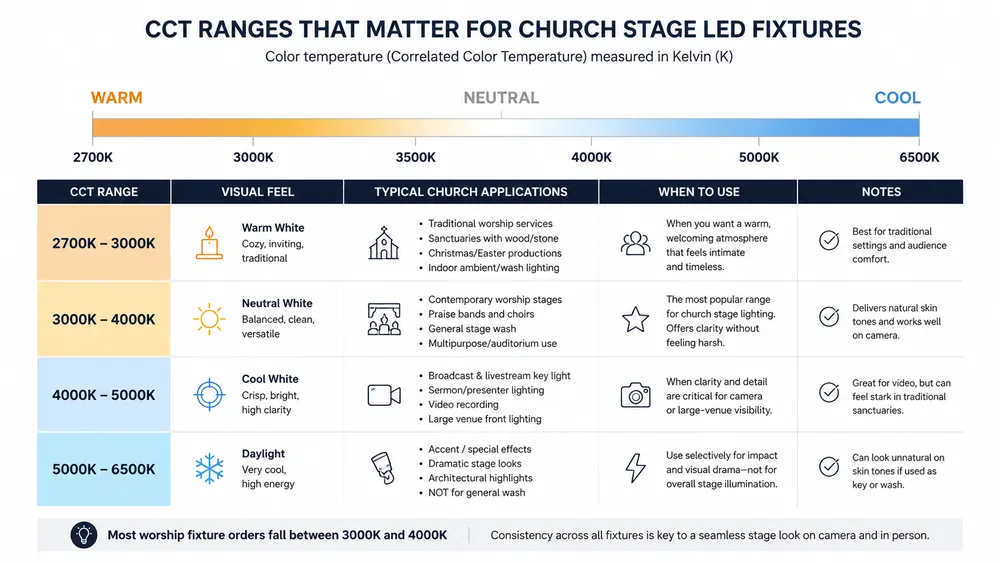
Not every Kelvin number has a real market behind it. Here's how the church stage LED color temperature range breaks down by buyer segment:
| CCT Range | Visual Character | Church Application Segment | Typical Fixture Types |
|---|---|---|---|
| 2700–3200 K | Warm white, amber undertone | Traditional/liturgical (Catholic, Anglican, mainline Protestant) — sermon close-ups, intimate worship | Fixed-CCT LED pars, warm-white ellipsoidals |
| 3500–4000 K | Neutral white, balanced | Contemporary worship, multi-use auditoriums, hybrid services | LED wash panels, tunable-white pars |
| 4500–5600 K | Daylight white | Broadcast-priority venues, livestream key lighting | Fresnel LEDs, high-CRI panel lights |
| 6000–6500 K | Cool daylight, blue undertone | Accent/effect only — rarely used as primary worship wash | Color-mixing fixtures, not standalone wash |
Most church integrators we work with land their orders between 3000 K and 4000 K. The warm white vs daylight church lighting split depends on whether the congregation prioritizes in-person atmosphere or camera quality — and increasingly, they want both.
The 3500–4000 K range has grown as a compromise: it reads warm enough for congregants in the room while sitting close enough to broadcast daylight that cameras white-balance without extreme correction. If you're building a fixture catalog for the worship segment, that neutral band should be your core offering.
How CRI and CCT interact for broadcast-quality worship lighting
Churches livestream by default now. Even a 200-seat congregation in a mid-size town runs a PTZ camera and pushes to YouTube every Sunday. That camera's auto white-balance responds differently depending on the CCT and CRI combination hitting the stage.
High CRI (90+) at 3200 K produces the richest skin tones on camera. Skin looks natural, the pastor's face separates from the background cleanly, and the color grading in post-production stays minimal. But achieving CRI 95 at 3200 K requires a precise phosphor formulation on the LED chip — not every chip supplier holds that spec consistently.
High CRI at 5600 K matches the broadcast daylight standard, which makes multi-camera setups easier. The trade-off: in-person congregants perceive the light as clinical or cold. Some churches solve this by using 5600 K only as a key light on the speaker while running 3200 K wash fixtures on the rest of the stage.
Here's the sourcing implication that most spec sheets don't make obvious: when you see "CRI 95" listed without a stated CCT measurement point, ask which Kelvin value that number was tested at. Some manufacturers measure CRI at the CCT where their phosphor performs best, then print that number on the datasheet for the entire tunable range — but CRI often drops 5–8 points at the ends of the range. If your church buyer chose the fixture for best color temperature for live streaming church services at 3200 K, but the CRI spec was measured at 4000 K, you have a gap.
Browse our full Church Stage Lighting fixture catalog to compare CRI and CCT specs across LED pars, washes, and fresnels designed for worship applications.
Tunable white vs fixed CCT — the procurement math
A tunable white fixture adjusts continuously between roughly 2700 K and 6500 K using either dual-phosphor LED arrays or separate warm and cool LED banks driven independently. A fixed CCT fixture outputs one Kelvin value — period.
The cost difference for bulk orders:
Fixed CCT fixtures run lower per-unit cost (simpler driver topology, single LED array, fewer DMX channels). For a single-venue project where the lighting designer has already locked the CCT requirement, this is the straightforward buy. No flexibility needed, no flexibility paid for.
Tunable white fixtures carry a 15–30% unit-cost premium depending on the LED configuration and driver complexity. But for integrators who serve multiple venues — or church networks with 5+ campuses — one tunable SKU replaces three or four fixed-CCT SKUs in your inventory. You ship the same fixture to a traditional sanctuary requesting 3000 K and a contemporary auditorium requesting 4000 K. Your warehouse holds one part number instead of four.
(We've shipped both configurations to church projects in Brazil and Nigeria — the tunable white reorder rate is higher because one fixture fits the main auditorium and the youth hall without separate SKUs.)
The honest trade-off: tunable white adds 1–2 DMX channels per fixture. For a church with a professional production team, that's nothing. For a church running their light board with Sunday-morning volunteers who learned DMX last month, those extra channels add programming confusion. When you're speccing for volunteer-operated venues, weigh whether the CCT flexibility actually gets used — or whether it just creates more scenes that nobody touches after install week.
CCT selection for worship spaces always comes back to this question: does your buyer need flexibility across venues, or simplicity within one venue? Match the fixture type to that answer.
CCT binning and batch consistency — what to check before signing a PO
LED chips coming off the same wafer don't all land on exactly the same Kelvin point. A chip specified as 3200 K might actually measure anywhere from 3050 K to 3350 K depending on the phosphor application uniformity and the specific wafer position. This variation range is the "bin."
For general architectural lighting, a wide bin is tolerable — nobody notices a 200 K spread across recessed downlights in a hallway. On a church stage with 40 identical fixtures pointed at the same cyclorama, a 200 K spread is immediately visible. The camera compresses the difference and makes it worse.
What to demand on your purchase order for church stage lighting color temperature consistency:
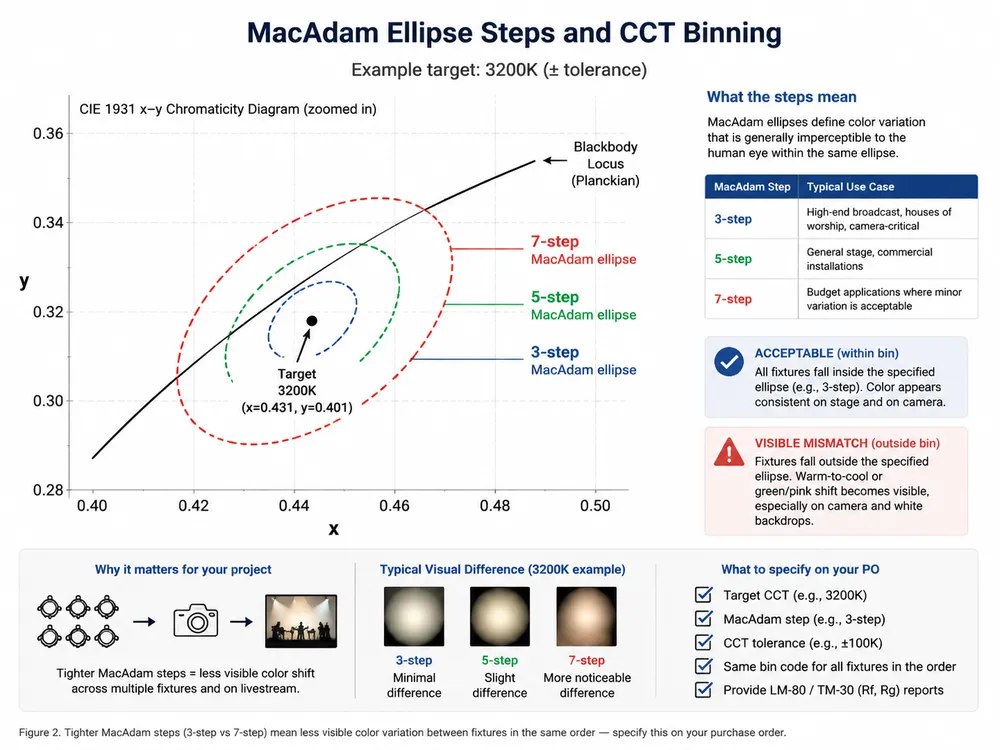
- MacAdam ellipse step: request 3-step or tighter. A 3-step MacAdam ellipse means color difference between any two fixtures is imperceptible to the human eye. 5-step is noticeable side-by-side. 7-step is obvious on camera.
- Single-bin guarantee per shipment: all fixtures in your order should use LEDs from the same binning group — not mixed across whatever the factory had in stock.
- LED chip manufacturer and specific series: "Cree" or "Osram" alone is not a spec. You need the chip series (e.g., Cree XLamp XP-G3, Osram Osconiq P 3030) because binning tightness varies by product line.
We specify the LED chip series at the component-sourcing stage and run incoming inspection on CCT binning before chips reach our SMT line. Reels that fall outside the stated bin get returned to the chip supplier, not mixed into your order. After assembly, every fixture goes through our photometric test lab — we verify actual CCT output against the bin spec before the fixture enters aging test. (This catches the occasional reel where the supplier's own bin labeling was off — it happens maybe once in 20 incoming shipments, but catching it saves you from fielding complaints.)
Ready to spec your next church lighting order with these binning requirements? Request a Quote and include your target CCT and MacAdam step tolerance — we'll confirm chip availability and lead time against your specific requirement.

Specification checklist for church lighting procurement
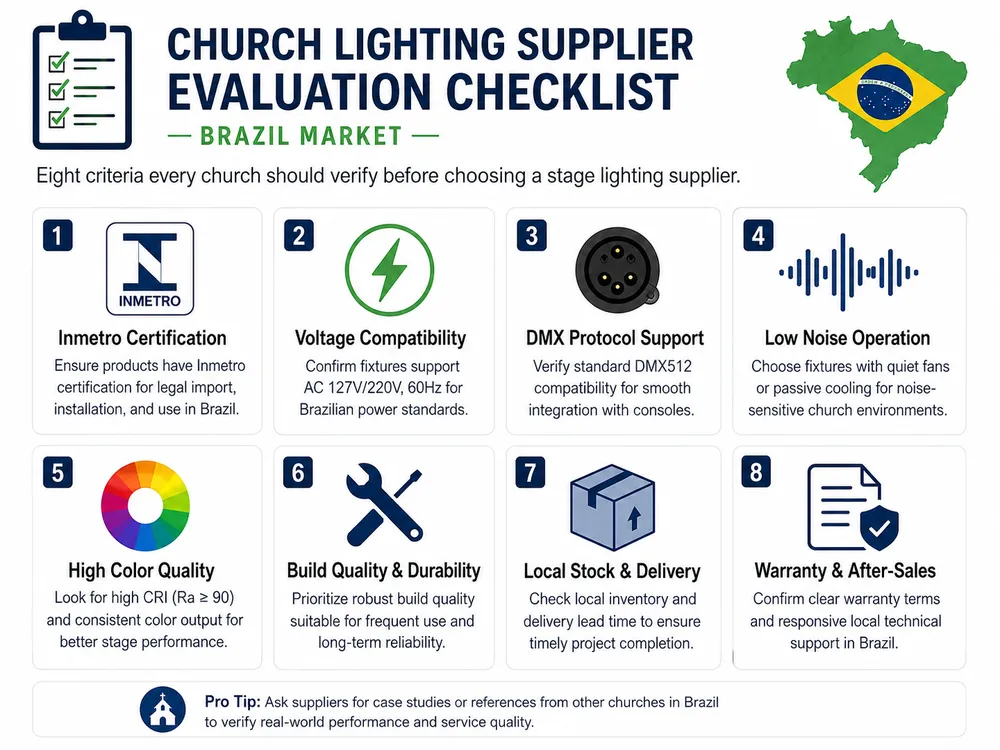
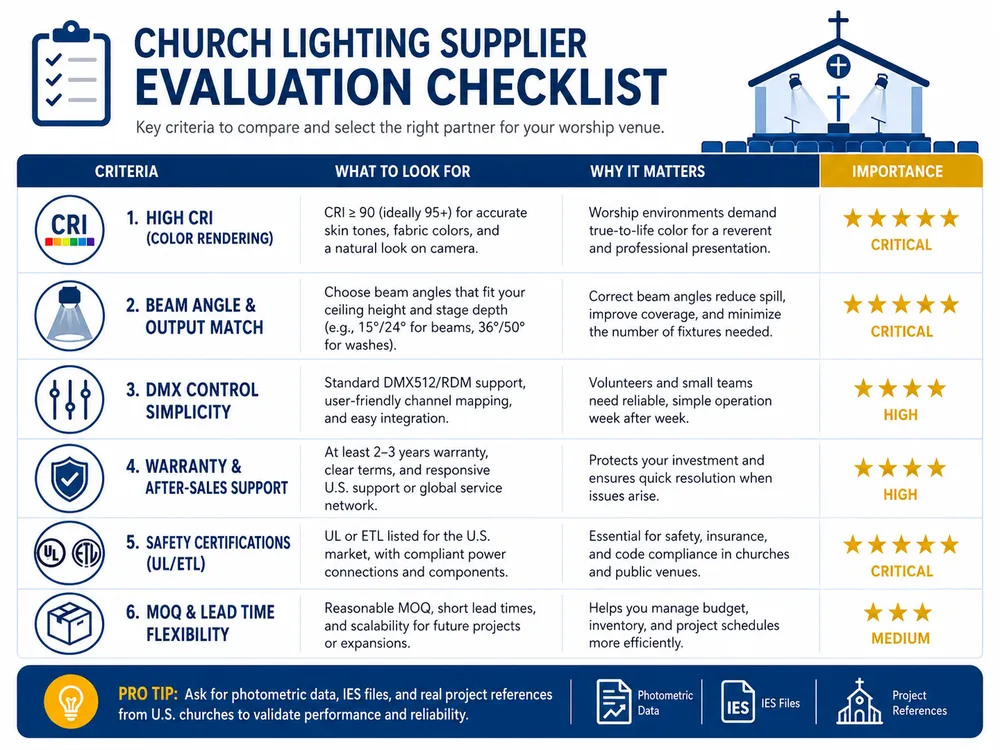
When you're evaluating fixture quotes for a church stage LED project — or handing a spec sheet to your purchasing department — these are the CCT-related line items that separate a professional quote from a vague one:
- Nominal CCT or tunable range: e.g., "3200 K fixed" or "2700–6500 K tunable white." If tunable, confirm the step resolution (smooth vs preset stops).
- MacAdam step tolerance: 3-step minimum for worship stage applications. If the supplier quotes 5-step or doesn't answer, you'll see variation on camera.
- CRI at specified CCT: not just "CRI 90+" — ask for the CRI value measured at the exact Kelvin point your project needs. If tunable, request CRI at both ends of the range plus midpoint.
- LED chip manufacturer and series number: confirms the fixture uses a defined, repeatable component — not whatever's cheapest on the spot market that month.
- 48-hour aging test confirmation: verifies the fixture's CCT output remains stable after thermal cycling, not just at initial power-on. Ask whether the factory's aging test measures CCT drift or only checks for dead LEDs.
- DMX channel count (if tunable): directly affects your programming budget and volunteer-operator complexity. A tunable fixture using 2 extra channels across 60 fixtures means 120 additional DMX addresses to configure.
(If a supplier can't answer the MacAdam step question, that tells you something about their incoming QC process — specifically that they probably don't run one for LED binning.)
This checklist works for LED pars, wash panels, fresnels, and ellipsoidals. Copy it into your next RFQ for how to choose color temperature for church stage LED fixtures without relying on guesswork.
Market segments where CCT drives reorder volume
If you're building or expanding a church lighting distribution business, the CCT spec you stock determines which segments you can serve without custom-ordering every project:
Traditional and liturgical congregations (Catholic, Anglican, mainline Protestant) strongly prefer 2700–3200 K. Order sizes tend to be smaller — 20 to 40 fixtures per project — but reorder loyalty is high once you establish the right CCT. These churches rarely change their lighting look, so your first order often sets a 10-year purchasing relationship. Warm white vs daylight church lighting is not a real debate in this segment; warm wins every time.
Contemporary megachurch and multi-site networks lean toward tunable white. Order sizes are larger — 60 to 200 fixtures per campus — and standardization across campuses drives volume. A church network that opens a new location every 18 months wants the same fixture in every room. Tunable white lets them adjust CCT per service style without different hardware in each venue.
Broadcast-first churches (online ministry focus, large production budgets) specify 4000–5600 K for key and fill positions. Fixture counts are smaller, but these buyers tolerate premium pricing for high CRI and tight binning. Their reorder pattern is driven by content quality requirements, not building expansion — they upgrade fixtures when camera technology improves.
Which segment is your primary market? Your church stage lighting color temperature catalog should cover the dominant CCT for that segment. If you serve multiple segments, tunable white reduces your stocking risk. Browse our Church Stage Lighting lineup to see which configurations align with your target market.