
Why Churches Overpay for Stage Lighting
Most houses of worship buy stage lighting the same way they buy office supplies — through whatever channel is most convenient. The problem is that "convenient" in the US lighting supply chain means two or three margin layers between the factory floor and your sanctuary ceiling.
Here's the typical path: a Chinese or US-headquartered manufacturer produces the fixture, sells it to a national distributor at 30–40% markup, and that distributor sells it to a regional dealer or AV integrator who adds another 20–30% before quoting your church. By the time a 200-seat congregation receives a proposal for 12 LED par washes, the per-fixture price is 60–100% above what the factory originally charged.
Churches feel this more than commercial venues because the budget is fixed, the procurement team is often volunteers, and the purchasing decision goes through committee approval that rewards "safe" choices over cost-efficient ones. The result: worship lighting suppliers that serve this market know price sensitivity is high but purchasing sophistication is low — and they price accordingly.
This article breaks down 10 established suppliers serving the US church lighting market, organized by business model so you can see exactly how each one sources and prices product. The goal is not to rank them 1–10 — it's to help you choose the sourcing route that fits your budget, timeline, and technical needs.
Supplier Evaluation Criteria That Actually Matter for Worship Venues
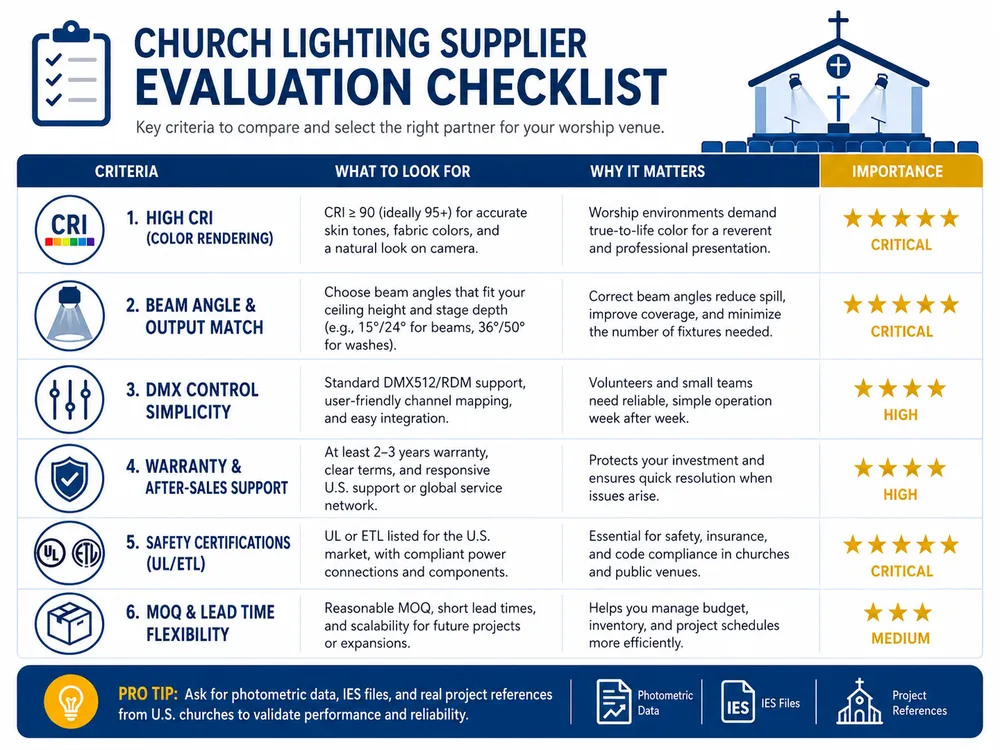
Before comparing specific church lighting companies in the USA, you need a framework. These six criteria separate suppliers who serve worship venues well from those who simply sell lighting products:
CRI (Color Rendering Index) and color temperature range. If you livestream services — and most churches do now — you need 90+ CRI fixtures. Many budget LED pars deliver 70–80 CRI, which looks fine in person but washes out skin tones on camera. Ask for CRI data sheets, not marketing claims. For color temperature, worship environments typically need variable CCT capability: 3200K warm white for traditional services, 5600K daylight for broadcast-quality video.
Beam angle matched to ceiling height. A 25° narrow beam that works beautifully with a 30-foot ceiling will create harsh hot spots in a 12-foot fellowship hall. Your supplier should ask about your ceiling height before recommending fixtures — if they don't, they're selling product, not solving your lighting problem.
DMX control complexity. Your tech team is volunteers. A 40-channel DMX fixture with 15 operating modes will overwhelm them. Look for suppliers who offer scene-preset fixtures or simplified DMX profiles — 4–8 channels max — so a volunteer can run Sunday morning lighting after one training session.
Warranty terms that cover commercial use cycles. Churches run fixtures 3–5 times per week, 52 weeks a year. That's 150–250 power cycles annually. A consumer warranty written for "home use" won't cover this duty cycle. Confirm the warranty explicitly includes commercial/institutional use.
UL/ETL certification and RoHS compliance. Your insurance carrier likely requires UL or ETL listing for permanently installed electrical fixtures. If a supplier can't provide the UL file number for a specific fixture, it's not listed — regardless of what the product page claims.
MOQ flexibility and lead time. Most churches need 8–30 fixtures for a full system. Some suppliers have minimums that start at 50–100 units, which pushes smaller churches toward retail pricing. Evaluate whether the supplier's MOQ structure fits your actual project scope.

US-Based Manufacturers Serving the Church Lighting Market
These six companies design and manufacture (or contract-manufacture) lighting fixtures with US-based headquarters. They control product development and set wholesale pricing — though most churches still purchase their products through dealer networks at marked-up prices.
Chauvet (chauvet.com) — Headquartered in Hollywood, Florida. Chauvet maintains a dedicated House of Worship product line with fixtures specifically positioned for sanctuary use. Their Ovation and COLORdash series are common in mid-size church installs. Pricing sits mid-to-premium, and their dealer network is extensive — which means most churches buy Chauvet products through a local integrator at dealer markup rather than at wholesale. Strength: worship-specific product development and wide parts availability. Limitation: the dealer model means you rarely see factory economics unless you're ordering 50+ units through an authorized reseller.
ADJ (American DJ) (adj.com) — Los Angeles headquarters. ADJ offers the broadest range of budget-to-mid-grade LED pars, wash lights, and moving heads in the US market. Their Mega series and 5P Hex fixtures show up frequently in small church installs due to accessible price points. (We've seen churches start with ADJ, then come to us two years later when the output degradation becomes noticeable on livestream — the LED chip quality at that price tier has a shorter CRI stability window.) Strength: low entry cost, immediate availability through dozens of retailers. Limitation: primarily DJ/entertainment positioning; CRI consistency and thermal management are less rigorous than worship-specific brands.
ETC (Electronic Theatre Controls) (etcconnect.com) — Middleton, Wisconsin. ETC is the premium standard in theatrical and architectural lighting, and their ColorSource and Desire series have strong adoption in churches with $50K+ lighting budgets. CRI performance is excellent (typically 92–96 across color temperatures), and build quality supports 20,000+ hour duty cycles without measurable degradation. Strength: unmatched reliability, outstanding CRI, deep theatrical expertise. Limitation: premium pricing puts ETC beyond reach for most church budgets under $30K.
Elation Professional (elationlighting.com) — Los Angeles. Elation occupies the professional tier used by larger churches and touring worship productions. Their Fuze and KL series deliver concert-grade output with high CRI. If your sanctuary seats 1,500+ and you're running IMAG (image magnification) with broadcast cameras, Elation's color science holds up under scrutiny. Strength: broadcast-quality color rendering, robust touring-grade construction. Limitation: pricing reflects concert-grade engineering — oversized for a 200-seat sanctuary.
Mega-Lite (mega-lite.com) — Houston, Texas. Mega-Lite positions specifically as a value-competitive alternative to Chauvet and ADJ, with growing church market share. Their Enlighten series targets worship venues with higher CRI than typical budget fixtures at price points 15–20% below comparable Chauvet models. Strength: competitive pricing with worship-relevant specs, US-based support. Limitation: smaller dealer network means less immediate local availability.
Blizzard Lighting (blizzardlighting.com) — Waukesha, Wisconsin. Blizzard targets the mid-range professional market with aggressive pricing versus premium brands. Their Toughpar and LB-Par series give churches pro-grade features (high CRI, IP-rated options, quiet fans) at price points between ADJ and Chauvet. Strength: pro specs without premium pricing, solid warranty terms. Limitation: brand recognition is lower, which can make committee purchasing approval harder when decision-makers haven't heard the name.
The common thread: all six manufacturers sell through dealer networks. The price you pay depends heavily on which channel you buy through — and most churches default to whatever their local AV integrator stocks, which adds 20–35% above what a direct relationship would cost.
US Multi-Brand Distributors and Online Retailers
These four suppliers don't manufacture fixtures — they aggregate brands and sell through retail, institutional accounts, or bundled packages. They add convenience, advisory services, and stock availability at the cost of an additional margin layer.
Full Compass Systems (fullcompass.com) — Madison, Wisconsin. Full Compass carries every major lighting brand (Chauvet, ADJ, ETC, Elation, Blizzard, and more) under one institutional purchasing account. Churches with established vendor relationships appreciate single-invoice convenience and net-30 terms. Strength: brand breadth, institutional purchasing structure, technical sales staff. Limitation: pricing reflects wholesale-plus-dealer economics — you're paying for the convenience of one-stop shopping.
B&H Photo (bhphotovideo.com) — New York City. B&H maintains a large pro lighting department with competitive retail pricing and institutional/education account options. Their catalog depth is excellent for comparison shopping, and tax-exempt purchasing is straightforward for 501(c)(3) organizations. Strength: competitive retail pricing, tax-exempt processing, massive inventory. Limitation: no worship-specific technical consultation — you need to know exactly what you want before ordering.
Sweetwater (sweetwater.com) — Fort Wayne, Indiana. Sweetwater stands out among worship lighting suppliers because they maintain a dedicated House of Worship advisory team with personal sales engineers who understand sanctuary lighting needs. For non-technical procurement teams, Sweetwater's guidance has real value — they'll ask about your room dimensions, camera setup, and volunteer capability before recommending fixtures. Strength: expert guidance for churches without in-house technical staff, personal relationship model. Limitation: pricing holds at MAP (minimum advertised price) — you won't find discount pricing here.
Stage Lighting Store (stagelightingstore.com) — Online retailer focused specifically on church and event lighting packages. They bundle fixtures, DMX controllers, and cabling into ready-to-install kits sized for small-to-mid worship venues. Strength: church-focused package bundles reduce decision complexity. Limitation: limited custom configuration, narrower brand selection, less suitable for sanctuaries over 500 seats.
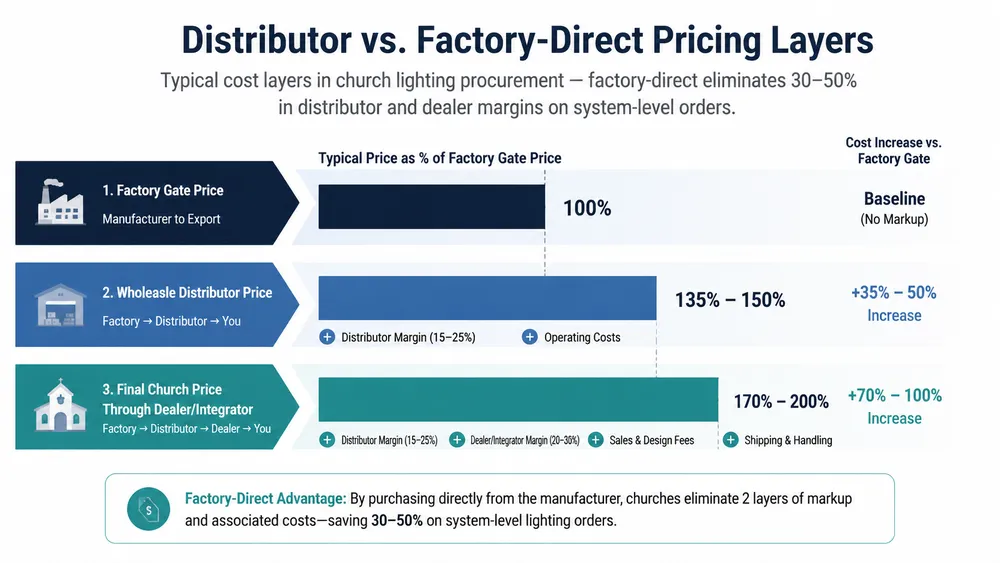
How the distributor model affects your cost: Manufacturer sells to distributor at 30–40% above factory cost. Distributor sells to you at 20–30% above their acquisition cost. By the time a fixture reaches your sanctuary, you've absorbed 50–70% in cumulative markup above the production cost. That margin pays for inventory carrying, local support, easier returns, and no import logistics — all of which have legitimate value. But for system-level purchases (12+ fixtures), that convenience premium adds up fast.
What Distributor Markup Actually Costs on a Church System Order
Let's put real structure around the cost difference. Take a typical church LED stage lights wholesale scenario: a 12-fixture RGBW LED par wash system for a 300-seat sanctuary with 18-foot ceilings.
| Cost Layer | Price as % of Factory Gate | What It Pays For |
|---|---|---|
| Factory gate price | 100% | Manufacturing, QC, packaging |
| US brand wholesale | 130–150% | Brand development, US warehousing, warranty reserve |
| Distributor/dealer to church | 165–200% | Local inventory, sales staff, return logistics, credit terms |
On a $150/fixture factory gate cost (realistic for a quality RGBW LED par with 90+ CRI), that 12-unit system looks like:
- Factory-direct: ~$1,800 for 12 units + shipping/duty
- Through US brand at MAP: ~$2,400–$2,700
- Through distributor/dealer: ~$3,000–$3,600
The $1,200–$1,800 difference on a 12-fixture order funds either additional fixtures, DMX control upgrades, or simply stays in the church's operating budget.
When the distributor premium is worth paying:
- Emergency replacement — a fixture dies Thursday before Easter Sunday, and you need one shipped overnight
- Single-fixture additions to an existing system where brand matching matters
- Projects under 8 units where the absolute dollar savings don't justify a new supplier relationship
- Zero tolerance for import paperwork or any delivery timeline beyond 5 business days
When factory-direct makes financial sense:
- Full sanctuary installations of 12–30+ fixtures — the per-unit savings compound meaningfully
- Multi-campus churches standardizing fixture packages across 3–5 locations
- Annual procurement budgets where you can plan 6–8 weeks ahead for production and shipping
- Projects requiring custom specifications (specific CCT presets, simplified DMX profiles, branded housings)
One objection I hear constantly: "We're a church — we can't handle importing." Factory-direct doesn't mean you're filing customs paperwork yourself. Manufacturers who serve institutional buyers ship DDP (Delivered Duty Paid) — the fixture arrives at your loading dock with all duties and logistics handled, same as receiving a domestic shipment. The only difference is lead time.
Certification and Compliance Requirements for Worship Installations
Before you commit to any supplier — domestic or factory-direct — verify these compliance basics:
UL or ETL listing is non-negotiable for permanently installed fixtures in most US jurisdictions. Your church insurance carrier almost certainly requires it for electrical equipment mounted to building structure. The test: ask the supplier for the specific UL or ETL file number (not a certificate image — the actual file number you can verify on UL's database). If they can't provide it, the fixture isn't listed regardless of what their product page suggests.
FCC Part 15 compliance prevents electromagnetic interference with wireless microphone systems, in-ear monitors, and streaming equipment. A non-compliant LED driver can introduce buzz into your audio chain that's nearly impossible to diagnose. (We spent three weeks helping a church in Texas troubleshoot audio interference that turned out to be uncertified LED par fixtures running on the same circuit as their wireless mic receivers.)
RoHS compliance matters if your denomination or congregation has environmental stewardship policies — and increasingly, if you're applying for green building credits on renovation projects.
IP rating becomes relevant for outdoor worship stages, multi-use venues with splash exposure, or fixtures installed above baptistry areas. IP65 handles rain and spray; IP67 handles temporary submersion. Indoor-only sanctuaries typically don't need IP ratings, but verify if your stage lighting will ever move outdoors for Easter sunrise services or community events.
How Factory-Direct Sourcing Works for Houses of Worship
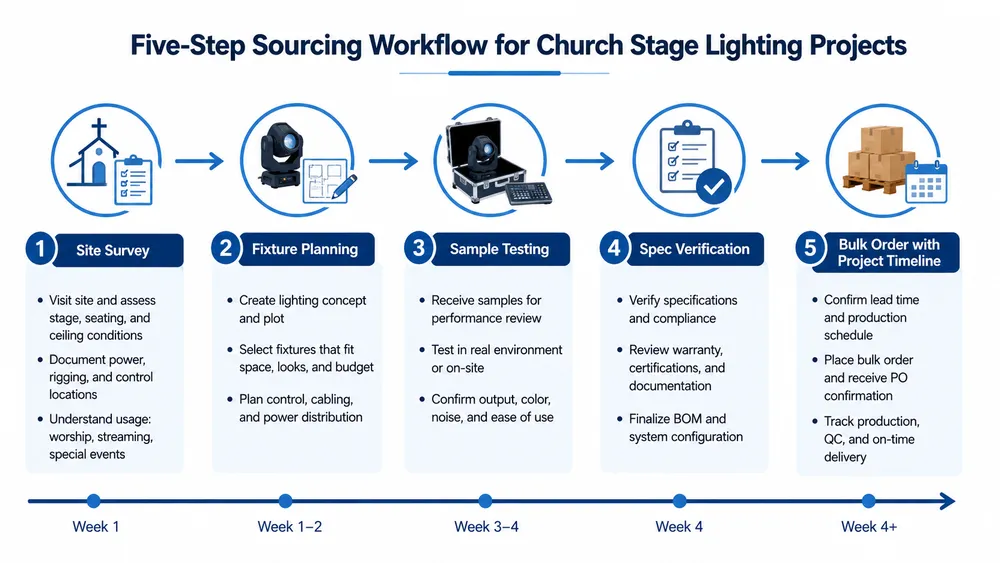
Factory-direct purchasing for church stage lighting follows a different procurement sequence than retail — but it's simpler than most church tech teams expect.
Step 1: Specify your space. You provide sanctuary dimensions (length, width, ceiling height), seating capacity, stage depth, and whether you livestream or record services. This determines fixture quantity, beam angles, and output requirements — not a one-size-fits-all package.
Step 2: Receive a fixture recommendation with real photometric data. A factory engineering team matches fixtures to your space using actual lumen-output and beam-spread calculations. You see CRI values, color temperature range, power consumption, and DMX channel counts before committing to anything. (This is where factory-direct differs most from retail — you get application engineering, not product catalog links.)
Step 3: Customize for your volunteer team. Factory-direct means you can request simplified DMX profiles (4–6 channels instead of 15+), preset scene modes that volunteers activate with one button, specific CCT defaults (3200K warm for your traditional service, 5600K daylight for your broadcast-focused contemporary service), and even custom gobo patterns for your church logo or cross motif.
Step 4: Production and delivery. Typical timeline is 4–6 weeks from order confirmation to DDP delivery at your facility. For churches planning a renovation or seasonal upgrade, this timeline fits comfortably within a typical committee approval → installation window. Urgent needs (Easter, Christmas production upgrades) require planning 8–10 weeks ahead.
MOQ reality for churches: Flexible manufacturers — including us at GDMonkey — start OEM/ODM orders at 30 units. A full sanctuary lighting system for a 300-seat church typically runs 12–24 fixtures. That means two or three churches pooling an order, or one church ordering its full system plus spares, clears the minimum easily. Smaller orders (8–12 units) are often accommodated on a case-by-case basis, particularly for LED church lighting fixtures with existing tooling.
The honest trade-off: you gain 30–50% cost savings and custom specification capability. You give up next-day availability and the ability to return individual fixtures to a local store. For system-level purchases where you're planning weeks ahead anyway, that trade-off lands in your favor.
Which Sourcing Route Fits Your Church
The right answer depends on four variables: order size, budget pressure, timeline, and whether you need customization. Here's how each scenario maps to a sourcing model:
Urgent single-fixture replacement (1–3 units, needed this week): Buy from a US retailer — Sweetwater, B&H, or Full Compass. Pay the retail premium for speed. This is exactly what distributors exist for, and the convenience is worth the markup on small emergency orders.
Small system upgrade (4–8 fixtures, 2–4 week timeline): Contact US manufacturers direct (Chauvet, Mega-Lite, Blizzard) for dealer pricing, or work with Sweetwater's worship advisory team if you need guidance selecting fixtures. At this volume, savings from factory-direct don't overcome the convenience gap — but get quotes from both channels so you understand your pricing baseline.
Full sanctuary installation (12–30+ fixtures, 6–8 week timeline): Factory-direct OEM delivers the strongest cost advantage at this volume. You save 30–50% versus dealer pricing, gain access to custom specifications (CCT presets, simplified DMX, branded housings), and receive application engineering support that matches fixtures to your specific space. Plan procurement 6–8 weeks ahead of your install date.
Multi-campus standardization (30–100+ fixtures annually): Factory-direct with an annual supply agreement. Lock pricing for the year, standardize fixtures across all campuses so volunteer training is consistent, and schedule quarterly shipments aligned with your maintenance and expansion calendar. This is where the cost structure difference becomes most significant — at 50+ units annually, you're operating at a cost level that local distributors physically cannot match while maintaining their own margins.
The honest framework: local worship lighting suppliers have real strengths — speed, familiarity, immediate support. Factory-direct has real cost and customization advantages at volume. Most churches benefit from using both channels strategically: local for emergencies and small adds, factory-direct for system builds and planned expansions. If you're evaluating a full system install, request a factory-direct quote with your sanctuary specs — at minimum, it establishes your true pricing baseline so you can negotiate more effectively with any channel.
Procurement Questions Church Tech Teams Actually Ask
What CRI rating do I need for church stage lighting with livestream?
90+ CRI minimum for services you broadcast or record. Below 90, skin tones shift toward green or magenta on camera — especially under LED fixtures with phosphor-converted white. For churches producing broadcast-quality content (multi-camera IMAG, YouTube/streaming), target 95+ TLCI (Television Lighting Consistency Index), which specifically measures how light renders on camera sensors rather than to the human eye. Most budget fixtures under $80/unit retail deliver 70–82 CRI — adequate for in-person but visibly poor on stream.
How many LED par fixtures do I need for a 300-seat sanctuary?
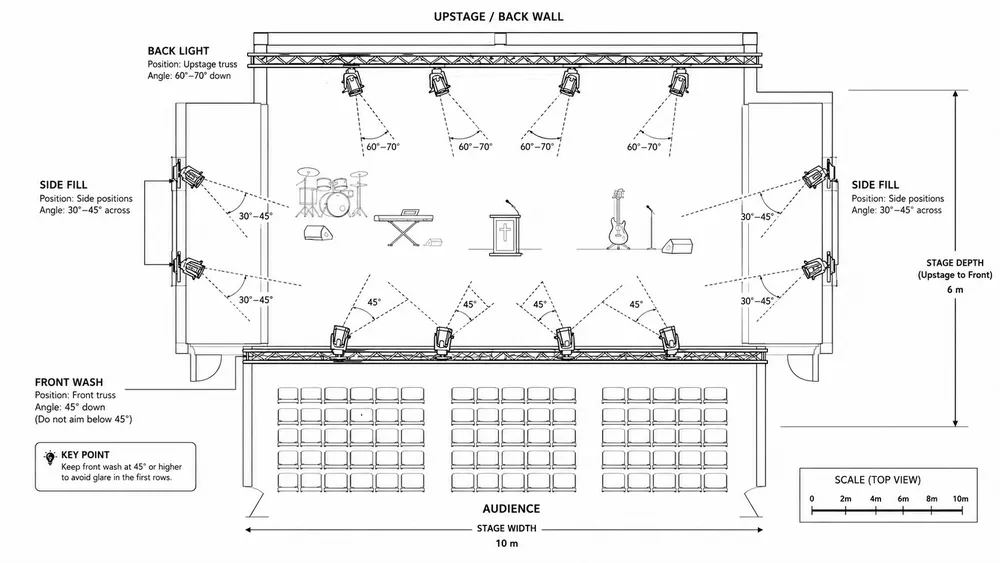
Depends on ceiling height and desired coverage overlap. General formula: divide your stage width by the beam spread diameter at mounting height. For a 40-foot-wide stage with 18-foot ceilings using 25° beam-angle fixtures, each fixture covers approximately 8 feet of stage width at floor level. That's 5 fixtures for front wash. Add a second row for back/top light and 2–4 color wash fixtures, and you're at 12–16 total LED pars for full coverage with redundancy. Lower ceilings (12 feet) need wider beam angles (40–60°) and fewer fixtures. Higher ceilings (25+ feet) need narrower beams and more fixtures spaced closer together.
Do church stage lights need UL certification for insurance?
Yes — in most cases, your property insurance policy requires permanently installed electrical fixtures to carry UL or ETL listing. Check your policy's "electrical equipment" clause. The critical distinction: UL certification applies to the specific product model, not the brand. A company may have some fixtures UL-listed and others that aren't. Ask for the UL file number for the exact SKU you're purchasing, then verify it at ul.com/database.
What is the typical lead time for factory-direct church lighting orders?
4–6 weeks from order confirmation to delivery at your facility, assuming standard fixture models with existing tooling. Custom specifications (specific CCT presets, modified DMX profiles, OEM branding) may add 1–2 weeks for engineering samples and approval. Fully custom optical designs requiring new tooling: 8–12 weeks. For comparison, US retailers ship stock items in 1–5 business days, and manufacturer back-orders typically run 2–4 weeks.
What color temperature is best for worship stage lighting?
No single CCT is "best" — the right answer depends on your service style and whether you broadcast. 3200K warm white creates the intimate, traditional ambiance that works well for acoustic worship, prayer segments, and services that prioritize in-room atmosphere. 5600K daylight renders skin tones cleanly on camera and matches natural light from windows, making it ideal for broadcast-focused contemporary services. Variable CCT fixtures (2700K–6500K) give you both in one fixture, controlled per-scene. If you only buy one type, variable CCT with a minimum 90 CRI covers every scenario without requiring separate fixture inventories for traditional vs. contemporary services.
Can a church buy stage lighting directly from a manufacturer?
Yes — and more churches do this than most people realize, particularly for system-level purchases. The practical barrier isn't legal or logistical — it's awareness. Most churches don't know factory-direct is an option because their entire supplier exposure comes from retail channels and AV integrators. The process: you specify your needs, the manufacturer quotes DDP (Delivered Duty Paid) pricing to your address, and the shipment arrives at your door with all customs and logistics handled. MOQ requirements vary — some factories require container loads (500+ units), but flexible OEM manufacturers start at 30 units, which covers a single sanctuary system. The trade-off is lead time (4–6 weeks vs. next-day retail) and the absence of local return logistics for individual fixtures.