
What triggers change orders in church lighting projects
Change orders on church lighting projects rarely come from the building committee deciding they want fancier fixtures halfway through. They come from costs that were always there but never made it into the original budget.
We see three triggers repeatedly in the RFQ stage:
- Rigging and structural costs discovered after fixture selection. The committee picks fixtures, gets pricing, approves the budget — then the installer shows up and finds wood joists rated for 15 kg where the fixture package needs 40 kg of hanging weight per truss point. Structural reinforcement was never line-itemed.
- DMX infrastructure underscoped. Volunteers assume new LED fixtures are plug-and-play like the old par cans. They are not. DMX cabling, signal distribution, and a control console need their own budget line, and the runs are often longer than anyone estimates until someone walks the ceiling with a tape measure.
- Electrical circuit capacity missed. A 200-seat sanctuary with a 1990s-era 100A panel may not have enough spare circuits for 20 new LED wash fixtures at 150W each. The electrician scope grows mid-project.
A typical change order on a 200–500 seat sanctuary adds 15–30% to the original lighting line item. Schedule slips 2–4 weeks while someone re-quotes the structural work or rewires a subpanel.
We see this from the factory side every month: churches send us fixture wishlists without ceiling heights, circuit maps, or rigging load data. That information gap is where the budget gap starts. The fixtures are actually the easy part to price — everything attached to the ceiling and running behind the walls is where projects go sideways.
The five budget categories most churches undercount
A realistic church stage lighting budget is not a fixture shopping list. It is five separate line items, and most committees only price the first one before seeking approval.
1. Fixtures — The LED pars, wash lights, spot fixtures, and any moving heads. This is what everyone budgets for.
2. DMX control and cabling — Console or software controller, DMX cables (3-pin or 5-pin runs), signal splitters, and potentially wireless DMX transmitters if your sound booth is far from stage. (We have churches that budget $0 for this line and then discover they need $3,000–$6,000 in control infrastructure the week fixtures arrive.)
3. Rigging and mounting hardware — Truss, pipe clamps, safety cables, ceiling anchors, and structural engineering review if the ceiling was not built for suspended loads.
4. Installation labor — Electrician hours, rigging crew time, and programming labor to build DMX scenes and presets for your services.
5. Contingency reserve — The money set aside for what you did not know you did not know.
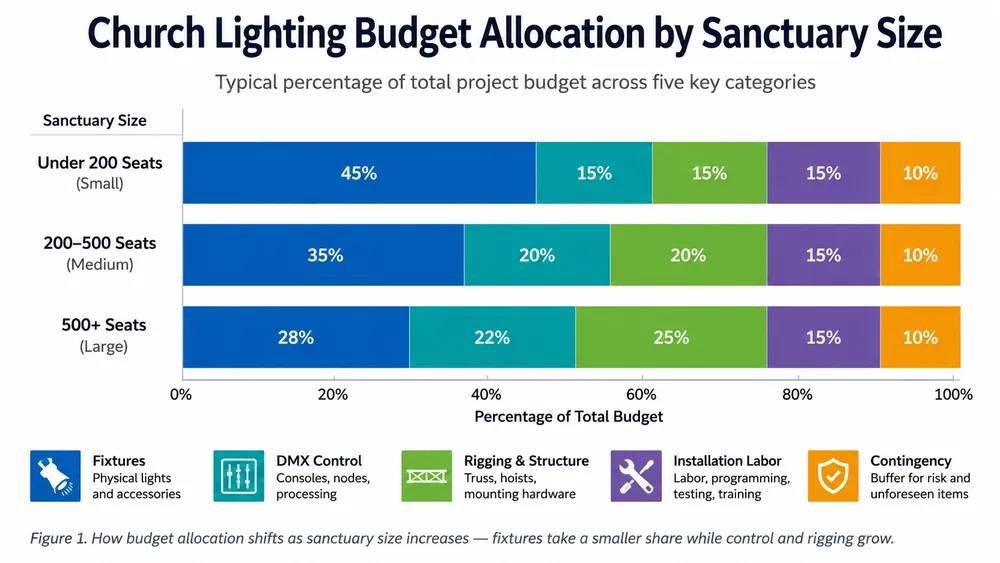
Here is how these percentages typically distribute by sanctuary size:
| Budget category | Under 200 seats | 200–500 seats | 500+ seats |
|---|---|---|---|
| Fixtures | 45–50% | 40–45% | 35–40% |
| DMX control & cabling | 15% | 15–18% | 18–20% |
| Rigging & mounting | 10–12% | 12–15% | 15–18% |
| Installation labor | 18–20% | 15–18% | 15% |
| Contingency | 8–10% | 10–12% | 12–15% |
Notice the pattern: fixture percentage drops as sanctuary size grows. Control complexity and rigging requirements scale faster than fixture count. A 500-seat room might only need 30% more fixtures than a 300-seat room, but the DMX universe count, cable runs, and structural engineering scope can double.
One cost most committees forget entirely: halogen lamp replacement. If you are comparing LED church stage lighting cost against keeping existing halogen, factor in $2,000–$5,000 per year in relamping labor and bulbs for a typical 300-seat install. LED eliminates that line item permanently, which changes the break-even math on total system cost.
Scoping requirements before you price fixtures
Every line item in the budget above maps to a scoping question. Skip the question, and the cost shows up later as a change order. Here is the sequence we walk through with every church buyer before we quote a fixture package:
1. Ceiling height and structural material
Steel truss, wood joist, or poured concrete — each determines mounting method, load capacity, and whether you need a structural engineer's signoff. Get the answer in writing from whoever built the building or from a licensed inspector.
Red flag: if your AV committee cannot provide ceiling load ratings, your rigging budget estimate is fiction until a structural engineer weighs in. Budget $1,500–$3,000 for that assessment before committing to anything else.
2. Stage dimensions and platform configuration
Fixed stage vs modular risers changes throw distance calculations. A 6-meter-deep stage with a 4-meter proscenium needs different fixture angles than a 3-meter platform against a back wall.
3. Service styles served
Traditional services with a choir and podium need even front wash. Contemporary worship with a band needs backlight, side wash, and color. Blended programs need both, which means more fixture positions and a more capable control system.
4. Livestream and broadcast requirements
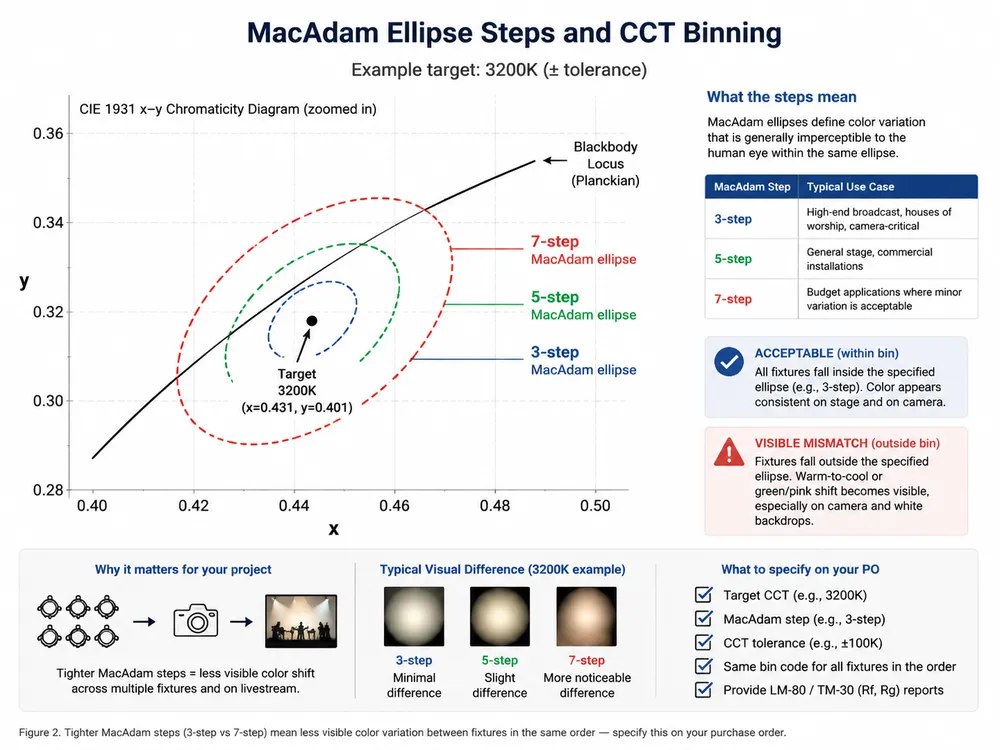
If you broadcast services, camera positions dictate minimum CRI (color rendering index) requirements — typically 90+ CRI for skin tones on video. Color temperature must stay consistent at 3200K or 5600K, not drift between fixtures. This affects which church stage lighting fixtures qualify and which do not.
5. Existing electrical capacity
Panel amperage, number of open breaker slots, and distance from panel to stage. A 30-meter cable run from the electrical room to the stage has voltage drop implications above 20A. Get an electrician to survey before you finalize fixture wattage totals.
6. Volunteer operator skill level
A volunteer team that runs sound on Sundays should not be handed a 2-universe DMX board with 40 fixture profiles. Match control complexity to who will actually operate it weekly. Simpler control costs less upfront and produces fewer support calls to your installer afterward.
Each of these six items takes 30 minutes to document properly. Skipping any one of them can generate a $2,000–$8,000 change order.
Specification mistakes that force mid-project upgrades
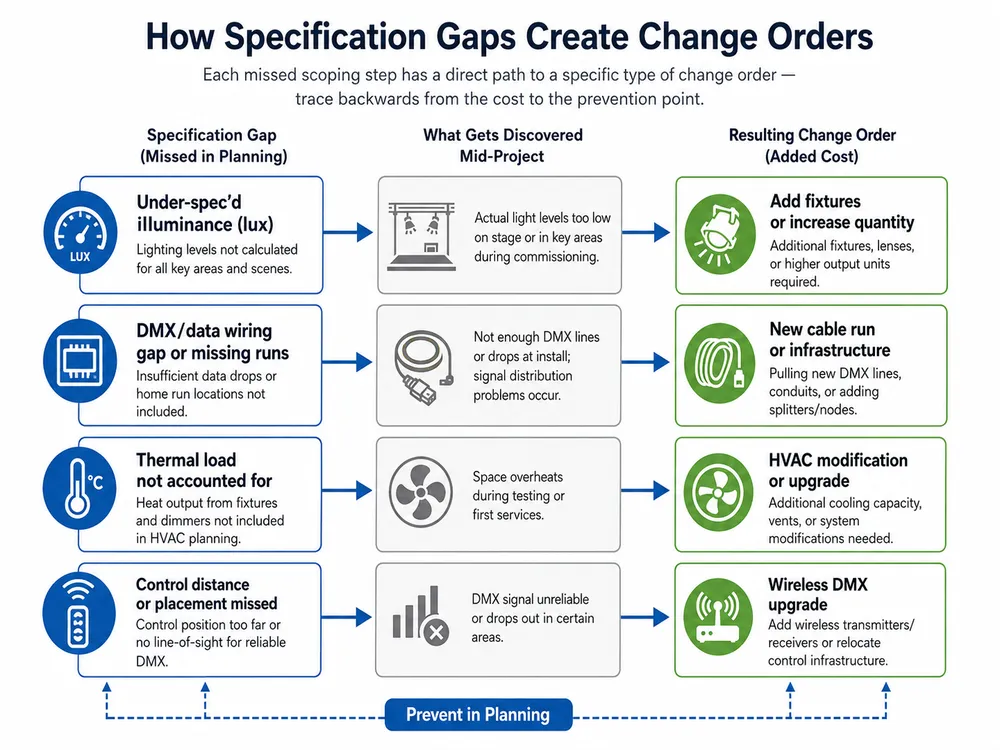
Even with a complete scope, specification errors create the same budget damage. These are the four mistakes we see most often from church lighting system planning documents that arrive with RFQs:
Specifying fixture count by aesthetics instead of lux-per-seat
"We want 12 par cans because that looks like enough" is not a specification. If you need 300 lux at platform level for video broadcast, calculate backwards from throw distance and fixture output. Under-specifying means ordering 4–6 additional fixtures mid-install when the camera operator reports the stage is dark on playback. That is a change order for fixtures, additional rigging points, and reprogramming.
Choosing DMX fixtures without confirming wiring supports the universe count
A standard DMX universe handles 512 channels. A 24-fixture LED par system with 6 channels per fixture uses 144 channels — fine on one universe. Add 8 moving heads at 16 channels each and you are at 272. Still fine. But if the existing wiring only has one DMX run from booth to stage, and you now need two separate universe outputs, someone has to pull new cable through the ceiling.
We ask every church buyer for circuit amperage and existing DMX infrastructure before we quote fixtures, because the wrong answer means either the fixture package changes or the electrician scope grows. Better to discover that in the quoting phase than after delivery.
Ignoring thermal load in the stage area
LED fixtures run cooler than halogen, but "cooler" is not "cold." Twenty 150W LED wash lights generate 3,000W of heat in a concentrated area. If your stage zone lacks adequate HVAC return, that heat accumulates and shortens fixture life. Worse, the building committee notices the stage is uncomfortable during summer services, and now HVAC modification enters the project scope mid-install.
Not accounting for control surface distance
If your sound booth is 30+ meters from the stage, a standard DMX cable run needs signal boosters or you risk data dropouts — flickering fixtures during service. The alternative is wireless DMX, which adds $800–$2,000 to the control budget. Either way, it needs to be in the original number.

Phased rollout vs single-phase: which actually saves money
Churches with rigid annual budgets often ask about splitting the project across two or three fiscal years. It can work, but only under specific conditions.
Single-phase advantages:
- One mobilization fee (rigging crew, electrician, programmer all come once)
- One programming session builds all scenes and presets together
- Lower total church stage lighting cost — typically 10–15% less than the same system deployed in phases
Phased approach works when:
- Your annual lighting allocation is capped and cannot absorb the full project in one cycle
- The sanctuary renovation itself is staged (ceiling work in year one, platform expansion in year two)
- Your volunteer team needs time between phases to learn the control system before more fixtures are added
Phased approach fails when:
- Phases are not designed together upfront. If phase 2 fixtures require a different DMX universe, heavier rigging, or a relocated control position, the integration cost erases the "savings" of spreading payments.
The fix: even on a phased install, pay for the full system design upfront. Get the entire fixture package, rigging plan, and DMX architecture specified in one document. Deploy in stages, but design once. This prevents phase 2 from becoming a change order on phase 1.
(Our MOQ starts at 30 units, so you can order phase 1 fixtures without committing to full-project volume. But we still recommend getting the complete system quoted so rigging and control architecture are designed as one coherent system — not two incompatible halves bolted together later.)
If you are ready to get the full system quoted upfront, send your sanctuary dimensions and budget ceiling for a fixture package quote.
FAQ
What is a realistic contingency percentage for a church lighting project?
10–15% if your structural survey and electrical audit are both complete before budgeting. 20% if either assessment is still outstanding. Contingency is not a slush fund for upgrades — it covers the unknown costs that proper scoping did not catch because every building has surprises behind the drywall.
Should the church hire a separate designer or get design from the fixture supplier?
Get design and supply from the same source when possible. Fixture selection and rigging are interdependent — a designer who does not know the fixture weights, mounting options, and DMX channel requirements will spec something that needs modification at install. When design and supply are separate, change orders create finger-pointing between parties. A supplier who handles both owns the outcome. See our church stage lighting fixture range and system design support.
How do we budget for DMX programming and scene creation?
Allocate 8–12 hours of programming labor for a typical 200–500 seat contemporary worship setup. That covers building scene presets for each service type (sermon, worship set, communion, special events), setting dimmer curves, and training one or two volunteers on recall. Some suppliers include basic programming in the installation quote; confirm that explicitly rather than assuming.
Can we reuse existing halogen dimmer racks with new LED fixtures?
Usually not without significant modification. Halogen dimmers use phase-cut (leading edge or trailing edge) dimming. LED fixtures with built-in drivers need constant-power circuits and accept dimming commands via DMX, not through voltage reduction at the wall. Budget for dimmer rack bypass or full replacement — typically $1,500–$4,000 depending on channel count.
What is the typical lead time from budget approval to completed installation?
8–14 weeks for a full system. That breaks down roughly as: fixture manufacturing and QC (3–5 weeks), international shipping (2–4 weeks), rigging and electrical installation (1–2 weeks), programming and handoff (2–3 days). Phased installs add 2–3 weeks per subsequent phase for crew re-mobilization and system re-programming.