

LED Church Stage Lighting Direct From Factory
LED par cans and wash fixtures engineered for worship environments — high CRI, zero flicker on camera, silent or near-silent operation.
RGBW and RGBWA+UV configurations from 80W to 200W. DMX512 control, convection or quiet fan cooling, and optical consistency across your entire batch. This is the product tier where most of our church lighting volume concentrates.
What This Product Line Covers — and Where It Sits in the Market
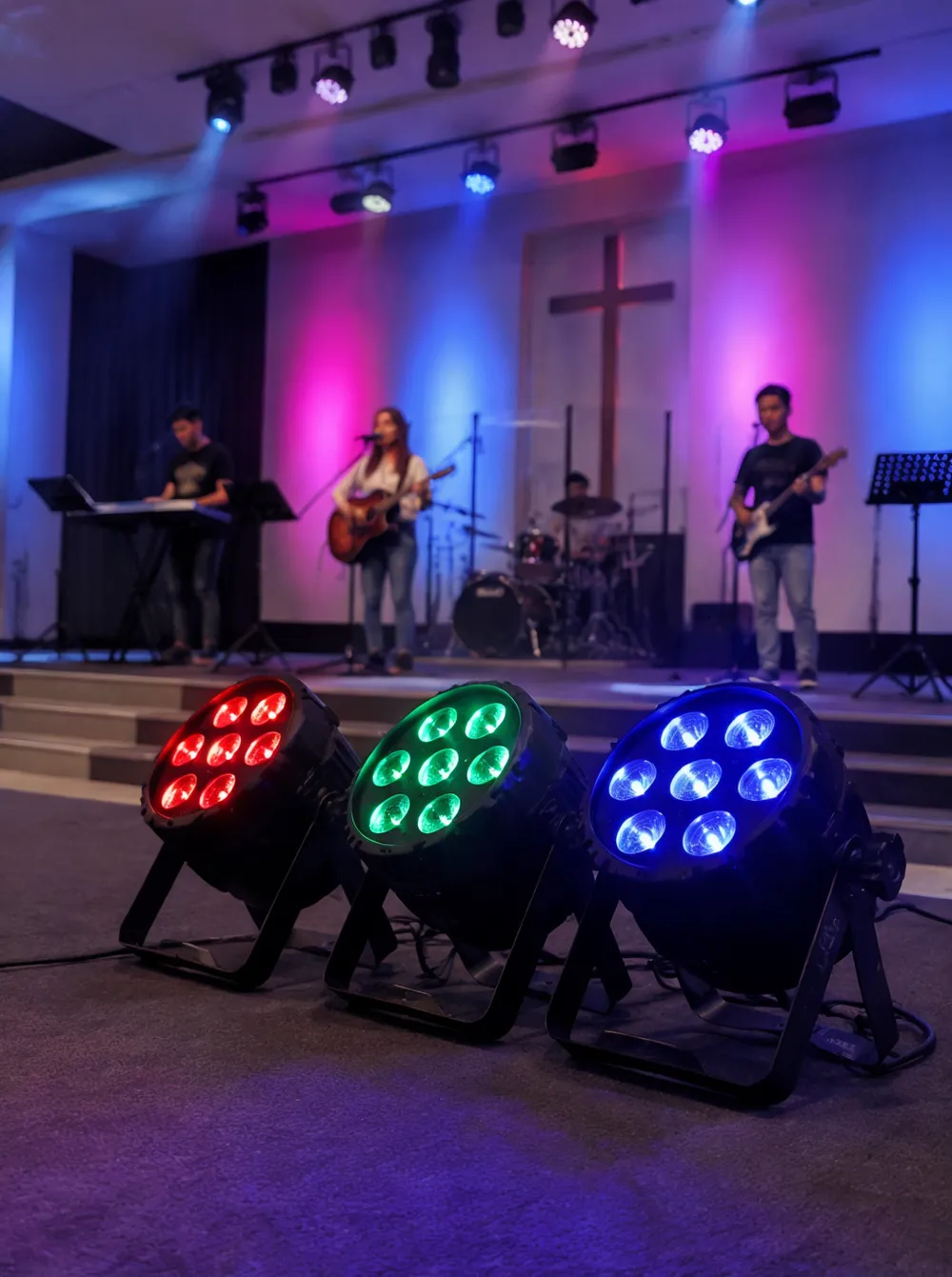
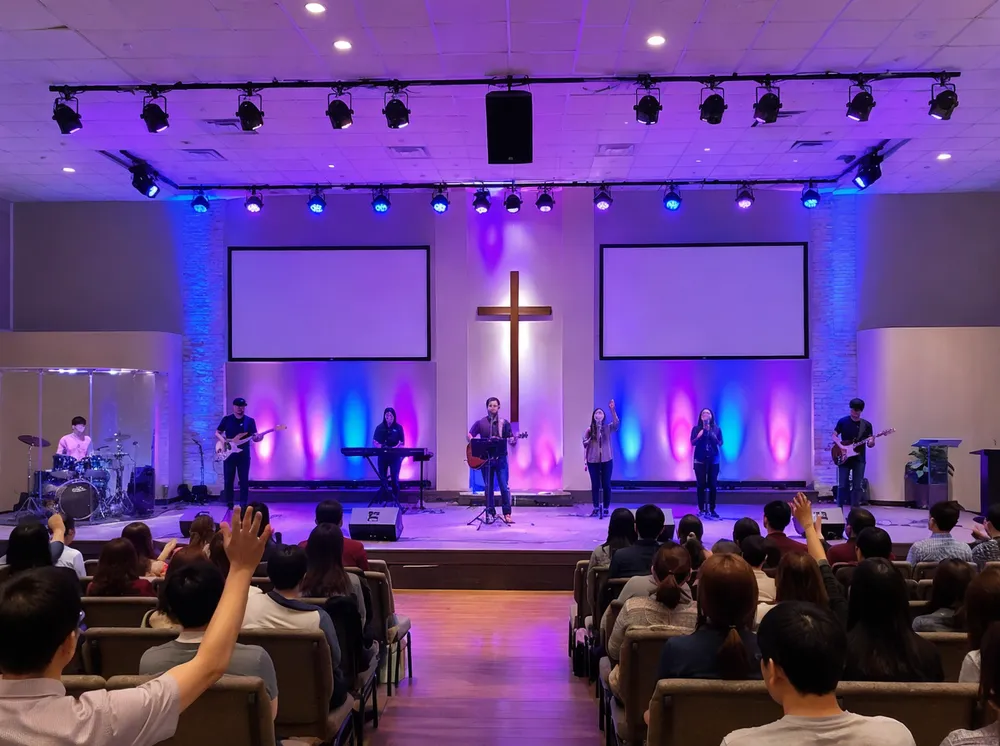
LED church stage lighting is our mid-tier worship fixture category — LED par cans and wash lights configured specifically for front wash, stage color, and accent lighting in congregations from 150 to 500 seats. These are not repackaged DJ fixtures with a "church" label. The optical design, driver architecture, and thermal management are purpose-built for the way churches actually use lighting: long static-on hours, camera-critical color rendering, and noise-sensitive environments.
If you're comparing this against our simple church stage lighting tier, the difference is control sophistication and output. Simple tier is plug-and-play for volunteer teams in small sanctuaries. LED tier gives you full DMX512 addressability, higher lumen output, wider beam angle options, and the CRI performance needed for livestream and broadcast. If your projects demand motorized zoom, framing shutters, or Art-Net/sACN integration, that's our professional church stage lighting tier.
The LED tier is where the volume lives for most of our church lighting distributors. The price point is accessible enough to win mid-market projects, the feature set is deep enough to satisfy technical worship teams, and the SKU count is manageable — you stock 4–6 models and cover the segment.
Product Tier Positioning
Technical Specifications — LED Church Stage Lighting Fixtures
Standard values across the LED church lighting range. Contact us for exact model-by-model data sheets with photometric distribution files (IES/LDT format available).
| Parameter | Specification Range |
|---|---|
| Light Source | RGBW quad-LED or RGBWA+UV (6-in-1) arrays |
| LED Count | 7×12W 12×12W 18×12W 24×12W |
| Output Range | 80–200W total LED power |
| CRI | ≥90 (R9 ≥80 on broadcast-spec models) |
| Beam Angle | 15°–60° fixed lens options; 15°–60° motorized zoom on select models |
| Color Temperature | 2700K–6500K variable white mode |
| Dimming | 0–100% linear, 16-bit smooth dimming available |
| Dimming Frequency | >20kHz PWM (flicker-free on all frame rates) |
| Control Protocol | DMX512, master-slave, auto-run, sound-active |
| DMX Channels | 4/6/8/10 channel modes depending on model |
| Cooling | Passive convection (models ≤120W) / Variable-speed fan <25dB (models >120W) |
| IP Rating | IP20 standard; IP65 available on outdoor-rated variants |
| Housing | Die-cast aluminum, powder-coated black (custom colors available 100+ units) |
| Mounting | Standard pipe clamp (48-51mm), safety cable point, yoke lock |
| Power Input | AC 100-240V, 50/60Hz (universal) |
| Weight | 2.5–6.8 kg depending on model and wattage |
Specifications shown are standard values across the LED church lighting range. Contact us for exact model-by-model data sheets with photometric distribution files (IES/LDT format available).
Camera-Ready Performance
>20kHz PWM eliminates banding and flicker across 24fps, 30fps, and 60fps capture. CRI ≥90 with R9 ≥80 on broadcast models ensures accurate skin tones on livestream.
Silent to Near-Silent
Models ≤120W use passive convection — zero mechanical noise. Higher wattage units use variable-speed fans that stay below 25dB, inaudible in worship environments.
Universal Power Input
AC 100–240V, 50/60Hz across all models. One SKU serves every export market without transformer or adapter complexity.
What Makes These Fixtures Hold Up in Worship Environments
The parent category page covers how worship environments punish cheap fixtures at a conceptual level. Here, we get specific about what we do differently in this product tier — the engineering decisions that protect your margin by preventing field failures and support calls.
Thermal Architecture — Why Lumen Output Holds Steady Over Years
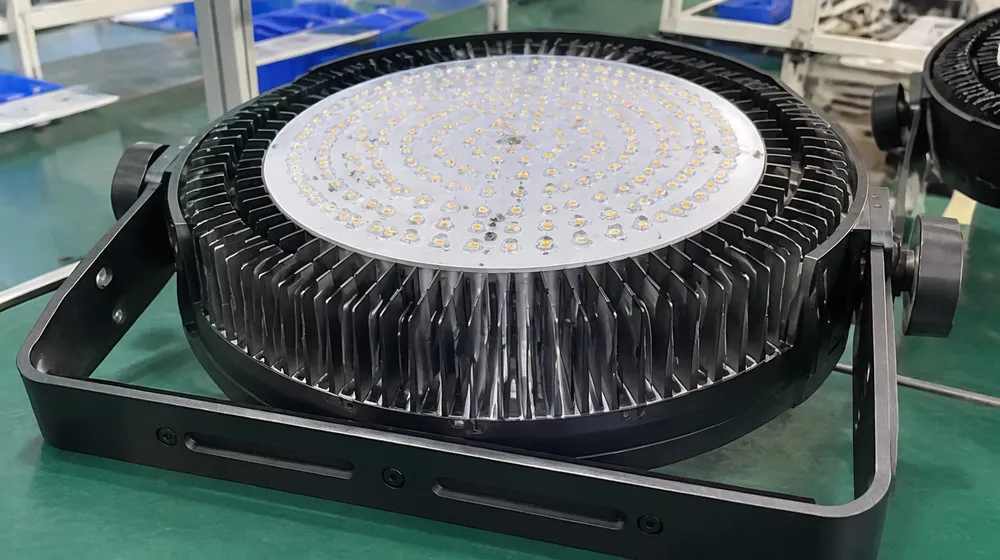
Worship services run fixtures at constant output for 60–90 minutes without the dynamic movement that cycles heat in concert environments. We oversize the heat sink mass relative to rated wattage on every LED church fixture — a 120W fixture gets the thermal mass you'd expect on a 160W design. The LED junction temperature stays 15–20°C below maximum rated operating temperature even at sustained full output.
The PCB substrate matters here. We use aluminum-core MCPCBs (Metal Core Printed Circuit Boards) with 2.0 W/m·K thermal conductivity on all LED church models. Cheaper fixtures use standard FR4 boards — adequate for intermittent use, but junction temperatures climb too high under worship duty cycles and L70 lifespan drops from 50,000 hours to under 20,000.
Development testing (2020): We tested both substrates side-by-side. The FR4 prototypes hit thermal throttle at 45 minutes of continuous full output. The aluminum-core boards ran indefinitely without degradation.
Your commercial benefit: Fixtures that maintain rated output throughout their service life mean no premature replacement costs for your install customers, and no "why are my lights dimmer than last year" support calls for your distribution accounts.
Flicker-Free Driver Design — The Spec That Changed in 2020
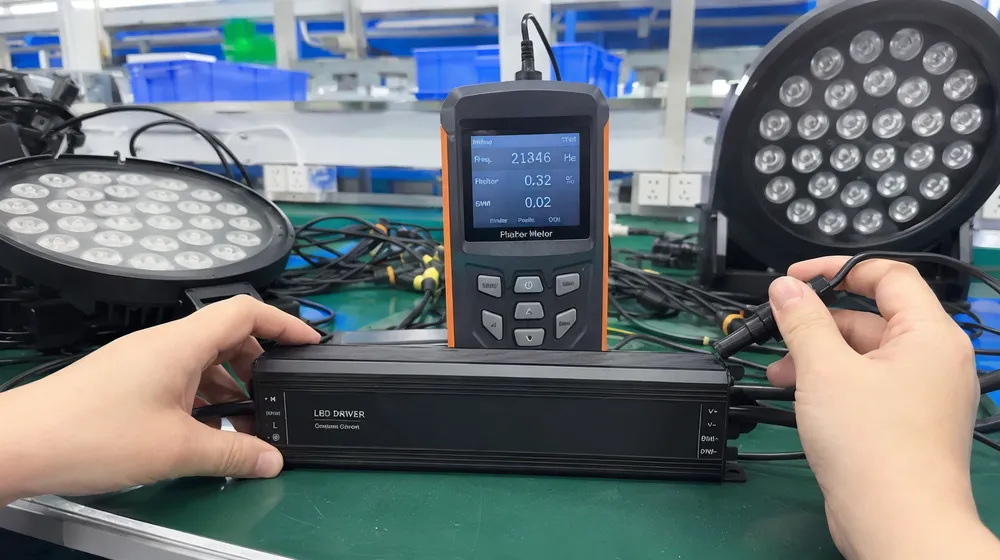
Every LED church fixture we ship uses constant-current drivers with PWM dimming frequency above 20kHz. At that frequency, no camera — whether shooting 24fps, 30fps, 60fps, or 120fps slow-motion — will pick up banding or flicker artifacts.
We test every unit at 25%, 50%, and 75% dim levels against a calibrated flicker meter during OQC. The test protocol documents the flicker percentage and stroboscopic visibility measure (SVM) per fixture. If your end customer requires verification documentation, we supply it per-batch.
Why this changed: Before 2020, maybe 30% of church fixture orders specified flicker testing. After COVID pushed every congregation into livestreaming, it became a universal requirement. We made it a mandatory QC step on all worship fixtures rather than an optional add-on — simpler for production, and you don't need to remember to request it.
Zero banding or flicker at all standard frame rates
Optical Consistency — Batch-to-Batch Color Matching
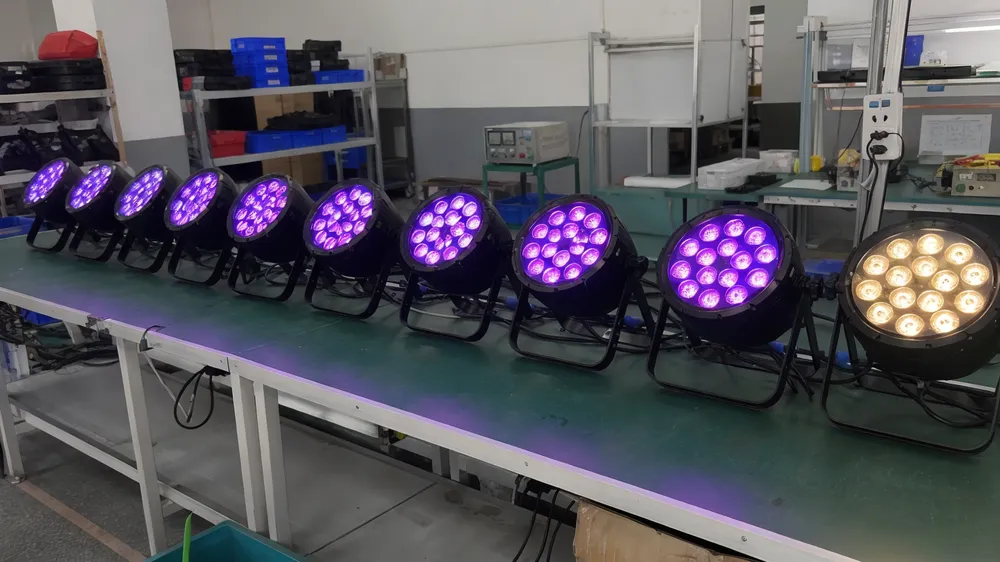
When you line up 8 or 12 LED pars as front wash across a stage, color uniformity fixture-to-fixture is non-negotiable. The problem is LED binning — even from the same manufacturer, LEDs from different production lots have slight wavelength and intensity variations.
Our approach: we procure LEDs in single-bin lots for each production run. Every fixture gets calibrated against a golden sample during assembly — white point, RGB primary saturation, and overall intensity are measured and stored in the fixture's onboard calibration memory. Your install team doesn't need to manually adjust individual fixtures to match; they come out of the box visually identical under the same DMX values.
- White point (CCT + duv)
- RGB primary saturation
- Overall intensity normalization
Your commercial benefit: You can fulfill reorders 6 months later and the new fixtures will still match the original installation. No awkward color mismatch when a church adds more wash fixtures to their existing rig.
Worship-Duty Engineering vs. Standard Fixtures — Key Differences
| Specification | GDMonkey LED Church | Typical Budget Fixture |
|---|---|---|
| PCB Substrate | Aluminum-core MCPCB (2.0 W/m·K) | Standard FR4 |
| Thermal Headroom | 15–20°C below max Tj | Operates near thermal limit |
| Sustained Full Output | Indefinite (no throttle) | Throttles at ~45 min |
| L70 Lifespan | 50,000+ hours | < 20,000 hours |
| PWM Dimming Frequency | > 20kHz (camera-safe) | 1–5kHz (visible banding) |
| Flicker QC | Mandatory — every unit tested | Optional / untested |
| Color Calibration | Golden-sample matched, stored onboard | No calibration (bin variance visible) |
Market Segments Where LED Church Stage Lighting Moves Volume
Each scenario below represents a market you can sell into profitably with this tier. The fixture specs are calibrated for these exact use cases.
Mid-Size Sanctuary Front Wash and Stage Color (200–500 Seats)
This is the primary market. Established churches with dedicated worship teams, regular livestreaming, and the budget to invest in proper lighting. A typical install uses 8–16 LED par cans — 6–10 fixtures as front wash in warm/neutral white, 4–6 fixtures as stage color in RGBW. Total project value per sanctuary runs 30–80 fixtures depending on ceiling height and stage depth.
Why this tier fits:
CRI ≥90 serves the camera. DMX512 gives the worship team scene-based control. The 80–200W output range covers everything from low-ceiling fellowship halls to 8-meter sanctuary vaulting without oversizing the fixture.
Distributor Order Pattern
These churches upgrade lighting every 5–8 years and add campuses. A single relationship with a 300-seat church today often turns into a 3-campus, 150+ fixture account within 5 years.
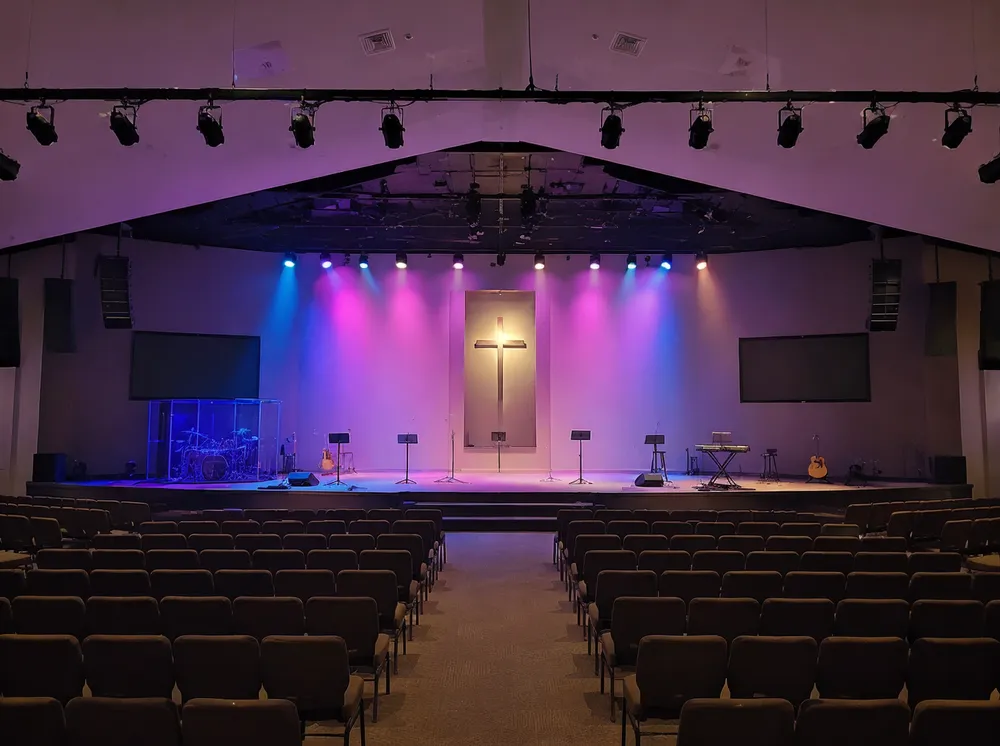
Multi-Campus Church Standardization Programs
Multi-site churches want visual consistency across campuses. When the same worship set plays at 4 locations via video or traveling worship teams, the lighting needs to match. These programs typically standardize on one par can model and one wash model across all sites — then reorder the same SKU every time they open a new campus or refresh an existing one.
Your advantage sourcing from us:
Because we calibrate every fixture against the same golden sample and maintain single-bin LED procurement, fixtures ordered 12 months apart will visually match. You can promise this to your multi-site customer with confidence.
Typical Order Size
40–100 fixtures per campus, 3–8 campuses per program. These are the accounts that turn into predictable annual reorder business.
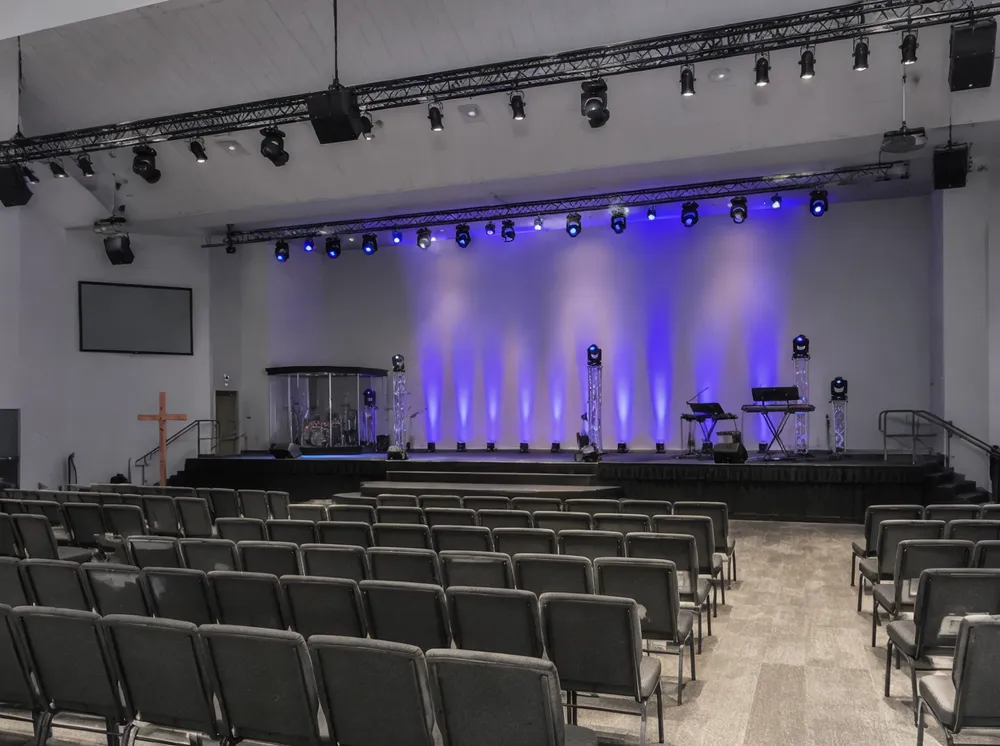
Church AV Rental and Production Companies
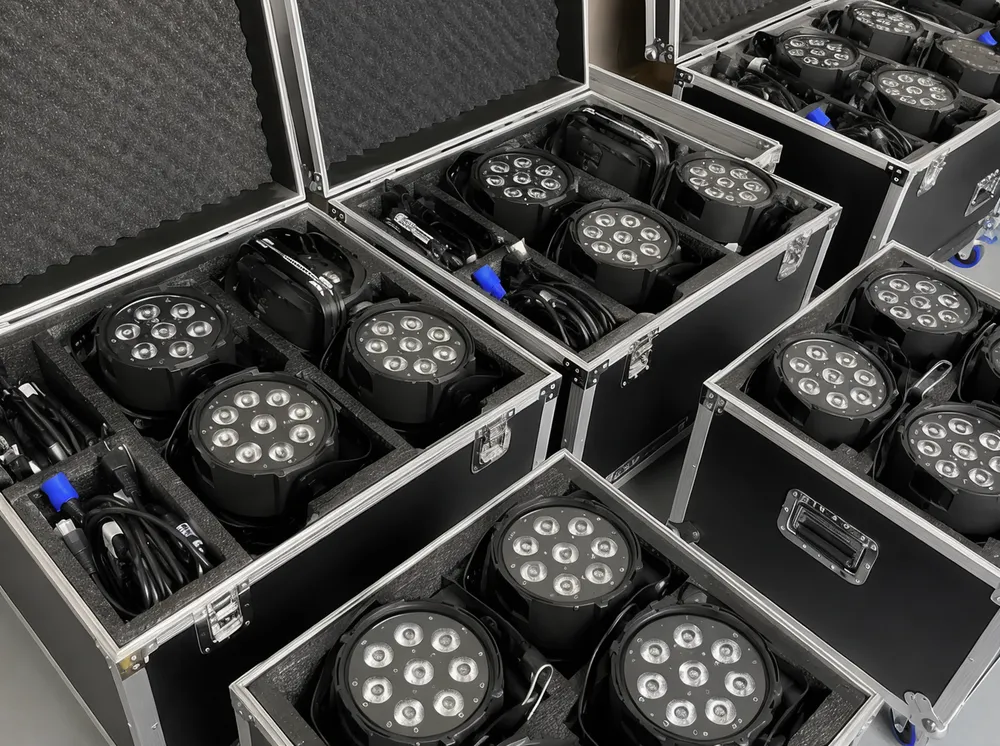
Portable church services — schools, theaters, community centers rented for Sunday mornings — need lighting that sets up fast, runs reliably, and fits in a van. Our compact LED pars (7×12W and 12×12W models) pack efficiently, weigh under 3.5 kg each, and handle weekly setup/teardown without mechanical degradation.
This segment favors convection-cooled models — no fan, no noise complaints when the rental venue's HVAC is quieter than expected.
Order & Reorder Cycle
Your rental customers buy 20–40 units at a time and replace fixtures every 3–4 years due to physical wear from transport, so the reorder cycle is shorter than fixed-install.
Outdoor Worship and Parking Lot Services (IP65 Variants)
Post-2020, outdoor services became permanent for many congregations. Covered pavilions, parking lot stages, and amphitheater worship spaces all need weather-rated lighting. Our IP65 LED church fixtures use silicone gasket sealing on all panel joints and IP-rated power/DMX connectors — they handle rain, morning dew, and dust without ingress.
Competitive Advantage
This segment is underserved by competitors because most worship lighting brands don't offer IP-rated versions. If you stock the IP65 variant alongside the standard IP20, you cover a market that your competitors' distributors can't touch.
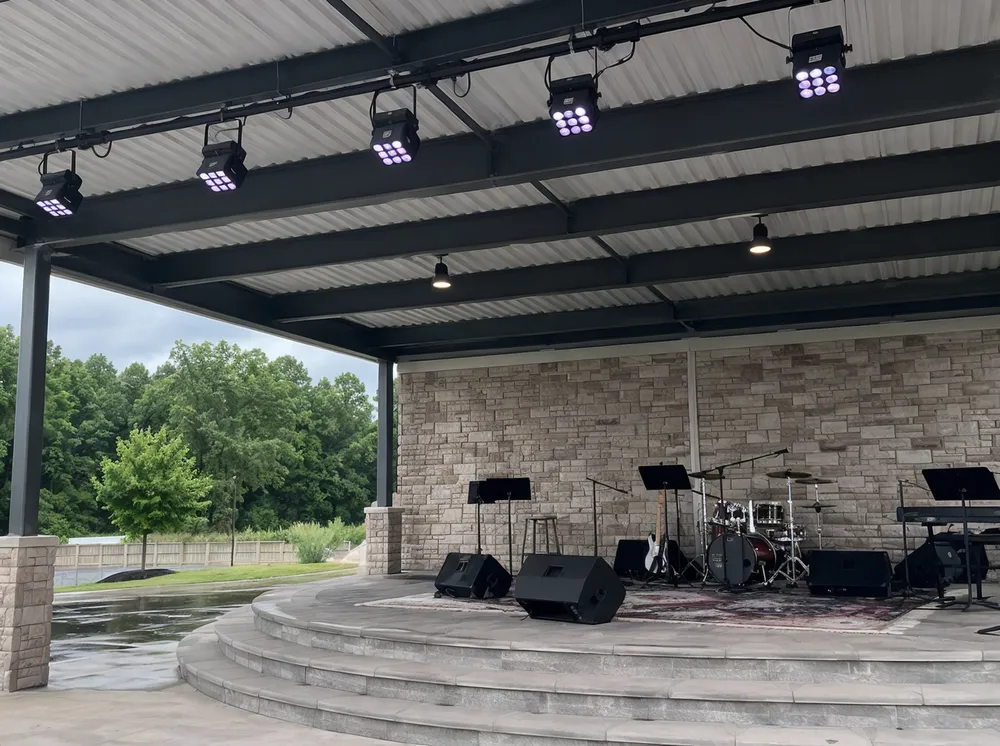
Customization for LED Church Stage Lighting — What You Can Spec
This tier has the widest customization range in our church product line because it's the highest-volume tier. Here's what you can modify and the MOQ implications:
Optical Customization
- Beam angle selection: 15°, 25°, 36°, 45°, 60° fixed lenses (interchangeable lens system on select models)
- LED array configuration: RGBW standard, RGBWA+UV on request, RGBA+Lime for extended color gamut
- Custom CRI optimization: standard ≥90, broadcast-grade ≥95 available with specific LED binning (adds 10–15% to LED component cost)
- Color temperature presets: custom warm/cool white presets programmed into firmware
Control and Firmware Customization
- Custom DMX profiles and channel mapping
- Integration with proprietary apps or wireless control systems
- Preset worship scene libraries burned into firmware (e.g., "Sermon," "Worship Set," "Communion" modes for volunteer operators)
- Custom startup behavior and address configuration
Branding and Housing
- Your logo laser-engraved or pad-printed on housing 30+ units
- Custom powder coat colors — any RAL or Pantone reference 100+ units
- Branded packaging with your documentation and QR codes 100+ units
- Custom safety labels and compliance markings for your target market
Limitations to Be Aware Of
- Housing form factor is fixed within each model platform — we can change color and branding, but reshaping the die-cast body requires new tooling 500+ units, 25–30 day tooling lead time
- IP65 sealing must be specified at order time; it cannot be retrofitted to IP20 housings
- Custom firmware requires a 10–15 day development and testing cycle before production sample approval
Minimum Order Quantities
MOQ scales with customization depth. Standard models with your branding start low; full OEM/ODM programs require commitment for optics, firmware, and packaging development.
30
Units — Catalog + Logo
200
Units — Full OEM/ODM
How We Build These Fixtures Process Details That Affect Your Field Failure Rate
The category page covers our general quality systems. Here's what happens specifically on the LED church lighting production line, and why each step exists.
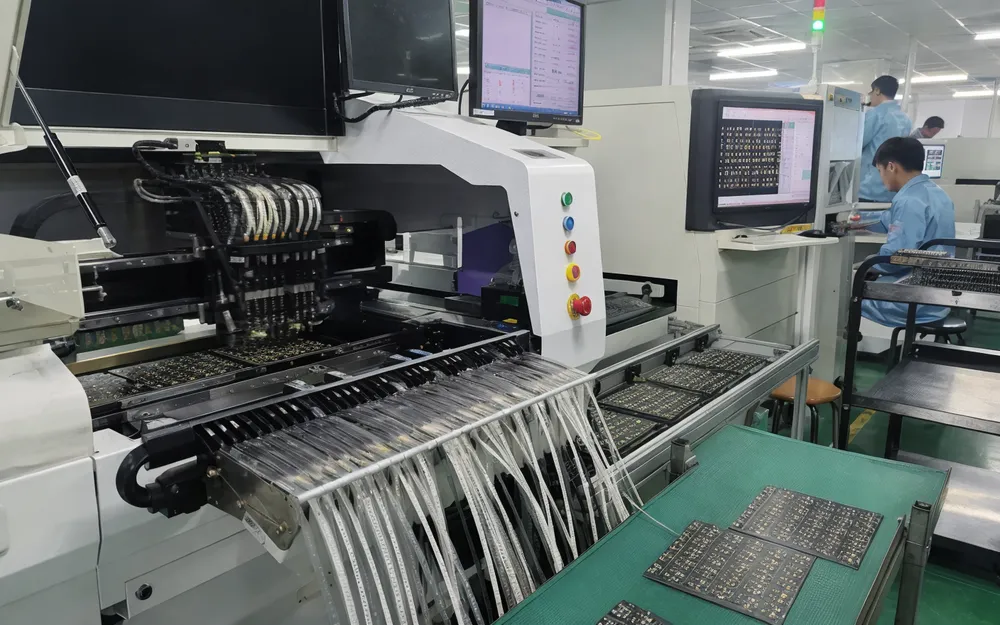
LED Chip Mounting
Automated SMT placement at ±0.05mm accuracy. Even slight misalignment on the LED array shifts the beam pattern and creates hot spots visible on camera. We verify chip placement with AOI (Automated Optical Inspection) before reflow soldering.
Reflow Soldering Profile
Modified reflow profile for church lighting boards — longer preheat zone, controlled peak temperature at 245°C (not the standard 260°C for generic boards). The lower peak protects the LED phosphor layer from thermal degradation. This costs an extra 30 seconds per board, but prevents the color shift that shows up at 5,000–10,000 hours on fixtures built with standard reflow profiles.
Driver Board Assembly
Wave soldering with nitrogen inerting for through-hole power components, followed by AOI inspection. The 105°C rated electrolytic capacitors are specced for 10,000+ hour life at rated temperature — under actual worship duty cycles (15–20 hours/week at 60–80% load), they'll outlast the LEDs.
Golden Sample Calibration
Every fixture goes onto the photometric bench and gets compared against the batch's golden sample. White point (x,y chromaticity coordinates), RGB primary intensity, and beam angle are recorded. Fixtures outside tolerance get re-calibrated or rejected. This gives you batch-to-batch consistency for reorders.
48-Hour Aging
Full power, continuous operation, ambient temperature monitored. We catch thermal management failures, marginal driver components, and intermittent connection issues. Roughly 0.3–0.5% of units fail aging — better discovered here than in your customer's sanctuary.
The Net Result
Our warranty claim rate on LED church fixtures runs below 0.5% across all export markets. Your support costs stay near zero.
Container Loading and Landed Cost Optimization
LED church par cans ship efficiently. The compact form factor and our packaging engineering mean your per-unit freight cost stays low relative to fixture value.
Typical Container Loading
| Model Range | Units per 20GP |
|---|---|
| 7×12W / 12×12W Compact Pars | 900–1,200 |
| 18×12W / 24×12W Full-Size Pars | 600–800 |
| Mixed Load (Assorted Models) | Custom calculation — optimal carton arrangement per container with loading plan provided on proforma invoice |
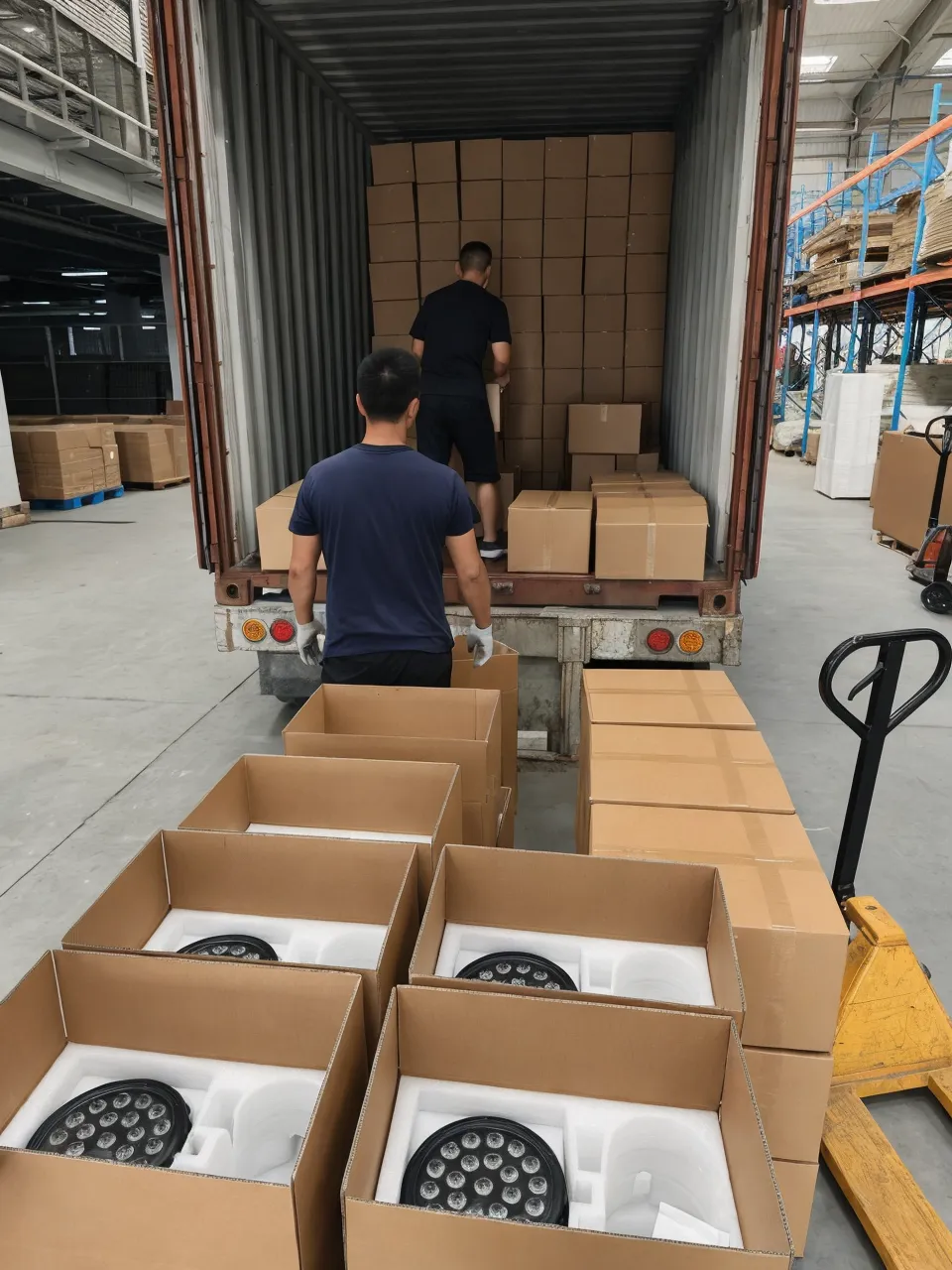
Packaging Details
- Molded EPE foam inner packaging shaped to each specific model
- Individual color box with product photo and specs (or your custom branded box)
- Master carton with reinforced corners — 4–6 units per master carton depending on model size
- Carton dimensions designed against container internal width to eliminate dead space
Note: We eliminated loose-fill foam peanuts from all packaging in 2021 — they migrate during sea transit and don't protect consistently. The molded EPE inserts cost slightly more but our damage claim rate dropped from 0.8% to under 0.1%.
Shipping Terms
Incoterms Available
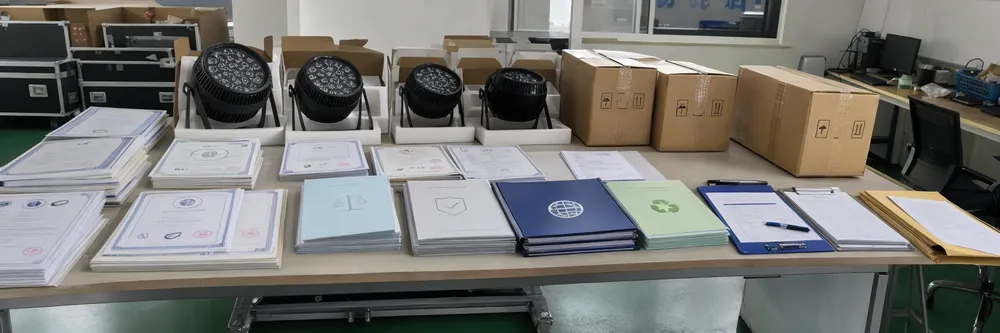
Full Documentation Included
- Commercial invoice & packing list
- Certificate of Origin (CO)
- Test reports per SKU
- Fumigation certificate for wooden pallets (if applicable)
Certifications and Compliance Pre-Qualified for Your Import Market
LED church stage lighting fixtures carry the following compliance qualifications, with all test reports and certificates provided per-SKU with your shipment documentation. Your compliance team gets what they need without requesting it batch-by-batch.
CE
EU Low Voltage Directive + EMC Directive. Standard on all models.
RoHS
Full compliance, test reports available per production batch.
FCC Part 15
EMC compliance for the North American market.
IP65
Available on outdoor-rated variants. Test report per IEC 60529.
ISO 9001:2015
Factory quality management system certification.
UL/ETL Listing
Available — manufactured to UL 1573 (Stage and Studio Luminaires) requirements on request.
UL/ETL for North American Distribution
If your distribution channel requires UL or ETL marks, discuss this at project initiation so we engineer compliance into the design from the start rather than retrofitting later. UL listing adds to engineering time and certification cost, but for the North American church market, many institutional buyers require it on purchase specifications.
Frequently Asked Questions LED Church Stage Lighting
What beam angle should I specify for LED church stage lighting in a typical sanctuary?
It depends on throw distance. For sanctuaries with 4–6 meter ceiling heights (common in churches under 300 seats), 45°–60° beam angles provide wide, even wash coverage without hot spots. For taller ceilings — 7–10 meters in larger auditoriums — specify 25°–36° to maintain intensity at stage level.
We stock 25°, 36°, and 60° lens options as standard.
If your projects span multiple ceiling heights, consider models with our interchangeable lens system — ship one fixture SKU and include multiple lens sets so the installer selects on-site.
RGBW versus RGBWA+UV — which LED configuration should I stock for church lighting?
RGBW (Red, Green, Blue, White) covers 90% of worship lighting needs — warm/cool white wash, saturated stage color, and smooth color mixing. The white chip provides clean high-CRI white without mixing artifacts.
RGBWA+UV adds amber and ultraviolet to the array — amber gives richer warm tones and better skin rendering in low color temperatures, UV enables fluorescent effects for youth services or special events.
For most distributors, RGBW is the core inventory SKU. Stock RGBWA+UV as a premium option for churches that specifically request it or have active youth ministry programs.
The price difference is approximately 12–15% per fixture.
How long do LED church stage lights actually last under worship use patterns?
At typical worship duty — 12–20 hours per week at 60–80% output — you're looking at 30,000–50,000 hours to L70 (the point where output degrades to 70% of original). That translates to 12–15+ years of actual use before replacement is needed.
The practical lifespan limiter is usually the driver circuit, not the LEDs. We spec 105°C electrolytic capacitors rated for 10,000+ hours at maximum temperature. Under worship duty cycles (well below maximum thermal stress), driver lifespan exceeds 8–10 years.
When fixtures do eventually need attention, it's a driver board swap — not a full fixture replacement.
Can LED church stage lighting fixtures run silently for use during sermons and prayer?
Models rated 120W and below in our LED church line use pure passive convection cooling — no moving parts, zero acoustic noise. These are suitable for any application where fan noise is unacceptable, including close-proximity mounting above a pulpit or in a recording studio environment.
Models above 120W use temperature-controlled variable-speed fans that activate only when thermal load requires it and operate below 25dB at typical ambient temperatures. In most HVAC-equipped sanctuaries, 25dB is below the background noise floor.
If absolute silence is mandatory at higher output levels, specify the convection-cooled models and accept slightly larger physical dimensions to accommodate the oversized passive heat sink.
What's the MOQ for LED church stage lighting, and can I mix models on one order?
Catalog models: 30 units MOQ per model. You can absolutely mix models within a single purchase order — 30 units of 12×12W RGBW pars plus 30 units of 18×12W RGBWA+UV washes ships as one consolidated order.
OEM/ODM with custom branding, firmware, or optical specification: 200 units per model for the initial production run, dropping to 100 units on subsequent reorders once your configuration is established in our system.
How do I avoid color mismatch when reordering LED church fixtures months later?
We maintain golden sample records and LED bin specifications for every production run. When you place a reorder — whether it's 3 months or 18 months later — we procure LEDs from the same bin range and calibrate against the original golden sample data.
The result is fixtures that visually match your previous batches under identical DMX values.
If the original LED bin is no longer available (rare, but it happens with discontinued chips), we notify you before production and offer a re-calibration option against a new reference that you approve.
Next Step — Get Specific Pricing for Your LED Church Lighting Order
Whether you're quoting an install project, building inventory for your distribution catalog, or developing a branded product line for the worship AV market — the fastest path forward is sending us your requirements.
Tell Us:
Which models or wattage range interest you
Your approximate quantity per order
Whether you need standard catalog or custom OEM/ODM
Your target market
We'll respond within 24 hours with model recommendations, FOB pricing, and a production timeline.
Typical First Order
Most new customers in this category start with a 30–50 unit order to evaluate build quality and test with their downstream customers before scaling. We can ship evaluation quantities within 20–25 days of order confirmation.
Teresa@gdmonkey.com
+86-135 3966 9939