

Disco DJ Lights Factory-Direct from GDMonkey
Disco DJ lights engineered and manufactured in-house — from LED disco balls to DMX-controlled club fixtures. 7 product lines covering every disco and DJ lighting format your buyers ask for. Full OEM/ODM capability with 30-unit MOQ on catalog models.
What This Category Covers and Why We Manufacture It In-House
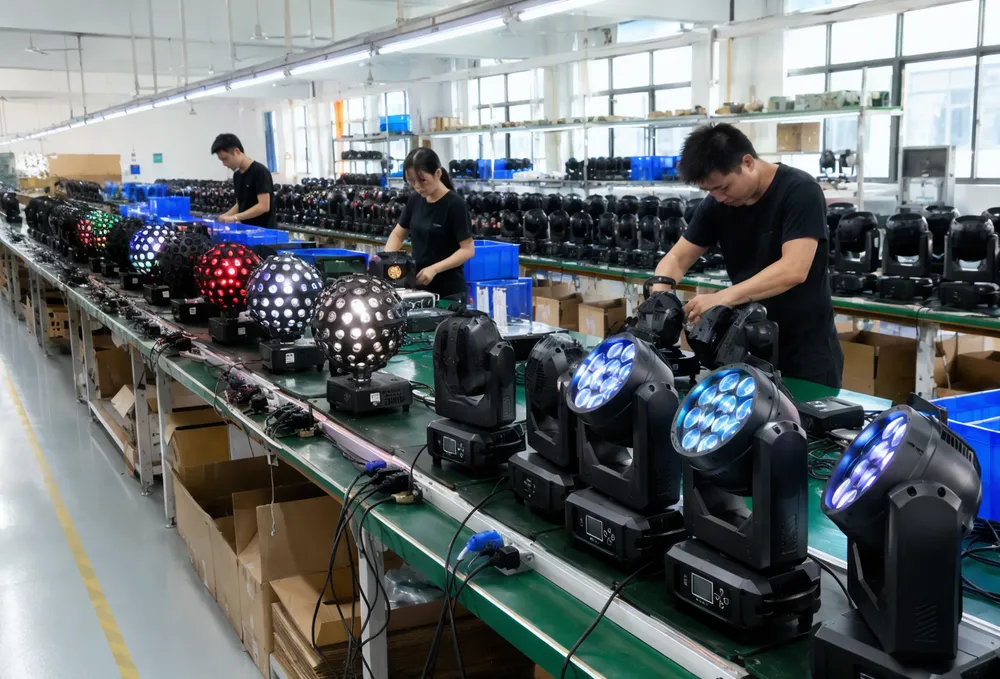
We build disco DJ lights — the full range, from classic rotating disco ball fixtures to programmable DMX-controlled effect units and dance floor laser systems. This isn't a side category we tack onto a stage lighting catalog. Disco and DJ effect lights account for a significant portion of our 350,000-unit annual output, and we've been engineering these products since 2012 when we started with motor-driven rotating fixtures.
The reason we keep this production in-house rather than outsourcing: disco DJ lights combine motor mechanics, LED optical systems, and control electronics in a compact housing that has to survive rental abuse. The motor that spins a disco ball mirror assembly runs tens of thousands of cycles in a venue. The LED array behind a gobo wheel generates concentrated heat in a sealed enclosure. These are specific engineering problems we've solved over 12 years of iteration, and they require tight coordination between our motor team, our optical engineers, and our thermal management group. You benefit because we control the failure modes at the design stage rather than discovering them in your customer's venue.
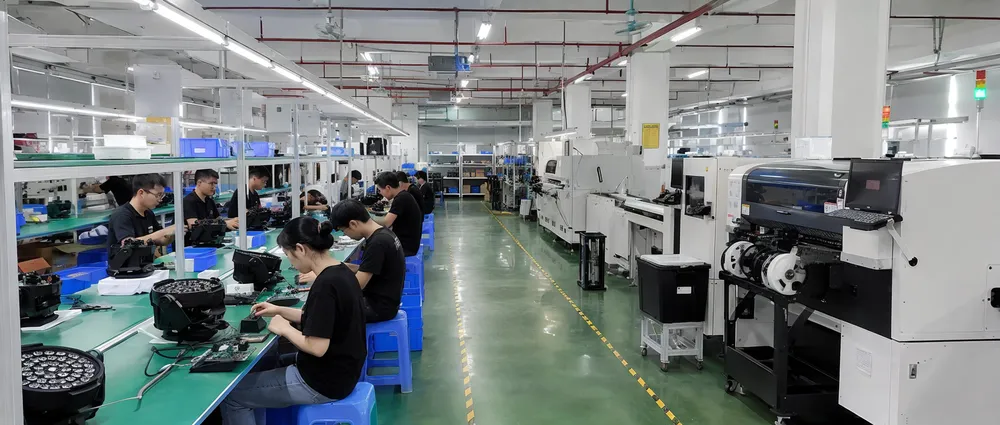
Our factory — 16,700 m² in Meizhou, Guangdong — runs 6 production lines. Disco DJ lights share SMT and motor assembly resources with our broader stage lighting production, but final assembly and calibration happen on dedicated cells configured for the specific test requirements of effect fixtures (beam pattern verification, motor run-in, DMX response testing). Your disco ball order and your LED effect order can run in parallel on the same PO without queuing.
Motor Mechanics
Rotating assemblies engineered for tens of thousands of cycles under continuous venue operation.
LED Optical Systems
Beam pattern design and thermal management for concentrated heat in sealed enclosures.
Control Electronics
DMX-512 protocol, sound-activation, and auto-run modes integrated at board level.
Product Line Overview
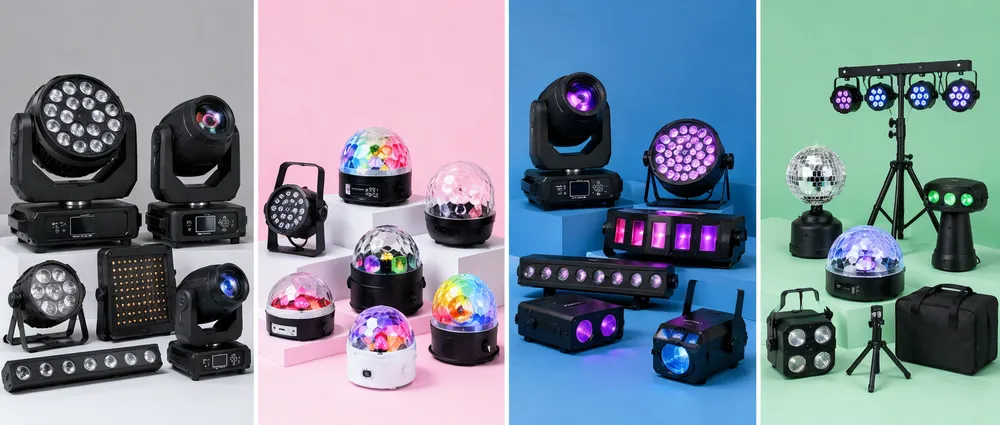
Seven distinct product families sit under our disco DJ lights category. Each targets a different market segment and application format — your buyers aren't choosing between "disco light A and disco light B." They're choosing the fixture type that matches their revenue channel.
Disco Ball Lights
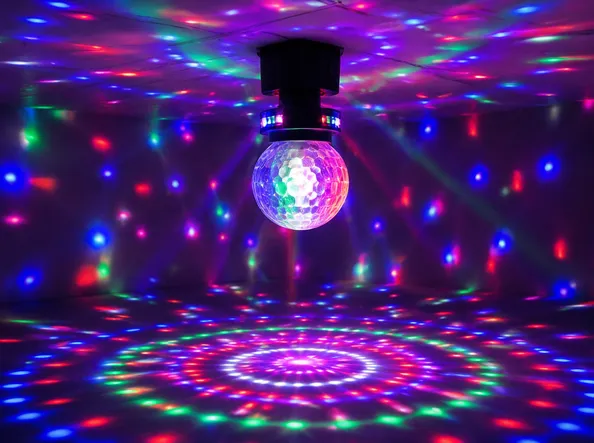
Mirror ball effect fixtures — motor-driven rotating assemblies with multi-color LED projection. The segment staple for rental houses and retail channels. Ceiling-mount and portable formats, with beam spread from tight spot projection to wide room-fill patterns.
View product line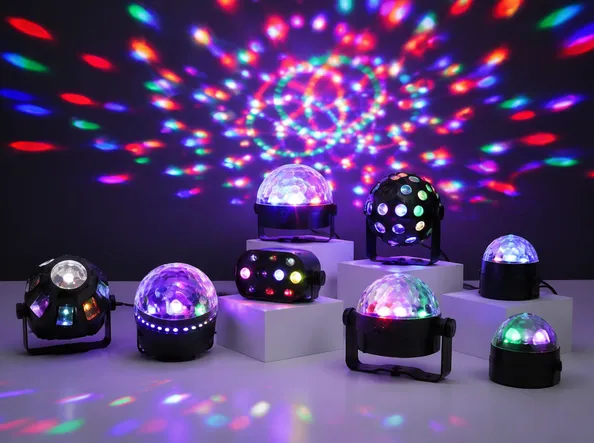
LED Disco DJ Lights
Multi-color LED effect fixtures with sound-activation and auto-run modes. The volume movers — units your retail accounts sell for home parties and small events. Built with internal microphones for music-sync and USB power options on compact models. Fastest inventory turn in the range due to price point and visual impact ratio.
View product line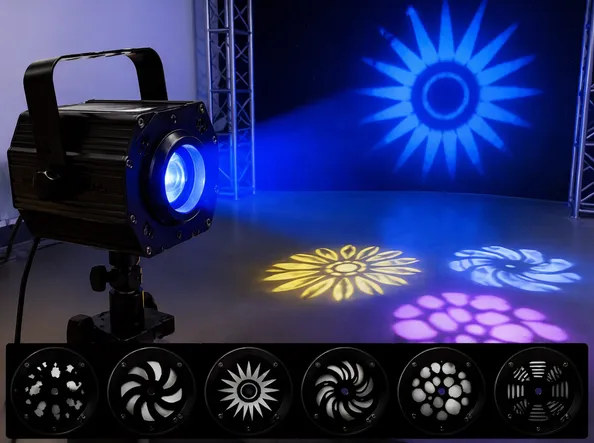
Gobo Disco DJ Lights
Pattern projection fixtures using interchangeable gobo wheels. Projects shapes, logos, or abstract patterns onto walls and dance floors. Rental and event contractors command higher per-event fees with gobo fixtures because they deliver venue-specific customization. Standard gobo sets supplied; custom gobo wheels available for OEM orders.
View product line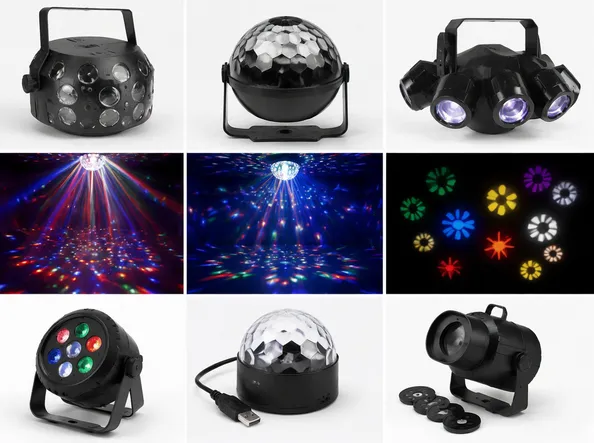
DMX Disco DJ Lights
Professional-grade disco fixtures with full DMX-512 control protocol. Built for installed club systems where a lighting controller runs the whole rig. 16-channel and 32-channel addressing options, RDM-compatible on select models. The margin product for your pro-audio and installed-systems customers.
View product line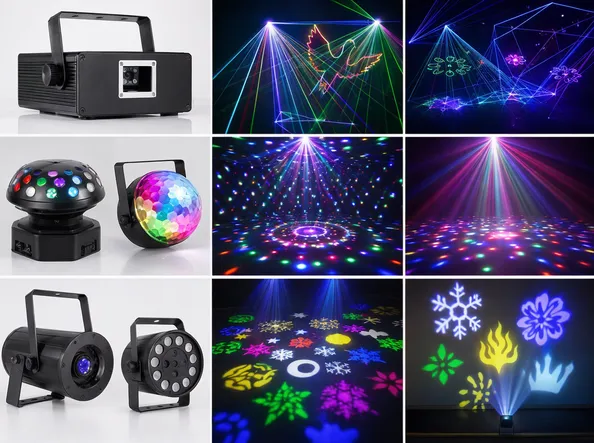
Disco Laser Lights
Solid-state laser modules producing beam effects, aerial patterns, and animation sequences. Class 3R and Class 3B configurations, with scan speeds up to 25kpps on standard galvo units. Laser compliance documentation (IEC 60825, FDA variance letters for US import) provided per model.
View product line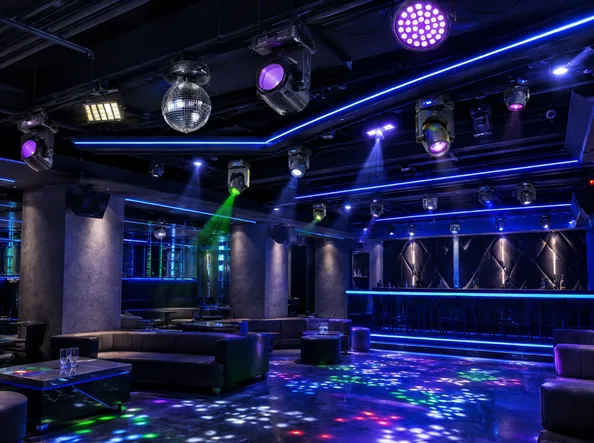
Club DJ Lights
Fixtures designed specifically for permanent nightclub installation — UV/neon effect units, LED strip integrations, and high-output wash effects for bar and lounge environments. IP20-rated for indoor permanent mount. Engineered for 8-12 hour daily run cycles under continuous nightly use.
View product line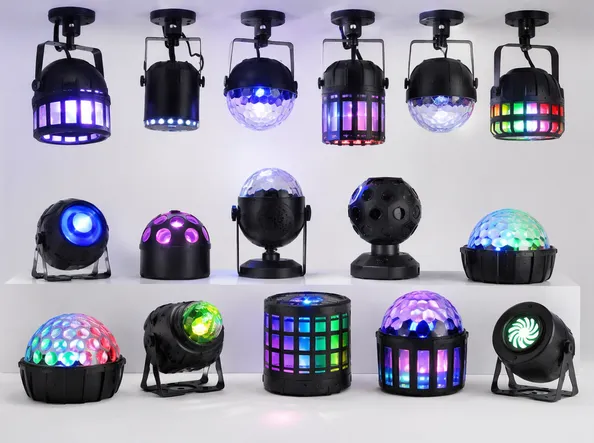
Dance Floor DJ Lights
Downward-projection and floor-level effect fixtures designed to light the dance surface itself rather than the room. Narrow-beam concentrated output, RGBW color mixing, and sound-pulse modes. Event rental customers package these with DJ setups as upsell bundles — they add visual impact without requiring ceiling rigging.
View product lineTechnical Specifications Across the Disco DJ Lights Range
Your procurement team needs to know our spec coverage fits your market requirements. Here's what we manufacture across this category.
| Parameter | Range Across Category | Notes |
|---|---|---|
| LED Source | 1W–10W individual LEDs, RGBW / RGBA / UV+RGB arrays | Epistar and Cree chips depending on model tier |
| Laser Source | 50mW–500mW, 532nm green / 650nm red / 450nm blue | Galvo scanning up to 25kpps |
| Motor Type | Stepper and DC brush motors, 2–12 RPM adjustable | Stepper on DMX models for precise positioning |
| Control Modes | Sound-active, auto-run, DMX-512, remote, app (WiFi/BT) | DMX + RDM on professional tier |
| DMX Channels | 4–32 channels depending on fixture complexity | Master/slave daisy-chain supported |
| Power Input | AC100-240V 50/60Hz (universal), DC 5V USB on compact models | Built-in switching PSU, no external adapter needed on AC units |
| Housing Material | ABS engineering plastic, aluminum alloy (pro series) | Aluminum on fixtures exceeding 50W thermal load |
| IP Rating | IP20 (indoor standard), IP44 available on select outdoor-capable models | IP65/IP67 on request for custom outdoor DJ events |
| Weight Range | 0.3kg (mini USB models) – 8.5kg (pro DMX laser units) | Directly affects your freight cost per unit |
| Operating Temp | -10°C to +45°C | Extended range available on custom orders |
LED Source
1W–10W individual LEDs, RGBW / RGBA / UV+RGB arrays
Epistar and Cree chips depending on model tier
Laser Source
50mW–500mW, 532nm green / 650nm red / 450nm blue
Galvo scanning up to 25kpps
Motor Type
Stepper and DC brush motors, 2–12 RPM adjustable
Stepper on DMX models for precise positioning
Control Modes
Sound-active, auto-run, DMX-512, remote, app (WiFi/BT)
DMX + RDM on professional tier
DMX Channels
4–32 channels depending on fixture complexity
Master/slave daisy-chain supported
Power Input
AC100-240V 50/60Hz (universal), DC 5V USB on compact models
Built-in switching PSU, no external adapter needed on AC units
Housing Material
ABS engineering plastic, aluminum alloy (pro series)
Aluminum on fixtures exceeding 50W thermal load
IP Rating
IP20 (indoor standard), IP44 available on select outdoor-capable models
IP65/IP67 on request for custom outdoor DJ events
Weight Range
0.3kg (mini USB models) – 8.5kg (pro DMX laser units)
Directly affects your freight cost per unit
Operating Temp
-10°C to +45°C
Extended range available on custom orders
Note: we don't list individual model specs here — those live on each product page with full photometric data. This table gives you the envelope we work within.
Market Segments Where Your Disco DJ Lights Revenue Lives
This isn't about where end users plug in the lights. It's about the commercial channels you can supply with this product line and the order patterns that make each segment profitable for your distribution business.
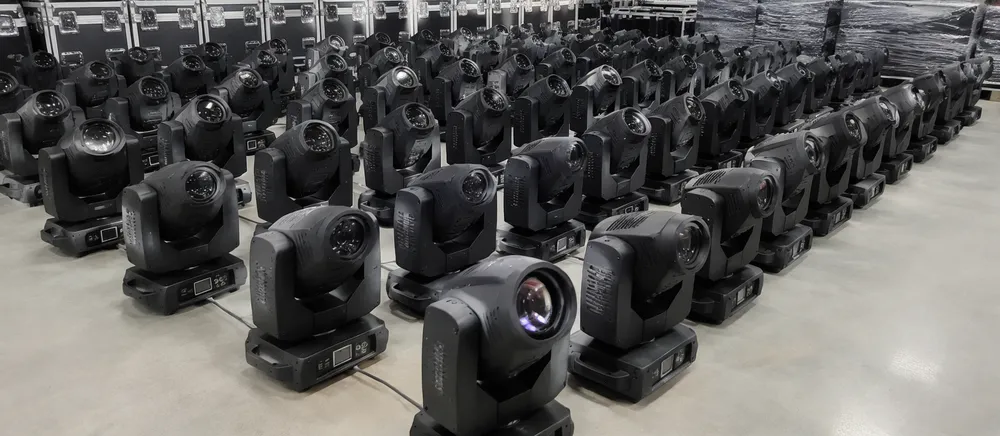
Entertainment Rental & Event Companies
Rental houses buy disco DJ lights in fleet quantities — 20-100 units of the same model for consistent show programming. They replace fixtures annually due to rental wear.
Your Margin Play
Sell them reliability — our 48-hour aging test means zero mid-event failures — and fast reorder availability. We maintain rolling stock on our top 15 rental-market SKUs.
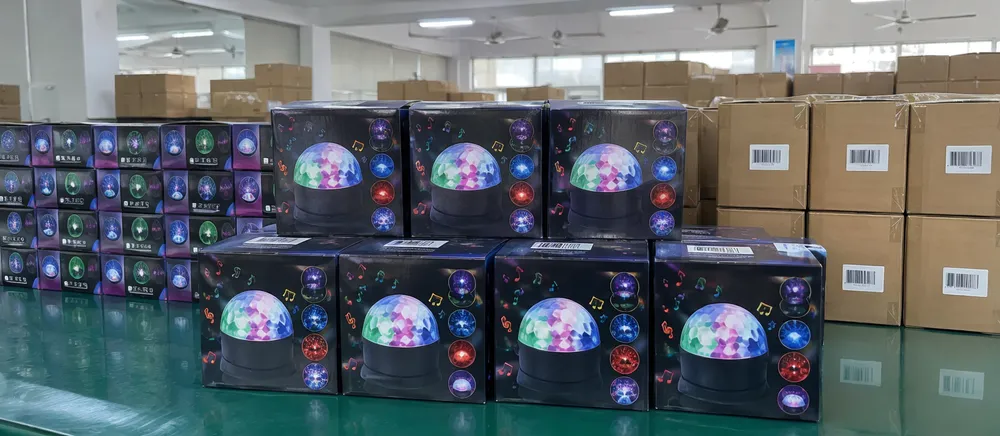
Retail & E-Commerce Channels
LED disco DJ lights in the sub-$30 retail segment sell in massive volume through Amazon, eBay, and regional platforms. We produce compact, retail-packaged units with UPC barcoding, color box packaging to your design, and FBA-ready carton dimensions.
Proven Performance
Our best-performing e-commerce client moves 3,000 units monthly of a single disco ball SKU — we keep their production on a rolling 45-day cycle.
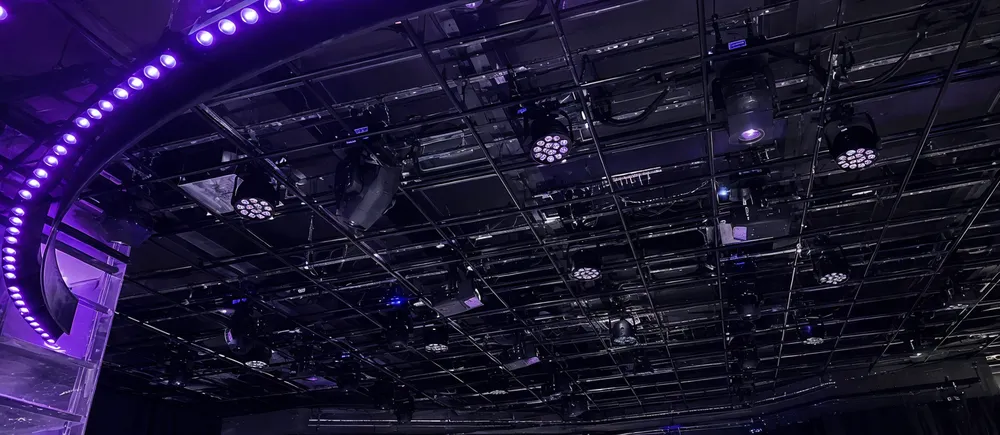
Installed Nightclub & Lounge Systems
DMX disco DJ lights and club fixtures go into permanent installations — ordered once per venue build-out, with ongoing expansion and replacement orders. Integrators buy on DMX compatibility and thermal longevity under continuous nightly use.
Your Value Proposition
Fixtures rated for 50,000+ hours with replaceable driver modules, so the venue doesn't gut the ceiling for a fixture swap.
Mobile DJ & KTV Equipment Distributors
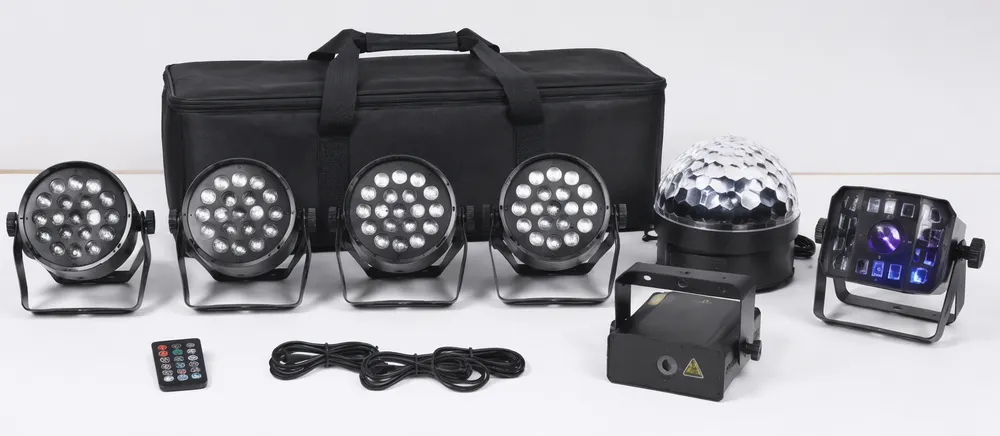
Mobile DJs and KTV operators buy compact, portable disco effects in sets of 4-8 units. They prioritize lightweight, multi-mode operation, and visual variety over raw output power.
Margin Expansion
Your margin expands when you bundle complementary fixtures — a disco ball + LED effect + laser as a packaged kit. We can pre-pack bundles to your SKU spec.
Project Contractors — Theme Parks, Cruise Ships, Event Venues
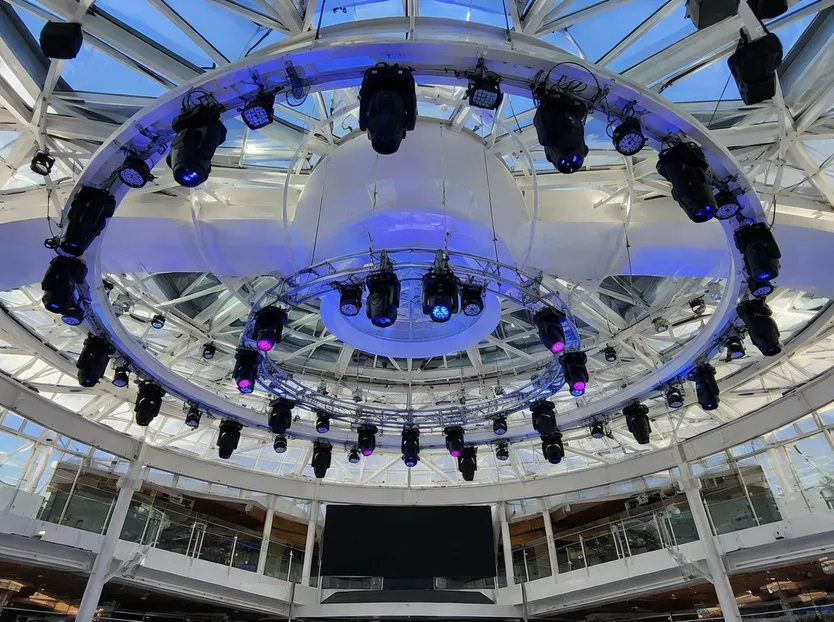
Project orders for disco and DJ effect lighting run 200-2,000 units with custom specifications: specific color temperatures, mounting hardware, control integration with house systems. DMX addressing, cable lengths, and finish colors are all customizable on our production line.
Lead Time
25-35 days on project orders depending on BOM complexity. Custom DMX addressing, cable lengths, mounting hardware, and finish colors all handled on our production line.
How We Prevent the Failures That Kill Your Margins
Disco DJ lights have specific failure modes that experienced buyers already know about — and worry about when evaluating a new supplier. We engineer against each of them at the production level.
Motor Failure on Rotating Fixtures
The mirror ball motor or gobo wheel motor is the most common point of failure in disco effect lights. Consumer-grade fixtures use cheap DC motors that burn out after 2,000–3,000 hours of continuous use.
We run stepper motors on our professional series and rated-life DC motors on our value tier, with every motor unit going through a 72-hour run-in cycle before assembly.
We test at 120% rated voltage to stress-screen weak windings. Your rental fleet doesn't go dark mid-event.
LED Lumen Depreciation
Disco DJ lights run LEDs at high current density in sealed enclosures — thermal management directly determines whether your fixtures still look bright after 12 months of service.
We use aluminum-core PCBs with direct thermal path to the housing on any fixture exceeding 30W. Heat sink fins are CNC-machined for consistent surface area, not die-cast with variable surface quality.
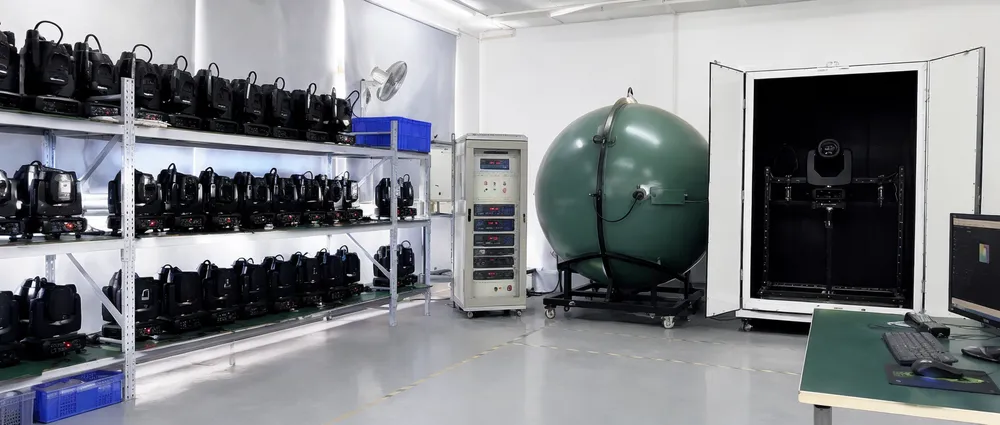
Result: less than 10% lumen depreciation at 10,000 hours on RGBW models.
We test this in our photometric lab monthly against reference samples from initial production — if a design drifts past 15% at any point in its lifecycle test, we redesign the thermal path before the next batch.
DMX Control Failures
Nothing frustrates an installed system more than a fixture that drops off the DMX chain intermittently. This is almost always a signal integrity issue at the RS-485 transceiver or a connector contact failure from vibration.
We use industrial-grade XLR connectors with spring-loaded contacts, not the stamped-pin budget connectors that work loose over time.
RS-485 line drivers are ESD-protected to 15kV — because every DJ who plugs in a fixture while the controller is hot is sending a transient down the data line.
Laser Diode Degradation
Laser modules are the highest-value component in our disco laser lights, and they're temperature-sensitive.
We mount laser diodes on copper heatsink blocks with thermal compound applied by automated dispenser (consistent 50μm bond line), not hand-applied paste with variable thickness.
Each laser module gets individual power measurement at 0h, 48h, and certified before shipping. Your warranty exposure on laser products stays predictable.
OEM/ODM Capability for Disco DJ Lights Build Your Brand on Our Platform
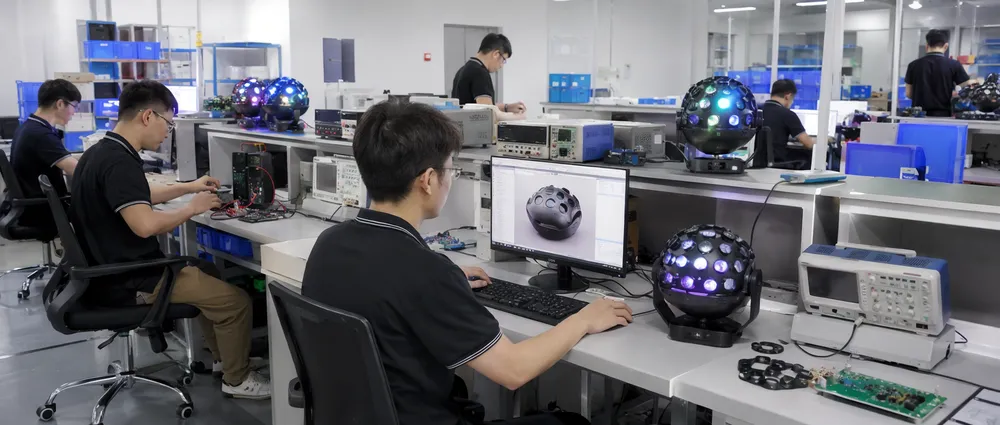
If you're building a private-label DJ lighting brand or need custom-spec fixtures for a project, our R&D team of 15 optical and electrical engineers develops from your concept to production-ready product.
Housing Design & Finish
Custom colors, logo molding, modified form factors. Powder coat or soft-touch finish on ABS, anodized or painted on aluminum housings.
Optical Configuration
Custom beam angles, gobo patterns, color wheel sequences, LED array layouts — tuned to your target application and market.
Control Firmware
Custom DMX channel maps, proprietary app integration, branded control interfaces, sound-reactive sensitivity tuning.
Packaging & Branding
Retail color box or plain brown carton, your UPC/EAN codes, instruction manuals in your brand voice, warranty cards with your contact information.
Compliance & Certification
We handle CE, FCC, and RoHS testing for OEM products. Test reports issued under your brand name or ours — your choice.
Timeline & MOQ
Test-sell before committing to container volumes.
Ready to start an OEM/ODM project?
Send us your brief and our engineering team will respond within 24 hours with a feasibility outline.
Shipping Disco DJ Lights Container Loading and Packaging Reality
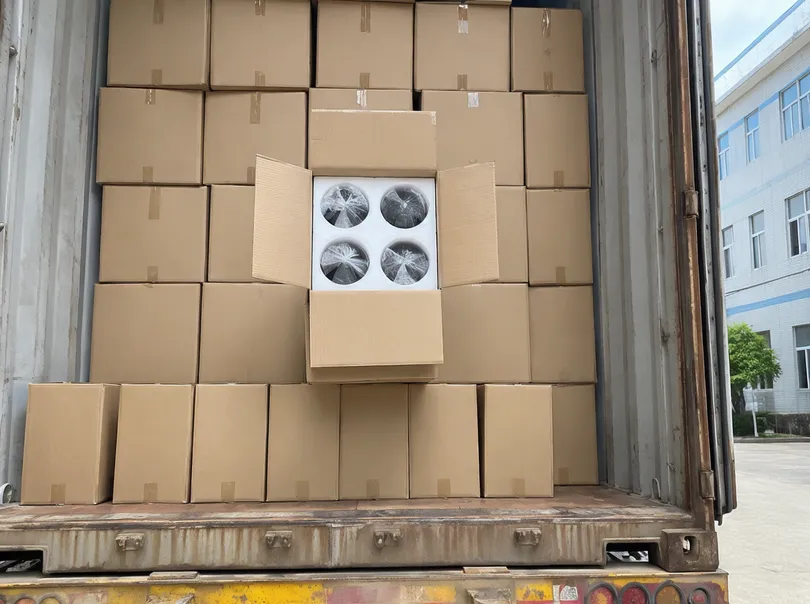
Disco DJ fixtures are lightweight compared to metal stage equipment, but they're optically fragile — lenses, mirrors, motor assemblies, and laser modules don't survive rough handling without proper packaging engineering. Here's what we do and what it means for your landed cost.
Carton Engineering
Molded EPE foam inserts since 2019
Each disco DJ light model has a dedicated molded EPE foam insert designed from the fixture's 3D geometry. We switched from universal cut-foam to molded inserts in 2019 after too many mirror assembly damage claims on sea freight shipments.
Current breakage rate on properly packed shipments:
Below 0.1%
Freight Cost Optimization
Volume-constrained, not weight-constrained
Because most disco DJ lights weigh under 5kg per unit, you're typically volume-constrained on container shipments. We optimize carton dimensions during product development to minimize dead air space.
Impact of a 3cm reduction in one carton dimension on a high-volume SKU:
+10–15% units per container
Translates directly to lower per-unit freight cost at your port.
Container Utilization by Product Type
| Product Line | Typical Carton Size | 20GP Loading | 40HQ Loading |
|---|---|---|---|
| Mini LED disco lights | 18×18×16 cm | ~2,400 units | ~5,200 units |
| Standard disco ball fixtures | 28×28×30 cm | ~800 units | ~1,800 units |
| DMX pro disco lights | 35×35×38 cm | ~480 units | ~1,050 units |
| Disco laser systems | 40×32×25 cm | ~600 units | ~1,300 units |
These are rough estimates — actual loading depends on palletization requirements and master carton configuration. We provide exact loading plans with your proforma invoice.
Trade Terms
- FOB Shenzhen/Guangzhou — standard trade term
- CIF and DDP — available on request
- Full export documentation, CE/FCC test reports, and commercial invoices included with every shipment
Choosing the Right Disco DJ Lights For Your Market Position
Not every fixture in this category fits every distribution channel. The selection depends on where your revenue comes from and what your end customers value.
If You Supply Rental Companies
Focus on DMX disco DJ lights and gobo disco lights. Rental operators need fixtures that integrate into DMX-controlled rigs and deliver venue-specific looks.
They pay premium unit prices and reorder when gear wears out. Your margin is in the pro tier, not the value tier.
If You Sell Through E-Commerce or Retail
LED disco DJ lights and disco ball lights at the sub-$30 retail price point are your volume drivers.
Sound-activation, plug-and-play operation, and eye-catching packaging move units. We can optimize packaging dimensions for FBA fee tiers.
If You Equip Nightclubs and Lounges
Club DJ lights with UV/neon effects and dance floor fixtures suit permanent installations.
Buyers in this channel order once per venue build and expect 50,000+ hour lifespan. Position on durability and thermal performance, not price.
If You Sell to Mobile DJs
Mixed bundles work. A set of 4 compact fixtures covering different effects (ball + LED wash + laser + dance floor spot) gives your buyer a complete rig in one purchase.
We pre-configure and pack bundles to your spec, so you ship one SKU instead of four.
If You're Entering a New Market
Tell us your target retail price point and regional market — we'll recommend a starter SKU mix based on what's moving for our existing distributors in that geography.
Most new partners start with 3–5 models, test for 90 days, then expand based on sell-through data.
Frequently Asked Questions — Disco DJ Lights Sourcing
What IP rating do I need for disco DJ lights used at outdoor events?
What IP rating do I need for disco DJ lights used at outdoor events?
For temporary outdoor events (festivals, garden parties, rooftop venues), IP44 handles splash protection and light rain. For permanent outdoor installation or events in tropical climates with heavy rain exposure, specify IP65.
We produce IP44 as a standard option on select models and do IP65 on custom orders — the cost increase is primarily in gasket tooling and conformal coating on the PCB, roughly 8-12% on unit cost depending on the fixture complexity.
Why do cheap disco DJ lights lose brightness after 6 months?
Why do cheap disco DJ lights lose brightness after 6 months?
Two causes: undersized heat sinks and over-driven LED currents. Budget manufacturers push LEDs past rated current to hit brightness specs without investing in adequate thermal dissipation. The junction temperature climbs, and lumen output degrades exponentially above 85°C.
Our design rule: aluminum-core PCB with thermal pad direct to housing, LED drive current at 85% of absolute maximum rating. The initial brightness is slightly lower on spec sheet, but at 10,000 hours your fixture still delivers 90%+ of original output. Your warranty claim rate stays near zero.
What's the difference between sound-activated and DMX-controlled disco lights?
What's the difference between sound-activated and DMX-controlled disco lights?
Sound-activated fixtures respond to ambient music through an internal microphone — no controller needed. They're consumer-friendly and sell well in retail.
DMX-controlled fixtures require an external lighting console and address configuration, but give precise programming control over color, movement, pattern, and timing.
For your business: sound-activated sells at lower price points in higher volume; DMX-controlled sells at higher margins to professional buyers. Most distributors carry both to cover the full market.
How do I verify laser compliance for importing disco laser lights to the US?
How do I verify laser compliance for importing disco laser lights to the US?
US import requires FDA/CDRH compliance under 21 CFR 1040.10. The manufacturer (that's us) must file an accession number with the FDA and provide a variance letter if applicable.
We handle this filing for every laser model we produce and supply the documentation package with your shipment — accession number, product report, certification label applied to each unit. Your customs clearance proceeds without hold.
What MOQ should I expect for custom-branded disco DJ lights?
What MOQ should I expect for custom-branded disco DJ lights?
Catalog models start at 30 units — useful for testing a product before committing.
For OEM branding (custom logo, packaging, color), MOQ is typically 200-500 units for the first production run depending on whether we're modifying existing tooling or creating new molds. After the first run, reorders start at 100 units.
We structured it this way because the per-unit tooling amortization on smaller runs makes the pricing impractical for both sides.
Can I mix different disco DJ light models on a single purchase order?
Can I mix different disco DJ light models on a single purchase order?
Yes — and most of our distributors do. Our 6 production lines run different product families in parallel, so a mixed PO (say, 500 disco balls + 300 LED effects + 200 laser units) ships as a complete container rather than split shipments.
Minimum 30 units per SKU on catalog models. Mixed POs are our standard operating mode, not an exception.
Start Sourcing Disco DJ Lights — What Happens Next
Send us your requirements — a product list, target market, volume estimate, or even a competitor product you want us to develop against.
Send Your Brief
Email your requirements to Teresa@gdmonkey.com or submit via our RFQ form.
24-Hour Response
We respond within 24 hours with pricing, product recommendations, and lead time estimates tailored to your market.
Sample Shipment
Sample order ships within 5-7 days for catalog models. Custom samples: 15-20 days.
Evaluate & Confirm
You evaluate samples, confirm specs, and place the production order when you're satisfied with fit and quality.
Production Run
Production runs 20-35 days. You receive progress photos and a pre-shipment inspection report before goods leave the factory.
Shipment & Documentation
Shipment with full documentation — CE, FCC, test reports, commercial invoice, packing list. Ready for customs clearance.
Not sure which models fit your market? Send us your target retail price range and customer profile. We'll suggest the 3-5 SKUs our data shows moving fastest in your region.