

DJ Lights and Speakers Setup Integrated AV Packages Built for One-Operator Resale
Factory-manufactured DJ lights and speakers setup packages where lighting and powered audio ship as a tested, synchronized system — not a box of mismatched components.
Sound-reactive DMX modes pre-programmed, universal voltage, two-case packing. Your end customer unloads, connects, and runs a full show without a lighting technician.
What This Product Is and Who Buys It From You
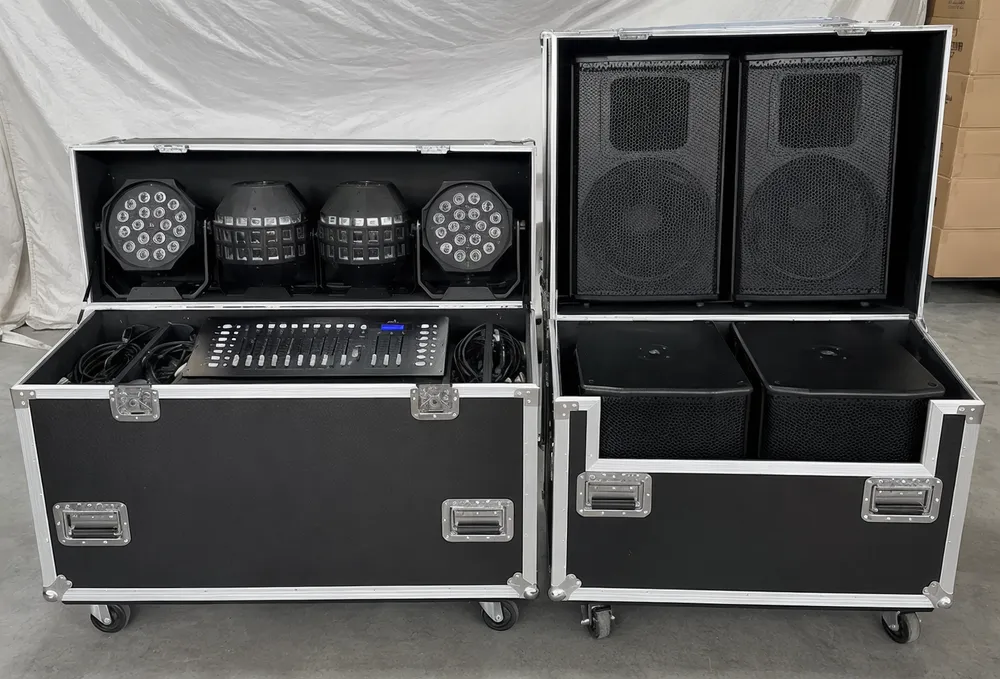
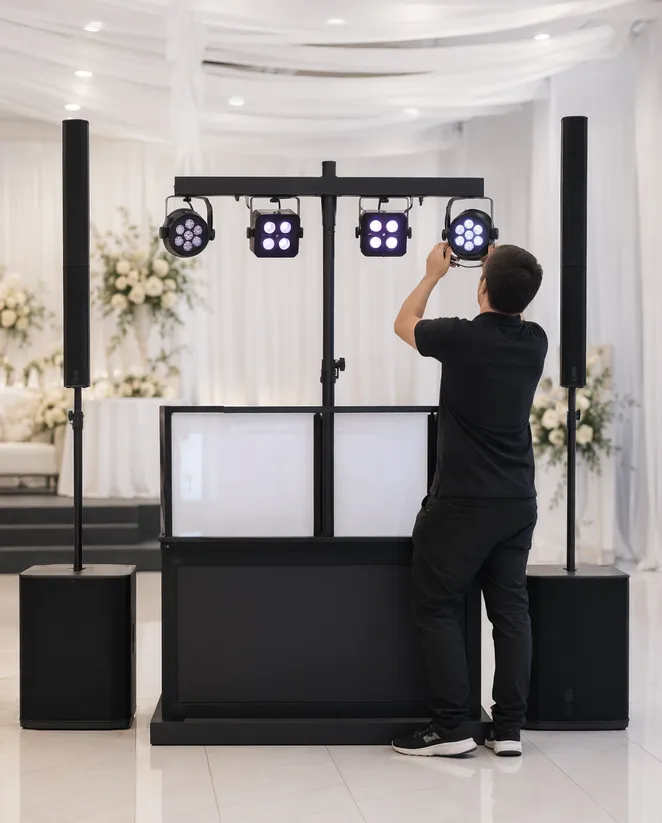
A DJ lights and speakers setup is a complete audio-visual package — LED fixtures, a DMX controller, powered speakers, cabling, and mounting hardware — designed to leave our factory as a single tested system and arrive at your end customer ready to perform. The target deployment: one-operator mobile DJs and small event companies running shows where a single person handles sound and lighting without separate control consoles for each.
This isn't a category overview. The parent DJ lights setup page covers the full range — truss rigs, booth kits, and integrated AV packages. This page is specifically about the integrated AV configuration: lights plus speakers, pre-matched, sound-reactive, packed in two road cases.
Your commercial angle: the DJ lights sound system segment is growing because the one-person-show operator model keeps expanding. Wedding DJs, corporate background music providers, small-venue entertainers — they can't justify separate lighting and audio budgets or the truck space to carry uncoordinated gear. You give them one SKU, one purchase, one setup time. Your margin comes from the integration value you're selling, not from marking up commodity speakers and generic PARs separately.
How This Fits the Product Line
Truss setups target rental fleets running large events with dedicated crew. Different scale, different buyer profile.
Booth kits are lighting-only for fixed installations. No audio, no road cases, no mobility logic.
Combines audio and lighting for the mobile, solo-operator channel — a distinct market segment with distinct stocking and pricing logic.
Target End Users
-
Wedding DJs
One van, one operator, full reception coverage
-
Corporate Background Music
Conference rooms, product launches, branded events
-
Small-Venue Entertainers
Bars, restaurants, community halls — 50–200 capacity
Your Margin Logic
Margin comes from the integration value you sell — not from marking up commodity speakers and generic PARs separately. One SKU, one purchase order, one setup time for the end customer.
Technical Specifications for This Configuration
Your procurement comparison starts here. These are the typical specifications for our standard DJ lights and speakers setup package — exact values for this product, not category-wide ranges.
| Parameter | Specification |
|---|---|
| Fixture Configuration (Standard) | 4× LED PAR (RGBW, 12×3W), 2× derby effect light, 1× laser effect |
| Speaker Configuration | 2× powered 12" full-range (250W RMS each), 1× powered 15" subwoofer (400W RMS) |
| Total System Power Draw | Lighting: ~380W Audio: ~900W Total: ~1,280W |
| DMX Controller | 192-channel desk with 12 pre-programmed sound-reactive scenes |
| Sound-to-Light Modes | Built-in microphone on controller, 4 sensitivity levels, beat-sync algorithm |
| DMX Channels Per Fixture | 4/8 ch selectable |
| LED Source Life | 50,000 hours rated |
| Speaker Frequency Response | 55Hz–18kHz (±3dB, full system with sub) |
| Speaker SPL | 123 dB peak (combined system) |
| Amplifier Type | Class D, built into each cabinet |
| Connector Standard | XLR (DMX) Speakon (Audio) powerCON (Power) |
| Voltage | 100–240V AC, 50/60Hz universal |
| IP Rating | IP20 (indoor use standard) |
| Case Packing | 2× wheeled road cases (lighting case + audio case) |
| Total System Weight | ~95 kg packed |
| Certifications | CE FCC RoHS |
Specifications shown are standard configuration values. Custom specifications (fixture count, speaker wattage, effects selection) available — contact us for a tailored spec sheet.
Engineering Note: powerCON Standardization (2021)
We standardized on powerCON connectors across the entire system in 2021. Before that, we shipped with IEC connectors on speakers and bare power cables on fixtures — the cable mess during setup was a constant complaint from the field. PowerCON daisy-chain simplified everything to three cable types total in the kit.
Lighting Fixtures
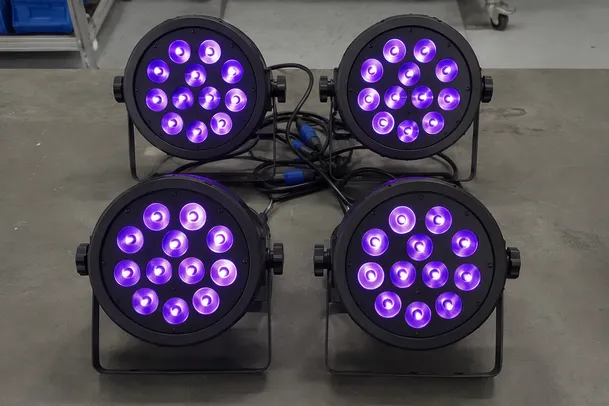
4× LED PAR (RGBW, 12×3W) + 2× derby effect + 1× laser effect. Sound-reactive via DMX controller.
Powered Audio
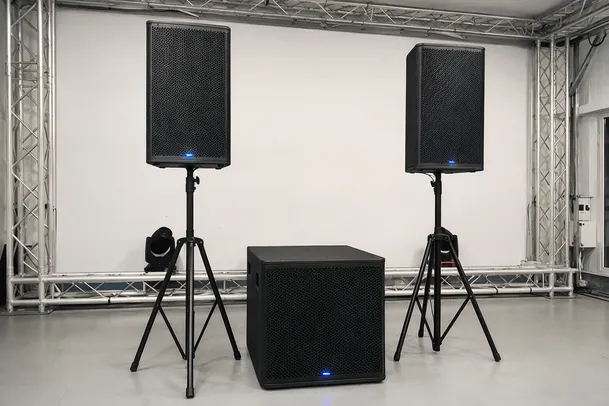
2× 12" full-range (250W RMS) + 1× 15" sub (400W RMS). Class D amplification built into each cabinet. 123 dB peak system SPL.
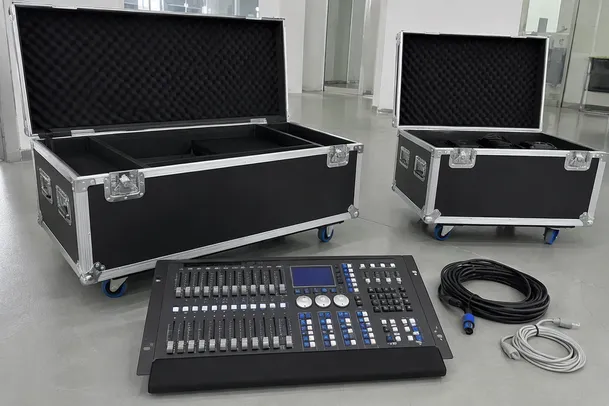
Control & Transport
192-ch DMX desk, 12 pre-programmed scenes, all cabling included. Ships in 2× wheeled road cases — ~95 kg total packed weight.
How Sound-Reactive Integration Actually Works at the Factory Level
This is where our DJ equipment lights setup differs from what trading companies assemble from catalog parts. When a trader bundles a generic DMX controller with off-the-shelf speakers, the "sound-reactive" mode is typically a microphone taped to the controller chassis picking up ambient room noise. The lighting response is random — it triggers on crowd chatter, HVAC rumble, door slams. Your end user watches the lights flash to nothing and calls your support line.
We engineer the sound-to-light chain as a single signal path. The controller's built-in microphone circuit includes a bandpass filter tuned to 80–200Hz — the kick drum and bass frequency range that actually represents musical beats. A DSP algorithm analyzes transient peaks in that band and translates them into DMX trigger events with adjustable attack and release times. The result: lights respond to musical rhythm, not to someone coughing in the front row.
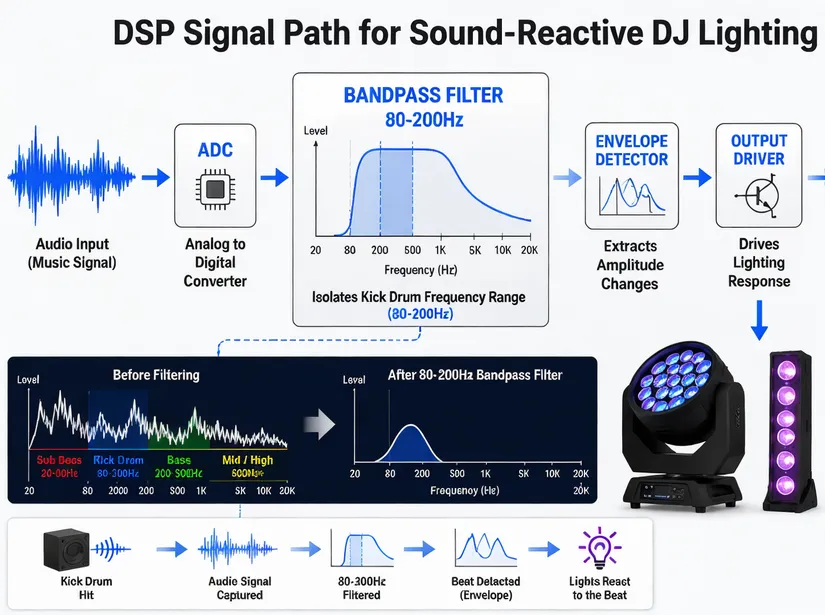
DSP-filtered signal path: 80–200Hz bandpass isolates musical beats from ambient noise
Trading Company Assembly
- Generic microphone taped to controller chassis
- Picks up ambient noise — crowd chatter, HVAC, door slams
- Random lighting response unrelated to music
- End user frustration → support calls → returns
- No firmware access or calibration capability
GDMonkey Factory Integration
- Bandpass filter circuit tuned to 80–200Hz (kick/bass)
- DSP analyzes transient peaks in musical beat range
- DMX triggers with adjustable attack and release times
- Lights lock to musical rhythm across all volume levels
- Pre-calibrated in integration lab before shipment
Pre-Shipment Calibration Protocol
We calibrate this in our integration lab before the kit ships. A technician plays reference tracks through the actual speakers in the kit at three volume levels and verifies that the lighting trigger stays locked to beat. The sensitivity curve is pre-set for each volume scenario. Your end user selects a mode (1 through 4), and the system tracks correctly from wedding dinner volume to dance floor peak without adjustment.
Low Background
Wedding dinner, cocktail hour volume levels
Medium Performance
Corporate events, mid-energy sets
Full Output
Dance floor peak, club-level SPL
The Integration Premium Your Business Captures
This integration quality is what separates a $600 branded system from a $300 loose bundle at the same component cost. Your buyer pays for the engineering that makes it work on first power-on without YouTube tutorials. You capture that integration premium because trading companies can't replicate the calibration step — they don't have the lab or the firmware access.
Discuss custom sound-reactive scene programming for your brandPackaging Architecture and Container Loading
DJ lights and speakers setup packages are dense — speakers are heavy, fixtures are fragile, and road cases eat cubic space. We've iterated the packing geometry across four production revisions to maximize your container utilization.
Standard 2-Case Packing
Case 1 — Lighting
All lighting fixtures + control + stands
- 4× PAR fixtures in molded foam compartments
- 2× Derby effects in padded dividers
- 1× Laser unit
- DMX controller + all DMX cables
- 2× Speaker stands
Case 2 — Audio
Speaker tops + sub + all cabling
- 2× Tops nested vertically with foam separation
- 1× Sub horizontal with corner protection
- All audio cables
- Power distribution cables
Container Loading (40HQ)
48–56
Systems per 40HQ
~0.85
CBM per system
3-high
Lighting stack
2-high
Audio stack
- Approximately 48–56 complete DJ lights and speakers setup systems per 40HQ container depending on whether you include optional speaker tripod stands in-case or bundle them separately
- Each system occupies ~0.85 CBM packed
- Stacking: lighting cases 3-high, audio cases 2-high (weight limit)
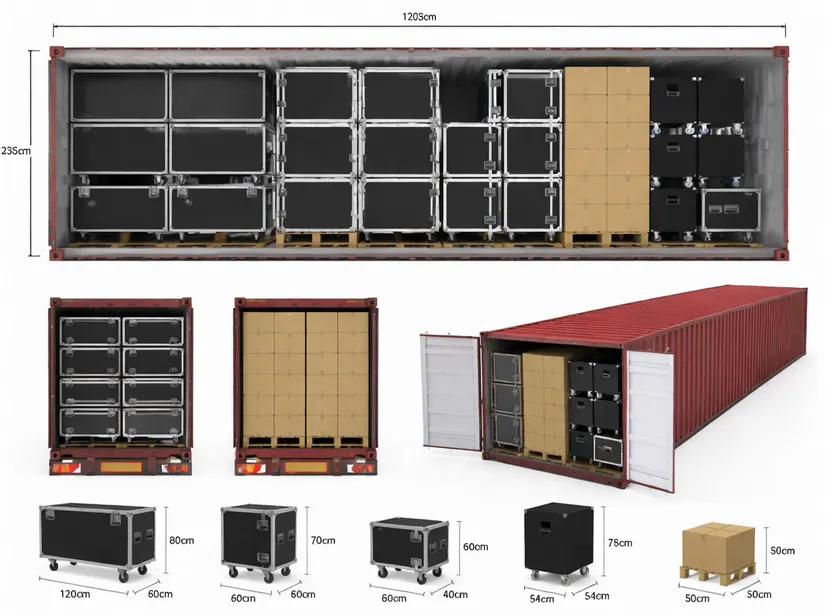
Loading plan provided with proforma invoice — exact pallet dimensions, gross weights, and stack limits
What Your Freight Forwarder Receives Before Order Confirmation
No port surprises, no half-empty containers.
Lesson from 2022
A Southeast Asian distributor ordered 60 systems assuming flat stacking on both case types. The audio cases exceeded the stacking limit at 3-high and we had to re-spec the container layout mid-production. Now we send the loading plan with the proforma invoice, before you commit.
Profitable Deployment Channels for Your DJ Lights Sound System Inventory
Each market segment below represents a distinct purchasing pattern and margin structure for your distribution business.
Mobile DJs Running Solo Weekly Events
Primary Volume Channel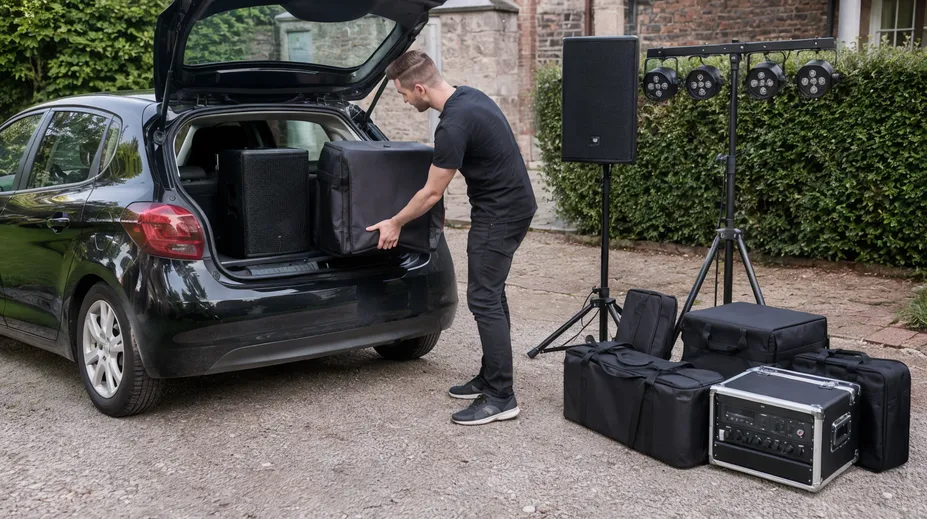
These operators do 1–4 events per week — weddings, birthdays, corporate mixers, school dances — and need a system that one person loads into a hatchback, sets up in 15 minutes, and controls from behind the DJ booth. They buy one complete system, use it until components age out (typically 2–3 years of weekly use), then replace the full kit.
Your Stocking Logic
This is your repeat-purchase SKU. Standard configuration, standard branding, online retail and DJ gear store distribution. Margins run 35–50% at retail because you're selling a solution, not components.
Our European distributors report that bundled AV packages outsell component-by-component sales 3:1 in the mobile DJ channel — the convenience premium is real and the buyer doesn't price-shop individual pieces.
Small Event Companies (2–5 Staff Operations)
Fleet Sales Channel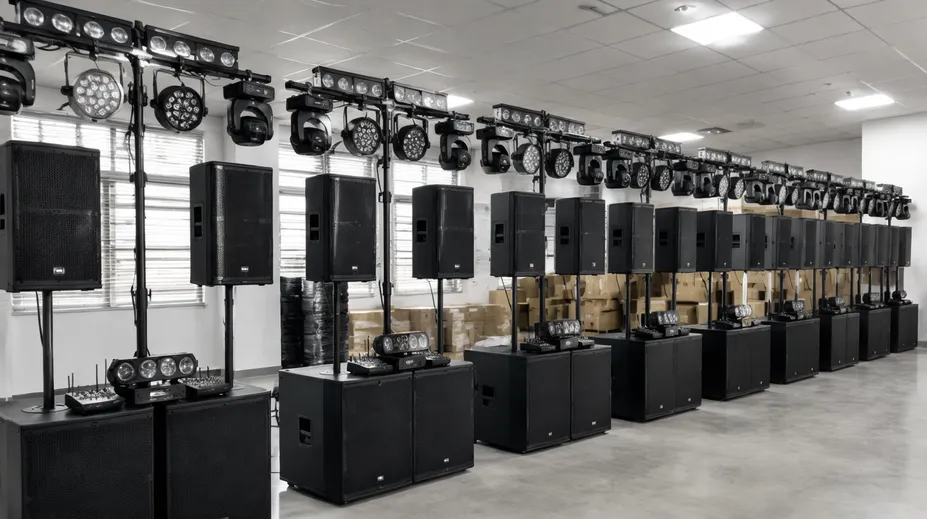
These companies run concurrent bookings and need 3–8 identical systems so any crew member can operate any kit interchangeably. Consistency matters — all systems must produce identical output so a client booking "Package B" gets the same experience regardless of which physical kit deploys.
Your Stocking Logic
Fleet sales of 5–10 systems per order, with reorders every 6–12 months as the company scales. Offer multi-unit discounts and brand them under a consistent package name.
These buyers are less price-sensitive than solo DJs — they're billing the client $500–2,000 per event and your $600–800 system cost is a small fraction of their revenue per use.
Online Retail & E-Commerce Channels
High AOV Channel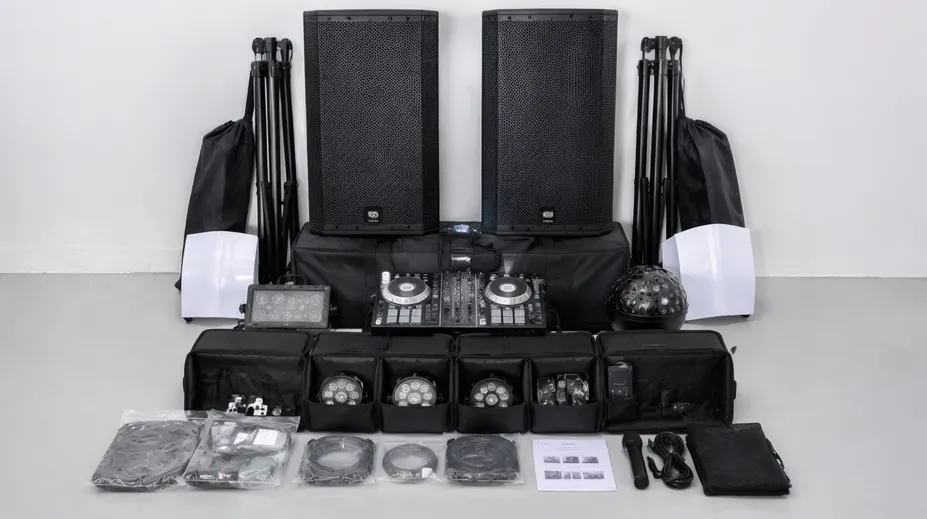
DJ lights and speakers setup packages sell well as complete "business-in-a-box" products on Amazon, DJ-specific retailers, and music equipment platforms. The key: they photograph well as a complete system, the product listing tells a simple story, and the unboxing experience is clean (two cases, labeled cables, printed quick-start card).
Your Stocking Logic
White-label or private-label packaging with Amazon FBA-ready carton dimensions. We can configure outer packaging to meet FBA oversized item requirements and include scannable UPC labels on each case.
The speaker case exceeds standard FBA dimensions, so plan for oversized tier fees — but the AOV on complete systems easily absorbs it.
Emerging Market Distributors
Growth Markets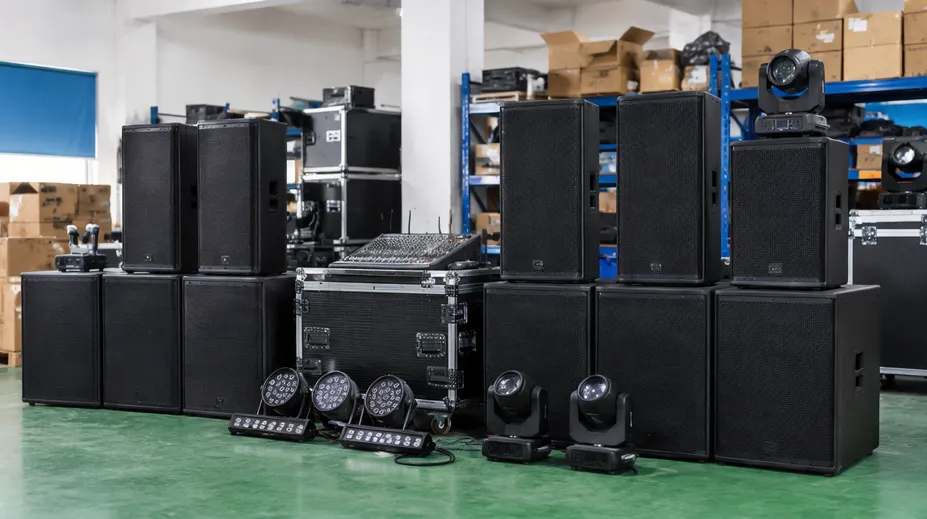
In markets where mobile entertainment is booming (Southeast Asia, Middle East, parts of Africa and South America), these complete systems sell faster than components because the end buyer often lacks the technical knowledge to assemble a rig from separate purchases. You're selling confidence — "everything works together out of the box" — in markets where after-sales support infrastructure is thin.
Your Stocking Logic
Specify surge-protected configurations with 90–264V input tolerance. We include MOV protection on all power supplies as standard, rated to 4kV spikes.
For tropical climates, ask about our conformal-coated PCB option that prevents condensation-related failures during monsoon season.
Additional cost for conformal coating: ~$3–5 per fixture. Saves your warranty budget in humid markets.
OEM Branding on Integrated AV Systems
You sell under your name — we build under yours. For DJ lights and speakers setup packages, OEM customization includes full brand control across every touchpoint.
Fixture Branding
Logo on every PAR and effect housing (pad printing or laser engraving), your brand name on the DMX controller front panel.
Speaker Branding
Your logo on speaker grilles (embossed metal badge or printed), your branding on amplifier panel rear labels.
Road Case Branding
Screen-printed logos on both case lids, branded hardware color options (silver, black, custom RAL).
Startup/Boot Sequence
Controller displays your brand logo on power-up; speaker amplifiers can show your brand on LED status panels.
DMX Scene Programming
Custom scene names and sequences tailored to your target market (wedding-warm, club-energy, corporate-subtle).
Documentation
Branded quick-start card, full user manual with your art direction, warranty card under your company name.
Minimum Order Quantities
MOQ starts at 30 complete systems for OEM branding. That's enough to:
- Test a branded SKU in your market
- Seed 5–10 demo units to key accounts
- Hold reserve inventory for initial reorders
Typical first orders run 50–100 systems once you've confirmed market demand.
Production Timeline
25–30 Days
Standard OEM — existing configuration with your branding applied
35–45 Days
Modified configurations — different speaker wattage, added fixture types, custom case foam layout
Include your brand guidelines and target configuration — we'll quote your OEM package.
Integration Testing Protocol — What Ships Is What Was Tested Together
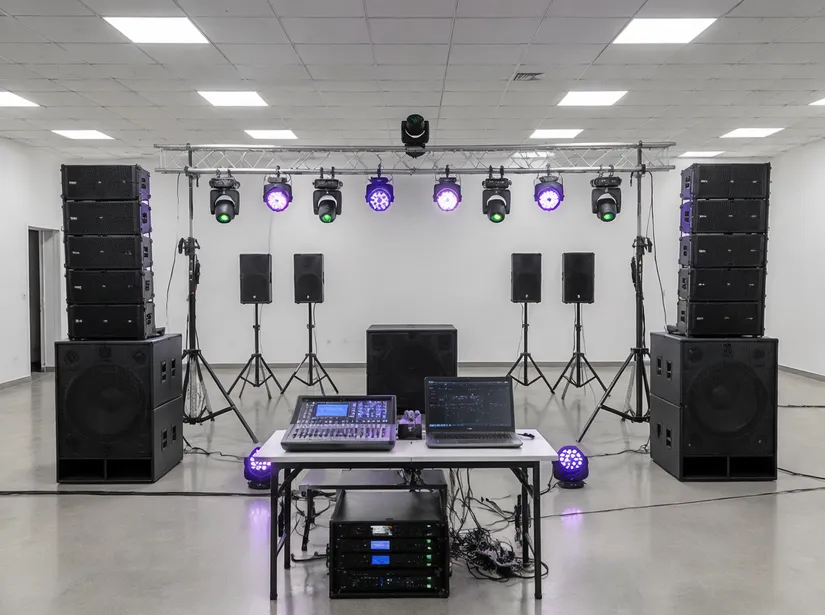
Every DJ lights and speakers setup system goes through a full-system integration test before case packing. Not individual fixture tests — full system, connected exactly as the end user will connect it.
The Test Sequence
All fixtures mounted on their intended stands/brackets and connected via DMX daisy-chain to the controller
All speakers connected to their amplifier channels with production audio cables from the kit
System powered on from a single power distribution point (simulating a single venue outlet)
All 12 pre-programmed DMX scenes cycled — verifying color output, movement, timing, and effect synchronization
Sound-reactive mode tested with reference audio at three volume levels through the actual speakers in the kit — verifying beat-lock accuracy and trigger reliability
Speaker output measured for SPL balance between left/right tops and subwoofer crossover frequency accuracy
48-hour aging test at full electrical load — all fixtures at full output, speakers at 75% rated power with pink noise
Final functional check after aging — catching any component drift or thermal degradation
Why Full-System Testing Matters
This process takes longer per system than testing fixtures and speakers independently. But it eliminates the failure mode that kills integrated packages: components that pass individual QC but fail together due to grounding issues, power supply interaction, or DMX addressing conflicts.
<1.2%
Our field return rate
4–6%
Industry average (trader-assembled)
Cost of returns: Each return costs $150–400 in reverse logistics alone, before replacement cost. At 100 systems per year, the quality differential pays for itself multiple times over.
Power Distribution Design and Venue Compatibility
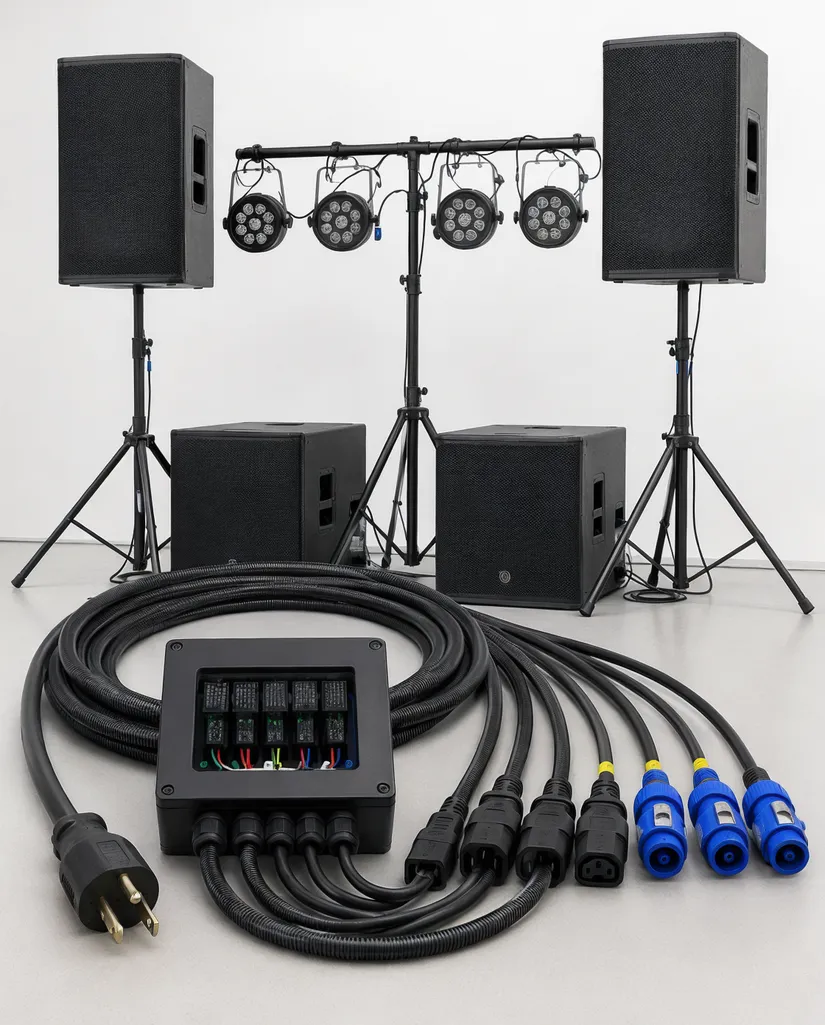
One question your buyers always get from end users: "Will this run on my venue's power?" We've designed the DJ lights and speakers setup system specifically to run from a single standard outlet in any market.
Total System Draw
~1,280W Full Output
That's within a single 15A/120V circuit (1,800W capacity) in North American venues, and well within a single 10A/230V circuit (2,300W capacity) in European and most international markets.
Your end user doesn't need a dedicated power drop or a generator — a single wall outlet handles the complete system.
How We Keep Draw Low
Class D amplification in the speakers — 85%+ efficiency vs. 50% for Class AB designs.
Optimized LED current drive — a typical PAR in our kit draws 34W actual at full white output, not the theoretical 36W that cheaper fixtures draw by over-driving LEDs for spec-sheet brightness.
Lower actual draw = cooler operation + longer LED life + full system stays under the single-circuit threshold.
Power-On Sequencing
Built into the power distribution harness: speakers energize 2 seconds after lighting to prevent inrush current stacking.
We added this after a batch of returns in 2020 where end users were tripping breakers on power-on by hitting everything simultaneously. The sequenced relay cost us $1.80 per system and eliminated that failure mode entirely.
Unstable Mains Protection
MOV Surge Protection
Rated to 4kV on every power supply in the kit
Universal Input Range
90–264V input across all PSUs
Field Proven
Middle Eastern & South American accounts run these on inconsistent mains without driver failures
Frequently Asked Questions About DJ Lights and Speakers Setup Sourcing
Can I specify different speaker wattage or driver sizes for my market's needs?
Can I specify different speaker wattage or driver sizes for my market's needs?
Yes. The standard configuration ships with 12" tops (250W RMS) and a 15" sub (400W RMS), but we can configure:
10" Tops
Saves ~4kg per speaker. Better for solo DJs carrying gear upstairs. Weight-sensitive markets.
15" Tops
Higher-output requirements for larger venues and outdoor deployments.
No Subwoofer
Ultra-compact two-case packages targeting the budget mobile DJ channel.
Speaker modifications affect lead time by 5–7 days for driver sourcing if we don't stock your specified component.
How do I handle warranty if a speaker fails but the lighting still works — does the whole system come back?
How do I handle warranty if a speaker fails but the lighting still works — does the whole system come back?
We design for component-level serviceability, not whole-system returns. Speakers ship as independently replaceable units — same connector standard, same amplifier module across the range.
If a top cabinet fails under warranty, you send one speaker back (or we ship a replacement forward), not the entire system. We provide your technician with a swap guide and the firmware settings to match the replacement unit to the existing system.
Your warranty cost per incident drops by 60–70% compared to full-system return policies.
What's the maximum cable run between the DMX controller and the farthest fixture in a DJ lights and speakers setup?
What's the maximum cable run between the DMX controller and the farthest fixture in a DJ lights and speakers setup?
In the standard configuration, the farthest fixture sits approximately 8–10 meters from the controller — well within DMX-512's 300m limit.
We include pre-cut cables at exact lengths for the standard layout:
Matched to typical speaker-stand-mounted fixture placement. For custom configurations with extended throw distances (outdoor setups, larger venue deployments), we offer 10m and 15m cable options or our wireless DMX transmitter/receiver module that eliminates cable runs entirely for an additional ~$18 per system.
Can the sound-reactive modes be disabled for events where the DJ uses separate lighting control?
Can the sound-reactive modes be disabled for events where the DJ uses separate lighting control?
Every fixture in the kit supports standalone DMX operation independent of the sound-reactive controller. Your end user can connect their own DMX console directly to the fixture chain and run full manual control — the sound-reactive programming lives in the controller, not the fixtures.
This means your buyers who start with the automated sound-reactive mode can later upgrade to a dedicated lighting console without replacing any fixtures. It's a growth path that keeps your initial system sale relevant even as the operator's skills develop.
What certifications do these systems carry for import into the EU and North America?
What certifications do these systems carry for import into the EU and North America?
CE marking covers EMC (EN 55032/55035) and electrical safety (EN 62368-1) for the full system — lighting and audio. FCC Part 15 Class B covers US import requirements. RoHS compliance on all electronic components.
We provide the full test report package (not just the certificate) so your customs broker has the documentation to clear without delays.
If you're distributing into markets requiring additional certifications (SASO for Saudi Arabia, NRTL listing for certain US commercial venues), discuss requirements during quoting — we can add targeted testing for your destination market.
What lead time should I plan for a first OEM order of DJ lights and speakers setup systems?
What lead time should I plan for a first OEM order of DJ lights and speakers setup systems?
25–30
Days
Standard config + your branding. From artwork approval and order confirmation.
35–45
Days
Modified specs (different speakers, additional fixtures, custom case layout) including engineering review.
20–25
Days
Reorders of approved configurations.
Includes pre-production sample approval (you sign off on a finished sample before we run the full batch). We recommend placing reorders when your inventory hits 60-day supply to maintain continuous stock.
Start With One System — Evaluate Before You Commit
Most new buyers order 1–2 sample systems to evaluate before committing to volume. You receive a production-representative sample — the same components, same assembly process, same integration test, same packing — within 7–10 days.
Run Your Own QC
Full production-representative sample for inspection and testing.
Demo at Your Showroom
Set it up for your sales team to demo to accounts.
Verify Calibration
Confirm sound-reactive calibration performs as described.
Scale When Ready
Production orders from 30 systems. Dedicated line at 200+.
6
Production Lines
350K
Annual Unit Capacity
30+
Min Production Order
48h
Engineering Response
Your DJ lights and speakers setup order doesn't compete for machine time with unrelated product runs.
Send your target market, volume expectation, and any OEM requirements. Engineering team responds with a recommended specification, FOB pricing, and container loading plan within 48 hours.