

Aluminum DJ Lighting Truss Stand Modular. Portable. Tour-Ready.
Stock a truss stand that handles your clients' weight loads and fits inside standard freight dimensions, so you move more units with fewer damage claims.
Built for repeated setup and teardown on tour schedules. 48-hour aging test on all electrical components. Ships to 50+ countries.
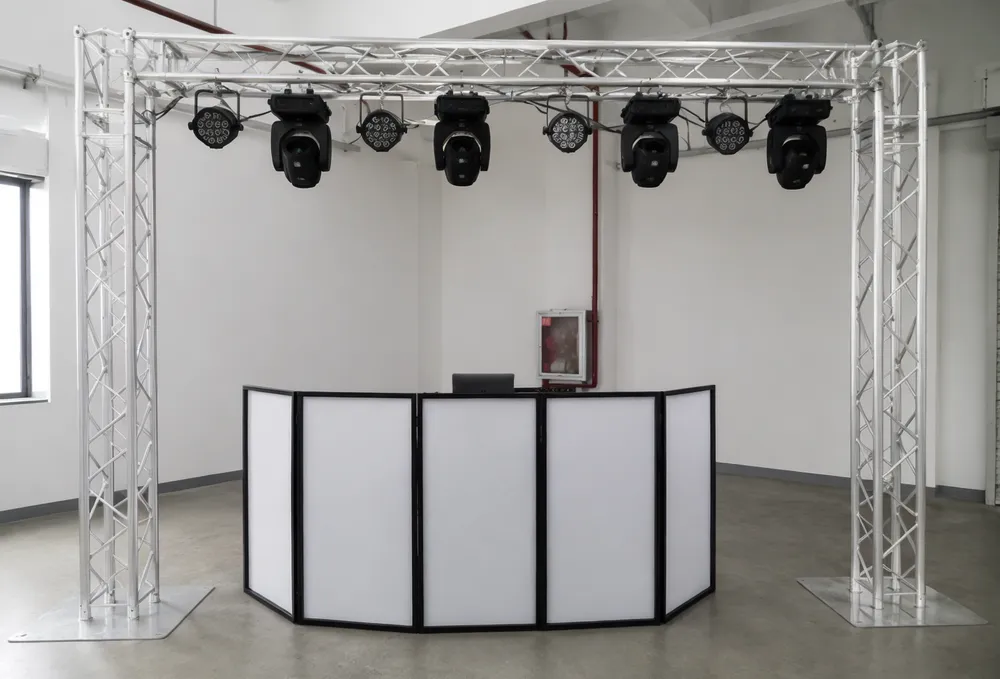
What This Product Is and Who It Serves
A DJ lighting truss stand is a modular aluminum framework — typically two vertical truss columns connected by a horizontal truss span — designed to elevate and support multiple lighting fixtures, effect units, and banners above a DJ booth or small stage. Unlike a simple tripod or T-bar, the truss configuration distributes load across a wider footprint, supports heavier total weight, and gives your buyer's customers a professional visual structure that signals "production value" to their clients.
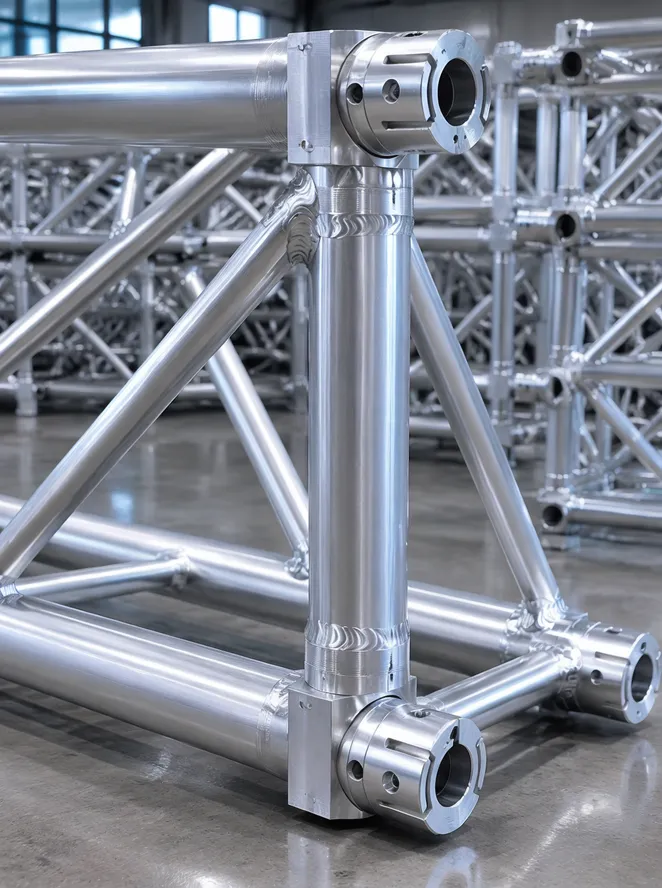
We build these in 6061-T6 aluminum alloy. The triangular and square truss profiles come off our CNC-cut and TIG-welded production line — the same line we use for our stage lighting fixture housings, so the tooling and weld quality standards carry over. Your end customers get a stand that doesn't flex under a 100kg fixture load; you get a product that won't generate returns from bent cross-members after six months of mobile DJ use.
The market for this product breaks into three clear segments: mobile DJ operators who need portable truss for weekly gigs, event rental companies stacking inventory for festival season, and AV integrators building semi-permanent installations in venues. Each segment buys differently — we'll get into that below — but the common thread is that they all punish suppliers whose truss fails on-site.
A collapsed truss stand at a wedding doesn't just cost a fixture; it costs your customer's reputation and your warranty margin.
Mobile DJs
Portable truss for weekly gigs — need fast setup and compact freight.
Event Rental
Stacking inventory for festival season — higher load, bulk orders.
AV Integrators
Semi-permanent venue installations — demanding structural consistency.
Structural Specifications & Load Ratings
Specifications shown are industry-standard values for this product type. Exact specifications depend on your selected configuration. Contact us for detailed technical drawings and load certification documents.
| Parameter | Typical Specification |
|---|---|
| Material | 6061-T6 aluminum alloy (main truss members), steel base plates |
| Truss Profile | Square or triangular, 150mm–300mm chord width |
| Vertical Column Height | Adjustable 2.0m–4.0m (common configurations) |
| Horizontal Span | 1.5m–3.0m (standard); custom lengths available |
| Maximum Load Capacity | 80–150kg (varies by span length and configuration) |
| Tube Wall Thickness | 2.0mm main chord, 1.5mm diagonal bracing |
| Connection System | Conical coupler or bolt-through pin system |
| Finish | Clear anodized or matte black powder coat |
| Packed Dimensions | Flat-pack sections, longest member typically ≤1.5m for standard freight |
| Unit Weight (Complete System) | 25–45kg depending on configuration |
Conical Coupler Connection
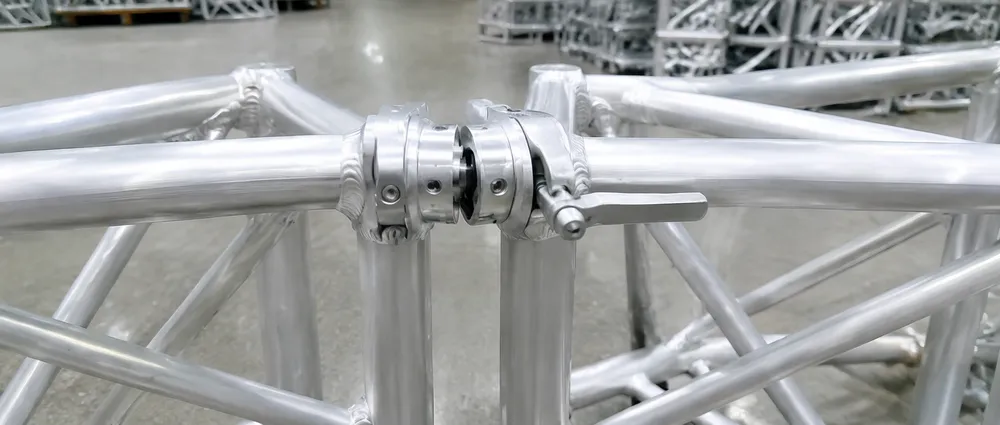
We switched from wing-bolt connections to conical couplers on our standard range in 2020 because wing-bolts loosen under vibration — and DJ truss lives in a bass-heavy environment. The conical system locks with a half-turn and stays tight through a four-hour set with subs pushing 130dB underneath.
We still offer wing-bolt versions for buyers whose markets prefer them — some rental companies like the tool-free assembly. Just specify at order.
Wall Thickness: Why 2.0mm
Tube wall thickness at 2.0mm on main chords gives you the structural safety factor without unnecessary weight. We tested 1.8mm chords under cyclic loading — they pass static ratings but develop micro-fatigue cracks at weld nodes after 200+ setup cycles.
The 0.2mm addition costs you almost nothing per unit but eliminates a failure mode that would surface exactly when your buyer's customer is loading fixtures for a show.
Key Differentiators
- Conical coupler stays tight at 130dB bass exposure
- 2.0mm wall eliminates micro-fatigue after 200+ cycles
- Same CNC/TIG line as fixture housings — consistent weld quality
- Longest flat-pack member ≤1.5m for standard freight
Portable Truss for Mobile DJs: Your Highest-Volume Segment
Mobile DJs represent the largest unit-volume market for this product. A single DJ operator typically owns 1–2 truss stands; a DJ company with 5–10 operators on rotation needs 8–15 units in inventory. Rental companies serving the mobile DJ market stock 20–50+ stands depending on their fleet size.
What Mobile DJs Demand
Setup under 15 minutes with one person, total packed weight manageable for a hatchback or small van, and a span wide enough to mount 4–6 fixtures (PAR cans, moving heads, lasers) without the stand looking empty. Our standard 2.5m span with 3.5m height hits this sweet spot.
Setup Time
Under 15 minutes, one person
Transport
Fits hatchback or small van
Fixture Capacity
4–6 fixtures per span
Distribution Opportunity: Repeat-Purchase Category
For your distribution business, mobile DJ truss is a repeat-purchase category. DJs upgrade, expand, or replace damaged gear on a 12–18 month cycle. A distributor carrying our truss alongside our LED par lights and moving heads can bundle "lighting rig packages" — the margin on the complete package typically runs 15–25% higher than selling components individually because you're solving a configuration problem, not just shipping hardware.
Bundle Margin Uplift
Complete "lighting rig packages" (truss + LED pars + moving heads) deliver 15–25% higher margin than individual component sales. You're solving a configuration problem, not just shipping hardware.
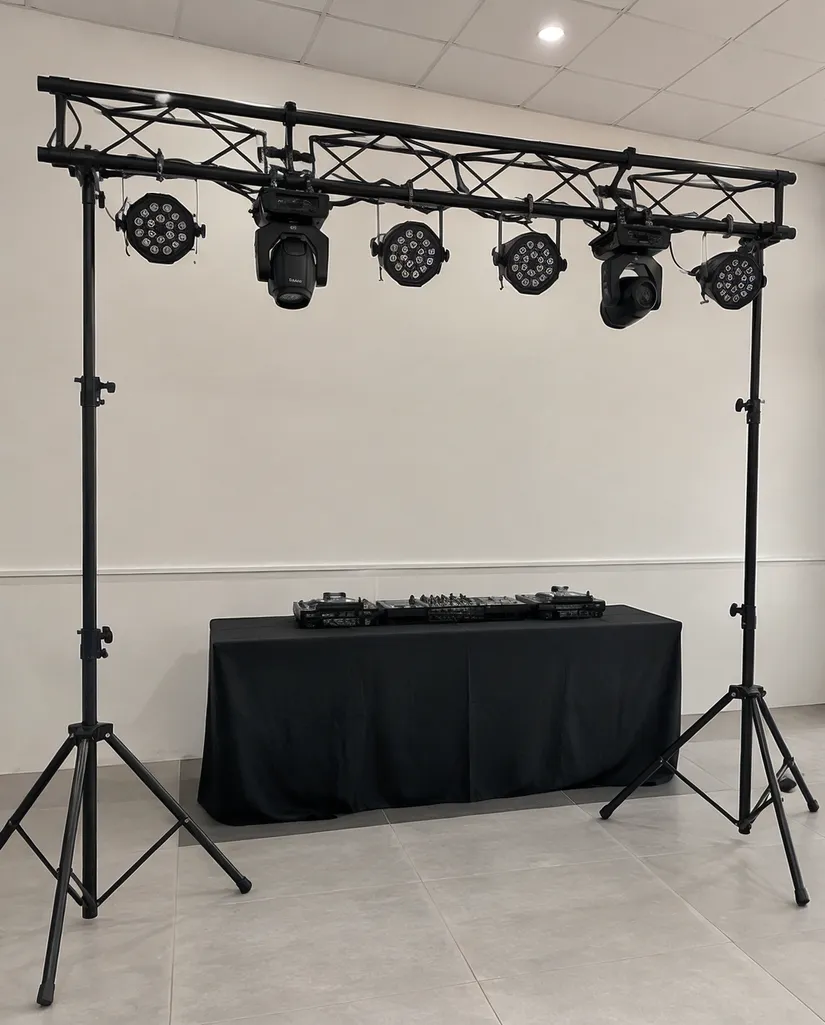
Standard 2.5m span × 3.5m height — fits 4–6 fixtures comfortably
Event Rental & Festival Applications: Higher Load, Higher Margins
Event rental companies buy truss stands rated for heavier loads — they're mounting 8–12 fixtures per span, sometimes adding banners or LED video panels. This segment pays more per unit because they need the 150kg-rated configurations with wider chord profiles and steel base plates rated for outdoor ground conditions.
Festival Season Bulk Orders
Festival season drives bulk orders. A mid-size rental company preparing for summer buys 30–80 truss stands in a single PO to cover simultaneous deployments across multiple events. Your lead time matters here — rental companies plan purchases 60–90 days before peak season, so our standard 20–30 day production lead time fits their planning cycle.
Rental Market Purchase Timeline
Planning: 60–90 days before peak season
Rental company assesses fleet needs for simultaneous deployments
Order: 30–80 units per PO (typical mid-size company)
Single purchase order covers full summer deployment schedule
Production: 20–30 day lead time
Standard lead time fits within the rental company's planning window
Finish Specification: Anodized vs. Powder Coat
We supply truss with anodized finish for rental applications because powder coat chips during repeated handling and transport. Anodized surfaces scratch instead of flaking — a cosmetic issue, not a structural one — and rental companies accept that as normal wear.
Powder coat looks better on day one but worse by month six in a rental fleet. We advise our rental-market distributors to default to anodized and keep the powder coat option for permanent install buyers.
Anodized Finish
Recommended for Rental
- Scratches instead of flaking
- Cosmetic-only wear pattern
- Survives repeated handling & transport
- Consistent appearance at month 6+
Powder Coat Finish
Best for Permanent Install
- Superior day-one appearance
- Chips during repeated handling
- Flaking degrades appearance quickly
- Ideal for fixed venues & installs
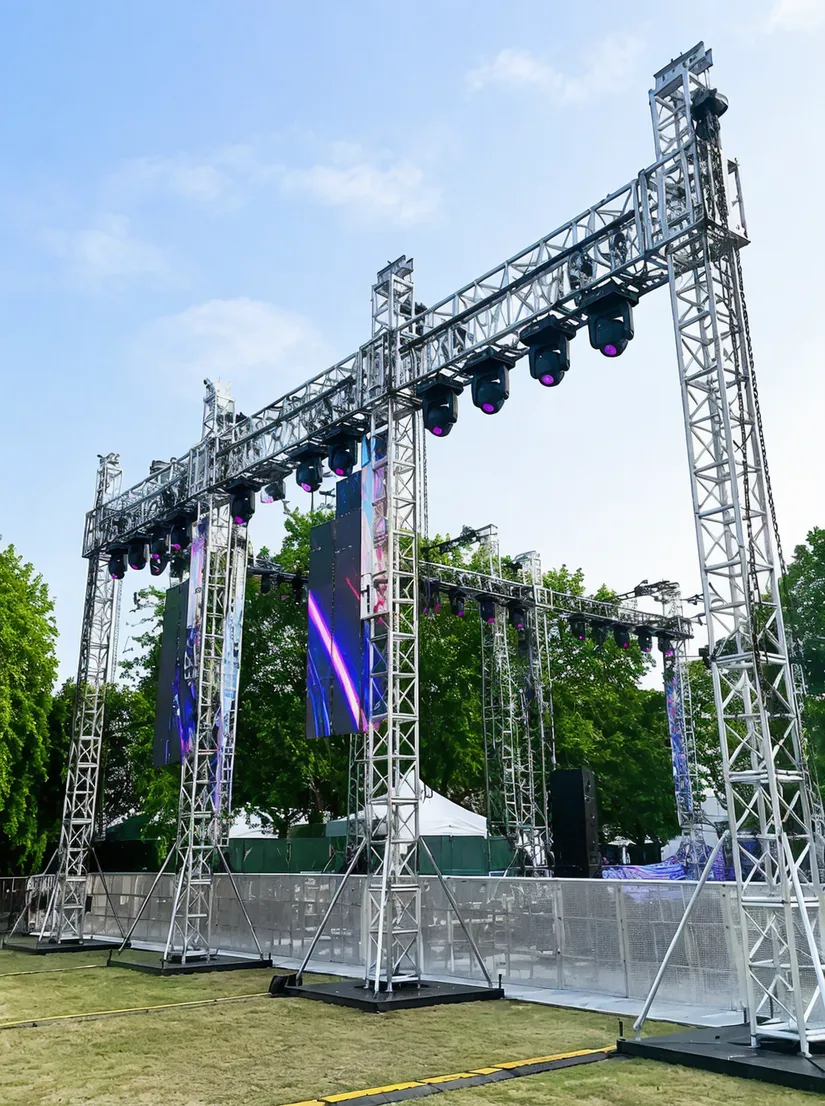
150kg-rated configuration with steel base plates — festival-ready
Manufacturing Process: How We Build Truss That Survives Touring
Our truss production runs on a dedicated welding line separate from our lighting fixture assembly. The sequence follows a controlled path from raw material to tested, packaged product:
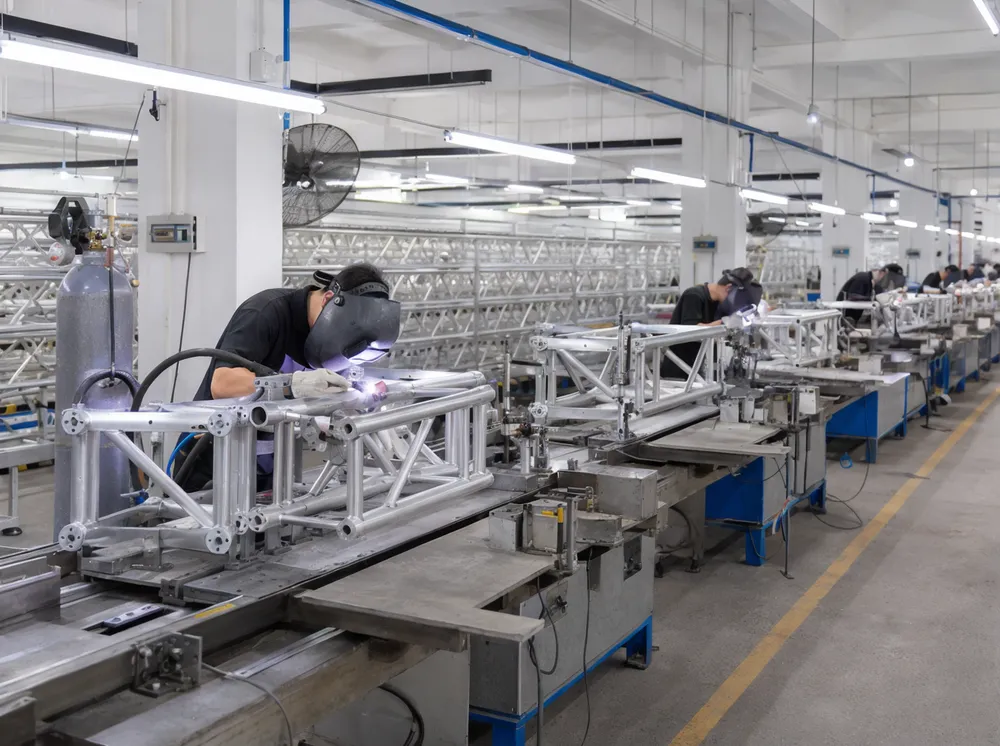
Jig Fixture Assembly — Where Consistency Lives
Every truss section gets assembled in a precision jig that holds chord members and diagonals at exact angles before welding. Without the jig, weld distortion pulls the truss out of square — and out-of-square truss won't mate cleanly with its connecting sections on-site.
Tolerance standard: We check every welded section against the jig after cooling. Sections that pull more than 1mm out of tolerance get straightened or scrapped.
TIG Welding on 6061-T6 — Controlled Heat Input
Too hot and you create a heat-affected zone that weakens the parent material around the weld. Our welders run at parameters validated through destructive pull testing — we periodically cut sample welds, machine them into test coupons, and pull them to failure to confirm the weld strength stays above target.
Industry Minimum
60%
of parent material yield
GDMonkey Standard
75%
of parent material yield
We hold ourselves to 75% because truss sees dynamic loading — fixtures swinging on clamps, wind load on outdoor rigs, vibration from bass. Static ratings aren't enough.
Inspection, Surface Treatment & Load Test
Weld Inspection
Visual weld inspection plus dye-penetrant testing on structural nodes.
Surface Treatment
Anodizing (15–20μm oxide layer) or powder coating (60–80μm) depending on SKU configuration.
Load Test
Static load test at 1.5× rated capacity for a minimum of 10 minutes before pass certification.
Customization: What You Can Specify
| Dimension | Standard Options | Custom Capability |
|---|---|---|
| Span Length | 1.5m, 2.0m, 2.5m, 3.0m | Custom lengths in 0.5m increments, MOQ 50 units |
| Column Height | 2.0m, 3.0m, 3.5m, 4.0m | Custom heights, MOQ 50 units |
| Truss Profile | 200mm square, 220mm triangular | Custom chord widths 150–400mm, MOQ 100 units |
| Finish Color | Silver anodized, matte black | Any RAL color powder coat, MOQ 30 units |
| Connection Type | Conical coupler (standard) | Wing-bolt, spigot pin (specify at order) |
| Branding | Unbranded (default) | Laser-etched logo, branded carry bags, custom stickers — MOQ 30 units |
| Base Plate | Standard steel plate | Weighted base, wheel kit, ground screw adapter — MOQ 50 units |
| Packaging | Standard carton with foam | Branded box, flight case option (priced separately) |
OEM From 30 Units — Test Your Market First
We support OEM from 30 units. That means you can test a private-label truss stand in your market without committing to a container. A typical trial order looks like this:
Typical Trial Order
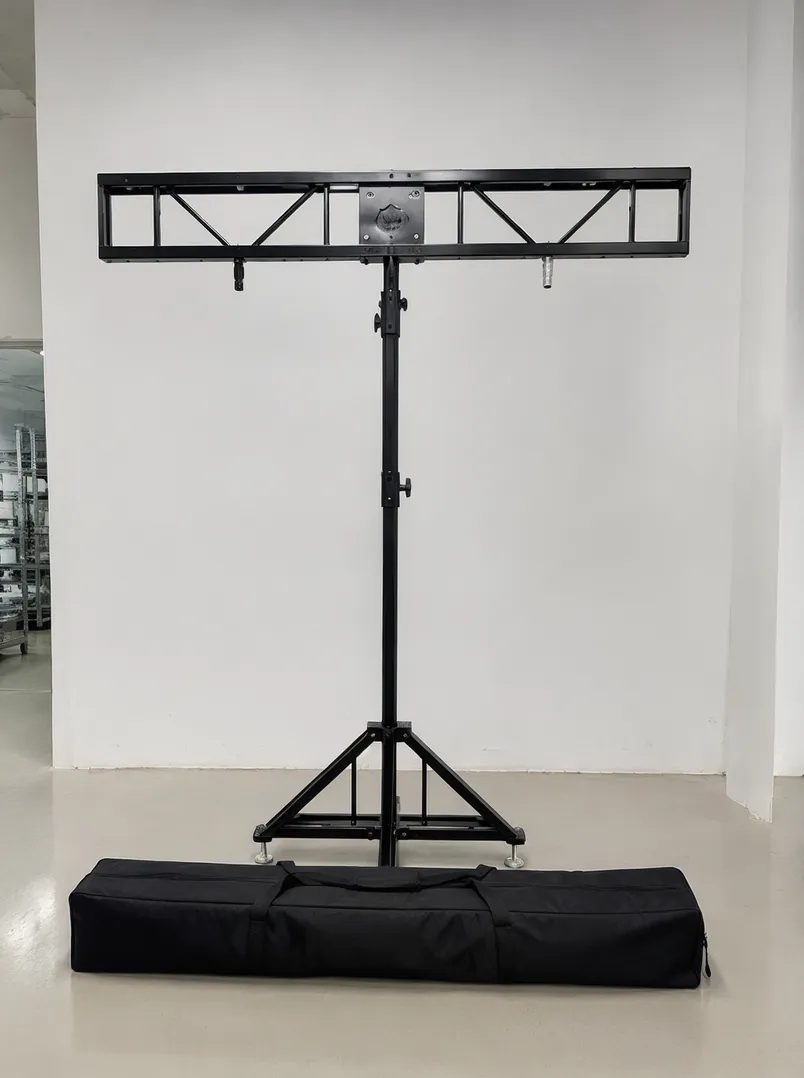
- 30 units — your logo laser-etched on the center span
- Your brand on the carry bag
- Shipped in 25–30 days
If the product moves, scale to 200–500 units on the next order and we'll cut new tooling for a branded base plate if needed.
Limitations Worth Knowing
Chord width changes below 150mm or above 400mm require new extrusion dies — that's a $2,000–3,000 tooling investment amortized over your first order.
Standard profiles (200mm square, 220mm triangular) use existing dies, so there's no tooling cost on standard configurations.
Or send a competitor sample — we'll reverse-engineer and quote your configuration.
Packaging & Container Loading Efficiency
Truss stands are bulky but predictable to pack. We ship them knocked-down: vertical columns, horizontal span, base plates, and hardware in separate nested packages within one master carton per set. This keeps the longest dimension under 1.5m, which means standard freight carriers handle it without oversize surcharges.
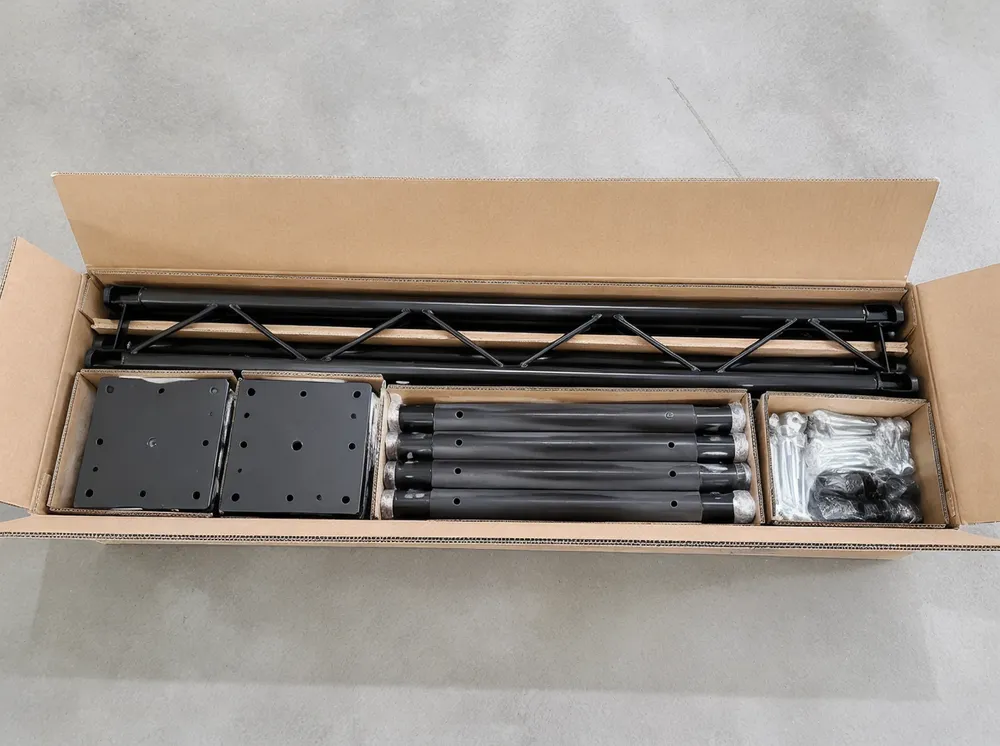
Knocked-Down Master Carton Spec
Carton Dimensions
1500mm × 350mm × 350mm
Gross Weight per Set
28–35 kg
Longest Dimension
Under 1.5m — no oversize surcharges
Packing Method
Nested separation: columns, span, base plates, hardware
Container Loading
| Container Type | Units per Container | Notes |
|---|---|---|
| 20' GP | 80–100 sets | Single-layer stacking, base plates at bottom |
| 40' HQ | 180–220 sets | Double-layer stacking possible with reinforced cartons |
Standard 2.5m span configuration. We palletize to your warehouse specification — Euro pallet, US standard, or floor-loaded per your request.
Retail-Ready Packaging for E-Commerce Channels
For distributors selling through e-commerce channels, we offer individual retail-ready packaging: printed box with product photography, assembly instructions, and a parts checklist. The retail box adds roughly $2–3 to your unit packaging cost but eliminates your warehouse repackaging step entirely.
Several of our Amazon-channel buyers switched to retail-ready packaging in 2023 and reported a measurable drop in "missing parts" complaints — turns out, a printed checklist inside the box prompts the end customer to count pieces before assuming something's missing.
Compliance & Market Entry Documentation
Our DJ lighting truss stands carry CE marking and comply with EN 17351 (temporary structures and lighting support systems) requirements for the European market. For North American distribution, we provide structural engineering calculations and load test certificates — your buyers can present these to venue safety officers or local permitting authorities.
CE Marking — European Market
Compliant with EN 17351 requirements for temporary structures and lighting support systems. Ready for EU distribution without additional testing on your end.
North American Certification
Structural engineering calculations and load test certificates provided. Your buyers can present these to venue safety officers or local permitting authorities.
RoHS Compliance
Applies to any electrical components included in powered configurations (LED strip channels, junction boxes). The base aluminum structure is inherently RoHS-compliant — no restricted substances.
Market-Specific Structural Certification
If you're entering a market that requires specific structural certification — TÜV for Germany, specific state engineering stamps for US venues — we provide the test data and drawings your local certifying body needs to issue market-specific approval.
We've done this process for buyers in 12 countries. The documentation package is standardized on our end, so it doesn't add lead time to your order.
Documentation We Provide
- Structural engineering calculations
- Load test certificates
- Technical drawings (CAD format)
- Material composition declarations
- EN 17351 compliance reports
- RoHS certificates (powered configs)
How This Truss Stand Compares to Other Stand Types
Not every buyer needs a truss stand. If your market primarily serves bedroom DJs or one-light setups, a simpler format might be the right stock decision. Here's how the options compare:
| Feature | DJ Lighting Truss Stand | DJ Lights Tripod Stand | DJ Lights T-Bar Stand |
|---|---|---|---|
| Typical load capacity | 80–150kg | 30–60kg | 40–80kg |
| Fixtures supported | 4–12 per span | 1–2 | 2–4 |
| Setup time (one person) | 10–20 minutes | 2–5 minutes | 3–8 minutes |
| Visual impact | High — professional production look | Moderate — functional | Moderate — clean but minimal |
| Transport size | Larger — van or trailer | Compact — fits in car trunk | Compact to moderate |
| Price point (your cost) | Higher | Lower | Mid-range |
| Best market fit | Event companies, touring DJs, rental fleets | Solo DJs, small venues, entry-level | Mobile DJs, mid-range events |
DJ Lighting Truss Stand
- Load capacity
- 80–150kg
- Fixtures supported
- 4–12 per span
- Setup time
- 10–20 minutes
- Visual impact
- High — professional production look
- Transport size
- Larger — van or trailer
- Price point
- Higher
- Best market fit
- Event companies, touring DJs, rental fleets
DJ Lights Tripod Stand
- Load capacity
- 30–60kg
- Fixtures supported
- 1–2
- Setup time
- 2–5 minutes
- Visual impact
- Moderate — functional
- Transport size
- Compact — fits in car trunk
- Price point
- Lower
- Best market fit
- Solo DJs, small venues, entry-level
DJ Lights T-Bar Stand
- Load capacity
- 40–80kg
- Fixtures supported
- 2–4
- Setup time
- 3–8 minutes
- Visual impact
- Moderate — clean but minimal
- Transport size
- Compact to moderate
- Price point
- Mid-range
- Best market fit
- Mobile DJs, mid-range events
If you already carry tripod stands and T-bar stands and want to move upmarket into the event rental and professional DJ segment, adding the truss stand to your catalog gives you the premium tier without changing suppliers. Same factory, same logistics contact, same quality system — just a wider margin product.
View the full DJ lights stand rangeFrequently Asked Questions
What maximum span length can I order for a DJ lighting truss stand without requiring custom extrusion tooling?
Standard extrusion profiles support spans up to 3.0m using our existing dies. Beyond 3.0m, we recommend a center support column or a two-section bolted span to maintain rated load capacity without mid-span deflection exceeding L/200. Custom extrusion for wider chords is available at 100-unit MOQ.
Aluminum truss vs steel truss for DJ lighting: which should I stock?
For portable DJ applications, aluminum wins on weight-to-strength ratio — a 2.5m aluminum truss span weighs roughly 40% less than a steel equivalent at comparable load ratings. Your mobile DJ customers will choose aluminum every time because they're loading and unloading gear solo. Steel truss makes sense for permanent venue installations where weight doesn't matter and cost per meter needs to be minimized.
If your market serves both, we produce both — but 90% of our DJ-channel orders are aluminum.
What's the actual load rating difference between square and triangular truss profiles?
At the same chord width, square truss offers approximately 15–20% higher bending resistance than triangular because it has four chords distributing the load instead of three. Triangular truss is lighter per meter and visually preferred for aesthetic-focused applications.
For DJ lighting, where fixtures mount from the bottom chord, square truss gives you a wider mounting surface and better lateral stability. We recommend square for spans above 2.5m or total fixture loads above 80kg.
How do I ensure the truss stand meets local safety regulations for my market?
We supply load test certificates and structural calculation packages with every order above 50 units. These documents are formatted for submission to local authorities in your market. For EU distribution, our CE marking covers the essential safety requirements.
For markets requiring independent third-party testing (TÜV, specific US state requirements), we provide the raw test data and engineering drawings your certifying body needs — typical turnaround for their review is 2–4 weeks.
What's the minimum order quantity for a private-label DJ lighting truss stand?
30 units. That gets you laser-etched branding on the truss members, branded carry bags, and your logo on the packaging. No tooling fees on standard configurations — you're only paying unit cost plus a small setup charge for the laser etching program.
Sample lead time is 7–10 days; production lead time is 20–30 days depending on the season.
Can I order the truss stand with integrated lighting fixtures as a complete package?
Yes. We manufacture both the truss hardware and the lighting fixtures (LED pars, moving heads, wash lights) on adjacent production lines in the same factory. We can supply complete DJ lighting truss systems — truss stand, fixtures pre-mounted with correct clamps, DMX wiring harness, and a single master carton — ready for your customer to unbox and set up.
This packaging eliminates the SKU complexity of selling components separately and gives you a higher-value bundle product.
Ask about complete system configurationsStart With a Sample Order
Most buyers new to our truss range start with 2–5 sample units to evaluate build quality, test the connection system, and confirm the packed dimensions work for their logistics. We ship samples within 7–10 days.
Send Us Your Requirements
Send us your requirements — span length, load needs, finish preference, and your target landed cost — and we'll come back with a configured quote and technical drawing within 48 hours.
If you have a competitor product you want us to match or improve on, send photos or a link. We'll spec an equivalent and note where we can improve weight, finish quality, or connection reliability.
Teresa — Export Sales
Configured quote and technical drawing within 48 hours
Explore More DJ Light Stands
Other stand types in the GDMonkey range
DJ Lights Tripod Stand
Height-adjustable tripod stands for mobile DJ lighting rigs.
DJ Lights T Bar Stand
T-bar configurations for multi-fixture mounting.
DJ Lights Stand Gigbar
All-in-one gigbar systems for fast setup and teardown.
Stage Lights Stand
Heavy-duty stands for permanent and touring stage installations.