

Your Product, Built on Our Production Lines
Custom stage lighting manufacturing from concept to container — OEM and ODM under one roof. 15 engineers, 6 production lines, and 12 years of fixture development.
You bring the brief; we deliver production-ready units with your brand, your specs, your firmware.
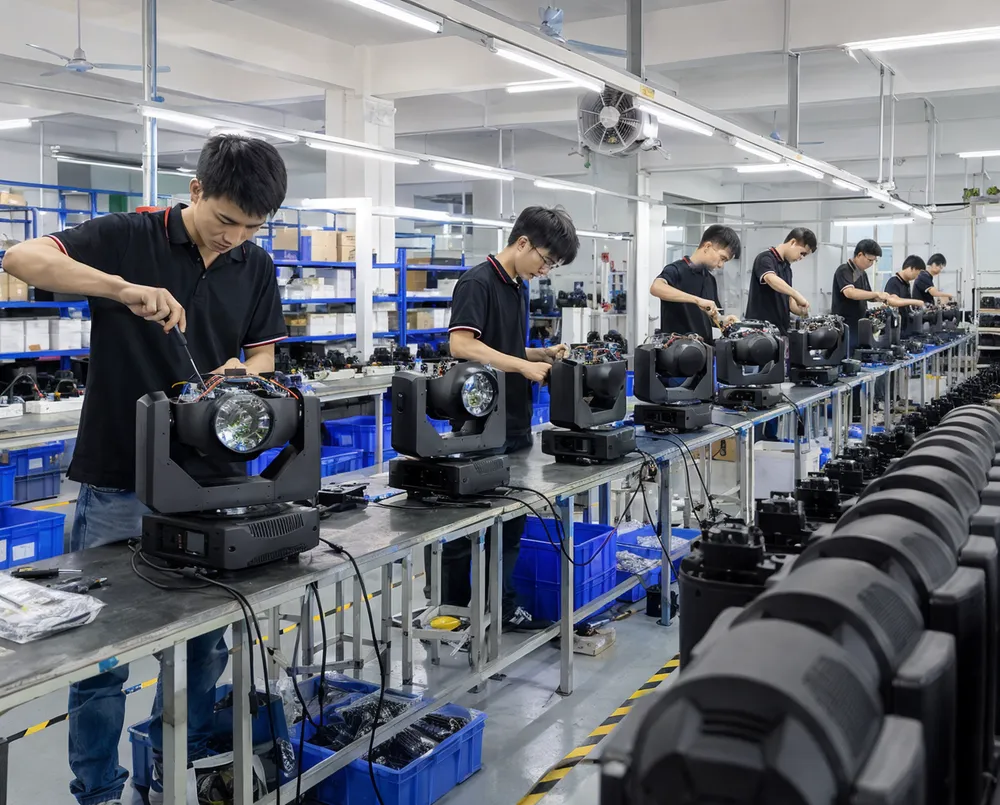
Two Collaboration Models — Pick the One That Matches Your Business
You don't need a design team to launch a product line with us, and you don't need to settle for off-the-shelf if you already have one.
OEM — You Design, We Produce
Full Design ControlYou bring your own fixture design — complete CAD files, a competitor sample to reverse-engineer, or a rough concept sketch with target specifications. Our engineering team translates that into production tooling, validates the optics and thermals, and runs your order on a dedicated line.
The result carries your brand name, your model numbers, your firmware splash screen. We're the factory behind your product, invisible to your end customer.
Best for: Companies that maintain their own product development team (or work with an external industrial designer) and need a manufacturing partner who won't second-guess specifications or slip in cost-reduction substitutions without asking.
Your BOM is your BOM — we execute it.
ODM — We Design, You Brand
Speed to MarketYou tell us the market segment you're targeting — rental houses, houses of worship, touring companies, nightclub installs — and the price point you need to hit. We select from our existing fixture platforms or adapt a current design to your requirements: modified beam angles, different LED arrays, adjusted color temperature range, custom housing colors.
You apply your brand, your packaging, your documentation. Time to market drops from months to weeks because the core engineering is already validated.
Best for: Speed matters more than total design control, or you're entering a new product category and want proven optical performance without funding a full development cycle.
Most of our first-time buyers start here — get a SKU into market, see how it sells, then graduate to full OEM on the second order once you know exactly what your customers want.
What We Can Customize — and Where the Boundaries Are
We've learned that vague "full customization supported" claims waste everyone's time. Here's what our production setup actually handles:
Optical System
- LED array configuration: chip count, wattage per chip, CCT range (2700K–10000K), RGBW/RGBA/RGBWAL mixing
- Beam angle selection: 5°–60° through lens and reflector changes
- Gobo and pattern: custom gobo designs etched in-house (glass or metal), custom color wheels
- Projection optics: motorized zoom ranges matched to your throw distance requirements
Mechanical & Housing
- Housing material: die-cast aluminum (standard), extruded aluminum, or steel for specific applications
- Custom colors: powder coat in any RAL or Pantone reference, MOQ 100 units for custom color runs (below that, changeover cost on the powder line doesn't pencil out for either of us)
- Form factor modifications: bracket design, mounting interface, connector placement
- IP rating upgrades: IP65 standard on outdoor fixtures, IP67 available with modified gasket and potting design
Electronics & Control
- DMX channel mapping: custom channel assignments and mode configurations per your protocol requirements
- Wireless control integration: W-DMX, CRMX, or proprietary RF modules
- Firmware customization: boot screen, preset scenes, RDM parameter configuration
- Power input: 100-240V auto-ranging standard; fixed voltage variants for specific markets; PowerCON, Neutrik TRUE1, or hardwire termination
Branding & Packaging
- Logo application: laser etching on housing, silkscreen on lens ring, backlit logo badge
- Product labeling: your model numbers, serial number sequences, compliance marks for your target market
- Packaging design: custom foam inserts, printed cartons with your branding, flight case integration drawings
- Documentation: user manuals under your brand, spec sheets in your template, QC certificates with your company header
What We Don't Do
Honesty saves inquiry time. Here are the boundaries of our manufacturing scope:
- We don't manufacture LED chips — we source from Luminus, Osram, and Cree and bin them in-house.
- We don't produce DMX consoles or control software.
- We don't take projects below 30 units — the engineering setup cost doesn't justify smaller runs. If your volume is below 30, our standard product range with logo customization is the better path.
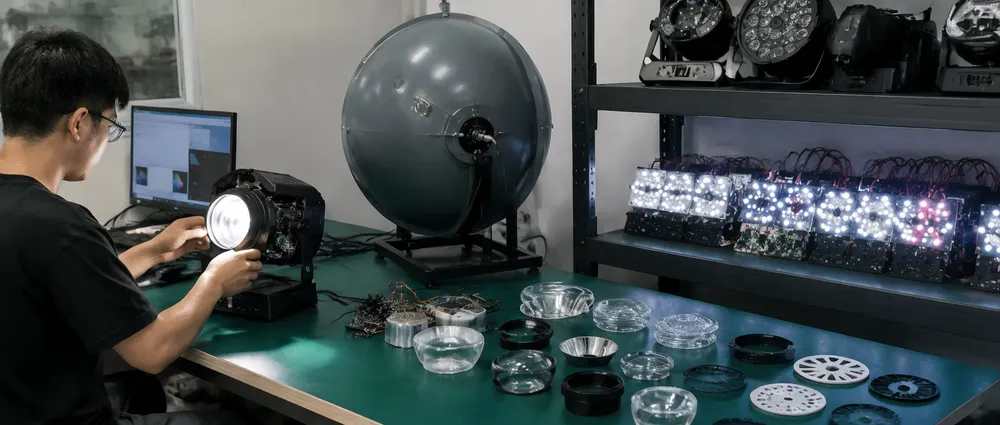
From Your Brief to Your Container — The Development Process
We've refined this workflow across hundreds of OEM ODM stage lighting projects since 2012. Each step has a clear deliverable and a decision point where you approve before we proceed.
Requirements Discussion
Days 1–3You send us your brief — could be a spec sheet, a rough sketch, a competitor fixture you want improved, or just a market description and target landed cost.
Our project engineer reviews feasibility, flags any constraints (thermal limits, component lead times, tooling complexity), and sends back a preliminary quotation with recommended specifications.
No cost for this stage.
Engineering Development
Days 4–20Once you approve the direction, our 15-person R&D team runs the development: optical simulation for beam pattern and lumen output, thermal modeling to validate junction temperatures under sustained load, mechanical design for housing and mounting, PCB layout and driver circuit design.
You receive 3D renders, optical simulation reports, and a finalized BOM for sign-off.
Timeline varies — a simple ODM variant of an existing platform might wrap in 5 days. A full custom moving head with new tooling runs 15-20 days of engineering. We'll tell you upfront which category your project falls into.
Sample Production & Approval
Days 15–30We produce 2-5 functional samples on pilot tooling. Samples go through the same 48-hour aging test and full QC sequence as production units — you're evaluating real performance, not a hand-built prototype that won't survive series production.
Samples ship by express courier for your hands-on evaluation. Adjustments from your feedback get incorporated and re-sampled if needed.
Production Tooling & Mass Production
Days 25–50After sample approval, we lock production tooling (if new tooling is involved), confirm your packaging design, and schedule your run on the production line.
Our 6 lines and 350,000-unit annual capacity mean your 2,000–10,000 unit order gets a clean production window without queuing.
Regular progress photos and inspection reports during production — you see your order being built.
Quality Verification & Shipment
Days 45–60100% of units pass 48-hour aging and functional testing. AQL sampling for cosmetics and packaging.
Pre-shipment inspection report issued (or your own third-party inspector is welcome on our floor — we've hosted SGS, BV, and TUV auditors regularly).
Container loading supervision ensures your pallet count and stacking orientation survive the ocean crossing.
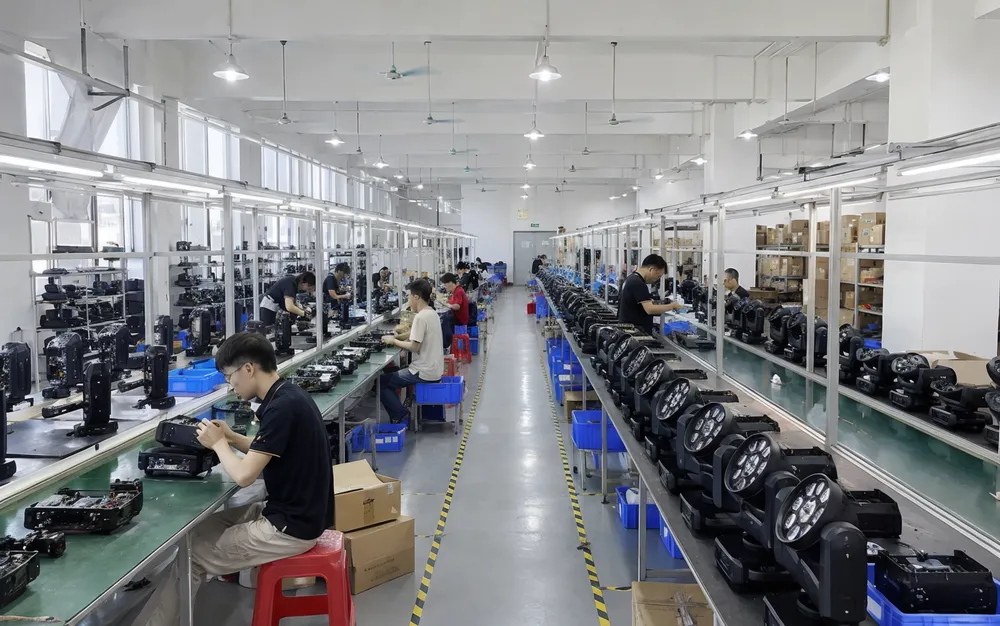
Total Timeline Summary
Standard complexity: 45-60 days from approved concept to container.
Simpler ODM projects with existing tooling can ship in 25-35 days.
We give you a specific timeline at the quotation stage — no surprises.
MOQ Structure and Pricing Logic
Standard OEM MOQ
30 units
For OEM orders using existing fixture platforms with branding and minor specification changes. This lets you test a new SKU in your market without committing to a full container.
Custom Tooling MOQ
200–500 units
Depending on tooling complexity. New housing molds amortize over the first order — once tooling is paid, subsequent orders drop to standard per-unit pricing with no tooling surcharge.
ODM Selection
30 units
Minimum across our standard range with your branding applied. Mix-and-match across models within a single order is fine — you can assemble a 10-SKU starter kit at 30 units per model.
Factory-Direct Pricing Advantage
Pricing scales with volume, obviously. But because you're buying factory-direct with no trading company margin, your starting unit cost is already at manufacturing-floor level.
A 500-unit order with us typically lands at the same unit price a trading company would charge for 2,000 units of the same fixture — that difference goes straight to your margin.
Tooling Transparency
We're transparent about tooling costs because we've seen too many buyers get surprised by hidden mold charges six weeks into a project.
We quote tooling separately, upfront, with clear ownership terms — the molds are yours once paid, stored at our facility for your reorders.
Your IP Stays in One Building
Custom stage lighting development involves your proprietary information — optical designs, firmware code, housing aesthetics, brand elements. Here's how we handle it:
NDA Execution Before Any Technical Exchange
We sign your NDA or provide our standard mutual NDA — your choice. This happens before you send detailed specifications, not after.
Single-Facility Development
Optical, electrical, thermal, and mechanical engineering all happen in our Pingyuan facility. No outsourced PCB design houses, no third-party firmware contractors seeing your code. The 15 engineers working on your project are our employees on our floor.
Tooling Ownership
Custom molds and dies paid for by you belong to you. They're marked with your project code and stored in our tool room for your exclusive use. We don't run your tooling for other buyers.
File Access Control
Your design files, BOM, firmware source code, and test data live on project-specific drives with role-based access limited to your assigned engineering team. When the project concludes, we can transfer complete technical packages to you or maintain them for reorder support — your call.
We can't claim we've never had an IP question arise in 12 years — but we can say that keeping everything in-house eliminates the most common leak vector in Chinese OEM manufacturing: subcontracted development work leaving the building.
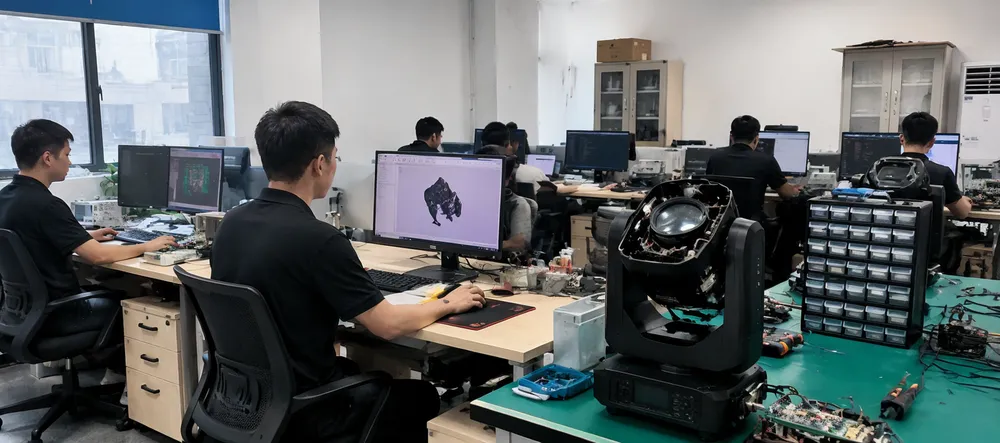
Certifications That Travel With Your Product
Every fixture we produce — OEM, ODM, or our own brand — passes through the same certification and compliance infrastructure:
| Certification | Coverage | Your Benefit |
|---|---|---|
| CE + EMC | All fixtures for European markets | Your EU import clears without hold or rework |
| FCC Part 15 | All fixtures for North American markets | No FCC enforcement risk for your US/Canada distribution |
| RoHS | Full product range | Meets EU restricted substance requirements — no WEEE complications |
| IP65 / IP67 | Outdoor-rated fixtures | Deploy in wet environments without failure-driven warranty exposure |
| ISO 9001:2015 | Manufacturing system | Your auditors can verify our process controls against a recognized standard |
Custom OEM projects inherit these certifications when the fixture design falls within our tested parameters. If your customization pushes outside certified ranges (new driver architecture, significantly altered EMC profile), we run re-certification testing as part of the development phase and include updated documentation — no post-production scramble.
Market Segments Where Our OEM Partners Operate
Your custom fixture ultimately serves a commercial opportunity. Here's where our current OEM and ODM stage lighting partners sell, and why these segments produce repeatable volume.
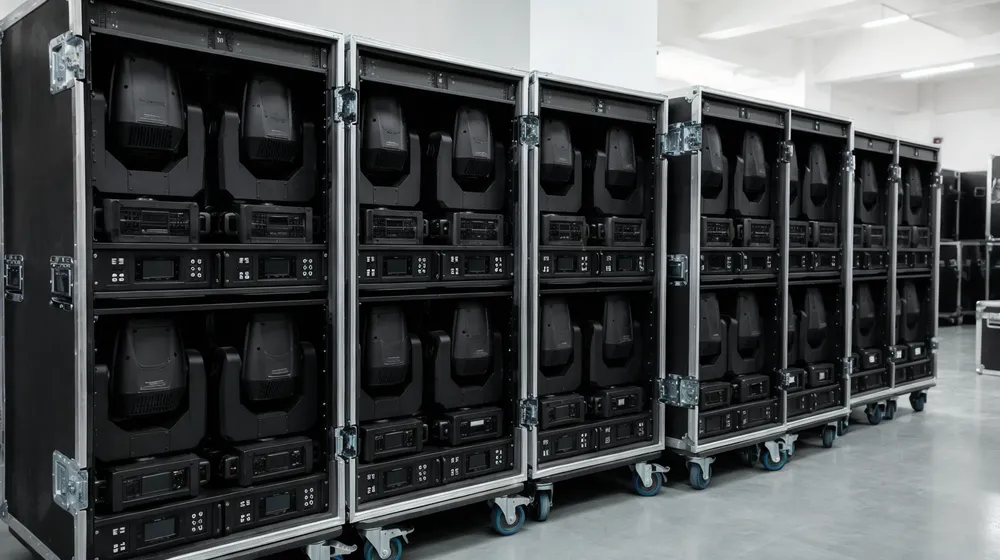
Rental & Production Houses
Moving heads, beam lights, and wash fixtures that rack-mount and tour. These buyers reorder annually as fleet expands or fixtures reach end-of-life rotation.
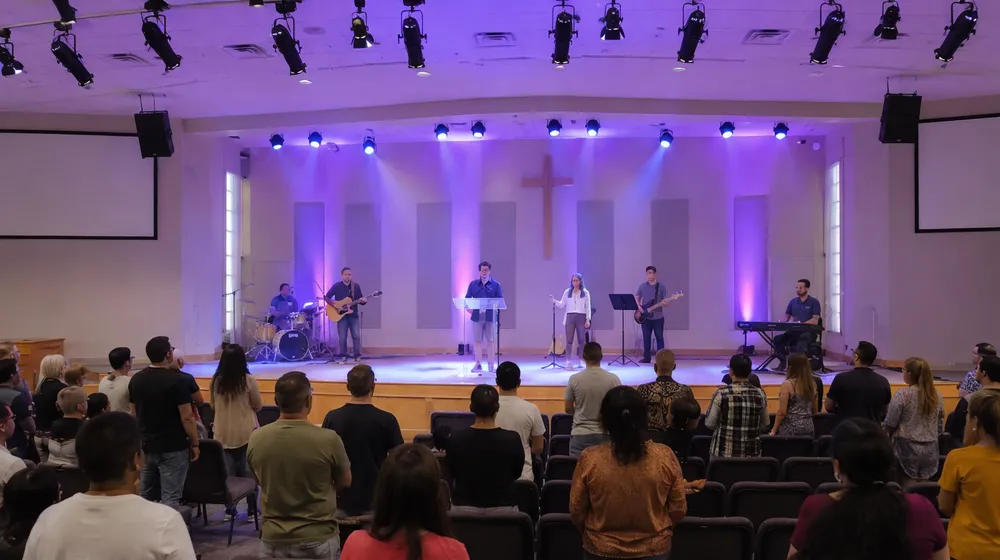
House of Worship AV Integrators
LED PARs, wash lights, and profile spots sold as part of installed AV packages. Churches upgrade every 3–5 years and the integrator specifies the fixture. If your brand is in their spec library, you capture recurring project revenue across their client base.
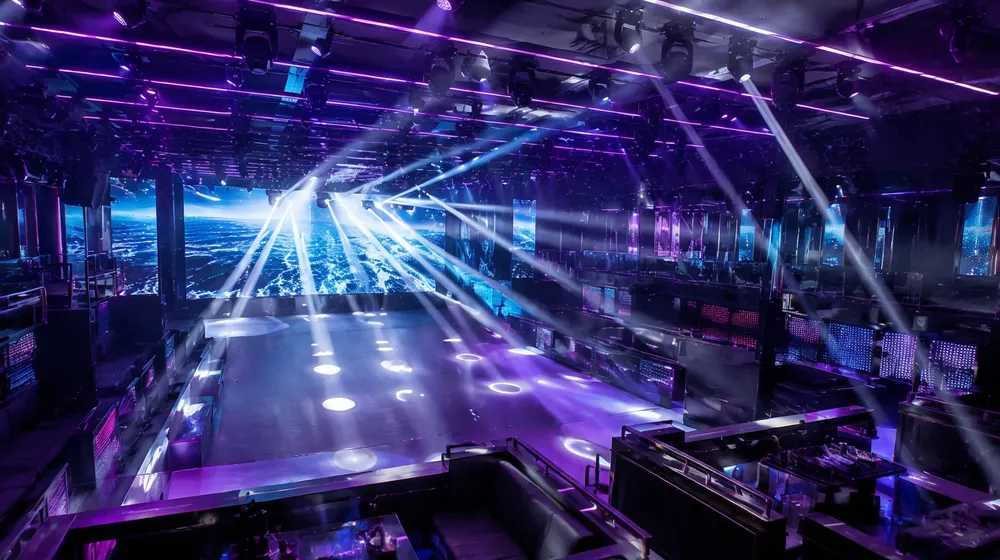
Nightclub & Venue Installers
Beam effects, moving heads, and laser fixtures specified into new venue builds or renovations. High visual impact per unit, decent margin, and once installed, you become the replacement source when a fixture reaches its hours.
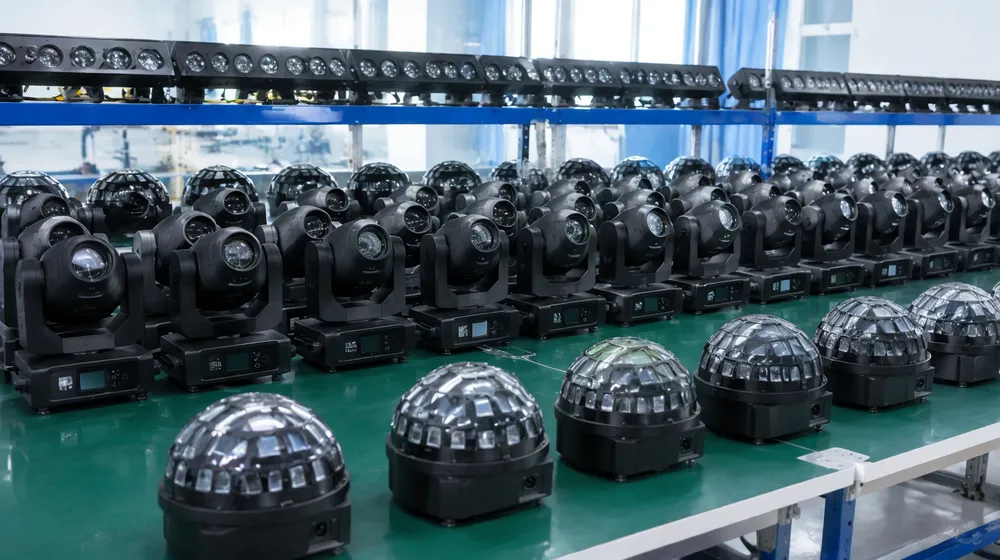
Distributors Serving DJ & Mobile Entertainers
Compact moving heads, derby effects, wash bars. Higher volume per SKU, price-sensitive, but steady demand. Your 500-unit MOQ lands at a unit cost that supports healthy dealer margin while staying competitive at street price.
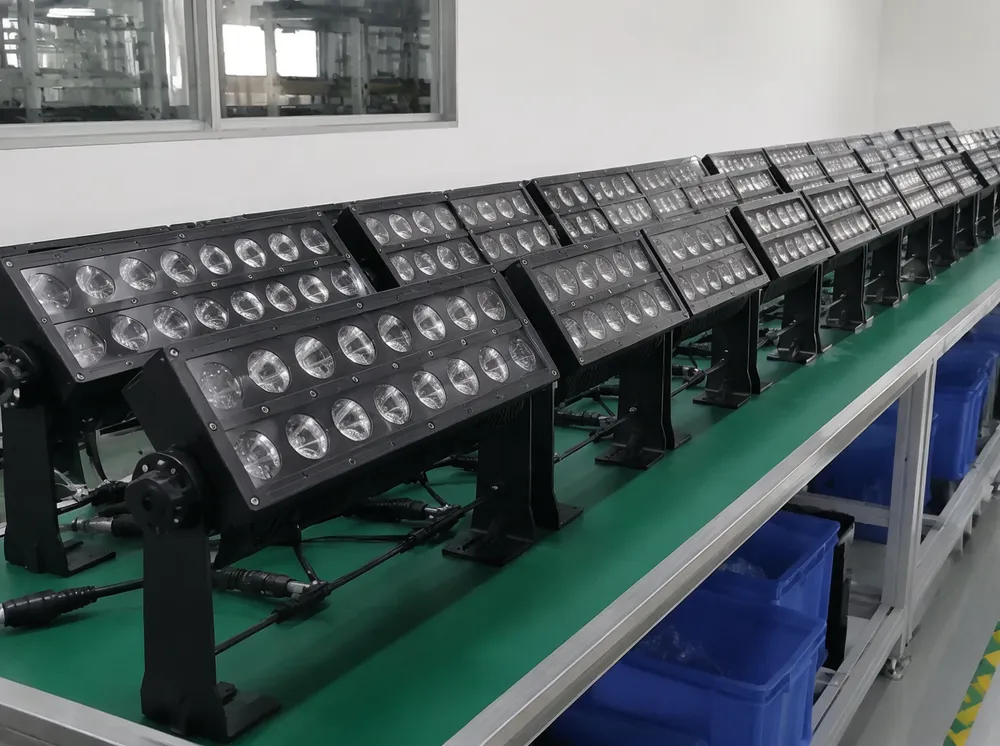
Architectural & Event Lighting Contractors
IP65/IP67 wash fixtures for outdoor installs, festivals, building illumination. Seasonal spikes around festival season, but the per-project volume is significant.
This segment has grown noticeably for us the past three years — worth building a product line around if you're not already in it.
Frequently Asked Questions
What file formats do you accept for custom OEM designs?
What file formats do you accept for custom OEM designs?
STEP, IGES, or SolidWorks native files for mechanical components. Gerber files for PCB layouts. For firmware, we work in C/C++ for STM32-based controllers.
If you're sending a concept rather than production files, a PDF with dimensions, target specs, and reference images is enough to get a feasibility assessment and preliminary quote started.
Can you match a competitor's fixture that we're currently sourcing?
Can you match a competitor's fixture that we're currently sourcing?
Yes — send us a sample unit and tell us what you want changed (improved thermals, different LED array, lower cost, different beam angle). We'll reverse-engineer the optical and mechanical design, identify improvement opportunities, and deliver samples of the new version.
Many of our OEM relationships started exactly this way.
How do you handle orders that mix OEM custom models with standard catalog products?
How do you handle orders that mix OEM custom models with standard catalog products?
Single shipment, single commercial invoice. Your custom fixtures and standard-range orders consolidate at our warehouse and load together. No split shipments unless you specifically request them — fewer logistics touchpoints on your end.
What happens if samples don't pass our approval?
What happens if samples don't pass our approval?
We revise and re-sample at no additional charge — typically 5–10 days for a revision cycle. Most projects require 1–2 rounds of refinement before production approval.
If after three revision cycles we can't meet your specification, we'll tell you directly whether it's a fundamental feasibility constraint or a tooling limitation, and recommend alternatives.
Do you support third-party factory inspections on OEM orders?
Do you support third-party factory inspections on OEM orders?
Absolutely. SGS, Bureau Veritas, TÜV, or your own QC team — we host inspections regularly and provide production schedules so you can book inspection timing in advance. Pre-shipment inspection access is standard for all OEM orders regardless of volume.
What's the reorder process once tooling exists?
What's the reorder process once tooling exists?
Fast. You send a PO with quantity and delivery date. We confirm material availability (usually 3–5 days for component procurement), schedule your run, and ship within 20–30 days.
No re-engineering, no re-sampling unless you're requesting a revision. Your tooling sits ready in our tool room.
Start Your OEM or ODM Project
You've read how it works. The fastest next step: send your product brief, a competitor sample, or even a rough description of what you need. Our engineering team reviews feasibility and responds within 48 hours with a preliminary specification and quotation — no commitment, no cost at this stage.
If you're not sure whether your project fits OEM or ODM, describe your situation and we'll recommend the model that gets you to market with the least risk and the best margin structure.
Structured quotation within 2 business days