

Stage Lighting Design Engineered by the Team That Builds the Lights
Design support from 15 optical and electrical engineers who manufacture 350,000 stage lighting units annually. Your lighting plan comes with fixtures we can produce, price, and ship — no third-party handoff.
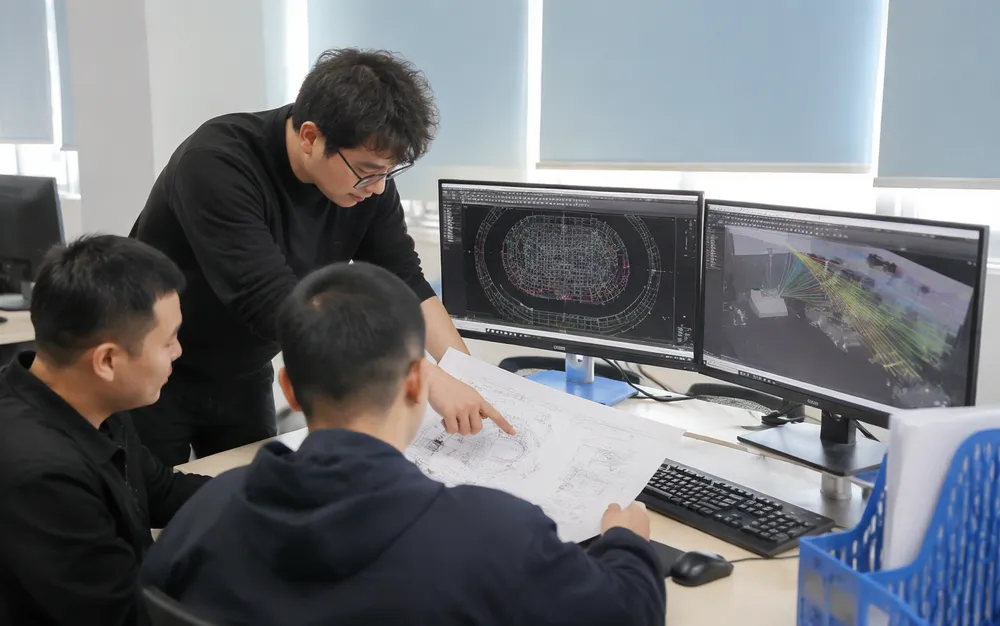
What This Service Covers — and Why It Exists
Most stage lighting manufacturers sell fixtures from a catalog. You pick a model, order a quantity, done. That works when you already know exactly what you need. But we've spent twelve years watching a different pattern play out: a buyer lands a venue project — a 600-seat church, a touring concert rig, a municipal theatre renovation — and they need more than a product list.
They need a lighting design that accounts for throw distances, beam overlap, DMX universes, power distribution, rigging weight limits, and fixture placement. Then they need someone who can actually produce the specified fixtures at the right price point and lead time.
That's what this service is. Our engineering team designs the lighting layout for your specific venue or project, specifies fixtures from our production range (or develops custom units if the project calls for it), and delivers a complete technical package.
Complete Technical Package Includes
You walk away with a buildable design and a single-source supply chain for everything in it.
We started offering this formally in 2018, but honestly we'd been doing it informally for years — distributors kept sending us venue dimensions and asking "what would you recommend?" We just built a proper process around it.
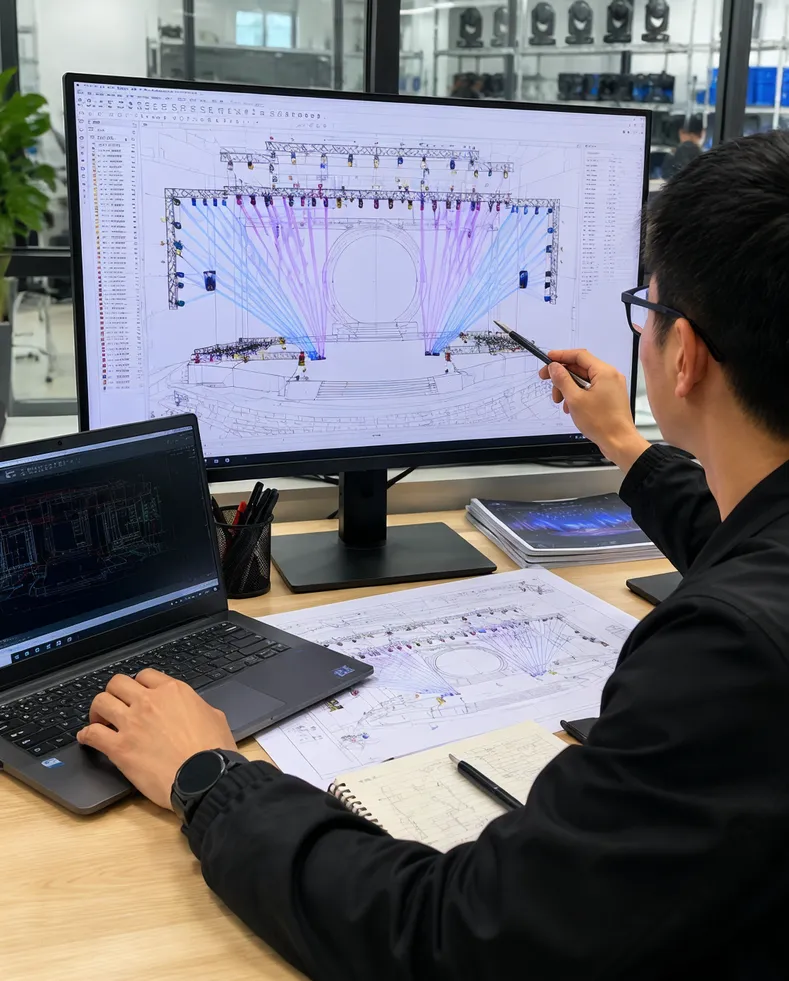
Design-to-Production Link
The engineers who design your system work in the same building as the team assembling your fixtures. Questions get resolved in hallway conversations, not two-week email chains.
How the Design Process Works — From Your Brief to Production-Ready Specs
Project Intake
You send us whatever you have — venue floor plans, CAD drawings, a napkin sketch with dimensions, photos of the existing installation, or just a written brief describing the space and its purpose.
We need:
- Venue dimensions
- Ceiling/rigging height
- Primary use case
- Power availability
- Budget envelope
Optical Layout
Our optical engineers model the space and design fixture placement for your coverage requirements. We calculate beam angles, lux levels at stage plane, and color mixing zones based on actual throw distances in your venue.
Fixture selection pulls from our production range first (faster lead time, better unit cost), but if the project needs something outside standard catalog, we spec custom optics or housings through R&D.
Deliverables:
- Preliminary fixture layout drawing
- Beam coverage simulation
- Recommended fixture list
Control Architecture
We design the DMX universe layout, address assignments, and signal distribution topology. For larger venues (200+ fixtures), we specify network architecture — DMX over cable, Art-Net over ethernet, or wireless DMX.
We also pre-program base scenes and cue lists if you want fixtures to arrive ready to plug in and run.
Documentation
Final Package:
- Fixture schedule (model, qty, position, DMX address)
- Beam coverage diagrams with lux calculations
- Power distribution plan (circuit loading, connectors)
- Rigging weight map (per-truss/per-bar loading)
- DMX universe map and signal flow diagram
- Bill of materials with production pricing
Production & Delivery
Once you approve the design, your fixture order goes directly to our production lines. No intermediary, no re-quoting from a separate manufacturer. The engineers who designed your system are in the same building as the people assembling your fixtures.
Typical Timeline
25–40 days from approved design to shipped goods
Standard catalog fixtures: shorter end. Custom-developed units: longer end.
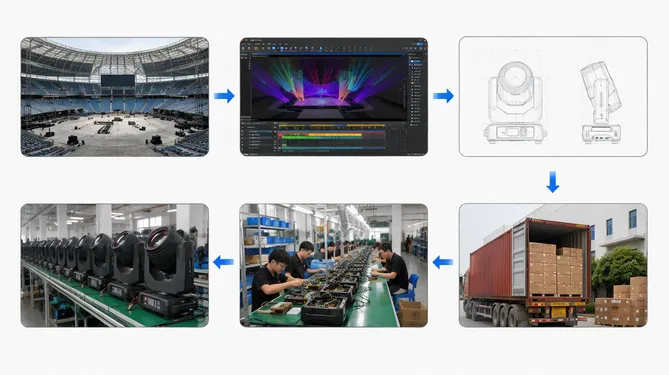
Why Single-Source Matters
If a production question comes up, it gets resolved in a hallway conversation, not a two-week email chain. Your design engineer and your production floor supervisor share a cafeteria. That's the speed advantage of factory-integrated design.
Send Your Venue Details for a Free Preliminary LayoutThe Commercial Advantage of Factory-Integrated Design
Here's why this matters to your bottom line, not just your project planning.
When design and manufacturing live under one roof, several cost layers disappear. You don't pay a lighting designer who specifies Brand A fixtures, then negotiate separately with Brand A's distributor, then discover lead times don't align with your installation date. You don't get a design that calls for fixtures your budget can't absorb.
Our engineers design within your cost constraints because they know our production costs — they spec what we can build profitably at your target price, not what looks best on paper.
For Distributors & Wholesalers
This service converts your end-clients' vague project needs into firm purchase orders. Your customer says "I need lighting for a 400-seat auditorium." Instead of spending your own time (or money) on a third-party designer, you forward the brief to us.
We produce the design under your brand, you present it to your client, and the resulting fixture order flows through your account. Your margin stays intact, your client gets professional-grade design work, and you didn't hire a consultant.
For Contractors & Integrators
You get a complete technical package that goes straight into your project proposal. Rigging loads, power draws, DMX topology — all specified with exact figures you can hand to your electrician and rigger.
No ambiguity, fewer change orders during installation.
One thing we won't do: design a system around another manufacturer's fixtures. The design service is integrated with our production capability — that's what makes it cost-effective. If you need brand-agnostic consulting, that's a different business model.
Venue Types We Design For — Your Market Segments
Each venue type below represents a repeatable project category for your business. We've delivered designs across all of them, which means we have reference layouts you can adapt rather than starting from scratch every time.
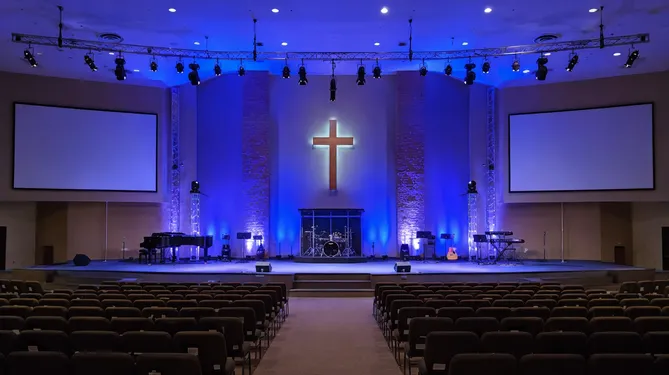
Houses of Worship
Churches, mosques, and temples represent one of the steadiest segments in stage lighting. Congregations upgrade lighting every 8–12 years, budgets are committee-approved (meaning they value detailed proposals over verbal quotes), and installations are usually straightforward — fixed rigging, moderate fixture counts, emphasis on front wash and color atmosphere.
Theatres & Performing Arts Centers
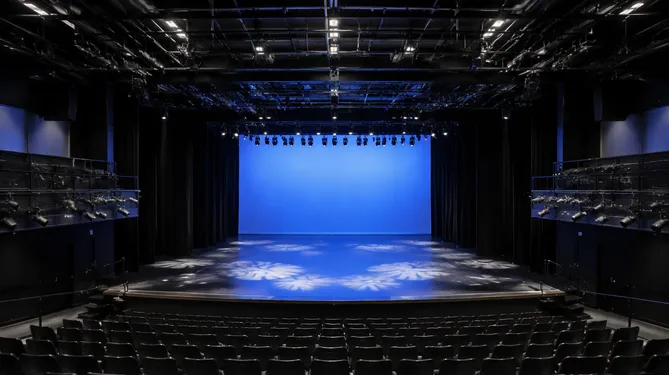
Requires the deepest design work — multiple lighting positions (FOH, mid-house, box boom, overhead electrics, cyc), tight beam control for scene isolation, motorized fixtures for repertory changeovers. We've designed for proscenium, thrust, and black box configurations. Theatre projects tend toward higher fixture counts and more complex DMX architecture, which pushes order values up accordingly.
Corporate Event Venues & Convention Centers
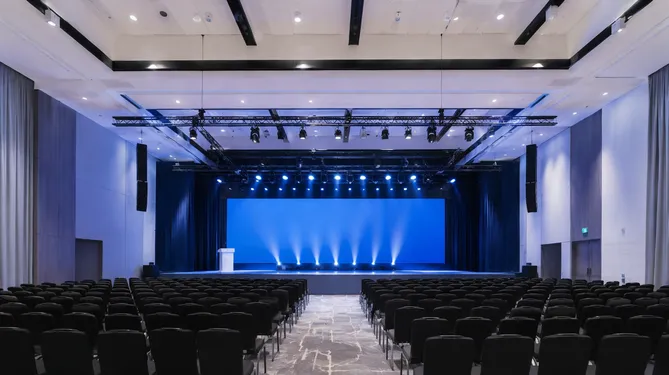
Multipurpose spaces that need flexible lighting — often a combination of fixed architectural wash and deployable stage fixtures for events. Design emphasis is on fast reconfiguration and operator simplicity. These accounts reorder when they expand or refresh, typically on 3–5 year cycles.
Touring & Rental Houses
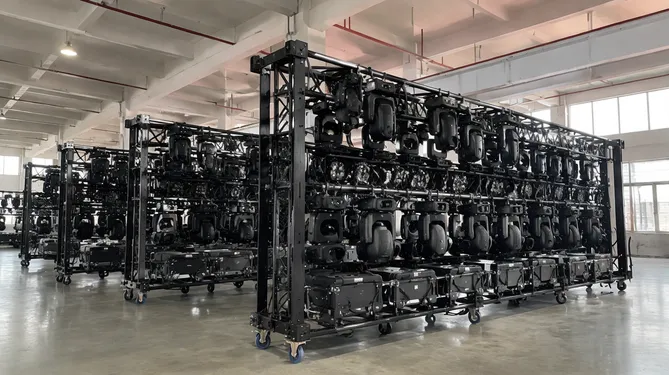
Rental companies need fixture packages designed for fast deployment and truck-pack efficiency. Design work here focuses on standardized rig modules that crews can set up in predictable time. High unit volumes because rental stock takes abuse and rotates out every 2–3 years.
Outdoor Stages & Festival Infrastructure
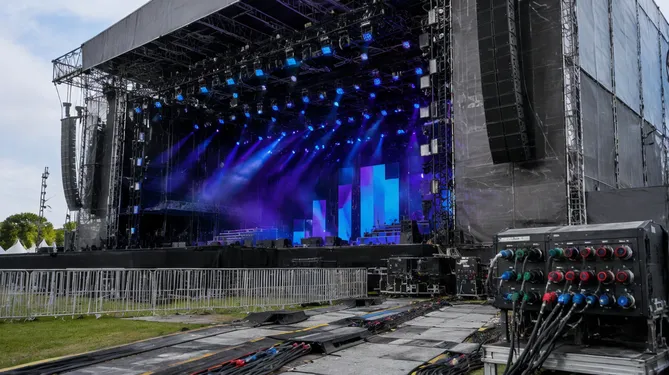
IP65/IP67-rated fixture specifications, weather-sealed cable management, and power distribution designed for generator feeds. Seasonal festival operators order annually for fleet expansion. This segment leans heavily on wash fixtures and high-output beam effects — products where our IP-rated production lines run at capacity every spring.
Tell us your venue type and size — we'll send a reference layout within 48 hours.
Technical Capabilities Behind the Design Work
The design service credibility rests on the engineering team behind it. Here's what that team actually does day-to-day, beyond this service:
Optical Engineering
Lens selection, reflector geometry, beam shaping. When we spec a 15° beam angle for a 12-meter throw in your theatre design, that number comes from the same engineers who designed the optical assembly in the fixture itself.
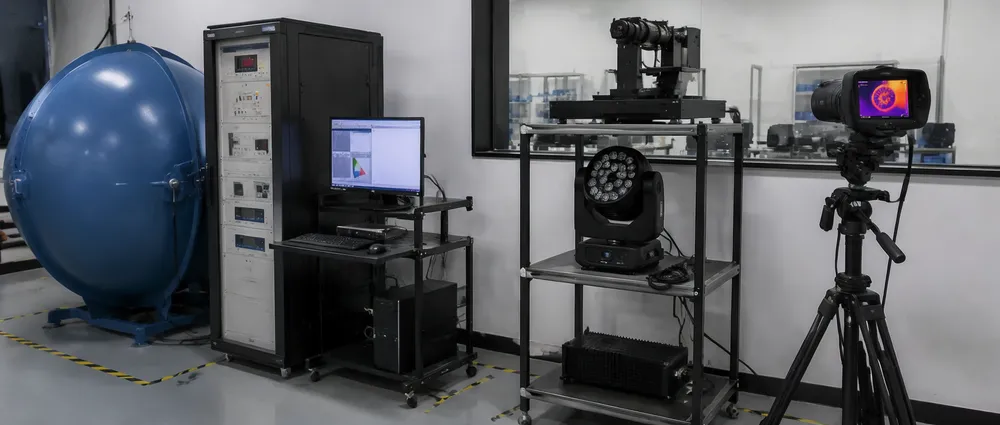
They know the real-world output at that distance because they measured it in our integrating sphere — not from a datasheet.
Thermal Engineering
Stage fixtures run hard — 8-12 hour duty cycles in some venues. Every fixture we spec in a design has been through thermal validation in our lab (junction temperature mapping at sustained full output).
If we put a 300W LED wash on your rigging plan, it's because we've confirmed it won't thermal-throttle at hour 6 and drop 30% of its output.
That failure mode is more common than buyers realize — cheap fixtures lose brightness progressively, and the venue operator doesn't notice until the space looks dim three months in.
DMX & Control Systems
Our firmware engineers write the DMX decoder code running inside our fixtures. When we design a control architecture for your venue, we're not guessing about fixture behavior — we know exactly how each unit responds to RDM queries, how it handles universe switchovers, and where the protocol edge cases live.
This means fewer "the fixtures aren't responding correctly" calls after installation.
Mechanical & Rigging
Every fixture has a published weight, but the rigging load that matters is dynamic load during pan/tilt movement on moving heads.
Our mechanical engineers calculate peak dynamic loads for each fixture model, so your rigging plan uses real numbers, not just static weight plus a generic safety factor.
Customization Within the Design — What Can Be Modified
Stage lighting design is inherently custom — no two venues are identical. But within the fixture hardware itself, you have options:
| Customization Dimension | What's Available | Impact on Lead Time |
|---|---|---|
| Beam angle / lens system | Standard options (8°, 15°, 25°, 36°, 45°) or custom lens assemblies | Standard: no impact. Custom lens: +7-10 days |
| Color temperature | 3200K, 4000K, 5600K, 6500K, or tunable white | Standard: no impact |
| Housing color | Black (standard), white, or any RAL color | RAL custom: +5 days for powder line changeover |
| DMX protocol variant | Standard DMX512, RDM, Art-Net, sACN, wireless DMX | Standard protocols: no impact. Wireless module: +3 days |
| IP rating | IP20 (indoor), IP54, IP65, IP67 | IP65/67 requires sealed housing — +5-7 days |
| Branding | Your logo on fixture body, custom boot screen, your company name on DMX identifier | 30-unit minimum for branding |
| Power input | 100-120V, 200-240V, or auto-sensing universal | No impact on standard voltage variants |
| Mounting hardware | Standard clamp, hanging bracket, floor stand plate, custom bracket | Custom bracket: +5-7 days for fabrication |
Standard Configuration MOQ
30 units for standard configuration fixtures within a design project. Below that threshold, per-unit tooling amortization makes pricing unfavorable for both of us.
Custom-Developed Fixtures
For new optical systems or new housing tooling, minimum is typically 100 units to justify tooling investment.
Compliance and Documentation For Your Target Market
Every fixture specified in your design ships with the documentation your market requires.
CE + EMC Test Reports
Required for EU import and for venues operating under European electrical codes.
FCC Part 15
US/Canada market compliance for electromagnetic emissions.
RoHS Declarations
Material compliance for EU markets and increasingly for Middle East tenders.
IP65/IP67 Test Certificates
For outdoor-rated fixtures, with ingress protection validated by third-party lab.
ISO 9001:2015
Quality management system covering design through production and delivery.
Complete Compliance File for Tenders
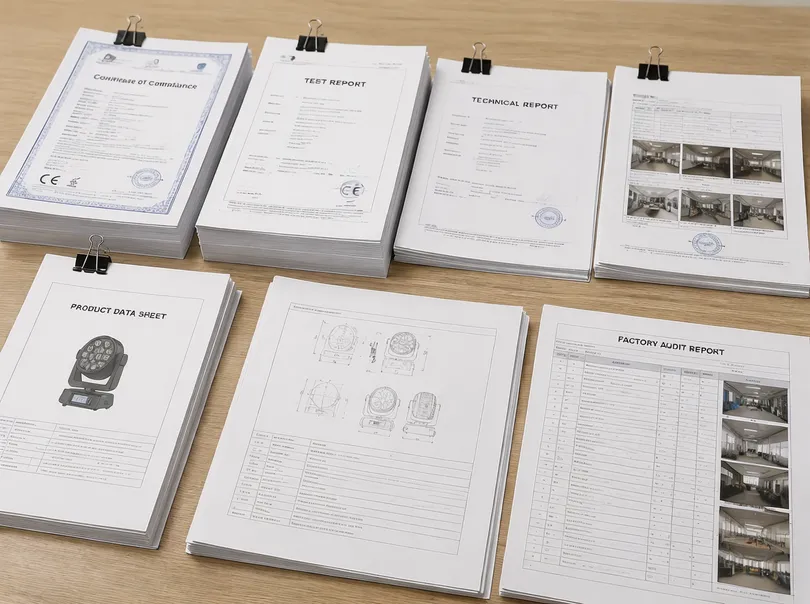
For project tenders that require manufacturer documentation packages — common in municipal theatre projects and large house-of-worship builds — we compile the complete compliance file: certificates, test reports, product data sheets, and factory audit records. This saves you the assembly work and ensures nothing is missing when the tender deadline hits.
- Certificates and test reports
- Product data sheets
- Factory audit records
- Compiled and formatted for your tender submission
Bidding on a project with specific compliance requirements not listed here? Ask. We've navigated requirements for markets across five continents — there's likely a precedent in our files.
What a Completed Design Package Looks Like
To be concrete about what you receive, here's the typical deliverable set for a mid-size venue (400–800 seats):
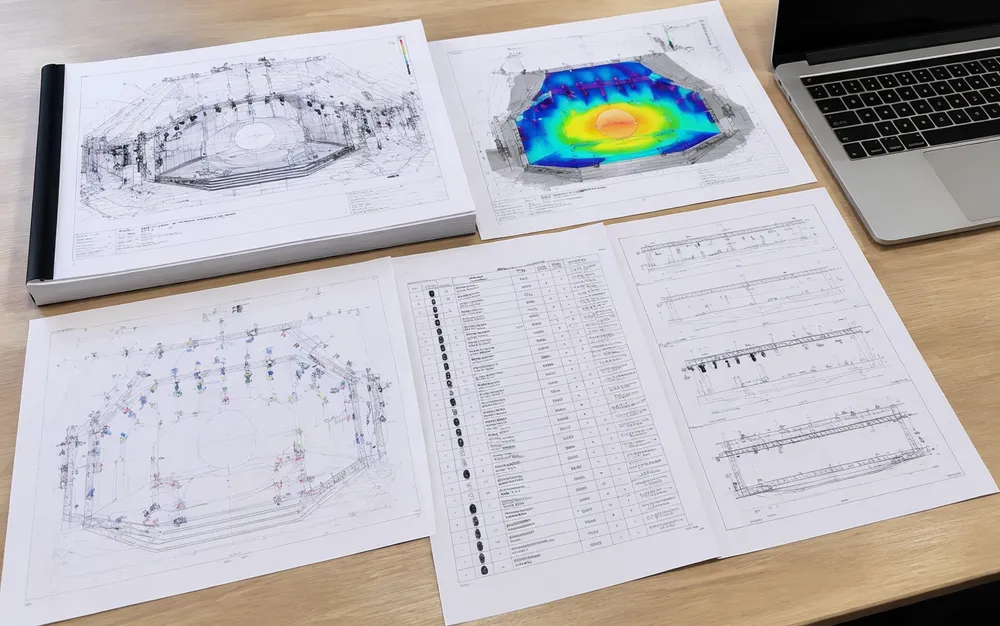
Fixture Schedule
40–120 fixtures specified by model, wattage, beam angle, color system, and mounting position.
Coverage Plot
CAD-generated beam coverage at stage level, showing overlap zones and dead spots (if any — there shouldn't be).
Lux Calculation
Average and peak illuminance at stage plane, per fixture group.
DMX Universe Layout
Address map, universe assignments, signal distribution diagram.
Power Distribution
Circuit loading per dimmer/relay position, total power draw, recommended breaker sizing.
Rigging Load Plan
Per-pipe or per-truss weight loading, with safety factor calculations.
Bill of Materials
Every fixture and accessory with quantity, unit price, and extended total — production-ready for your purchase order.
Control Pre-Programming
Optional: base scenes, color presets, and example cue sequences loaded onto a console file or programmed into fixture memory.
Delivery Format
The documentation arrives as a PDF package plus editable CAD files (DWG/DXF). If you're integrating with a larger architectural or A/V design, our files drop into your consultant's drawing set.
See the deliverable quality before committing to a full project.
Pricing Structure for Design Services
We don't charge separately for lighting design when it leads to a fixture order from our production lines. The design work is folded into your fixture purchase — it's part of our sales engineering process, not a standalone consulting fee.
Design + Production Order
Design service included at no additional charge. Your investment is the fixture purchase itself.
Included with orderDesign-Only
Available on a project-fee basis for buyers evaluating their options. Fee is credited against any subsequent fixture order placed within 6 months.
Project fee — creditableRedesign & Revision Cycles
First two revisions included. Additional revision cycles by agreement — but in practice, most projects finalize within two rounds because our engineers ask the right questions during intake.
2 revisions includedWhy This Structure Works
Lighting design drives fixture specification, and fixture specification drives production orders. We're not a consulting firm — we're a manufacturer that uses design capability to earn your production business. The incentives are aligned: we design a system that performs well for your venue, you order the fixtures from us, your end-client is satisfied, and you come back for the next project.
Frequently Asked Questions
How detailed does my initial project brief need to be?
As detailed as you have. Floor plans with dimensions are ideal, but we've started designs from a set of photos and a sentence like "500-seat church, contemporary worship, budget around $30,000 for lighting." Our intake call fills the gaps. The more you provide upfront, the faster the first draft comes back — but don't wait until you have perfect drawings to reach out.
Can you match an existing lighting design that specifies another manufacturer's fixtures?
Yes. If you have a design that calls for a competitor's specific models, send it over. We'll identify equivalent fixtures from our range (matching output, beam angle, color system, and mechanical form factor) and re-quote the project on our production. Most specifications translate directly; where there's no direct equivalent, we'll flag it and propose alternatives.
What if my project requires fixtures you don't currently produce?
Our R&D team develops custom fixtures for projects that justify the tooling investment. Threshold is typically 100+ units for a new fixture development (covers mold and optical tooling costs). Below that quantity, we work within our existing range with customized parameters — lens swaps, housing color changes, firmware modifications — which covers most project requirements without new tooling.
How do you handle IP-rated outdoor designs differently from indoor venues?
Outdoor designs specify IP65 or IP67-rated fixtures from our sealed production line, add cable management rated for UV and weather exposure, and account for thermal performance in ambient temperatures up to 45°C. Power distribution design includes GFCI/RCD protection per local electrical code. We also spec heavier-gauge mounting hardware rated for wind loading — outdoor truss and ground support sees forces that indoor rigging doesn't.
What's the typical turnaround from brief to first design draft?
5–10 working days for the first layout, depending on venue complexity. A straightforward single-room worship space might come back in 5 days. A multi-room performing arts center with fly system integration takes closer to 10. Rush timelines are possible if you're working against a tender deadline — let us know upfront and we'll prioritize accordingly.
Do you provide on-site commissioning support?
We provide remote commissioning support — fixture configuration guidance, DMX troubleshooting, and programming assistance via video call during your installation. On-site visits are available for large-scale projects (200+ fixtures) on a case-by-case basis, typically in Southeast Asia and Middle East markets where we have field engineers positioned.
Start Your Stage Lighting Design Project
You have a venue, a timeline, and a budget. We have 15 engineers, 6 production lines, and twelve years of manufacturing stage lighting fixtures.
Send Us Your Project Brief
Send us your project brief — floor plans, venue photos, written description, competitor quote you want us to match, or even just the venue name and seat count. We'll respond within 48 hours with a preliminary assessment and next steps.
48-hour response — preliminary assessment and next steps
Direct Contact
Most buyers start with a single venue project to test our design quality and production capability, then bring repeat projects as they close new contracts. The first project is where you evaluate us — after that, it's just a phone call to kick off the next one.