

Moving Head Stage Lighting Spotlight
Factory-built moving head spotlight with precision optics and full DMX control — engineered for rental fleets, install projects, and distribution inventory.
150W to 350W LED configurations, 540°/270° pan/tilt travel, gobo + color wheel systems. Every unit ships after 48-hour full-load aging — your warranty return rate stays near zero.
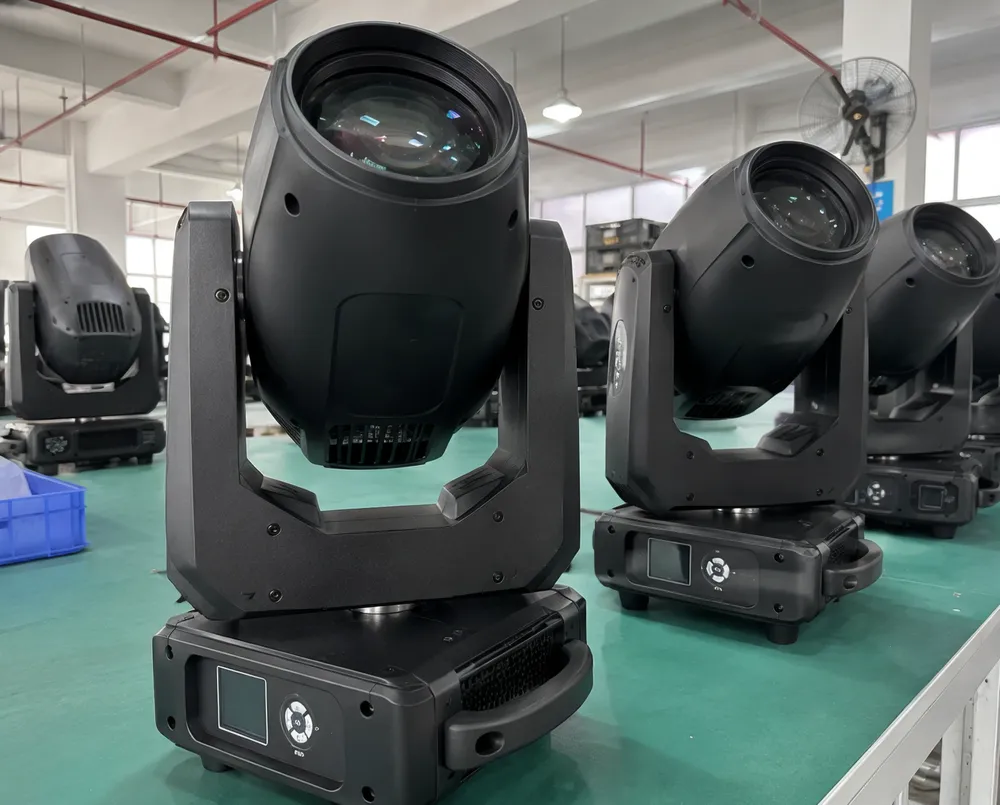
What This Fixture Is and Where It Fits Your Product Line
A moving head stage lighting spotlight combines motorized pan/tilt movement with a focused beam output — gobos, color wheels, prism effects, and precise dimming through a single fixture. Unlike wash-type moving heads that flood wide areas with color, spotlights produce a defined beam with hard or soft edges, projectable patterns, and mid-air effects.
That distinction matters for your catalog: spotlights sell into applications where the light itself is visible (concerts, theatre, broadcast), while wash lights sell into applications where the lit surface matters (architectural, corporate events).
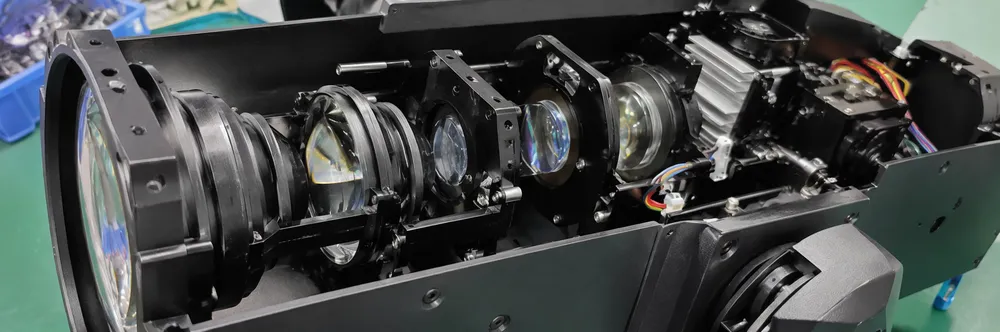
We build these in wattage tiers from 150W through 350W LED, covering everything from mid-size club installs to touring rigs and large venue permanent installations. The optical path uses a condensing lens system with motorized focus and zoom, so one SKU covers multiple throw distances without fixture swaps. For your inventory planning, that means fewer SKUs to stock while covering more project requirements per unit.
Our moving head heritage goes back to GDMonkey's founding DNA — we started in electromechanical assemblies and rotation mechanisms in 2012, so the pan/tilt drive system is where we've invested the most engineering time. Smoother motion, less mechanical noise, and fewer gear failures over 10,000-hour duty cycles. That motor expertise is genuinely our oldest manufacturing competence — it predates our LED optical work by years.
Spotlight
- Defined beam with hard/soft edges
- Projectable gobo patterns
- Mid-air visible beam effects
- Concerts, theatre, broadcast
Wash Light
- Wide flood, soft coverage
- Surface color, not beam shape
- Architectural, corporate events
- Different buyer set
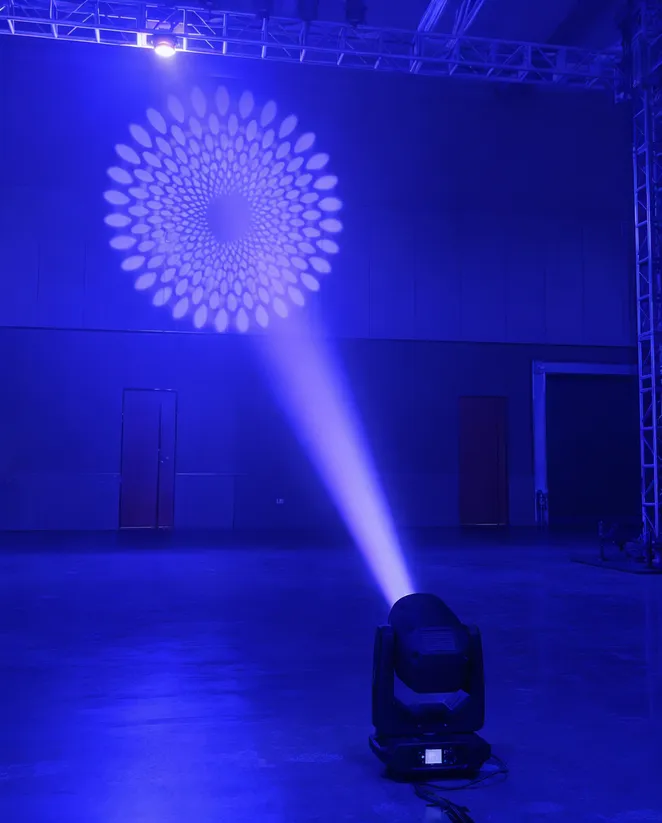
Inventory Planning Advantage
Motorized focus and zoom in one SKU covers multiple throw distances without fixture swaps — fewer SKUs to stock while covering more project requirements per unit. 150W through 350W tiers span mid-size club installs through touring rigs and large venue permanent installations.
Technical Specifications: What You're Quoting Against
This table gives you what you need for your comparison sheet. Specifications shown are industry-standard values across our moving head spotlight range — your order is built to your selected configuration.
| Parameter | Typical Specification Range |
|---|---|
| Light source | High-power LED, 150W / 200W / 250W / 350W configurations |
| Color temperature | 7500K–8500K (cool white, standard for spot applications) |
| Pan range | 540° (3-phase motor, 16-bit resolution) |
| Tilt range | 270° (3-phase motor, 16-bit resolution) |
| Pan/tilt speed | Adjustable, fast mode <2.2s (pan 540°), <1.5s (tilt 270°) |
| Color wheel | 7 dichroic colors + open, split-color capable |
| Gobo wheel 1 (rotating) | 7 interchangeable gobos + open, indexable and continuous rotation |
| Gobo wheel 2 (fixed) | 9 static gobos + open |
| Prism | Rotating 3-facet or 8-facet (model dependent) |
| Focus | Motorized linear focus, 2m to infinity |
| Zoom | Motorized, 8°–22° beam angle (model dependent) |
| Dimmer | 0–100% linear, 16-bit fine dimming |
| Strobe | 1–25Hz, random strobe supported |
| Control | DMX512, RDM, Art-Net optional, standalone/sound-active modes |
| DMX channels | 16 / 20 / 24 channel modes |
| Input voltage | AC 100–240V, 50/60Hz (universal) |
| Power consumption | 180W–420W (varies by LED wattage) |
| IP rating | IP20 (standard indoor); IP65 housing available for outdoor spec |
| Weight | 15–25 kg (varies by model and housing material) |
| Housing | Die-cast aluminum with CNC-machined heatsink |
| Noise level | <35dB at low-speed fan mode (theatre-quiet operation) |
| Cooling | Forced-air, temperature-controlled variable-speed fan |
| Operating temperature | -20°C to +45°C |
Universal Voltage
AC 100–240V, 50/60Hz input means one SKU works across all your export markets without transformer hassles.
16-bit Pan/Tilt
Keeps movement smooth at slow speeds — critical for theatre and broadcast where jerky motion is immediately visible to the audience and reflects poorly on the installer.
Theatre-Quiet
<35dB at low-speed fan mode. Variable-speed temperature-controlled cooling lets you spec these into noise-sensitive venues with confidence.
Need the exact spec sheet matching your project requirements? Contact us for the full spec sheet and CAD drawings for your configuration.
Optical System and Beam Quality: What Your Downstream Buyers Actually See
The optical path is where a moving head spotlight either earns premium pricing or gets commoditized. We use a condensing lens assembly with precision-ground glass optics — not molded plastic lenses that yellow under UV exposure and lose transmission efficiency within 18 months. The difference shows up in your return rate and your customers' willingness to reorder.
Precision Lens Alignment
Our lens alignment is done on optical calibration rigs with tolerance of ±0.3° on beam center. That means your batch of 50 units produces consistent hotspot positioning — the LD doesn't need to re-focus each fixture individually during rig setup.
For rental companies (your likely downstream buyers), consistent fixture-to-fixture beam quality directly reduces setup labor cost.
Open Gobo System — No Proprietary Lock-In
The gobo system uses replaceable standard-size gobos (B-size for our 200W–350W models). Your customers can source custom gobos from any third-party gobo supplier without proprietary lock-in.
We deliberately avoid proprietary gobo sizes because locked-in consumables anger end-users and create after-sales headaches that ultimately land back on your support desk.
Color Rendering Options
CRI 70+
Suitable for concert touring, event rental, and architectural applications where color accuracy is secondary to output intensity.
CRI 90+
Uses a different LED bin selection and a modified optical coating — it's a separate SKU, not a firmware toggle. Required where skin tones matter on camera or under house lights.
We tried software-based CRI correction early on. It cost too much output intensity. A proper high-CRI LED bin is the only honest solution.
Pan/Tilt Drive: The Mechanical Heart of a Moving Head
This is where we invest disproportionately, and where cheap moving heads fail first. The pan/tilt mechanism on a spotlight carries 15–25 kg of head assembly through continuous high-speed repositioning — motors, gears, belts, and bearings all taking repetitive mechanical stress over thousands of hours.
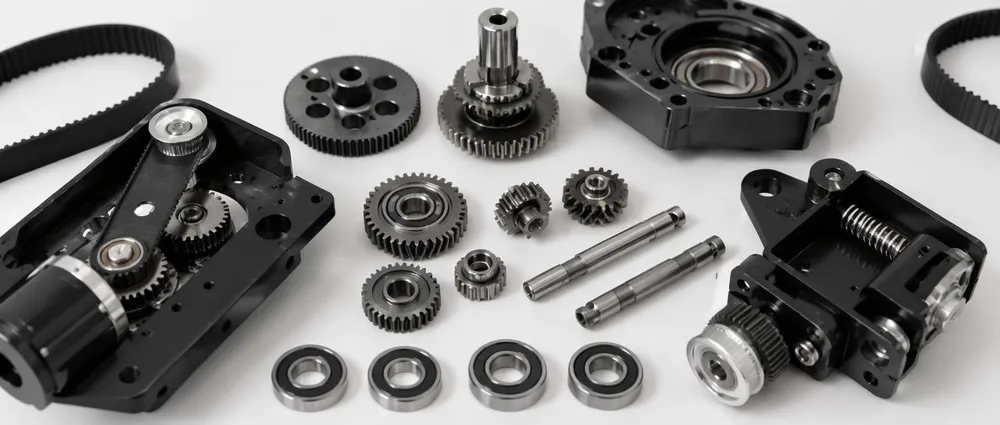
3-Phase Steppers + Steel Gears
We use 3-phase stepper motors with steel-core gear reduction on both axes. The gear set is CNC-cut hardened steel, not injection-molded nylon.
Nylon gears are quieter on day one but develop backlash within 2,000 hours of use — that backlash shows up as position drift during slow pan movements, which is immediately visible in a theatre follow-spot application. Steel gears maintain positional accuracy across the full rated life.
Self-Compensating Belt Tensioner
Belt tension on the tilt axis uses a spring-loaded tensioner that self-compensates as the belt wears.
Without this, belt-driven moving heads develop a characteristic "thunk" at direction changes after 6–12 months — a noise complaint your rental customers will bring back to you.
16-Bit Encoder Resolution
65,536 steps across the 540° pan travel — that's 0.008° per step.
Smooth enough for slow theatrical tracking. Fast enough for concert beam effects. Your one SKU covers both use cases without an "upgrade" option that fragments your inventory.
Our motor assembly line has been running since 2012. We've gone through four generations of gear tooth profiles on this product line. The current geometry came out of a 2020 redesign specifically targeting noise under 35dB at slow-speed operation — theatre installers were our loudest voice on that requirement.
Market Segments Where Moving Head Spotlights Generate Repeat Orders
Each application below represents a specific procurement channel with predictable volume patterns. This isn't a lifestyle brochure — it's your market planning reference.
Rental & Production Companies
Largest Volume Channel Globally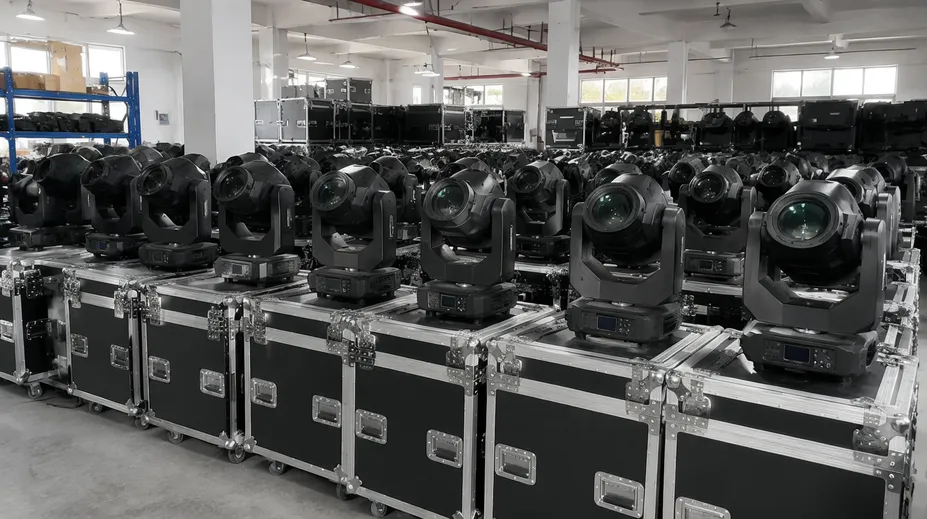
Rental fleets are the single largest volume channel for moving head spotlights globally. A mid-size production company typically maintains 20–80 spotlights in their inventory, with 15–25% annual replacement due to mechanical wear and technology refresh.
Orders are seasonal — pre-budget (Q4) and pre-festival season (Q1–Q2) concentrate purchasing.
Standard Rental Spec
Your value angle: consistent batch quality means the LD can grab any unit from the warehouse without matching issues. Our 48-hour aging means you're not shipping DOA units that create emergency replacements mid-gig.
Theatre & Performing Arts Venues
Higher Margins, Stickier Orders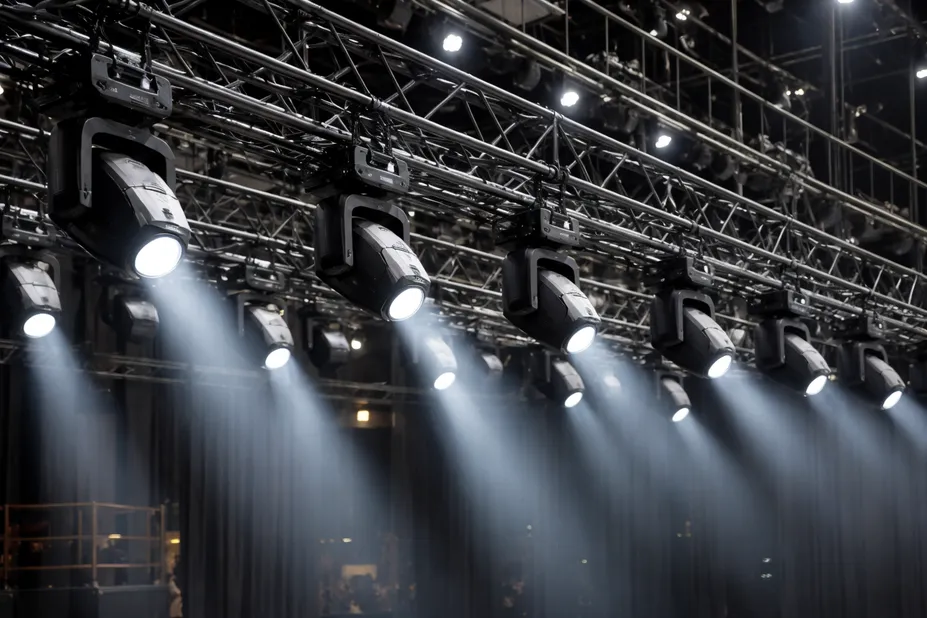
Fixed installations, typically 12–40 units per venue, with 7–10 year replacement cycles. Procurement runs through AV integrators and theatre consultants — your sales cycle is longer but margins are higher and orders are stickier.
Segment Priorities
Product fit: The quiet fan mode and 16-bit dimming on our spotlight directly targets this segment. No flicker at low dim levels, no audible fan noise during quiet dramatic moments.
Houses of Worship
Fastest-Growing Segment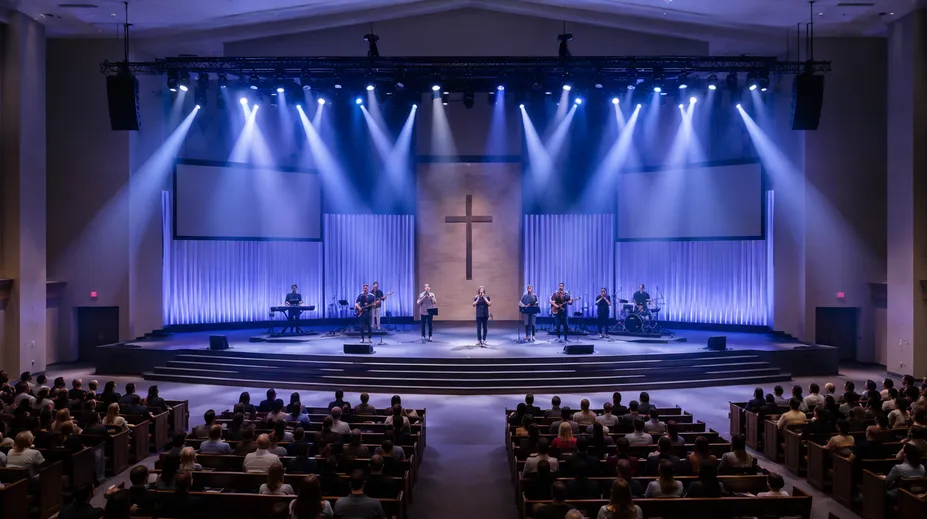
Churches and megachurches are the fastest-growing segment in professional lighting. A single large worship facility installs 8–30 moving heads in their main sanctuary, with upgrade cycles of 3–5 years driven by volunteer-friendly technology (wireless DMX, preset scenes, app control).
Volume per venue is moderate, but the segment is enormous — 300,000+ churches in the US alone, with growing AV budgets.
Volunteer-Friendly Features
Distribution value: Our Art-Net and wireless DMX options make the fixture accessible for volunteer-operated systems. For your distribution business, this segment means steady mid-volume orders with minimal technical support overhead.
Broadcast Studios & Event Spaces
Precision Color & Flicker-Free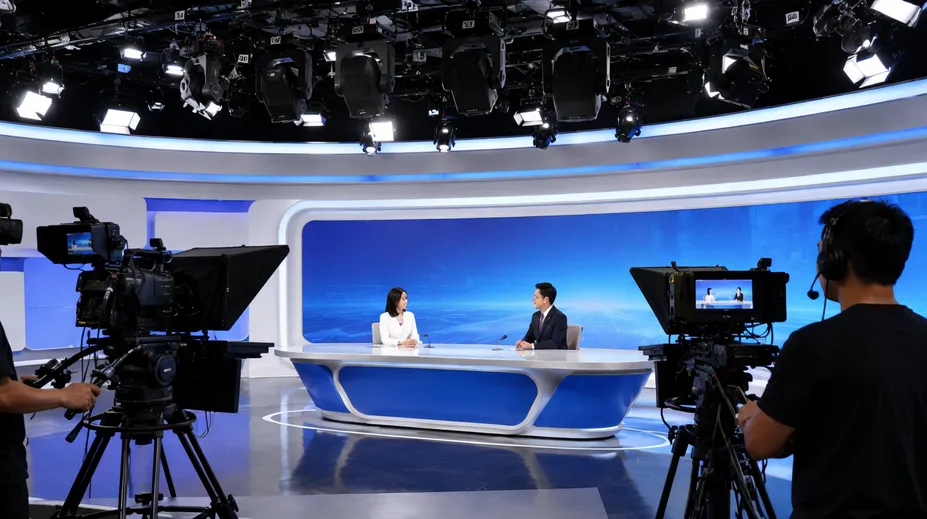
Studios require precise color temperature consistency (±100K unit-to-unit variation), high CRI, flicker-free operation at all camera frame rates, and DMX/Art-Net integration with studio automation systems.
Event spaces (corporate venues, hotels, convention centers) overlap with rental spec but prioritize aesthetics of the fixture housing and low noise for speech-focused events.
Critical Requirements
Same product, different positioning: Both channels value the same product — it's your spec sheet positioning and marketing that changes, not the hardware.
OEM/ODM Customization: Your Brand, Your Specification
We support full customization from as few as 30 units. That's not a typo — 30 units gets you a branded product with your identity on it. Here's what's on the table:
Branding & Visual Identity
| Customization | MOQ | Lead Time Impact |
|---|---|---|
| Logo on housing (laser engraved or pad-printed) | 30 units | None |
| Custom housing color (powder coat, any RAL) | 100 units | +5–7 days |
| Custom boot screen / firmware branding | 30 units | None |
| Custom packaging with your branding | 30 units | +3–5 days |
| Private-label user manual and spec sheet | 30 units | None |
Technical Customization
| Customization | MOQ | Lead Time Impact |
|---|---|---|
| LED wattage selection (150W/200W/250W/350W) | 30 units | None — standard options |
| Custom gobo set (your patterns pre-installed) | 50 units | +3 days |
| Zoom range modification | 200 units | +10–15 days (lens tooling) |
| Custom DMX channel layout | 50 units | +5 days (firmware) |
| Wireless DMX module integration | 30 units | None — drop-in module |
| IP65 outdoor housing upgrade | 100 units | +7–10 days |
| Custom beam angle (fixed-focus version) | 200 units | +10 days (optics change) |
| Custom connector type (powerCON, 5-pin XLR, etc.) | 30 units | None |
Limitations — What We'll Tell You Upfront
- Housing geometry changes (new mold tooling) start at 500-unit MOQ — below that, the tooling amortization makes the per-unit cost uncompetitive.
- Color wheel and gobo wheel slot count is fixed by the mechanical chassis design. Adding slots requires a new internal frame, which is a 500+ unit conversation.
- We don't support customer-supplied LED chips. Our optical path is calibrated to specific LED bins from approved suppliers — mixing in unknown chips voids our optical performance guarantee.
Honest limitation: Custom lens tooling for a new zoom range is a real investment. If your volume is under 200 units, we'd recommend choosing from our existing 8°–22° or 10°–25° zoom configurations instead. Same performance, no tooling cost passed to you.
How We Build This Fixture: Process Details That Protect Your Margin
Die-Cast Aluminum Housing
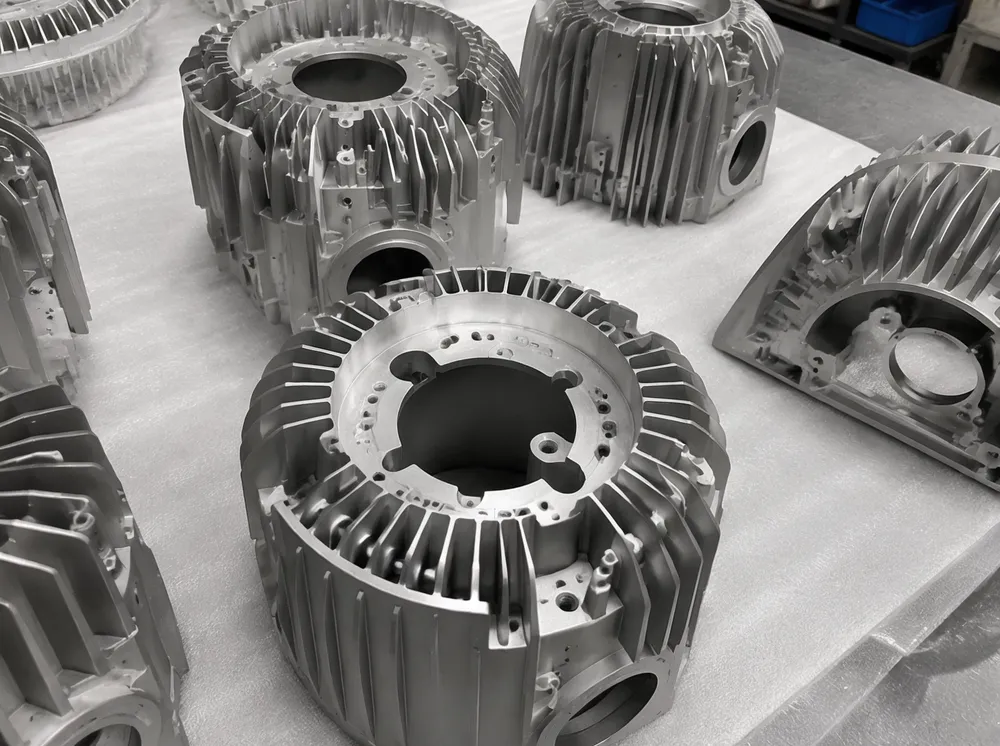
The body starts as ADC12 aluminum alloy in our die-casting shop — 280-ton hydraulic press, T6 heat treatment post-casting. We machine the heatsink fins in-house on CNC rather than using generic extrusion profiles.
A moving head spotlight concentrates high thermal load in a compact head assembly that's constantly changing orientation. Generic heatsink geometries assume a fixed mounting angle. Our fin pattern works equally well at any tilt position because we designed it for omnidirectional convection.
Post-machining, the housing goes through chromate conversion coating before powder coat. This two-stage surface treatment is why our powder coat doesn't flake at screw bosses and joint lines after thermal cycling — a common failure mode on cheaper fixtures where the powder goes directly onto bare aluminum.
We added the chromate step in 2017 after seeing adhesion failures on units returned from Southeast Asian rental companies — humidity plus thermal cycling was eating the finish.
LED Module and Optical Assembly
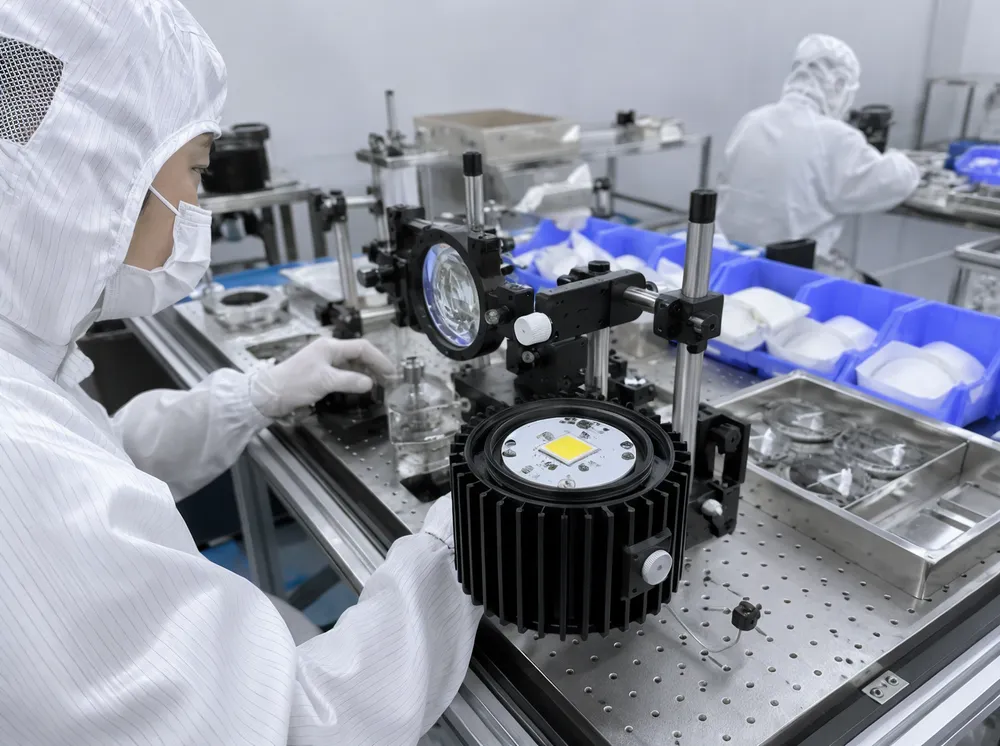
LED chips come from our approved bin list — currently Luminus CBM-360 for 200W+ configurations, Luminus CBT-90 for the 150W variant. We bin-match within ±100K color temperature and ±3% flux output per production batch.
The chips mount on MCPCB with thermal interface material rated at 3.5 W/mK, attached to the CNC-machined heatsink with controlled-torque fasteners.
Optical assembly happens in a clean-room environment (ISO Class 8). Lens mounting uses precision alignment jigs with optical verification — beam center deviation must fall within ±0.3° before the head assembly proceeds to motor integration.
This step is why your batch comes out uniform.
Motor Integration and Calibration
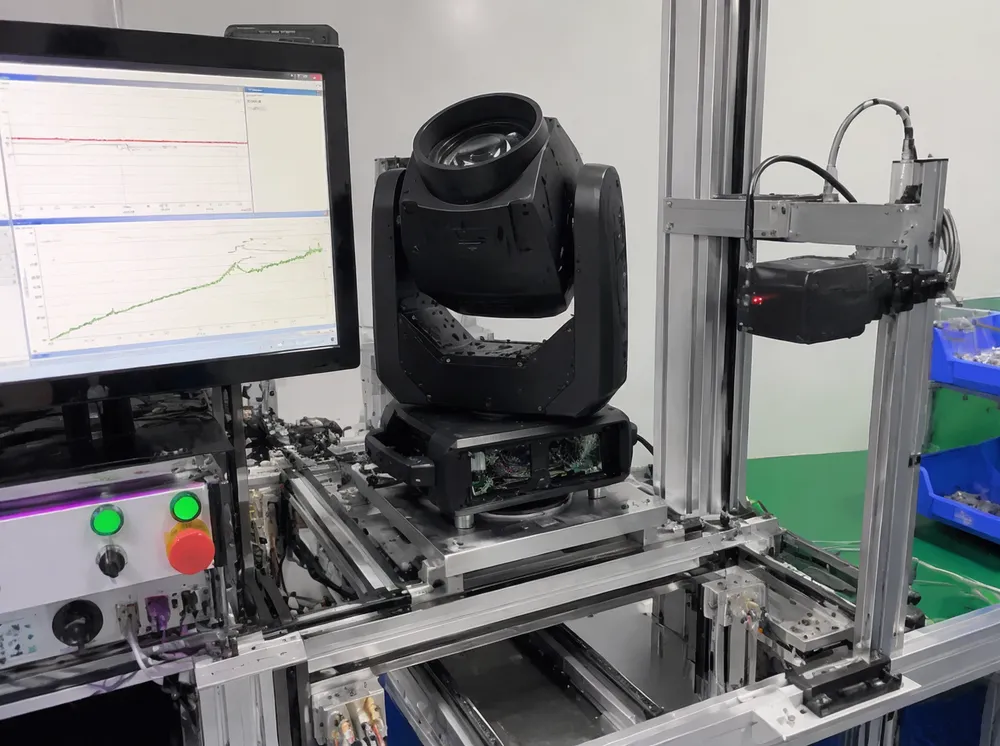
Pan/tilt motors mount on precision-bored housing interfaces with self-aligning bearings. After mechanical assembly, every unit runs through automated calibration — a test rig drives the head through full range of motion while a laser position sensor verifies that actual position matches commanded position across all 65,536 encoder steps.
Units showing deviation >0.02° get pulled for adjustment.
48-Hour Aging and Final QC
Every unit — not a sample lot, every single unit — goes on the aging rack for 48 hours at full electrical load. Full LED output, continuous pan/tilt motion, color and gobo wheel cycling.
This catches infant mortality across the entire BOM: capacitor failures, LED driver thermal issues, motor bearing defects, intermittent solder joints.
After aging, 100% functional testing verifies:
- DMX response across all channel modes
- Color mixing accuracy
- Dimming linearity
- Gobo indexing precision
- Mechanical noise level
of production units eliminated before reaching your warehouse. Each one a warranty claim, a truck roll, a damaged relationship — absorbed in our production so you don't absorb it in the field.
Packaging and Container Loading: Your Landed Cost Calculation
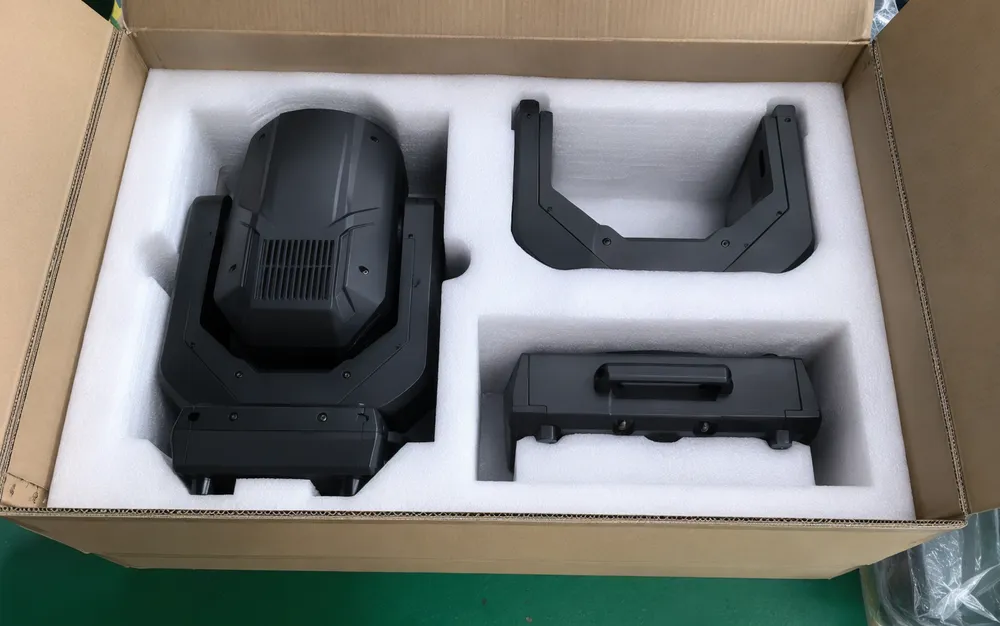
Each moving head spotlight ships in individual molded foam packaging inside a corrugated master carton. The foam insert is custom-molded to the fixture profile — the head, yoke, and base each sit in their own cavity. No newspaper stuffing, no generic foam sheets.
Container Loading Efficiency
| Model (by wattage) | Unit Carton Dimensions | Units per 20GP | Units per 40HQ |
|---|---|---|---|
| 150W compact | 45 × 35 × 55 cm | ~180 units | ~420 units |
| 200W standard | 50 × 40 × 60 cm | ~140 units | ~320 units |
| 250W–350W full-size | 55 × 45 × 65 cm | ~100 units | ~240 units |
Loading quantities are estimates based on standard carton stacking. Actual quantities depend on palletization requirements and any additional packaging (e.g., flight case bundles).
Flight Case Option
For buyers who resell with flight cases: we can ship fixtures pre-loaded in road cases (2-unit or 4-unit configurations). This adds to your per-unit cost but eliminates the case-fitting step at your warehouse — your product arrives shelf-ready or rental-ready.
Custom Labeling
Barcode labeling, inner/outer carton marks, and packing documentation formatted to your warehouse receiving system. We adapt to your requirements — just send us your labeling template with the first order.
Compliance Documentation: Pre-Qualified for Your Import Markets
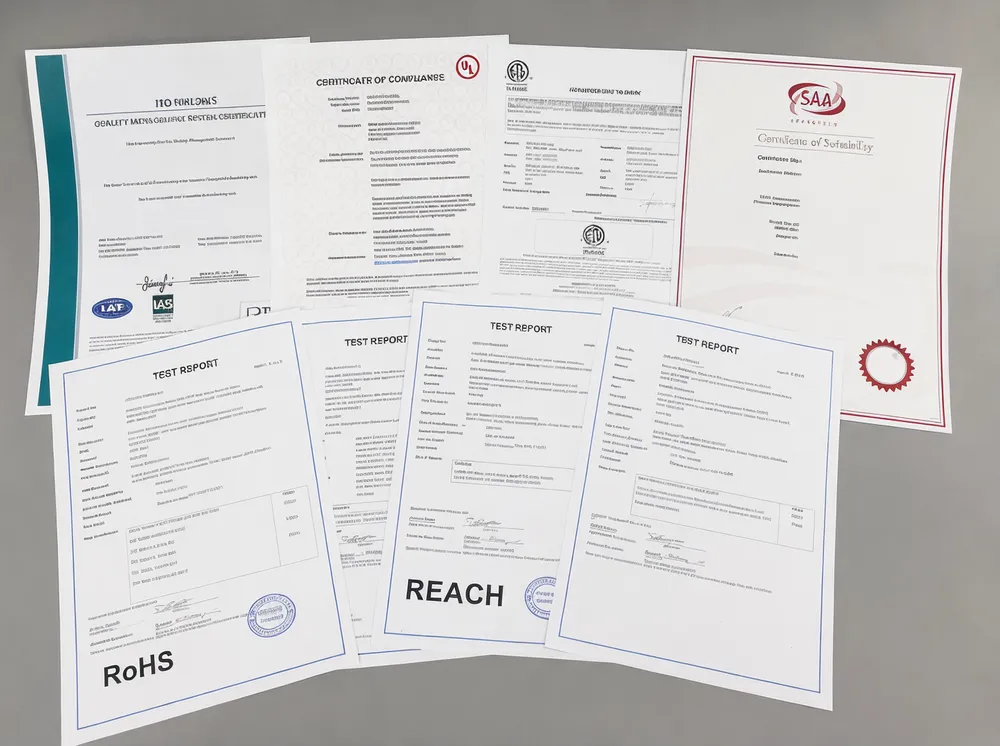
Every moving head spotlight in our range carries current compliance documentation for major import markets.
CE (EMC + LVD)
Coverage: European Union
Customs clearance without additional testing — Declaration of Conformity provided per shipment.
FCC Part 15
Coverage: United States / Canada
No FCC filing required on your end — test reports available for CBP review.
RoHS
Coverage: EU, UK, multiple Asia-Pacific markets
Material compliance declarations included with shipping docs.
IP65 (Outdoor Models)
Coverage: Global
Ingress protection test reports available — required for outdoor installation permits in most jurisdictions.
ISO 9001:2015
Coverage: Manufacturing system
Factory audit reports available for your supplier qualification process.
Per-Project Certifications
For specific market requirements — UL listing for US commercial installations, ETL for Canadian projects, SAA for Australian markets — we can provide test samples and coordinate with the certification body. These are per-project certifications that depend on the exact SKU configuration you order.
RoHS & REACH Built Into Our BOM
RoHS and REACH compliance is built into our BOM from procurement onward: lead-free solder, halogen-free PCB substrates, restricted substance declarations from all component suppliers. Your European distribution partners won't face documentation gaps at customs.
If This Spotlight Doesn't Match Your Application
Moving head spotlights are one fixture type within our full spotlight category. If your project needs something different, here's where to look.
Theatre Spotlight
Your requirement: Fixed-position spotlight with manual focus
No motors — simpler, lighter, lower cost, higher optical efficiency.
DMX Spotlight
Your requirement: Spotlight with advanced DMX programming
Optimized for complex cueing, expanded channel modes.
Warm White Spotlight
Your requirement: Warm-toned key light for broadcast/film
3200K native CCT, CRI 95+, flicker-free at all frame rates.
Stage Flood Lights
Your requirement: Wide-coverage wash for stages
Broad beam, high lumen output, even field coverage.
DJ Spotlight
Your requirement: Compact spot for mobile DJ rigs
Lighter weight, simplified control, lower price point.
Building a Mixed Lighting Rig?
We'd rather point you to the right product than oversell the wrong one. If you're building a mixed lighting rig and need spotlights alongside wash fixtures or effects, send us the full fixture list — we'll quote the complete package with volume pricing across categories.
Frequently Asked Questions: Moving Head Spotlight Procurement
What IP rating do I need for outdoor festival and touring applications?
For outdoor use where the fixture is exposed to rain, specify IP65. Our standard indoor units are IP20 — fine for permanent installations and indoor rental, but they'll fail if exposed to weather.
The IP65 version uses sealed optical chambers, potted electronics, and gasket-sealed housing joints. It adds approximately 15% to unit cost and 2–3 kg to fixture weight.
Most touring companies stock both versions — IP20 for indoor gigs, IP65 for festivals and outdoor corporate events.
How do I prevent moving head motor failures in high-use rental environments?
The primary failure mode is gear wear from continuous high-speed operation combined with poor maintenance intervals. Our steel-gear design resists wear significantly longer than nylon-gear alternatives, but maintenance still matters.
We recommend a 2,000-hour inspection interval for rental fleet units:
- Check belt tension
- Verify pan/tilt calibration via DMX reset
- Clean the cooling fans
We provide a maintenance guide with each shipment that your technical staff can follow. On our fixtures, the gear train is accessible through a single cover plate — 4 screws, no special tools.
150W vs 250W vs 350W: how do I choose the right wattage for my market?
Match wattage to typical throw distance in your target applications:
Clubs, small theatres, houses of worship under 500 seats
Mid-size concert venues, large churches, corporate event spaces
Arenas, large theatres, outdoor stages
If you're unsure, 200–250W is the volume sweet spot for most distributors — it covers the broadest range of downstream applications without the premium cost of the 350W tier.
Can I order a sample before committing to production volume?
Yes. Sample orders start at 1 unit at list pricing. Most new buyers order 2–3 units to test with their own customers and verify fixture-to-fixture consistency.
Sample production takes 3–7 days for standard configurations. Custom OEM samples (your branding, modified specs) take 10–15 days.
Sample cost is credited toward your first production order of 30+ units.
What's the typical lead time for a 500-unit production order?
Standard configurations: 20–25 days from deposit confirmation.
Custom OEM orders with branding and minor spec changes: 25–30 days.
Orders requiring new tooling (custom housing color, special gobo sets): 30–35 days.
We provide a production schedule with milestone dates at order confirmation — you'll know exactly when your shipment hits the water.
Why do some cheap moving heads develop position drift after a few months?
Position drift is almost always a gear wear issue. Manufacturers using injection-molded nylon gears save on initial cost but introduce backlash as the tooth surfaces wear.
The symptom: fixtures that don't return precisely to programmed positions, especially visible during slow pan movements in theatre applications.
Steel-core gear sets like ours maintain tooth profile geometry across the full rated service life. The cost difference per unit is small — the warranty claim difference over 2,000 hours of operation is significant.
Next Step: Get Your Configuration Quoted
You've got the specs, the customization options, and the compliance documentation. The fastest path forward:
Tell Us Your Application
Which market segment, what wattage range, indoor or outdoor
Tell Us Your Volume
Even approximate. It determines MOQ tier pricing and production scheduling
Tell Us Your Branding Needs
Plain, your logo, or full OEM package
We'll return a detailed quotation with spec sheet, sample timeline, and production schedule within 48 hours. If you have a competitor sample or reference product you want us to match or improve on, send photos or a spec sheet — our engineering team will analyze and respond with a feasibility assessment.
Teresa Liu — Export Sales
Get a Quote for Moving Head SpotlightsExplore More Stage Lighting Spotlights
Precision optics for front-of-house and follow-spot applications
DMX Stage Lighting SpotlightFull DMX512 control for automated lighting rigs
Warm White Stage Lighting Spotlight3200K tungsten-match for broadcast and theatre
Stage Lighting Flood LightsWide-angle wash for cyclorama and stage fill
DJ Spotlight LightsCompact fixtures for mobile DJs and club installs
All Stage Lighting Spotlights →Browse the full category