

Stage Lighting Flood Lights Wide-Area LED Wash Fixtures
Broad-beam LED flood fixtures built for rental fleets, installed venues, and outdoor stages — where consistent output across the full throw distance protects your reputation and your margin.
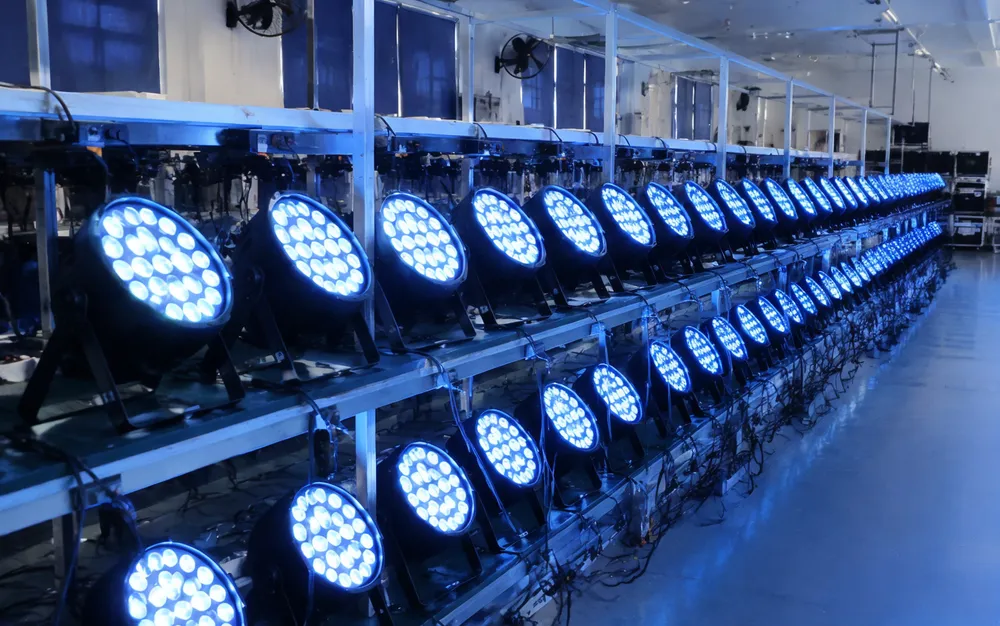
Engineered for even, high-output wash coverage across large performance areas. 48-hour aging tested before shipment.
Product Definition
What Stage Lighting Flood Lights Are — And Why They're a Separate SKU Decision
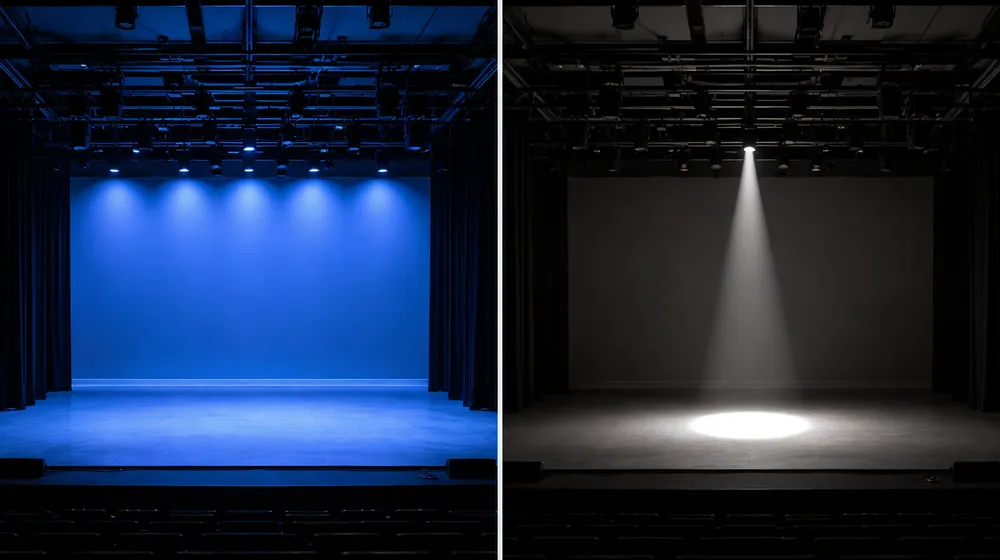
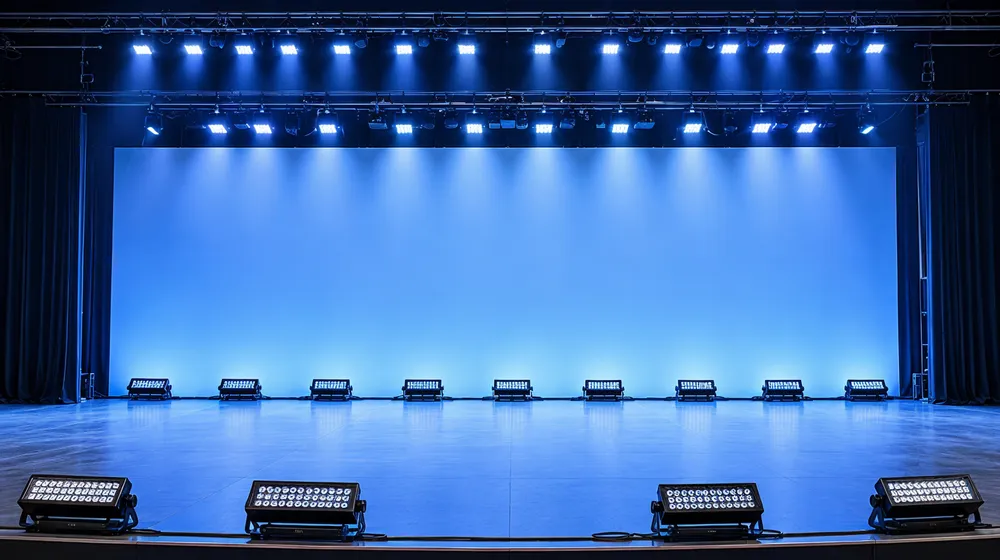
Stage lighting flood lights are wide-beam wash fixtures designed to cover large areas with uniform illumination rather than focusing on a single point. Where a spotlight isolates a performer or set piece, a flood light fills the stage — backdrops, cycloramas, architectural surfaces, and open-air performance zones all depend on floods for their base layer of light.
For your business, this distinction matters at the product-mix level. Floods are the volume backbone of any rental or install lighting package. A 200-seat theatre needs maybe 8–12 spotlights but 20–40 flood fixtures to cover the cyclorama, wings, and general wash. Concert touring rigs run even higher ratios. That's why flood lights typically account for the largest single line item in a stage lighting procurement — and why getting your landed cost and failure rate right on floods has outsized impact on your overall margin.
Our stage lighting flood lights use high-density LED arrays (RGBW or RGBWA+UV configurations) with asymmetric reflector geometry to deliver smooth, edge-to-edge coverage without hotspots or visible beam edges. We produce them across wattage ranges from 54W compact pars to 400W+ high-output cyc floods, all running off standard DMX512 or Art-Net control protocols.
Asymmetric Reflector Design — Fewer Fixtures, Same Coverage
A symmetric reflector gives you a bright center and dim edges, which means your lighting designer has to double-overlap fixtures to get even coverage. Our asymmetric optics let you space fixtures wider apart, so you need fewer units to cover the same throw. Fewer fixtures on the rig = lower procurement cost + faster setup for your rental crew.
Volume SKU
20–40 flood fixtures per 200-seat theatre vs. 8–12 spotlights. Floods are your highest-volume line item.
RGBW / RGBWA+UV
High-density LED arrays with full color mixing capability, from subtle pastels to saturated washes.
54W – 400W+ Range
From compact pars to high-output cyc floods. DMX512 and Art-Net control across the full range.
Specifications
Technical Specifications for Procurement Comparison
Specifications shown are standard values across our flood light range. Exact parameters vary by model and configuration. Contact us for detailed model-specific data sheets.
| Parameter | Typical Specification |
|---|---|
| LED Source | High-power SMD LEDs (Epistar/Cree chips), RGBW or RGBWA+UV |
| Wattage Range | 54W – 400W (model-dependent) |
| Beam Angle | 25°×45° asymmetric (standard), 60° symmetric (wash variant), 15°–60° zoom (motorized zoom models) |
| Color Temperature | 2700K–6500K (tunable white models); full RGBW color mixing on color models |
| CRI | ≥90 (tunable white models), ≥85 (RGBW models) |
| Lumen Output | 3,000–28,000 lm (model-dependent) |
| Dimming | 0–100% smooth, 16-bit resolution, 4 selectable dimming curves |
| Control Protocol | DMX512, RDM, Art-Net, sACN; standalone master/slave |
| DMX Channels | 4/6/8/12 channel modes |
| IP Rating | IP20 (indoor), IP65 (outdoor-rated models) |
| Housing | Die-cast aluminum with black powder coat, integrated heatsink fins |
| Cooling | Convection (low-wattage) / forced-air with temperature-controlled fans (200W+) |
| Power Input | AC 100–240V, 50/60Hz (universal) |
| Operating Temperature | -20°C to +45°C |
| Weight | 3.5 kg (54W) – 18 kg (400W) |
| Mounting | Dual-yoke bracket, standard Omega clamp compatible |
| Lifespan | 50,000 hours (LED rated L70) |
IP65
Outdoor Rated
≥90
CRI (White)
28K lm
Max Output
16-bit
Dimming Resolution
50K hrs
LED Lifespan (L70)
Need to compare these specs against a specific project requirement?
Send us your spec sheet — we'll confirm fit and quote within 48 hours.
Where Stage Flood Lights Generate Revenue Market Segments Worth Stocking
Rental & Event Production Companies
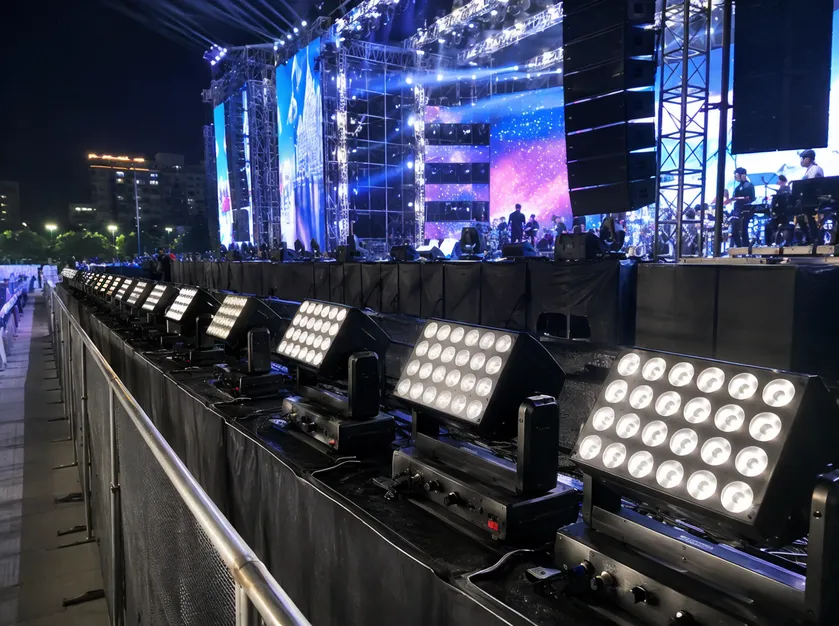
This is the highest-volume segment for flood lights. Rental houses cycle their wash fixtures 150–200 days per year across weddings, corporate events, concerts, and festivals. At that utilization rate, the total cost of ownership calculation is simple: unit cost + failure rate + power consumption over 3-year fleet life.
Our 48-hour aging test and 100% inspection at outgoing means your rental fleet RMA rate stays below 1% — compare that to the 5–8% industry average for untested imports that cost you repair labor, missed gig revenue, and client trust.
Typical Order Pattern
100–500 units for initial fleet buildout, then 50–100 unit replenishment orders annually. We keep popular configurations in semi-finished inventory specifically for rental companies who need fast turnarounds on restock orders.
Houses of Worship — Fixed Installation
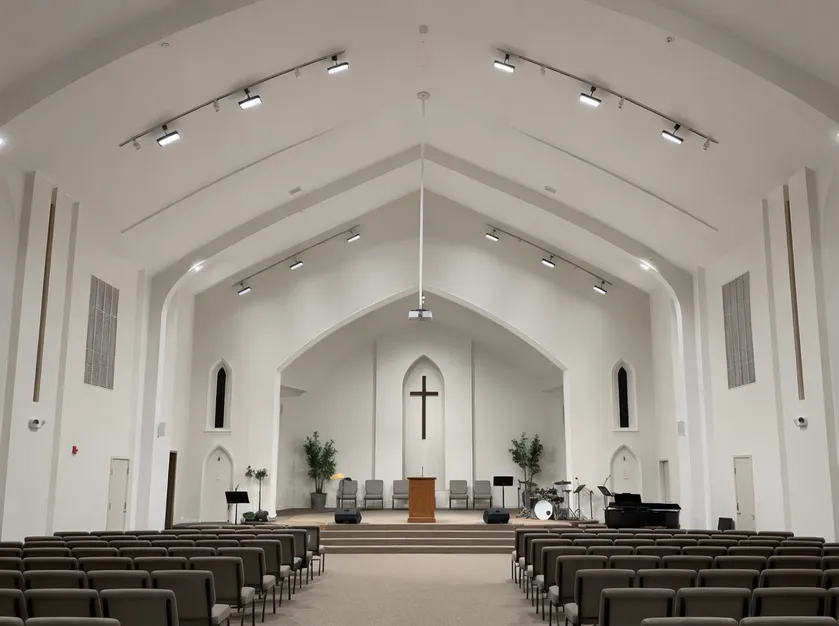
Churches, mosques, temples, and synagogues represent a steadily growing segment. These are fixed-install projects, usually 20–60 flood fixtures per venue, specified by AV integrators and purchased through regional distributors.
The key requirement here is silent operation — worship services don't tolerate fan noise. Our convection-cooled models under 150W run completely silent, and the forced-air models above 200W use temperature-controlled EC fans that stay inaudible below 70% thermal load (which covers 90% of typical worship service scenarios where fixtures aren't running at full output continuously).
Distribution Insight
Worship is a high-margin segment because buyers value reliability and low maintenance over absolute lowest price. Reorder cycles are long (5–7 years for replacement) but the per-project value is strong.
Outdoor Festivals & Architectural Lighting
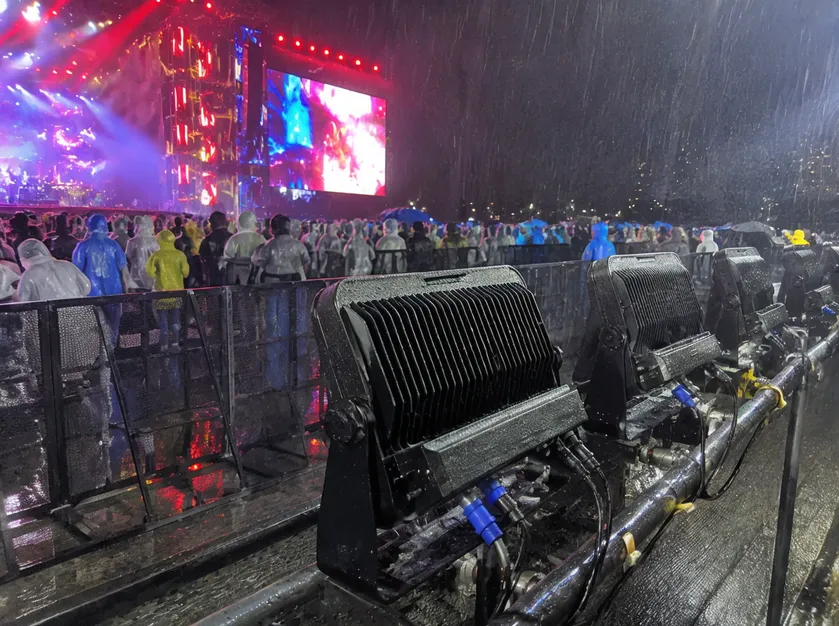
IP65-rated stage flood lights for outdoor use command a premium because the sealed optics, potted electronics, and marine-grade connectors add real material cost. That price premium passes through to your buyer. Festival rental companies and outdoor venue operators need fixtures that survive rain, dust, and temperature swings without failure mid-show.
We pot the LED driver boards with thermal-conductive silicone and use IP-rated Seetronic or Neutrik power connectors as standard on outdoor models.
Engineering Note
We switched to potted drivers after seeing condensation-related driver failures on fixtures returned from Southeast Asian monsoon-season events — the conformal coating alone wasn't enough for continuous high-humidity exposure.
Theatre & Broadcast — Cyclorama and Backdrop Wash
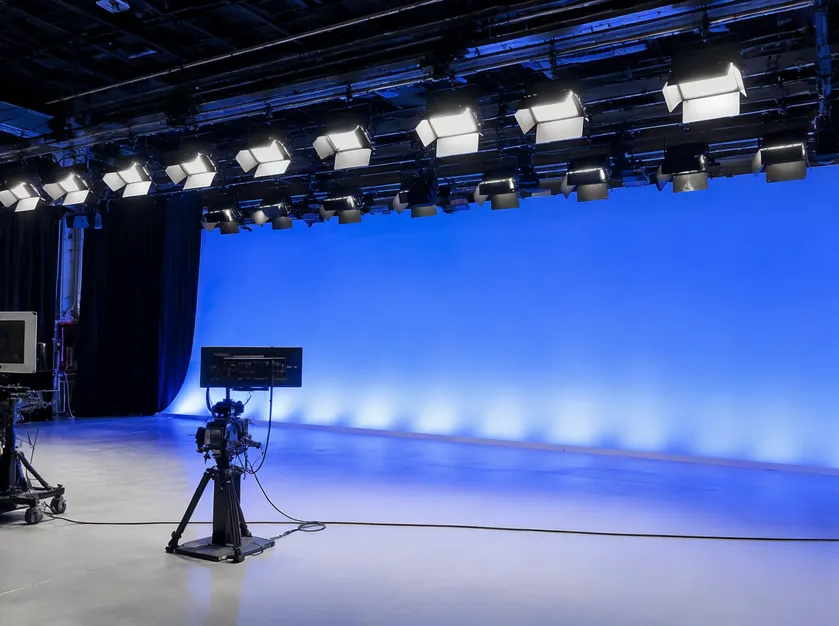
Theatres and broadcast studios use flood lights specifically for cyclorama illumination, where color uniformity across a 12–20 meter backdrop is the technical requirement. Uneven coverage reads on camera as visible bands. Our asymmetric optics and RGBW+UV LED arrays produce consistent color mixing across the full throw without the overlap-intensive setup that generic floods require.
Broadcast integrators order in project lots (30–80 fixtures per studio fit-out), and the key selling point is CRI ≥90 combined with flicker-free dimming at high-speed camera frame rates. We test dimming performance at 1000fps to verify zero flicker — this is a pass/fail requirement for broadcast, not a nice-to-have.
Tell us which segment you're targeting — we'll recommend the right model configuration and quote accordingly.
Get Segment-Specific RecommendationsOptical Engineering That Reduces Your Per-Project Fixture Count
This is where flood lights from different factories diverge in real commercial value, even when the spec sheets look similar on paper.
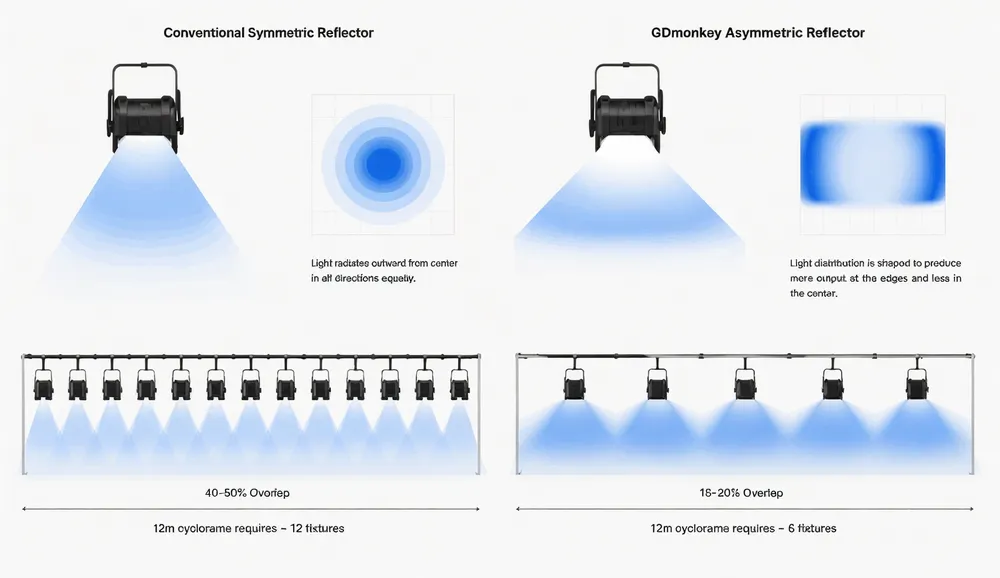
Conventional Symmetric Reflector
Light radiates outward from center in all directions equally. The result is a bright hotspot in the middle and rapid falloff at the edges.
To get even coverage across a 10-meter backdrop, you need to overlap fixtures by 40–50%, which means your rig requires more fixtures, more power, and more rigging points.
GDMonkey Asymmetric Reflector
Light distribution is deliberately shaped to produce more output at the beam edges and less in the center. The result: a smooth, even wash field that requires only 15–20% overlap between adjacent fixtures.
On a typical 12-meter cyclorama, that's the difference between needing 8 fixtures and needing 12.
What 33% Fewer Fixtures Means for Your Business
More Competitive Bids
Lower total fixture cost for the client while maintaining your margin per unit.
Better Margin Per Fixture
Sell 8 premium units instead of 12 commodity units — maintained revenue with better margin per fixture sold.
Either way, the optical performance is your competitive selling point to the end customer.
Photometric Validation & IES Data
We validate beam uniformity on every production batch using an integrating sphere and goniometer measurement. The beam profile data ships with every order as a photometric file (IES format) that your customers' lighting designers can plug directly into their visualization software.
Most competing factories don't provide IES files at all — their customers have to guess at fixture spacing. Providing real photometric data positions you as a premium supplier even before the fixture ships.
IES Files Included
Every order ships with real photometric data for designer visualization software
Customization Scope — What You Can Spec on Your Order
| Customization Dimension | Available Options | Impact on MOQ / Lead Time |
|---|---|---|
| LED Configuration | RGBW, RGBWA, RGBWA+UV, Tunable White (2700–6500K), Single Color | No MOQ impact; standard configurations |
| Wattage / LED Count | 18×3W through 72×6W arrays | No MOQ impact on standard arrays; custom arrays from 100 units |
| Beam Angle | 15°, 25°, 25°×45° asymmetric, 40°, 60°, 15–60° motorized zoom | No MOQ impact on standard optics; custom lens molds from 500 units |
| Housing Color | Black (standard), white, custom RAL colors | Custom colors from 100 units; add 3–5 days for powder line changeover |
| IP Rating | IP20 (standard indoor), IP65 (outdoor sealed) | No MOQ impact; existing production variants |
| Control Protocol | DMX512 (standard), Art-Net, sACN, wireless DMX (W-DMX/CRMX) | Wireless add-on from 50 units |
| Connector Type | PowerCON (standard), Seetronic, TRUE1, country-specific power cable | No MOQ impact on standard connectors |
| Branding | Your logo on housing, custom firmware splash screen, private-label packaging | OEM branding from 30 units |
| Mounting | Standard yoke, floor stand adapter, truss-mount quick-release, recessed ceiling mount | Non-standard mounting from 100 units |
| Accessories | Barn doors, gel frames, diffusion filters, rain covers | Available as add-on SKUs |
LED Configuration
RGBW, RGBWA, RGBWA+UV, Tunable White (2700–6500K), Single Color
No MOQ impact; standard configurations
Wattage / LED Count
18×3W through 72×6W arrays
No MOQ impact on standard arrays; custom arrays from 100 units
Beam Angle
15°, 25°, 25°×45° asymmetric, 40°, 60°, 15–60° motorized zoom
No MOQ impact on standard optics; custom lens molds from 500 units
Housing Color
Black (standard), white, custom RAL colors
Custom colors from 100 units; add 3–5 days for powder line changeover
IP Rating
IP20 (standard indoor), IP65 (outdoor sealed)
No MOQ impact; existing production variants
Control Protocol
DMX512 (standard), Art-Net, sACN, wireless DMX (W-DMX/CRMX)
Wireless add-on from 50 units
Connector Type
PowerCON (standard), Seetronic, TRUE1, country-specific power cable
No MOQ impact on standard connectors
Branding
Your logo on housing, custom firmware splash screen, private-label packaging
OEM branding from 30 units
Mounting
Standard yoke, floor stand adapter, truss-mount quick-release, recessed ceiling mount
Non-standard mounting from 100 units
Accessories
Barn doors, gel frames, diffusion filters, rain covers
Available as add-on SKUs
What we can't customize (being transparent here)
- • LED chip brand changes below 200 units aren't practical because of SMT reel minimum buys.
- • Housing dimensions are fixed per model — we can change finish and color, but modifying the die-cast mold for dimensional changes is a tooling investment that only makes sense above 2,000 units.
- • Firmware modifications beyond splash screen and default settings require engineering time, so we quote those on a per-project basis.
Starting an OEM program? Send your brand requirements — logo, packaging specs, target configuration — and we'll confirm feasibility within 48 hours.
Thermal Management and LED Longevity — Protecting Your Fleet Investment
LED flood lights that overheat don't just dim — they degrade irreversibly. Every 10°C above optimal junction temperature cuts LED lifespan by roughly 50%. For a rental company running fixtures 200 days per year at full output, the difference between a well-cooled fixture and a poorly-cooled one is the difference between 7-year fleet life and 3-year fleet life. That's your capital expenditure amortization in one line.
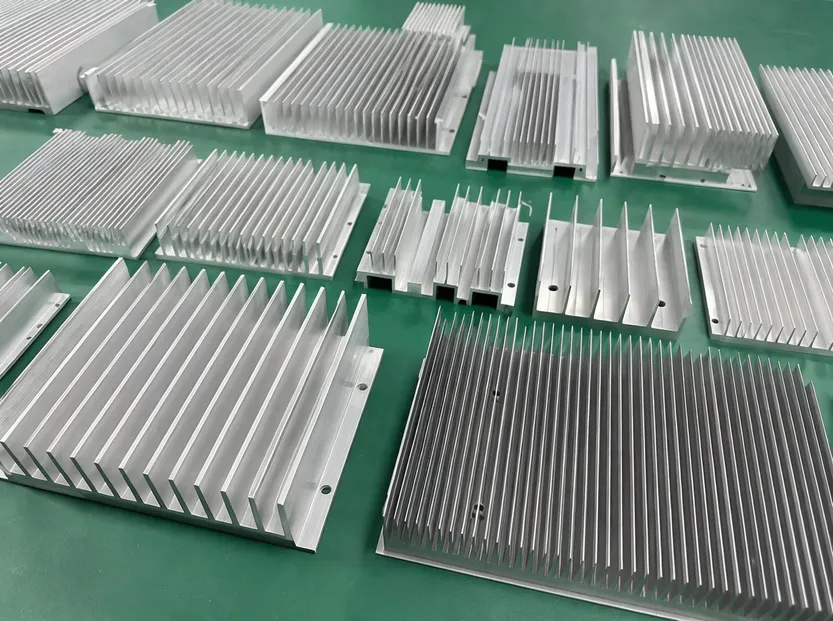
We machine our own heatsink fins from 6063-T5 aluminum rather than buying generic extruded heatsinks. The fin geometry is designed per-model based on the LED array wattage and expected duty cycle — a 400W flood gets a different thermal stack than a 100W compact model. Fin pitch, height, and surface area are calculated so junction temperature stays below 85°C at continuous full output in a 40°C ambient environment.
<85°C
Junction temp at full output
40°C
Rated ambient environment
<25dB
Fan noise at 50% output
7yr
Fleet life with proper cooling
Intelligent Forced-Air Cooling
For models above 200W, we add forced-air cooling with temperature-controlled brushless DC fans. The fans don't run at a fixed speed — they respond to actual heatsink temperature via an onboard thermistor.
- ▸ At 50% output (typical for most wash applications), the fans either don't spin at all or run at minimum speed, keeping acoustic noise below 25dB.
- ▸ At sustained 100% output in a hot environment, they ramp up automatically.
- ▸ This extends both fan bearing life and LED array life compared to fixtures running fans at full speed continuously.
Thermal Paste QC — Why It Matters
We've measured competitor teardowns where the thermal paste between LED board and heatsink was applied inconsistently — some chips making good contact, others with air gaps. That's a guaranteed early failure on the LEDs with poor thermal coupling.
- ▸ Automated paste dispensing with controlled volume per application point
- ▸ Post-assembly thermal imaging to verify contact uniformity across every LED in the array
- ▸ Eliminates the random early failures caused by uneven thermal coupling in budget fixtures
Fleet Life Impact: Proper Cooling vs. Inadequate Cooling
GDMonkey — Engineered Thermal Stack
~7 years at 200 days/yr full output • Junction <85°C • Per-model fin geometry
Generic — Standard Extruded Heatsink
~3 years at same duty cycle • Inconsistent paste • Fixed-speed fans
Every 10°C above optimal junction temperature cuts LED lifespan by roughly 50%. The capital expenditure difference between a 7-year amortization cycle and a 3-year replacement cycle is significant for fleets above 50 fixtures.
Quality Verification — What "48-Hour Aging Test" Actually Means for Your Returns Rate
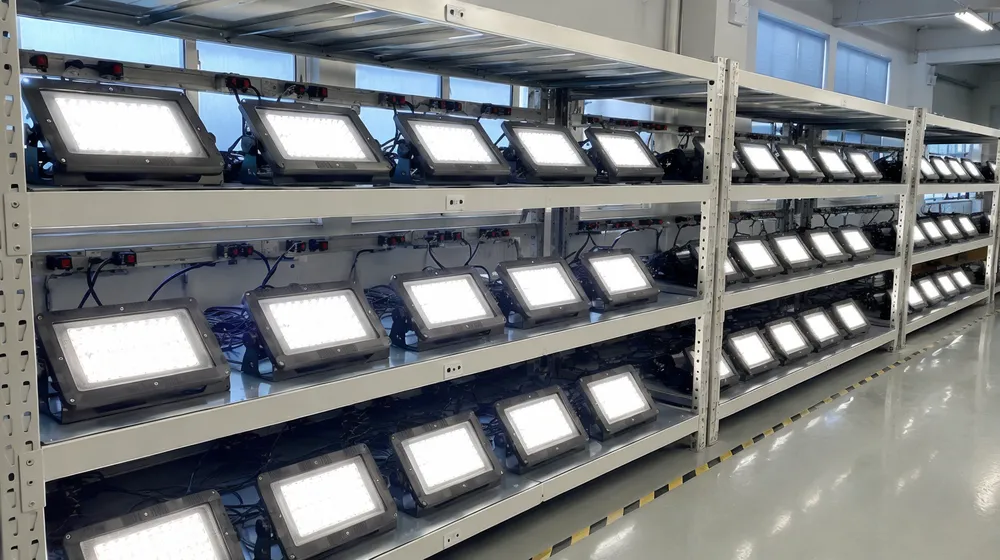
Every flood light we ship goes through full-load burn-in for 48 continuous hours before it gets a shipping label. Not batch sampling — every unit.
Here's what happens during those 48 hours: the fixture runs at maximum output on all LED channels. If an LED chip is going to fail early (infant mortality), it fails in our aging rack, not in your customer's venue. If a capacitor in the LED driver is marginal, it pops here, not three months into service. If a thermal interface has an air gap, the junction temperature alarm triggers here, and the unit goes back to rework.
After Aging: 100% Functional Testing Covers
DMX Response
All channel modes verified for correct signal interpretation
Color Calibration Accuracy
Measured against reference values for unit-to-unit consistency
Dimming Linearity and Smoothness
No stepping or flicker across the full dimming curve
Fan Operation & Thermal Regulation
200W+ models tested for active cooling performance
Mechanical Integrity
Yoke lock, safety cable point, connector seating all inspected
IP Seal Integrity
Outdoor models undergo pressure-decay leak test
<0.8%
Warranty claim rate across all export markets
3 Years
Continuous tracking data backing this rate
992/1,000
Fixtures performing without a support ticket or return
Compliance and Certification — Pre-Qualified for Your Target Markets
CE (LVD + EMC)
Scope: Full EU market access
Your Benefit: No import holds or re-testing at your border
FCC Part 15
Scope: US and Canadian market
Your Benefit: Compliant out of the box for North American distribution
RoHS
Scope: Restricted substances compliance
Your Benefit: Meets EU, UK, and increasingly Asian import requirements
IP65
Scope: Ingress protection (outdoor models)
Your Benefit: Sell into outdoor festival and architectural markets confidently
IP67
Scope: Submersible rating (select models)
Your Benefit: Premium positioning for extreme-environment applications
ISO 9001:2015
Scope: Quality management system
Your Benefit: Audit-ready documentation for your procurement compliance requirements
Documentation Included
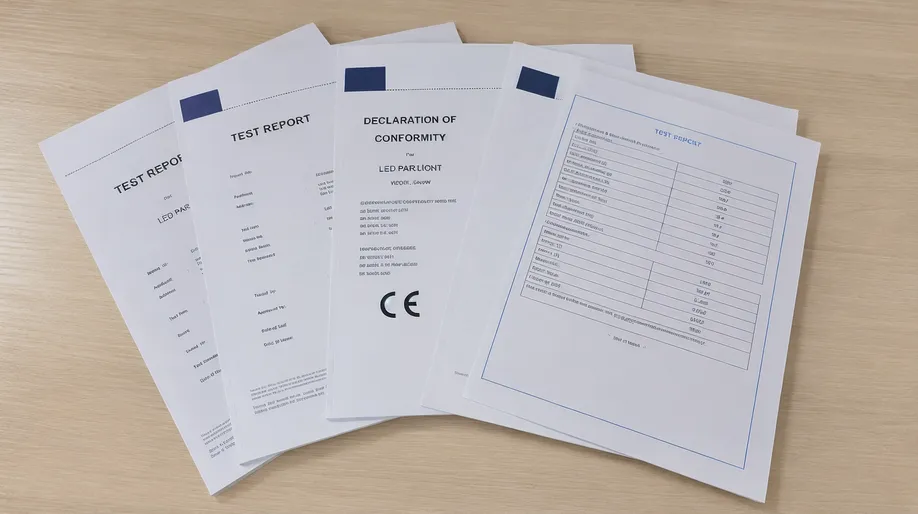
All test reports and declarations of conformity are available in your shipment documentation, formatted for customs clearance in your destination country. We handle the paperwork structure — you don't need to reconstruct compliance files from scratch.
Additional Market Certifications
For buyers selling into markets with additional local requirements (SAA for Australia, KC for Korea, PSE for Japan), we can arrange third-party testing through our accredited lab partners.
Typically 4-6 weeks for certification
Engineering support cost absorbed on orders above 500 units
Available: SAA (Australia), KC (Korea), PSE (Japan), and other regional standards
Packaging and Container Loading — Your Landed Cost Calculation
We calculate container loading plans per order and share the layout before production so you can verify against your logistics budget.
Individual Unit Packaging
Molded EPE foam insert for shock absorption during transit
Inner carton with individual unit protection
Accessory kit included: power cable, safety chain, clamp adaptor
Master Carton
Double-wall corrugated construction
Stacking strength rated for 6-high container loading
Carton dimensions vary by model; optimized for container volume utilization
Container Loading Quantities
20GP
~800
units
40HQ
~1,800
units
20GP
~280
units
40HQ
~650
units
Palletization
Available on request; adds 5–8% to volume but speeds warehouse receiving significantly.
Custom Labeling
Custom barcode, SKU, and carton markings per your warehouse system requirements.
Blind Shipping
Private-label packaging with zero GDMonkey branding — ready for your brand identity.
LCL Shipment Reinforcement
If you're shipping LCL, we pack and reinforce accordingly — LCL shipments take more handling abuse than full containers.
Learned this from early days when a shared-container shipment arrived with crushed master cartons because the logistics company stacked heavy cargo on top. Now our LCL cartons get extra reinforcement and "fragile/this side up" markings in the destination language.
Production Lead Time
20–30 days standard models
30–45 days custom configurations
Sample Units
Ship within 5–7 days
From ready stock or semi-finished inventory
How Stage Flood Lights Differ from Other Fixtures in Our Spotlight Range
You're looking at this page, which means you may also be evaluating our other spotlight-category fixtures. Here's how floods fit in the context of the full range — and when you'd choose one over the other:
Most buyers stock flood lights alongside 2–3 other fixture types to cover a full project scope. If you're building a product line or rental inventory from scratch, tell us your target market and we'll recommend a starter fixture mix based on what moves in your region.
Stage Flood Lights
This Page
Best for:
Wide-area even wash — backdrops, cycloramas, general stage fill
Why choose:
Asymmetric optics for uniform coverage; highest output per fixture
Theatre Spotlight
Best for:
Tight beam for performer isolation or gobo projection
Why choose:
Focused beam with framing shutters and pattern projection
View Theatre SpotlightMoving Head Spotlight
Best for:
Automated position + color on a moving fixture
Why choose:
Pan/tilt movement for dynamic shows and touring rigs
View Moving Head SpotlightDMX Spotlight
Best for:
DMX-controlled spot with programmable color and intensity
Why choose:
Full DMX integration for complex cue programming
View DMX SpotlightWarm White Spotlight
Best for:
Warm-tone wash for intimate or architectural settings
Why choose:
High-CRI tungsten-tone output for film-friendly environments
View Warm White SpotlightDJ Spotlight
Best for:
Compact effect lighting for DJ and club environments
Why choose:
Music-reactive modes and compact form factor for mobile DJs
View DJ SpotlightBuilding a product line or rental inventory from scratch? Tell us your target market and we'll recommend a starter fixture mix based on what moves in your region.
Frequently Asked Questions — Stage Lighting Flood Lights
What IP rating do I need for outdoor stage flood lights?
What IP rating do I need for outdoor stage flood lights?
IP65 handles rain, dust, and washdown — sufficient for 95% of outdoor festival and architectural applications. IP67 adds temporary submersion protection, which matters for ground-mounted fixtures in locations prone to standing water or for wash-down cleaning between events.
If your fixtures live permanently outdoors year-round, IP65 minimum. If they go out for weekend festivals and come back to the warehouse, IP65 is more than adequate, and the lower unit cost protects your margin.
How many stage flood lights do I need for a 10-meter cyclorama?
How many stage flood lights do I need for a 10-meter cyclorama?
With symmetric-optic floods, you'd typically need 10–12 fixtures spaced at 0.8–1.0m intervals for even coverage. Our asymmetric-optic models cut that to 6–8 fixtures at 1.2–1.5m spacing because the beam-edge output is engineered to be uniform rather than falling off.
We provide IES photometric files with every order so your customers' designers can simulate exact spacing in Vectorworks or WYSIWYG before installation.
RGBW vs. tunable white floods — which configuration should I stock?
RGBW vs. tunable white floods — which configuration should I stock?
RGBW serves 80% of the market — concerts, events, theatre, and architectural color wash all need full color mixing. Tunable white (2700–6500K variable CCT) targets broadcast studios, film sets, and high-CRI theatre applications where color accuracy under camera matters more than color variety.
If you serve both segments, stock RGBW as your volume SKU and tunable white as a premium add-on. The margin on tunable white is typically 15–20% higher because the LED binning requirements are tighter.
What's the realistic lifespan of LED flood lights in rental use?
What's the realistic lifespan of LED flood lights in rental use?
At 200 days/year, 8 hours/day average runtime, that's 1,600 hours annually. With proper thermal management (our fixtures maintaining junction temp below 85°C), LED L70 life is 50,000 hours — which translates to 30+ years of rental use before meaningful brightness loss.
In practice, the fixture body, connectors, and moving parts (fans, locks) will wear out before the LEDs do. Budget for fan replacement around year 5–6 on forced-air models. Our design uses standard replaceable fan modules — a 10-minute field swap, no factory return needed.
What's the MOQ for OEM-branded stage flood lights?
What's the MOQ for OEM-branded stage flood lights?
30 units — branding on existing models (your logo, packaging, firmware splash screen).
100 units — custom configurations (non-standard LED array, modified optics, new housing color).
2,000 units — full custom tooling (new housing design).
Most new buyers start with 50–100 OEM units of an existing model to test market response, then move to custom configurations on reorders.
Start Your Flood Light Order or Sample Request
Whether you're building a rental fleet, quoting a venue installation, or adding wash fixtures to your distribution catalog, the next step is the same: send us your requirements and we'll respond with a model recommendation, pricing structure, and sample timeline.
What to include in your inquiry:
- Target application (rental, install, distribution)
- Quantity range (even a rough estimate helps us quote accurately)
- Configuration preferences (wattage, beam angle, IP rating, color system)
- OEM/branding needs (if applicable)
- Destination market (helps us include the right compliance documentation)
Teresa@gdmonkey.com
+86-135 3966 9939
24h
Quote Response
5–7 Days
Sample Shipping
20–30 Days
Production Delivery
Your inquiry reaches our engineering and sales team directly — no distributors, no intermediaries, no telephone game between you and the people who build the fixtures.
Explore More Stage Lighting