

Wedding Stage Lighting Fixtures Built for Rental Fleet Profitability
LED wash, wireless PAR, and pin spot fixtures engineered for ceremony-grade performance and commercial rental durability.
Silent operation, flicker-free dimming at any camera frame rate, and housing that survives 200+ deployment cycles — the fixtures your clients book every weekend without complaints.
Burn-in QC
48-hour
OEM Branding
From 30 pcs
Certifications
CE FCC RoHS
Annual Capacity
350,000 units
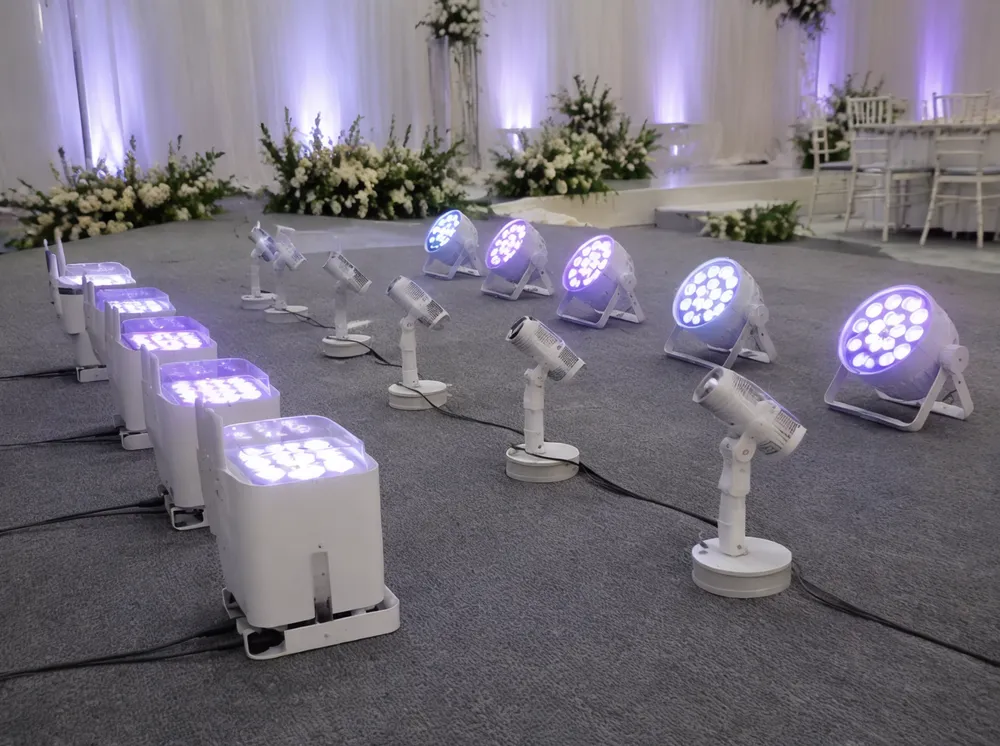
What This Product Line Covers — And Who It's For
Wedding stage lighting fixtures is our ceremony-and-décor-focused range: LED wash uplights (battery-powered and wired), RGBWA+UV PAR cans, pin spot arrays for table centerpiece illumination, and compact moving head wash units with CTO color temperature correction from 2700K to 6500K.
These are not the high-energy dance floor fixtures — those live in our dance stage lighting line. This range is designed around a single commercial requirement: produce beautiful, silent, color-accurate light that makes your rental client's event look premium while surviving weekly re-deployment without service calls.
Your end customers are wedding planners, venue managers, and church AV coordinators who expect the light to disappear — no fan noise during vow exchanges, no visible flicker on videographer footage, no color inconsistency between fixtures deployed in a row. Your business requirement is simpler: fixtures that go out, come back, go out again, and keep earning revenue without eating into your margin through repairs, replacements, or client complaints.
LED Wash Uplights
Battery-powered & wired, RGBWA+UV
Wireless PAR Cans
Cable-free deployment, app & DMX control
Pin Spot Arrays
Narrow-beam centerpiece illumination
Compact Moving Head Wash
CTO 2700K–6500K, motorized zoom
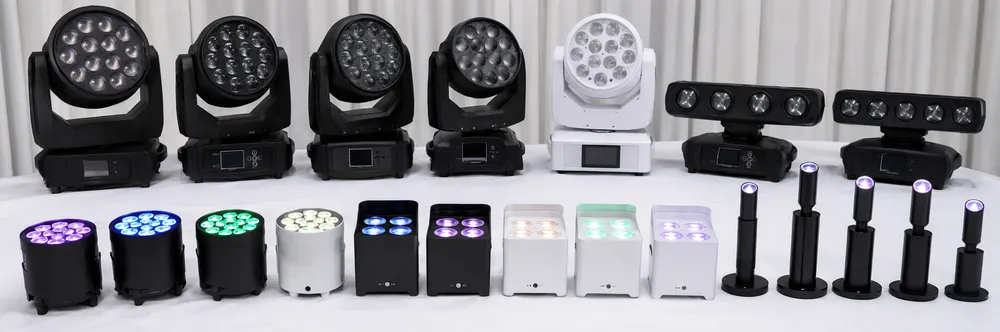
Fixture Range and Technical Specifications
Specifications shown are standard production values. Exact parameters are configured during the quoting process based on your target price point and end-use environment. Contact us for detailed model-specific data sheets.
| Parameter | LED PAR / Uplight | Battery Wireless PAR | Pin Spot | Moving Head Wash (Compact) |
|---|---|---|---|---|
| LED Source | RGBWA+UV 6-in-1 | RGBWA+UV 6-in-1 | Warm White / RGBW | RGBW or RGBWA+UV |
| Wattage | 12×12W or 18×18W | 6×12W or 12×12W | 10W–30W | 7×40W or 12×40W |
| Beam Angle | 25° (standard), 15°–60° zoom available | 25° standard | 5°–15° narrow spot | 8°–60° motorized zoom |
| Control Protocol | DMX512, Master/Slave, Sound-active | Wireless DMX, IR remote, App | DMX512, Standalone | DMX512, Art-Net |
| Noise Level | <20dB (convection-cooled) | Silent (passive thermal) | Silent | <28dB (temp-controlled fan) |
| IP Rating | IP20 (indoor) / IP65 (outdoor) | IP20 | IP20 | IP20 |
| Battery | N/A | 15–20 hours (full RGBW) | N/A | N/A |
| Housing | Die-cast aluminum, powder coated | Die-cast aluminum, powder coated | Machined aluminum | Die-cast aluminum |
| Weight | 3.2–6.8 kg | 3.5–5.5 kg | 0.8–1.5 kg | 8–14 kg |
| Dimming | 0–100% linear, 16-bit | 0–100% linear, 16-bit | 0–100% smooth | 0–100% linear, 16-bit |
| Color Temperature | 2700K–6500K (white modes) | 2700K–6500K (white modes) | 2700K or 3200K fixed (warm white) | Full-spectrum mixing |
Flicker-Free at All Dimming Levels
PWM frequency runs at 25kHz minimum, so videographers shooting 24fps, 30fps, or 120fps slow-motion get clean footage without banding or roll bars. No exceptions at any dimming percentage across the 0–100% range.
Color Rendering Above Ra 95
On warm-white modes, CRI exceeds Ra 95 — because skin tones under wedding lighting are the difference between a photography referral and a complaint. This is the specification that photographers notice first.
Silent Operation — The Specification That Protects Your Client Relationships
Fan noise during ceremonies is the single most common complaint rental operators receive from wedding planners — and it's the complaint that kills repeat bookings.
Fixtures Below 150W — Zero Fans
We took a different approach to thermal management on the ceremony-rated fixtures in this line. Instead of running a fan at constant speed and slapping a "<30dB" number on the spec sheet, we eliminated fans entirely on fixtures below 150W.
The LED PAR and wireless PAR units use a passive heatsink system — oversized aluminum fin arrays machined directly into the rear housing, with thermal interface material bonding the LED PCB to the heatsink mass. No fans means zero acoustic output. Truly zero, not "you probably won't notice it."
Higher-Wattage Moving Heads — Temperature-Regulated Curves
For the higher-wattage moving head wash fixtures that do require active cooling, we run temperature-regulated fan curves. The fan doesn't spin until the internal temperature sensor hits 45°C on the driver board — which takes 15-20 minutes at typical ceremony output levels (40-60% brightness on warm-white).
During a 30-minute ceremony? The fan likely never engages. During a 4-hour reception? It ramps up gradually to a maximum of 28dB, which sits below ambient room noise in any venue with 100+ guests.
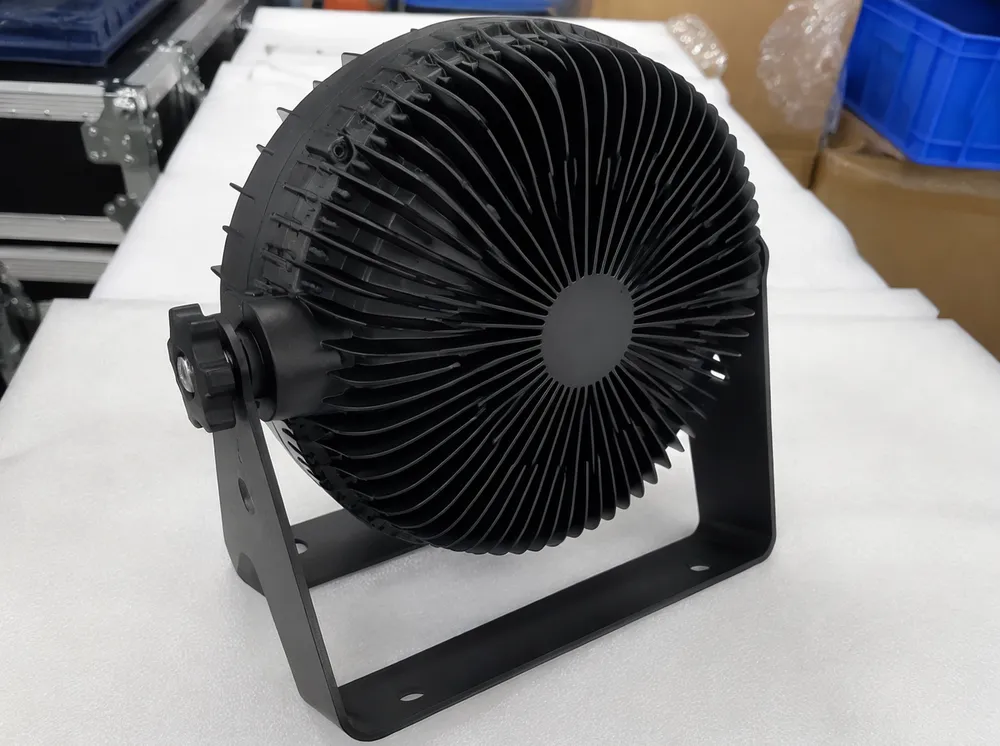
18×18W PAR — Three Thermal Revisions to Full Passive Cooling
We went through three thermal architecture revisions on the 18×18W PAR before we achieved sustained full output without forced-air cooling. The final design uses a radial-fin heatsink with 0.8mm fin spacing and a vertical-orientation mounting recommendation.
It costs us 15% more in aluminum per unit than a standard flat-back design. It also means your client's officiant never has to raise their voice over a cooling fan.
The Commercial Reality
Wedding planners talk to each other. One noise complaint about your lighting equipment travels through the local planner network within a month. Silent fixtures aren't a premium feature — they're minimum viability for the ceremony segment.
Battery Wireless PAR — Cable-Free Deployment Economics
Battery-powered wireless PARs are the highest-margin rental item in most wedding lighting inventories. One reason: setup time.
Setup Time = Revenue Capacity
Your crew deploys a 20-unit uplight package in 30-40 minutes with wireless units versus 90+ minutes with cabled fixtures. That's labor cost you don't bill, and it's the difference between servicing one event per crew per day and squeezing in two.
Our wireless PAR fixtures run 15-20 hours on a single charge at full RGBW output. Most wedding ceremonies and receptions last 6-8 hours total. Your fixtures complete the event with charge to spare, eliminating the mid-event battery swap that cheaper units require at the 4-hour mark.
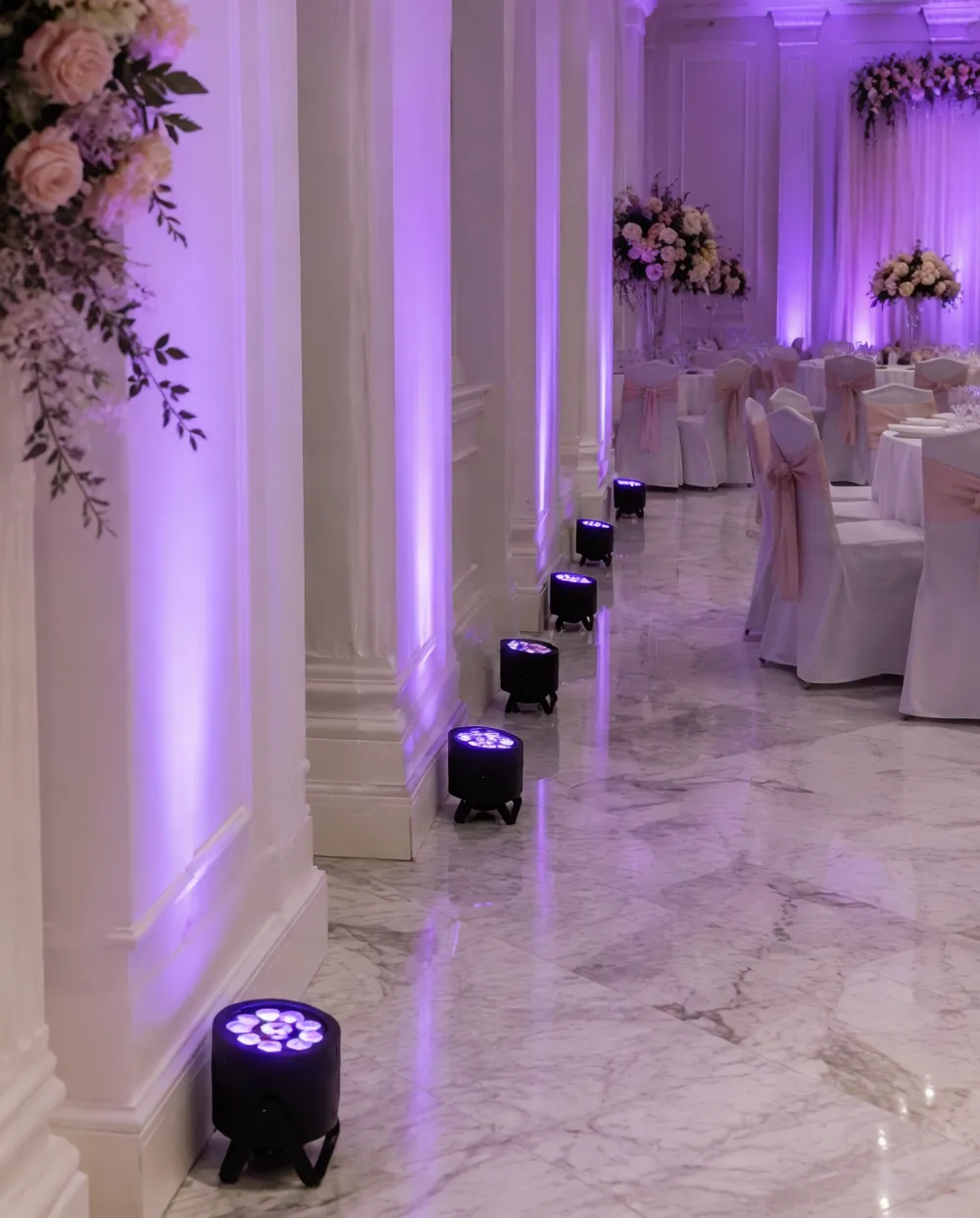
Battery Management — Two-Season Longevity
Standard lithium-ion packs in budget fixtures degrade to 60% capacity within 400 charge cycles — roughly one rental season of weekly use.
We integrate cell-balanced battery management with temperature-compensated charging that reduces charge rate when cell temperature exceeds 35°C.
Result: 80% capacity retention at 800 cycles. Your wireless PARs hold their stated runtime through two full seasons before you need to consider cell replacement.
Field-Serviceable Battery Module
When cells eventually do need replacement, we design the battery compartment as a field-serviceable module. Four screws, pull the old pack, plug the new one in. Your technician does it on the bench in 10 minutes.
You're not sending fixtures back to the factory or scrapping a $200 fixture because a $35 battery pack degraded.
Replacement Process
Wireless DMX — Interference-Proof Signal
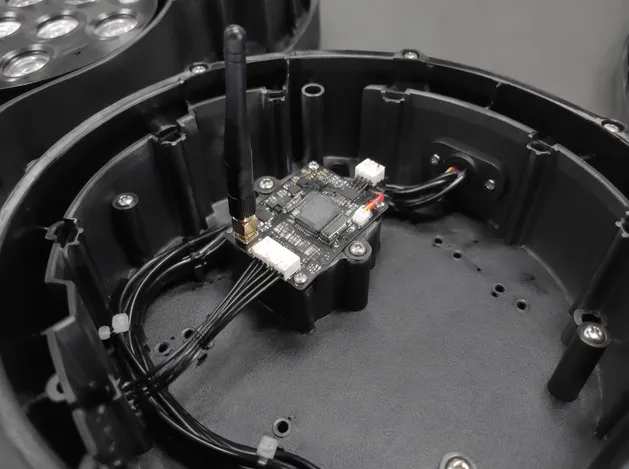
Wireless DMX operates on FHSS across 80+ channels — your signal holds in convention center environments with dense Wi-Fi and Bluetooth interference.
We've tested reliable DMX transmission at 100-meter line-of-sight range in exhibition halls with 50+ competing RF sources running simultaneously.
Wedding Church Stage Lighting Sanctuary Coverage Without Excessive Fixture Counts
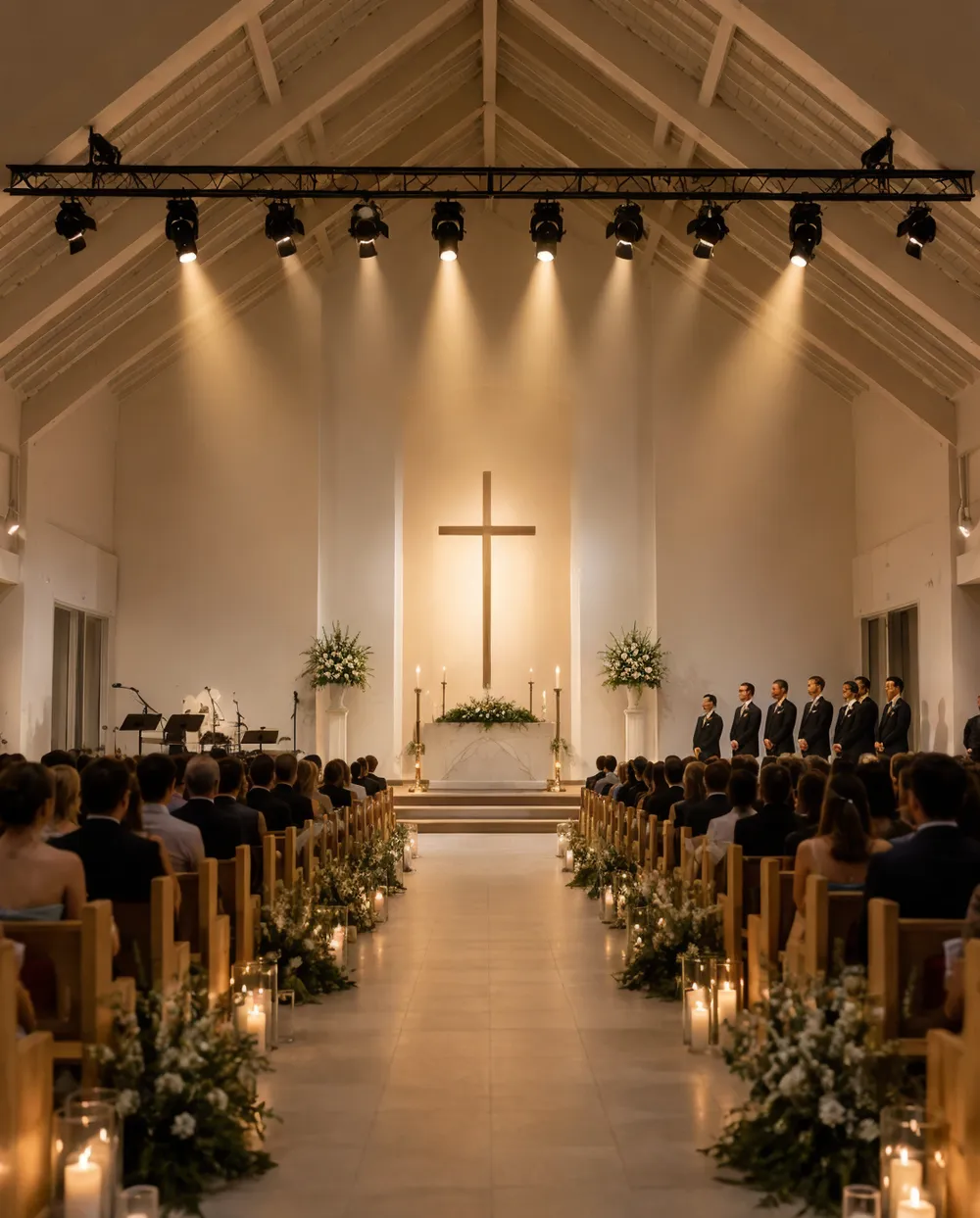
Churches present a specific challenge: high ceilings (8–15 meters in many sanctuaries), fixed mounting positions (front-of-house truss or ceiling brackets), and a requirement for even wash coverage across the stage and first several rows of seating. The wrong fixture choice means either dark spots between pools of light or an over-specified rig that blows the church's AV budget.
Wide Zoom Optics
Our ceremony fixtures address sanctuary coverage with wide zoom optics — 15° to 60° motorized zoom on the moving head wash models, and a standard 40° beam angle on the PAR fixtures with optional 25° or 60° lens swaps.
Predictable Quoting — 12-Fixture Package
A 12-fixture package (8 PARs + 4 compact moving head washes) covers a typical 200-seat sanctuary from a single front truss position. Your quoting becomes predictable: you know the fixture count, you know the total system cost, and your client sees full-room transformation without multiple revision requests.
Dual-Mode Color Temperature — Worship + Wedding
Color temperature matters in churches more than in any other wedding venue type. Worship services run at 3200K–4500K for stage visibility. Wedding ceremonies need 2700K–3200K warm amber.
Our firmware supports dual-mode operation — worship preset and wedding preset selectable via DMX channel — so the same installed fixtures serve both weekly services and Saturday ceremonies. One fixture purchase covers both use cases for the church, and one sale covers both revenue streams for you.
Stage visibility for weekly services
Warm amber for ceremony ambiance
Housing Finish Options — White for Light Ceilings
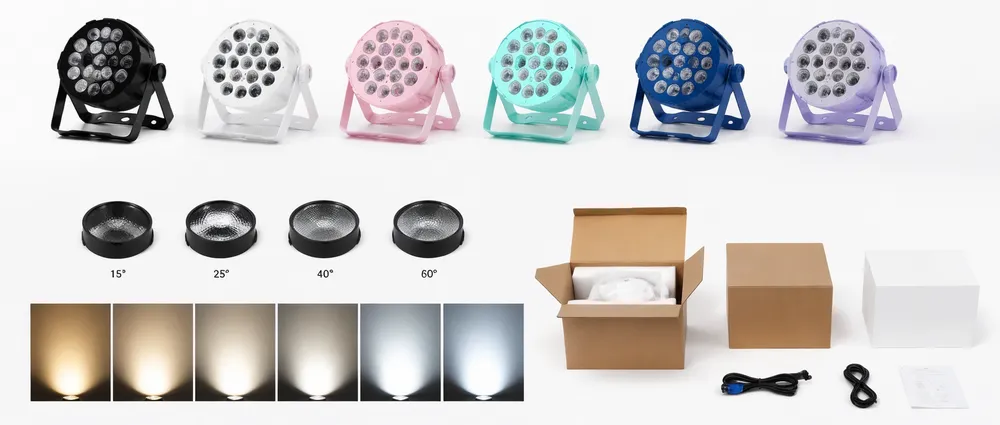
Churches also care about aesthetics of the fixture itself when it's visible overhead. We offer a matte black and a matte white housing finish as standard, with the white option specifically developed for churches with light-colored ceilings where black fixtures create visual distraction. No MOQ difference between colors.
How We Build These — Manufacturing Choices That Show Up in Your P&L
The category page covers our general manufacturing approach for wedding lighting. Here's what matters specifically for the ceremony fixture line and how it translates to your cost of ownership.
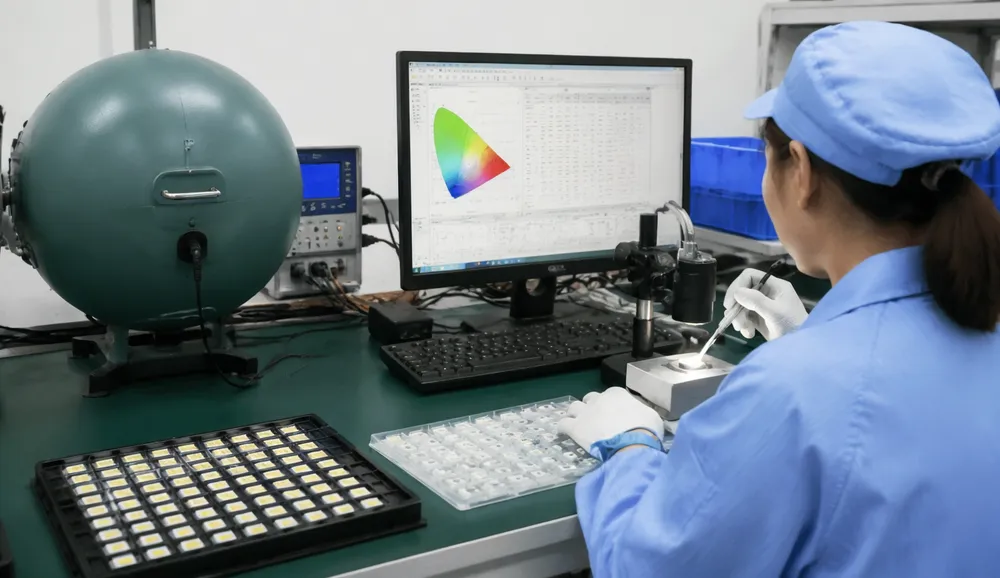
LED Binning at Incoming Inspection
Every warm-white LED chip is tested and binned to ±100K color temperature and ±2 SDCM (Standard Deviation of Color Matching) before entering the SMT line.
When your client deploys 20 uplights in a line down a church aisle, every fixture matches every other fixture. No color drift between units, no embarrassing warm-cool alternating pattern that gets noticed in photographs.
70–80% LED Drive Current Strategy
We don't run LEDs at their rated maximum to hit a headline brightness number. We drive at 70–80% of maximum rated current and compensate with optimized reflector geometry to achieve identical lumen output.
The difference shows up at 2,000 operating hours: our fixtures maintain 95%+ of initial brightness while max-driven LEDs have typically dropped to 70–80%. Your fleet stays at spec performance for three rental seasons instead of needing LED module replacements after one.
Connector Durability Testing
PowerCon and 5-pin DMX connectors get rated and tested for 5,000+ insertion cycles before fixture integration. Every connector is panel-mounted with strain relief — not PCB-mounted where a rough cable pull cracks the solder joint.
A connector failure at 9 PM on a Saturday during a wedding is a service call that costs you $200–500 in emergency labor, plus the reputation damage. We over-engineer this joint specifically because the failure cost is so disproportionate to the component cost.
Die-Cast Aluminum Housing
Die-cast construction with 2.0mm minimum wall thickness absorbs impact at internal rib structures without deforming the lens mount. The ceremony fixtures aren't high-abuse like the dance floor units, but they still go in and out of road cases every weekend.
Your optical alignment stays factory-calibrated through 200+ deployment cycles — the beam angle and hotspot centering on fixture number 200 matches fixture number 1 out of the box.
Customization Scope for Wedding Lighting Fixtures
Tell us what you need to customize and the volume you're planning. We'll tell you what's feasible, what it costs, and what the timeline looks like — no ambiguity.
Standard Customization
No tooling charge, no MOQ increase
| Dimension | Options |
|---|---|
| Housing Color | Matte black, matte white, any RAL color at orders >50 units |
| LED Color Temperature | 2700K, 3000K, 3200K, 4000K, 5600K, 6500K (warm white models) |
| Beam Angle Lens | 15°, 25°, 40°, 60° (interchangeable lens system on PAR models) |
| DMX Personality | Standard, compact (fewer channels), custom preset scenes |
| Branding | Logo silkscreen on housing, custom packaging, branded manuals |
| Power Input | 100-120V / 220-240V configured per destination market |
| Firmware Language | English, Spanish, French, Arabic display menus on LCD models |
ODM Customization
Requires development cycle, 4–6 weeks lead time
- Custom beam angle optimization for specific venue ceiling heights
- Modified color mixing curves tuned to regional wedding color preferences
- Proprietary wireless control protocol integration (beyond standard FHSS DMX)
- Custom battery capacity for extended-runtime wireless fixtures
- Modified housing dimensions for specific flight case compatibility
- Custom DMX personality profiles for specific lighting consoles
Limitations — What We'll Tell You Upfront
- Housing tooling modification requires 300+ unit commitment — the die-casting mold cost needs to amortize across enough units to keep your per-unit price sane
- Custom Pantone color matching requires 200+ units per color per SKU — below that, select from our standard RAL palette
- IP65 upgrade on standard IP20 models is a separate SKU, not a field modification — sealing, cable glands, and conformal coating are production-line decisions
- Battery chemistry changes (e.g., LiFePO4 for extreme temperature markets) require 500+ unit commitment due to BMS firmware validation
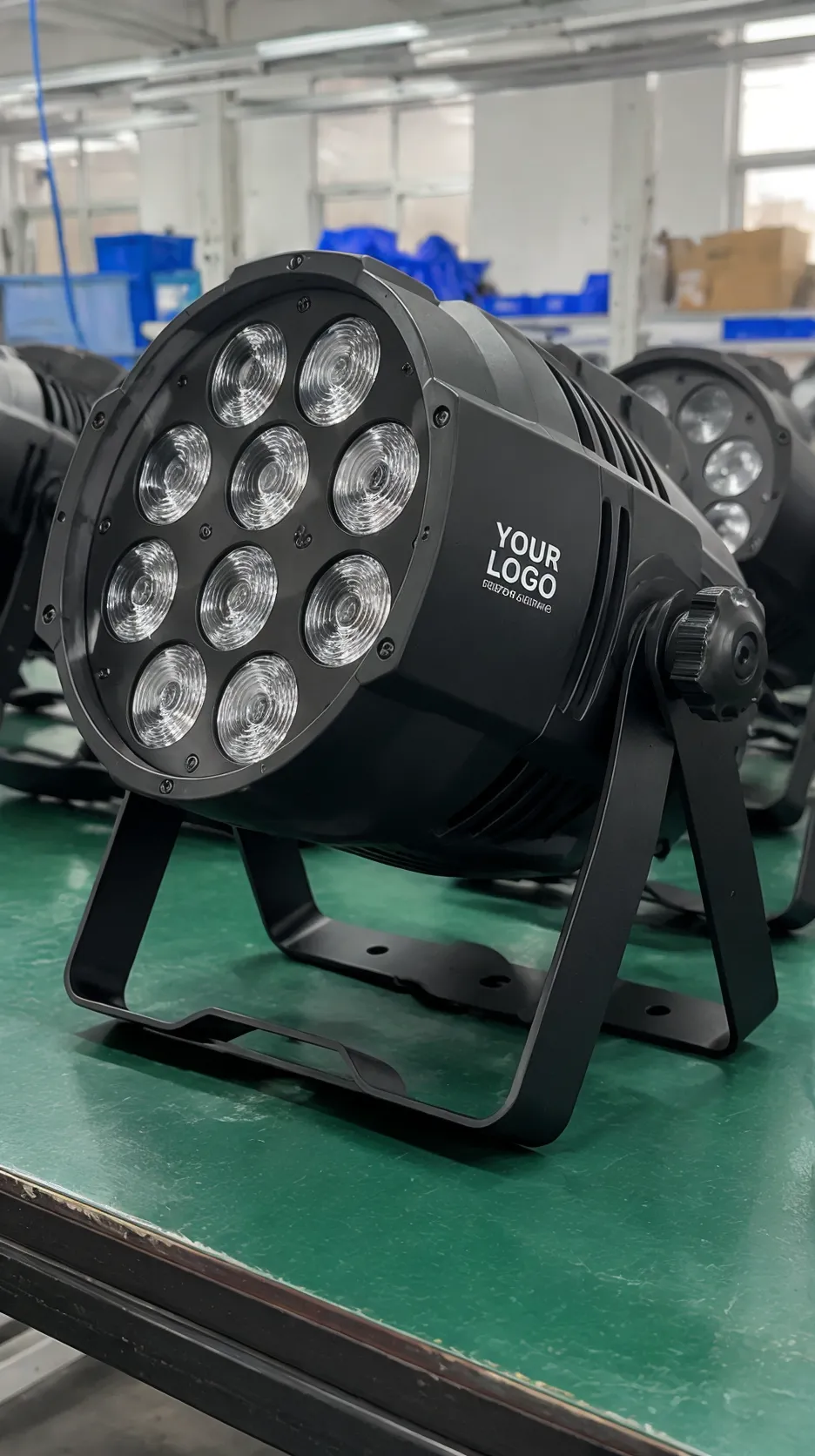
Application Segments — Where Your Buyers Deploy These Fixtures
Each segment has different margin expectations and feature priorities. Tell us which customer type you serve, and we'll recommend the fixture mix, specification tier, and pricing structure that matches your sales model.
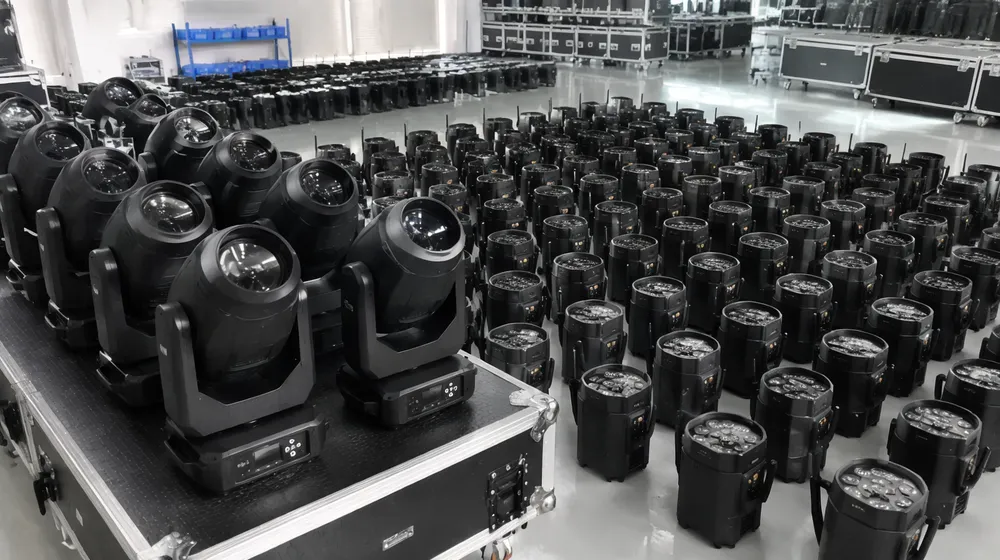
Event Rental Fleet Inventory
The primary market. Event rental companies buy 50–200 mixed fixtures to build a complete wedding lighting package: 12–20 wireless uplights for room washes, 4–8 pin spots for table highlights, 4–6 moving head washes for stage and dance floor coverage.
Typical reorder cycle is 12–18 months as fleet expands with business growth or fixtures rotate out after 3 rental seasons. High-utilization fixtures (wireless PARs especially) earn their cost back within 8–12 weekends of rental bookings.
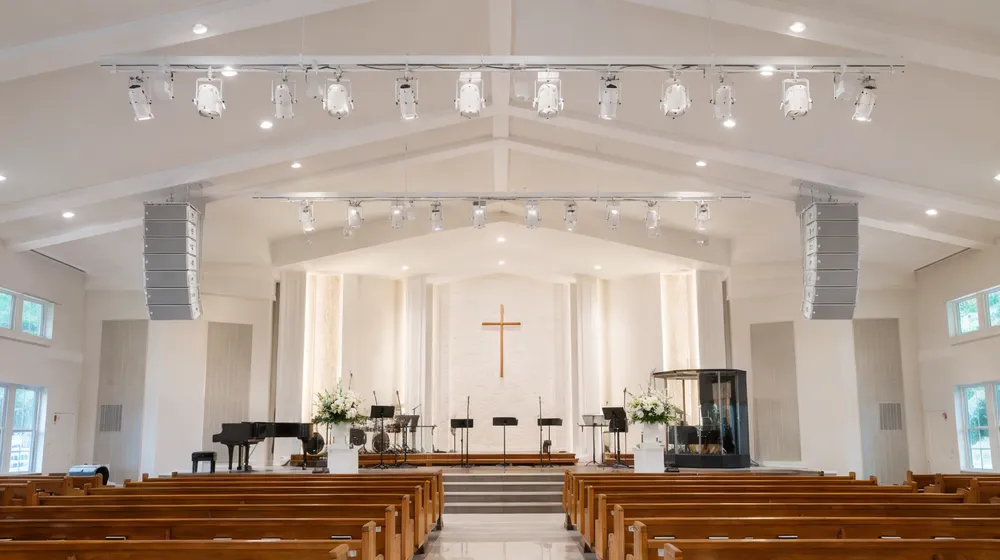
Church and House of Worship Installations
Permanent ceiling-mount systems in sanctuaries that serve double duty — worship services during the week, wedding ceremonies on weekends. Order volumes typically 30–80 fixtures per installation, with repeat orders when the installer wins additional venue contracts.
The dual-mode firmware (worship + wedding presets) is specifically what this segment needs — one fixture sale serves two use cases for the venue, which simplifies your pitch to the church decision-maker.
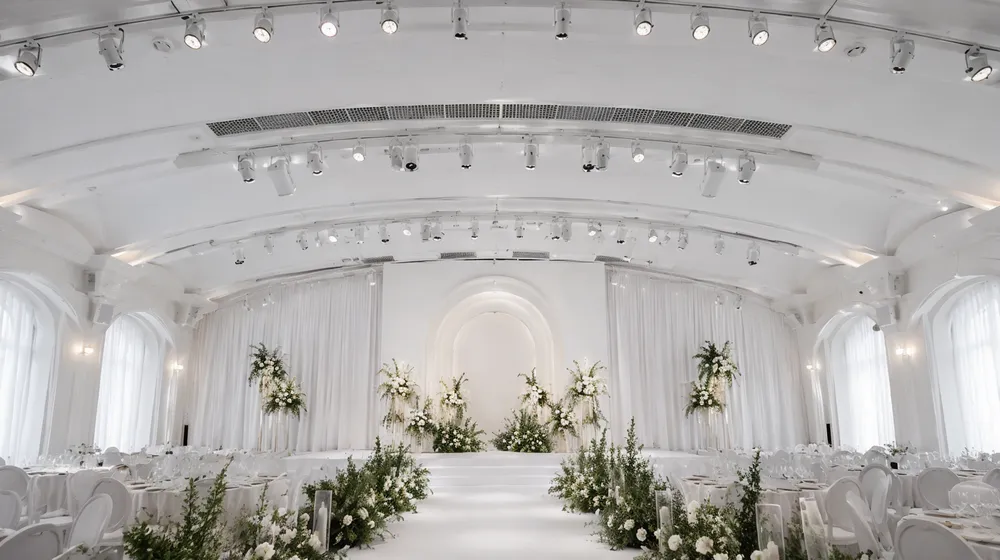
Wedding Venue Permanent Installs
Banquet halls, boutique hotels, estate venues, and dedicated wedding spaces that install permanent architectural lighting rigs. These buyers need silent operation, architectural aesthetics (white housings, minimal visual profile), and integration with house DMX control systems.
Orders are project-based (40–120 fixtures per venue) with long-term replacement/expansion potential as venues renovate or add outdoor ceremony spaces requiring IP65-rated units.
AV Distribution — Building a Branded Wedding Lighting Line
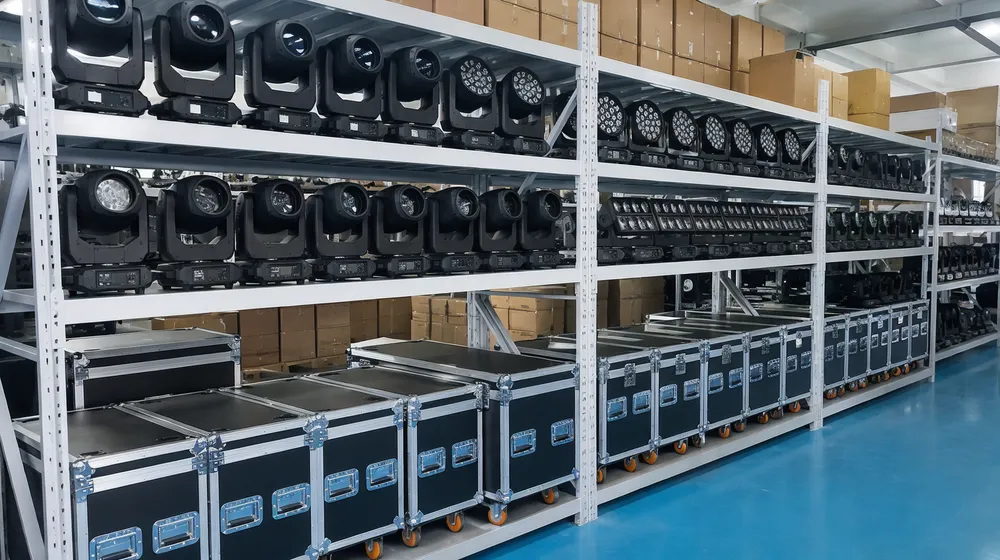
Distributors stocking 500–2,000+ units across multiple SKUs for resale to rental companies and integrators. This segment needs competitive landed cost per unit, consistent reorder supply (same specs, same quality, same delivery window every time), and OEM branding to build a product line their dealer network recognizes.
We maintain buffer stock on our most popular wedding fixture configurations for distributors who need 7-day replenishment without waiting for a full production run.
Tell us which customer type you serve, and we'll recommend the fixture mix, specification tier, and pricing structure that matches your sales model.
Tell Us Your SegmentCompliance and Documentation — Pre-Qualified for Your Market
Your wedding stage lighting imports need documentation that satisfies customs, insurance underwriters, and venue safety requirements before the fixtures generate revenue. We provide all applicable certifications and test reports as standard — formatted for your specific import market.
CE + EMC (Europe)
EN 55015 emissions testing, EN 60598 luminaire safety — complete test reports included with shipment, not provided "upon request" after you've already cleared customs.
FCC Part 15 (North America)
Declaration of conformity for electromagnetic emissions, including wireless DMX modules where applicable — FCC ID registered.
RoHS
Full restricted-substance compliance with material content declarations per fixture model — required for EU market access.
IP65 Test Reports (Outdoor Models)
IEC 60529 ingress protection testing with actual test conditions documented — venues and insurance companies increasingly require proof, not just a claimed rating.
ISO 9001:2015
Quality management certification covering our production process — available for your supplier qualification package.
Additional Market Requirements
UL listing for specific US jurisdictions, SAA for Australia, specific Middle Eastern conformity marks — raise them during quoting and we'll confirm what's available or what testing we can arrange.
Packaging and Landed Cost Optimization
Wedding lighting has a favorable freight profile — compact fixtures with moderate weight, high container utilization, and no hazardous materials classification (lithium batteries in wireless PARs ship under UN3481 Section II exemption at these cell capacities).
Container Loading — Typical Wedding Fixture Mix
| Configuration | 20GP | 40HQ |
|---|---|---|
| Full wireless PAR order | 650–900 | 1,300–1,800 |
| Full LED PAR (wired) order | 900–1,200 | 1,800–2,400 |
| Mixed wedding package (PARs + pin spots + moving heads) | 400–600 | 800–1,200 |
| Pin spots only | 2,000–3,000 | 4,000–6,000 |
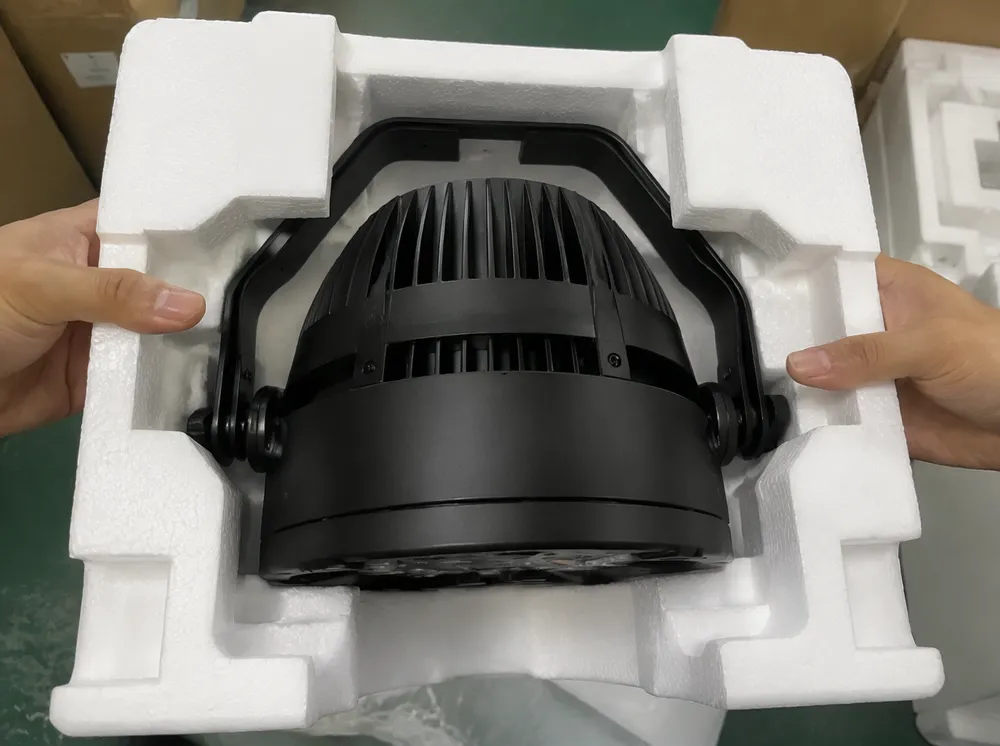
Individual Molded-Foam Packaging
Every fixture ships in individual molded-foam packaging with the fixture held at structural mounting points — not resting on the lens or housing surface.
Road-Case-Ready Packaging
Available for distributors who resell directly to rental companies: fixtures pre-loaded into padded flight cases, so your customer opens the delivery and goes straight to deployment.
Lithium Battery Compliance — Handled as Standard
Shipping lithium-battery wireless fixtures requires UN38.3 battery test reports and proper Section II markings on outer cartons. We handle this documentation as standard — it's not an add-on service or afterthought. Your freight forwarder receives the correct declarations and MSDS without chasing us for paperwork.
Frequently Asked Questions Wedding Stage Lighting Fixtures
What's the actual runtime difference between cheap wireless PARs and properly managed battery fixtures?
What's the actual runtime difference between cheap wireless PARs and properly managed battery fixtures?
Budget wireless PARs typically advertise 8-10 hours of runtime at "standard output" — which usually means 40-50% brightness with only 3 of 6 LED colors active. At full RGBW output (the mode you'll actually use at events), they run 4-5 hours.
Ours run 15-20 hours at full RGBW output on initial charge, and maintain 80% of that capacity at 800 charge cycles due to temperature-compensated charging and cell balancing.
After one year of weekly rental use, our fixtures still complete a full 8-hour wedding on a single charge. Budget alternatives are doing mid-event battery swaps by month six.
How do I calculate the right fixture count for a wedding ceremony space?
How do I calculate the right fixture count for a wedding ceremony space?
For even wash coverage with no dark spots: divide the room's longest dimension by the fixture's beam spread at mounting height, then add 20% overlap between adjacent fixture pools.
Practical Rule — 25° PAR at 4m Height
One fixture covers approximately 1.8 meters of floor area. A 15-meter church aisle needs 10-12 units for full coverage without gaps.
For wider rooms (banquet halls), calculate both length and width separately.
We include a coverage calculator spreadsheet with our quotation that inputs your specific room dimensions and outputs a fixture count — send us your venue measurements and we'll do the math for you.
Can I use the same fixtures for outdoor ceremonies and indoor receptions?
Can I use the same fixtures for outdoor ceremonies and indoor receptions?
Only if you order IP65-rated models specifically. IP20 fixtures (our standard indoor range) should never be deployed outdoors — even under a tent with open sides, morning dew condensation will corrode unsealed driver boards within one season.
Our IP65 wedding fixtures use conformal-coated PCBs, sealed cable glands, and gasket-sealed lens assemblies. They handle direct rain exposure.
Fleet Mix Recommendation
- IP20 for dedicated indoor inventory — lighter weight, lower cost
- IP65 for outdoor-capable fixtures — eliminates the revenue loss of turning down outdoor ceremony bookings
The outdoor units cost approximately 15-20% more per unit due to sealing components and conformal coating.
What causes visible flicker in wedding lighting footage, and how do I verify a fixture won't flicker?
What causes visible flicker in wedding lighting footage, and how do I verify a fixture won't flicker?
Flicker in video footage comes from low-frequency PWM dimming. Budget fixtures dim LEDs by pulsing them on and off at frequencies between 100Hz and 1kHz — invisible to the naked eye, but clearly visible as banding or rolling bars when shot at frame rates that don't divide evenly into the PWM frequency.
Our wedding fixtures run PWM at 25kHz minimum (most models at 32kHz), which is beyond the capture range of any video camera at any frame rate or shutter speed.
Quick Verification Test
When evaluating samples, test at 10% brightness with your phone's slow-motion mode at 240fps — that's where low-PWM flicker becomes most obvious. Our fixtures show no banding at any dimming level at any capture speed.
What's the MOQ and lead time for a first order of branded wedding lighting?
What's the MOQ and lead time for a first order of branded wedding lighting?
30 units per SKU for OEM branding — logo on housing, custom packaging, branded documentation. Standard models with branding ship in 20-25 days.
If you're testing the market, a 30-unit mixed sample order across 2-3 SKUs lets you assess both product quality and customer response without container-load commitment.
Order Timeline Summary
- Sample units (unbranded): 3-7 days
- Standard models with branding: 20-25 days
- Full ODM development: +4-6 weeks development before production
If This Isn't Quite Right Related Products
Dance Stage Lighting
Looking for high-energy dance floor effects rather than ceremony fixtures? Beam moving heads, derby effects, and strobe/wash hybrids designed for reception parties and entertainment segments.
View dance lighting rangeWedding Stage Lighting — Full Category
Need to evaluate the full wedding lighting category before committing to a specific fixture type? Complete range overview, specification comparisons, and manufacturing approach across both ceremony and dance fixture lines.
Browse full categoryGet a Quote for Wedding Stage Lighting Fixtures
Send us your fixture list — model types, approximate quantities, target market, and any branding or customization requirements. Even a rough list works. Our engineering team will respond within 48 hours with specific model recommendations, configuration options, and detailed pricing.
If you're building a wedding lighting line from scratch, tell us your target customer segment and market region. We'll suggest a starter SKU mix based on what's performing for our existing distributors in that territory — which fixture types rent most frequently, what quantities rental companies typically begin with, and where the unit economics land.
Response within 48 hours with model recommendations and pricing