

Wedding Stage Lighting Manufacturer for Rental & Event Supply
LED wash, beam, moving head, and effect fixtures — the complete product line event companies actually deploy, built by a factory that understands duty-cycle demands.
Wedding stage lighting engineered for commercial rental fleets and permanent venue installations.
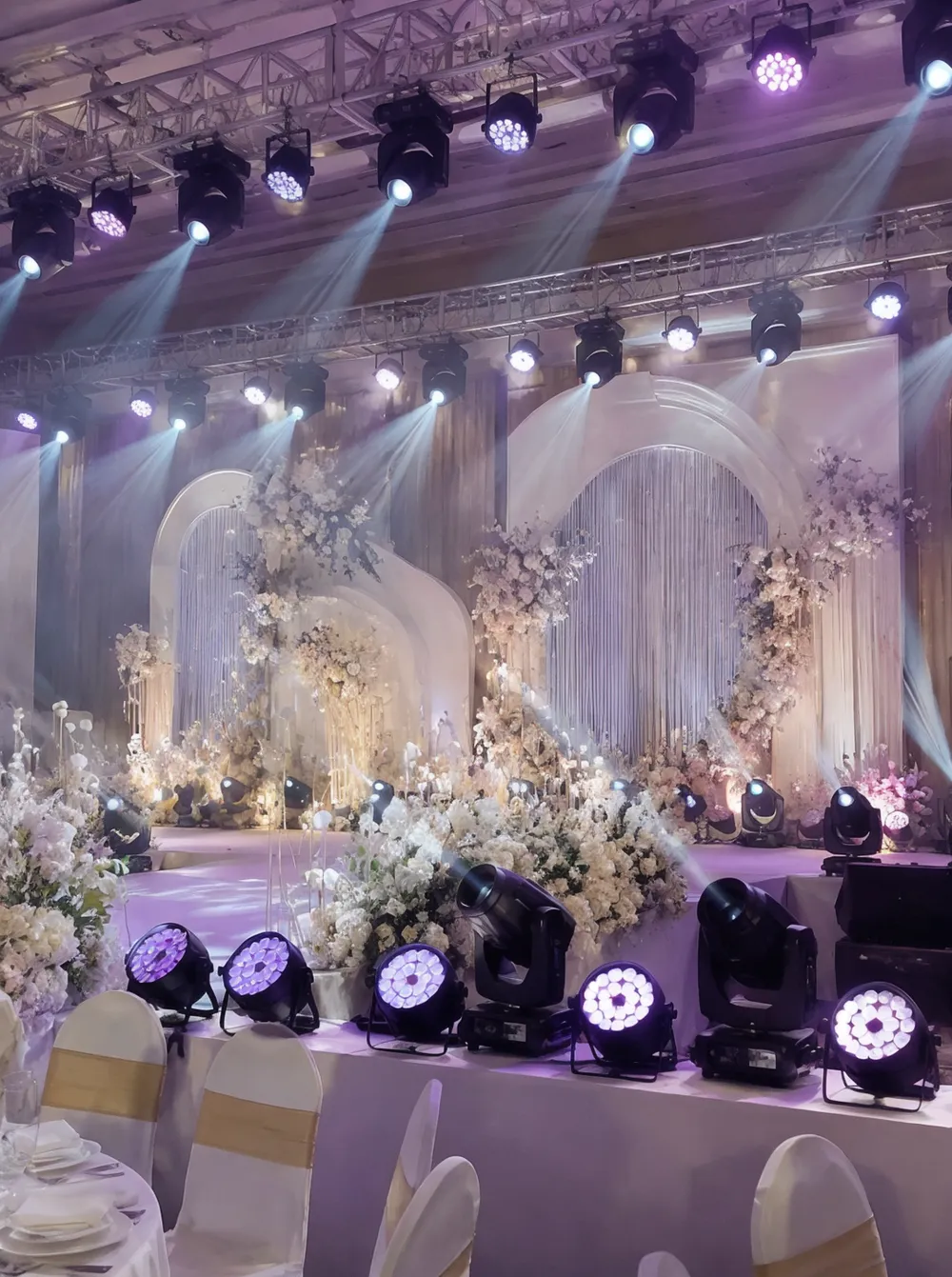
The Wedding & Event Lighting Market — What You're Actually Selling Into
Wedding lighting is rental-fleet business. Your fixtures don't sit in one venue — they go out every weekend, get loaded into vans, rigged by crews working under time pressure, and struck again at midnight. The product that survives this cycle profitably is not the same product someone buys for a single home installation.
We build for that reality. Our wedding stage lighting line is designed around three commercial demands: fast rigging and striking, consistent output across mixed-brand DMX systems, and physical durability through hundreds of deploy-and-return cycles. Every material choice and engineering decision traces back to your total cost of ownership over a 3-year fleet lifecycle, not just the purchase price on day one.
The segment breaks into two distinct fixture categories — dedicated wedding and event fixtures (uplights, wash bars, pin spots, moving head washes tuned for warm-white ceremony looks) and dance stage lighting (high-energy beam effects, derby lights, and strobe systems for reception parties and entertainment). We manufacture both under one roof, so you consolidate your supply chain into a single purchase order instead of sourcing decorative fixtures from one vendor and effect lights from another.
Three Commercial Demands We Engineer For
-
Fast Rigging & Striking Designed for weekend turnaround under time pressure
-
Mixed-Brand DMX Consistency Reliable output in any multi-vendor control system
-
Physical Durability Hundreds of deploy-and-return cycles over a 3-year fleet lifecycle
Wedding Stage Lighting Fixtures — Ceremony & Décor Inventory
Wedding Stage Lighting Fixtures covers the fixtures your rental clients book for ceremonies, receptions, and church events: LED wash uplights, battery-powered wireless PARs, pin spot arrays, and moving head wash units with CTO color temperature correction.
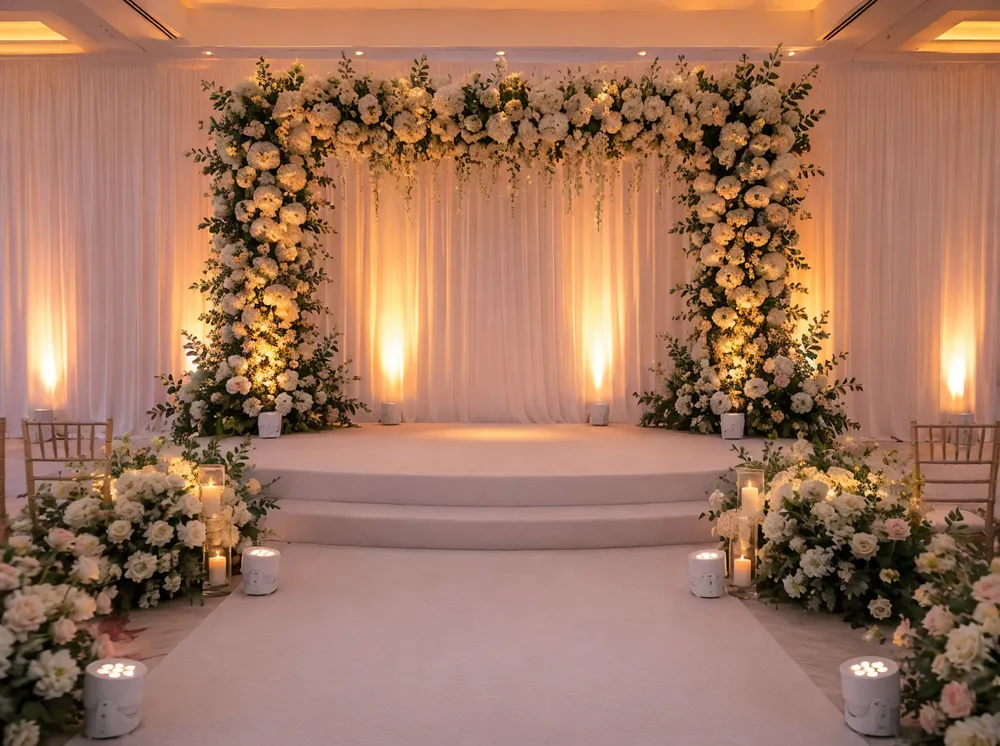
Design Philosophy: Built Around the Wedding Rental Workflow
These fixtures share a design philosophy built around the wedding rental workflow. Battery-powered units eliminate cable runs across venue floors — your crew rigs a 20-fixture uplight package in 40 minutes instead of 90. RGBWA+UV LED arrays produce the warm amber and soft lavender tones that wedding planners request weekly, without gel changes. Silent fan-less thermal management means no fixture noise during vow exchanges.
We switched from active cooling to passive heatsink designs on our ceremony-focused fixtures in 2019 after rental operators told us fan hum was their number-one client complaint.
The commercial value: warm-white-dominant fixtures with smooth dimming and flicker-free output at any camera frame rate. Your rental clients get clean footage from their videographers without post-production color correction — that translates directly to repeat bookings and referrals for your customer, which means repeat orders for you.
Battery-Powered
No cable runs. 20-fixture uplight package rigged in 40 minutes instead of 90.
RGBWA+UV Arrays
Warm amber, soft lavender, and every tone wedding planners request — no gel changes needed.
Silent Operation
Passive heatsink thermal management. Zero fan noise during vow exchanges and ceremonies.
Flicker-Free Output
Clean footage at any camera frame rate. No post-production color correction required.
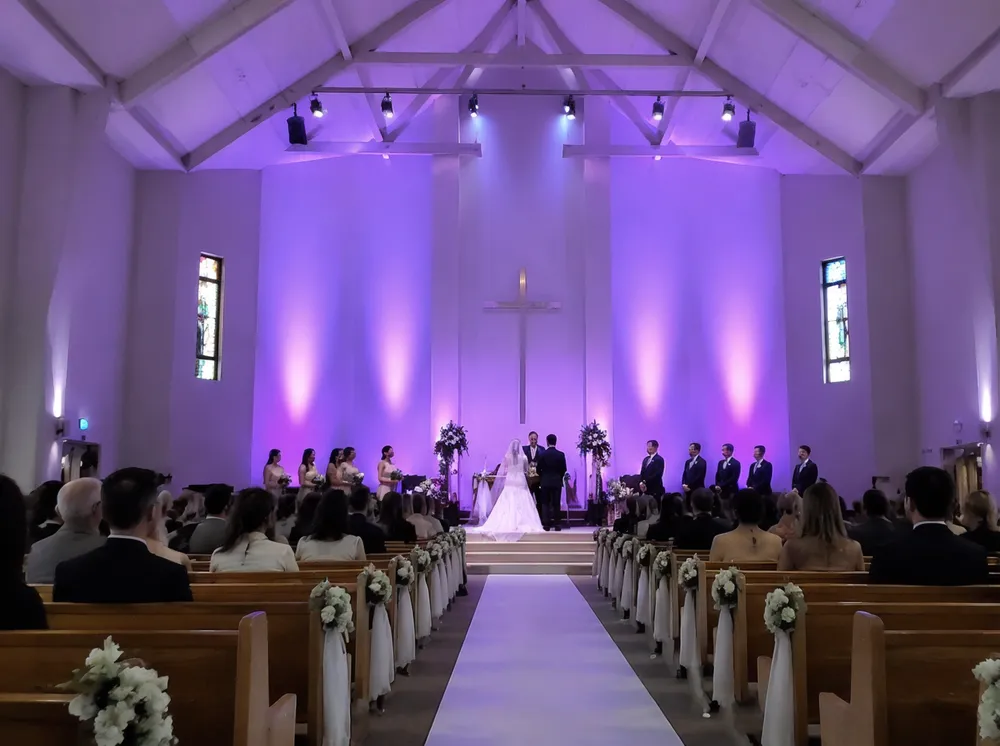
Wedding Church Stage Lighting
For wedding church stage lighting specifically, we build IP20-rated indoor fixtures with wide beam angles (15°–60° zoom range) that cover high-ceiling sanctuary spaces without requiring excessive fixture counts.
A 12-unit package covers a typical 200-seat church — your quoting becomes predictable, and your customers see full-room transformation without sticker shock.
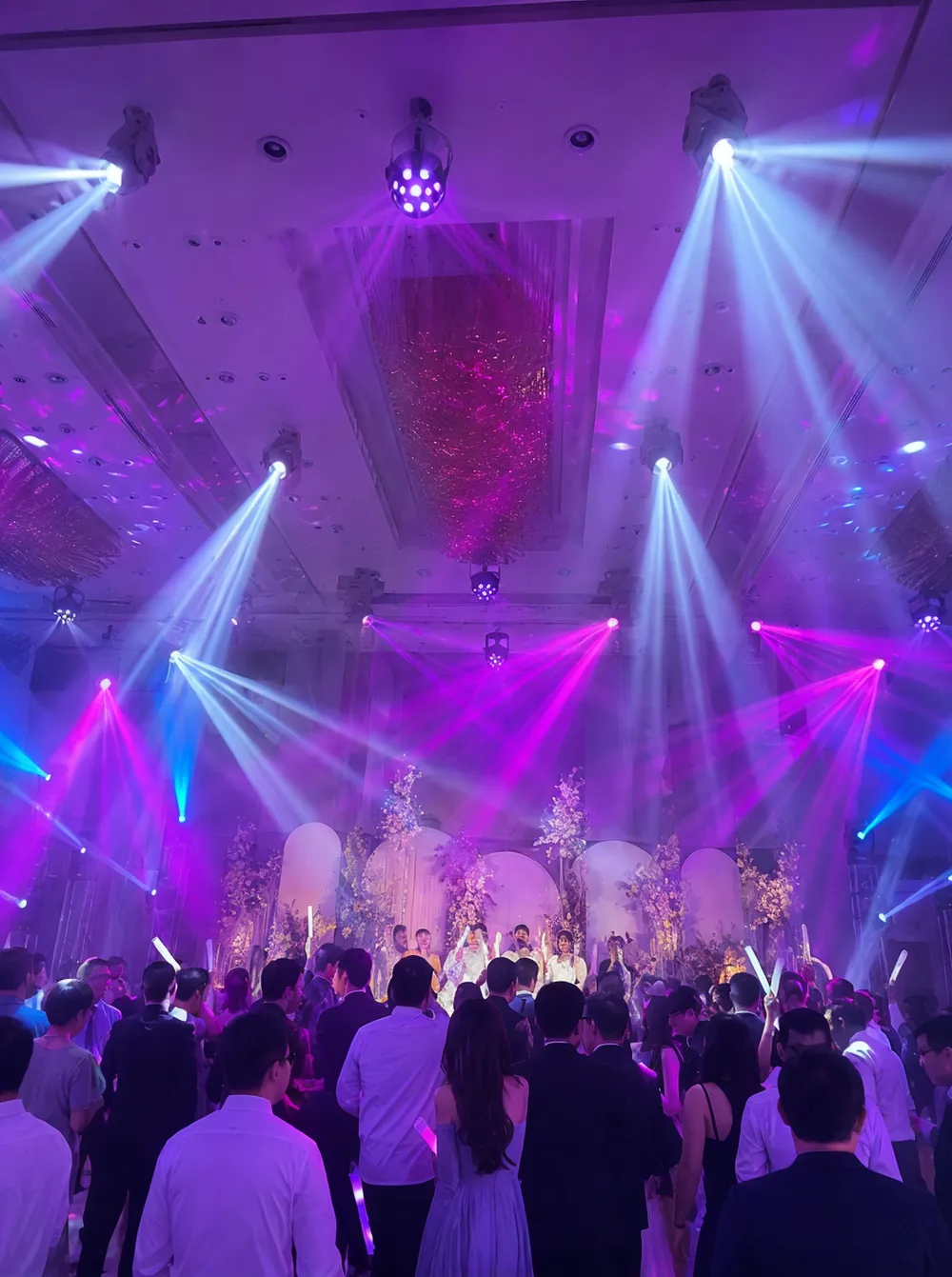
Dance Stage Lighting Reception & Entertainment Inventory
Dance Stage Lighting is the high-energy half of your fleet: beam moving heads, LED derby effects, hazers with integrated LED illumination, and strobe/wash hybrid fixtures that turn a reception ballroom into a dance floor.
This is where duty-cycle engineering matters most. A beam moving head running full output on a wedding dance floor operates 4–6 hours continuously, often in venues with limited air circulation and ambient temperatures above 30°C. Our thermal management keeps LED junction temperatures below 85°C at sustained full output — that's the difference between a fixture that holds its rated lumen output all night and one that thermally throttles down to 60% by hour three.
Your client won't notice the gradual dimming, but their guests will notice when the energy drops at 11 PM.
Built for Mobile Rental Abuse
Dance fixtures take more physical abuse than ceremony lights. They're mounted on stands, rigged overhead, moved every weekend. The housing and connector engineering directly determine your long-term service call rate and fleet replacement costs.
Die-Cast Aluminum Housing
2.5mm wall thickness on structural joints — not the 1.5mm stamped-steel housings that develop stress cracks after six months of mobile use.
Panel-Mounted Connectors
Powercon and DMX connectors are panel-mounted with strain relief — because a loose connector at 10 PM on a Saturday is a service call that costs you reputation.
Thermal Management
LED junction temperatures stay below 85°C at sustained full output. Forced-air cooling with temperature-controlled fan speed maintains rated lumens across 4–6 hour continuous duty cycles.
Specification Ranges Across the Wedding Lighting Line
| Parameter | Wedding Fixtures | Dance Stage Fixtures |
|---|---|---|
| LED Source | RGBWA+UV, Warm White, CTO-adjustable | RGBW, Single-color beam, RGB laser diode |
| Wattage Range | 6W–200W per fixture | 50W–350W per fixture |
| Beam Angle | 15°–60° (zoom models available) | 2°–45° (fixed or motorized zoom) |
| Control | DMX512, Wireless DMX, Sound-active, Master/Slave | DMX512, Art-Net, Sound-active |
| IP Rating | IP20 (indoor), IP65 (outdoor ceremony) | IP20 (indoor), IP65 (outdoor stage) |
| Power | AC 100-240V, Battery-powered options | AC 100-240V |
| Color Temperature | 2700K–6500K (warm ceremony to cool dance) | N/A (full-color mixing) |
| Housing Material | Die-cast aluminum, powder coated | Die-cast aluminum, 2.5mm structural joints |
| Cooling | Passive (ceremony), Forced-air (high wattage) | Forced-air with temperature-controlled fan speed |
| Noise Level | <25dB (ceremony-rated) | <35dB (event-acceptable) |
Configuration Is Quote-Specific
These are category-wide ranges. Your specific configuration — LED count, wattage tier, beam angle, control protocol — gets determined during the quoting process based on your target retail price point and end-use environment.
How We Manufacture for Rental-Fleet Durability
Most wedding lighting on the market is designed for the showroom, not for the back of a van. We engineer specifically for the commercial rental lifecycle because that's who buys from us — event companies and distributors stocking rental inventory.
Connector Reliability
Every DMX and power connector gets rated for 5,000+ insertion cycles. We test at the connector level before fixture assembly — pulling and reconnecting under load, checking for intermittent signal at each cycle.
A connector that fails at cycle 800 is a fixture that goes dead mid-event, and that's a phone call you don't want to take from your customer.
Housing Impact Resistance
Die-cast aluminum housings pass a 1-meter drop test onto concrete at four orientations. Stamped steel dents. Die-cast aluminum absorbs the impact at the internal rib structure without deforming the lens mount or shifting optical alignment.
Your fixture works identically after it rolls off a road case — which is something that will happen.
Thermal Cycling Endurance
Wedding fixtures live in storage at 5°C and operate at 45°C ambient in summer tents. We run thermal cycling tests — 200 cycles between -10°C and 60°C — on every LED array and driver board design before production sign-off.
Solder joint fatigue from thermal expansion mismatch is the silent killer of LED fixtures in rental fleets. We screen for it here, not in your warehouse.
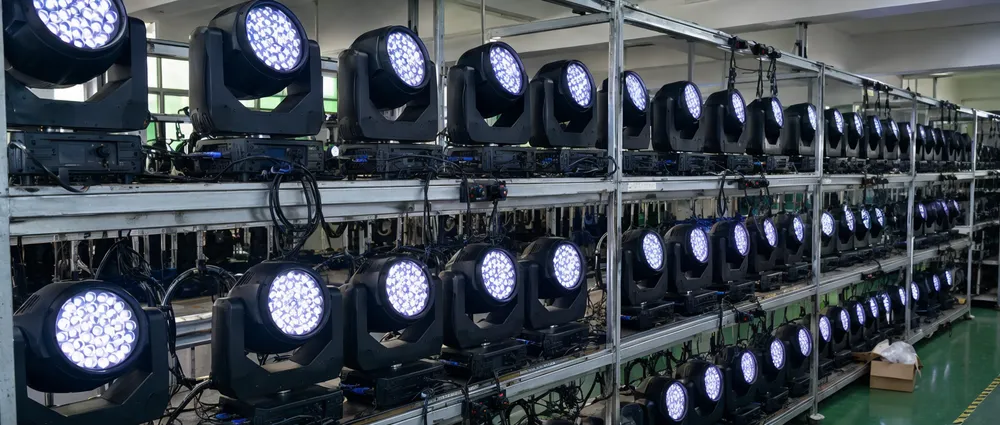
48-Hour Aging at Full Load
Every single unit runs 48 hours at maximum output before it ships. This catches infant mortality — capacitor failures, LED driver instability, thermal throttling thresholds that only appear after sustained operation.
Your fixtures arrive burn-in tested, so the failures happen in our factory, not at your customer's venue.
Why We Accept the Throughput Cost
The 48-hour test costs us production throughput. We could ship faster without it. But a dead fixture at a wedding is a $500 service call minimum for your operation, plus the reputational damage that doesn't have a number. The math is simple.
OEM/ODM for Wedding Lighting — Your Brand, Our Production
Wedding and event lighting is a brand-driven market. Your customers choose a rental company or buy from a distributor partly based on the equipment brand they see listed. Selling generic fixtures limits your markup. OEM/ODM turns our manufacturing into your product line.
30-Unit Minimum Orders
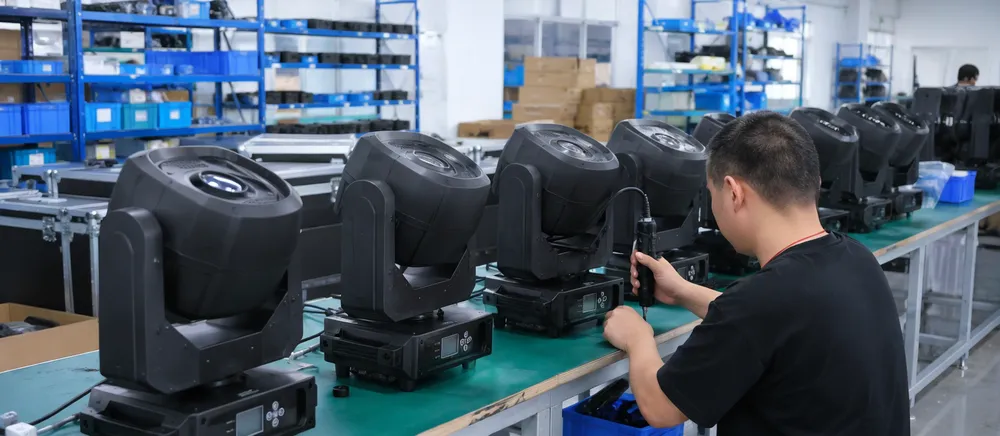
We support custom branding from 30-unit minimum orders. That threshold exists because we can do a branding changeover — logo silkscreen on housings, custom packaging, firmware splash screen — without a dedicated production run. At 30 units, you're testing a new SKU in your market. At 500 units, you're building a product line.
What OEM Covers
- Your logo on the fixture housing
- Custom color finish on housings — from our standard RAL palette at no extra tooling charge, or custom Pantone match for orders above 200 units
- Your brand name on packaging and user manuals
- Your company as the listed manufacturer on documentation
Sample timeline: Existing fixture with your brand treatment — sample within 7–10 days.
What ODM Covers
- Custom beam angle optimization for your target venue type
- Modified color temperature presets tuned for your market — some regions prefer warmer ceremony tones than others
- Custom DMX personality profiles matching popular lighting consoles in your territory
- Firmware modifications for proprietary wireless control integration
Development timeline: Full ODM project runs 4–6 weeks from approved brief to production samples.
Need Samples for a Trade Show?
If you need samples for a trade show with a fixed date, tell us the deadline upfront. We'll work backwards from your booth setup day to ensure your branded samples arrive ready to display.
Packaging & Container Loading for Event Lighting
Wedding lighting fixtures have specific shipping challenges: optical components that don't tolerate vibration, protruding yokes on moving heads, and the commercial reality that your landed cost per unit includes the freight.
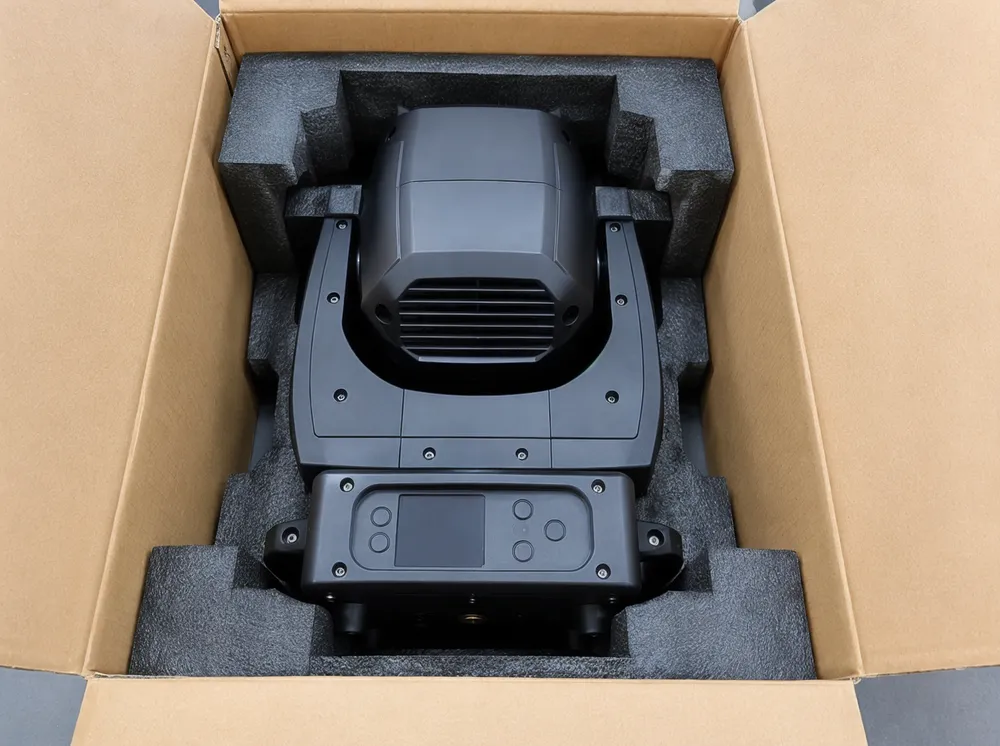
We pack every fixture in custom molded-foam inserts sized to the specific model — not generic bubble wrap in an oversized box. The foam cradle holds the fixture at the yoke mount points (the structural joint), not at the lens or housing surface. Moving heads ship with pan/tilt locks engaged and a secondary foam restraint on the head assembly.
Container Loading Data
Representative figures — varies by model mix
| Fixture Type | Units per 20GP | Units per 40HQ | CBM per Unit |
|---|---|---|---|
| LED PAR / Uplight | 800–1,200 | 1,600–2,400 | 0.015–0.025 |
| Battery Wireless PAR | 600–900 | 1,200–1,800 | 0.020–0.030 |
| Moving Head Wash (compact) | 200–350 | 400–700 | 0.055–0.080 |
| Moving Head Beam (full-size) | 150–250 | 300–500 | 0.080–0.120 |
| Effect / Derby Lights | 500–800 | 1,000–1,600 | 0.020–0.035 |
Road-Case-Ready Packaging
Available for distributors who resell directly to rental companies. We can pack fixtures pre-loaded into branded flight cases with foam-cut interiors — your customer opens the shipment and goes straight to deployment without repackaging. The flight cases add cost per unit but eliminate your customer's need to source cases separately, which is a markup opportunity for your sales.
Common Failure Modes in Wedding Lighting — And How We Prevent Them
If you've sourced wedding lighting before, you've probably encountered at least one of these problems. They're not bad luck — they're engineering shortcuts that show up under commercial use conditions.
Rapid Lumen Depreciation in Warm-White LEDs
The Problem
Budget fixtures use commodity LED chips driven at maximum current to hit their rated brightness on the spec sheet. After 500 hours of operation, output drops 20–30%.
Our Approach
We drive LED chips at 70–80% of their rated maximum current. Initial brightness is identical (we compensate with optimized reflector geometry), but the L70 lifetime extends from 15,000 hours to 40,000+ hours. Your rental fleet holds its output quality across three seasons instead of needing lamp replacements after one.
Wireless DMX Dropout in Crowded RF Environments
The Problem
Wedding venues in hotels and conference centers have dense Wi-Fi, Bluetooth, and radio interference. Cheap wireless DMX modules operating on fixed 2.4GHz channels lose signal.
Our Approach
We use frequency-hopping spread spectrum (FHSS) wireless modules with automatic channel selection across 80+ channels. In testing, we maintain reliable DMX transmission at 100-meter range even in convention center environments with 50+ competing RF sources.
Battery Degradation on Wireless Fixtures
The Problem
Lithium-ion batteries in wireless PARs lose capacity after 300–400 charge cycles with standard charge management.
Our Approach
We integrate battery management systems with cell balancing, temperature-compensated charging, and configurable charge-rate limiting. Result: 80% capacity retention at 800 cycles. Your wireless fixtures maintain their stated runtime rating for two full rental seasons instead of degrading to 60% capacity after six months.
Color Consistency Drift Between Fixtures
The Problem
When you deploy 20 uplights in a line, a 200K color temperature difference between units is visible to the naked eye. This happens when LED chips aren't binned tightly at incoming inspection.
Our Approach
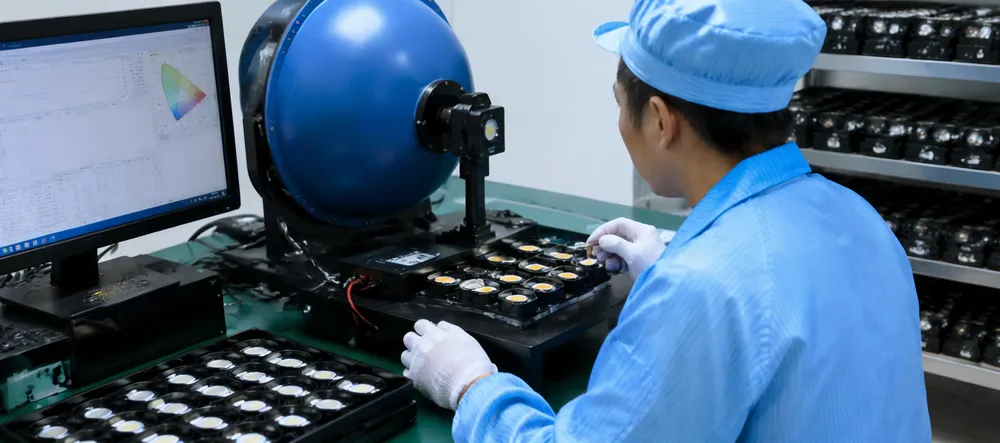
We bin all white LEDs to within ±100K of target CCT and ±2 SDCM on color point before they enter the SMT line. Every fixture in your batch matches every other fixture in the same batch.
Compliance Documentation for Your Market Entry
Your wedding stage lighting imports need documentation that satisfies customs, insurance, and venue requirements in your territory. We provide this as standard — not as a follow-up scramble after your shipment is already on the water.
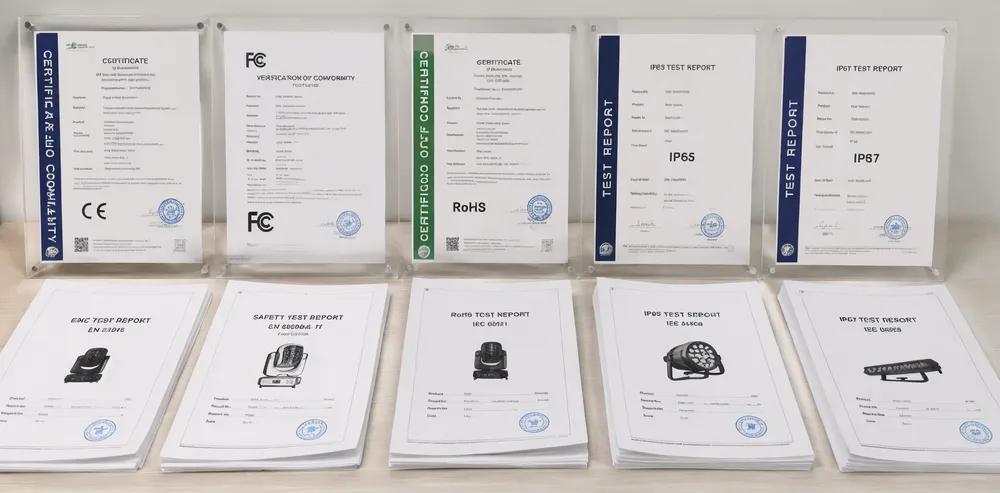
CE + EMC (Europe)
Full EN 55015 EMC test reports and EN 60598 safety certification for luminaires. Your fixtures clear EU customs with documentation already in hand.
FCC Part 15 (North America)
Electromagnetic emissions testing and declaration of conformity. Includes wireless DMX modules where applicable — FCC ID registered and test reports available for your import file.
RoHS
Lead-free manufacturing with restricted-substance declarations from all component suppliers. Material content documentation available for each fixture model.
IP65/IP67 (Outdoor-Rated Models)
Ingress protection testing per IEC 60529. Includes the actual test report showing water jet angles, duration, and pass criteria — not just a claimed rating. Your outdoor ceremony fixtures are documented for venues that require proof of weather rating for insurance purposes.
ISO 9001:2015
Quality management system certification covering our entire production process. Available as part of your supplier qualification package.
Country-Specific Formatting
We format compliance documentation to match your import country's requirements. If your customs broker needs specific certificate formats, declaration layouts, or test report translations, tell us during the order process and we'll deliver it with the shipment.
Who Buys Wedding Stage Lighting From Us — And How They Deploy It
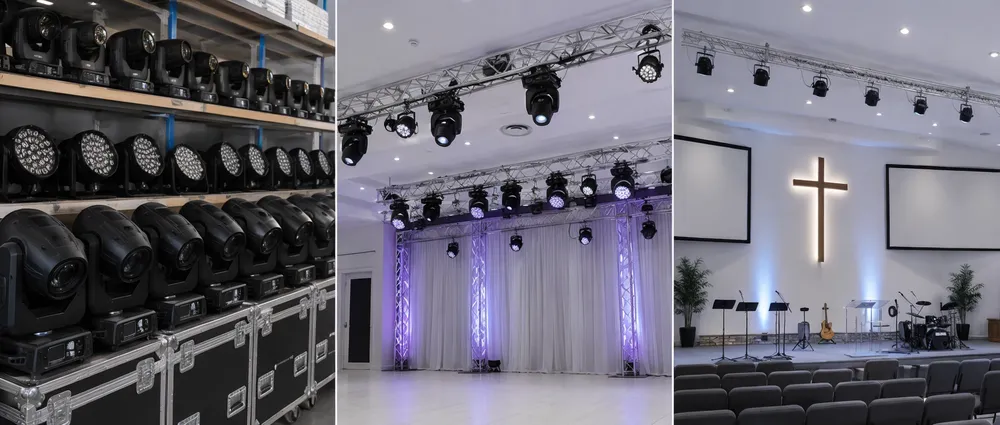
Event Rental Companies
Inventory Builders
Building or expanding their lighting inventory. They need brand consistency across the fleet and fixtures that survive weekly deployment cycles.
AV Distributors
Volume Stockists
Stocking wedding lighting alongside audio and video equipment. They resell to rental companies, venues, and AV integrators. They need competitive landed cost, reliable reorder supply, and OEM branding to build a product line their dealers recognize.
Venue Installation Contractors
Permanent Rigging
Specifying permanent lighting rigs for wedding venues, churches, and banquet halls. They need fixtures rated for continuous duty, silent operation during ceremonies, and DMX integration with house control systems. Their orders are project-based and repeat when they win the next venue contract.
Church AV Teams
Worship + Wedding Dual-Use
Upgrading or installing stage lighting for worship services and wedding ceremonies hosted in church sanctuaries. The wedding church stage lighting segment overlaps significantly with worship lighting — same venues, same requirements for warm color temperatures, silent operation, and DMX compatibility with church-standard controllers.
Different Segments, Different Configurations
Each of these segments has different ordering patterns, different price sensitivity, and different feature priorities. Tell us which segment you serve, and we'll recommend the fixture mix and specification tier that matches your margin targets.
Frequently Asked Questions — Wedding Stage Lighting Sourcing
What IP rating do I need for outdoor wedding ceremony lighting?
IP65 minimum for any fixture exposed to open air — that covers rain, dust, and the moisture from morning dew if your crew sets up the night before. For fixtures mounted at ground level near sprinklers or in coastal environments with salt spray, specify IP67.
Our outdoor-rated wedding fixtures are tested per IEC 60529 with full test reports, not just a claimed number on the spec sheet.
Indoor-only fixtures (IP20) should never go outdoors, even under a tent with open sides — condensation alone will corrode unsealed electronics within a season.
How do I prevent color mismatch when deploying 20+ uplights in a row?
Color mismatch comes from two sources: LED bin inconsistency and driver current variation between fixtures.
On the LED side: We bin all white chips to ±100K CCT and ±2 SDCM before assembly — tight enough that adjacent fixtures are visually indistinguishable.
On the driver side: Constant-current regulation holds output within ±1% across units.
When you order a batch, request that we ship from a single production run. If you reorder six months later and need exact color matching to your existing fleet, reference your original order number — we keep LED bin records for every batch and will match to the same bin range.
Why do battery wireless PAR fixtures lose runtime after 6 months of rental use?
Standard lithium-ion batteries degrade based on charge cycles, temperature exposure during charging, and depth of discharge. Most budget fixtures lack proper battery management — they charge at maximum rate regardless of cell temperature, and they discharge to near-zero before triggering low-battery indication.
Our BMS implements:
- Temperature-compensated charging (reduces charge rate above 35°C)
- Cell balancing across multi-cell packs
- Configurable low-voltage cutoff at 15% remaining capacity rather than 5%
Result: 80% capacity retention at 800 cycles versus the industry-typical 60% retention at 400 cycles. Your fleet holds its rated 12-hour runtime through two full seasons of weekly use.
What's the difference between wedding church stage lighting and standard worship lighting fixtures?
Mechanically and electronically, they're the same fixture. The difference is in the pre-programmed scene presets and color temperature bias.
Wedding church fixtures are optimized for ceremony aesthetics — warm amber uplighting (2700K–3200K), soft lavender washes, and champagne-gold tones that complement wedding décor.
Standard worship fixtures prioritize full-spectrum white light (3200K–5600K variable) for stage visibility during sermons and music.
We can configure either preset package in firmware during production at no additional cost. If your market serves churches that host both weekly services and weekend weddings, order with dual-mode firmware that switches between worship and wedding presets via DMX channel selection.
What MOQ and lead time should I expect for a branded wedding lighting order?
OEM branding (your logo, packaging, documentation) starts at 30 units per SKU — enough to test market response without committing to container-load quantities.
Lead time: 20–25 days for standard models with branding, 30–35 days for ODM variants with custom specifications. Sample units from existing models ship within 3–7 days.
If you're building a complete branded wedding lighting line across multiple fixture types, we can stage production to ship the full range in a single consolidated container, which saves you on freight versus multiple smaller shipments.
Start Building Your Wedding Lighting Inventory
Send us your target fixture list — even if it's rough. A model mix, a quantity estimate, a target landed price per unit. Our engineering team will come back with specific model recommendations from our existing range, any customization options that apply, and a detailed quotation within 48 hours.
If you're entering the wedding lighting segment for the first time, tell us your market region and target customer type. We'll suggest a starter fixture mix based on what's moving for our existing distributors in that territory — which SKUs rent most frequently, what quantities most rental companies begin with, and where the margin sits.
Explore More Wedding Lighting