

Dance Floor DJ Lights Commercial-Grade Fixtures for High-Traffic Venues
Sound-reactive, DMX-compatible, and built to run 8+ hours nightly without thermal throttle or color drift. Engineered for continuous commercial operation — not bedroom party toys that burn out after 200 hours.
What Separates Dance Floor Fixtures from General DJ Lights
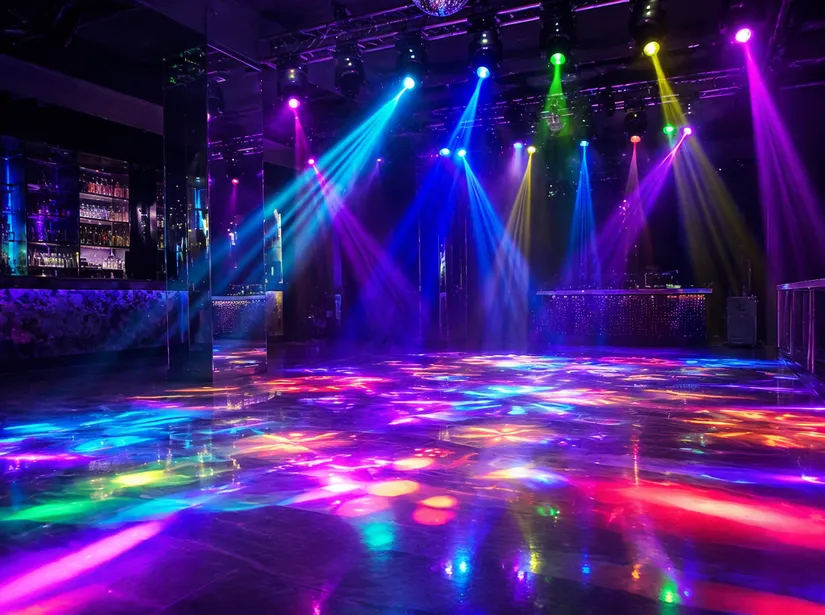
Dance floor DJ lights serve a specific installation context: they mount above or around the dance floor itself, fire downward or across the floor plane, and run at full output for the entire operating night. That's a different engineering challenge than a stage wash or a booth-mounted effect that cycles on and off.
Thermal Endurance
Dance floor lights run continuously, often in ceiling-recessed positions with limited airflow. The heat sink design and driver derating must support 8–12 hour sustained output without throttling brightness. General DJ effects cycle on and off — these don't.
Optical Throw Pattern
The beam needs to cover a dance floor area (typically 50–150 m²) from mounting heights of 3–5 meters. That demands specific lens arrays and reflector geometry that general DJ effects don't optimize for.
Sound Reactivity That Works
Our microphone circuits filter below 80 Hz to avoid the fixture strobing on subwoofer rumble rather than responding to musical transients. In a bass-heavy dance floor environment, this is the difference between usable lighting and a seizure hazard.
Why This Matters for Your Inventory Planning
Dance floor DJ lights sell into nightclubs, KTV rooms, wedding/event venues, and entertainment complexes where fixtures run every single night. That's a replacement and reorder cycle driven by operating hours, not by trend changes. Your accounts come back because they need reliability, not because they want a new look.
Technical Specifications for the Dance Floor Series
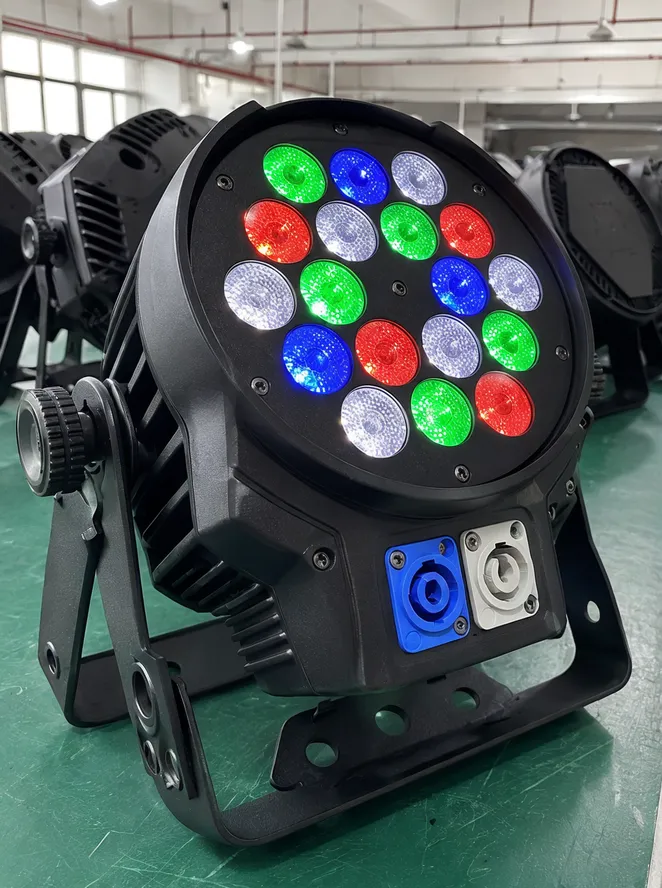
Standard values for our dance floor series. Exact parameters vary by model configuration. We offer both the 8×10W and 12×10W configurations because venue size drives the choice — smaller KTV rooms don't need 120W of output, and your customers don't need to pay for headroom they'll never use.
Configuration Guide
8×10W — Optimized for KTV rooms and smaller venue dance floors under 80 m². Lower power draw, lower unit cost for price-sensitive accounts.
12×10W — Full output for nightclub main floors 80–150 m², higher ceiling mounts, and venues demanding maximum beam punch.
Need detailed data sheets on specific SKUs for your market?
Get Model Sheets & PricingWhere Dance Floor DJ Lights Sell Market Segments Worth Stocking
Your dance floor DJ lights inventory serves multiple verticals with the same core SKU, which simplifies your warehousing while expanding your addressable market. One product family, four revenue channels.
Nightclub and Bar Installations
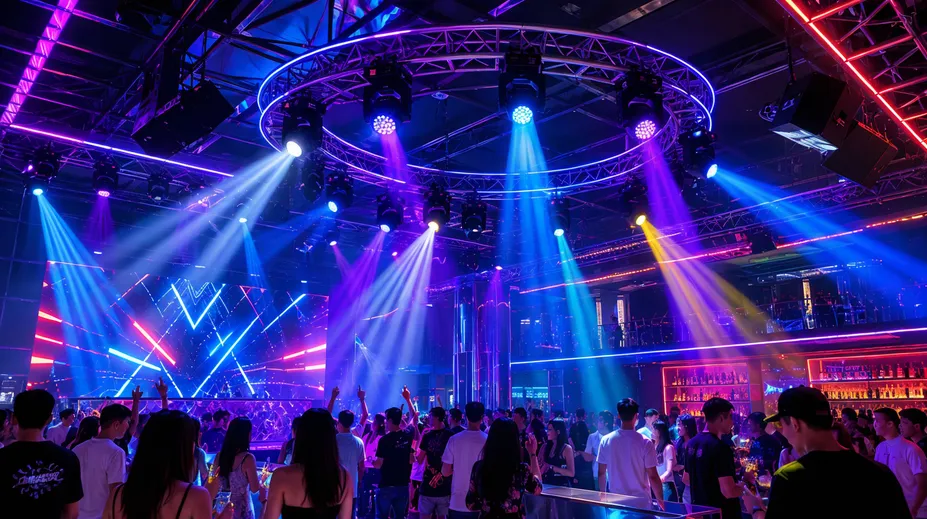
Nightclubs replace dance floor lighting on a 2–3 year cycle driven by operating hours and interior refresh schedules. A mid-size club runs 6–8 dance floor fixtures, and chains standardize across locations.
If you supply the club installation market, dance floor DJ lights are a recurring line item — not a one-time project sale.
KTV and Private Room Entertainment
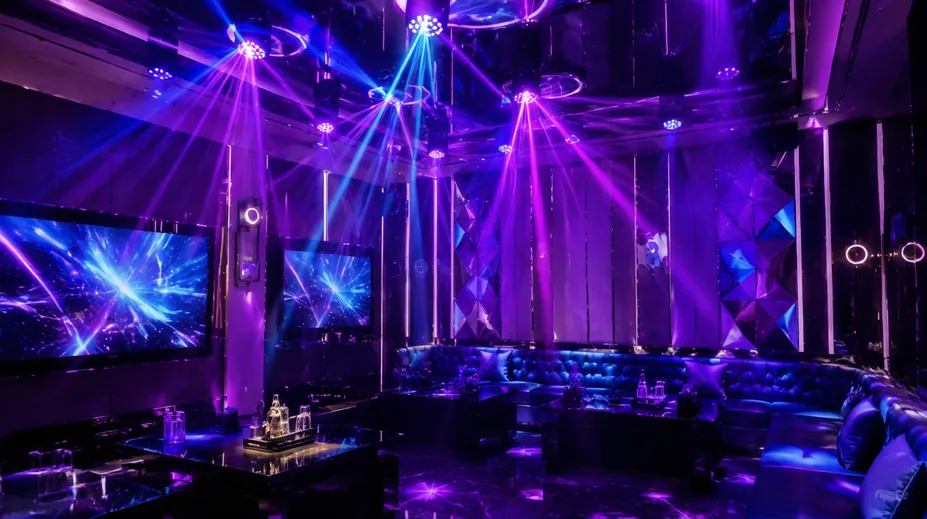
KTV venues deploy 2–4 dancing DJ lights per room, and a typical venue operates 20–80 rooms. One venue account alone can represent 40–320 fixtures.
The KTV segment in Southeast Asia and the Middle East is expanding aggressively — new builds are opening faster than suppliers can service them. Landing one venue operator relationship turns into ongoing volume as they open new locations.
Wedding and Event Rental Companies
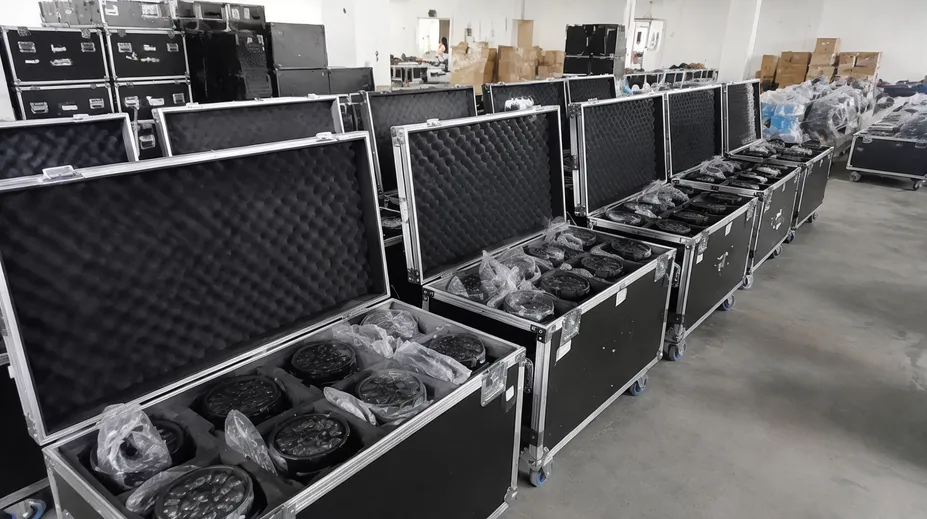
Event rental fleets take heavy abuse — setup/teardown every weekend, transport vibration, outdoor exposure, staff handling. These buyers purchase on durability and repairability, not on lowest price.
They order 20–50 units at a time and reorder when fixtures fail faster than expected. If your product survives rental use, you earn repeat business without competing on price.
This segment is why we over-spec the housing thickness and PowerCon connectors — rental companies destroy anything that isn't built for rough handling.
Commercial Entertainment Complexes
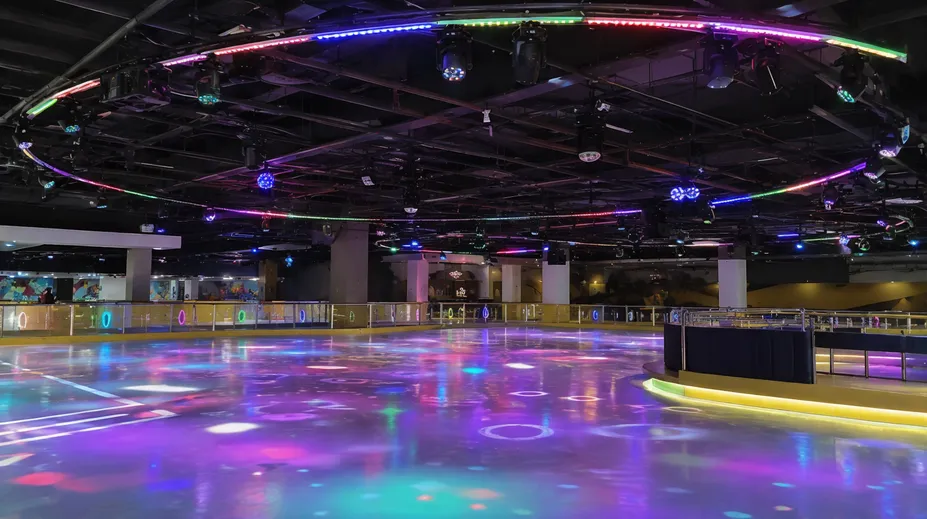
Skating rinks, bowling alleys, family entertainment centers, cruise ship entertainment decks — any commercial space with a dance or activity floor.
These are project-based orders (100–500 units per facility), often specified by lighting designers or AV contractors. The procurement decision typically sits with a facilities manager comparing three quotes, so spec-sheet completeness and certification documentation close the deal.
Tell us which segments you serve — we'll recommend the right model mix.
Get Segment-Specific RecommendationsThermal Engineering for Continuous Operation
This is where cheap dance floor lights fail your customers and generate returns for you. A fixture that looks fine in a 10-minute demo will throttle output or suffer premature LED degradation after 4–6 hours of continuous use in a ceiling-mounted position with restricted airflow.
Validation Testing
- Development stage: 72 hours at full output in 45°C ambient chamber
- Production units: 48-hour aging test at full rated power
- Reject policy: Any fixture that dims or shuts down during burn-in gets rejected
We absorb a 0.3–0.5% factory reject rate rather than let thermally marginal units ship to your warehouse and become your customer's problem six months later.
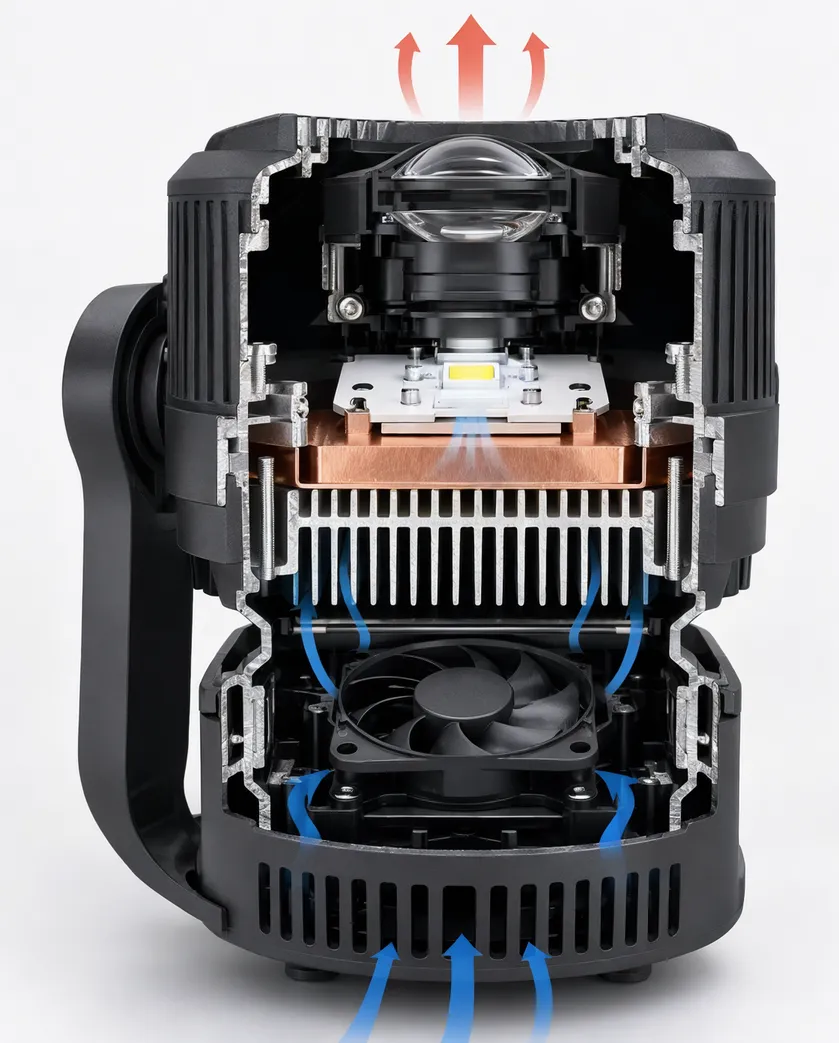
We address thermal management at three levels:
Die-Cast Aluminum Housing — Primary Heat Sink
We run 3mm wall thickness on the rear housing section with integrated fin geometry that provides 40% more surface area than a stamped steel shell. The housing itself is your first line of thermal defense — passive dissipation that works regardless of fan status or airflow conditions.
Copper-Core MCPCB — Direct Thermal Path
The internal thermal path uses direct copper-core MCPCB (metal-core PCB) mounting for the LED array. This eliminates the thermal resistance of a standard FR4 board between the LEDs and the heat management system — heat moves from junction to housing without insulating layers blocking the path.
Variable-Speed Fan — Temperature Feedback Loop
The fan operates on a temperature feedback loop — it ramps based on actual junction temperature readings, not on a fixed timer. The fixture stays quiet during low-output scenes and only pushes air volume when thermal load requires it. Your venues get intelligent noise management without sacrificing thermal headroom when the fixture is running full-tilt at 2 AM.
The Commercial Result
Your accounts don't call you about lights dimming at 2 AM. Your warranty claim rate stays where it should be — near zero.
Customization Scope for OEM and Private Label Programs
If you're building a branded product line or need fixtures configured for a specific market, here's what we can modify on the dance floor DJ lights platform.
Optical Configuration
- LED count and wattage: 8×10W, 12×10W, 12×15W, or custom arrays
- Beam angle selection — narrow spot, medium flood, wide wash, or motorized zoom on premium models
- Color system variants: RGBW, RGBA, RGBWAL (adding amber and lime for expanded CRI)
- UV LED addition for fluorescent/glow party applications
Housing & Finish
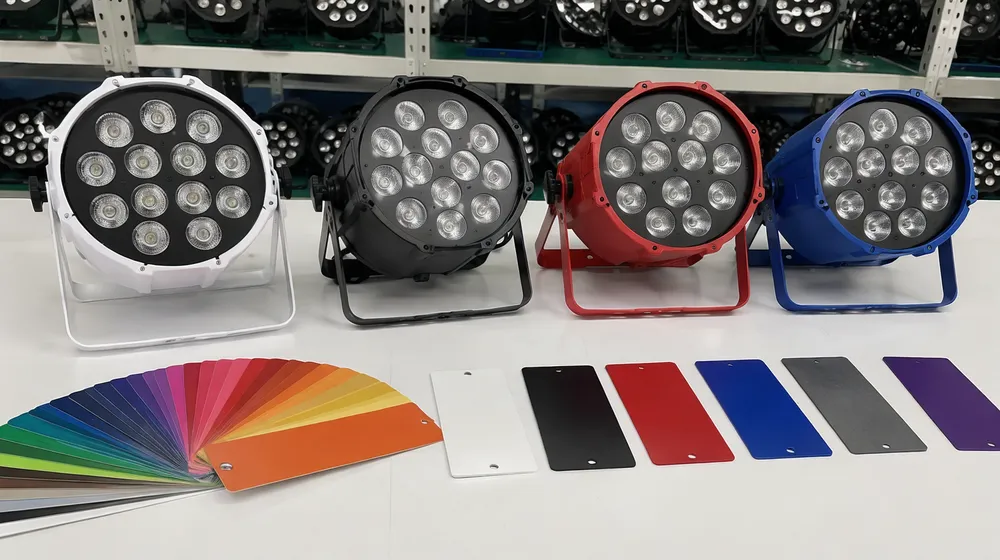
- Custom powder coat colors — any RAL color, MOQ 100 units for custom colors
- Logo printing, laser engraving, or custom badge plate on front fascia
- Modified bracket mounting for specific ceiling/truss systems
Control & Connectivity
- Custom DMX channel maps and personality profiles
- Wireless DMX module pre-installed (various protocols supported)
- Bluetooth/app control integration for your proprietary ecosystem
- Custom sound-sensitivity tuning for specific venue types
Electrical & Regulatory
- Regional power cord and plug configurations
- Additional certification testing for specific markets (UL, SAA, PSE — lead time varies)
- Modified voltage input range for non-standard power infrastructure
Packaging & Labeling
- Your brand packaging with custom retail or distribution box design
- SKU barcoding per your warehouse system
- Multilingual quick-start guides with your branding
- Individual unit serialization for your warranty tracking
What We Can't Easily Modify
The core housing die-cast tooling represents significant investment, so external form factor changes require MOQ discussion — typically 1,000+ units to justify new molds. Internal architecture changes (LED array, driver, optics) are straightforward on the existing platform.
OEM Program Logistics
Standard OEM Lead Time
25–35 days
after sample approval
First-Run MOQ (OEM Config)
200 units
for custom configurations
Logo + Packaging Only
30 units
catalog models minimum
Send a competitor sample or spec sheet — we'll return a feasibility assessment and quote within 48 hours.
Certifications and Market Compliance
Our dance floor DJ lights carry CE, RoHS, and FCC certification as standard — pre-qualified for import into the EU and North America without additional testing on your side. IP65-rated versions add IEC 60529 ingress protection testing for outdoor or wet-environment installations.
What this means for your import process: you receive test reports and certificates per SKU with your shipment documentation. Your customs clearance and market compliance teams have what they need without chasing paperwork after the container arrives.
For specific markets requiring additional certification (UL for US commercial installation codes, SAA for Australia, PSE for Japan), we support the testing process and handle sample submission to the relevant labs. Certification timeline depends on the lab queue — typically 6–10 weeks for UL, 4–6 weeks for SAA. We'll confirm exact timeline and cost-share structure before you commit.
We maintain active relationships with TÜV, SGS, and Intertek testing labs — we're in their systems already, which shortens the admin cycle on new certification applications.
Standard Certifications
CE Mark
EU market access
FCC
North America EMC
RoHS
Hazardous substance restriction
IP65 (select models)
IEC 60529 ingress protection
Available on Request
EMC Compliance Note
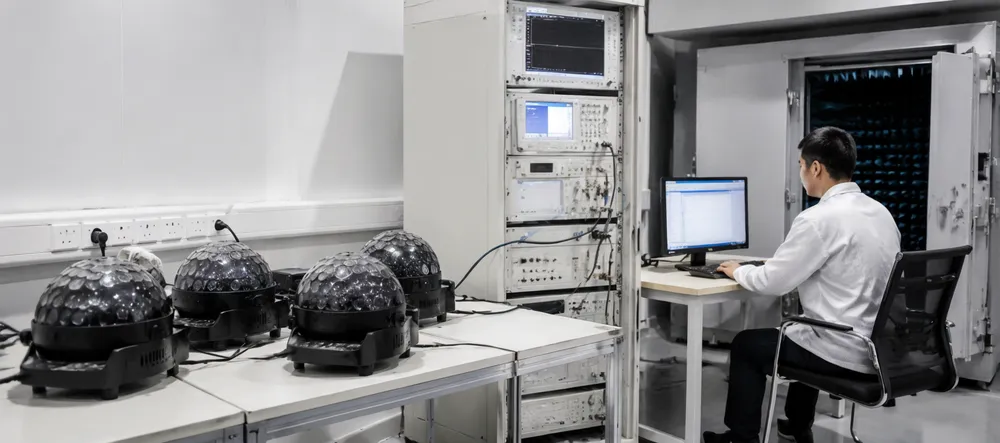
Dance floor environments are electrically noisy — DMX data lines running alongside power cables, high-power amplifiers nearby, dimmers on shared circuits. Our driver boards are designed with full EMI filtering and shielded DMX input, which means your customers don't get fixture malfunctions blamed on "electrical interference." The FCC and CE EMC test reports demonstrate compliance at actual operating conditions, not bench-test ideals.
Packaging Engineered for Freight Survival and Warehouse Efficiency
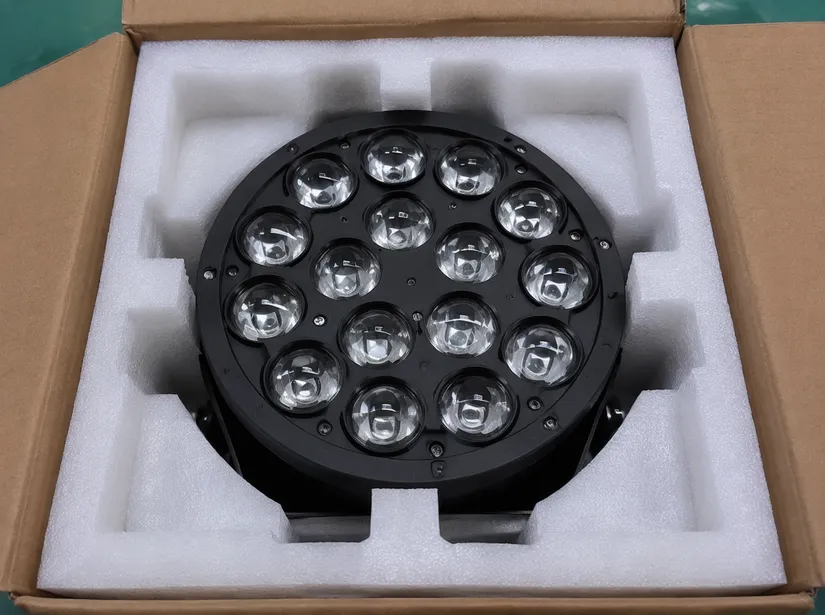
Dance floor DJ lights ship in individual inner cartons with molded EPE foam inserts — lens face and optical assembly get dedicated cradle protection because that's where freight damage costs you money. Each inner carton packs into master cartons of 2 or 4 units depending on fixture size.
Container Loading Math for Your Logistics Planning
| Container Type | Approx. Units (Standard 8×10W) | Gross Weight |
|---|---|---|
| 20GP | ~800–1,000 units | ~5,500–6,500 kg |
| 40HQ | ~1,800–2,200 units | ~12,000–14,000 kg |
We optimize carton outer dimensions against container interior dimensions during product development — not as a shipping afterthought. The 2-unit master carton for our standard dance floor fixture is sized so they palletize cleanly against 40HQ interior width with minimal dead space.
Amazon FBA & E-Commerce Fulfillment
For Amazon FBA or e-commerce fulfillment channels: we can ship in retail-ready individual boxes with your branding, UPC barcode labeling, and FBA-compliant carton labels. Blind drop-ship capability is standard — no GDMonkey branding visible on the product or packaging when you're selling under your own brand.
Damage Claim History
Below 0.2%
Across our last 12 months of shipments. The molded EPE switch we made in 2019 effectively eliminated lens cracking and bracket bending during sea freight — the two most common damage modes for this fixture type.
UPC Labeling
Blind Drop-Ship
Production Capacity and Lead Time Reality
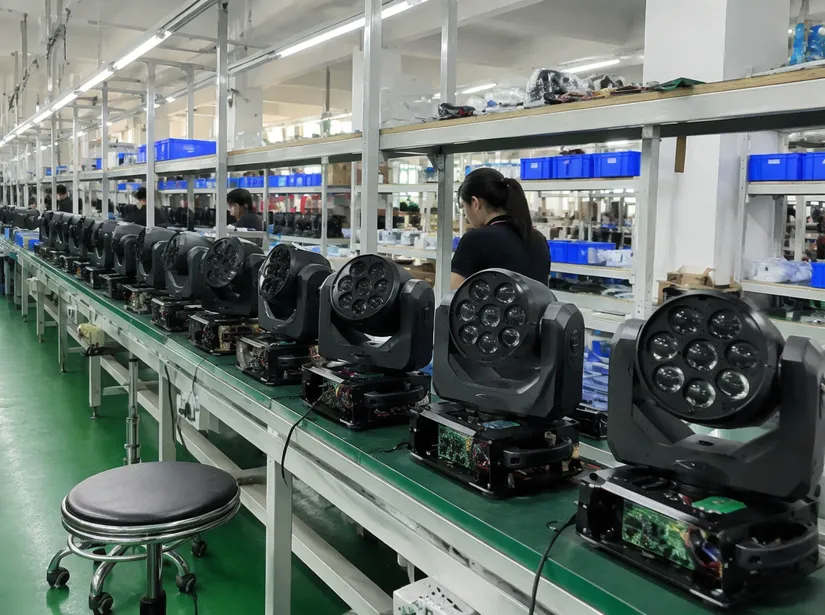
We run dance floor DJ lights on a dedicated line alongside our DJ effect lighting family. Current production capacity for this product category: approximately 15,000–20,000 units per month across all configurations when running at normal scheduling (single shift, 6 days).
What That Means for Your Orders
Standard Catalog Models
20–25 days
From order confirmation to ready-for-ship
OEM Models (Existing Tooling)
25–35 days
Depending on customization scope
New Configuration (First Run)
+10–15 days
Added for engineering sample approval cycle
No Surprise Lead Time Slippage
We don't quote lead times we can't hold. If there's a production queue issue that affects your timeline, you'll hear about it within 48 hours of order confirmation — not two weeks before your expected ship date.
This happens maybe twice a year during peak season in September–October when everyone orders for year-end event season simultaneously. We'll tell you upfront and offer options.
Reorder Simplicity
Once your first order establishes the approved golden sample and production spec, reorders reference the existing documentation. No re-approval cycle, no re-engineering.
Your second order typically ships 5–7 days faster than the first because setup and approval are already complete.
Frequently Asked Questions Dance Floor DJ Lights
What IP rating do I need for dance floor DJ lights in an outdoor venue?
What IP rating do I need for dance floor DJ lights in an outdoor venue?
IP65 minimum for any fixture exposed to rain, sprinkler systems, or open-air humidity. Our standard indoor dance floor fixtures are IP20 — appropriate for controlled indoor environments.
For rooftop bars, pool deck areas, or outdoor festival dance floors, specify the IP65-rated version. The sealed housing adds approximately 12–15% to unit cost but eliminates moisture ingress failures that would otherwise generate warranty claims within the first rainy season.
How many dance floor DJ lights do I need per square meter of coverage?
How many dance floor DJ lights do I need per square meter of coverage?
Depends on mounting height and beam angle selection. As a working rule: one fixture with a 35–45° beam at 4m mounting height covers approximately 12–16 m² of floor area with adequate lux density for effect visibility.
A 200 m² dance floor typically needs 12–16 fixtures for full coverage.
We can provide a lighting layout calculation based on your customer's specific venue dimensions — send us the floor plan and ceiling height, and our optical team will return a fixture count recommendation with beam overlap diagrams.
Quick reference: 1 fixture @ 4m height = ~12–16 m² coverage (35–45° beam)
Why do cheap dance floor lights dim after a few months of commercial use?
Why do cheap dance floor lights dim after a few months of commercial use?
Two failure modes:
Thermal degradation from inadequate heat sinking
When LED junction temperature consistently exceeds rated maximum, the phosphor layer degrades and you lose 20–40% lumen output within 2,000–3,000 hours.
Capacitor aging in the driver circuit
Cheap electrolytic capacitors in the constant-current driver degrade under heat stress, causing visible flicker and reduced output.
We use 105°C-rated capacitors and oversized heat sinks to keep operating temperatures well below these failure thresholds. The 48-hour burn-in catches any units with marginal thermal performance before they ship.
Can I mix dance floor DJ lights with my existing DMX lighting system?
Can I mix dance floor DJ lights with my existing DMX lighting system?
Yes — standard DMX512 protocol, both 3-pin and 5-pin XLR connections. Our dance floor fixtures address and respond on standard DMX channels without proprietary controllers.
If your customers run common lighting consoles (MA, Chamsys, Avolites, or any DMX-compliant desk), the fixtures integrate without compatibility issues. We provide DMX personality files for major console platforms on request.
What's the MOQ for custom-branded dance floor DJ lights?
What's the MOQ for custom-branded dance floor DJ lights?
The difference is whether we're applying cosmetic branding to an existing production model or running a custom BOM through engineering and production setup:
30 units
Catalog models with your logo and custom packaging
200 units
Full OEM configuration — modified optics, custom color temperature, specific beam angle, your firmware preset
Related Products in the Disco DJ Lights Family
If dance floor DJ lights don't precisely match your market positioning or your customers need complementary fixtures, explore our sibling products:
LED Disco DJ Lights
Broader category covering full LED-based disco effects, from compact party fixtures to multi-beam installations.
DMX Disco DJ Lights
For buyers focused specifically on professional DMX-controlled installations where protocol reliability is the primary spec.
Club DJ Lights
Purpose-built for permanent nightclub installation with emphasis on architectural integration and full-night operation.
Disco Ball Lights
Classic rotating beam effects that pair with dance floor fixtures for complete venue lighting packages.
Gobo Disco DJ Lights
Pattern projection fixtures that add branded logos or decorative patterns to the dance floor surface.
Disco Laser Lights
Laser-based effect systems for venues wanting high-impact aerial effects above the dance floor.
Most of our distribution partners stock 3–4 product types from this family to cover the full venue lighting scope. A typical venue order combines dance floor fixtures with gobo projectors and laser effects for a complete package — worth considering for your catalog breadth.
View all disco DJ lights optionsStart With Your Specific Requirements
You're evaluating dance floor DJ lights for your distribution catalog, a project pipeline, or a private-label program. The fastest path forward: send us your target market, typical order volumes, and any specific technical requirements. We'll respond with model recommendations, FOB pricing for your volume tier, and exact lead time for your configuration.
What to Include in Your Inquiry
-
Target Market / Region Helps us recommend the correct voltage, plug type, and certifications
-
Estimated Annual Volume or First-Order Quantity Determines your FOB pricing tier and production slot availability
-
Any Specific Certifications Required CE, FCC, ETL, RoHS, or regional standards for your market
-
OEM Branding Needs Logo placement, custom packaging, private-label documentation
-
Indoor-Only or IP65 Outdoor-Rated Determines housing material, gasket spec, and conformal coating requirements
Reach Our Project Team
We respond within 24 hours. Sample orders ship within 5–7 business days for catalog models.
Request a Quote for Dance Floor DJ Lights- You send requirements — we acknowledge within 24 hours
- Project engineer reviews and returns model recommendations + FOB pricing
- Sample approval → production slot confirmed with exact lead time