

DMX Disco DJ Lights Professional-Grade Disco Fixtures with Full Protocol Control
DMX disco DJ lights engineered for installed club systems and professional rental rigs — full DMX-512 protocol, RDM feedback, 16/32-channel addressing.
The margin product in the disco lighting category. Your pro-audio and installed-systems customers pay premium unit prices for fixtures that integrate seamlessly into DMX-controlled environments. We build them with industrial RS-485 transceivers and stepper motor positioning that holds up across 50,000+ hour duty cycles.
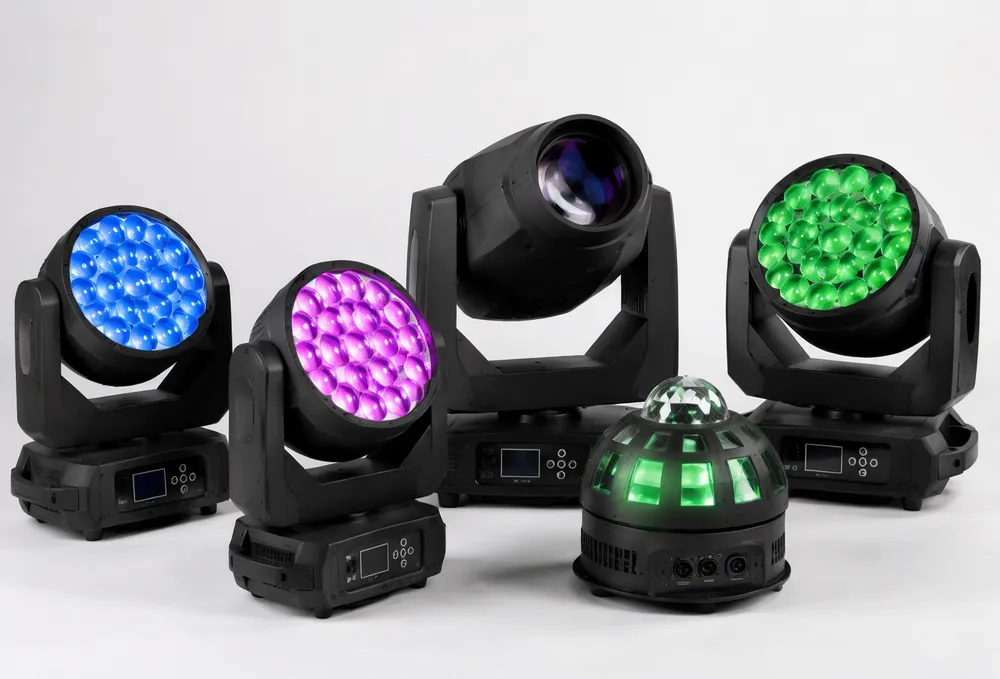
What DMX Disco DJ Lights Are and Where They Sit in Your Product Line
DMX disco DJ lights are disco and DJ effect fixtures — rotating effects, multi-color wash, gobo projection, strobes — built around full DMX-512 control protocol rather than standalone sound-activation or auto-run modes. The distinction matters commercially: these fixtures go into environments where a lighting controller runs the entire rig from a single console. Nightclub installations, professional mobile DJ setups, touring rental inventories, and event production houses all require DMX-addressable fixtures because they need programmable, repeatable, synchronized shows.
Within our disco DJ lights category, DMX disco DJ lights are the professional tier. Where our LED disco DJ lights sell at high volume into retail and e-commerce channels at sub-$30 price points, and our disco ball lights serve the plug-and-play party market, DMX fixtures command 3-5x the unit price and sell to buyers who evaluate on signal integrity, thermal longevity, and controller compatibility rather than retail packaging appeal. Your margin per unit is substantially higher, and your customers are stickier — once a venue programs 40 fixtures into their lighting console, they reorder the same model for years.
If your channel primarily serves consumer retail buyers who won't own a DMX controller, look at our LED disco DJ lights instead. DMX disco DJ lights need a professional buyer on the other end.
Category Positioning
DMX Disco DJ Lights
Professional tier · 3-5x unit price · Installed systems
High volume · Sub-$30 · Retail/e-commerce
Plug-and-play · Party market · Consumer
Why Buyers Stay
- Programmed into console — reorder same model for years
- Higher margin per unit vs. retail-tier products
- Stickier customer relationships
DMX Control Architecture — What's Inside and Why It Holds Your Signal Chain Together
The most expensive problem in installed disco DJ stage lighting isn't a dead LED — it's a fixture that drops off the DMX chain during a show. Intermittent signal loss means one fixture goes dark or holds its last state while the rest of the rig keeps running. Your customer calls you. You eat the service call or the replacement.
We engineer against this failure at three levels:
RS-485 Transceiver Selection
We use industrial-grade RS-485 line drivers with 15kV ESD protection on both data pins. Every time someone hot-plugs a fixture while the controller is already transmitting, a transient hits the data line. Consumer-grade transceivers survive a few of these events before the protection diode breaks down.
Ours survive indefinitely because we spec the same transceiver class used in industrial automation bus systems.
We switched to these in 2018 after tracing intermittent DMX dropout complaints from a nightclub chain to degraded transceivers on fixtures that had been hot-plugged hundreds of times.
Connector Contact Integrity
XLR connectors on our DMX disco DJ lights use spring-loaded socket contacts, not stamped pins that work loose under vibration. The bass frequencies in a nightclub physically vibrate the fixture housing all night.
Over months, stamped-pin XLR contacts develop micro-gaps that create intermittent data loss. Spring contacts maintain pressure regardless of vibration state.
We also machine the XLR barrel from solid brass rather than zinc die-cast — the threads don't strip when your installer is working overhead.
DMX Addressing & RDM Capability
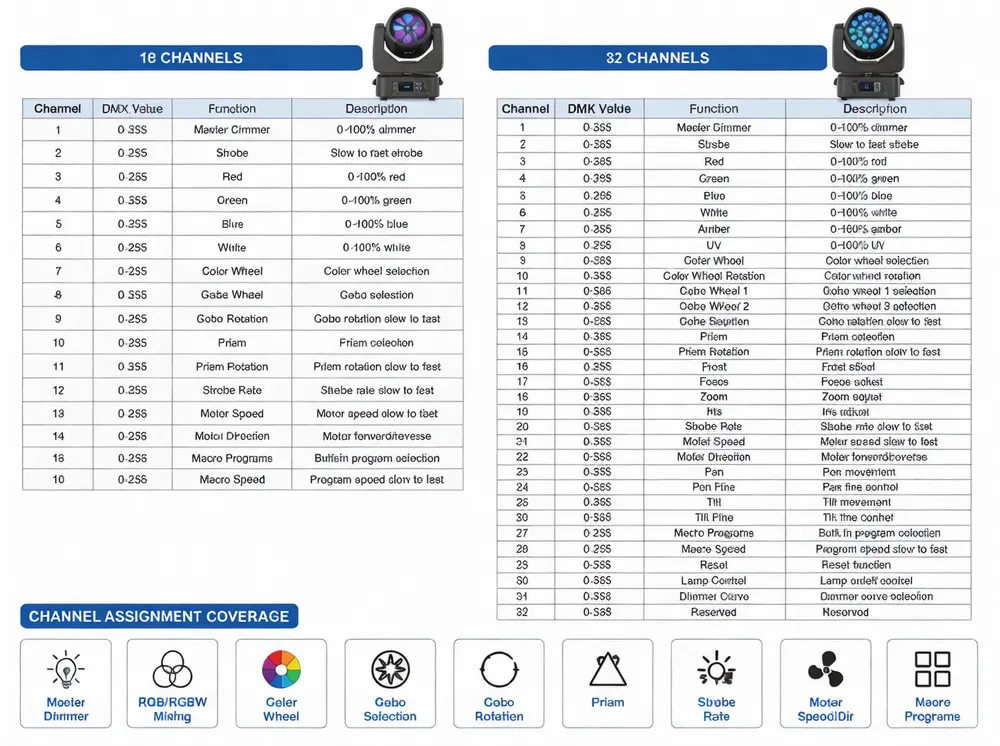
Standard models offer 16-channel DMX addressing. Pro-tier configurations support 32-channel addressing with full RDM (Remote Device Management) — meaning your customer's console can query fixture status, set addresses remotely, and monitor lamp hours without physically touching each unit.
For a nightclub with 40+ fixtures mounted at ceiling height, RDM eliminates the ladder truck every time an address needs changing.
Channel Assignment Coverage
The exact channel map depends on fixture complexity — we provide full DMX protocol charts with every model. Standard channel assignment covers:
Need DMX protocol documentation and pricing for your project?
We supply full channel maps, RDM specifications, and fixture datasheets with every quotation.
Technical Specifications DMX Disco DJ Lights Range
These specifications cover our standard DMX disco DJ light models. Your procurement comparison sheet starts here.
Standard Models
Pro Models
Specifications shown are representative of our standard product range. Exact specifications vary by model and are provided with individual datasheets. Contact us for detailed model specs and photometric data.
Stepper Motor Precision The Mechanical Core of DMX Disco Effects
Positioning, Not Just Spinning
In a DMX-controlled disco fixture, the motor doesn't just spin — it positions. When the console sends a gobo change command, the motor indexes to an exact angular position and holds. When it sends a slow rotation command, the motor turns at a precise, repeatable speed. This is fundamentally different from the DC brush motors used in consumer disco lights, which spin at approximately the right speed and can't index at all.
We run stepper motors on all DMX disco DJ lights, with microstepping drivers that divide each full step into 16–64 microsteps. The result: smooth gobo rotation without visible stepping artifacts at slow speeds, and precise snap-to-position performance on indexed gobo changes. The controller sends the command, and the gobo lands where it should — not one slot off, not half a degree late.
72-Hour Stress Screening
Every stepper motor unit goes through a 72-hour run-in cycle before assembly into the fixture. We run them at 120% of rated voltage during this period to stress-screen weak windings and thermal failures. The units that pass are the units that will run 50,000 hours without position drift or stall. The ones that don't pass never reach your inventory.
Motor Heritage
Our motor heritage from pre-2012 electromechanical assembly work still pays off here. We've been engineering rotation mechanisms and long-cycle motor life since before we made lighting fixtures. The pan/tilt mechanisms in our moving heads use the same motor platform — it's proven across hundreds of thousands of deployed units.
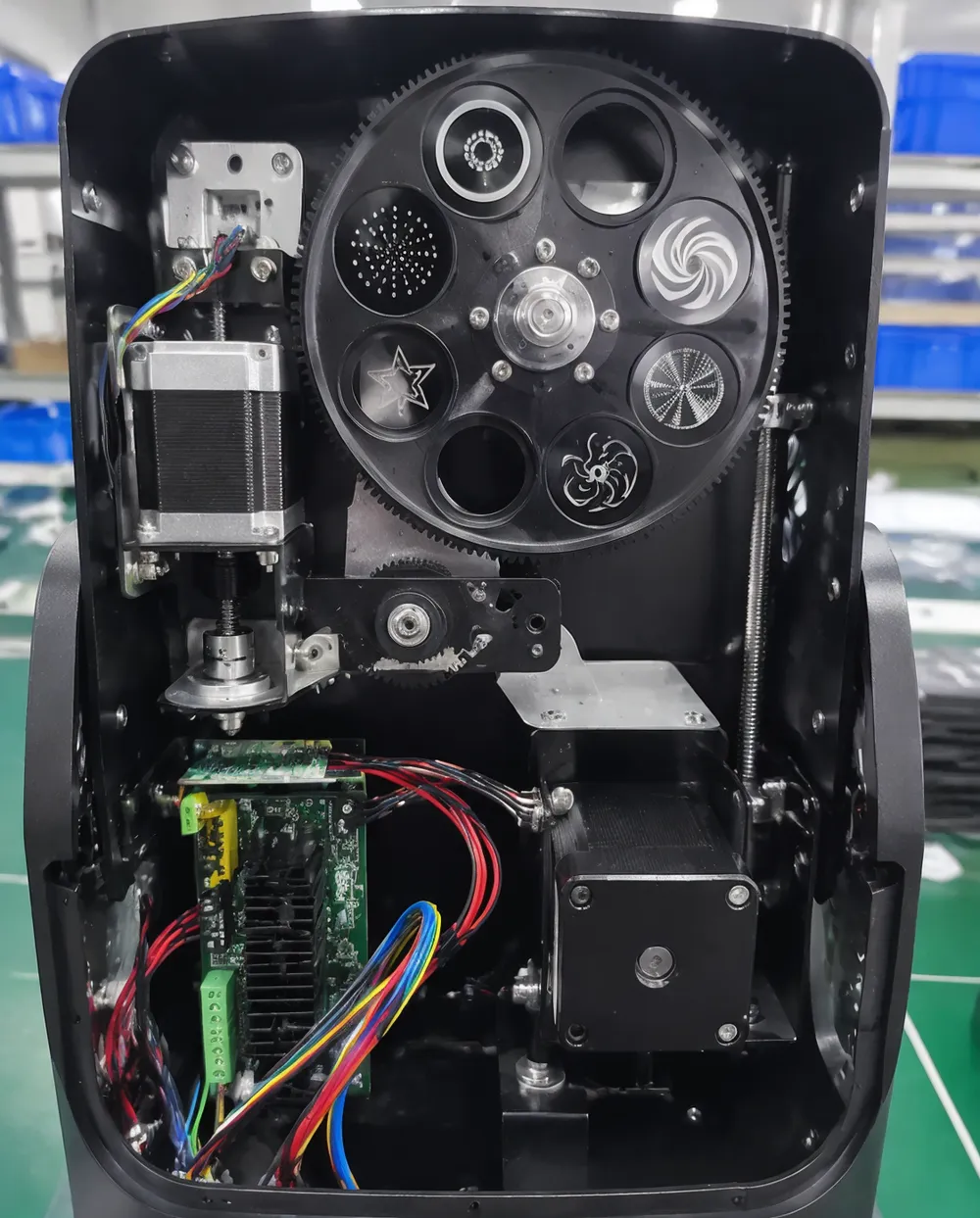
Key Motor Specs
Thermal Engineering for Continuous Nightly Operation
DMX disco DJ lights in a nightclub run 6–10 hours every night, 5–7 nights a week. That's a thermal endurance test that consumer-grade disco lights aren't designed to survive. The LEDs generate concentrated heat inside a sealed housing. Without adequate thermal management, junction temperatures climb above 100°C, and lumen output drops measurably within months.
Our approach on DMX fixtures above 50W:
Aluminum-Core PCBs with Direct Thermal Path
The LED array mounts on a metal-core circuit board bonded directly to the aluminum housing. No air gap, no thermal pad with variable bond quality. Heat travels from LED junction through the PCB metal core into the housing mass continuously. We verify bond quality with thermal imaging on every batch — any PCB showing hot spots outside the expected thermal gradient gets rejected before assembly.
CNC-Machined Heatsink Geometry
The fin pattern on our DMX fixture housings is CNC-machined, not die-cast. Die-casting produces variable surface quality — porosity and incomplete fill reduce the effective surface area. CNC machining delivers consistent fin height, thickness, and spacing across every unit. The thermal resistance is predictable, not a range.
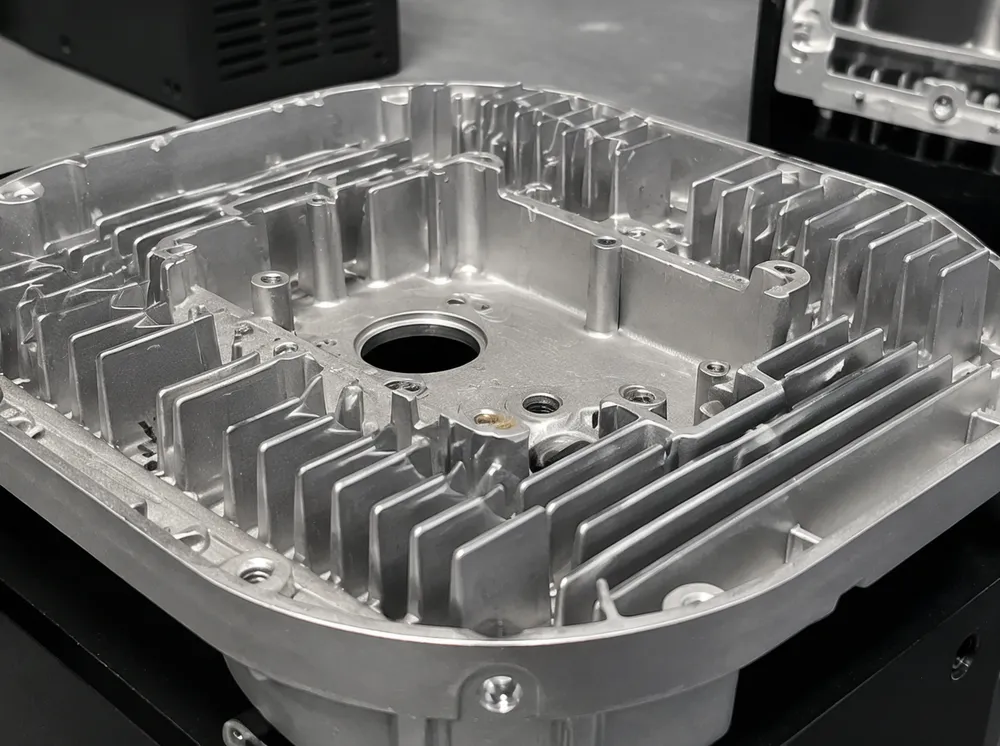
Verified Result
<10% Lumen Depreciation at 10,000 Hours
on RGBW models. Tested monthly in our photometric lab against reference samples from initial production. If any model drifts past 15% at any measurement interval, we redesign the thermal path before the next production batch.
What this means for your distribution business:
Near-zero warranty exposure on lumen depreciation claims — the most common source of "fixture still works but customer is unhappy" complaints in installed disco stage lighting. Your customer's fixtures look the same brightness two years into installation as the day they went up.
Revenue Segments for DMX Disco DJ Lights
Each segment below represents a distinct order pattern, margin structure, and reorder cadence. Knowing where your buyers sit determines which DMX fixture configurations to stock.
Nightclub and Lounge Installations
Permanent installations order 20–60 DMX disco DJ lights per venue build-out. The integrator or contractor specifies fixtures that match the venue's controller ecosystem and architectural mounting positions. Once programmed into the house console, these fixtures stay for 3–5 years — with expansion orders as the venue adds rooms or refreshes zones.
Your margin play: sell on DMX compatibility, RDM remote management, and thermal longevity. The integrator cares about fewer service calls post-install. The venue owner cares about lights that still look bright after 18 months of nightly abuse. Both concerns land on our engineering choices.
Professional Rental and Event Production
Rental houses buy DMX disco DJ stage lighting in fleet quantities — 20–100 identical units per SKU for consistent show programming across events. They replace fixtures on a 2–3 year cycle as rental wear accumulates. Fleet consistency matters: every unit needs to produce identical output and respond identically to DMX commands so the technician doesn't adjust per-fixture.
Stock advantage: We maintain rolling stock on our top rental-market DMX SKUs, so your 50-unit reorder ships from finished goods rather than waiting for a production run. Fleet buyers hate lead time surprises — they need replacements before the next gig, not in 30 days.
System Integrators and AV Contractors
Project-based orders for hotels, cruise ships, theme parks, and event venues. Orders range from 50–500 units with custom specifications: specific DMX channel maps, non-standard cable lengths, custom mounting brackets, integration with proprietary house control systems. Lead time tolerance is higher (project schedules plan months ahead), but customization requirements are more complex.
Your value for this segment: access to our engineering team who can modify firmware and hardware to project spec without minimum quantity barriers on the engineering work.
Mobile DJ Equipment Distribution
Professional mobile DJs who own DMX controllers buy DMX disco DJ lights as premium upgrades from consumer gear. Typical order: sets of 4–8 units. They want compact, lightweight DMX fixtures that travel safely in road cases and set up quickly on T-bars.
Distribution opportunity: Package DMX disco fixtures with complementary effects — a gobo fixture + wash effect + laser as a DMX-controlled kit at a bundle price.
Customization on the DMX Platform What We Modify, What's Fixed
DMX disco DJ lights have more customization depth than consumer-tier effects because the buyer base expects fixtures configured to specific system requirements. Here's what moves and what doesn't on our production line.
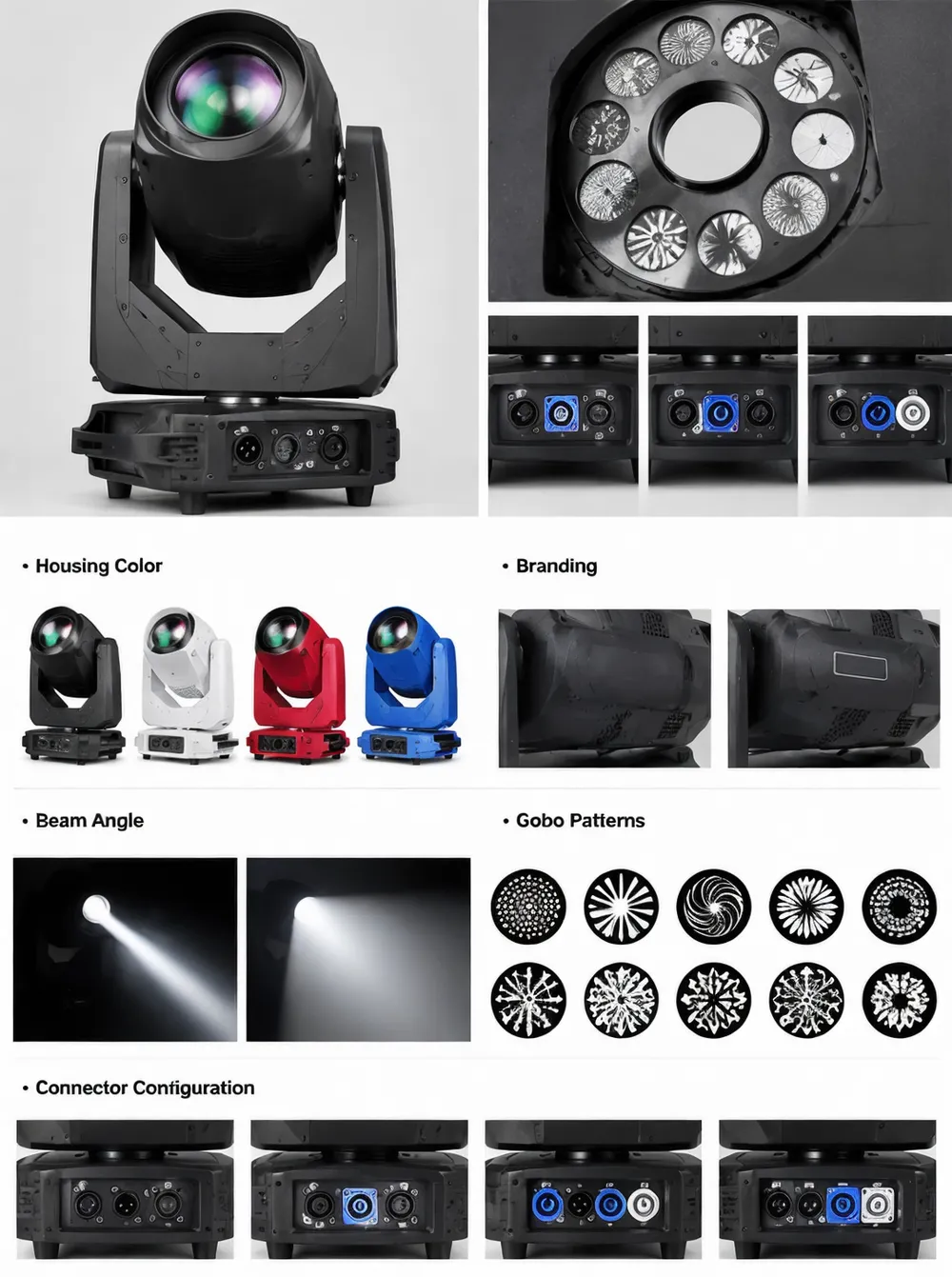
Fully Customizable
DMX Channel Map
Rearrange channel assignments to match your customer's console programming preferences. We reflash firmware to your requested map at no extra cost on orders above 100 units.
Gobo Patterns
Custom gobo wheels with your buyer's patterns, logos, or venue-specific designs. Minimum: 50 gobo sets per pattern.
Housing Color
Any RAL powder coat color on aluminum housings. Standard is matte black; white and custom colors add 5–7 days to lead time.
Branding
Your logo laser-engraved on the housing, custom boot screen on LCD-equipped models, branded packaging.
Connector Configuration
3-pin, 5-pin, or both XLR. PowerCON power input on pro models.
Beam Angle
Lens changes available to shift from tight spot to wider wash coverage.
Customizable with MOQ / Tooling Considerations
Housing Form Factor Modifications
Requires modified tooling. Feasible on orders above 500 units where tooling cost amortizes sensibly.
Custom LED Array Configurations
Different chip count, different color combinations (UV, amber, lime). Engineering review required; 2-week development cycle.
Wireless DMX Integration
We can add CRMX or W-DMX receiver modules internally. Certification adds time.
Fixed (Not Economical to Modify)
DMX-512 Protocol Standard
Non-negotiable. All fixtures conform to USITT DMX-512/1990.
Stepper Motor Platform
Our motor/driver combination is validated for 50,000 hours; we won't substitute.
Power Supply Architecture
Switching PSU with universal input (100–240V) is standard across all DMX models.
OEM Timeline
30–45
days — confirmed spec to production-ready samples on existing platform modifications
60–90
days — if new tooling is required
200+
units — first-run MOQ for branded variants of existing models
Our engineering team responds within 48 hours.
Manufacturing Process How DMX Fixtures Differ from Consumer-Grade Production
We build both consumer-tier disco lights (sound-activated, auto-run, USB-powered minis) and professional DMX disco DJ lights on the same factory floor but with fundamentally different production processes. The differences explain why DMX fixtures cost more and why the cost is justified for your margin.
SMT Soldering and LED Mounting
Consumer Disco Lights
Single-pass wave soldering — fast, sufficient for simple PCBs.
DMX Fixtures
Selective soldering on critical signal paths (DMX transceiver connections) plus reflow on the LED array. DMX data line solder joints need to survive years of thermal cycling without developing cold-joint failures.
We AOI-inspect 100% of DMX PCBs, not sample-based.
Motor Assembly
Consumer Fixtures
DC brush motor, press-fitted into housing, functional test only.
DMX Fixtures
Stepper motor with precision bearing pre-load, mounted on machined locating pins for exact angular alignment to the gobo wheel.
After assembly, each motor/gobo assembly runs a positioning accuracy test — the gobo must land within ±0.5° of the commanded position across all slots.
Aging Test Protocol
Consumer Disco Lights
12-hour power-on test.
DMX Disco DJ Lights
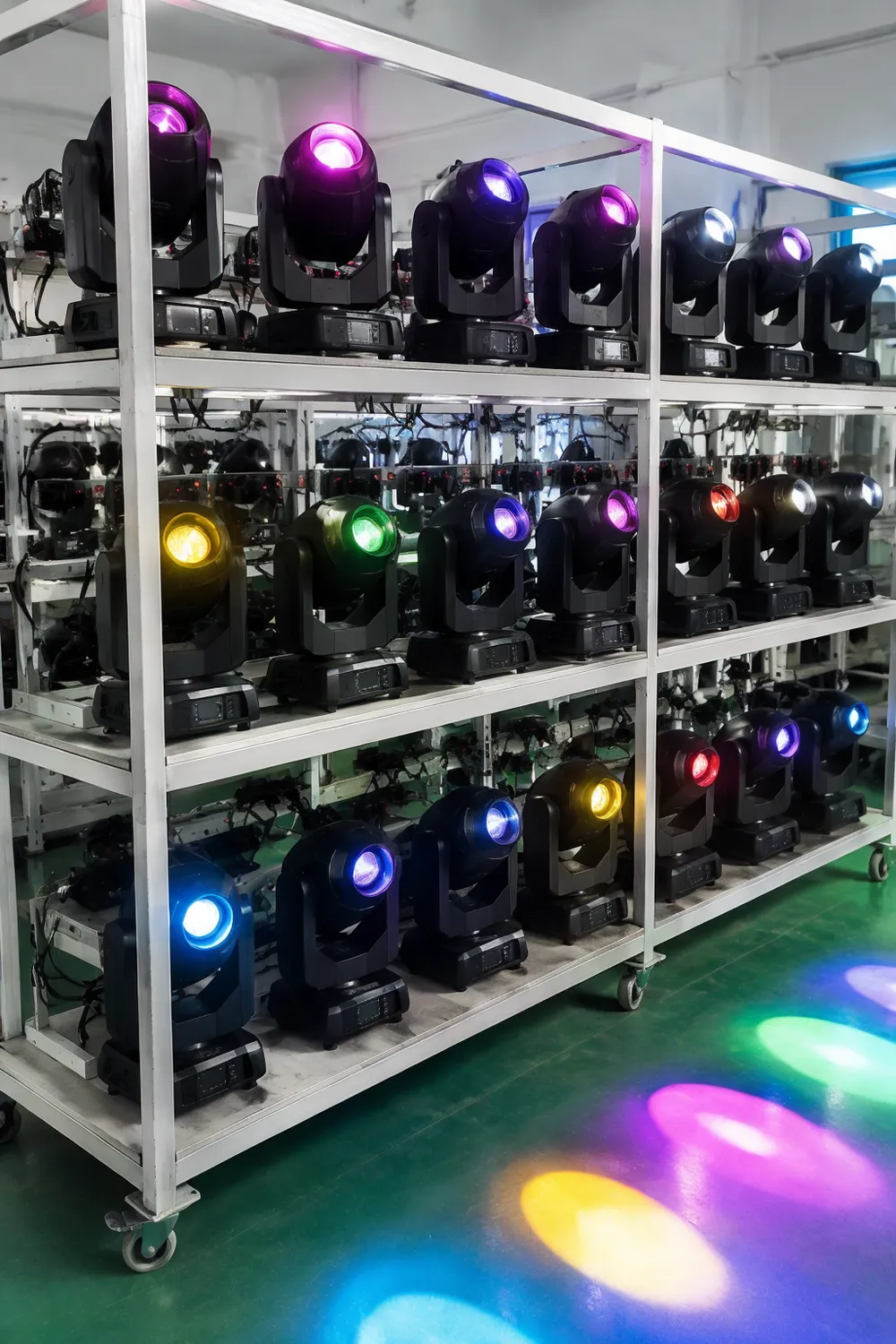
48-hour full-load aging with continuous DMX signal input cycling through all channels, all color states, all gobo positions, all motor speeds.
We're testing signal integrity under thermal stress, not just power-on survival. A fixture that passes 48 hours of continuous DMX cycling won't develop communication issues in the field.
Final Calibration
Consumer Fixtures
Visual inspection only.
DMX Fixtures
Individual photometric measurement — lumen output, beam angle, color coordinates — recorded against the model's reference standard. Units outside tolerance get re-aligned or rejected.
Why This Matters for Your Margin
This is why our DMX disco DJ lights carry a higher unit cost than commodity alternatives — and why your warranty return rate stays below 0.5% across the installed base.
100%
AOI Inspection
48hr
Burn-in Test
±0.5°
Gobo Accuracy
<0.5%
Return Rate
Compliance Documentation for Your Import Markets
DMX disco DJ lights entering North America, Europe, and most international markets need specific certifications. We handle this at the production level so your customs clearance proceeds without holds.
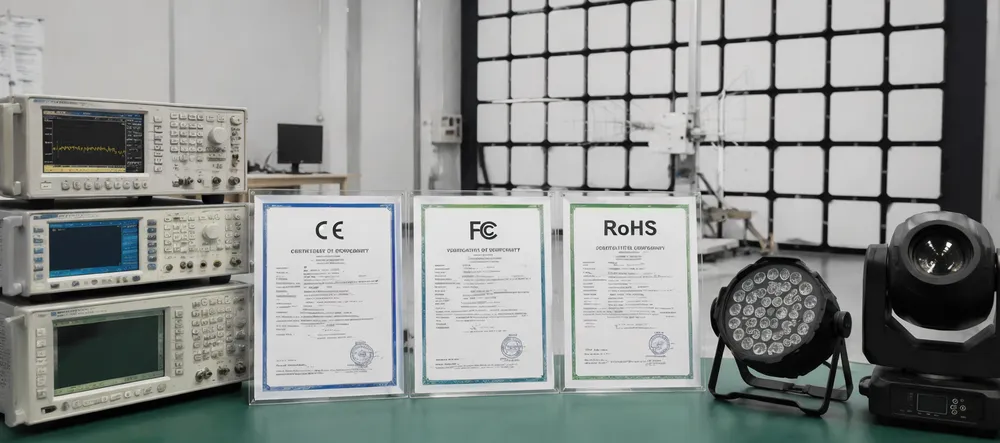
Certifications on Standard DMX Models
Full test reports available per model
Verified in our EMC pre-compliance chamber and confirmed by accredited lab
All materials declarations on file; lead-free solder, halogen-free PCB substrate
IP44 documentation available on sealed variants
Available Upon Request
IP65/IP67 Testing
For custom outdoor-rated DMX fixtures requiring higher ingress protection ratings
ETL/UL Listing
Available on specific models for buyers requiring NRTL certification (US/Canada). We coordinate with the test lab and absorb the timeline into your project schedule.
OEM EMC Test Reports
Product-specific EMC test reports with your brand name for OEM regulatory filings
Full Documentation Packages with Every Shipment
We supply CE declarations of conformity, FCC compliance statements, RoHS material declarations, and photometric test reports. Your import broker receives what they need without follow-up requests.
Shipping Specifications and Container Loading
DMX disco DJ lights are heavier and more mechanically complex than consumer disco effects, which changes your packaging and freight math.
Container Loading Reference
| Model Tier | Unit Weight | Carton Dimensions | 20GP Loading | 40HQ Loading |
|---|---|---|---|---|
| Standard DMX (ABS housing) | 3.5–6.0 kg | 35×35×38 cm | ~480 units | ~1,050 units |
| Pro DMX (aluminum housing) | 5.5–8.5 kg | 40×38×42 cm | ~360 units | ~790 units |
Transit Protection
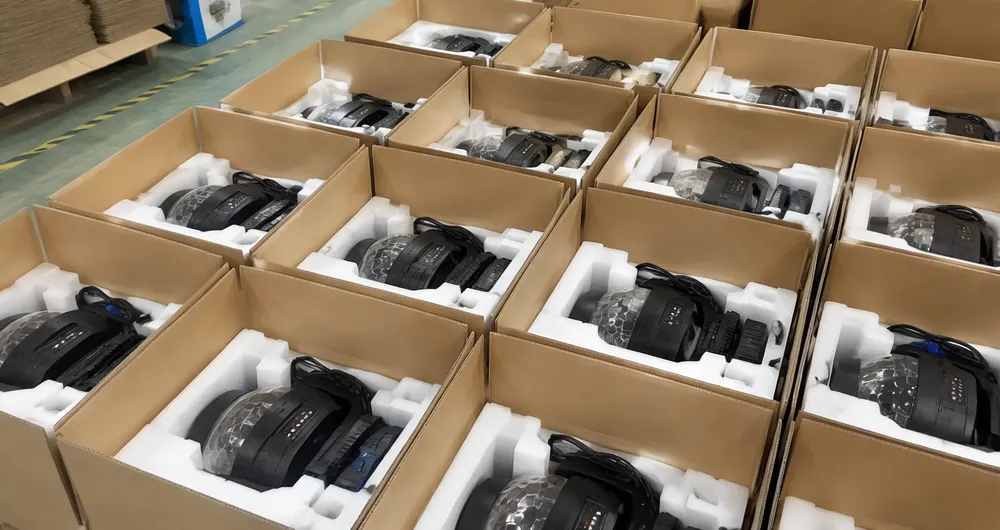
Each unit ships in a molded EPE foam insert designed from the fixture's 3D geometry. The gobo wheel and motor assembly are the fragile components — the foam cradle isolates them from transit shock.
We switched from cut-foam to molded inserts on DMX models specifically because the stepper motor/gobo assembly is more damage-sensitive than consumer disco ball mirrors.
Freight Optimization
DMX fixtures are volume-constrained on containers — the weight doesn't hit limits before the space does.
We optimize carton dimensions during product development to maximize container utilization. A 2cm reduction in height on the master carton adds approximately 8–12% more units per container on high-volume SKUs.
Trade Terms
Choosing Between DMX Disco DJ Lights and Sibling Products
If you're evaluating multiple product lines within our disco DJ lights range, here's how DMX fixtures differ from adjacent categories and when each makes sense for your channel.
DMX vs LED Disco DJ Lights
LED disco lights are consumer-oriented, sound-activated, and sell at high volume through retail and e-commerce. DMX fixtures sell at lower volume but higher margin to professional buyers.
Stock both if your channel spans consumer and pro. Focus on DMX if you exclusively serve installers and rental houses.
View LED Disco DJ LightsDMX vs Club DJ Lights
Club lights are also DMX-capable but emphasize UV/neon effects and ambient wash for lounge aesthetics. DMX disco fixtures emphasize gobo projection, beam effects, and dynamic show programming.
Choose based on whether your customers are programming dynamic shows (DMX disco) or creating static ambient environments (club).
View Club DJ LightsDMX vs Gobo Disco DJ Lights
Our gobo disco range includes both DMX-controlled and standalone gobo projectors. If your buyer specifically needs DMX-controlled gobo effects, the overlap lives in our DMX disco line's gobo-equipped models.
The standalone gobo range serves venues without DMX infrastructure.
View Gobo Disco DJ LightsNot sure which mix fits your market?
Most distributors serving the professional segment carry 3–5 DMX disco fixture SKUs covering: one compact beam effect, one multi-gobo projector, one RGBW wash, and one hybrid effect. We can recommend a starter mix based on your target geography and channel.
Frequently Asked Questions DMX Disco DJ Lights Procurement
How many DMX channels should I spec for my customers' applications?
9–16 channels covers most single-effect disco DJ stage lighting fixtures — color mixing, gobo selection, motor speed, dimmer, strobe. 32-channel fixtures are multi-function heads with separate control over pan/tilt, multiple gobo wheels, prism, focus, and fine color adjustment.
For your installed nightclub customers, 16-channel models balance programming flexibility with console channel budget. For touring rental companies running large rigs, 32-channel gives full parametric control but consumes more console universe capacity.
What's the maximum DMX daisy-chain length before signal degrades?
DMX-512 spec limits cable runs to 300m total per universe (1,200m with repeaters). In practice, disco DJ environments rarely hit this — a typical nightclub rig stays under 100m total cable length.
The real-world signal integrity issue is connector quality and ESD damage, not cable length. Our fixtures use industrial-grade XLR with spring contacts and 15kV ESD-protected transceivers, so you can daisy-chain 32+ fixtures without signal degradation in typical venue distances.
Can I mix GDMonkey DMX disco lights with fixtures from other manufacturers on the same chain?
Yes — DMX-512 is a universal protocol standard. Our fixtures respond to the same commands as any other compliant fixture. Channel mapping differs by manufacturer, so your customer's console programmer needs our DMX protocol chart (supplied with every unit).
RDM-equipped models will identify themselves to any RDM-capable console automatically.
What's the failure rate I should plan for in warranty budgeting?
Across our installed base of DMX disco DJ lights shipped since 2020, field failure rate within 24 months sits below 0.5%. The 48-hour aging test at full load catches infant mortality failures before shipping.
The most common field issue after aging is connector damage from rough handling during installation — not an internal component failure. For warranty budgeting, plan on less than 1 unit per 200 deployed requiring service within 2 years.
What MOQ applies to DMX disco DJ lights with custom branding?
30 units
Catalog (unbranded)
200 units
OEM branding (first run)
500 units
Custom housing/tooling
For OEM branding — your logo, custom packaging, modified DMX channel map — MOQ is 200 units on the first production run. Reorders start at 100 units. Custom housing colors or mechanical modifications typically require 500 units to justify tooling cost.
Do you supply DMX disco DJ lights pre-configured in road cases for mobile DJ distribution?
We don't manufacture road cases in-house, but we coordinate with case suppliers and deliver fixtures pre-installed in cases as a turnkey SKU if you provide the case spec. Minimum 50 sets for case-bundled orders.
Most of our mobile DJ distributors purchase fixtures and cases separately for more flexible inventory management.
Start Sourcing DMX Disco DJ Lights — Your Next Steps
Send us your requirements — whether that's a model inquiry, a project specification, or a "we want to build a DMX disco line under our brand" conversation.
What We Need From You for an Accurate Quote
-
Target Models or Fixture Types Beam effect, gobo projector, wash, hybrid
-
Approximate Quantity per SKU OEM/ODM starts from 200 units
-
DMX Channel Requirements 16-channel or 32-channel addressing
-
Custom Branding, Firmware, or Hardware Modifications Logo placement, UI language, protocol adjustments
-
Target Delivery Date and Destination Port Allows us to lock production slots and freight routing
What Happens Next
We respond within 24 hours with pricing, lead time, and product recommendations.
Samples ship within 5–7 days for catalog models.
Custom OEM/ODM projects receive a full engineering brief with timeline and tooling costs.