

LED DJ Spotlight Narrow Beam Optics · 8°–15° · Factory Direct
Tight beam concentration, high lumen-per-degree output, and consistent color across production batches — so your rental fleet or distribution catalog has a reliable spot fixture that holds value against commodity alternatives.
What This Fixture Is — and Where It Sits in Your Product Line
The LED DJ spotlight is our focused-beam fixture: narrow beam angles (typically 8°–15°), higher lumen concentration per degree than par cans, and optical systems designed for precise point illumination rather than broad wash coverage. You use these for pin-spot accent lighting (wedding cake spotting, table centerpiece highlights, display case illumination) and manual follow-spot applications at small-to-mid venues.
Within GDMonkey's LED DJ lights range, the spotlight occupies a distinct slot from par lights. Par cans give you 25°–45° flood wash — they light a stage area. Spotlights give you a defined circle of light on a single subject from distance. That's a different inventory category, a different rental use case, and critically for your margin, a product that doesn't get price-compared directly against commodity par cans.
Your downstream customers perceive spotlights as specialized tools, which supports higher per-unit pricing in your catalog.
LED DJ Spotlight
- ▸ 8°–15° beam angle
- ▸ Pin-spot & follow-spot use
- ▸ High lumen/degree
- ▸ Defined circle on subject
- ▸ Perceived as specialized tool
Par Can (Wash Fixture)
- ▸ 25°–45° flood wash
- ▸ Stage area coverage
- ▸ Even distribution focus
- ▸ Broad coverage per unit
- ▸ Commodity-priced category
Why LED Replaced Halogen Pin Spots
We've been building focused-beam LED fixtures since 2015, when the mobile DJ market started moving away from halogen pin spots. The LED advantage for your distribution business is straightforward: no lamp replacements (halogen pin spots burned through bulbs every 200–500 hours), lower heat output (less venue HVAC load, fewer burn-risk complaints at wedding installations), and DMX controllability that halogen couldn't offer.
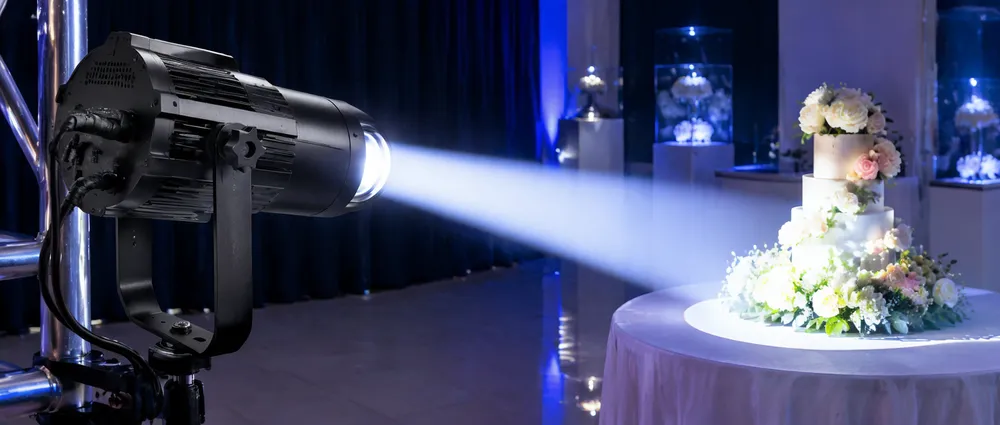
Optical Design — Why Beam Quality Determines Your Return Rate
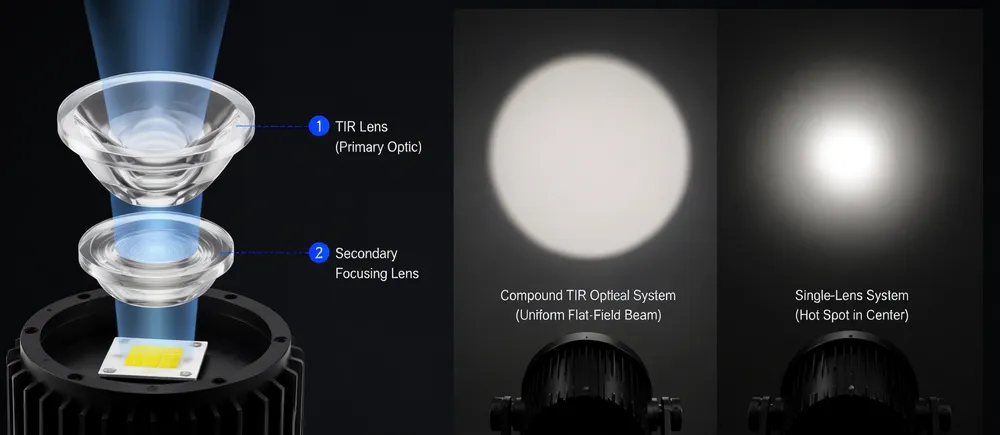
The core engineering challenge with an LED DJ spotlight is getting high lumen concentration into a narrow beam without ugly artifacts — hot spots in the center, color fringing at the edges, or visible LED array patterns projected onto the illuminated surface. Cheap spotlights just stick a lens in front of an LED array and call it done. The result is an uneven beam that your rental clients complain about after one event.
TIR Lens (Primary Optic)
A precision-molded TIR (total internal reflection) lens matched to the specific LED chip geometry. It collects light from the full LED emission angle and redirects it into a uniform column. This eliminates the center hot spot that plagues single-lens designs.
Secondary Focusing Lens
Controls the final beam angle after the TIR lens has created the uniform column. This two-stage approach produces a flat-field beam — uniform brightness across the entire projected circle with clean edges.
Chip-Specific Optical Matching
Our optical engineering team (part of the 15-engineer R&D group) designs the TIR lens profile specifically for each spotlight model's LED chip. We don't use off-the-shelf generic lenses across the range.
When we switched from Epistar to Luminus chips on our 30W spotlight variant in 2022, the TIR lens had to be re-profiled because the die size and emission angle changed. That kind of optical-to-chip matching is invisible to the buyer until they compare beam quality side by side — then it's obvious.
Business Outcome
Zero "uneven beam" complaints from rental clients, no field returns based on optical quality, and a product that justifies its price point when set up next to a cheaper competitor at a trade show demo.
Technical Specifications
Specs designed for the copy-paste test — your procurement team can drop this table directly into a comparison sheet alongside competing quotes.
| Parameter | Typical Value |
|---|---|
| LED Source | 10W–50W single-die or multi-die LED (CREE or Luminus, model-dependent) |
| Color Options | RGBW 4-in-1, warm white (3200K), cool white (6500K), single-color variants available |
| Beam Angle | 8°, 10°, 12°, or 15° (model-dependent; interchangeable lens option on select models) |
| Lumen Output | 800–3,500 lumens (varies by wattage and color configuration) |
| CRI | ≥85 (warm white variants); ≥90 available on ODM request |
| DMX Channels | 1/4/6/8 channel modes (model-dependent) |
| Control Modes | DMX512, sound-active, master/slave, auto-run, manual dimmer |
| Dimming | 0-100% smooth linear dimming, 16-bit dimming available on higher-end models |
| Strobe | 1-20Hz adjustable |
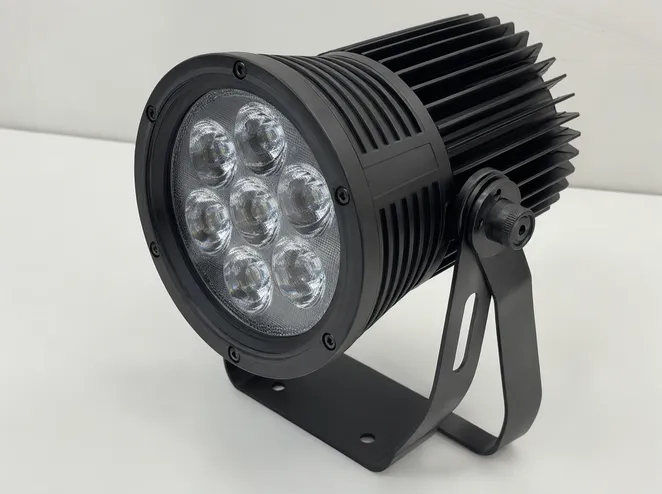
| Housing | Die-cast aluminum with integrated heatsink fins |
| IP Rating | IP20 (standard indoor), IP54 available for outdoor event use |
| Input Voltage | AC 100-240V, 50/60Hz |
| Weight | 1.5–4.5kg (depending on model wattage) |
| Mounting | Standard bracket mount with adjustable angle lock + safety cable loop |
| Connector | PowerCon in/out for daisy-chain power (3-pin and 5-pin DMX in/out) |
Specifications represent industry-typical values across our LED DJ spotlight range. Exact parameters vary by model and configuration. Contact us for detailed datasheets on specific SKUs.
Need Custom Parameters?
If you need parameters we haven't listed — specific throw distance calculations, foot-candle readings at given distances, or custom color temperature options — send us the requirement and we'll respond with measured data from our photometric lab.
Request Detailed Spec SheetKey Highlights
How We Build These — Process Choices That Affect Your Warranty Costs
The LED DJ spotlight shares our standard production infrastructure with the broader LED DJ lights line. What's different at the product level is the optical assembly and calibration stage.
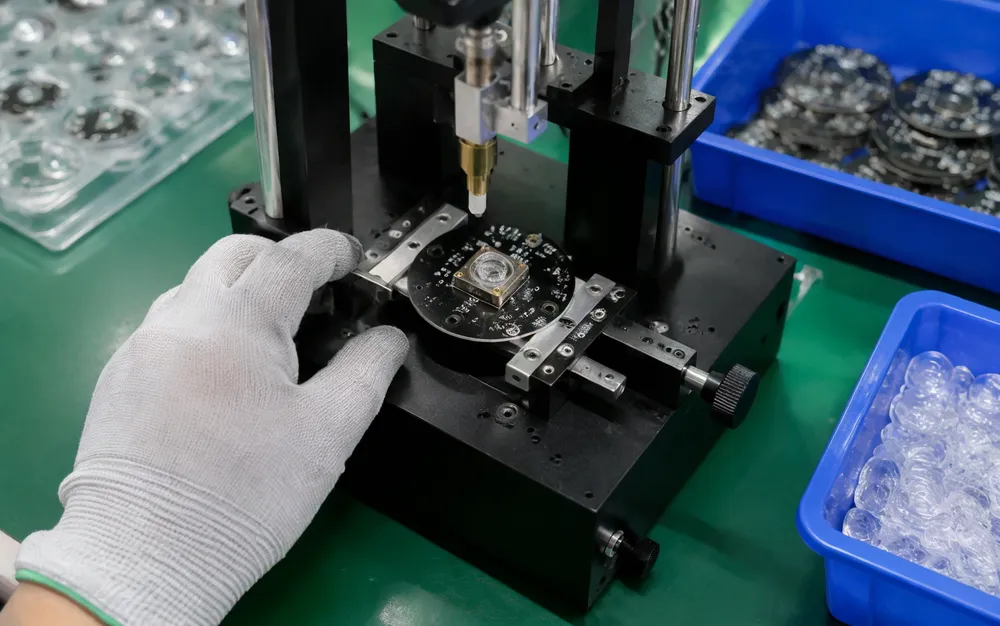
Optical Alignment — ±0.1mm Positioning Tolerance
After the LED is mounted on the PCB via automated pick-and-place, each spotlight unit goes through an optical alignment station where the TIR lens is positioned and locked relative to the LED die. Positioning tolerance is ±0.1mm — tighter than our par light assembly because beam angle accuracy is more critical on a spot fixture.
A 0.3mm lens misalignment on a par light shifts the wash pattern slightly and nobody notices. The same misalignment on a spotlight creates a visible off-center hot spot that your client sees projected on a wedding cake from 5 meters away.
Automated Beam Verification
After alignment, every unit goes onto our beam pattern measurement rig. A camera captures the projected beam at a standardized distance, software compares it against the reference pattern, and units with centering deviation beyond threshold get reworked.
Lens Adhesive Protocol
We implemented the automated beam check in 2020 after catching a batch where the lens adhesive hadn't fully cured, allowing subtle shift during transport. The fix was simple — longer cure time plus post-cure verification — but it required adding the measurement station to the line.
48-Hour Aging + Thermal Validation
The 48-hour aging test applies to spotlights the same as every other fixture we ship. Full electrical load, continuous operation, thermal monitoring. For spotlights specifically, we also verify that beam alignment hasn't shifted during the thermal cycling — thermal expansion in the housing could theoretically move the lens mount.
Designed For It, Verified Anyway
Thermal expansion in the housing could theoretically move the lens mount during the aging cycle. It doesn't — because we design for it — but we verify anyway. The shared production infrastructure (SMT lines, die-casting equipment, 48-hour aging racks) means these checks add minimal per-unit cost while substantially reducing your field failure rate.
Market Segments Where LED DJ Spotlights Generate Consistent Revenue
Each application below represents a repeatable order pattern for your distribution business — not a one-off project.
Wedding and Event Rental Market
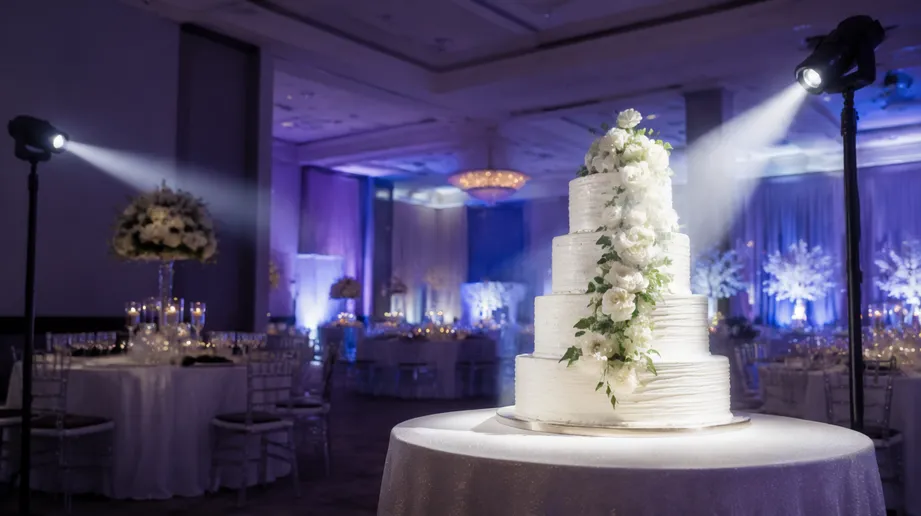
Mobile DJs and event rental companies deploy spotlights for cake spotting, centerpiece highlights, and performer follow-spots. The purchase pattern: 4-8 spotlights per DJ rig, refreshed every 2-3 years. Rental companies stock 20-40 units for fleet standardization.
This segment generates year-round demand because weddings and corporate events don't have an off-season in most markets.
Your Margin Advantage
Spotlights aren't commodity par cans. Rental companies charge per-fixture premiums for pin-spot packages (clients pay extra for "cake lighting" as an add-on service), so your wholesale price isn't squeezed the same way wash light pricing gets compressed.
Retail Display and Commercial Installations
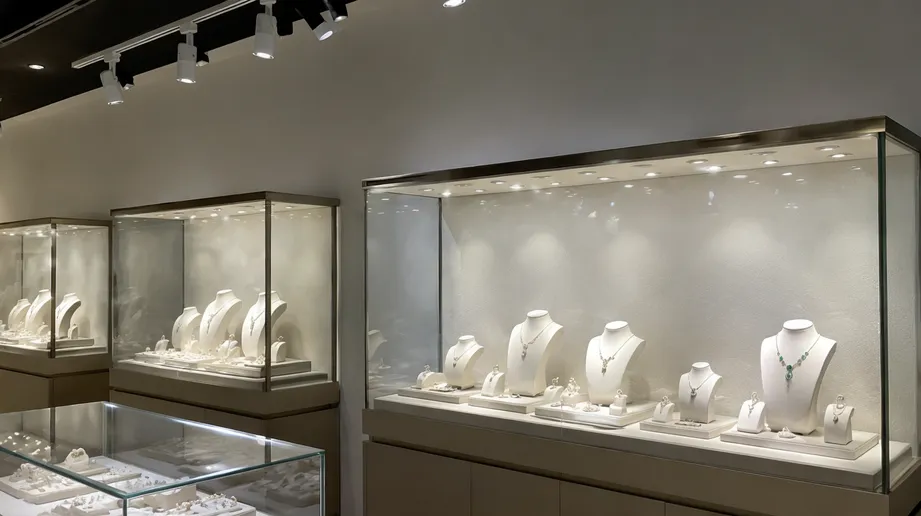
Jewelry stores, museum exhibit lighting, retail window displays, art galleries — all need focused accent lighting with precise beam control. These buyers order 10-30 units per project through commercial lighting distributors.
The value for your distribution business: commercial accounts reorder for new store locations, seasonal display refreshes, and multi-site rollouts. One relationship with a retail chain's facilities team can generate 50-200 units annually.
Segment-Specific Variants
Our warm white (3200K) and high-CRI (≥90) variants specifically target this segment — accurate color rendering matters when you're lighting a $50,000 diamond necklace or a painting.
Houses of Worship — Pulpit and Choir Spotlighting
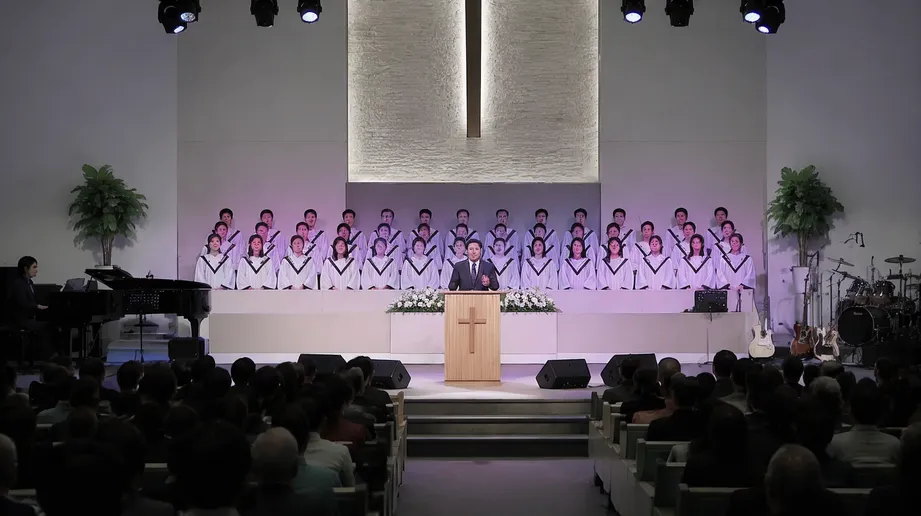
Churches upgrading from halogen follow-spots to LED represent a growing segment. Typical order: 4-12 spotlights per sanctuary for pulpit highlighting, choir pin-spotting, and baptistry illumination.
Multi-campus churches repeat-order for each new location. The segment is budget-conscious but loyal — once a church standardizes on a fixture model, they reorder the same SKU for consistency across locations.
Small Venue Performance Spaces
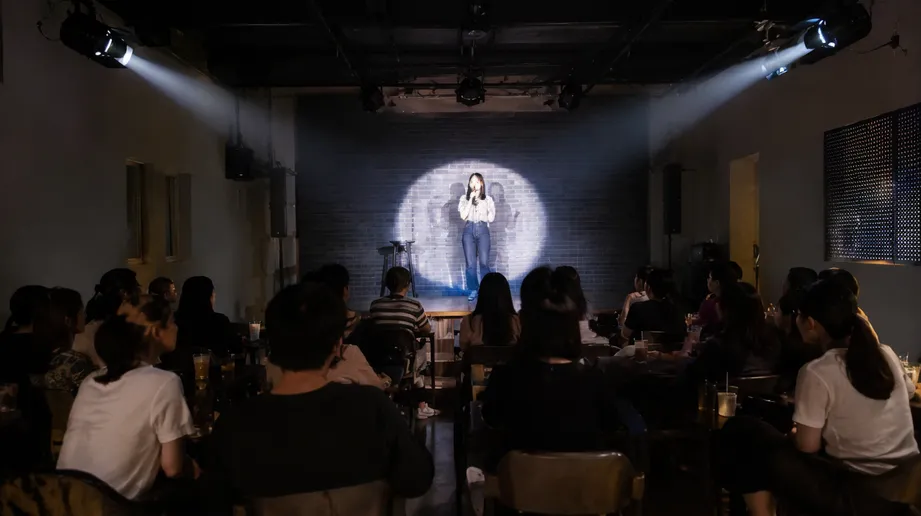
Bars, comedy clubs, poetry venues, small theaters — these need 2-6 spotlights for performer follow-spot duty without the budget for full moving head fixtures.
Your pricing advantage: an LED DJ spotlight at the $80-150 wholesale tier fills this need where a $500+ moving head is overkill. The venue gets focused beam control; you capture a segment that moving head distributors overlook.
Customization Scope — What You Can Specify on Your Order
OEM — Your Brand on Our Existing Designs
- Logo laser-engraved or silk-screened on housing body
- Custom packaging: box artwork, user manual, warranty card in your branding
- Firmware boot screen with your logo (LED display or DMX indicator sequence)
- Custom rear-panel labeling (DMX mode names, your model number)
- Private-labeled compliance documentation
ODM — Modified Specifications
- Beam angle: custom lens tooling for angles outside standard 8°/10°/12°/15° range
- LED chip selection: specify CREE, Luminus, or other qualified brands; select CRI tier
- Color temperature: custom CCT for specific applications (2700K retail warm, 4000K neutral, etc.)
- Housing color: standard black/white powder coat, or custom RAL color match (100+ unit minimum for custom RAL)
- Wireless DMX: factory-installed CRMX-compatible or proprietary 2.4GHz module
- IP upgrade: modify standard IP20 indoor model to IP54 splash-proof for outdoor events
- Custom DMX channel mapping: specific channel assignments to match your customers' preferred console layouts
- Mounting bracket modifications: T-bar adapter, truss clamp, ceiling flush-mount options
Limitations and Lead Times
MOQ
30
units for all OEM/ODM
OEM (Brand Only)
7-10days
samples; 20-25 days production
ODM (Existing Tooling)
15-20days
samples (lens, chip, or color changes)
ODM (New Lens Tooling)
+20-25days
additional for mold development
Maximum custom beam angle without new reflector housing: 6°-18° range using interchangeable lens inserts.
If your target application needs something outside these parameters — say, a 3° super-narrow spot for long-throw architectural use — tell us. We'll confirm whether it's achievable with a lens change or requires optical system redesign, and quote accordingly.
Certifications and Downstream Market Compliance
Our LED DJ spotlights carry CE, FCC (Part 15 Class B), and RoHS documentation standard. IP54-rated outdoor variants include third-party IP test reports.
What this means for your import operations: your shipments clear customs in EU and North American markets without compliance holds. The documentation package includes EMC test reports, safety test reports, and material declarations formatted for your import filing.
Need ETL/UL, SAA, or Other Regional Marks?
Our fixtures are designed to underlying IEC safety standards — certification is a documentation and testing exercise, not a redesign. We'll confirm timeline and cost before you commit.
Learn more about our factory capabilities and quality system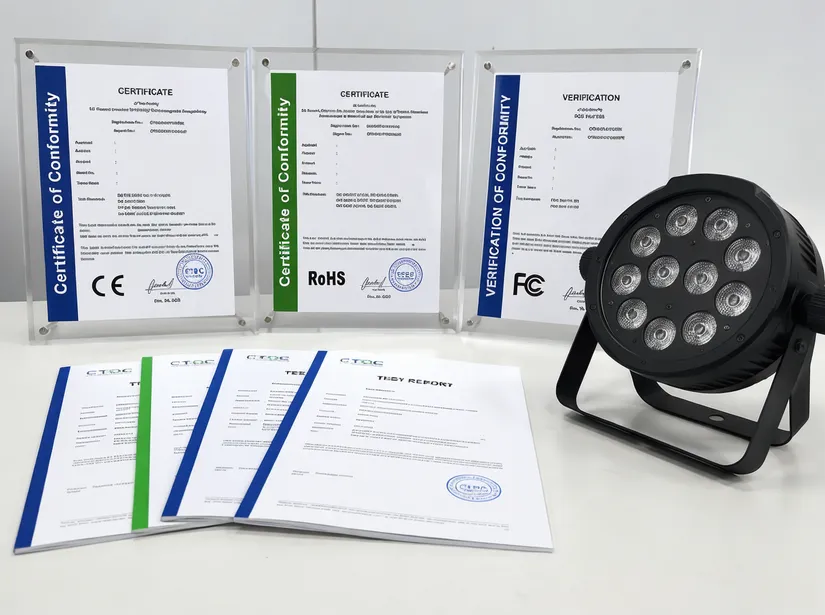
Specific Downstream Requirements
EU Markets
- • EN 60598-1 safety — covered
- • EN 55015 EMC — covered
- • EN 62471 photobiological safety — covered
North America
- • FCC Part 15 verified
- • Suitable for residential and commercial environments
Photobiological Safety
EN 62471 Risk Group 1 (exempt or low risk) for standard models — relevant if you sell into venues with occupational health compliance.
Environmental
- • RoHS compliant bill of materials
- • Lead-free soldering
- • REACH-compliant per current SVHC list
Packaging and Shipping Economics
Each LED DJ spotlight ships in an individual color box with custom-molded foam insert. The foam profile matches the fixture geometry exactly — no movement during transit, no bracket-dents-housing damage. Master cartons are double-wall corrugated, rated for 5-high container stacking.
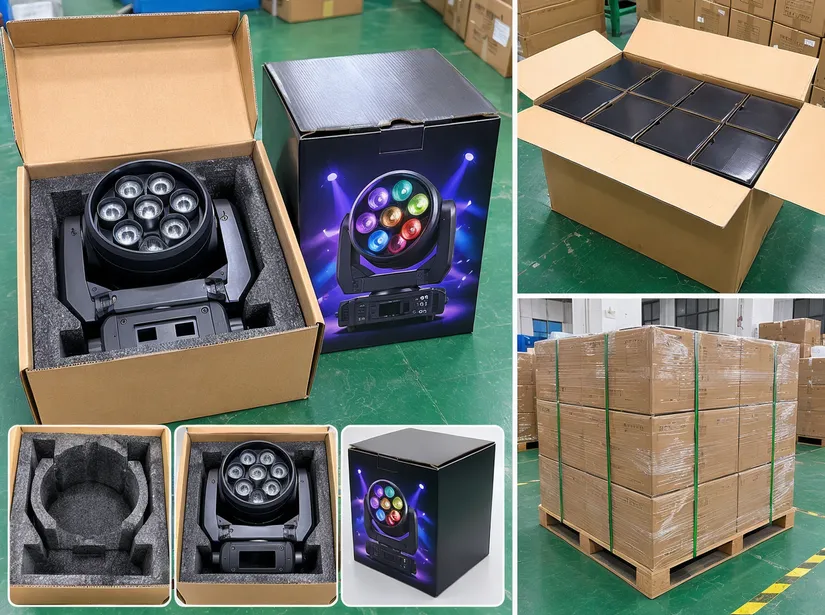
Container Loading Configurations
| Configuration | Unit Box (cm) | Units / Master Carton | Master Cartons / 20GP | Master Cartons / 40HQ |
|---|---|---|---|---|
| Compact Spotlight (10–20W) | 24 × 18 × 20 | 4 | 320 (1,280 units) | 660 (2,640 units) |
| Standard Spotlight (30–50W) | 30 × 22 × 26 | 2 | 240 (480 units) | 500 (1,000 units) |
Mixed-Product Containers
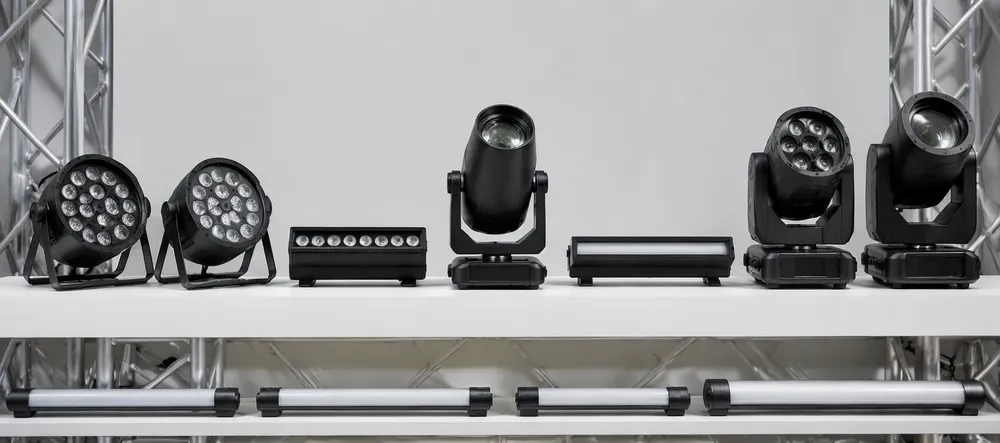
For mixed-product containers (spotlights combined with par lights, tube lights, or pixel bars from our LED DJ range), our logistics team calculates optimized loading plans.
Consolidating multiple fixture types into one shipment is normal for us — single bill of lading, single customs clearance, lower per-unit freight cost than ordering separately.
Amazon & E-Commerce Channels
We can produce shelf-ready retail packaging with barcode labeling, multilingual feature callouts, and frustration-free unboxing design.
FBA carton labeling and case pack configurations are supported.
Retail packaging adds 5–7 days on first orders for artwork approval.
- Barcode labeling
- Multilingual callouts
- FBA case pack configs
- Frustration-free unboxing
Compared to Other Fixtures in the LED DJ Range
Not sure whether the spotlight is the right fixture for your application? Here's where it sits relative to sibling products in the GDMonkey LED DJ lighting catalog.
Broad Stage Wash / Uplighting
25°–45° beam spread for area coverage, not point illumination. Par lights fill zones; spotlights pick out targets.
LED DJ Par LightsPixel Chase / Matrix Patterns
Individually addressable segments for dynamic visual effects. Pixel bars create motion graphics; spotlights deliver static focused beams.
LED DJ Pixel BarLinear Accent Lighting
Architectural lines and booth framing, not focused spots. Tubes define edges and surfaces; spotlights isolate subjects.
LED DJ Tube LightsHigher Wattage / Touring-Grade
150W–280W, heavier-duty housing for permanent install and production touring. Stage lights deliver raw output at scale; spotlights offer precision at moderate wattage.
LED DJ Stage LightsBudget-Friendly Party Effects
Sub-2kg compact effects for high-volume party pack sales. Mini lights maximize unit count per shipment; spotlights maximize beam control per fixture.
Mini LED DJ LightsThe Spotlight's Position
The spotlight fills the gap between a par light (too wide) and a full moving head (too expensive, too complex for pin-spot duty). If your catalog covers par lights and moving heads but lacks a dedicated pin-spot/follow-spot product, this is the SKU that captures that middle segment.
Frequently Asked Questions — LED DJ Spotlight Sourcing
What beam angle should I stock for general-purpose DJ and event use?
10° or 12° covers the majority of mobile DJ pin-spot applications — cake spotting from 3–5 meter throw distance, table centerpiece highlighting, performer accent at small venues. Stock 10° as your standard SKU.
Reserve 8° for buyers specifically requesting long-throw applications (15+ meter follow-spot in theater-style venues), and 15° for buyers who want a slightly wider pool for display case illumination.
Why do cheap LED spotlights produce a ring-shaped beam pattern instead of a solid circle?
That's the "donut effect" — caused by using a simple convex lens directly over an LED array without proper optical collimation. The lens focuses the LED's edge emission more than the center, creating a bright ring with a dim center.
We eliminate this with a TIR primary lens that collects and homogenizes the full emission pattern before the secondary focusing lens shapes the beam.
Supplier evaluation tip: Request a beam photo at rated throw distance — the donut effect is immediately visible and is a clear indicator of optical shortcutting.
Can I mix spotlights with par lights and pixel bars on a single DMX universe?
Yes. All fixtures in our LED DJ range use standard DMX512 protocol with consistent implementation. Daisy-chain spotlights, pars, tubes, and pixel bars on one universe (512 channels total).
Channel addressing is sequential — the spotlight uses 4–8 channels per fixture depending on mode, so plan your address map accordingly.
We can customize channel mode assignments on OEM orders if you need specific configurations to match your customers' preferred controller presets.
How does thermal management in a spotlight differ from a par light?
Par lights spread their heat load across a wide-body housing with radial fins. Spotlights concentrate higher wattage into a smaller optical assembly area — the heat density per square centimeter is higher.
We compensate with deeper fin profiles on the rear housing and larger thermal interface area between the LED PCB and the heatsink body.
Our 48-hour aging test specifically validates that beam alignment doesn't shift as the housing thermally cycles — thermal expansion in a poorly designed spotlight housing can gradually decenter the lens over hours of use.
What's the minimum order for a custom beam angle that isn't in your standard range?
30 units, same as all OEM/ODM. If the desired angle (say, 6° or 18°) is achievable with an interchangeable lens insert in our existing housing, no new tooling is needed — samples in 15–20 days.
If the angle requires a new TIR lens mold (typically for very narrow angles below 6°), tooling development adds 20–25 days and a one-time mold cost.
We'll confirm which path applies after reviewing your target angle and throw distance requirements.
Next Step — Get Your LED DJ Spotlight Quote
Send us your requirements: target beam angle, wattage tier, quantity, and any OEM branding or specification modifications. Our engineering team will respond within 48 hours with a detailed quotation including unit pricing at your volume, sample lead time, and production timeline.
If you're not sure which configuration fits your market, tell us your target application segment and retail/wholesale price positioning. We'll recommend the spec that gives you the best cost-to-performance ratio for your channel.