

LED DJ Stage Lights Pro-Grade Fixtures for Production & Venue Deployment
Built for 12+ hour continuous duty — higher wattage, heavier housing, and professional DMX implementation for production companies and fixed installations.
These sit in a different tier than compact DJ par lights. 150W–280W output, die-cast aluminum construction, and thermal management validated across 48-hour aging — your deployment clients get fixtures that deliver rated lumen output at hour twelve, not just at minute one.
What These Are — and What Separates Them from the Rest of the DJ Lights Line
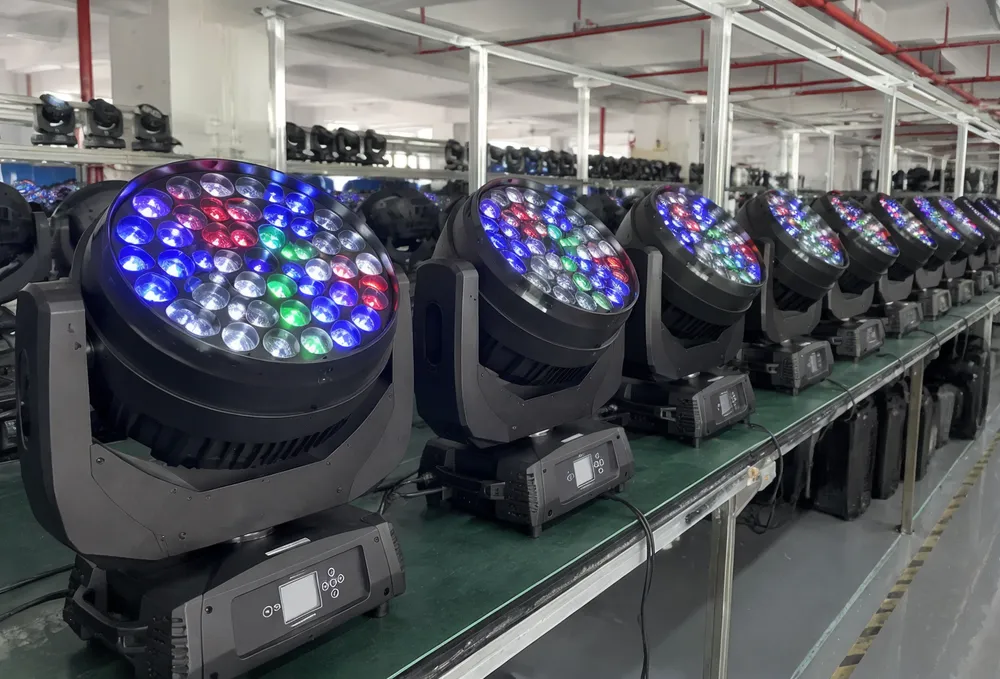
LED DJ stage lights are the full-size fixtures in our DJ lighting range — purpose-built for permanent venue installations and touring production rigs where output, durability, and uninterrupted operation define the job. They share the same DMX protocol and control ecosystem as our LED DJ par lights and LED DJ tube lights, but the engineering underneath is built for a different duty profile.
Where a compact DJ par light is designed to be lightweight, quick-rigging, and affordable enough to buy in stacks of eight, our stage LED DJ lights are designed to be hung on a truss, run at full output for an entire festival day, and survive years of truck loading. The housing is heavier die-cast aluminum — integrated heatsink geometry, not a bolt-on thermal pad. The LED arrays run higher wattage (150W–280W per fixture versus 54W–120W for par cans). The DMX implementation supports 12–24 channel modes for granular control over color mixing, dimming curves, and strobe rates that production lighting designers actually use.
For your business, the distinction maps to a different buyer segment and a different margin profile. Stage lights sell to production companies, venue integrators, and touring operators who buy fewer units at higher per-unit value — and who reorder when they expand fleet or add trucks. Lower volume, higher margin per transaction, longer customer lifetime value.
Stage Lights vs. Par Lights
Wattage
150W–280W vs. 54W–120W
Housing
Integrated heatsink geometry vs. bolt-on thermal pad
DMX Channels
12–24 channels vs. 4–8 channels
Duty Cycle
12+ hour continuous vs. event-length bursts
Buyer Profile
Production companies, venue integrators, touring ops — fewer units, higher margin, longer LTV
Technical Specifications — What Your Buyers Need for Their Spec Sheets
Specifications shown are standard production values. Contact us for detailed datasheets on specific models.
Lumen Output Measured at Thermal Equilibrium
We measure lumen output at thermal equilibrium — after the fixture has been running 30+ minutes — not at cold startup. The number you see here is the number your venue gets at hour six.
Need a specific model datasheet? We'll send the full photometric and mechanical drawings within 24h.
Thermal Architecture That Protects Your Deployment Contracts
This is where LED DJ stage lights succeed or fail in the field, and where most product returns originate for distributors stocking cheaper alternatives. A 200W+ LED fixture generates serious heat. Without adequate thermal management, the driver throttles output to protect the LEDs — your customer spec'd for 15,000 lumens and gets 10,000 after two hours. That's a callback, a warranty discussion, and a lost account.
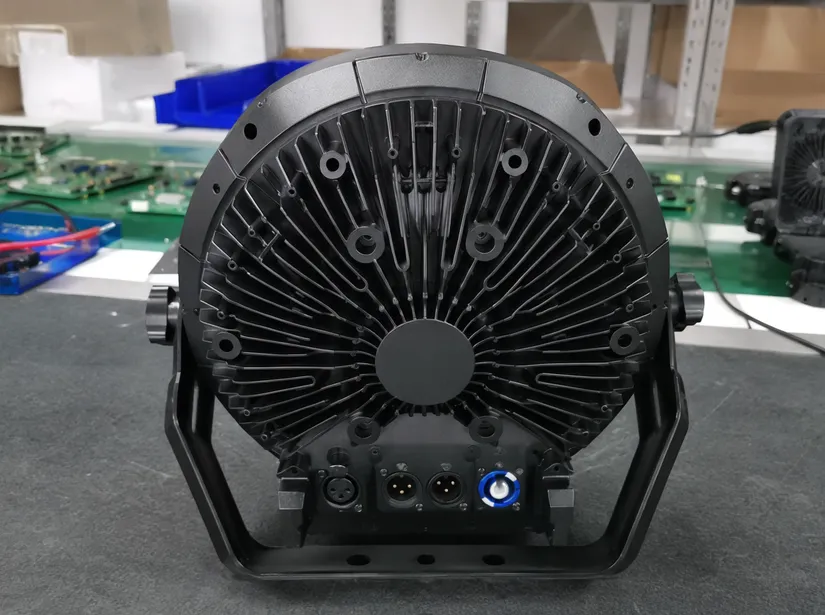
We machine heatsink geometry specific to each stage light model. The die-cast aluminum housing itself is the heatsink — radial fin patterns on the rear body calculated for the fixture's exact LED wattage and expected ambient temperature range. No separate heatsink bolted onto a flat chassis, no thermal pads bridging air gaps. The entire rear shell participates in heat dissipation.
Thermal Engineering Process
Finite element simulation first, then physical validation with thermocouple arrays placed directly on the LED PCB during sustained full-output aging. We target junction temperatures below 85°C at 45°C ambient — that's worst-case summer outdoor staging conditions. If a prototype exceeds this during testing, we iterate the heatsink geometry before the model enters production.
We went through four fin pattern revisions on our 280W RGBWAL fixture before thermals stayed stable under those conditions — each iteration added 3–5 days to development, but the field failure rate on that model is essentially zero.
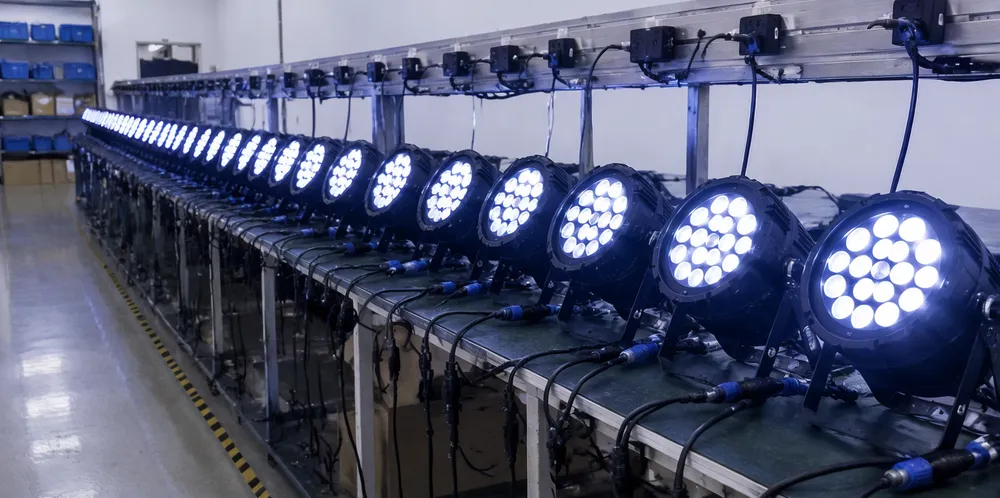
The 48-hour aging test at full electrical load catches any unit where thermal throttling activates. Those units get pulled, diagnosed, and reworked before they ever reach packing. Your rental fleet performs at rated output through back-to-back 12-hour festival days.
DMX and Control — Fewer Support Tickets for Your Distribution Business
Stage lighting that misbehaves on DMX is the fastest way to generate after-sales costs. A fixture that drops its address on power cycle, flickers during slow fades, or doesn't respond consistently across a 20-unit chain creates downstream service issues that eat your margin.
We write all DMX decoder firmware in-house — three engineers dedicated to control protocol development. Every LED DJ stage light model runs through a DMX stress test during production: 10,000 consecutive channel changes at maximum refresh rate, power-cycle address retention verification (fixture must restore its last DMX address within 1 second of power-on), and synchronization accuracy testing across 32-unit daisy chains.
RDM Support
Remote Device Management lets your venue clients reconfigure fixtures from the console without climbing trusses — address assignment, sensor readbacks, lamp-hour tracking over the data line.
1200Hz+ Refresh
No visible flicker on broadcast or streaming cameras. Your production company clients don't get complaints from videographers.
4 Selectable Dimming Curves
Linear, square-law, inverse square, and S-curve. The lighting designer picks the curve that matches their visual intent without fighting the fixture.
Wireless DMX (Optional)
Factory-installed CRMX-compatible module eliminates cable runs in venues where running DMX line is impractical or adds rigging time.
Production DMX Stress Test
- 10,000 consecutive channel changes at maximum refresh rate
- Power-cycle address retention — fixture restores last DMX address within 1 second of power-on
- Synchronization accuracy testing across 32-unit daisy chains
Field-Updatable Firmware
Firmware is field-updatable via USB across all current-generation models. If a venue needs a custom DMX mode map or a specific startup default state, it's a USB stick update — not a return-to-factory event.
Your after-sales cost on firmware issues is effectively zero.
Where Stage LED DJ Lights Generate Revenue Market Segments Worth Stocking
These aren't compact party lights that sell through volume and low price. LED DJ stage lights sell into segments where per-unit value is higher, purchase decisions involve technical evaluation, and customer relationships last years.
Touring Production Companies
Core Segment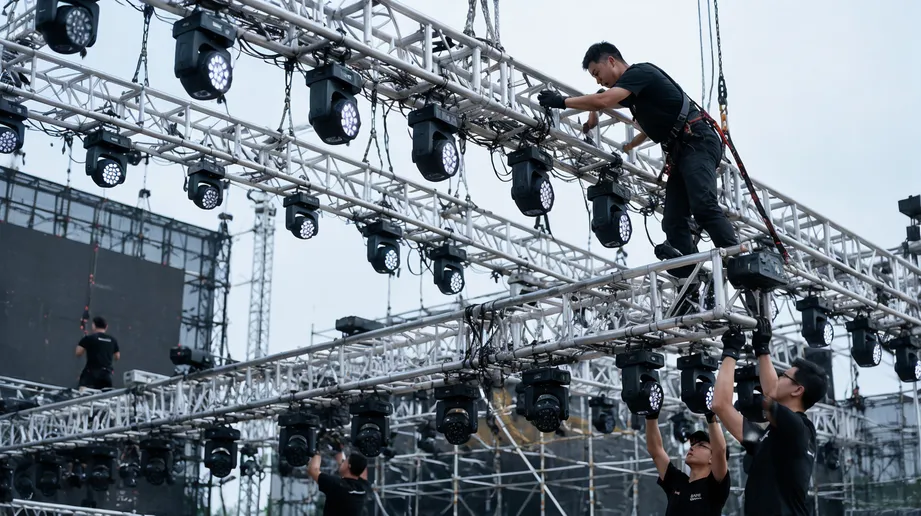
Production companies carry 50–200+ stage fixtures in their inventory and deploy them across concerts, corporate shows, and festival circuits. They need fixtures rated for continuous duty, fast rigging on truss systems, and reliable DMX response when 40+ units run on a single universe.
Typical purchase pattern: initial fleet buy of 20–60 units, followed by 10–20 unit expansion orders annually as they add trucks or replace aging inventory.
Your margin comes from being the fixture supplier they standardize on — switching costs are high once their crew knows the rigging and programming workflow.
Permanent Venue Installations
High-Value Orders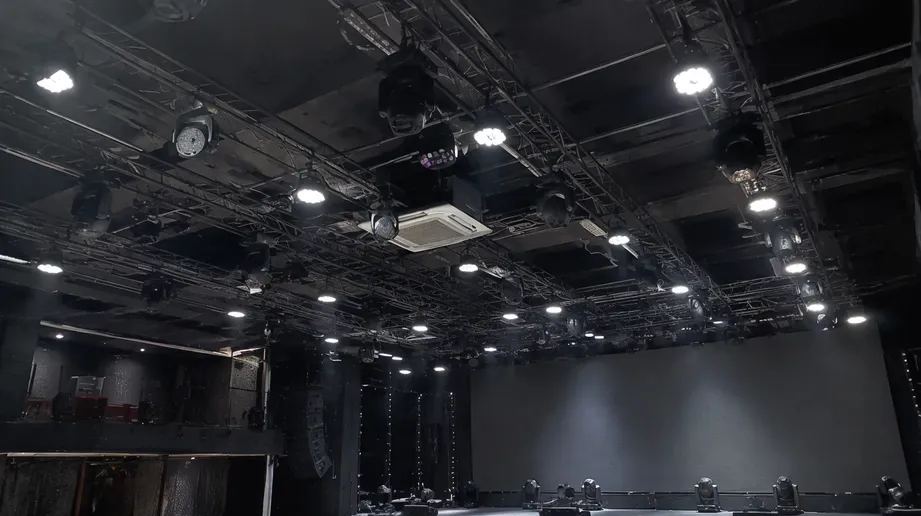
Nightclubs, concert halls, theatres, and event spaces installing fixed lighting rigs. These buyers spec 30–100 stage fixtures per venue, typically through integration contractors.
The decision cycle is longer (3–6 months from spec to purchase), but the order sizes are substantial and the replacement cycle runs 5–8 years.
Your value here: offering a product line deep enough that the integrator can spec wash, spot, and effect fixtures from one supplier with consistent DMX implementation and matched color rendering.
Houses of Worship — The Multi-Campus Multiplier
Recurring Revenue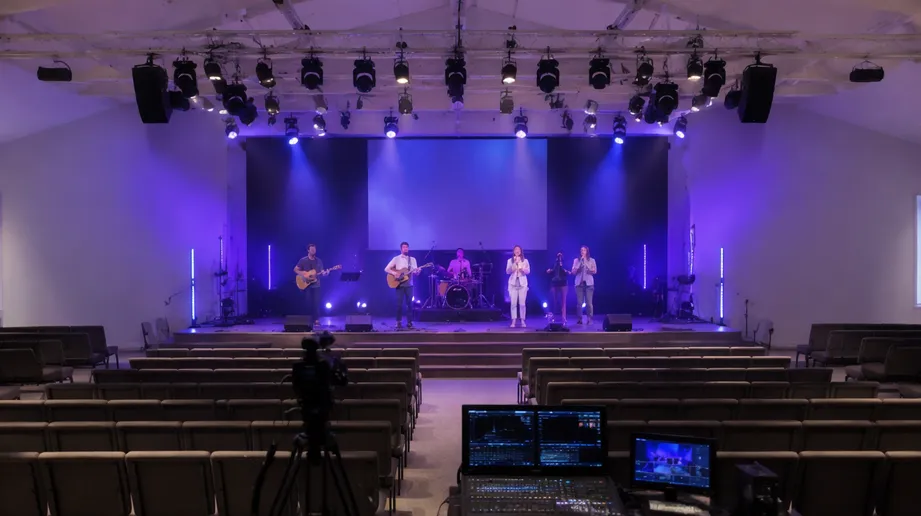
Churches upgrading from legacy halogen to LED stage lighting. Individual sanctuary orders run 20–80 fixtures.
The real volume comes from multi-campus denominations that standardize on a fixture package and repeat-order for every new campus. This segment has grown consistently over the past three years — churches invest in production-quality lighting for livestream and broadcast, not just in-room ambiance.
Budget-sensitive but recurring, with annual equipment refresh budgets that create predictable reorder patterns.
Rental Houses Building Pro-Tier Inventory
Upsell Enabler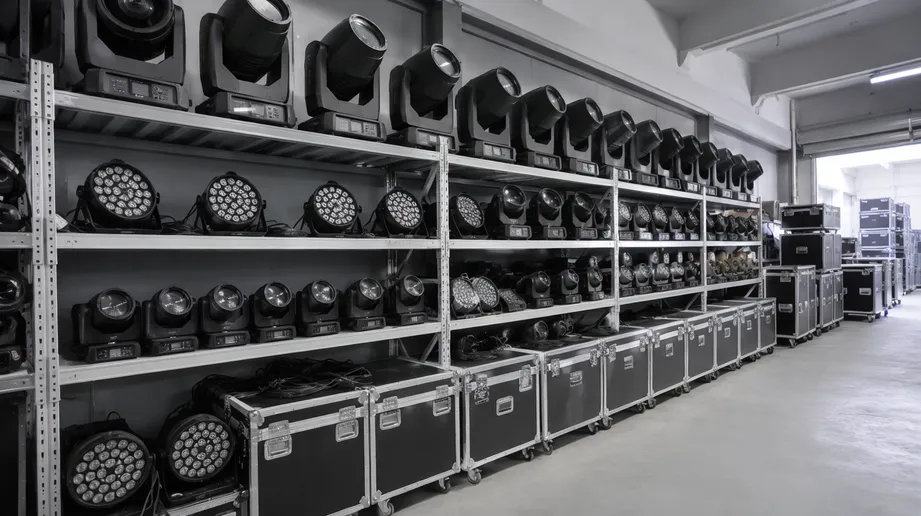
Event rental companies stocking stage-grade fixtures alongside their DJ-tier gear, specifically for production-level clients who need higher output than standard par cans deliver.
These buyers differentiate their service tier by offering pro-grade lighting packages — your stage lights become their upsell product, carrying higher rental rates per fixture than compact DJ lights.
Optical System — Color Consistency Across Your Entire Batch
When a venue installs 40 LED DJ stage lights on a truss, every fixture must produce identical color at the same DMX value. One unit shifting slightly greener or warmer than its neighbors is immediately visible to the lighting designer — and it's a warranty discussion that lands on your desk.
We control this at three points in production:
LED Chip Binning at Incoming Inspection
Chips are purchased in pre-binned lots within 2 SDCM for color LEDs and ±50K CCT / ±0.003 Duv for white LEDs.
IQC sample-tests forward voltage and dominant wavelength against the supplier's bin certificate before any lot enters the SMT line.
Lots drifting outside our acceptance window get rejected — regardless of supply chain pressure.
Automated Placement Accuracy
Pick-and-place mounts LED chips at ±0.05mm positional accuracy.
Misplaced chips shift beam pattern and create uneven light distribution visible from 3 meters on a white surface.
Every PCB assembly passes automated optical inspection before lens alignment.
Lens Calibration Per Fixture
After LED mounting, each fixture's lens assembly gets aligned against a photometric target.
Beam angle, hotspot centering, and edge uniformity verified before the housing closes.
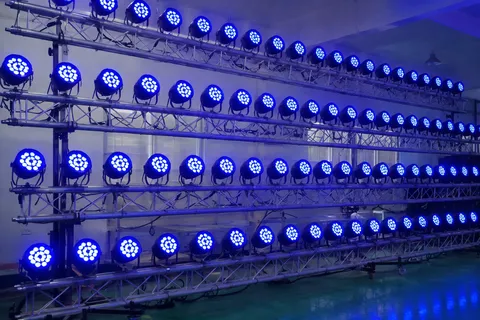
The Result: Complete Batch Interchangeability
When you ship 40 identical stage lights to a venue contractor, any fixture in that batch is interchangeable with any other. No visual mismatch, no "unit #17 looks different" service calls.
Repeat Order Bin Matching
We maintain LED binning records per production lot tied to your order history, so repeat orders 6 months later are priority-matched to the same bin specification.
If an exact bin match isn't achievable due to supplier availability, we flag it before production — never after.
OEM/ODM — Your Brand on a Pro-Grade Platform
Most buyers in the stage light segment aren't selling unbranded fixtures. You need your brand identity on a product that justifies professional pricing. We support full customization starting from 30 units.
OEM
Your brand on our existing stage light platform
- Logo laser-engraved or silk-screened on die-cast housing
- Custom packaging with your brand design and product photography
- Firmware boot screen with your logo and model designation
- Custom DMX mode labeling on rear LCD/label panel
- Private-labeled compliance documentation (CE/FCC with your brand as importer)
- Custom color housing (standard powder coat palette; custom RAL on 100+ units)
ODM
Engineering modifications to platform
- Modified LED array configurations — different wattage, chip count, color system
- Custom beam optics — different lens angle, add/remove frost filter, motorized zoom
- Modified housing form factor within existing structural platform
- Custom control features — specific DMX channel maps, proprietary wireless protocol integration, Ethernet/ArtNet input
- Thermal re-validation included for any configuration that changes power dissipation
Development Timeline
OEM variants sample
ODM engineering modifications to approved sample
New housing tooling (confirmed upfront if needed)
The 30-unit MOQ lets you test a branded SKU in your market before committing to production volume.
Durability Testing — What Your Warranty Exposure Actually Looks Like
Every LED DJ stage light ships after passing our full production validation sequence. This isn't a sampling protocol — it's 100% unit testing.
48-Hour Aging at Full Load
Every single fixture runs at maximum rated output for 48 continuous hours. Temperature, lumen output, and power consumption are monitored.
Units showing any thermal throttling, lumen drop beyond 3%, or power fluctuation get pulled and reworked. This catches infant mortality failures — capacitor issues, driver instabilities, LED bonding defects — before the fixture reaches your warehouse.
DMX Stress Sequence
10,000 channel changes at maximum refresh rate, including power-cycle recovery testing.
Fixtures must hold their DMX address through 50 consecutive power cycles without drift.
Mechanical Vibration
Stage fixtures spend their lives on trucks and truss. We run vibration testing simulating transport conditions to verify housing integrity, bracket attachment, and internal component mounting.
IP Testing (Outdoor Models)
IP65 jet spray and IP67 submersion testing on applicable models — not just at product qualification, but random sampling during production runs.
O-ring seats inspected for debris before every lens assembly.
Field Failure Rate — First Year
Across all models currently in production
Most of those 0.5% are handling damage, not component failure. Your warranty reserve for these products can be minimal.
Packaging and Container Loading for Stage Fixtures
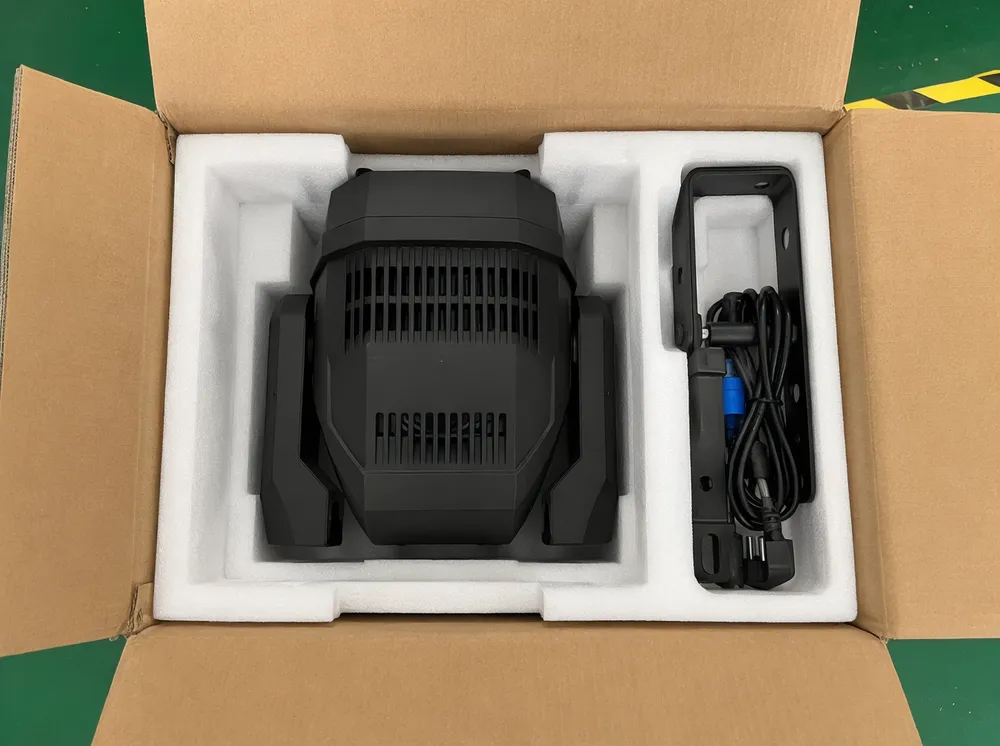
LED DJ stage lights are heavier and more expensive per unit than compact DJ fixtures, so packaging design prioritizes protection over density. Each unit ships in an individual color box with custom-molded high-density foam — the foam geometry wraps the fixture body, yoke bracket, and power cable separately to eliminate movement during transit.
Master cartons are double-wall corrugated, rated for 4-high stacking in container loading. All packaging passes ISTA 3A transport simulation (drop, vibration, compression) before we approve a new model's packaging design.
For mixed containers — stage lights combined with par cans or tube lights in one shipment — our logistics team calculates a custom loading plan. This is normal for us and doesn't add lead time.
Container Loading Reference
| Fixture Model Range | Unit Box Dims (cm) | Units / Master Carton | Master Cartons / 20GP | Master Cartons / 40HQ |
|---|---|---|---|---|
| 150W–200W Stage Lights | 48 × 35 × 38 | 2 | 180 (360 units) | 380 (760 units) |
| 200W–280W Stage Lights | 55 × 40 × 42 | 1 | 220 (220 units) | 460 (460 units) |
Packaging Format Options
Retail-Ready
Shelf-ready packaging with your brand identity and product imagery for pro-audio dealer channels.
Neutral Plain Box
Unbranded packaging for distributors who rebrand or repackage before resale.
Flight-Case-Ready
No individual color boxes — bulk-packed for customers who transfer directly into flight cases.
Mixed Container
Stage lights combined with par cans or tube lights — custom loading plan at no extra lead time.
Certifications Pre-Qualified for Your Import Markets
Every LED DJ stage light carries CE, FCC, and RoHS documentation. IP65 and IP67 test reports are available for applicable outdoor-rated models. This is the baseline that keeps your containers moving through customs in North America and Europe without holds or supplemental testing.
If your market requires ETL/UL for North America, SAA for Australia, or other country-specific marks, our fixtures are designed to meet the underlying safety standards — certification is documentation, not redesign. We'll confirm timeline and cost before you commit.
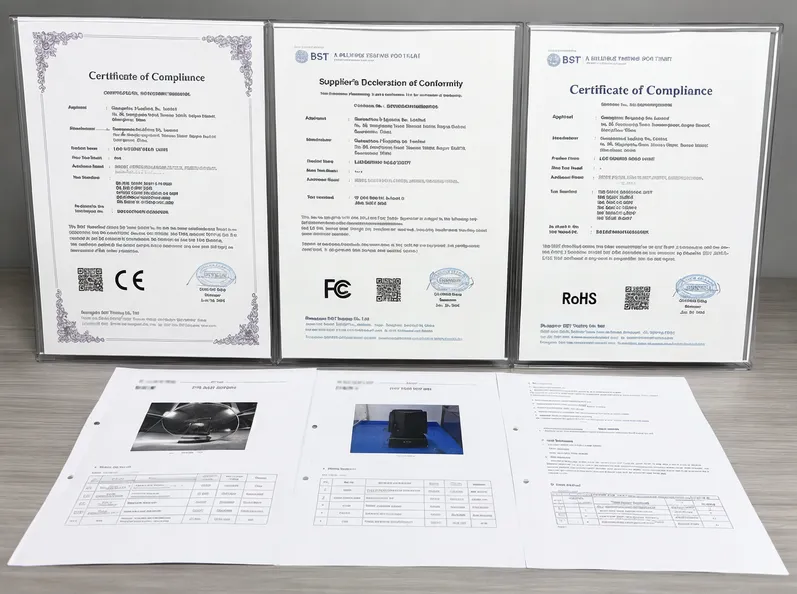
CE (EU)
- EN 60598-1 safety
- EN 55015 EMC
- EN 62471 photobiological safety
FCC (US)
- Part 15 Class B verified
RoHS
- Full material declarations available
- Lead-free soldering process
IP Testing
- Third-party lab reports for rated models
- IP65 and IP67 available upon request
ISO 9001:2015
- Factory quality management system
- Audit report available for supplier qualification
Additional Markets
- ETL/UL — North America
- SAA — Australia
- Country-specific marks on request
Need compliance documentation for your market?
We'll confirm timeline, cost, and available test reports before you commit.
Frequently Asked Questions LED DJ Stage Lights Sourcing
What wattage range should I stock for general production and venue use?
What wattage range should I stock for general production and venue use?
For most production companies and mid-size venues (200–1000 capacity), 150W–200W fixtures cover the majority of applications — sufficient output for stage wash and key lighting at typical throw distances (5–12 meters).
Stock 250W+ for large venues, festival stages, and touring rigs where throw distances exceed 15 meters or where the fixture competes with ambient daylight.
We recommend carrying both tiers: the 150W range for volume sales and the 250W+ range as your premium upsell product.
How do LED DJ stage lights differ from moving heads in terms of stocking strategy?
How do LED DJ stage lights differ from moving heads in terms of stocking strategy?
Stage lights (static wash/spot fixtures) are your bread-and-butter inventory — lower unit cost, simpler operation, less mechanical maintenance. Moving heads carry higher per-unit margin but also higher mechanical failure risk and service cost (motors, gears, position sensors).
Most distributors stock stage lights for volume deployment and moving heads for premium packages. The two categories serve different deployment scenarios, not competing ones — your buyers typically purchase both.
What IP rating do I need for outdoor festival and touring deployment?
What IP rating do I need for outdoor festival and touring deployment?
IP54 handles temporary outdoor use with overhead stage roofing — rain splash and dust but no direct water exposure.
IP65 is the minimum for fixtures exposed to weather without overhead protection (outdoor festival rigs, rooftop venues, building facades). We produce both.
The price difference between IP54 and IP65 on the same base fixture is modest — mainly gasket material and cable gland specification — so if your buyers deploy in mixed environments, defaulting to IP65 across your fleet simplifies your inventory management.
Can I mix your LED DJ stage lights with your par lights on the same DMX universe?
Can I mix your LED DJ stage lights with your par lights on the same DMX universe?
Yes — all fixtures in our LED DJ lights range use standard DMX512 with consistent implementation. You can daisy-chain stage lights, par lights, tube lights, and pixel bars on a single DMX universe (512 channels).
RDM support on the stage lights lets your venue clients discover and address them remotely without manual configuration at each fixture.
What's the typical lead time for a 100-unit branded stage light order?
What's the typical lead time for a 100-unit branded stage light order?
Standard production run: 20–30 days from order confirmation to ready-for-shipment.
OEM branding (logo, packaging, firmware splash screen) doesn't add to lead time on orders above 50 units — it runs parallel with production.
If your order includes ODM modifications (custom lens angle, modified color system, different housing finish), add 10–15 days for engineering validation and sample approval before production starts.
Next Step Get Your Stage Light Configuration Quoted
Send us your target fixture specs, quantity, and branding requirements. If you have a competitor sample you want us to match or improve on, ship it to us or send photos and a datasheet — our engineering team will reverse-reference and quote within 48 hours.
Most buyers in this segment start with a 2–5 unit sample order to validate output, build quality, and DMX performance with their own customers. We can ship production samples within 7 days for standard models.
Explore More LED DJ Lights