

Laser Moving DJ Lights Factory-Built Laser Moving Heads
Laser-diode aerial effects that LED optics physically cannot produce — motorized pan/tilt positioning with coherent light beams visible at 50+ meters of throw.
A specialty SKU with limited factory-level competition. Fewer suppliers means you hold pricing power in the nightclub, festival, and high-end install segments.
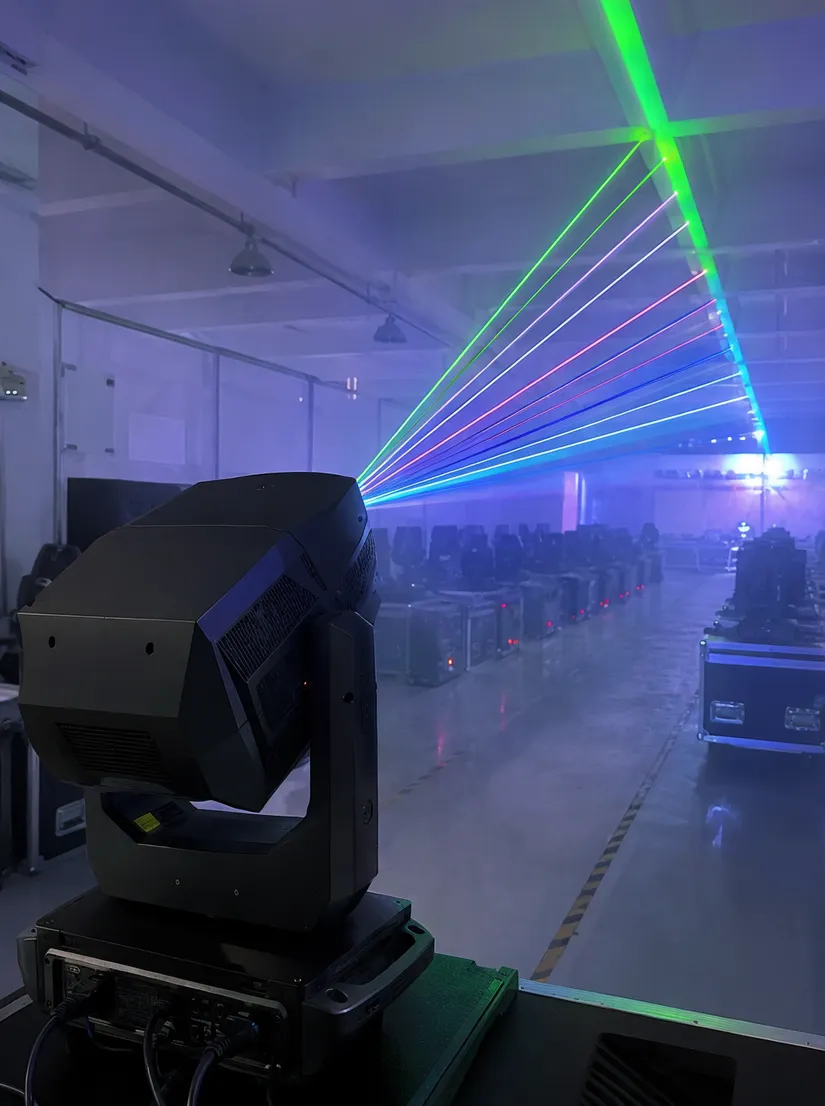
What Laser Moving DJ Lights Are — and Why They're a Catalog Differentiator
Laser moving DJ lights combine laser diode sources with motorized pan/tilt positioning systems — the same mechanical platform as our beam and LED moving heads, but firing coherent light instead of LED-generated wash or spot output. The result is razor-thin aerial beams that remain visible at 50+ meters of throw in haze, with a sharpness and punch that broadband LED sources physically cannot match regardless of wattage.
For your distribution or rental business, laser moving heads occupy a specific commercial position: they're specialty fixtures with fewer competing suppliers. Most moving head manufacturers produce beam and wash units (the commodity segment) but avoid laser because the diode sourcing, optical safety engineering, and thermal management are different disciplines. We manufacture both — which means you source your entire moving head catalog from one factory, including the laser units that most of your competitors can't easily find a manufacturer for.
The commercial implication is straightforward: laser moving DJ lights let you stock a fixture category where pricing pressure is lower and margins are healthier than on standard LED moving heads. Your buyers in the nightclub, festival, and touring segments actively seek laser effects — and the supplier who can actually deliver them from stock captures that demand.
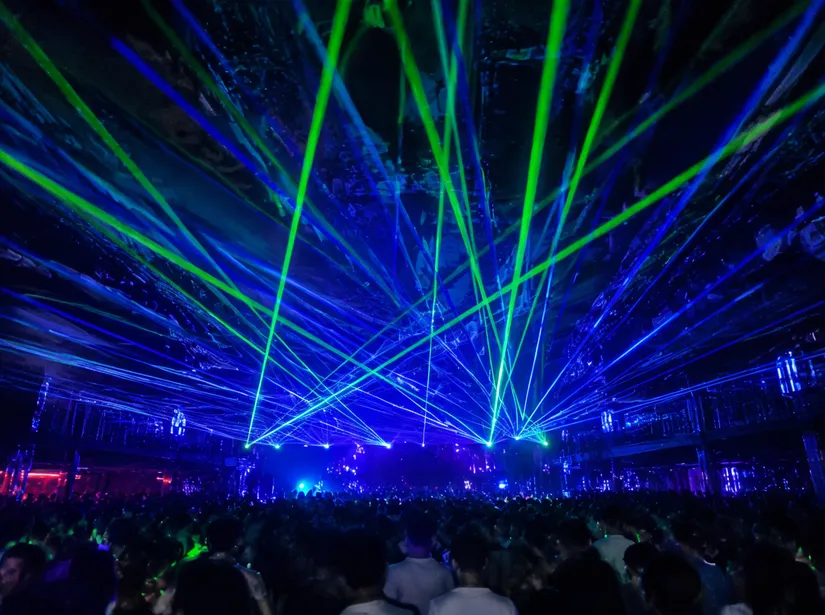
Lower Pricing Pressure
Fewer factory-level competitors means healthier margins compared to commodity LED moving heads.
Single-Factory Catalog
Source beam, wash, and laser moving heads from one manufacturer — simplify logistics and consolidate QC.
Captures Active Demand
Nightclub, festival, and touring buyers actively seek laser effects — the supplier who delivers from stock wins the order.
Laser Source and Optical Architecture
We use semiconductor laser diodes — not DPSS (diode-pumped solid-state) modules, which dominated ten years ago and carried reliability problems that gave laser fixtures a bad reputation in the rental market. Modern direct-diode sources offer faster modulation response, longer operational life, and none of the thermal alignment drift that plagued DPSS systems.
For context: If your customers had bad experiences with laser fixtures in 2015–2018, the source technology has moved on. Those failures were DPSS-related — thermal alignment drift, short module life, and fragile resonator cavities. Direct-diode semiconductor sources eliminate these failure modes entirely.
Typical Configurations — Laser Moving DJ Lights
| Parameter | Standard Configuration | Notes |
|---|---|---|
| Source type | Direct-diode semiconductor laser | Red, green, blue individual modules or RGB combined |
| Output power range | 500mW – 5W total (model dependent) | Measured at aperture after optical path losses |
| Beam divergence | < 1.5 mrad typical | Maintains beam visibility at 50m+ throw |
| Modulation speed | > 30 kHz (blanking-capable) | Enables clean pattern scanning without visible lag |
| Color system | RGB analog mixing, 16.7M colors | Independent power control per color channel |
| Scanning system | High-speed galvo scanners (20–40 KPPS) | ILDA-standard rated for pattern projection |
| DMX channels | 12–20 CH (model dependent) | Pan/tilt + laser control + pattern selection |
| Pan / Tilt | 540° pan / 270° tilt | Same mechanical platform as our beam moving heads |
Specifications shown are representative of our standard laser moving head range. Contact us for exact model specifications and data sheets.
Optical Train — Combined Moving Head + Laser Show in One Fixture
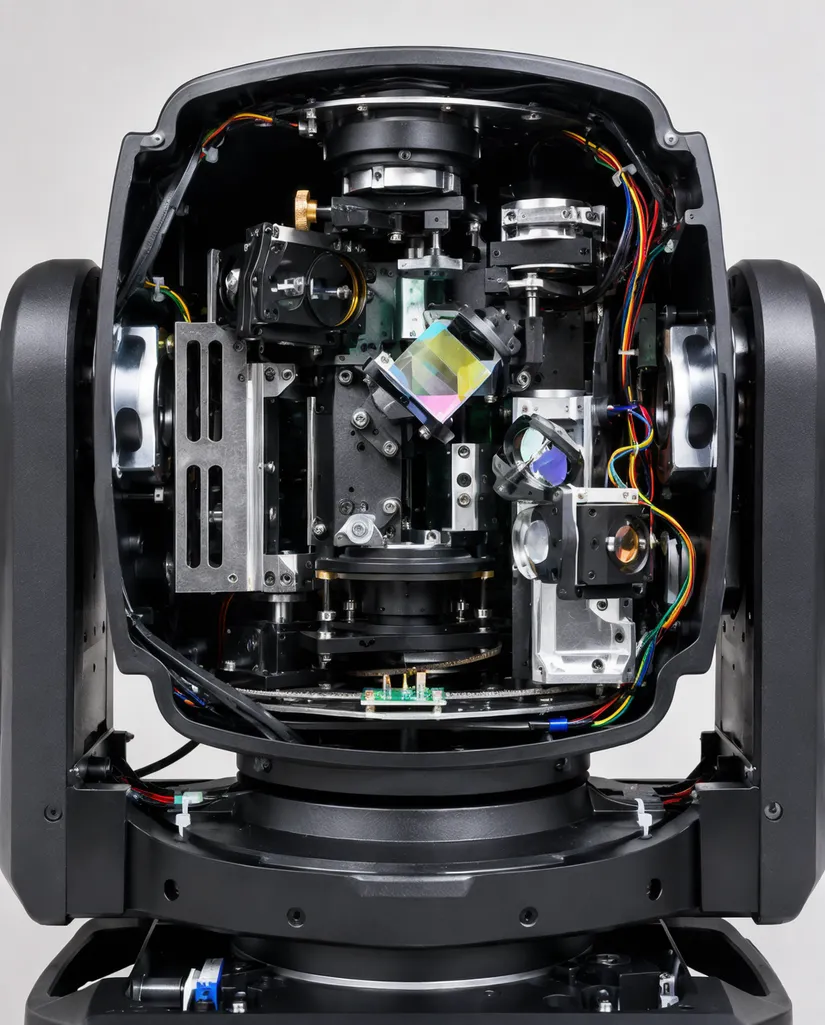
The optical train includes a beam combiner for RGB synthesis, a motorized diffraction grating (produces multi-beam fan effects from a single source), and galvanometric scanners for pattern projection — all mounted on our standard pan/tilt mechanism.
Your buyer gets both motorized fixture positioning AND internal laser scanning, combining moving head utility with laser show capability in one rigging point. This dual functionality means one fixture replaces what previously required a static laser projector plus a separate moving head — reducing rigging points, cable runs, and inventory depth for rental houses.
RGB Beam Combiner
Full-spectrum color synthesis
Motorized Grating
Multi-beam fan effects
Galvo Scanners
20–40 KPPS pattern projection
Thermal Management for Laser Diodes The Detail That Determines Field Life
Laser diodes degrade faster than LEDs when junction temperature exceeds their rated threshold — and the degradation curve is steeper. An LED that runs hot loses brightness gradually over thousands of hours. A laser diode that runs hot loses output power within weeks, and eventually drops below the visible threshold entirely. This is the primary failure mode that makes buyers switch laser fixture suppliers.
We address this with a dedicated thermal architecture separate from the main fixture housing:
Dedicated Thermal Architecture
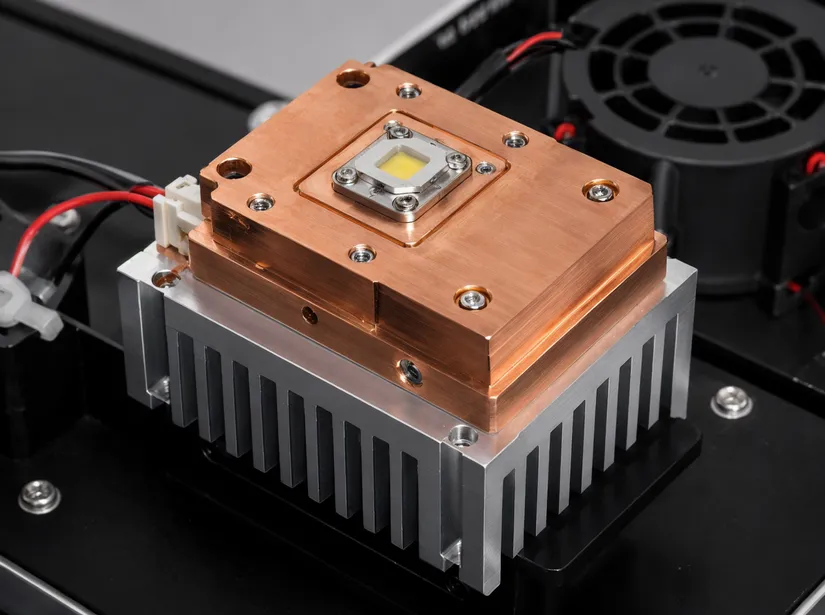
The laser module assembly sits on a CNC-machined copper heat spreader (not aluminum — copper's thermal conductivity is roughly 60% higher) bonded directly to the diode substrate. This feeds into a finned aluminum heatsink block with a temperature-controlled DC fan that ramps based on diode substrate temperature measured by an NTC thermistor.
If substrate temperature approaches the diode's rated maximum (typically 45–55°C depending on wavelength), the firmware reduces output power automatically before thermal damage occurs.
48-Hour Aging Validation
We validate diode operating temperature during the 48-hour aging test specifically — not just "does it turn on," but "does substrate temperature stabilize below threshold after 48 hours of continuous full-output operation in a 35°C ambient environment."
Units where thermal performance exceeds our margin don't ship. We reject roughly 2–3% of laser modules at this stage — almost always due to thermal interface material application inconsistencies rather than diode defects. Better to catch it here than have your customer's laser lose 30% output after three months of nightclub use.
Thermal System Specs
The Practical Result for Your Business
Our laser moving DJ lights maintain their specified output power rating for 10,000+ hours of operation at rated ambient conditions. Your rental fleet doesn't progressively dim over the first year.
Safety Engineering and Regulatory Compliance for Laser Products
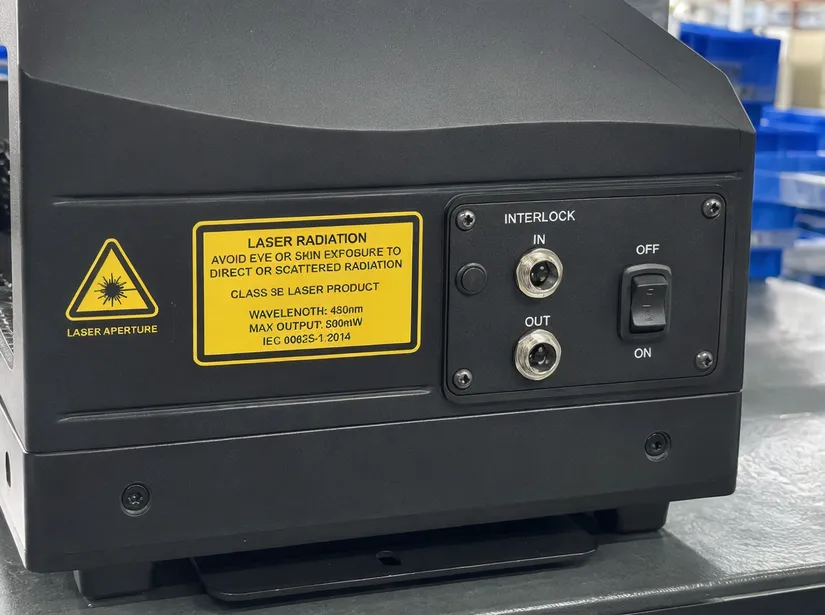
Laser products face stricter regulatory requirements than LED fixtures — and buyers who don't understand this face customs seizures and liability exposure. We handle the compliance engineering at the factory level so you're importing a fully documented, classification-labeled product.
IEC 60825-1 Classification
Laser class clearly marked on the fixture housing per international standard
Interlock Circuit
Fixture disables laser output if the housing is opened during operation — required by safety standards, not optional
Beam Termination Safety
Laser output shuts down if the pan/tilt mechanism loses position feedback — prevents uncontrolled beam escape during mechanical failure
Key Switch / Enable Control
Prevents unauthorized activation — required for Class 3B/4 products in most jurisdictions
Market Access Certifications
Documentation Package Included
For your import process: we provide full technical documentation packages including:
- Test reports from accredited laboratories
- Declarations of conformity
- User safety information documents
- Classification justification per IEC 60825-1
If your market requires variance permits or specific local laser product registrations (the US FDA/CDRH variance process, for example), our engineering team can supply the technical data your regulatory consultant needs to file.
First-Time Laser Importers
Many buyers are surprised to learn that laser entertainment fixtures require more regulatory documentation than LED products. If you're adding laser moving heads to your catalog for the first time, factor in 2–4 weeks for your local registration process depending on jurisdiction. We'll walk you through what's needed for your specific market.
Where Laser Moving DJ Lights Generate Revenue — Market Segments
Each segment below represents a distinct commercial opportunity — repeat ordering patterns, margin structures, and buyer behaviors you can build distribution around.
Nightclub Premium Installations
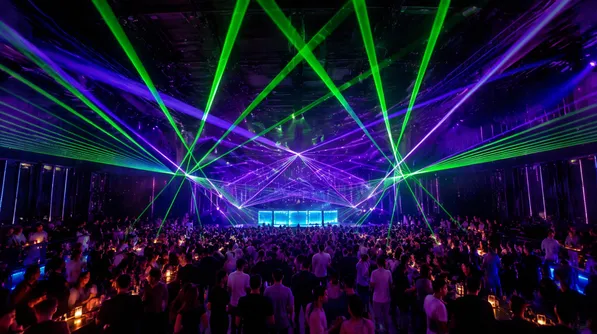
High-end clubs invest in laser effects because they create the visual spectacle that gets posted on social media — which drives venue traffic, which keeps the club open, which generates fixture replacement budgets.
The buyer pool is smaller and the specification requirement (laser experience, safety compliance, installation expertise) filters out casual competitors.
Music Festivals & Touring Production
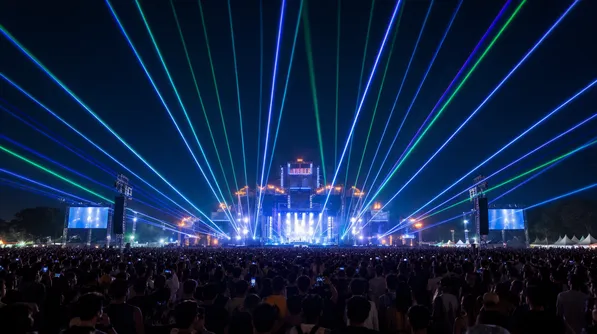
Outdoor festivals use laser moving heads for aerial effects visible across large crowds — the one effect type that scales with venue size rather than losing impact at distance.
Our batch calibration and 48-hour aging directly address their specification requirements for output uniformity across large fleets.
Middle Eastern & Southeast Asian Venues
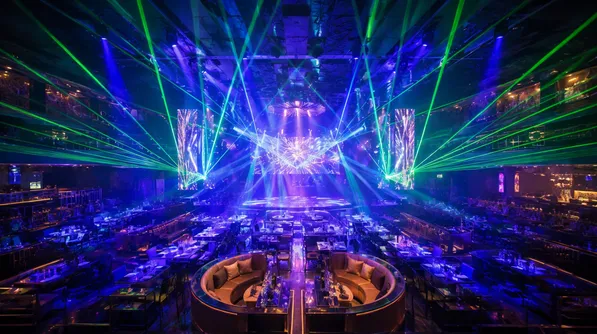
We've seen strong demand growth from these regions over the past three years. Large-format entertainment venues (mall complexes, themed restaurants, VIP lounges) in the Gulf states and Southeast Asia specify laser effects as standard — not optional premium upgrades.
If you distribute into these markets, laser moving DJ lights are a catalog requirement, not a specialty add-on.
AV Integration & Corporate Events
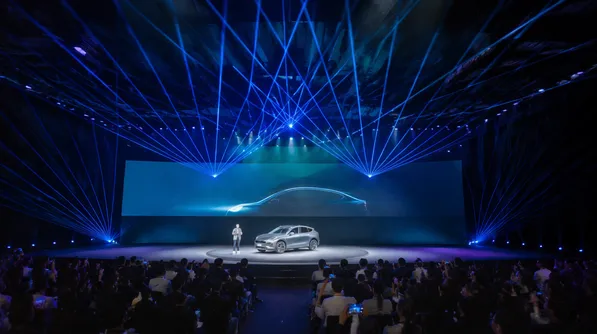
Integrators specify laser fixtures for product launches, auto shows, and branded experiences where the visual quality needs to exceed what LED moving heads can deliver.
Theme Parks & Permanent Entertainment Installations
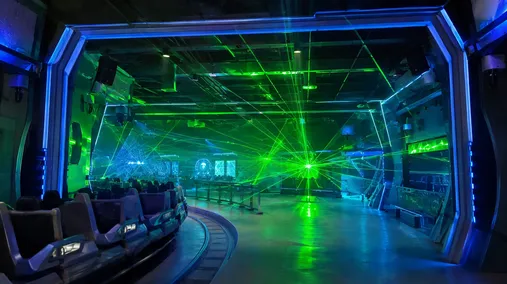
Laser effects in ride experiences, show scenes, and architectural features. Long procurement cycles (6–18 months) but large order quantities (50–200+ units) with replacement schedules built into operating budgets.
Customization Scope for Laser Moving DJ Lights
Laser moving heads have more customization dimensions than standard LED fixtures because the laser module, scanning system, and safety features can all be configured independently.
What We Can Customize
Output Power
Scale laser module wattage up or down based on your target market's regulatory environment and application requirements — lower power for jurisdictions with strict laser classification rules, higher power for outdoor festival use.
Color Configuration
Single-color (green only for maximum visibility efficiency), dual-color (red/green), or full RGB — each configuration has a different cost point and BOM.
Scanning System
Basic galvo scanners for beam-only effects (simpler, lower cost) or high-speed ILDA-rated scanners for pattern and text projection (premium positioning).
Pan/Tilt Speed & Range
Standard 540°/270° or extended range for specific installation geometries.
DMX Channel Layout
Standard DMX mode or custom channel assignments to match your buyer's existing control infrastructure.
Housing Finish
Standard black powder coat, white for architectural installations, or custom RAL color on orders above 100 units.
Branding
Your logo, your model name, your packaging, your firmware boot screen.
Connector Configuration
PowerCon/XLR standard, or alternative connector types for specific regional preferences.
What Cannot Be Changed Below 200 Units
Base Housing Geometry
Uses our standard moving head chassis — new housing tooling starts at 200-unit commitment.
Fundamental Optical Architecture
Beam combiner geometry and galvo mount positions are fixed below the 200-unit threshold.
MOQ & Lead Time Impact
| Customization Level | MOQ | Samples | Production |
|---|---|---|---|
| Standard OEM Branding on existing configuration | 30 units | 7–10 days | 20–30 days |
| Configuration Changes Power, color, scanning modifications | 50 units | +5–7 days | Module sourcing lead |
| Full ODM New housing or optical design | 200 units | Engineering phase | 45–60 days + production |
Packaging, Container Loading, and Landed Cost Considerations
Laser moving heads share the same housing platform as our beam moving heads — similar weight class (typically 12–18 kg per unit depending on laser module configuration), similar packaging volume. Each fixture ships in a custom-molded foam cradle inside a reinforced master carton.
Container Loading Reference
| Configuration | Units / Carton | 20GP | 40HQ |
|---|---|---|---|
| Standard laser moving head 12–15 kg | 2 | 160–200 | 340–420 |
| High-power laser moving head 15–18 kg | 2 | 130–160 | 280–340 |
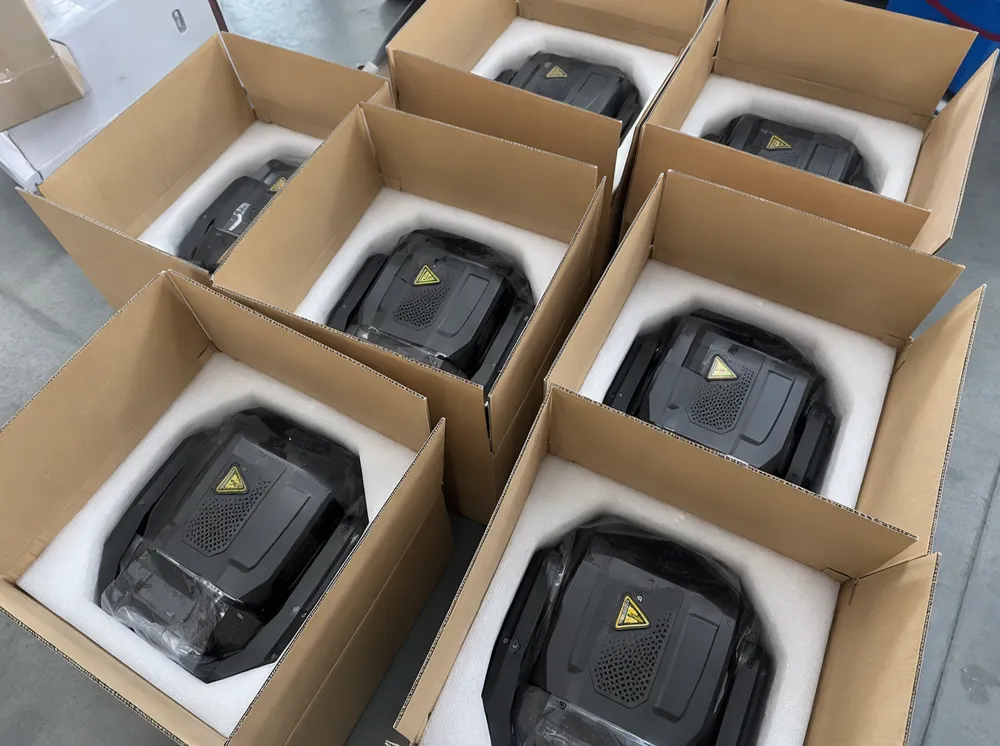
Transport-Locked Pan/Tilt
The foam cradle locks the pan/tilt mechanism in transport position — the head is immobilized to prevent stress on the tilt gear during shipping. We added this feature after early-generation units arrived with micro-backlash from the head bouncing during ocean transit. Small detail, but it matters for the fixture's accuracy when your customer unpacks it.
Mixed-Model Consolidation
For mixed-model orders (laser heads combined with beam, spider, or mini units from our full range), we consolidate into a single container with an optimized loading plan. Your landed cost calculation simplifies to one shipping booking, one customs clearance, one delivery coordinate — regardless of how many SKUs you ordered.
Transit Damage Rate
Transit damage rate on our moving head packaging: below 0.3% across five years of container shipments. Your freight insurance claims stay minimal.
Comparing Laser Moving Heads to Other Moving DJ Light Types
You likely stock or are considering multiple moving head categories. Here's how laser units position relative to siblings in your catalog — not better or worse, but serving different commercial functions.
| Dimension | Laser Moving DJ Lights | Beam Moving DJ Lights | LED Moving DJ Lights |
|---|---|---|---|
| Core visual effect | Razor-thin aerial beams, pattern scanning | Sharp mid-air beam effects | Wash, spot, or hybrid coverage |
| Competitive density | Low (fewer manufacturers) | High (commodity segment) | High (commodity segment) |
| Typical margin vs. LED | +20–40% | +5–15% | Baseline |
| Regulatory complexity | Higher (laser safety classification) | Standard (CE/FCC) | Standard (CE/FCC) |
| Buyer expertise required | Moderate (safety handling, registration) | Low | Low |
| Best market segments | Premium clubs, festivals, touring, themed entertainment | Nightclubs, rental, events | Worship, theater, install, rental |
| Reorder driver | Fleet expansion, replacement due to output decline | Fleet expansion, lamp EOL (if lamp-based) | Fleet expansion, spec upgrades |
The Commercial Insight
Laser moving DJ lights complement rather than replace your beam and LED catalog. They serve the premium tier where competition is thinner and margins are healthier. Buyers who need laser effects rarely substitute with non-laser fixtures — it's a distinct requirement, not a preference. Stocking laser units captures demand that would otherwise go to a different supplier entirely.
Need a different moving head type?
Beam Moving DJ Lights
Concentrated beam effects for nightclubs, rental, and events.
Spider Moving DJ Lights
Multi-beam geometric coverage for dynamic stage setups.
Mini Moving DJ Lights
Budget-conscious markets and compact venue installations.
LED Moving DJ Lights
Wash and spot duties for worship, theater, install, and rental.
Frequently Asked Questions Laser Moving DJ Lights
What laser classification do your moving DJ lights fall under?
What laser classification do your moving DJ lights fall under?
Most of our laser moving heads are classified as Class 3B or Class 4 under IEC 60825-1, depending on output power. Units below 500mW total output may qualify as Class 3R in certain beam configurations.
We provide the classification determination documentation with every order — your regulatory filing uses our data directly rather than requiring independent testing.
If your market has specific classification thresholds that affect import requirements (the US FDA/CDRH system differs slightly from IEC), tell us your destination and we'll confirm which models qualify under which class.
How do laser moving DJ lights perform outdoors compared to indoor haze environments?
How do laser moving DJ lights perform outdoors compared to indoor haze environments?
Laser beams are visible in proportion to particulate density in the air. Indoors with theatrical haze, even 500mW laser output produces clearly visible aerial effects.
Outdoors without artificial haze, you need higher output power (2W+) to achieve visible beams — natural humidity and ambient dust provide some scattering, but less than controlled haze.
For outdoor festival applications, specify our higher-power models (3–5W output) and budget for haze machines in your customer's production design.
We offer IP65-rated laser moving heads specifically for permanent outdoor installation where weather exposure is a factor.
What's the operational lifespan of the laser diodes?
What's the operational lifespan of the laser diodes?
Our direct-diode laser modules are rated for 10,000–15,000 hours at specified output power, measured to L80 (80% of initial output).
Actual lifespan depends heavily on thermal management — which is why we invest disproportionately in the copper heat spreader and temperature-controlled fan system. At typical nightclub duty cycles (5 hours/night, 5 nights/week), you're looking at 7–10 years before a customer needs module replacement.
We stock replacement laser modules for all current models and can supply them as spare parts if your service operation needs them.
Can I get laser-only output without the motorized movement?
Can I get laser-only output without the motorized movement?
Yes — we manufacture static-mount laser fixtures on the same production line, without the pan/tilt mechanism.
However, the motorized version (laser moving DJ lights) commands a significant price premium in the market because it combines two functions in one rigging point — your customer reduces fixture count, cabling, and rigging time.
Most distributors find the moving version outsells static 3:1 in the same price segment because the value proposition is clearer to the end buyer.
What's the minimum order for custom laser power or color configurations?
What's the minimum order for custom laser power or color configurations?
50 units per configuration. At that quantity, we source laser diode modules to your specified power and wavelength combination without minimum-buy surcharges from our diode suppliers.
Below 50 units, we can still accommodate custom configurations but the per-unit laser module cost increases because we're buying outside of bulk diode pricing.
Standard catalog configurations (which cover 80% of market demand) start at 30 units with no premium.
Your Next Step with Laser Moving DJ Lights
Adding Laser Moving Heads for the First Time?
Start with a 30-unit sample order of our standard RGB configuration. Test the fixtures with your own customers, verify the regulatory documentation works for your import market, and confirm that the build quality matches what your distribution business requires.
Samples ship within 3–7 days.
Already Sell Laser Fixtures — Switching or Adding a Supplier?
Send us the fixture you're currently sourcing — or just the spec sheet. We'll match or improve the specification, provide comparison samples, and quote production with our standard 48-hour aging and 100% functional testing included.
Engineering review and preliminary quote returned within 48 hours.
Email Teresa@gdmonkey.com or WhatsApp +86-135 3966 9939 with your requirements.