

Moving DJ Lights Factory-Direct from GDMonkey
Moving DJ lights engineered and manufactured in our own 16,700 m² facility — not sourced, not traded, built.
Five product lines covering beam, spider, laser, mini, and LED moving heads. OEM/ODM from 30 units, every fixture 48-hour aged before it ships.
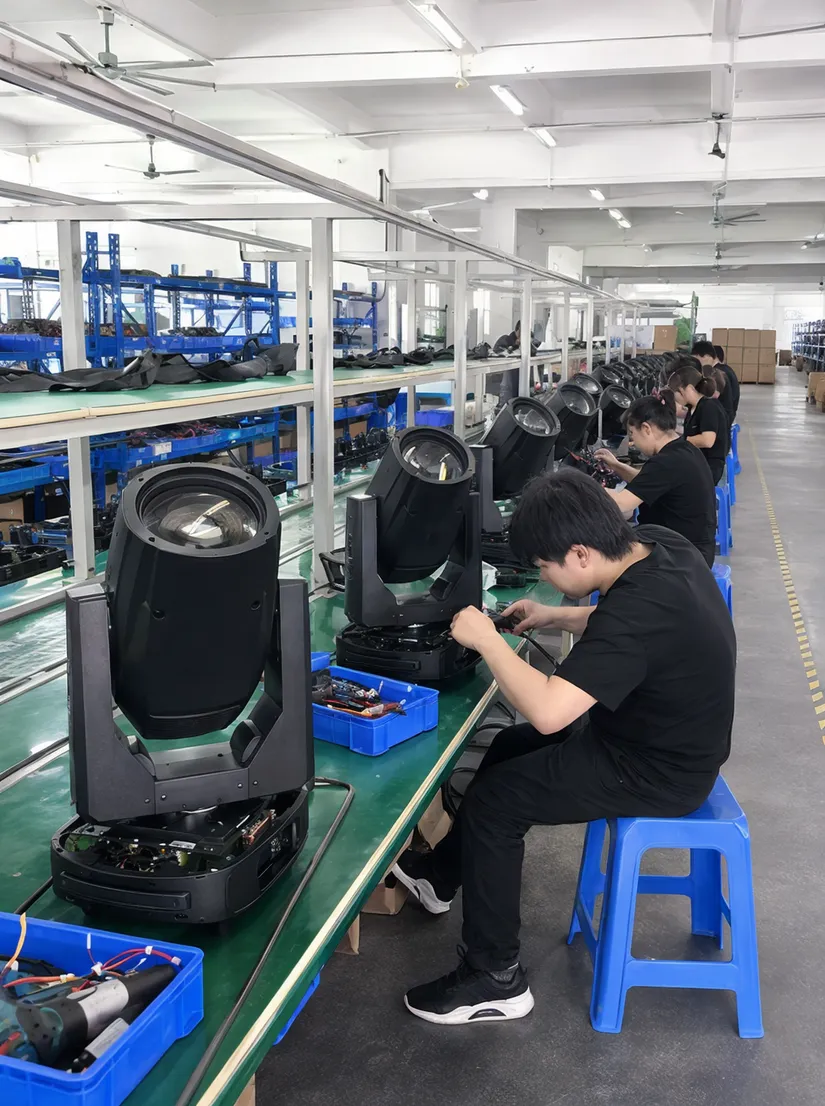
What We Mean by "Moving DJ Lights" — and What You're Actually Buying
Moving DJ lights are motorized fixtures with pan/tilt mechanisms that throw beams, washes, or patterns across a venue under DMX or sound-activated control. They're the workhorses of mobile DJs, nightclub installations, rental houses, and event companies — which means they're also the workhorses of your product catalog if you sell into those segments.
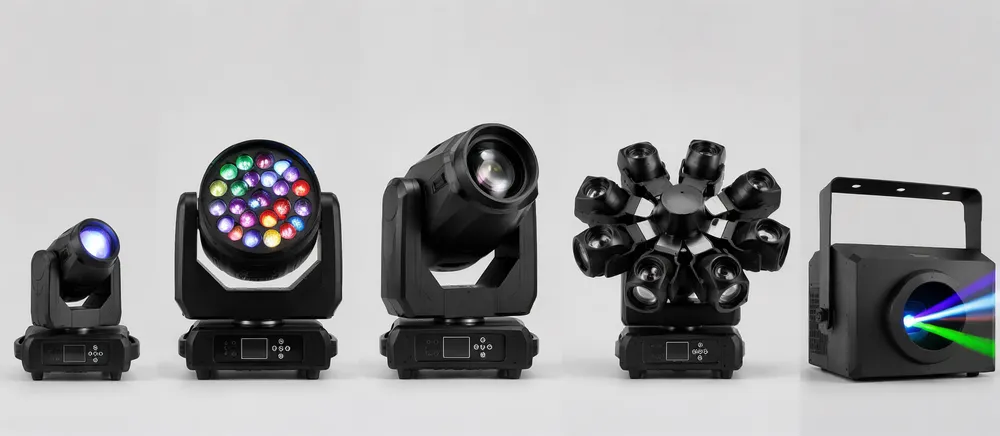
We manufacture the full range here in Pingyuan County, Guangdong: beam moving DJ lights for sharp mid-air effects, spider moving heads for multi-beam crowd scanning, laser-hybrid moving fixtures, compact mini units for mobile DJs, and full-size LED moving heads for stage wash and spot duties. Every variant comes off our own production line — same facility, same QC system, same engineering team. You're consolidating your moving head supply chain into one factory that actually builds the motors, mounts the optics, and programs the DMX firmware.
For your business, that means one purchase order covers your entire moving head catalog. No coordinating three suppliers with three lead times and three quality levels. One engineering contact, one inspection standard, one shipping schedule.
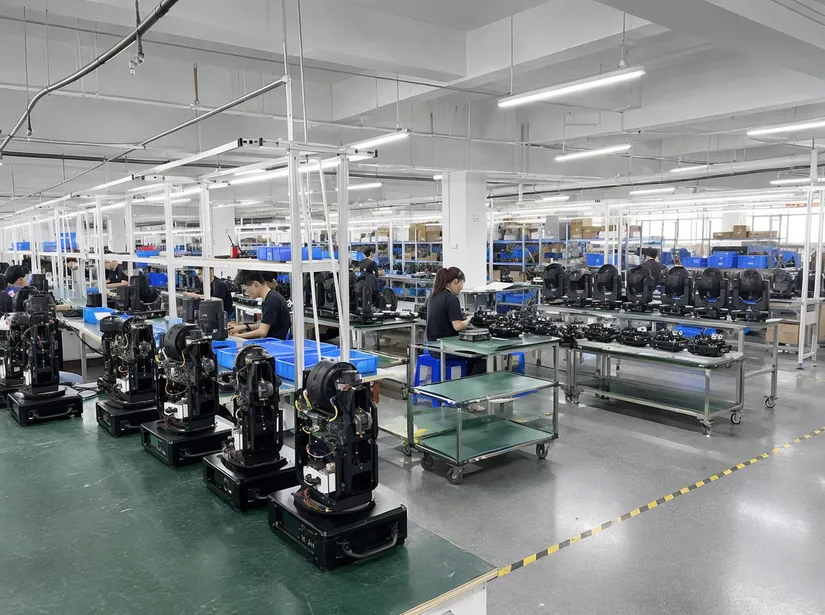
Single-Source Advantage
One PO, one QC standard, one lead time — across all five moving head product lines.
Moving DJ Lights Product Line
Five distinct product families — each engineered for a specific segment of the professional lighting market. All manufactured under one roof.
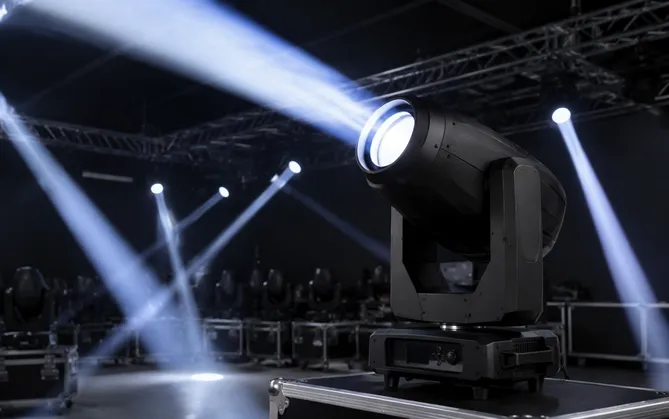
Beam Moving DJ Lights
Concentrated beam output producing tight, punchy mid-air effects. These are your highest-margin SKUs for nightclub installers and rental inventory because beam effects are what audiences notice first. Pan/tilt speed, gobo selection, and prism effects vary by model.
View Beam Moving DJ Lights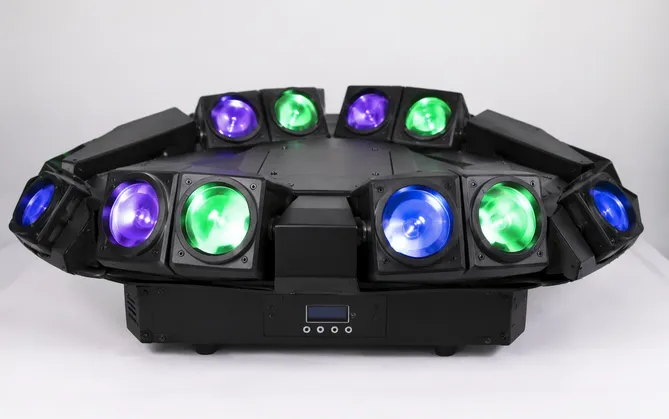
Spider Moving DJ Lights
Multi-head fixtures with independently controlled beam segments — usually 8 to 12 LED heads on a moving bar or triangle frame. Spider lights fill large spaces with sweeping geometric patterns from a single fixture, reducing your customer's rigging time and cabling. Strong sellers for mobile DJs who want maximum visual impact from minimal truck space.
View Spider Moving DJ Lights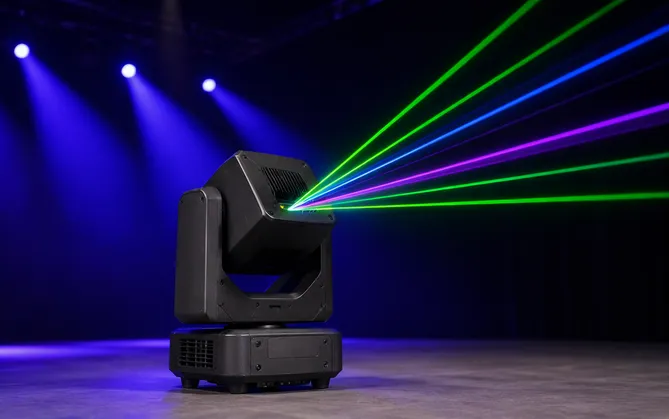
Laser Moving DJ Lights
Hybrid units combining laser diode output with motorized pan/tilt positioning. Laser moving heads deliver razor-sharp aerial effects that LED-based fixtures can't replicate in hazy environments. A growing segment — especially in Southeast Asian and Middle Eastern nightclub projects where laser effects command premium install pricing.
View Laser Moving DJ Lights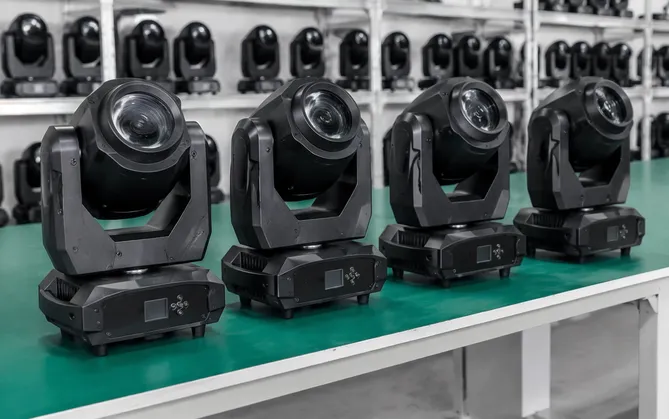
Mini Moving DJ Lights
Compact moving heads — typically under 4 kg and running 30W to 100W LED sources. Purpose-built for mobile DJs, small venue installs, and budget-conscious rental houses. Low weight means lower shipping cost per unit for you, and the price point opens up volume orders from entertainment startups and DJ equipment e-commerce resellers.
View Mini Moving DJ Lights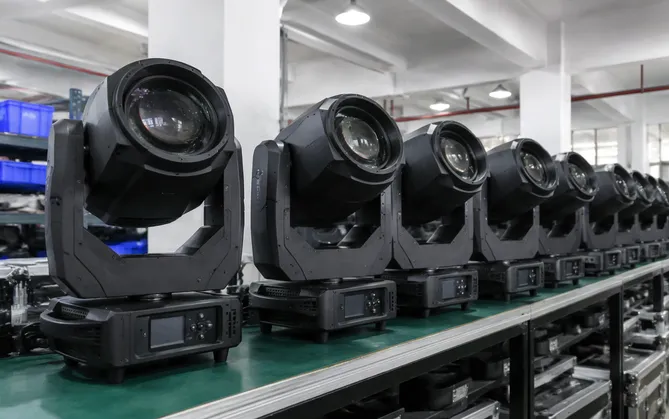
LED Moving DJ Lights
Full-size LED moving heads for wash, spot, and beam-spot-wash hybrid duties. LED source means no lamp replacement — a selling point your customers care about for fixed installations. Wattage ranges from 100W to 400W+ depending on throw distance requirements. These are the fixtures that anchor stage plots for touring, houses of worship, and theater productions.
View LED Moving DJ LightsNeed the Full Catalog?
One purchase order covers your entire moving head catalog. OEM/ODM from 30 units with one engineering contact and one shipping schedule.
Request a QuotePan/Tilt Mechanism Engineering Where Moving Heads Live or Die
The motor assembly is the single most failure-prone component in any moving DJ light. We know this because we've been building pan/tilt systems since 2012, and the warranty returns that come back from the field are overwhelmingly mechanical — stripped gears, motor burnout from heat soak, belt slip on high-speed repositioning. Not LED failures. Not driver boards. Motors.
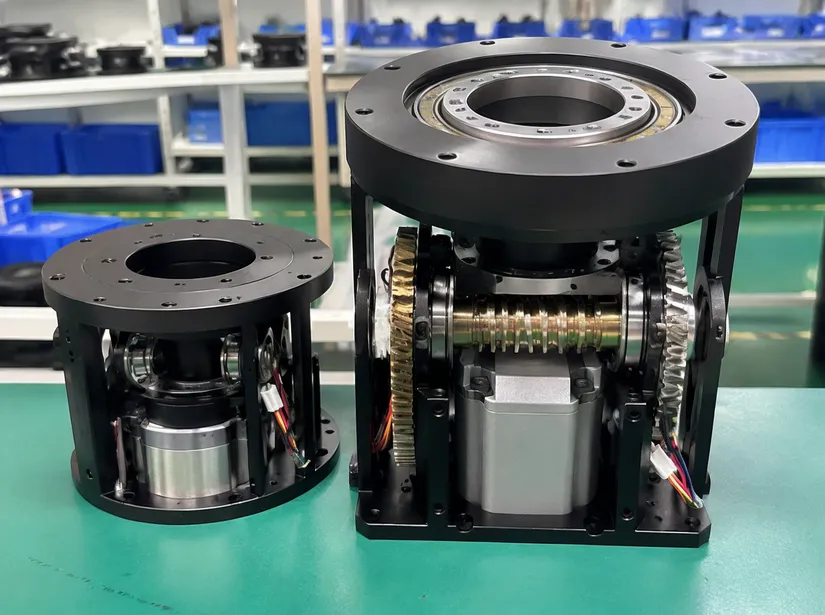
Our background is in low-voltage electromechanical assemblies, which is why we brought pan/tilt production fully in-house rather than buying generic motor modules from third-party component suppliers. We wind our own stepper motors and machine our own gear sets. The pan mechanism uses a dual-bearing race with a hardened steel worm gear — the same geometry you'd see in industrial positioning systems, scaled down to fixture size. Tilt runs on a precision-ground gear pair with anti-backlash spring loading, so the head doesn't drift under its own weight during slow movements.
What this means in practice: our pan/tilt assemblies survive 50,000+ full-rotation cycles in accelerated life testing before we see measurable backlash increase. The industry average on budget fixtures is closer to 15,000 cycles before the head starts "nodding" at rest positions — that's about 6 months of nightly club use. Your rental house customers notice this difference immediately: fixtures that still snap to position after a year of abuse versus fixtures that develop visible play within months.
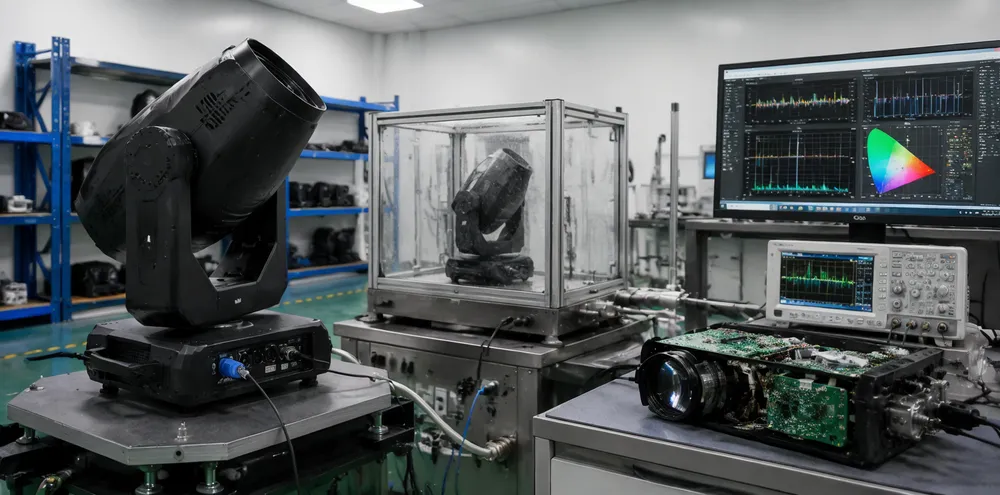
We calibrate every motor assembly individually on a dedicated test jig before it enters final fixture assembly. Pan speed, tilt speed, positioning accuracy (±0.3°), and hold torque under load are all verified against spec. This isn't sample-based — every single moving head gets motor-level verification. That calibration data stays on file if you ever need to trace a specific unit.
Durability Comparison
Measured as full-rotation cycles before measurable backlash increase in accelerated life testing.
In-House Motor Winding
Custom stepper motors wound and assembled on-site — no third-party generic modules.
±0.3° Positioning
Every motor verified for pan speed, tilt speed, accuracy, and hold torque on a dedicated calibration jig.
Anti-Backlash Tilt
Spring-loaded precision gear pair prevents head drift under its own weight during slow movements.
Unit-Level Traceability
Calibration data stored per fixture — trace any specific unit back to its motor-level QC record.
Optical Systems Across the Range Beam Angles, Lumen Output, Color Consistency
Moving DJ lights are ultimately optical instruments. The motor points the light — but the optical system determines whether your buyer's customer sees a crisp beam, a smooth wash, or a blotchy mess. We run three distinct optical architectures across our moving head product lines.
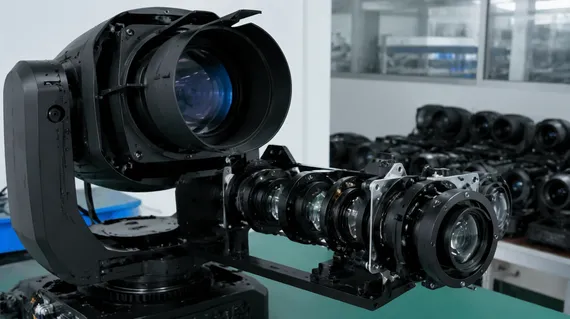
Beam / Spot Fixtures
Precision glass optics with multi-element lens trains. We grind and coat our own condenser lenses in-house — anti-reflective coatings, UV filtering on lamp-based units.
- Beam mode: 1°–5° beam angle
- Spot mode: 8°–15° with motorized zoom
- Gobo projection: Precision focal-plane system — crisp patterns at 15m throw, not just 5m
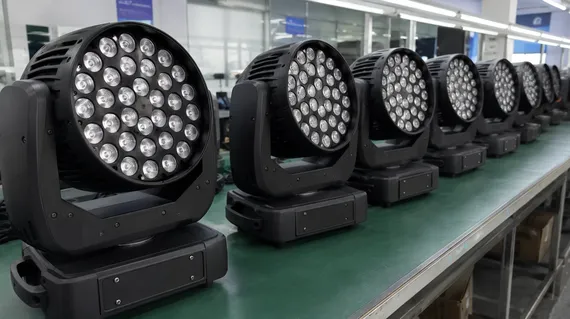
Wash Fixtures
Fresnel or PC lens front-end with individual LED pixel control. Custom-binned LED arrays — every chip batch tested for forward voltage and CCT deviation before the SMT line.
- Color consistency: ±100K CCT max deviation within a fixture
- Lumen uniformity: ±3% output across all pixels
- Long-term: No visible pixel degradation at 2,000+ hours — sorted at component level
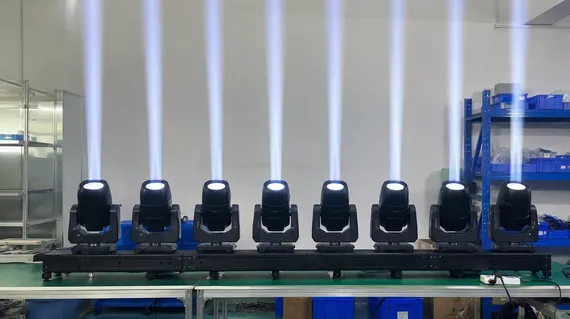
Spider / Multi-Head
Individual high-power LED optics on each head — typically 10W–40W RGBW per head with 4°–8° native beam angle. The engineering challenge: mechanical alignment across all heads.
- Parallel alignment: Eight heads verified on fixture jig for perfect beam parallelism
- Per-head power: 10W–40W RGBW with 4°–8° native angle
- Why it matters: Competitors skip this — invisible in photos, obvious when six of eight heads point different directions
Photometric Data Available on Request
We provide IES files, beam angle measurements, and lumen output figures verified in our integrating sphere — data your specification-writing customers need for venue design calculations.
The 48-Hour Aging Protocol Why Your Warranty Returns Stay Low
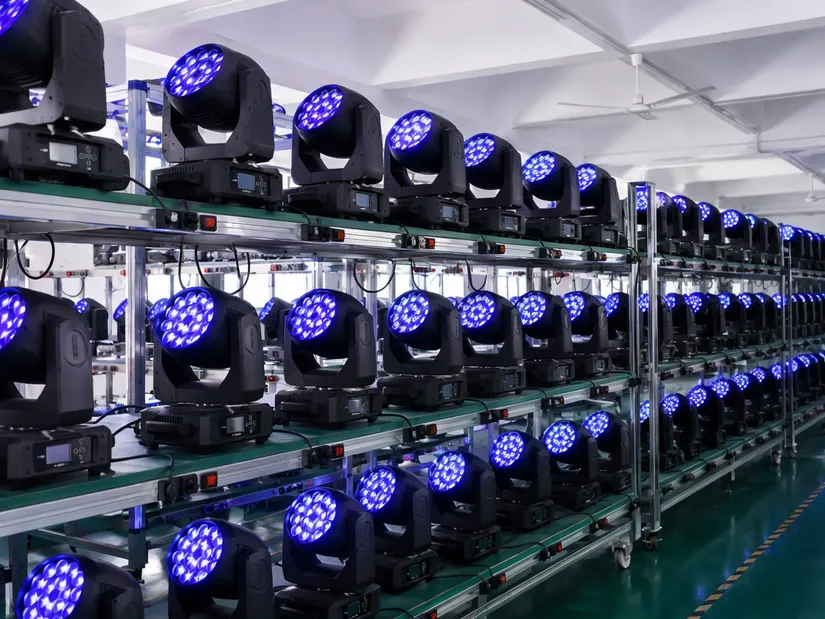
Every moving DJ light we build — every single unit, not a batch sample — runs a 48-hour continuous aging test at full electrical and mechanical load before packaging. Full brightness, continuous pan/tilt cycling, color wheel rotation, gobo indexing, all running simultaneously for two full days.
This catches infant mortality failures: capacitor degradation under thermal stress, LED driver output drift at sustained temperature, motor coil overheating on continuous duty, DMX decoder logic errors under extended operation. These are defects that a 10-minute functional test at end-of-line will never find — they only surface after hours of thermal soaking. We catch them here, in our test racks, not after the fixture has shipped to your customer's venue and failed mid-show.
The Math Is Simple
The 48-hour test adds production time. Some factories skip it because the extra rack space and electricity cost money. But a single warranty return on a moving head — international shipping both directions, a technician's time to diagnose, the replacement unit, and the reputational cost to your brand — exceeds the cost of aging a hundred units.
Infant Mortality Failures Caught During Aging
Capacitor Degradation
Under thermal stress over sustained hours
LED Driver Output Drift
At sustained operating temperature
Motor Coil Overheating
On continuous duty cycling
DMX Decoder Logic Errors
Under extended operation stress
Post-Aging 100% Functional Testing
After aging, 100% functional testing confirms every parameter. AQL inspection covers cosmetic finish, packaging integrity, and labeling accuracy.
DMX Response
Across all 512 channels verified
Color Mixing Accuracy
Against reference values
Dimming Curve Linearity
0–100% verified continuous
Pan/Tilt Accuracy
Speed and positioning precision
Gobo Indexing Precision
Exact positioning confirmed
Reset-to-Home
Consistency on every power cycle
OEM/ODM Moving Heads Your Brand, Your Firmware, Our Production Line
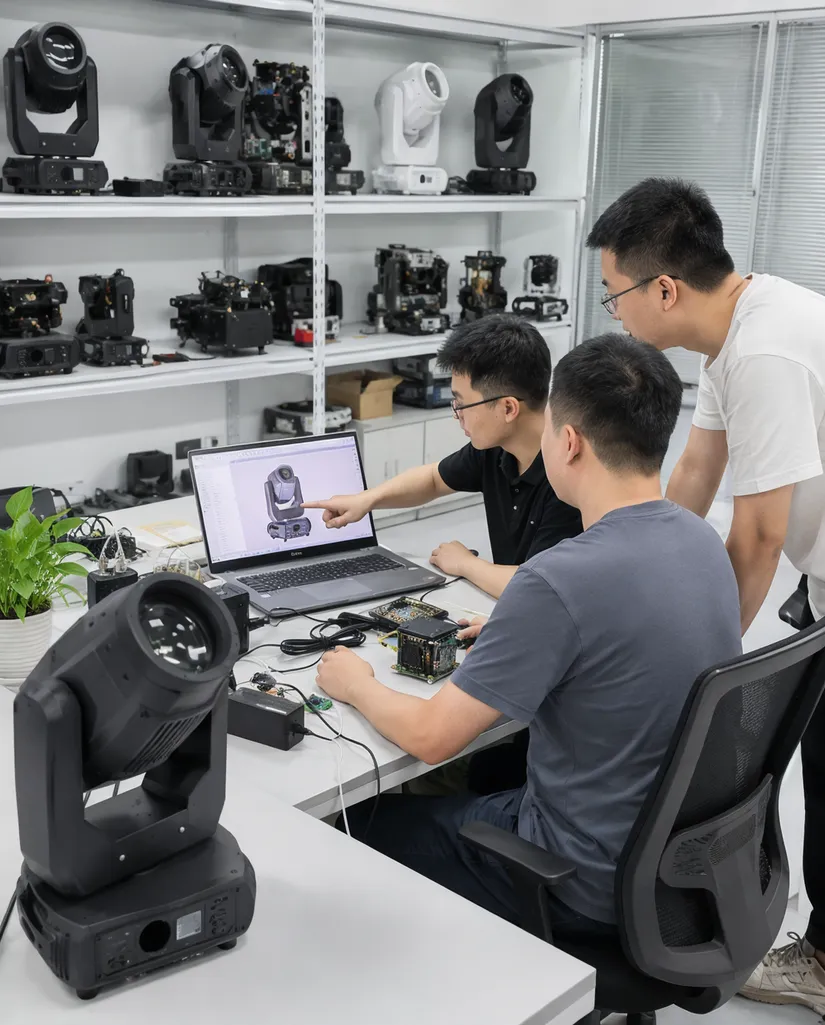
We support OEM and ODM development starting at 30 units. That's low enough to test a new SKU in your market without container-load commitment, and high enough that we can dedicate proper engineering resources to your project.
OEM Scope
Your brand on our proven platform
- Logo printing or engraving on housing
- Custom packaging with your branding
- Firmware splash screen customization
- Private-label documentation and spec sheets
Turnaround: 7–10 days for samples on existing fixture platforms
ODM Scope
Custom development to your specification
- New optical configurations (beam angle, color system, output power)
- Custom housing design or modification (rigging points, materials, IP rating)
- Proprietary control protocols beyond standard DMX
- Wireless control integration (W-DMX, ArtNet, sACN)
R&D Team: 15-person in-house — optical, electrical, thermal, mechanical engineering. Your IP doesn't leave the building.
From Concept to Production-Ready
Most full-custom ODM projects move from concept approval to production-ready samples within 3–4 development cycles. We've done custom moving heads for rental houses that needed a specific throw distance and gobo library, for AV integrators who required proprietary wireless control, and for branded entertainment companies that needed a unique housing silhouette to match their visual identity.
If you're launching a new fixture line and want to skip the 18-month product development cycle of doing it in-house, this is the path — bring us a spec or even a competitor sample, and we'll engineer the production version.
30-Unit MOQ Market Testing
Your 30-unit MOQ means you can test three different configurations — say, a 150W beam, a 250W spot, and a full-size wash — across your distribution territory before committing to production volumes. Scale whichever models sell.
Compliance and Market Access — CE, FCC, RoHS, IP Ratings on File
Moving DJ lights cross borders with documentation requirements that vary by destination. We maintain standing certifications so you don't hit customs delays or compliance rejections.
| Certification | Coverage | Your Benefit |
|---|---|---|
| CE (EMC + LVD) | European Union market access | Direct import into EU without third-party re-testing |
| FCC Part 15 | North American electromagnetic compliance | No FCC detention risk at US/Canadian ports |
| RoHS | Restricted substances compliance | Meets EU/UK hazardous materials directives |
| IP65 / IP67 | Ingress protection (select outdoor models) | Sell into outdoor festival and architectural segments |
| ISO 9001:2015 | Quality management system | Audit documentation available for your supplier qualification process |
Documentation Ships With Order
All test reports and declarations of conformity included. No separate document requests needed.
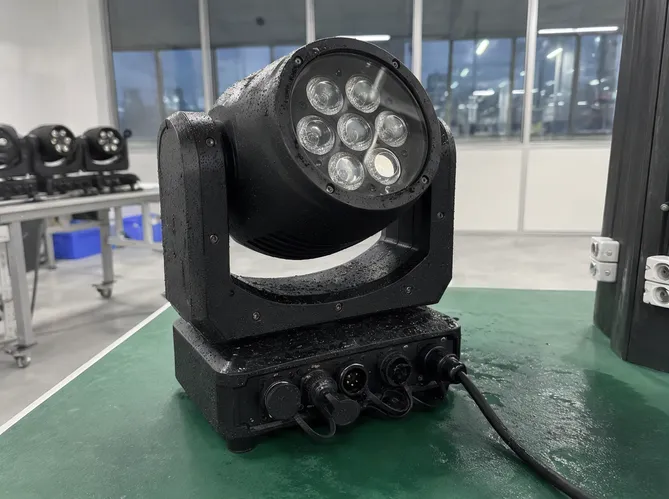
IP65 & IP67 Outdoor Models
For outdoor moving DJ lights, we offer IP65 and IP67 rated units with sealed optical chambers, gasket-protected DMX/power connectors, and drainage channels in the housing base.
Markets IP Rating Unlocks
These open up the outdoor festival, architectural lighting, and theme park segments for your distribution business — markets where non-IP-rated fixtures simply can't compete.
Need Additional Certifications?
If your import market requires additional certifications (UL listing for certain US commercial installations, for example), our engineering team can work with your preferred test lab to complete the documentation.
Container Loading and Landed Cost Optimization
Moving heads are bulky relative to their value — the motor housings and rigging hardware prevent flat-packing. Getting your container utilization right directly impacts your per-unit landed cost.
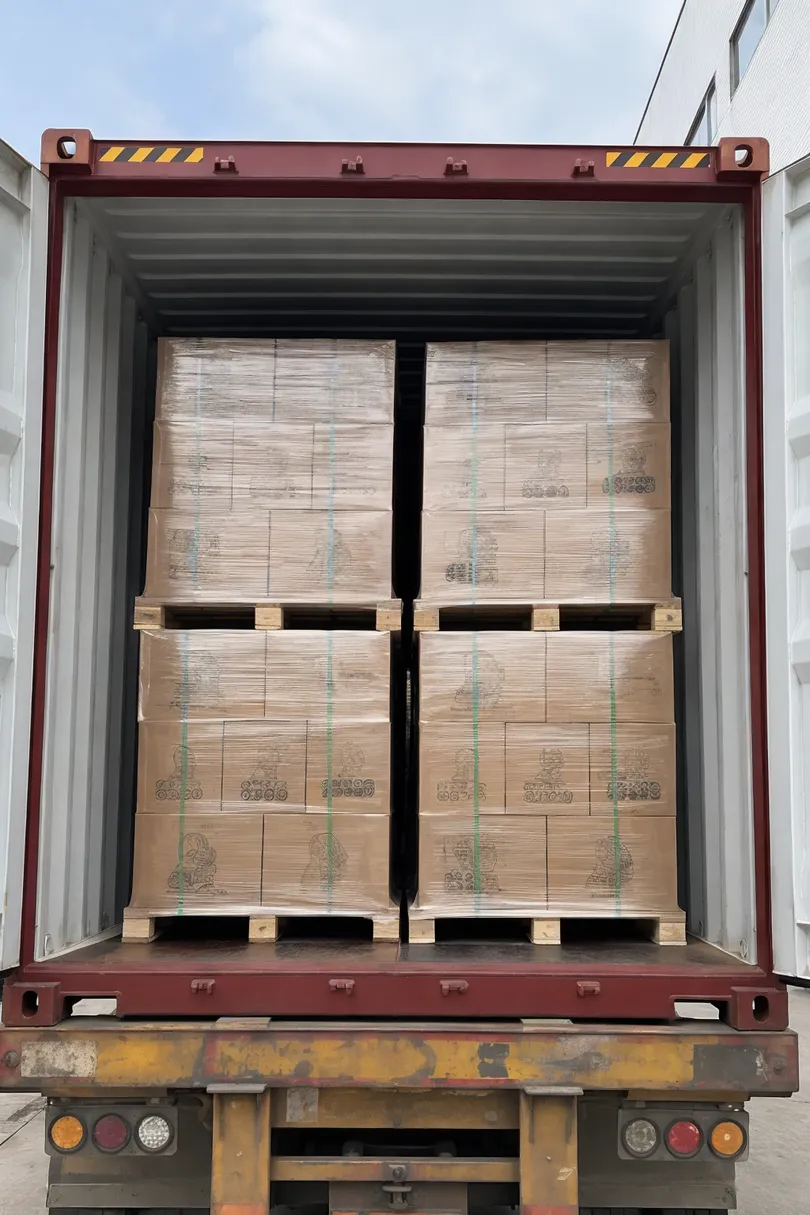
We've optimized our packaging specifically for export container loading.
Mini Moving DJ Lights
Under 4 kg per unit
- 8 units per master carton
- ~320 units per 20GP container
Standard Beam/Spot Heads
8–15 kg per unit
- 2–4 units per master carton (size-dependent)
- ~150–220 units per 20GP container
Full-Size LED Wash Heads
15–25 kg per unit
- 1–2 units per master carton with molded foam inserts
- ~80–120 units per 20GP container
Below 0.3% Transit Damage Rate
Each unit ships in individual molded foam cradles inside reinforced master cartons — we've maintained below 0.3% transit damage rate across five years of container shipments. The foam mold is custom-cut to each fixture model's geometry. Generic bubble wrap doesn't protect a cantilevered moving head arm during a Pacific crossing.
Mixed-Model Container Loading
We palletize to your container type (20GP or 40HQ) and can adjust master carton configurations for mixed-model orders. If you're ordering across multiple product lines — say, beam heads plus mini units plus spiders for a distributor restock — we can coordinate the loading plan so higher-weight items sit at container floor level and lighter units stack above, maximizing your cubic utilization.
LCL for Trial Orders
For LCL (less-than-container-load) shipments on smaller trial orders, we coordinate with consolidators at Shenzhen and Guangzhou ports. Your 30-unit trial order ships efficiently without paying for empty container space.
<0.3%
Transit Damage Rate
5 yr
Consistent Track Record
20GP/40HQ
Container Options
30 units
Min Trial via LCL
Market Segments Where Moving DJ Lights Generate Repeat Orders
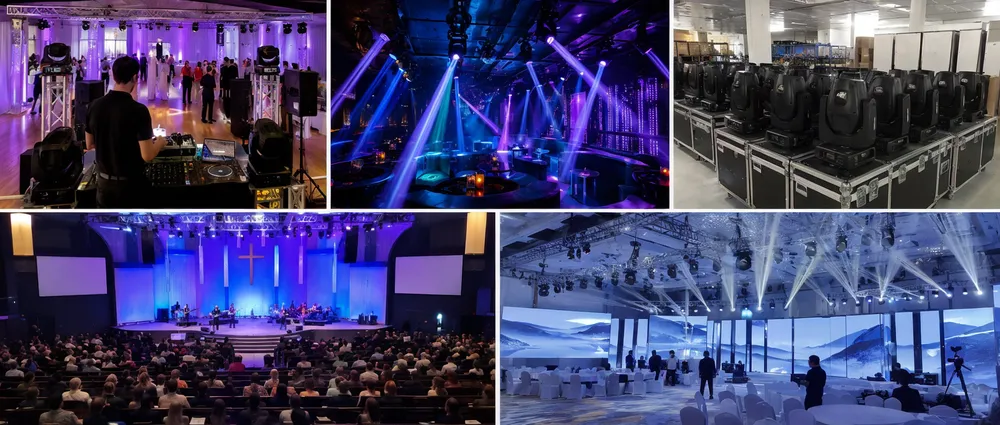
This isn't a description of how end users enjoy their lights. This is where your money comes from — the commercial segments that produce repeat purchase orders.
Mobile DJ Supply
DJs replace and upgrade gear every 12–24 months. Distributors serving this segment see consistent reorder cycles. Mini and spider moving heads are the entry-point SKUs; beam and LED heads serve the upgrade tier.
Volume is steady, margins are protected by brand loyalty once a DJ locks into a fixture ecosystem.
Nightclub Installations
Fixed-install moving heads in clubs run 4–6 hours nightly. Clubs budget for fixture replacement every 3–5 years and typically order 8–40 units per venue.
Your installer customers want consistent supply — same model available year after year without surprise discontinuations. We maintain model continuity specifically for this reason.
Rental & Production Companies
These buyers purchase in quantity (20–100+ units per order) and reorder when they expand fleet or replace damaged inventory. They care about fixture uniformity — every unit in a rig must perform identically.
Our batch consistency (verified by our LED binning and motor calibration processes) is their primary purchasing criterion.
Houses of Worship
Churches and religious venues have shifted heavily toward LED moving heads for stage lighting. Budget cycles are annual, orders are typically 8–20 units, and the buying decision often involves a technical director specifying fixtures for a board-approved budget.
A growing segment with low price sensitivity relative to feature requirements.
Event & AV Integration
Integrators specify fixtures for corporate events, broadcast studios, and theatrical productions. They purchase to deploy in projects and need manufacturer support documentation (photometric data, rigging certifications, CAD models).
Your moving head range becomes specified into their standard equipment list — and stays there as long as you maintain supply.
Selecting the Right Moving Head Configuration for Your Market
Your market position determines which fixtures you stock. Here's how we see the product lines mapping to buyer segments:
Budget-Conscious Markets
Emerging DJ scenes · Entry-level entertainment · Price-driven e-commerce
Start with mini moving DJ lights. Low unit cost, low shipping weight, high volume potential. Margin is thin per unit but the volume makes it work.
Professional Rental & Install
Nightclubs · Production companies · AV integrators
LED moving heads and beam moving heads are your core catalog. These buyers pay for output power, build quality, and fixture longevity. Your margin per unit is higher, reorder cycles are predictable, and these customers specify by model number once they trust the fixture.
Spectacle & Effect-Driven Markets
Festivals · High-end clubs · Touring productions
Spider moving heads and laser moving heads differentiate your catalog from competitors selling only generic beam/wash fixtures. These are specialty SKUs with limited competition — fewer suppliers means you hold pricing power.
Building a Complete Line from Scratch
Full tiered catalog · One factory · One PO
We can structure a tiered catalog for you — entry (mini), mid-range (LED spot/wash), and premium (beam + spider + laser) — all from one factory, one purchase order, consistent visual branding across the range.
Not sure which configuration fits?
Send us your target market description and volume expectations — we'll recommend a starter SKU mix based on what's actually moving for distributors in your region.
Common Failure Modes in Moving DJ Lights — and How We Engineer Around Them
We've been manufacturing moving heads for over a decade. We know what breaks, because we've seen every failure mode come back through warranty channels — from our early years and from competitors' fixtures our buyers have sent us as "match this, but make it not break" reference samples.
Motor & Gear Failure
Most Common Field Failure
The problem: Cheap fixtures use undersized stepper motors and plastic gears that strip under continuous duty.
Our solution: Metal gear trains with hardened tooth profiles and motors rated for sustained torque at operating temperature — not just peak torque at room temperature.
Accelerated life test: 50,000 full pan cycles before measurable wear
LED Lumen Depreciation
Thermal Design Problem
The problem: Budget LED fixtures lose 30–40% brightness within the first year because the thermal design can't maintain junction temperature below degradation thresholds.
Our solution: We machine custom aluminum heatsinks for each model (not generic fin extrusions), validate junction temperature at sustained full output during the design phase, and reject any thermal design that can't maintain L80 at 20,000 hours.
L80 (80% of initial lumens) guaranteed at 20,000 hours — no progressive dimming across installed fleets
DMX Communication Errors
Signal Integrity Issue
The problem: Intermittent DMX response — flickering, missed cues, random resets — typically stems from poor signal isolation on the decoder board or marginal power supply design that introduces noise under thermal stress.
Our solution: Our DMX decoder uses optically isolated input circuitry and filtered power rails. The 48-hour aging test specifically monitors for DMX response anomalies under thermal saturation.
Zero tolerance: if a fixture drops even one DMX frame during 48 hours of continuous operation, it doesn't ship
Water Ingress on Outdoor Units
Sealing & IP Integrity
The problem: IP rating printed on a spec sheet means nothing if the gaskets aren't properly seated or the housing drainage is poorly designed.
Our solution: We pressure-test every IP65/IP67 unit — not just the prototype, every production unit — and use silicone gaskets with mechanical compression verification (gasket squeeze percentage measured at assembly).
Field failure rate for water ingress on IP-rated fixtures: below 0.1%
These aren't theoretical concerns. They're the specific reasons buyers switch suppliers — and the specific reasons our repeat order rate from year-one customers exceeds 75%.
Frequently Asked Questions — Moving DJ Lights
What IP rating do I need for outdoor moving DJ lights?
For covered outdoor stages (festival tents, permanent gazebos), IP54 handles splash and dust.
For fully exposed outdoor installations — rooftop venues, open-air festivals, architectural façades — specify IP65 minimum.
If the fixture faces direct rain or high-pressure washdown, IP67 is the correct choice.
We manufacture both IP65 and IP67 moving heads with sealed optical chambers and pressure-equalized housing vents.
Why do some moving heads develop "head nod" after a few months of use?
Head nod — the fixture head drifting slightly from its programmed position — results from gear backlash accumulation as soft metal or plastic gear teeth wear under repeated cycling.
This is almost always a materials problem: the original gear set was spec'd too soft for continuous-duty use.
Our tilt mechanism uses hardened steel worm gears with anti-backlash spring preload, which maintains positioning accuracy past 50,000 cycles.
If you're experiencing this with your current supplier's fixtures, the mechanism design is the root cause, not a firmware issue.
What's the difference between lamp-based and LED-source moving DJ lights for resale?
Lamp fixtures (discharge/halide sources): Produce higher-intensity beam effects per watt and better gobo projection crispness — preferred by purist lighting designers.
LED fixtures: Eliminate lamp replacement cost (a major selling point for fixed installations), offer instant on/off with no strike time, and provide RGBW color mixing without mechanical color wheels.
For your resale business:
- Lamp fixtures — higher per-unit margin but require you to stock replacement lamps as an accessory line
- LED fixtures — slightly lower margins but zero after-sale consumable support burden
Most distributors now carry both — LED for install market, lamp for rental/touring.
Can I order a mixed container of different moving head models?
Yes. We consolidate mixed-model orders into a single production schedule and ship in one container.
Your purchase order can combine beam heads, spider fixtures, mini units, and LED wash heads across our full range.
Minimum per-model quantity within a mixed order: 30 units.
We optimize the container loading plan for mixed dimensions and weights to maximize your cubic utilization.
What's the typical lead time for OEM moving DJ lights with custom branding?
OEM (existing fixture platform with your logo, packaging, and firmware screen): 7–10 days for approval samples, then 20–30 days for production depending on quantity.
ODM (custom development): add 3–4 development cycles before production (typically 45–60 days for engineering, then standard production lead time).
Rush production is available at a premium for time-sensitive launches — discuss with our sales team for specific scheduling.
How do you ensure color consistency across a large batch of LED moving heads?
We bin-sort all LED chips at incoming quality control — testing forward voltage and correlated color temperature (CCT) before they enter the SMT line.
Max CCT Deviation
±100K
Max Lumen Deviation
±3%
Units from the same production run use LEDs from the same bin, guaranteeing visual uniformity when your customer rigs 20 identical fixtures side by side.
We retain bin records per production batch, so reorders can be matched to previous color characteristics if visual continuity matters to your client.
Start with a Sample Order or a Full Catalog Discussion
You've seen the range. The next step depends on where you are in your buying cycle.
Testing a New Supplier
Order 30 units of any single model — beam, spider, mini, LED, or laser. Run them through your own QA, demo them for your customers, put them on a rental gig.
Samples ship within 3–7 days on standard models
Building or Expanding a Product Line
Tell us your target market, volume expectations, and price tier. We'll recommend a SKU mix, provide full catalog pricing, and spec any OEM branding or custom modifications you need.
Full catalog pricing & OEM configuration
Replacing an Unreliable Supplier
Send us the fixture you're currently sourcing — or just the spec sheet. We'll match or improve the performance, quote production, and ship comparison samples so you can evaluate side by side before switching.
Side-by-side comparison before commitment
Reach Our Sales Engineering Team
Teresa@gdmonkey.com
+86-135 3966 9939
Response Time
Engineering review and preliminary quote back within 48 hours