

Moving Head Stage Lighting Lights Factory-Direct from GDMonkey
Beam, spot, wash, and hybrid moving head stage lighting lights manufactured on our dedicated moving head production line in Guangdong. Pan/tilt mechanisms built on 12+ years of electromechanical motor expertise.
100W compact units to 350W+ touring fixtures — OEM/ODM from 30 units, 48-hour aging on every unit before shipment.
What Makes This Product Line Different from Generic Moving Heads
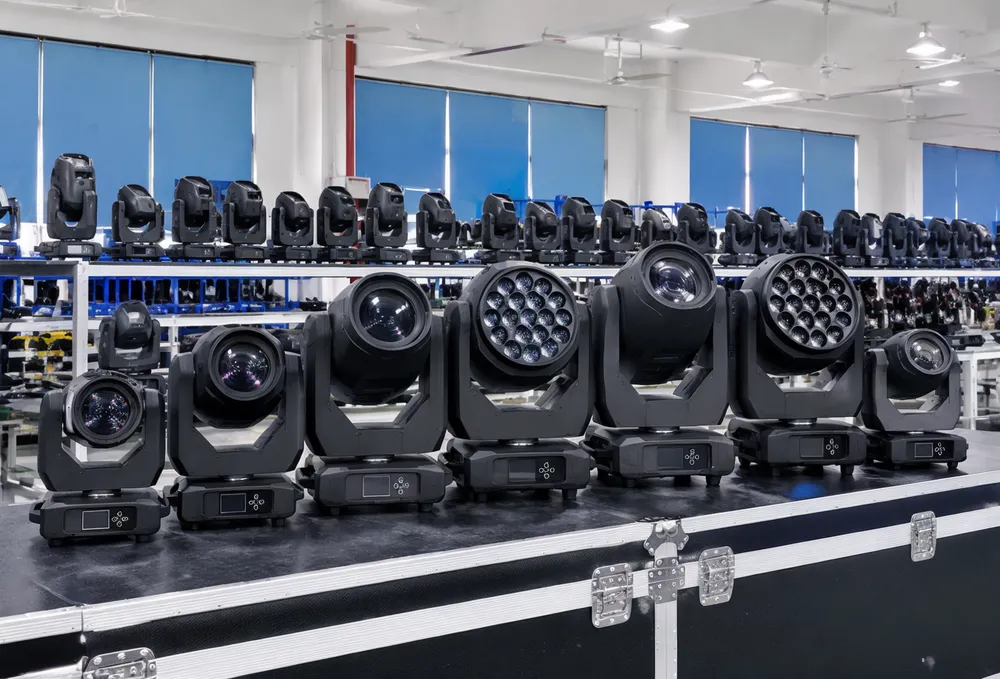
Moving head stage lighting lights are the highest-margin fixtures in the professional lighting category — and the ones most likely to generate warranty returns if the supplier cuts corners on mechanical components. We build moving heads on a dedicated production line (Line 5 of our six-line facility) that runs exclusively motorized fixture assemblies: pan/tilt mechanisms, gobo wheel systems, color wheels, and prism assemblies.
Our origin story matters here. GDMonkey started in 2012 building electromechanical assemblies — low-voltage motors, rotation mechanisms, and gear systems for entertainment devices. When we expanded into professional stage lighting, moving heads were the natural extension. We didn't learn motors to build moving heads. We learned moving heads because we already understood motors.
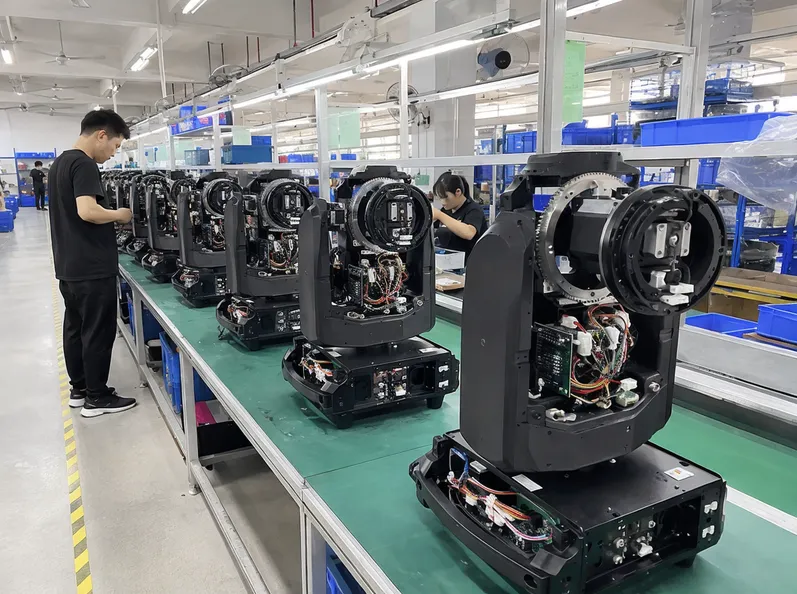
That heritage shows up in specifics: sintered metal gears instead of injection-molded plastic, pan/tilt motors rated at 2.4× the actual fixture head weight, stepper drivers with dedicated heatsink fins and thermal cutout protection. The result you care about — fewer mechanical failures across 10,000+ hour duty cycles, which means your warranty return rate stays near zero instead of climbing after 18 months in rental fleets.
The parent category page covers our full stage lighting lights range including general manufacturing approach and QC philosophy. This page goes deeper on moving head-specific engineering, specifications, and commercial applications.
Engineering Heritage
- Sintered metal gears replace injection-molded plastic in all pan/tilt drives
- 2.4× motor over-rating — motors rated at 2.4× actual fixture head weight
- Thermal cutout protection on stepper drivers with dedicated heatsink fins
- 10,000+ hour duty cycles — near-zero warranty return rate through 18+ months
- Dedicated Line 5 — exclusively motorized fixture assemblies since 2012
Moving Head Configurations and What Each Sells Into
We produce four moving head types. Each serves a different segment of your downstream market, and you'll likely want at least two in your catalog to cover the accounts available to you.
Beam Moving Heads
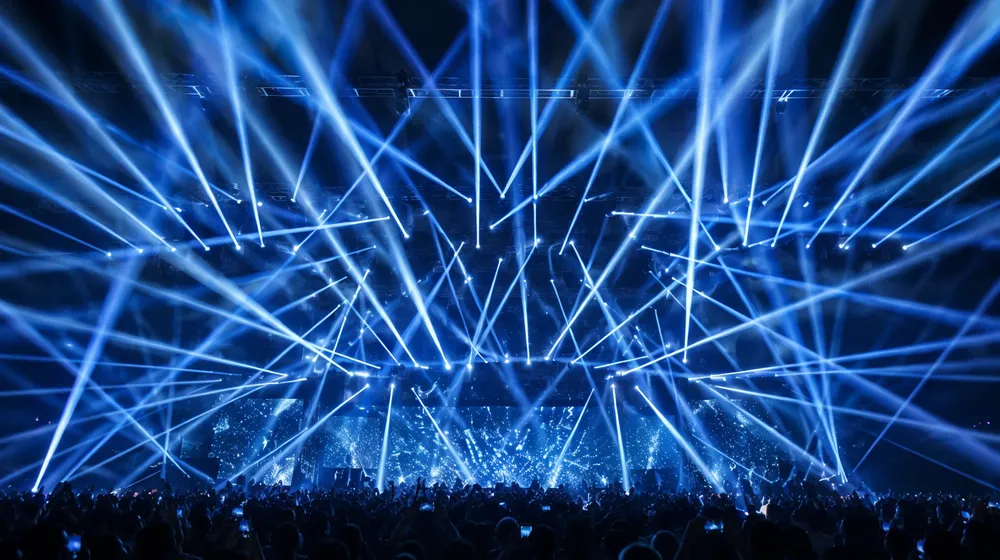
Tight, concentrated output — typically 1°-3° beam angle — designed for aerial effects, sweeping beams visible through haze, and long-throw punch. The visual impact is dramatic: narrow shafts of light cutting through darkness. These are the fixtures that define a show's "wow factor" in touring concerts, music festivals, and nightclub installations.
Commercial Angle
Beam moving heads are what rental companies and production houses rent by the dozen for single events. A touring show spec might call for 20-40 identical beam fixtures. When your customer re-books the same show for a 12-city tour, that's 12 rental events on the same fixtures. High reorder frequency for spares and fleet expansion.
Spot Moving Heads
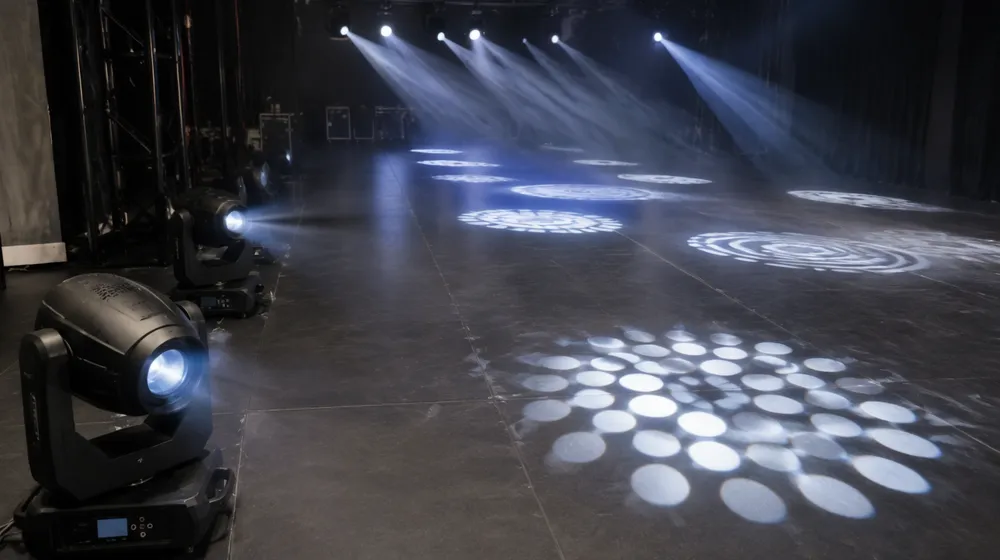
Mid-range beam angles (12°-25°) with gobo projection capability — patterns, logos, and texture effects projected onto surfaces. Rotating and fixed gobo wheels, motorized focus, iris control. These are the workhorses of theatrical productions, corporate events, and live broadcast studios where shaped light matters more than raw punch.
Commercial Angle
Spot moving heads sell into the broadest buyer base. Theatre companies, churches, AV integrators, corporate event firms — any application where projected patterns or focused spot effects are needed. Less "spec sheet sexy" than beams, but significantly higher total addressable market. We sell roughly 3:1 spot-to-beam ratio across our distributor network.
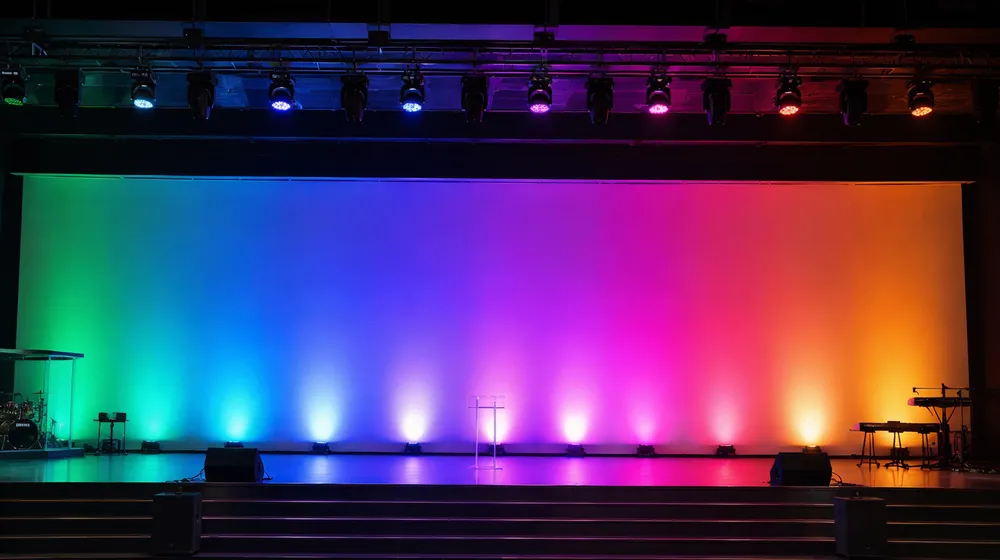
Wash Moving Heads
Wide-coverage RGBW/RGBWA+UV color washing — smooth gradients across stage surfaces, even coverage without hard beam edges. Motorized zoom typically spans 10°-60°. These replace banks of par cans with a single fixture that can color-wash an entire stage backdrop or facade.
Commercial Angle
Wash moving heads are the fleet-builder fixtures. A permanent install in a church, auditorium, or event venue needs 8-20 units for full stage coverage. Rental inventory follows the same pattern — you need multiples to create even washes. Per-fixture price is lower than beam or spot equivalents, but volume per order is higher.
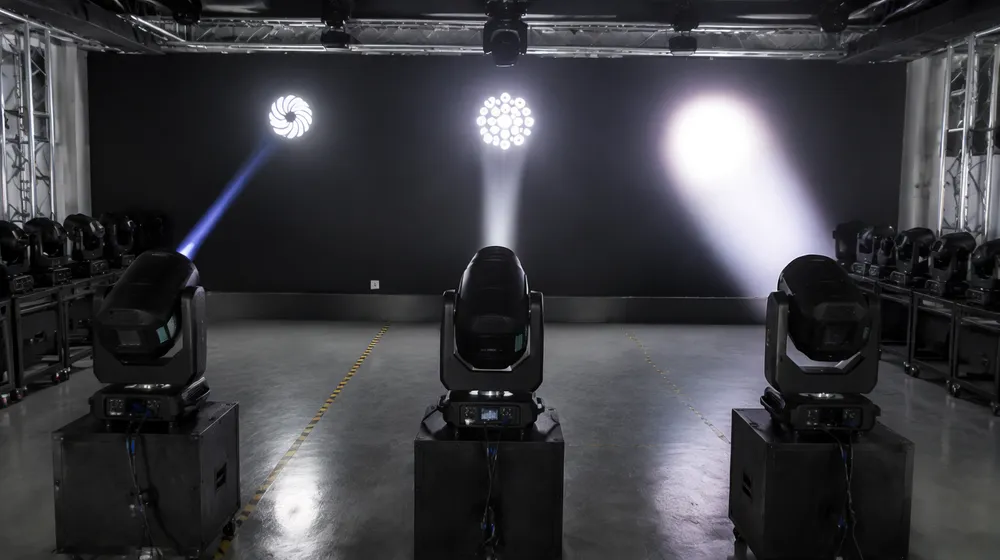
Hybrid Moving Heads
Beam + spot + wash modes in a single fixture body. CMY color mixing, gobo wheels, prism effects, and zoom range that spans tight beam through wide wash. One fixture, three functions. These are the premium tier — highest unit price, broadest versatility.
Commercial Angle
Hybrid moving heads command the highest per-unit margin in the category. Rental companies love them because one fixture covers multiple show requirements, reducing total inventory investment. Distributors who can reliably supply hybrids with consistent quality build the stickiest accounts. The flip side: hybrids are mechanically complex, so factory QC is non-negotiable — a hybrid that fails mid-mode-change during a show is the fastest way to lose a rental account.
Technical Specifications for Moving Head Stage Lighting Lights
The table below shows typical parameter ranges across our moving head product families. Individual model data sheets provide exact values — request specific model specs when you inquire.
| Parameter | Beam | Spot | Wash | Hybrid |
|---|---|---|---|---|
| LED/Lamp Source | 150W–350W | 100W–300W | 120W–400W | 200W–350W |
| LED Type | Osram, Luminus (model dependent) | Osram, Cree | Osram RGBW arrays | Osram, Luminus |
| Beam Angle | 1°–3° fixed | 12°–25° (motorized focus) | 10°–60° (motorized zoom) | 3°–50° (full zoom range) |
| Pan Range | 540° | 540° | 540° | 540° |
| Tilt Range | 270° | 270° | 270° | 270° |
| Pan/Tilt Resolution | 16-bit fine | 16-bit fine | 16-bit fine | 16-bit fine |
| Color System | Color wheel (14+ colors) | Color wheel + CTO | RGBW / RGBWA+UV mixing | CMY + color wheel + CTO |
| Gobo Wheels | Fixed (1 wheel) | Rotating + fixed (2 wheels) | N/A | Rotating + fixed (2 wheels) |
| Prism | Yes (8-facet typical) | Optional | N/A | Yes (multiple prism options) |
| DMX Channels | 16–20ch | 18–24ch | 12–18ch | 24–36ch |
| Control Protocols | DMX512, RDM | DMX512, Art-Net, RDM | DMX512, Art-Net, sACN | DMX512, Art-Net, sACN, RDM |
| IP Rating | IP20 | IP20 | IP20 (IP65 outdoor models) | IP20 |
| Housing | Die-cast aluminum | Die-cast aluminum | Die-cast aluminum | Die-cast aluminum |
| Weight Range | 12–22 kg | 10–20 kg | 8–18 kg | 18–28 kg |
| Power Input | AC 100–240V, 50/60Hz | AC 100–240V, 50/60Hz | AC 100–240V, 50/60Hz | AC 100–240V, 50/60Hz |
Specifications shown are standard values across our production range. Exact parameters vary by model. Contact us for detailed data sheets on specific SKUs.
Moving head stage lighting lights require precise optical and mechanical calibration that consumer-grade fixtures skip. Our 16-bit pan/tilt resolution delivers 65,536 positional steps across the travel range — visible as smooth, jitter-free movement at slow speeds, which matters for theatrical cues and broadcast environments where camera picks up any stepping artifact.
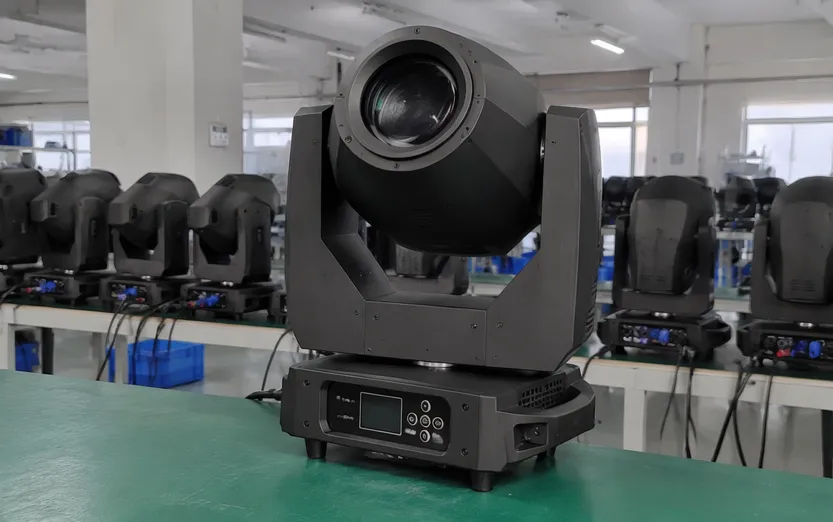
The Mechanical Engineering That Protects Your Warranty Margin
Moving heads fail differently than static fixtures. A par can with an LED driver failure sits dark — disappointing, but not catastrophic. A moving head with a stripped gear or burned pan motor fails during movement, mid-show, with the beam stuck pointing at the wrong spot. That's a client call at midnight and a warranty claim the next morning.
We over-engineer the mechanical system specifically to prevent that failure mode. Here's what that means in production terms:
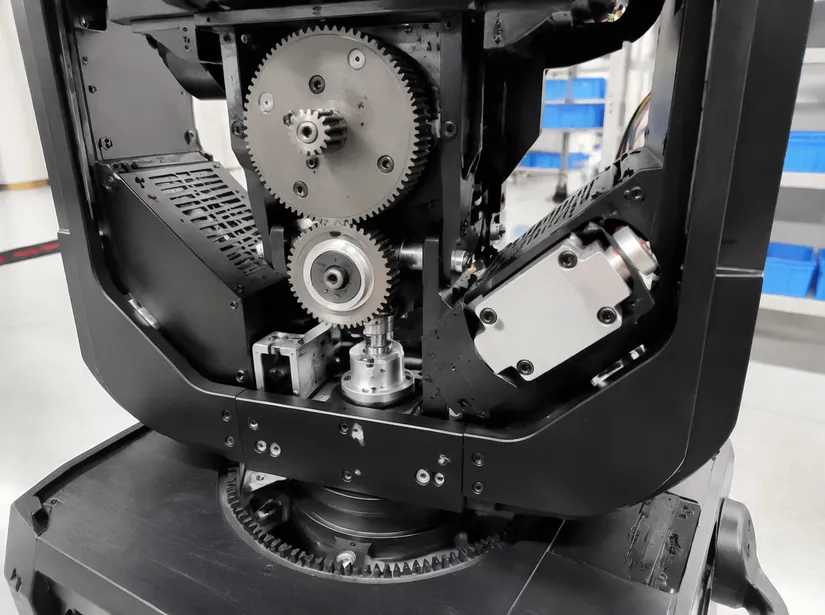
Pan/Tilt Motor Specification
Motors are rated at 2.4× the actual head load. A fixture head weighing 5 kg runs on a tilt motor rated for 12 kg continuous duty. The margin absorbs heat buildup during rapid-movement sequences (EDM shows, touring rock productions with aggressive cue timing) without approaching the motor's thermal limit.
We test pan and tilt motors individually on a dynamometer before they enter the assembly line — reject rate on incoming motors runs 2–3%, which we catch before assembly rather than after.
Gear System
Sintered metal gears rather than injection-molded plastic. Plastic gears are cheaper and quieter initially, but they wear. After 3,000–5,000 hours of continuous use, molded plastic develops tooth wear that introduces backlash — the head "hunts" during slow movements, never quite settling on the DMX-commanded position.
Sintered metal costs us more per unit, but the gear set lasts the life of the fixture. We switched from plastic to metal gears in 2016 after analyzing the failure pattern on returned units. The gear swap eliminated our single largest mechanical warranty category.
Stepper Driver Thermal Management
Each stepper driver board carries its own finned heatsink and a thermal cutout rated at 90°C. If a driver reaches thermal limit — possible if the fixture is mounted in an enclosed truss position with restricted airflow — it reduces speed rather than burning out.
The fixture slows down instead of failing. Your customer notices reduced performance; they don't notice a dead fixture.
Belt vs. Direct Drive
Our beam and hybrid moving heads use toothed belt drive for pan axis and direct gear for tilt. Belt drive on pan eliminates gear noise entirely (important for theatre and broadcast applications where ambient noise matters) while still delivering the positional accuracy of 16-bit control.
The tilt axis uses direct gear because the load is asymmetric and belt slip under rapid directional changes isn't acceptable.
Why This Matters to Your Margin
This mechanical depth is why moving heads from our facility carry different warranty economics than units from suppliers who assemble purchased subcomponents without designing the drive system. Your cost-of-failure math on a single moving head warranty return — the unit cost, two-way freight, technician time, customer relationship damage — typically exceeds the landed cost difference between our fixtures and a cheaper alternative.
Market Segments Your Moving Head Inventory Opens
Each application below represents a repeatable sales channel — not a one-time project, but a market segment with predictable reorder patterns.
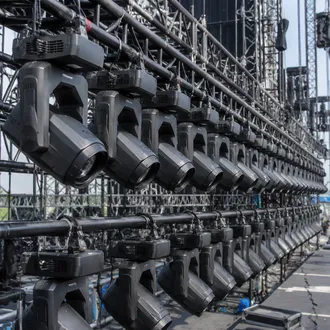
Touring Production & Concert Rental
Production companies running 50–200 show dates per year need beam and hybrid moving heads in fleets of 20–60 matching units. They buy for reliability across sustained use, inter-unit consistency (every fixture in the rig must match in output and color), and road-worthiness. Replacement and expansion orders typically come 12–18 months after initial purchase as units accumulate hours and the production scales.
Order Pattern
Initial fleet purchase of 20–40 units, followed by 5–10 unit top-ups annually. Premium price tolerance — these buyers will pay more for proven reliability because one fixture failure during a show costs them far more than the fixture itself.
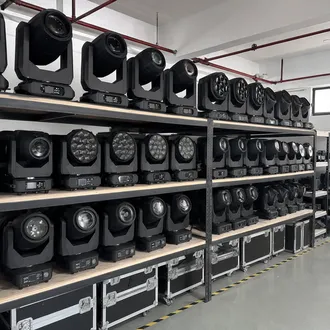
Event & AV Rental Houses
These buyers stock moving heads for sub-rental to event planners, wedding companies, and corporate event producers. They need a mix of beam (for wow-factor), wash (for stage fill), and spot (for pattern projection). Rental revenue model means they amortize fixture cost across 50–100 rental events per unit per year — so low failure rate directly multiplies their ROI.
Order Pattern
10–30 units per model, typically ordering 2–3 different moving head types simultaneously. Reorder cycle of 18–24 months as they refresh inventory. Price sensitivity is moderate — they'll buy mid-range if the reliability is proven.
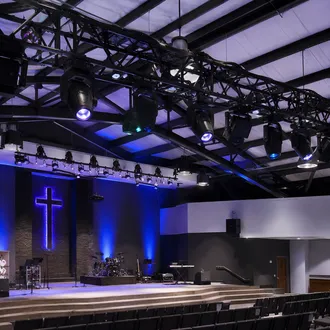
Houses of Worship
Churches and worship centers represent one of the largest single-venue installation markets for moving head stage lighting. A mid-size church install specifies 8–16 moving heads (mix of spot and wash) mounted on permanent truss. Mega-churches scale to 40+ units. These are project sales — typically specified by an AV integrator who buys from a distributor.
Order Pattern
Project-based, 8–40 units per installation. Silent fan operation or hybrid cooling matters here — worship environments have quiet moments where fan noise is disruptive. We offer low-noise fan configurations on our wash and spot models specifically for this segment — ask about the "worship spec" when quoting.
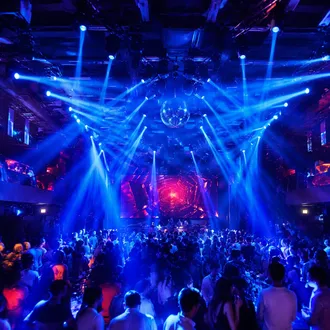
Nightclub & Entertainment Venues
Permanent installations in clubs, bars, and entertainment complexes. Beam moving heads dominate this segment — the narrow beam cutting through haze is the visual identity of nightlife lighting. Typical install: 8–20 beam or hybrid units on ceiling-mounted truss. These fixtures run 4–8 hours per night, 5–7 nights per week — among the highest duty-cycle applications.
Order Pattern
Project-based initial order of 8–20 units. Replacement cycle of 2–3 years as fixtures accumulate 5,000–10,000+ operating hours. Reliability under sustained nightly use is the purchasing criterion that matters most.
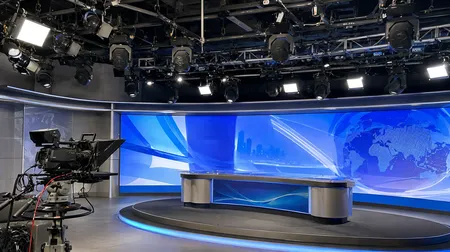
TV/Film Studios & Broadcast
Spot and hybrid moving heads with precise positioning, silent operation, and flicker-free dimming. Broadcast environments require fixtures with PWM frequencies above camera refresh rates (typically 1,200Hz+ to eliminate on-camera flicker). This is a smaller market by unit volume but carries premium pricing and extreme stickiness — once a studio standardizes on your fixture, they buy nothing else for years.
Order Pattern
10–30 units per studio build-out, with long purchase cycles but zero tolerance for quality issues.
Customization Options and Limitations
Moving head stage lighting lights are complex assemblies — customization scope is broader than static fixtures, but some parameters have engineering limits.
What We Customize Freely
| Customization Type | Options | MOQ Impact |
|---|---|---|
| Branding (OEM) | Logo engraving, boot screen, packaging, label | None — standard 30-unit MOQ |
| Color wheel colors | Custom dichroic filter selection | 50+ units (filter sourcing) |
| Gobo patterns | Custom fixed gobos to your artwork | 30+ units (gobo etching) |
| DMX personality | Custom channel map, mode configuration | 30+ units (firmware modification) |
| Housing color | Custom RAL color powder coat | 100+ units (line changeover cost) |
| Voltage configuration | 100-120V / 220-240V / Universal | None — standard offering |
| Control protocol | DMX512, Art-Net, sACN, wireless DMX add-on | Model dependent |
| Connector type | PowerCon, XLR 3/5-pin, EtherCon | None on standard models |
What We Can Customize with Development (ODM)
Custom beam angle or zoom range (requires new lens system design — 3–4 development cycles)
Modified housing geometry for specific mounting requirements
Custom LED source integration (different wattage, different LED chip manufacturer)
Proprietary control protocols or wireless integration
Modified weight or form factor for specific truss/rigging constraints
Combined feature sets from different models into one fixture
ODM Development Terms
MOQ: typically 100–300 units for production runs after sample approval, depending on tooling requirements. Development samples in 3–4 weeks from approved concept.
What Cannot Be Changed
Pan/tilt range is mechanically fixed at 540°/270° — the slip ring and housing geometry determine these limits.
IP20 indoor models cannot be converted to outdoor rating post-design (requires sealed housing redesign from scratch).
Weight reduction below a certain threshold compromises thermal mass and structural integrity — we'll tell you the realistic minimum for your spec.
Honest Engineering Note
The most common customization request we decline is "make it lighter but keep the same output." Physics sets a floor — a 350W fixture needs thermal mass to dissipate heat safely. We can optimize, but we won't compromise the thermal margin to save 2 kg if it shortens LED life.
Compliance and Certification For Your Import Markets
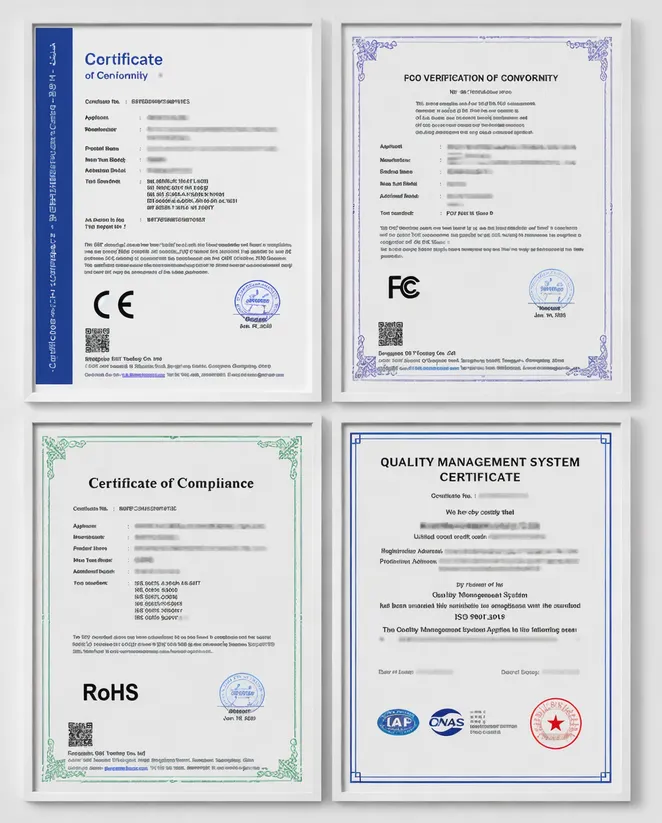
Moving head stage lighting lights from our production carry the following certifications as standard:
| Certification | Coverage | Relevance |
|---|---|---|
| CE | Low Voltage Directive + EMC Directive | Required for EU market entry |
| FCC Part 15 Class B | Electromagnetic emissions | Required for US market |
| RoHS | Restricted substance compliance | Required for EU, increasingly requested globally |
| ISO 9001:2015 | Quality management system | Factory-level certification; supports buyer qualification audits |
Standard Import Process
CE and FCC documentation ships with your order. Your customs clearance in the EU and North America proceeds without compliance delays or supplementary testing requirements. Test reports from accredited labs are available for your records.
Additional Market Certifications
If your market requires ETL/UL listing, SAA (Australia), or country-specific safety marks — discuss during the quotation stage. We maintain relationships with accredited testing labs and can coordinate third-party certification for your target market. Most additional certifications add 4–6 weeks to the timeline and a per-model testing fee, but the process is routine for us.
RoHS/REACH for European Distribution
Our bill of materials uses lead-free solder, halogen-free PCB substrates, and SVHC-compliant components. Restricted substance declarations are available for your import documentation. If your downstream buyers require material safety data sheets or REACH declarations, we provide them as standard.
Packaging, Loading, and Logistics For Moving Head Shipments
Moving heads are the most fragile fixtures in the stage lighting category — exposed pan/tilt mechanisms, protruding lens assemblies, and precision optical components that don't tolerate impact. Our packaging engineering reflects this.
Individual Unit Packaging
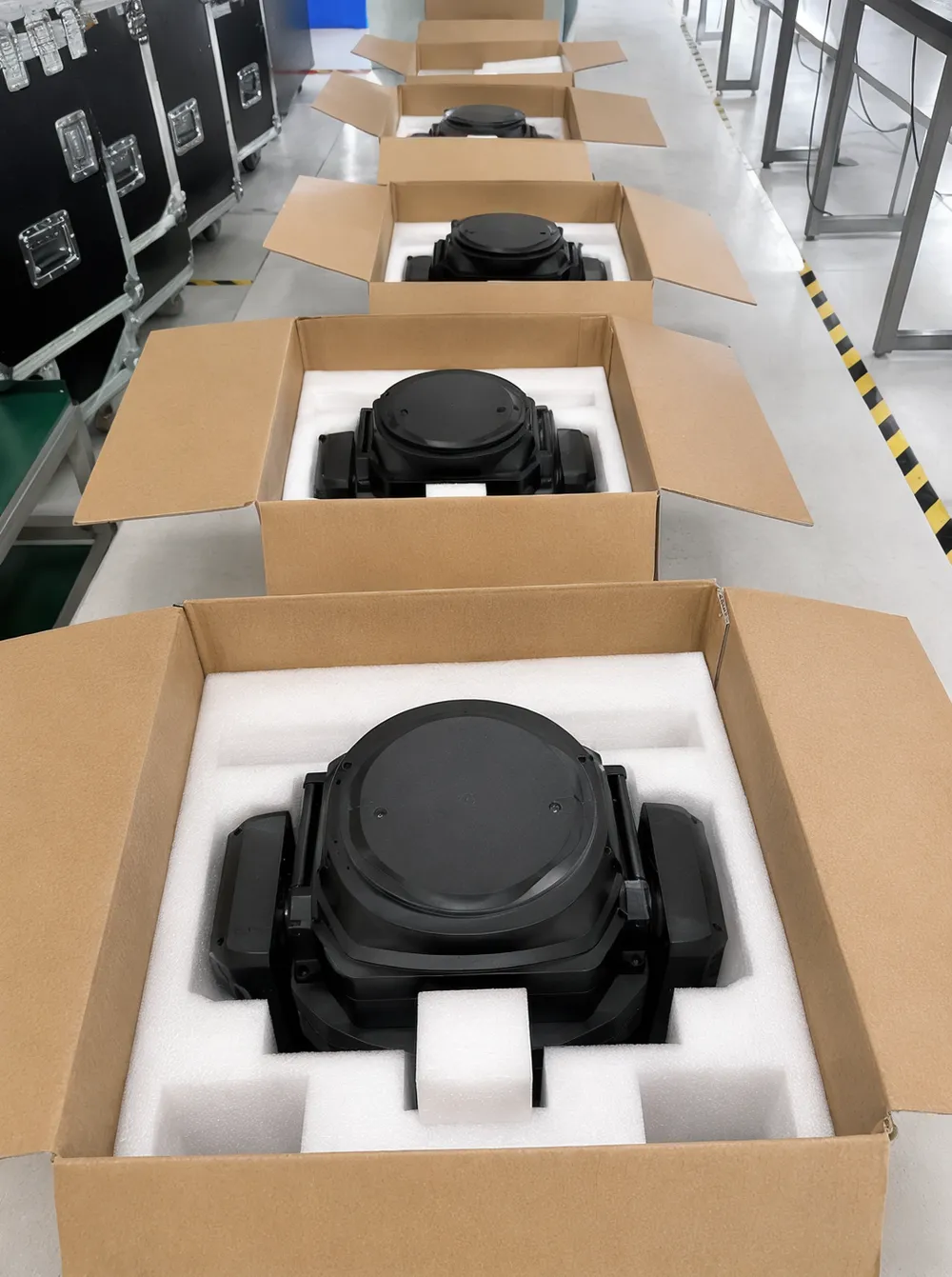
Custom-molded EPE foam inserts contoured to each model's geometry. Yoke locks engaged during packing to prevent pan/tilt movement in transit. Lens cover in place with foam standoff to prevent pressure on the glass. Flight-case models ship in their own road case (adds to unit cube but eliminates transit damage entirely).
Master Cartons
Double-wall corrugated, rated for 4-high stacking in container. Corner protectors on master cartons containing units over 15 kg.
Labeling & Documentation
Carton marks, barcodes, packing lists, and commercial invoices formatted to your receiving system spec. If you're running Amazon FBA, we can configure FNSKU labeling and poly-bag requirements. If you're shipping to a distributor warehouse, we label to your WMS intake format.
Container Loading Estimates
| Fixture Type | Units per 20GP | Units per 40HQ |
|---|---|---|
| Compact moving heads (100–150W) | 300–400 | 600–800 |
| Mid-range moving heads (200–230W) | 200–350 | 400–700 |
| Large moving heads (300W+) | 150–250 | 300–500 |
| Moving heads with road cases | 80–150 | 160–300 |
Exact loading quantities depend on model dimensions and packaging configuration. We provide a detailed packing plan with confirmed carton dimensions during order confirmation — you'll know exactly how your container fills before production starts.
Frequently Asked Questions About Moving Head Stage Lighting Lights
What wattage moving head do I need for different throw distances?
What wattage moving head do I need for different throw distances?
Match wattage to throw: 100–150W covers 8–15 meter throw distances effectively — clubs, small stages, mobile DJ setups. 200–250W handles 15–22 meter throws for mid-size venues, churches, and corporate events. 300W+ is for 22–30+ meter throws — concert halls, touring productions, large outdoor stages.
The relationship isn't linear because optical system efficiency varies by model, but these are reliable working guidelines for stocking decisions.
If your market is primarily small venues, don't over-spec — a 350W fixture on a 10-meter throw is wasted output and unnecessary cost to your customer.
100–150W
8–15m throw
Clubs, small stages, mobile DJ
200–250W
15–22m throw
Mid-size venues, churches, corporate
300W+
22–30m+ throw
Concert halls, touring, outdoor
Why do cheap moving heads develop "jitter" after several months of use?
Why do cheap moving heads develop "jitter" after several months of use?
Positional jitter — the head hunting or vibrating slightly instead of holding a commanded position — almost always traces to gear wear in the pan/tilt drive system. Injection-molded plastic gears develop tooth wear under continuous use, introducing backlash that the stepper motor can't compensate for.
The fix is simple at the design stage: sintered metal gears that maintain dimensional stability across the fixture's service life.
Cost reality: At the factory cost level, the gear material upgrade adds a few dollars per unit. At the warranty cost level, one jittering fixture returned from a rental company costs 20–50× that difference.
What's the difference between a color wheel and CMY color mixing?
What's the difference between a color wheel and CMY color mixing?
Color Wheel
Discrete colors on rotating glass filters — you get 14–16 fixed colors with snap or scroll transitions between them. Fast, punchy, good for beam effects where saturated single colors matter.
CMY (Cyan-Magenta-Yellow)
Subtractive color mixing with graduated filters that can produce any color in the spectrum including pastels and subtle tints. Slower transition but infinite color range.
For your catalog: Beam fixtures typically use color wheels (effect-driven). Spot and hybrid fixtures use CMY (precision-driven). Wash fixtures use direct LED color mixing (RGBW) which is the fastest of all.
Stock according to your market's needs — event rental buyers want the versatility of CMY; nightclub accounts want the speed and punch of color wheels.
How do I choose between spot and hybrid moving heads for my inventory?
How do I choose between spot and hybrid moving heads for my inventory?
If your customer base is price-sensitive and application-specific — theatre companies that only need gobo projection, or installers who need precise focus control — pure spot models deliver better value.
If your buyers serve multiple event types (corporate → concert → theatre) and want fixture versatility, hybrids command the premium because one fixture replaces three.
Most distributors starting out do better with spot models (broader addressable market, lower unit cost, faster turns). Add hybrids once you have accounts that specifically request multi-mode capability and can absorb the price premium.
We can spec both in a single order for you to test market response.
What maintenance do moving head fixtures require?
What maintenance do moving head fixtures require?
Routine maintenance for moving heads:
Lens cleaning
Every 200–400 hours of haze exposure
Gobo wheel dust removal
Quarterly in heavy-use environments
Pan/tilt bearing lubrication
Annually — sealed bearings require minimal service
Fan filter cleaning
Monthly in dusty environments
Provide this maintenance schedule to your rental house and AV integrator customers — it extends fixture life from the typical 3–5 years to 7–10 years in field use, which makes your product look better and reduces warranty pressure on your business.
Sibling Product Lines Under Stage Lighting Lights
Moving heads are the top-margin fixture category, but your accounts likely need complementary product lines. Here's how our other stage lighting families fit alongside moving heads in your catalog:
LED Stage Lighting
Fixed LED wash and color fixtures. Lower unit price, higher volume per order. Every rental house that buys moving heads also stocks LED washes for fill and ambient coverage.
View product linePar Lights Stage Lighting
Compact par cans in 56/64 form factors. The volume-mover of stage lighting — churches buy 20–40 per installation, rental houses stock 100+. Excellent entry product for new accounts.
View product lineOutdoor Stage Lighting
IP65/IP67-rated fixtures for festival stages and exterior installations. If your buyers serve outdoor events, these carry a 30–50% price premium over indoor equivalents.
View product lineConcert Stage Lighting
High-output touring-grade fixtures for large venues and concert rigs. Natural upsell path for accounts that start with mid-range moving heads and scale into touring production.
View product lineNext Steps: Sample, Quote, or Custom Development
You've read the engineering detail and market positioning. Here's how to move forward based on where you are:
Evaluating Suppliers
Send us your current product requirements — wattage range, fixture types, annual volume estimate, target markets. We'll reply with model recommendations and FOB pricing within 48 hours.
Ready to Test Units
Sample orders of 1–5 moving heads ship within 3–7 days. Put them on your rental floor or demo rig, run them for a month, then decide on volume. We'd rather you validate quality firsthand than trust a spec sheet.
Custom Development
Have a fixture concept — different beam angle, specific feature combination, proprietary control integration? Send a brief or even a competitor sample you want us to match-and-improve. Our R&D team reviews feasibility and returns a development timeline.
Already Sourcing — Want Better Cost
If you're buying moving heads from another supplier and want a factory-direct comparison, send us your current specs. We'll quote the equivalent and show you where the margin improves.