

Par Lights Stage Lighting For Your Inventory
LED par lights engineered for rental fleets, install contracts, and wholesale distribution — not hobby use.
Full RGBW and RGBWA+UV mixing, die-cast aluminum housing, and 48-hour burn-in on every unit before it ships to your warehouse.
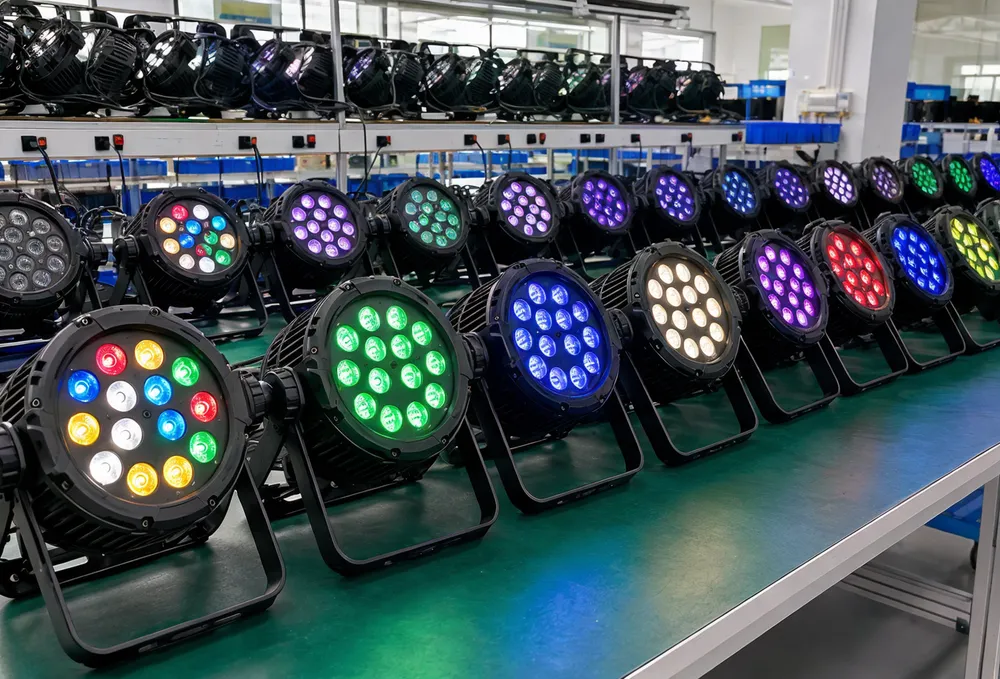
What You're Sourcing: Our Par Light Range
Par lights are the workhorse of any stage lighting inventory. They wash stages, light architectural facades, fill truss rigs for touring, and cover every corporate AV gig that needs flat, even color. If you stock stage lighting or bid on install projects, par cans are the SKU that moves volume — and the one where per-unit margin adds up fastest because your customers reorder them in multiples of 8, 12, or 24.
We manufacture LED par lights across the output range that matters for professional use: compact 54×3W units for mobile DJs and small-venue installs, full-size 18×18W RGBWA+UV fixtures for touring and theater, and IP65-rated outdoor pars for architectural and event work. All share the same production platform — same SMT lines, same QC process, same burn-in — so quality stays consistent whether you order the entry-level model or the flagship.
The distinction from what you'll find at a trading company: we control the LED bin selection, the driver circuit design, the thermal path, and the firmware. When you need a specific beam angle for a project spec, or a particular color temperature for an architectural install, we adjust at the source. No middleman relay, no "we'll ask the factory" delays.
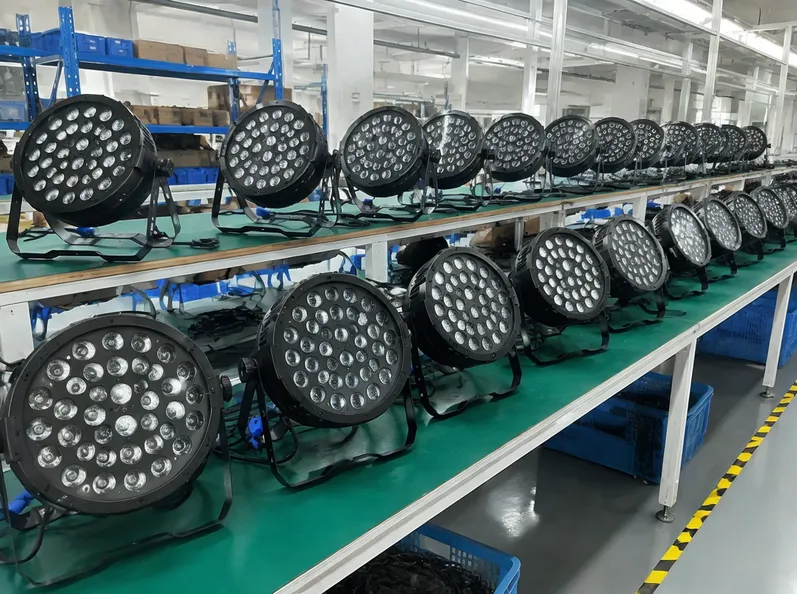
Production Range
- Compact 54×3W — Mobile DJs, small-venue installs
- Mid-Range 18×12W — Corporate AV, event rental
- Full-Size 18×18W — Touring, theater
- Outdoor IP65 — Architectural, all-weather events
Same SMT Platform
Every model — entry to flagship — shares the same production lines and QC process.
Source-Level Control
LED bin selection, driver circuit, thermal path, and firmware — all designed in-house.
Spec-Level Adjustments
Need a specific beam angle or color temp for a project? We adjust at the source.
No Middleman Relay
Direct factory communication — no "we'll ask the factory" delays from trading companies.
Technical Specifications Across the Par Light Series
Standard values across our current production range. Exact parameters vary by model variant — contact us for detailed datasheets on the specific SKU you're evaluating.
| Parameter | Compact Par (54×3W) | Mid-Range Par (18×12W) | Full-Size Par (18×18W) | Outdoor Par (IP65) |
|---|---|---|---|---|
| LED Configuration | 54× 3W RGBW | 18× 12W RGBW | 18× 18W RGBWA+UV | 18× 18W RGBWA+UV |
| Total Wattage | 162W | 216W | 324W | 324W |
| Beam Angle | 25° / 45° (lens-selectable) | 15° / 25° / 45° | 15° / 25° / 45° | 25° / 45° |
| Color Mixing | RGBW 4-in-1 | RGBW 4-in-1 | RGBWA+UV 6-in-1 | RGBWA+UV 6-in-1 |
| CRI | Typical 90+ | Typical 92+ | Typical 92+ | Typical 92+ |
| Dimming | 0-100% linear, 16-bit | 0-100% linear, 16-bit | 0-100% linear, 16-bit | 0-100% linear, 16-bit |
| Control | DMX512, auto, sound, master-slave | DMX512, Art-Net, auto, sound | DMX512, Art-Net, RDM, wireless optional | DMX512, Art-Net, RDM |
| Housing | Die-cast aluminum | Die-cast aluminum | Die-cast aluminum | Die-cast aluminum, IP65 sealed |
| Weight | 3.2–3.8 kg | 5.5–6.2 kg | 7.0–7.8 kg | 8.5–9.5 kg |
| Cooling | Convection (silent) | Fan-cooled (low noise) | Fan-cooled (variable speed) | Fan-cooled (sealed path) |
| LED Lifespan | 50,000 hours | 50,000 hours | 50,000 hours | 50,000 hours |
LED Binning: Why Your Fleet Matches
We bin all LEDs to within ±100K color temperature and ±2 SDCM before they enter the SMT line. When you order 500 par cans for a rental fleet, every fixture produces the same white when lined up on a truss.
We reject roughly 4–6% of incoming LED reels at IQC for color deviation — it costs us yield, but it saves you the embarrassment of mismatched fixtures on a client's stage.
Optical Design and Color Mixing That Protect Your Rental Revenue
This is where par lights either earn their place in a rental inventory or become warranty headaches. The optics determine whether your fixtures deliver consistent, even washes across a 12-meter stage — or show hotspots and color fringing that make your lighting designer clients reach for a different rental house next time.
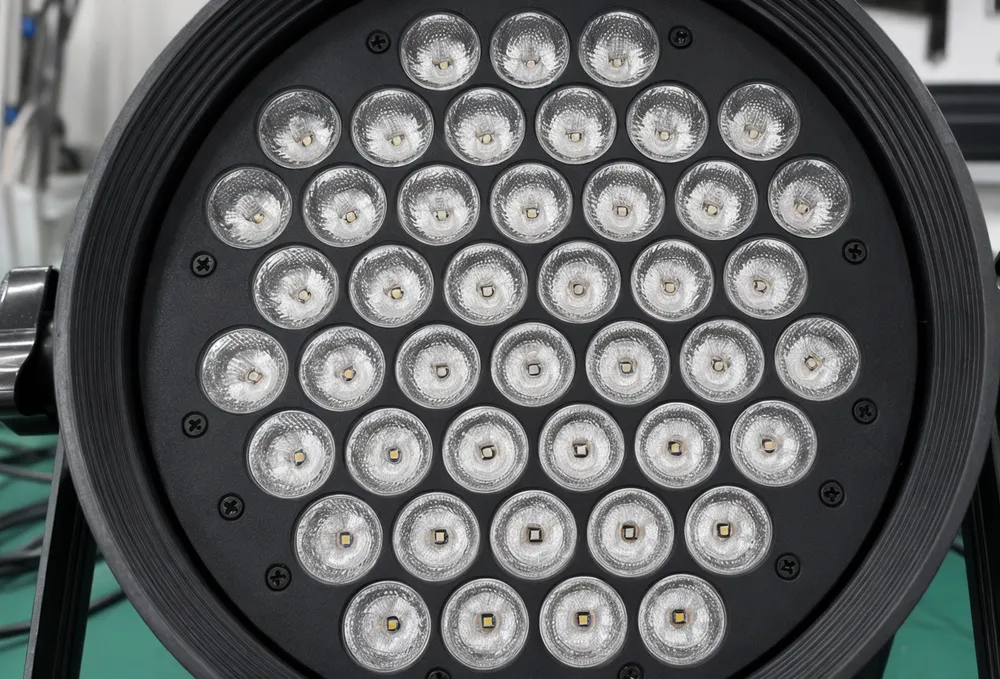
In-House Lens Design — Not Generic Fresnels
We design our own lens arrays in-house rather than buying generic Fresnel lenses from the optical component market. Each LED position gets a precision-molded PMMA lens matched to the specific chip package geometry — TIR (total internal reflection) optics for the narrow-beam configurations, textured diffuser lenses for the wide-wash variants.
±2° Field Angle Consistency Unit-to-Unit
Field angles hold within ±2° unit-to-unit across your order, and the color mixing zone starts closer to the fixture face, so your minimum throw distance stays practical for small venues.
6-in-1 RGBWA+UV — One SKU Replaces Three
The 6-in-1 RGBWA+UV mixing on our full-size pars gives you fixtures that cover every color demand without carrying separate amber-wash and UV-wash units in your inventory. One SKU replaces three in your truck pack — that's real savings on warehouse space and truck loading.
Amber & UV Implementation
We added the amber and UV chips on dedicated channels rather than mixing them through the RGB array. Costs slightly more per PCB, but the amber is actually warm and the UV actually activates fluorescent materials instead of just looking purple.
Dimming Resolution
16-bit dimming resolution across all channels means your fixtures dim smoothly to zero without stepping artifacts — critical for theater installs and broadcast environments where clients notice the flicker that 8-bit dimming produces below 5%.
Inventory Efficiency
Full RGBWA+UV coverage from a single fixture type eliminates the need to stock separate amber-wash and UV-wash par models — reducing warehouse SKU count and simplifying truck packs for your logistics team.
Market Segments Where Par Lights Drive Repeat Orders
Rental Houses and AV Companies
Volume Buyers — Annual Reorders
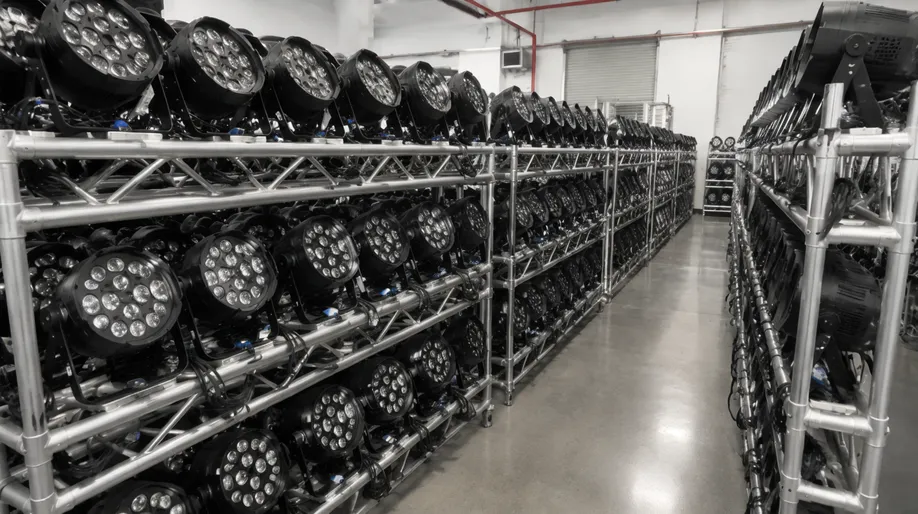
Rental companies buy par lights in multiples of 24-48 units, matched to standard truss configurations. They reorder annually as their fleet expands or as fixtures reach end-of-life after 3-5 years of touring duty. Your margin sits in the consistency and reliability — a rental company doesn't come back for a second order of 48 units if the first batch had color shift issues or fan failures at month six.
48-hour burn-in eliminates the infant mortality failures that create mid-contract downtime for rental operators. Every fixture in your batch has already survived the thermal stress that causes early capacitor and driver failures, so your warranty claim rate stays below 1%.
Houses of Worship — Audio-Visual Upgrade Budgets
Budget-Cycle Driven — Predictable Pipeline
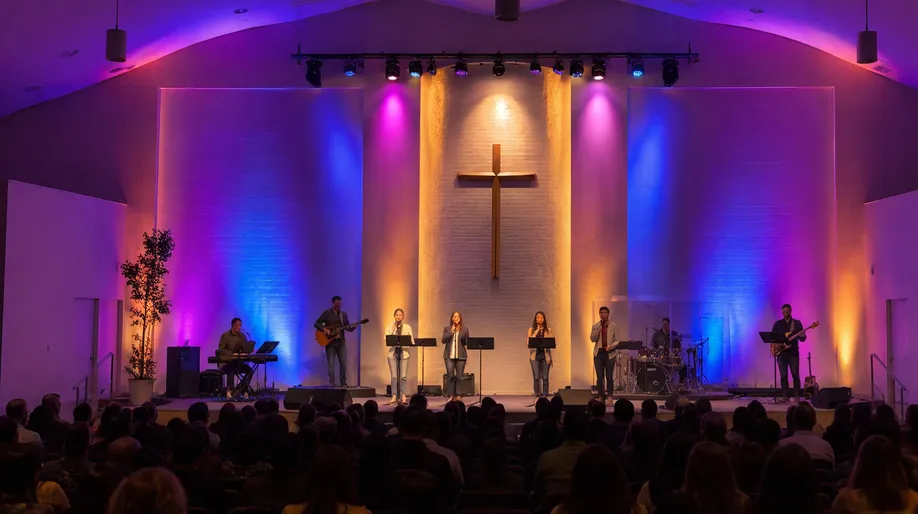
Churches, mosques, and temples represent a stable, budget-cycle-driven segment. Congregations allocate annual AV improvement funds, and lighting upgrades typically run 12-36 par fixtures per installation. The buying cycle is predictable: budget approval Q1, specification and bidding Q2, install Q3. If you're a regional AV contractor or distributor selling into this space, par lights are the volume anchor of every house-of-worship lighting package.
Our silent-running compact pars (convection-cooled, zero fan noise) fit worship environments where audio clarity is non-negotiable. The full RGBW mixing handles everything from warm amber sermon lighting to saturated concert-style worship sets.
Touring and Event Production
High-Cycle Durability — 200+ Gigs/Year
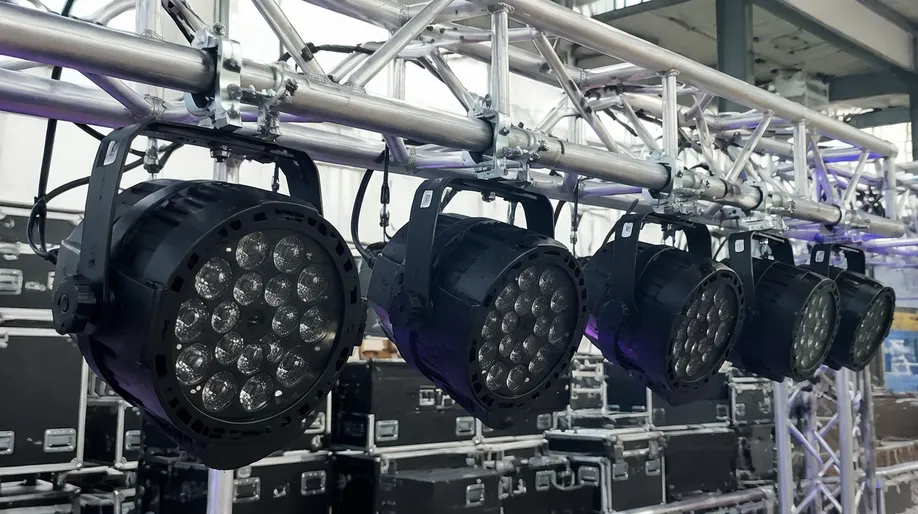
Touring productions cycle par lights hard — daily setup/teardown, truck vibration, temperature swings from outdoor festivals to indoor theaters. Your fixtures need to survive 200+ gig cycles per year.
Die-cast aluminum housings with integrated rigging points (standard Omega bracket, safety cable attachment) handle the mechanical stress that sheet-metal housings can't sustain over a touring season.
Architectural and Permanent Install
Specify Once — High-Spec Requirements
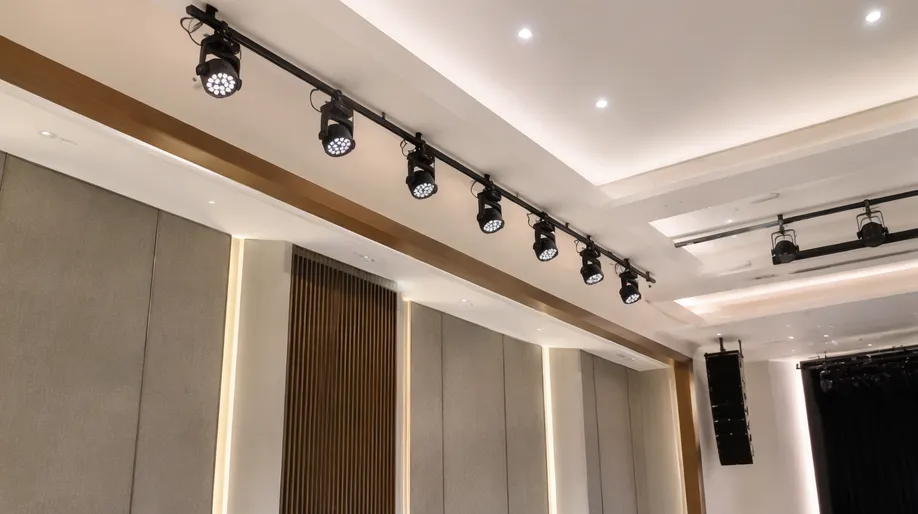
Hotels, restaurants, museums, theaters with permanent rigs — these projects order once but specify carefully. CRI above 90, specific color temperatures, flicker-free dimming for camera-friendly environments.
Our Art-Net and RDM control options integrate with the building management systems and architectural lighting controllers these projects typically specify.
Tell us which segment you're selling into — we'll recommend the par light configuration and MOQ that fits your market.
Get Segment-Specific RecommendationsHow We Build Par Lights: Production Process That Affects Your Bottom Line
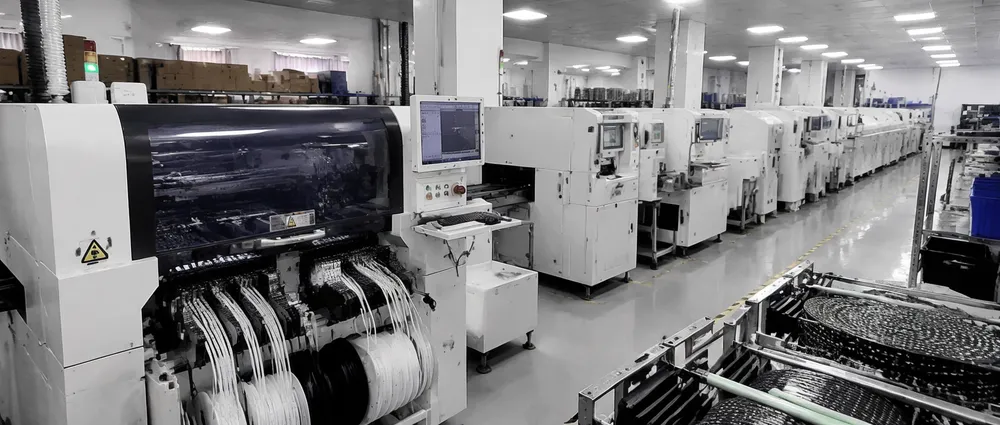
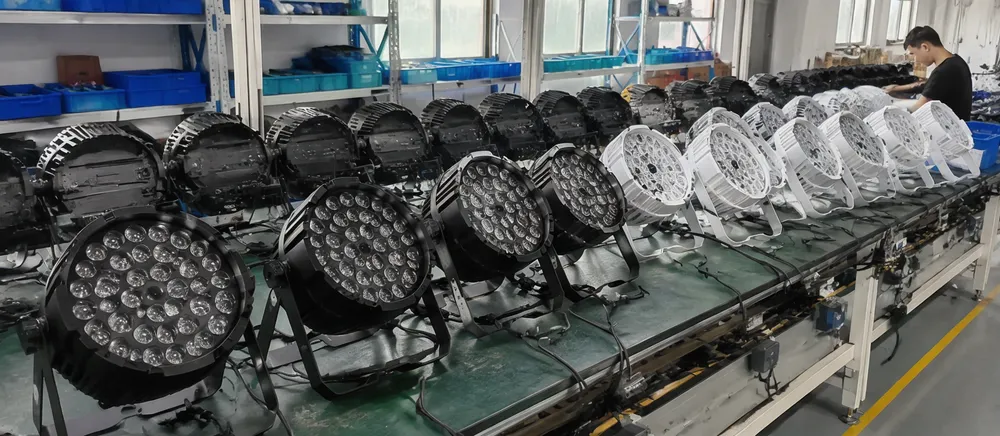
We run par light production on two of our six SMT lines — dedicated capacity that means your par light order doesn't compete for machine time against moving head or beam light production.
LED Mounting
Automated pick-and-place at ±0.05mm positions each LED chip precisely on the aluminum-core PCB. This isn't cosmetic precision — it determines optical alignment with the lens array above.
A chip that's 0.3mm off-center shifts the beam angle by 1-2° and creates visible asymmetry in a multi-fixture wash. Manual mounting can't hold this tolerance across 500 boards in a production run.
Thermal Management
We machine our own heatsink profiles rather than buying off-the-shelf extrusions. A 324W par light running full-output RGBWA+UV generates substantial heat concentrated in a compact housing.
Our heatsink geometry is tuned to the specific thermal load — fin spacing calculated for the airflow path of that particular housing design, not a generic profile that happens to fit. Junction temperature stays below 80°C at sustained full output, which directly protects LED lumen maintenance over the 50,000-hour rated life.
Testing note: We tested three heatsink iterations on the 18×18W model before thermal imaging confirmed adequate cooling at 40°C ambient — the operating reality of an outdoor stage in summer, not the 25°C lab condition some manufacturers spec at.
Driver Circuitry
Constant-current LED drivers designed in-house, matched to the LED forward voltage characteristics of the specific bin we're using.
Power factor correction above 0.95 on all models — relevant for large installs where poor PF creates penalty charges on your client's electrical bill.
Flicker-free output at any dimming level, measured and verified against the IEEE 1789 flicker standard.
Final Assembly & Testing
After soldering and board-level testing, the complete optical assembly (PCB + lens array + housing) goes through beam pattern verification. A calibration rig confirms beam angle, center-point intensity, and color coordinates against the production spec.
48-hour aging test at maximum electrical load
100% functional testing — DMX response across all channels, dimming curve linearity, thermal shutdown behavior
OEM/ODM Customization: Build Your Own Par Light SKU
We don't just sell finished par lights from a fixed catalog. If your market needs a specific configuration, we build it.
What You Can Customize
| Customization Dimension | Options | Impact on MOQ / Lead Time |
|---|---|---|
| LED Configuration | RGBW, RGBWA, RGBWA+UV, single-color white (tunable CCT), pure amber, pure UV | No MOQ change for standard chip types |
| Beam Angle | 15°, 25°, 35°, 45°, or asymmetric options | No MOQ change (lens swap) |
| Housing Color | Standard black, white, or any RAL color | Custom RAL: 100-unit minimum per color |
| Control Protocol | DMX512, Art-Net, sACN, wireless DMX (W-DMX or CRMX compatible), Bluetooth app | Wireless adds component lead time (7-10 days) |
| IP Rating | IP20 (indoor standard), IP54, IP65, IP67 | Higher IP requires different housing tooling |
| Branding | Your logo on housing, lens ring, and rear label; custom firmware boot screen; white-label packaging | From 30-unit MOQ |
| Power Input | 100-240V universal, or region-specific (100-120V / 220-240V) with appropriate plug | No MOQ change |
| Mounting | Standard Omega bracket, floor stand adapter, recessed ceiling mount, custom bracket | Custom bracket: tooling charge applies |
OEM vs. ODM — What's Practical
OEM — Your Brand, Our Existing Design
Take any model from our production range, apply your logo, packaging, and documentation. This is how most new buyers start — test the market with your branding on a proven fixture before investing in custom development.
ODM — Your Specification, Our Engineering
You define the output requirements, beam characteristics, housing style, or control integration — our 15-engineer R&D team develops it into a production-ready fixture.
If you're not sure whether your requirement needs full ODM or just an OEM variant with spec changes, send us the brief. Most requests land somewhere in between — a modified driver board, a different lens array, or an adjusted housing dimension that uses existing tooling with minor CNC program changes.
Send a specification or reference sample — we'll confirm feasibility and quote within 48 hours.
Compliance and Certification: Pre-Qualified for Your Import Markets
Every par light we ship carries documentation for the markets you're selling into.
CE (EMC + LVD)
Full test reports per EN 55015, EN 61547, and EN 60598-1 — your European import clears customs without delays.
FCC Part 15
EMC compliance documentation for US/Canada market entry.
RoHS (2011/65/EU)
Full material declarations — lead-free solder, halogen-free PCB substrates, restricted substance compliance throughout the BOM.
IP65/IP67
Outdoor models: Ingress protection testing per IEC 60529, with test reports available for your project specifications.
Extended Market Certifications
For markets with additional requirements — SAA for Australia, KC for South Korea, PSE for Japan — we've completed these certifications on specific models and can extend them to your OEM variants.
The test lab relationship and baseline documentation are already in place, so adding a market certification to your custom SKU doesn't start from zero.
On-Site EMC Pre-Compliance
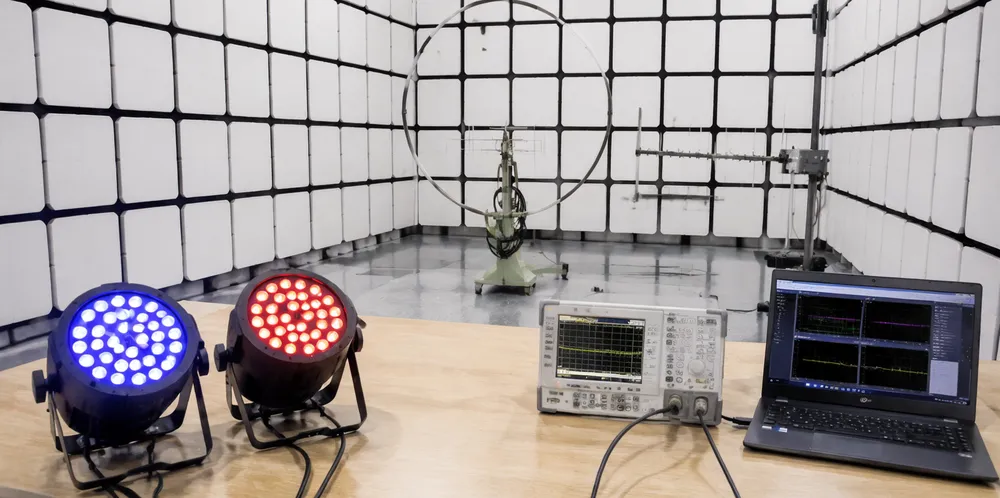
We maintain an EMC pre-compliance chamber on-site to verify new designs before sending them to the accredited lab. This catches most issues in-house, so your custom development doesn't hit surprise certification failures that add months to your launch timeline.
CE failure on a finished product design is expensive — you're paying for the re-test and potentially retooling. Our pre-compliance step eliminates that risk before tooling investment.
Packaging and Container Loading for Par Light Orders
Par lights ship well — compact geometry, stackable, and durable enough for standard export packaging without excessive protection material eating into your container utilization.
Individual Unit Packaging
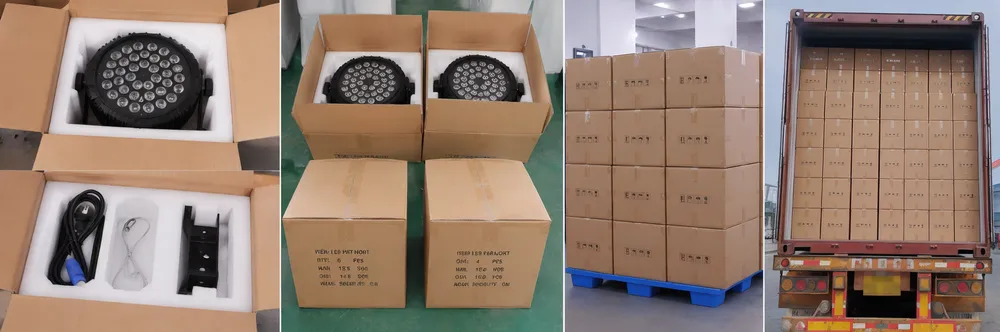
Each fixture in molded foam insert within an inner carton. Foam profiles are cut to the specific model dimensions — not generic padding that allows movement during transit. Power cable, safety cable, and Omega bracket packed in a separate compartment to prevent housing scratches.
Master Carton Configuration
Compact Pars (54×3W)
6 units per master carton
Carton: 580 × 380 × 420mm
Mid-Range / Full-Size Pars
4 units per master carton
Carton: 560 × 380 × 480mm
All master cartons rated for 5-high stacking under container conditions.
Container Loading Estimates
White-Label & Custom Packaging
Your brand on inner cartons, master cartons, foam inserts, and included documentation. Barcode labeling (UPC/EAN) and carton marking formatted to your warehouse receiving system.
If you're shipping direct to Amazon FBA or a 3PL, we format labels and carton dimensions to their intake requirements.
Mixed-Model Containers
Mixed-model containers are common with our buyers — you're not locked into a single SKU per shipment.
We palletize mixed orders with clear carton marking per model, so your warehouse team sorts efficiently on arrival.
Par Lights vs. Other Stage Lighting Fixtures: When to Stock What
If you're building or expanding a stage lighting product line, knowing where par lights sit relative to other fixture types helps you plan your SKU mix and inventory allocation.
| Fixture Type | Primary Function | Typical Order Pattern | Where Par Lights Differ |
|---|---|---|---|
| Par Lights | Flat wash, color fill, architectural | High volume, reorders in multiples | Highest unit volume per order; simplest inventory management |
| Moving Head Stage Lighting | Beam effects, spot projection, aerial patterns | Lower volume, higher unit value | Moving heads are show centerpieces; pars are the foundation beneath them |
| LED Stage Lighting (general) | Broad category covering pars, washes, battens | Varies by sub-type | Par lights are the most versatile single SKU within the LED category |
| Outdoor Stage Lighting | Weather-resistant wash and effects | Seasonal demand spikes | Our IP65 pars bridge both categories — one SKU for indoor/outdoor |
| Concert Stage Lighting | High-output touring fixtures | Project-based bulk orders | Pars fill 60-70% of a typical concert rig by fixture count |
Par Lights
Function: Flat wash, color fill, architectural
Orders: High volume, reorders in multiples
Difference: Highest unit volume per order; simplest inventory management
Moving Head Stage Lighting
Function: Beam effects, spot projection, aerial patterns
Orders: Lower volume, higher unit value
Difference: Moving heads are show centerpieces; pars are the foundation beneath them
LED Stage Lighting (general)
Function: Broad category covering pars, washes, battens
Orders: Varies by sub-type
Difference: Par lights are the most versatile single SKU within the LED category
Outdoor Stage Lighting
Function: Weather-resistant wash and effects
Orders: Seasonal demand spikes
Difference: Our IP65 pars bridge both categories — one SKU for indoor/outdoor
Concert Stage Lighting
Function: High-output touring fixtures
Orders: Project-based bulk orders
Difference: Pars fill 60-70% of a typical concert rig by fixture count
Volume vs. Margin: Where Par Lights Fit Your Business
Par lights are where most distributors generate their highest unit volume. They're the fixture type that every rental house, every church, every AV company, and every event contractor needs in quantity. Your moving heads and beam lights are margin drivers per unit — your par lights are volume drivers that fill containers.
Frequently Asked Questions Par Lights for Commercial Buyers
What IP rating do I need for par lights used at outdoor festivals and events?
IP65 minimum for any fixture exposed to weather. IP65 means full dust-tight sealing plus protection against water jets from any direction — enough for rain exposure during outdoor events. Our IP65 outdoor pars use silicone gasket sealing at every housing joint, sealed cable glands, and hydrophobic-coated lens faces.
If your fixtures need to survive sustained submersion (ground-recessed wash applications or fountain lighting), you need IP67 — we produce those as well, with potted driver assemblies and welded housing seams.
How many DMX channels do your par lights use, and can I customize the channel layout?
Standard channel modes range from 4-channel (RGBW direct) up to 12-channel (RGBWA+UV with individual dimmer, strobe, and macro channels).
For OEM orders, we can program custom DMX personality profiles to match your existing console presets or your downstream customers' preferred channel layouts. This is a firmware adjustment with no additional hardware cost — just specify the channel map with your order.
What's the actual color consistency unit-to-unit across a 500-piece par light order?
We bin incoming LEDs to ±100K CCT and ≤2 SDCM (Standard Deviation of Color Matching) before mounting.
In practical terms: line up 24 fixtures from anywhere in your 500-unit batch on a truss, set them all to the same DMX value, and you won't see visible color difference at audience distance.
We verify this with integrating sphere measurements on a sample from each production lot — measurement reports available with your shipment documentation if your customers require them.
Can I get warm-white-only par lights with tunable CCT for architectural installs?
Yes. We produce tunable white pars with 2700K–6500K range using dedicated warm and cool white LED arrays (not RGBW color-mixed white, which looks different on camera). CRI 95+ on the tunable white models.
These sell well into hotel, restaurant, and museum install projects where color rendering and camera-friendly flicker-free output are the specification priorities. MOQ is the same as our standard color-mixing pars.
What's the lead time from order confirmation to shipment?
- Standard models from our production range: 20–25 days for orders up to 1,000 units.
- OEM branding variants (existing model, your logo and packaging): 25–30 days including packaging artwork confirmation.
- Full ODM custom development: add 30–45 days for engineering development and sample approval before the production lead time starts.
We hold component inventory for our standard par light range, so lead times don't spike on reorders — your second order often ships faster than your first.
Do your par lights work with wireless DMX systems?
We offer built-in wireless DMX receiver options — compatible with W-DMX (Wireless Solution), CRMX (LumenRadio), or our own 2.4GHz wireless protocol depending on your market's standard. Wireless adds a receiver module to the internal PCB assembly.
If your rental clients use a mix of wireless systems, we can also build with a standard 5-pin DMX input so they connect their own brand-specific wireless receiver externally. Specify your preference at order time.
Start Your Par Light Order
You've read the specs, you understand the production process, and you know the customization range. The next step is straightforward: tell us what you need, and we'll respond with pricing, lead time, and sample availability within 48 hours.
Most buyers start with a 30–50 unit trial order to verify build quality and test market response, then scale to container quantities on reorder. We support that approach — low MOQ on the first run, competitive volume pricing when you're ready to scale.
What to Include in Your Inquiry
-
Target model(s) and quantity
-
Any customization requirements (LED config, housing color, branding, beam angle)
-
Your destination market (so we include the right certification documentation)
-
Whether you need samples before committing to production quantity