
Brazil's Evangelical Lighting Demand — Why Sourcing Is Getting Harder
Brazil's evangelical community has crossed 60 million people and continues expanding. New church constructions, sanctuary renovations, and multi-campus expansions are generating steady demand for professional stage lighting equipment — and the local supply chain is struggling to keep pace.
The growth segment is mid-size venues seating 200 to 1,500 people. These churches need real stage lighting — LED wash fixtures, focused spotlights for the pastor, moving heads for worship sets, color-accurate front light for livestream cameras — but they don't carry megachurch budgets. They need professional-grade evangelical church lighting equipment at landed costs that leave room for the rest of the AV build.
Here's where it gets complicated. Brazil's dual-voltage power grid runs 127V in São Paulo, Rio de Janeiro, and much of the northeast, while Brasília, the southern states, and parts of Minas Gerais use 220V. Generic imported fixtures often arrive configured for a single voltage. Plug a 220V-only fixture into a 127V outlet and you get dim, flickering output. Reverse that mismatch and you get burned drivers. Every church stage lighting supplier serving Brazil needs to answer the voltage question before anything else.
Local distributor inventory for church-specific fixtures — silent cooling for worship environments, warm-white wash for camera-friendly sermon lighting, narrow-beam spots for stage isolation — is thin. Most local AV suppliers stock event and concert gear, then try to sell it into churches. The mismatch shows up in noise complaints, bad color temperatures on livestream, and overpowered fixtures washing out intimate sanctuary spaces.
This article maps 10 real suppliers across four sourcing models — local manufacturers, distributors, international brands, and factory-direct import — so you can make a sourcing decision based on your actual church size, budget, and procurement timeline.
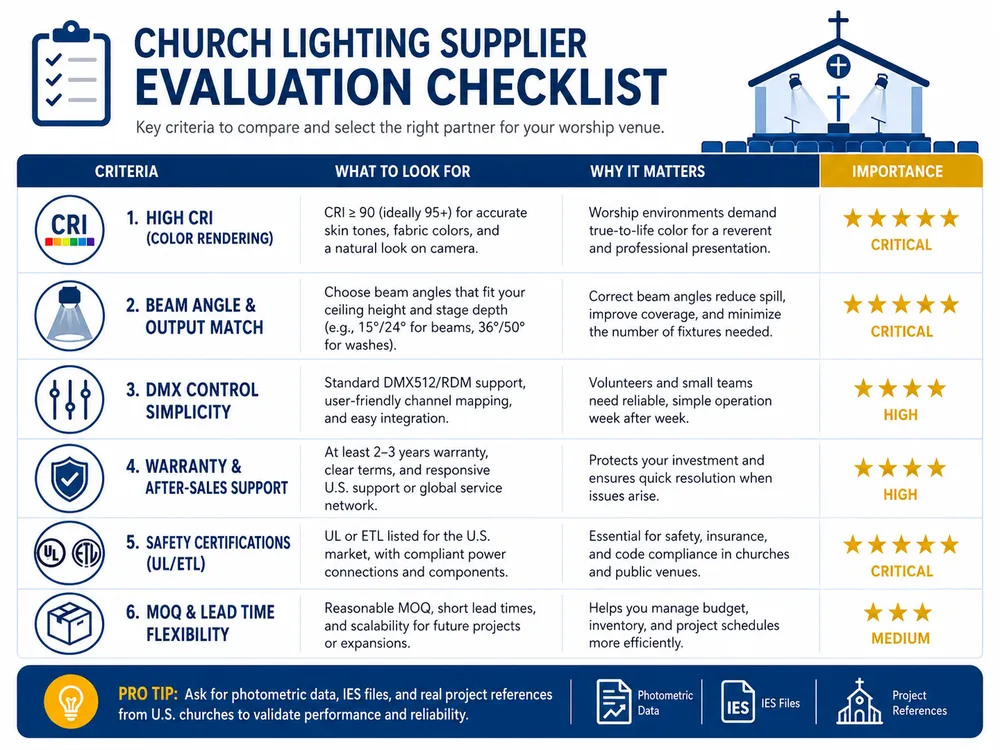
Evaluation Criteria for Church Lighting Suppliers in Brazil
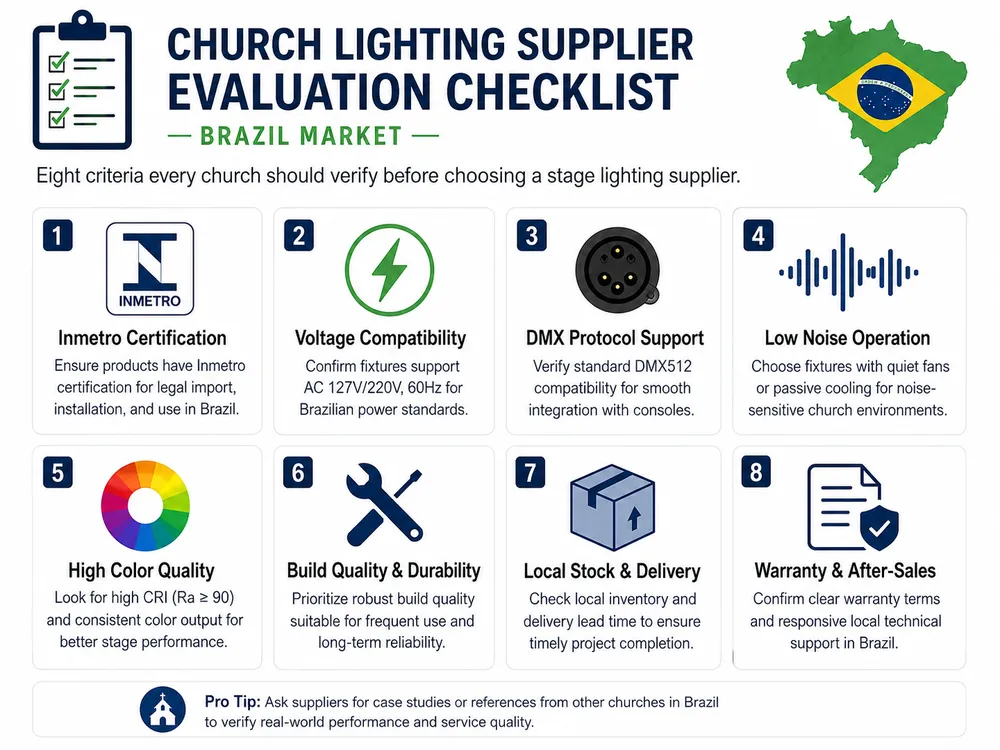
Before comparing individual companies, you need a framework. The criteria below separate suppliers who understand church applications from those just selling generic event gear into the worship market. Use this as a checklist when evaluating any church stage lighting supplier in Brazil — whether local or imported.
Inmetro compliance. Electrical equipment sold commercially in Brazil requires Inmetro certification. Ask any supplier for their certificate number or the registered number on the product label. If they can't produce it, you're taking on compliance risk — especially if your church is part of a denomination with institutional procurement policies. (Many smaller importers skip this step. The fixture works, but you have no legal cover if there's an electrical incident.)
Voltage range. Confirm whether fixtures operate on 127V, 220V, or both. Universal-input power supplies (100–240V auto-sensing) are the safest option for churches that may relocate equipment between campuses in different voltage regions. Single-voltage fixtures are cheaper but lock you to one grid standard.
DMX512 and sACN protocol support. If your tech team runs ProPresenter, EasyWorship, or a standalone DMX console, every fixture must respond to the same control protocol. Ask for confirmed DMX512 compliance and check whether sACN (streaming ACN over Ethernet) is supported for larger installations with network-based control. Protocol mismatch is one of the most common post-installation frustrations we see in church LED stage lights Brazil deployments — fixtures that "support DMX" but address incorrectly or drop frames under heavy scene changes.
Noise level. Worship environments are not concerts. A 200-seat sanctuary with spoken-word sermons, quiet prayer moments, and acoustic worship sets demands fixtures under 30dB. Forced-air fans on concert-grade moving heads can hit 40–50dB — audible from the first three rows. Specify convection-cooled or fan-silent modes for any fixture mounted within 10 meters of the congregation. This is the single most overlooked spec in iluminação de palco para igrejas — lighting that sounds like a computer server room ruins the worship experience.
Color temperature accuracy and CRI. Livestream cameras are unforgiving. If your front wash runs below CRI 90, skin tones go muddy on camera. If color temperature drifts between fixtures (some reading 3400K, others 3800K), your video team spends hours in post correcting it. Ask for measured CCT and CRI data, not just catalog claims. Consistent LED church stage lighting starts with consistent LED binning at the factory level.
After-sales and spare parts access. LED drivers fail. Power supplies burn out after voltage surges. Ask whether your supplier stocks replacement drivers in-country or whether you're waiting 45 days for a shipment from overseas. For churches running 3–5 services per week, a dead fixture that stays dead for six weeks means renting a replacement or leaving a dark spot on stage.
Minimum order flexibility. Churches buy 10–50 fixtures for a typical upgrade. If a supplier's minimum is 100 or 200 units, they're an event rental supplier, not a church partner. Confirm MOQ before requesting a quote.
Import documentation support. For factory-direct purchases, does the supplier provide commercial invoices with correct NCM tariff codes (typically 9405.42 for LED luminaires), packing lists formatted for Brazilian customs clearance, and CE/RoHS documentation that supports Inmetro registration applications?

Local Brazilian Suppliers — Distributors, Integrators, and National Brands
The Brazilian church stage lighting market is served by three distinct supplier models. Understanding which type you're dealing with tells you more about pricing, lead times, and product depth than any brand name alone. These are the fornecedores de iluminação cênica igreja that most buyers encounter first.
National Manufacturers and Assemblers
Arclite Iluminação Cênica (arclite.com.br) manufactures stage wash lights and LED PAR fixtures domestically with Inmetro-registered products. Their strength is that everything ships from Brazilian soil — no customs delays, no import duty surprises, and warranty service happens locally. The product range is narrower than what you'll find from importers, focusing on wash and PAR fixtures rather than full-system solutions including moving heads and effects. Best fit for smaller churches that need basic stage wash and front fill without the complexity of imported gear.
PLS Professional Light & Sound (plspro.com.br) is one of Brazil's more established domestic manufacturers of LED PARs, moving heads, and DMX controllers. PLS has a meaningful installed base in evangelical churches across the southeast region. Their products are designed for Brazilian voltage standards from the start, eliminating compatibility questions. Product development cycles are slower than you'd see from Chinese OEMs — the catalog updates less frequently — but what they ship is field-proven in Brazilian worship environments. Best fit for churches wanting a domestic brand with local tech support and a track record in the worship segment.
Distributors and Importers
Audiolux Iluminação Profissional (audiolux.com.br) operates out of São Paulo as a professional AV distributor serving churches, theatres, and event venues. They carry multiple imported fixture brands and can provide system design consultation — not just product sales. For churches without in-house AV expertise, the design support adds genuine value. The trade-off is pricing: distributor margins plus import costs mean you're paying a premium over factory-direct for the same fixture specifications.
LedTec Iluminação (ledtec.com.br) specializes in LED stage and architectural lighting, supplying churches across southern Brazil. Their focus on LED specifically means deeper product knowledge in that category — they can advise on CRI requirements for video, beam angles for different sanctuary geometries, and dimming protocols. Coverage is strongest in the south (Paraná, Santa Catarina, Rio Grande do Sul), more limited in the northeast.
Hayonik (hayonik.com.br) imports and brands stage lighting and DJ equipment under their own label, distributing through a dealer network covering most of Brazil. The Hayonik brand has broad penetration in churches through its competitive pricing at the entry and mid-tier level. The product comes from Chinese factories (as do most global lighting brands at this price point) but arrives with Brazilian-market warranty and local spare parts availability. Best fit for churches needing quick access to affordable fixtures through a familiar purchasing channel.
Music Pro Áudio e Iluminação (musicpro.com.br) is a multi-branch retail and wholesale operation carrying both imported and national lighting brands. Churches with wholesale accounts can access volume pricing, and the multi-branch presence means physical product inspection before purchase — relevant when you're standardizing across a fixture type. Their church-specific product knowledge varies by branch and staff experience.
Project-Based Integrators
Skypix Iluminação (skypix.com.br) operates as a project-based supplier specializing in church and theatre installations across São Paulo and Minas Gerais. They sell fixtures as part of turnkey packages including system design, rigging, wiring, DMX programming, and commissioning. Per-unit fixture cost is higher than buying direct from a distributor because you're paying for design and installation labor rolled into the package. The value proposition is clear for churches without AV volunteer teams — you get a working system, not a pile of boxes. Less relevant for churches that already have capable tech teams.
Croma Efeto Visual (cromaefeto.com.br) supplies LED wash lights, moving heads, and effects for evangelical venues, combining product sales with installation services. They serve the mid-market: churches large enough to need professional-grade fixtures but small enough that they don't have dedicated AV departments. Similar model to Skypix — the convenience premium is justified when you need someone else to do the system design and hanging.
What Local Suppliers Do Well
Be honest about the advantages: local church stage lighting suppliers in Brazil offer faster emergency replacement, communication in Portuguese during business hours, physical showrooms where you can evaluate beam quality in person, and warranty service without international shipping. For urgent single-fixture replacements or churches with zero import experience, local supply is the practical choice.
The limitation across all local models: product range is constrained to what's already been imported and certified. If you need specific beam angles, custom color temperature profiles, or fixtures configured for your particular sanctuary geometry, you're limited to what's in stock or in the current catalog. Custom work means a factory relationship.
International Brands with Brazilian Presence
Chauvet (chauvet.com) represents the dominant international brand model in the Brazilian church LED stage lights market. As a US-headquartered manufacturer with authorized distributors in Brazil, Chauvet offers a catalog of professional stage lighting fixtures with global brand recognition, extensive documentation, and well-established DMX profiles for common lighting consoles.
The premium is real: expect 2–3× the per-unit cost of equivalent-specification Chinese-manufactured fixtures when purchasing Chauvet through Brazilian distributors. That price includes the brand's established R&D investment, global support infrastructure, and the local distributor's margin on top. For megachurches with institutional procurement committees, brand recognition can simplify the approval process — specifying "Chauvet" in a purchase request requires less justification than explaining a lesser-known manufacturer.
For the growing segment of mid-size evangelical venues (200–800 seats) where professional stage lighting for mega churches in Brazil isn't the relevant benchmark and budget constraints are real, the international brand premium often exceeds what the procurement committee can justify. The fixture performs identically to a factory-direct equivalent — the same LED chips, similar optical design, comparable build quality — but the landed cost difference funds additional fixtures, DMX controllers, or rigging hardware.
Worth noting: Chauvet's authorized Brazilian distributors typically carry a fraction of the full international product catalog. Church-specific SKUs (worship-optimized color profiles, ultra-silent fixtures, narrow-beam pastor spots) may not be available locally through the brand's distribution network even when they exist in the global lineup.
The Convenience Premium — What Local Sourcing Actually Costs
Every layer between the factory and your church adds cost. Understanding the actual markup chain helps you decide where convenience is worth paying for and where it's compressing your project budget unnecessarily.
A typical cost chain for wholesale church lighting equipment in Brazil through import:
- Factory FOB price: base manufacturing cost (e.g., $120 for a quality 18×10W RGBW LED PAR)
- Ocean freight + insurance: $8–15 per fixture in a consolidated shipment to Santos
- Import duty (II): approximately 18% on NCM 9405.42 (LED luminaires)
- ICMS: varies by state — 7% for intra-state in São Paulo, up to 18% for interstate transactions
- PIS/COFINS: combined ~9.25% on the CIF + duty value
- Distributor margin: 30–60% markup over their landed cost
- Integrator markup (if project-based): additional 20–40% for design and installation services
The result: that $120 FOB fixture can land on your church stage at $350–$500 when purchased through a local distributor, or $450–$650 through a project integrator. The convenience layers nearly triple the factory price.
When the premium makes sense: you need one replacement fixture this week; the church has no member with import experience; the project includes system design you can't do in-house; the order is small enough (under 10 fixtures) that import logistics overhead exceeds the savings.
When the premium compresses your budget unnecessarily: you're upgrading a sanctuary with 20–50 fixtures; you're standardizing fixture types across a multi-campus organization; your AV team is technically capable and only needs the hardware; you're planning repeat procurement over 2–3 years as the church grows.
The question isn't whether local suppliers charge too much — they carry real costs and provide real convenience. The question is whether your specific situation justifies the convenience premium or whether a different sourcing model gives you more fixtures, better specifications, or deeper reserves for the same budget.
Factory-Direct Import as a Strategic Alternative
GDMonkey enters this list as the factory-direct alternative — not a local supplier and not positioning as one. We're a Chinese manufacturer with 12 years of stage lighting production shipping CIF to Santos and Paranaguá for Brazilian church projects. The sourcing model is different, and the trade-offs are different.
The economics: factory-direct eliminates the distributor and integrator margin layers described above. You're purchasing at factory pricing plus freight, with import duties and taxes as the only markups beyond our invoice. For a 30-fixture sanctuary upgrade, the per-unit savings typically fund an additional 8–12 fixtures at the same total project budget — or let you spec higher-quality optics and build quality without exceeding the original ceiling.
Voltage compatibility: we produce church stage lighting fixtures with universal-input power supplies (100–240V, 50/60Hz auto-sensing) as standard for Brazilian orders. No voltage mismatch risk, no field modifications, no separate SKUs for São Paulo versus Brasília installations.
Worship-appropriate noise levels: our LED PAR and wash fixtures use passive convection cooling rather than forced-air fans — measured at <25dB during operation. Moving heads use low-RPM fans with PWM speed control that ramp down during static scenes. We've shipped over 200 church projects globally, and noise complaints are the #1 issue we hear about from churches that bought event-grade gear designed for concert venues. (Our R&D team actually tests fixture noise with a calibrated SPL meter at 1 meter distance in our semi-anechoic chamber — the published spec matches the real-world reading.)
DMX512 and sACN: confirmed compatibility with DMX512 on all fixtures, with sACN available on our network-enabled moving heads and wash bars. ProPresenter, EasyWorship, Lightkey, and standard DMX consoles all address our fixtures correctly — we maintain a fixture library for GDTF/MVR integration.
OEM/ODM from 30 units: realistic for a single mid-size church upgrade. You can brand fixtures with your ministry name, specify custom default color temperature (we see many Brazilian churches requesting 3200K warm white as the default power-on state), and configure DMX channel layouts to match your console programming.
Import documentation for Brazilian customs: commercial invoices formatted with correct NCM codes (9405.42.10 for fixed LED luminaires, 9405.42.90 for other LED fixtures), detailed packing lists with individual carton dimensions and weights for cargo manifest filing, and CE/RoHS/FCC test reports that support your Inmetro registration application. We've shipped enough containers to Brazil to know what your despachante aduaneiro needs — the paperwork arrives clean.
Portuguese-language technical documentation: user manuals, DMX channel maps, and wiring diagrams available in Portuguese. Your volunteer tech team doesn't need to translate spec sheets.
For affordable LED moving heads for Brazilian churches in the 150W–300W range, factory-direct pricing typically comes in at 40–55% below what the same specification costs through a local distributor. The trade-off: you wait 25–35 days for production and shipping instead of buying from stock. For planned upgrades (not emergency replacements), that timeline is acceptable.
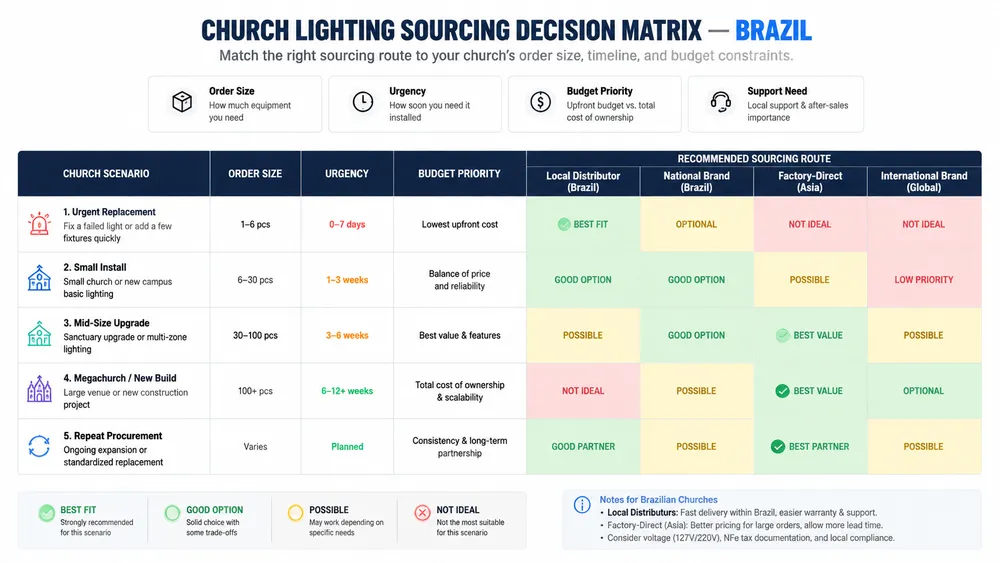
Sourcing Decision Matrix — Which Route Fits Your Church
No single sourcing model works for every situation. The right choice depends on order size, urgency, budget sensitivity, and your team's technical capability. Here's how to match the best church stage lighting suppliers in São Paulo and beyond to your actual scenario:
| Scenario | Recommended Route | Best-Fit Suppliers | Why |
|---|---|---|---|
| Urgent single-fixture replacement | Local distributor | Hayonik, Music Pro | In-stock availability, same-week delivery, no import wait |
| Small church first install (5–15 fixtures) | National brand / marketplace | PLS, Arclite | Pre-certified for Brazil, simple procurement, no customs process |
| Mid-size sanctuary upgrade (20–50 fixtures) | Factory-direct import | GDMonkey | Best unit economics, custom configuration, voltage-matched from factory |
| Megachurch institutional procurement | International brand or factory-direct OEM | Chauvet, GDMonkey | Brand approval compliance or custom branding with institutional-grade documentation |
| Multi-campus / repeat procurement | Factory-direct with annual agreement | GDMonkey | Volume pricing, consistent SKUs across campuses, predictable delivery schedule |
For the urgent replacement buyer: keep a relationship with Hayonik or Music Pro for emergency stock access. One fixture failure before Sunday service is not the time for a 30-day import process. Local supply exists to solve this exact problem — pay the premium willingly for genuine urgency.
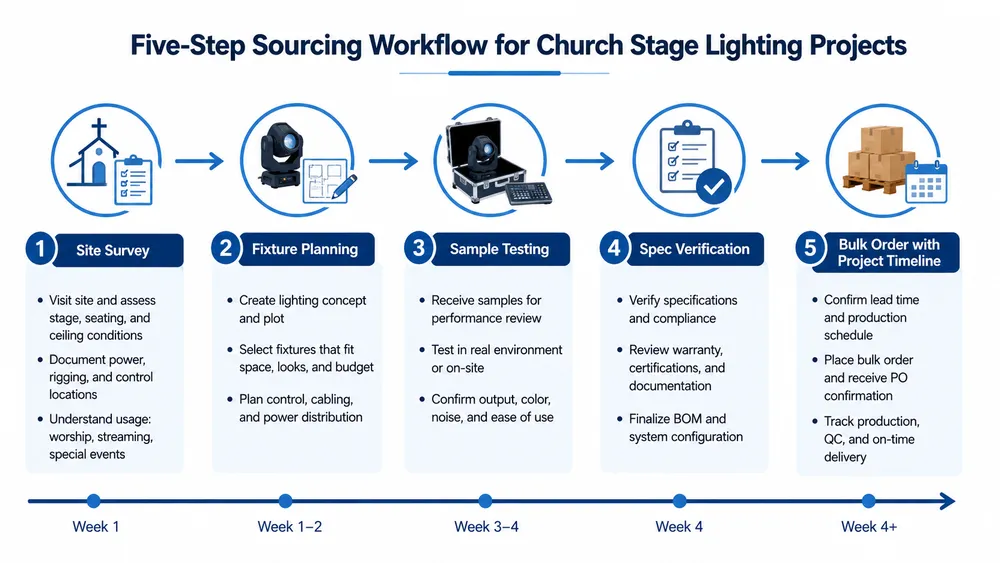
For the planned upgrade buyer: if you're specifying 20+ fixtures for a sanctuary renovation with a 60–90 day project timeline, factory-direct changes your budget math entirely. Request a factory-direct quote with your venue dimensions, ceiling height, and desired fixture types — CIF pricing to your nearest port arrives within 48 hours, giving you a concrete comparison against local quotes.
For the multi-campus organization: standardizing evangelical church lighting equipment across locations means consistent appearance on camera, interchangeable spare inventory, and simplified volunteer training. Factory-direct with an annual supply agreement locks in pricing and ensures identical fixtures ship to each campus as expansions happen.
The sourcing landscape isn't about which supplier is "best" in absolute terms. It's about which model fits where you are right now — and knowing when to switch models as your needs change.