
Why church projects keep catching integrators off guard
You've done concert installs. You've wired corporate boardrooms. Then a 400-seat Baptist church in suburban Texas calls with a $35,000 budget and a building committee that meets once a month, and suddenly nothing in your workflow applies cleanly.
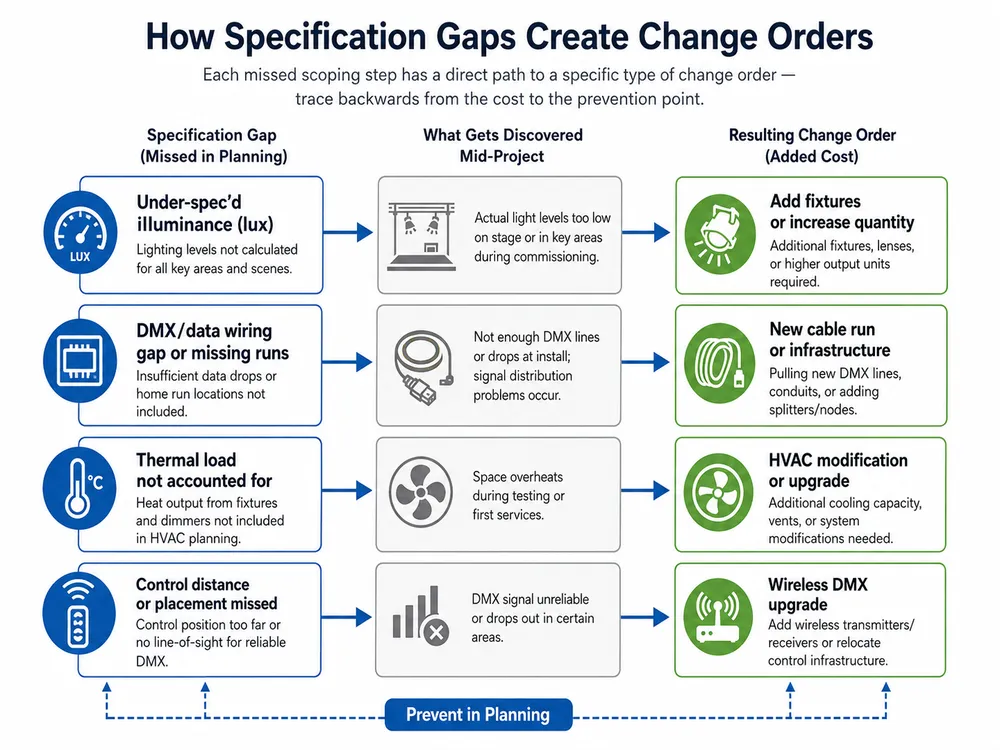
Church stage lighting guides written for end-user congregations won't help you here. The constraints are different at every level: volunteer operators who rotate every quarter, fixed architectural ceilings with no fly system, donation-funded budgets that can't absorb a change order, and livestream cameras running at the same time as in-room worship. Spec the wrong fixtures and you'll end up with a rig that overheats behind a closed soffit, or a DMX system so deep that the church's volunteer team stops touching half the channels within six months.
This article walks through the sourcing workflow from a church lighting system integrator's perspective — fixture categories, ceiling and rigging realities, the step-by-step path from site survey to bulk order, and the channel decision between distributor stock and manufacturer-direct purchasing.
Fixture categories that matter for house of worship lighting design
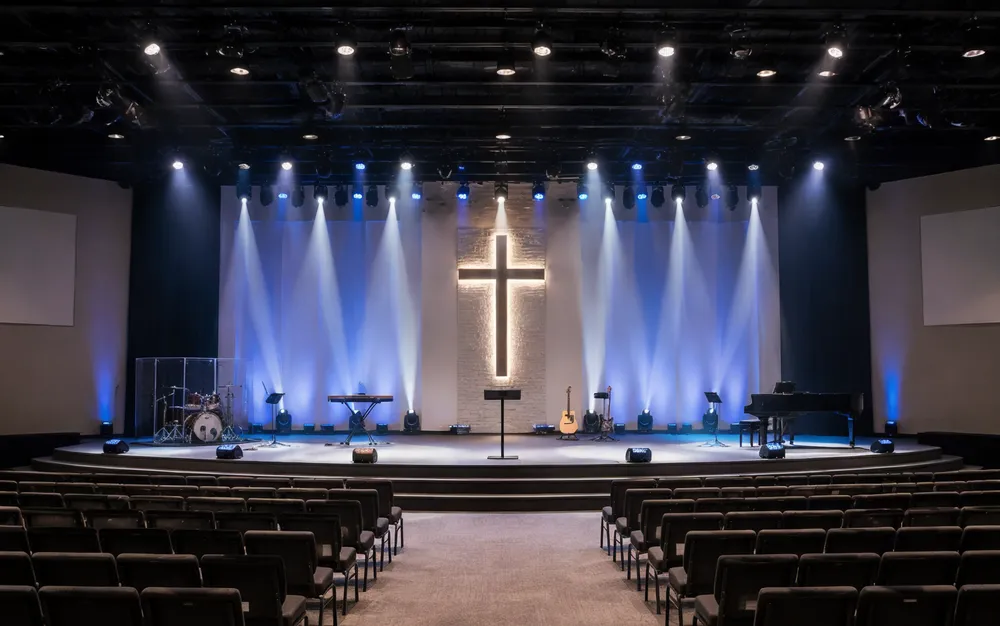
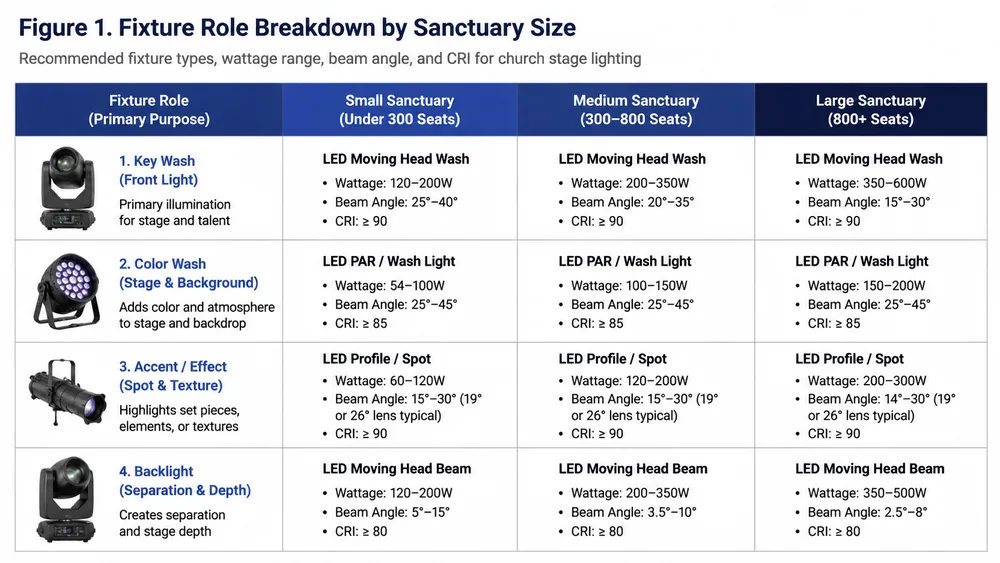
Not every fixture category earns its rigging weight in a sanctuary. We've shipped church stage LED fixtures into 200+ worship projects across North America, Brazil, and Nigeria, and the installations that hold up long-term almost always fill four functional roles — no more, no less.
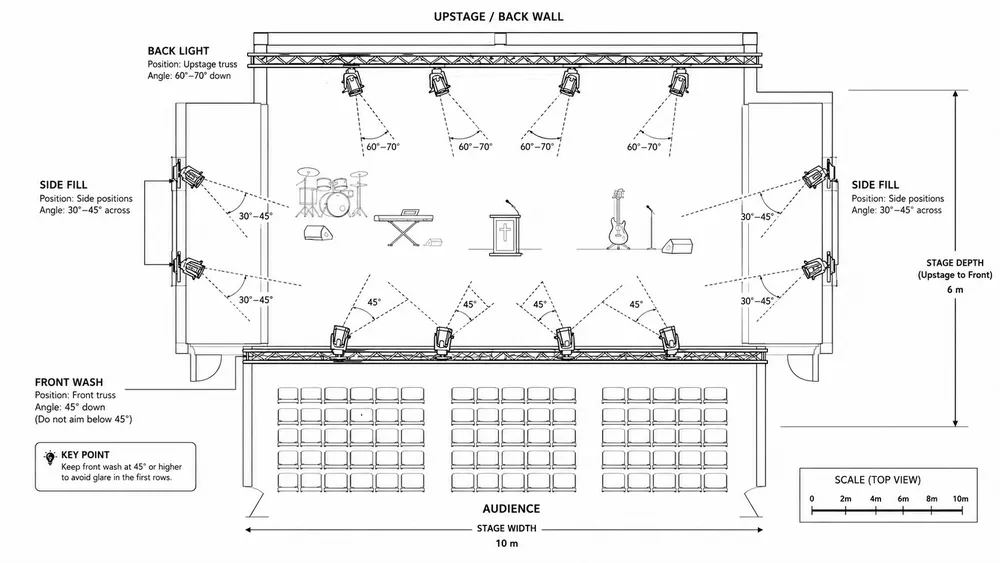
Key/front wash — LED pars or Fresnels. These carry 80% of the visual workload during a service. The specs that matter: lumen output per fixture, beam angle (typically 25°–45° depending on throw distance), CRI 90+ for camera-friendly skin tones, and tunable white capability in the 3000K–5600K range. Tunable white is non-negotiable for worship because you need to match house lights during service transitions without a hard color shift on the livestream feed.
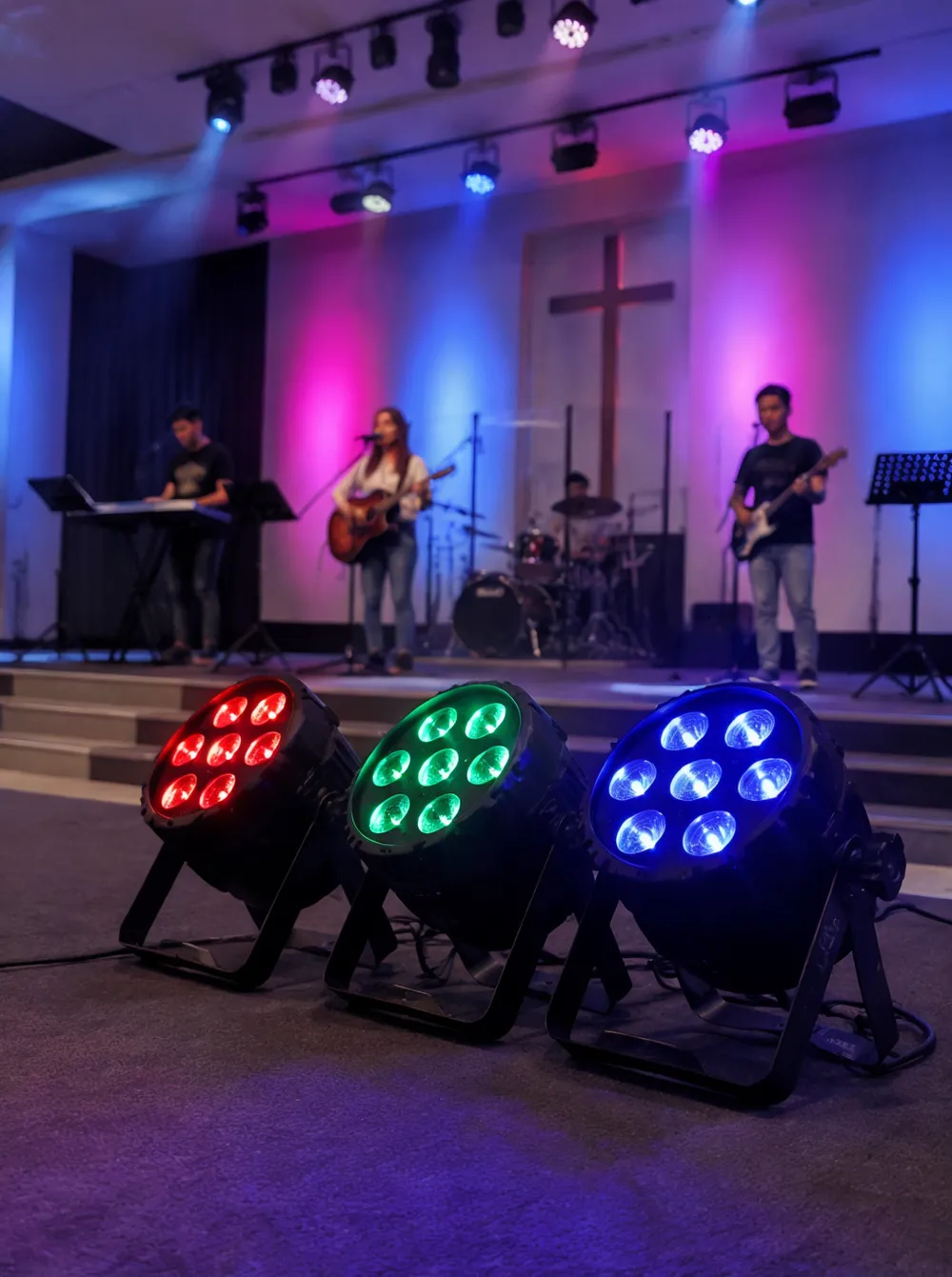
Color wash — RGBW LED pars or battens. Used for song sets, seasonal themes, and mood transitions. Here you care about color mixing smoothness (no visible color shadows at short throw), dimming curve quality (smooth fade to black without stepping), and wattage-to-coverage ratio. Most 300-seat sanctuaries need 8–12 color wash units across two battens.
Accent/effect — Moving heads, spot or beam. This is where integrators over-spec most often. A 200W LED moving head covers the vast majority of 500-seat sanctuaries with room to spare. Specifying 300W+ concert-grade units adds fixture weight (12–18 kg versus 8–12 kg), more heat output at the ceiling, higher noise floor from cooling fans, and cost your client doesn't need. (We see this pattern constantly — integrators pulling from concert rental inventory lists instead of sizing to the room.)
Backlight/silhouette — LED strips or profile spots. These separate the speaker from the background on camera. Lower wattage, tighter beam control, and warm white or amber options. Often the cheapest fixtures in the rig but the most visible on livestream.
For each role, pull these specs from the data sheet before you specify anything: lumen output, beam angle range, CRI/TLCI, CCT range (fixed vs tunable), DMX channel modes, fixture weight with clamp, and rated ambient operating temperature. That last one matters more in churches than in concert rigs because of ceiling constraints — which brings us to the next section.
Browse the full Church Stage Lighting category for fixture specs segmented by worship application.
Ceiling height and rigging load — the specs that kill projects
Most worship spaces have fixed architectural ceilings. No fly system, no motorized battens, no road crew to re-rig between services. The ceiling structure you see during the site survey is what you're working with for the next 10–15 years.
Ceiling height tiers and what they mean for fixture selection:
| Sanctuary type | Typical ceiling height | Throw distance to stage | Fixture implication |
|---|---|---|---|
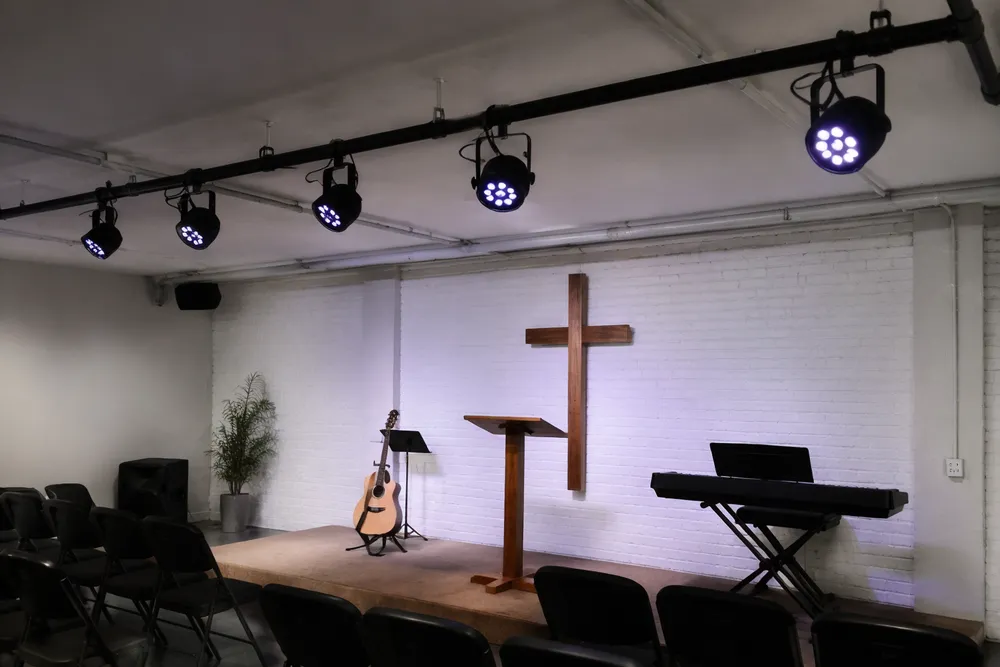
| Small chapel | 4–6 m | 3–5 m | Wider beam angles (40°+), lower wattage (60–100W pars), fixture body visible to congregation |
| Mid-size sanctuary | 6–10 m | 5–8 m | Standard beam angles (25°–40°), medium wattage (100–200W), moderate heat management needed |
| Large auditorium | 10–15 m | 8–12 m | Narrower beams (15°–25°), higher wattage (200–300W), weight becomes the constraint |
Lower ceilings trap more heat at fixture level, require wider beam angles for coverage, and make fixture bodies visible to the congregation — so aesthetics matter in a way they don't for truss-mounted concert rigs.
Rigging load reality: Typical church ceiling structures support 15–30 kg per linear meter on pipe or truss battens. A 200W LED moving head weighs 10–15 kg with clamp and safety cable. Before ordering, calculate total rig weight per batten position and confirm with a structural engineer — especially in older buildings where the ceiling was designed for speakers and banners, not lighting rigs.
Thermal management in enclosed ceilings: When fixtures mount above a false ceiling or inside a soffit with limited airflow, ambient temperature at fixture level can exceed 35°C. LED driver life degrades above that threshold. Passive aluminum heat sinks handle most open-ceiling installs, but enclosed environments may need lower-wattage fixtures, forced-air pathways, or fixtures rated for higher ambient operation (check the data sheet for "Ta max" — if it says 40°C or 45°C, you have more margin for enclosed mounting).
The sourcing mistake here: specifying fixtures by output alone without confirming throw distance. A 150W LED par at 5m throw delivers similar stage-level lux to a 300W par at 12m throw. The difference? Weight, cost, heat load on your rigging, and fan noise that a 300-seat chapel will actually hear during a quiet prayer.
Sourcing workflow — site survey to bulk order
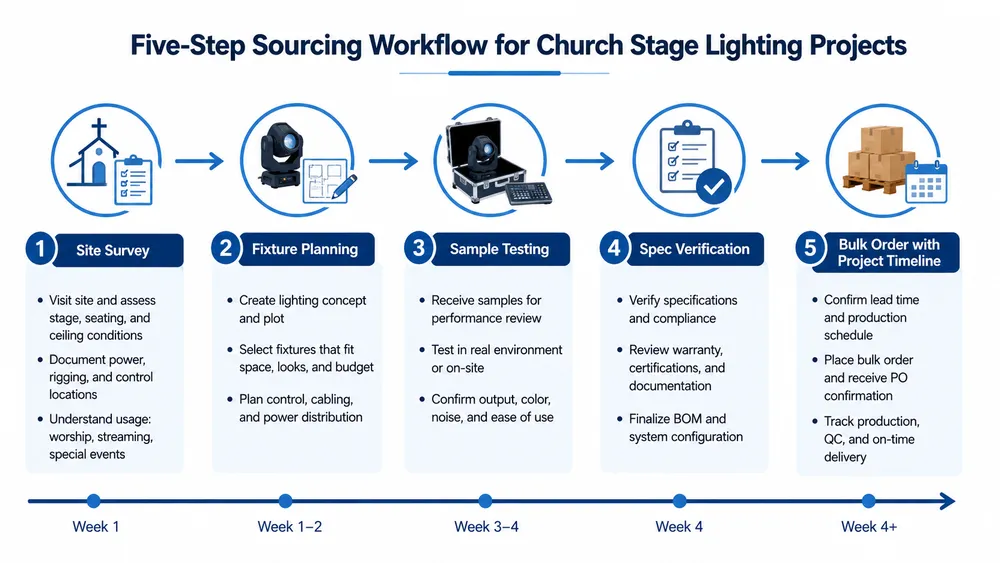
This church stage lighting sourcing checklist breaks the purchasing process into five steps. Every step has a deliverable that protects your margin and prevents callbacks.
Step 1: Site survey data collection
Collect before you open a single manufacturer catalog:
- Sanctuary dimensions (L × W × ceiling height at stage, at seating, at rear)
- Ceiling structure type (exposed steel, drywall soffit, wood beam, concrete)
- Existing electrical capacity — amps per circuit, number of available circuits, panel location
- Current fixture positions and cable run paths
- Livestream camera positions, lens focal lengths, and current white balance settings
- HVAC vent locations relative to planned fixture positions
Step 2: Fixture quantity planning
Calculate positions per role based on stage width and coverage angle. Rule of thumb for front wash: one LED par per 1.5–2m of stage width at a 5m throw distance with 30% beam overlap between adjacent fixtures. A 10m-wide stage at 5m throw with 40° beam angle pars needs roughly 6–8 units for even key light coverage.
For color wash, plan one fixture per 1.5m of batten length. For moving heads, 2–4 units cover most sanctuaries under 800 seats — resist the impulse to spec more.
Step 3: Sample testing
Request 2–3 sample fixtures per category from your shortlisted manufacturer. Bench-test for:
- Measured lumen output versus data sheet claims
- Color temperature consistency across sample units (measure with a spectrometer, not your eyes)
- DMX compatibility with the church's existing console or your planned console
- Fan noise at full output — measure at 2m distance in a quiet room
- Dimming curve smoothness from 100% to 0%
(We run a 48-hour aging test on every unit before shipment, but I still recommend bench-testing your samples independently. It confirms performance under your specific power conditions and gives you documented baseline data for the client handoff.)
Step 4: Spec sheet verification
Before committing to the bulk order, verify that the factory can provide:
- Photometric data files (IES format) for your lighting design software
- Thermal test reports showing junction temperature at rated ambient
- Safety certifications matching the installation jurisdiction — CE for general export, UL/ETL if the church's insurance carrier requires it for North American installs
- EMC compliance documentation (FCC Part 15 for US installations)
If the manufacturer can't provide IES files or thermal data on request, that's a signal. You can request a project quote with your fixture list and ask for engineering documentation as part of the quotation package — any factory that actually runs their own testing lab will send this without hesitation.
Step 5: Bulk order with project timeline
Align lead time with your install schedule:
- Standard models (catalog SKUs): 2–4 weeks production
- Custom color temperature bins or OEM branding: 4–6 weeks production
- Sea freight to North America: 3–5 weeks
- Air freight: 7–10 days
Plan to receive fixtures at least 2 weeks before install date. That buffer gives you time to pre-program DMX addresses, verify consistency across the batch, and catch any shipping damage before you're on-site with a crew.
MOQ reality for project purchasing: You're buying 20–80 fixtures per order, not container loads. Confirm that your manufacturer supports project-quantity MOQs — we start at 30 units per SKU for standard models, which fits most mid-size sanctuary projects in a single order.

Manufacturer-direct vs. distributor — cost and control trade-offs for church stage LED fixtures
Both channels serve a purpose. The question is which one fits your project economics.
Distributor channel: Local stock ships in 2–5 days. Returns are straightforward. But you're limited to catalog SKUs with fixed color temperatures and standard configurations. Typical distributor markup runs 30–50% over factory price, and you won't get photometric files or thermal test data unless you specifically chase them down. For a church lighting system integrator doing repeat installs, that markup compounds across every project.
Manufacturer-direct channel: Longer lead time (2–6 weeks door-to-door depending on shipping mode), but you get access to engineering data — IES files, thermal reports, EMC test certificates — as part of the quotation process. You also unlock custom color temperature bins (useful when a church's existing house lights are an unusual CCT and you need front wash to match), OEM branding on fixtures if you're building your own installation brand, and lower unit cost at project volumes.
When to use each:
- Distributor: emergency replacements, small add-on orders under 10 units, or when the church needs a fixture next week and can't wait for production.
- Manufacturer-direct: planned projects over 20 units where you need specific specs, documentation for the church's insurance or building code review, or custom CCT matching.
The practical hybrid approach: maintain a distributor account for service and warranty replacement stock, but source your initial project orders direct from factory. That structure maximizes your project margin while keeping service response fast for post-install support.
What integrators get wrong in worship lighting — and where it costs margin
After supporting 200+ church sanctuary projects, the failure patterns are consistent. Every one of these mistakes costs you a truck roll, a re-spec, or a margin-eating concession.
Over-speccing wattage for the ceiling height. A 300W moving head in a 6m-ceiling sanctuary is 150W more than you need, 4–6 kg heavier per fixture than necessary, louder from the cooling fans, and harder on the church's electrical budget. The congregation notices fan noise during quiet moments. Spec to the room, not to the product catalog.
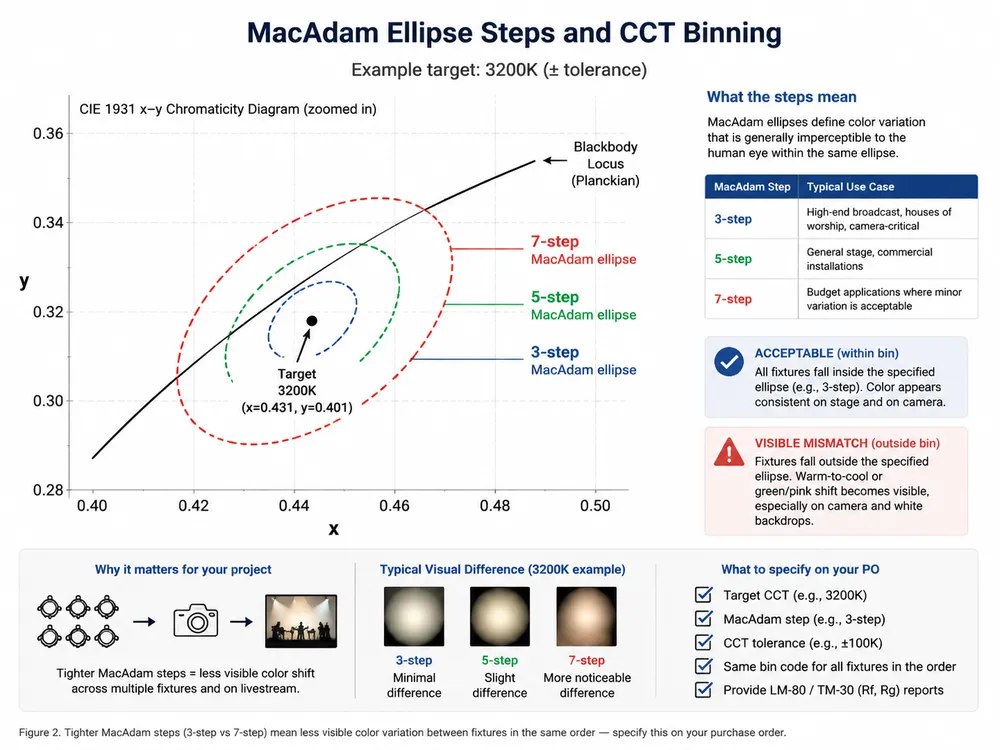
Ignoring LED bin matching across batches. Ordering front wash fixtures from two different production batches — or worse, two different suppliers — without confirming LED color bin consistency. The result: adjacent fixtures that look visibly different when set to the same CCT. On camera, it's obvious. Callbacks and re-lamping come out of your margin. (We bin-match within ±100K across production batches specifically for this reason, but not every manufacturer does. Ask for the binning tolerance before you order.)
Forgetting the volunteer factor. A 48-channel DMX rig with 200+ parameters looks impressive in your design software. Six months later, the church's volunteer tech team — typically 2–4 people who rotate monthly — has stopped using anything beyond the first three scenes because the system is too complex to operate without training. Specify simpler preset-based control (8–12 scenes) with optional full DMX override accessible to trained operators. Your post-install support calls drop by half.
No documentation handoff. The install looks great on commissioning day. Six months later, nobody at the church can replicate the settings because no one documented DMX addresses, scene programming, fixture positions, or cable routing. Include a laminated one-page rig sheet as part of your deliverable. It costs you 30 minutes and prevents the majority of "can you come back and fix this" requests that eat into your profit on the project.
Frequently asked questions — church stage lighting sourcing
What CRI/TLCI rating do church stage lights need for livestream quality?
90+ CRI and 85+ TLCI for competent livestream reproduction. Below 85 CRI, skin tones shift green or magenta under camera auto white balance, and the media team starts fighting color correction in post rather than trusting the lighting. Most professional church stage LED fixtures from reputable manufacturers hit 92–95 CRI. TLCI is the camera-specific metric — ask for it separately if the data sheet only lists CRI.
How many LED pars do I need for a 12m-wide church stage?
At 40° beam angle with 5m throw distance and 30% overlap between adjacent fixtures, roughly 6–8 LED pars for even front wash coverage. For narrower 25° beam angles (common at longer throw distances), increase to 10–12 units. Always calculate based on beam width at the throw distance, not fixture count alone.
Can I mix fixture brands on the same DMX universe?
Technically, any DMX-512 compliant fixture works on the same universe. Practically, color temperature drift between brands creates visible inconsistency when adjacent fixtures are set to the same CCT value. Source all fixtures within the same functional role (front wash, color wash) from a single manufacturer to guarantee bin-matched LED output. Mix brands across roles if needed — front wash from one manufacturer, LED moving heads from another — but not within the same visual layer.
What's the realistic lead time for a 50-fixture church project order from China?
Standard catalog models: 2–4 weeks production plus 3–5 weeks ocean freight to North American ports (total 5–9 weeks). Air freight cuts transit to 7–10 days but adds $3–5/kg to your landed cost. Custom CCT bins or OEM branding: add 2 weeks to production. Plan 8–10 weeks total for sea delivery, 4–6 weeks for air. Build in a 2-week receiving buffer before your scheduled install date.
Do I need IP-rated fixtures for indoor church installations?
IP20 (standard indoor rating — protected against solid objects over 12mm, no water protection) is fine for open-ceiling installations with adequate ventilation. If fixtures mount inside enclosed soffits, near HVAC supply vents where condensation forms, or in any position where cleaning crews might spray near them, specify IP44 minimum. Outdoor worship spaces or covered pavilions need IP65 or higher.