

Green Laser DJ Lights Maximum Visibility Per Milliwatt
Single-wavelength 532nm green laser DJ lights — the brightest perceived beam color at any given power class.
When your market restricts total laser power but your buyers still demand visible beam shows, green at 532nm delivers what RGB cannot: full impact within regulatory limits.
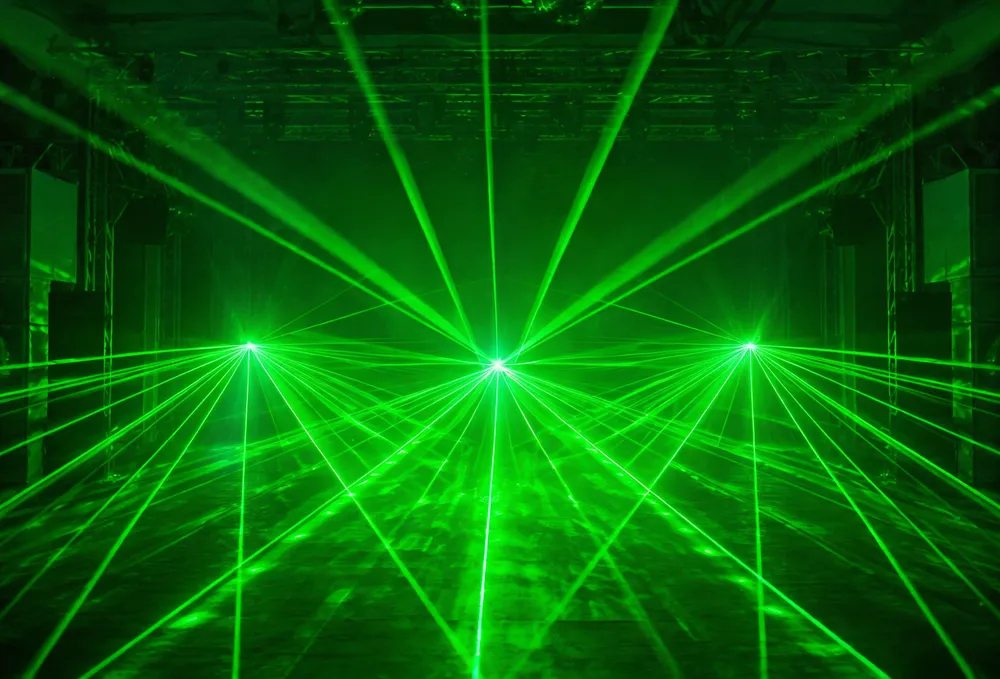
Why 532nm Green Moves Volume in Power-Restricted Markets
Human scotopic and photopic vision peaks near 555nm, and 532nm sits close enough that the eye perceives green laser beams as roughly 10× brighter than red at identical milliwatt output. This isn't physics trivia — it's the commercial reason green laser DJ lights outsell single-color red in every market where total laser power is capped by regulation.
The EU, Australia, and several Southeast Asian markets enforce strict laser power class limits for entertainment use. In these environments, your buyers cannot simply spec a higher-wattage RGB unit to compensate for dim beams. They need maximum visual punch from minimum power. A 100 mW green laser projecting 532nm beams through haze creates the same audience impact as a 300–400 mW RGB unit running green-dominant patterns — at a fraction of the regulatory burden and compliance cost.
For your distribution business, this translates directly: green laser DJ lights let you serve power-restricted markets with a lower-cost SKU that still delivers a premium visual result. Your margin per unit is healthy because the end user perceives high value (bright, sharp beams cutting through venue haze), while your manufacturing cost stays below full RGB configurations.
We've seen our EU and Australian distributors build 40–60% of their laser category revenue on green-only units for exactly this reason. The Middle East is catching up — several Gulf states introduced entertainment laser power caps in 2024, and green SKU demand from that region has doubled since.
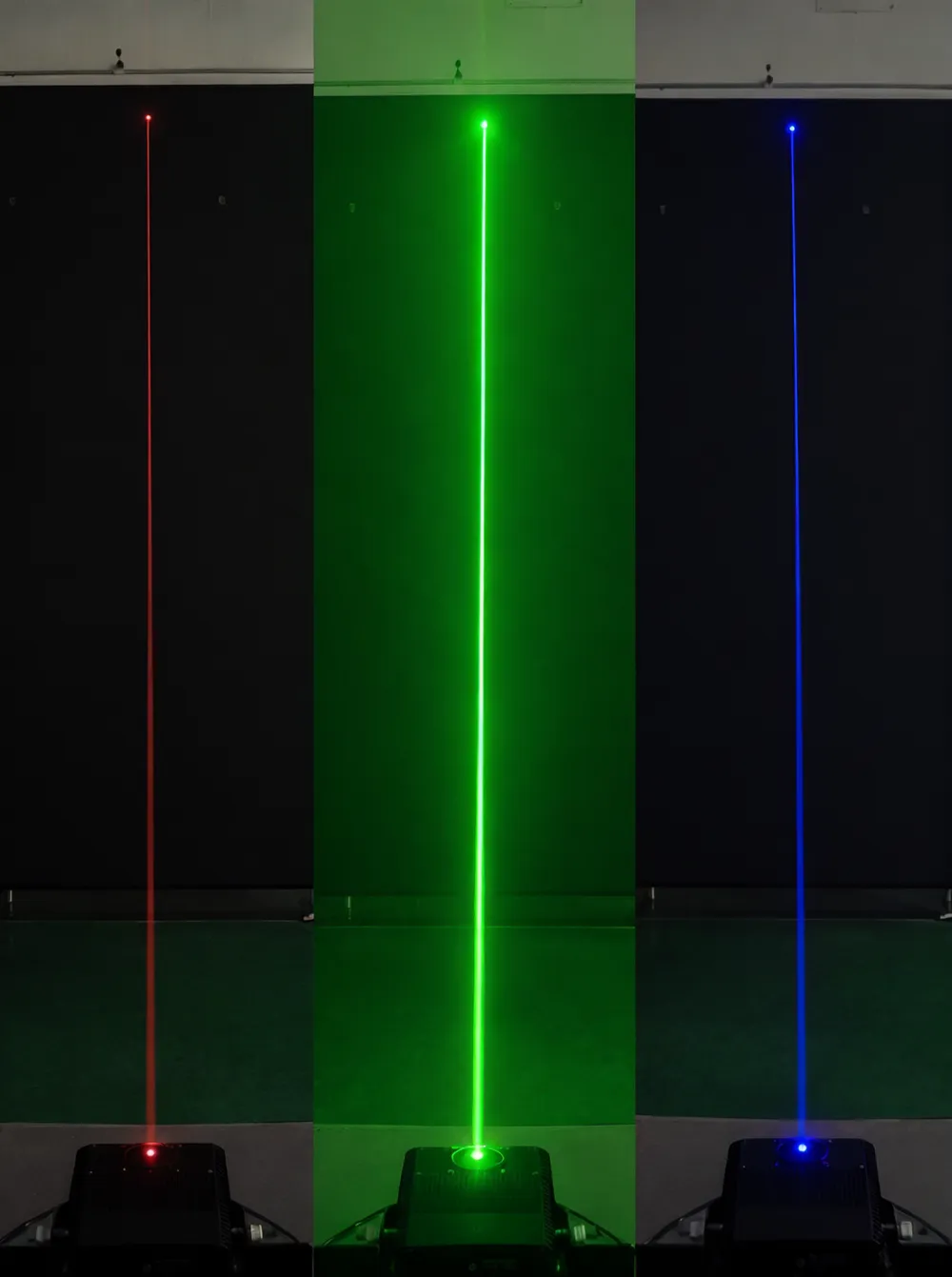
Perceived brightness vs. red at same mW
Laser category revenue (EU/AU distributors)
Gulf-region green SKU demand (2024)
The Distributor Advantage
A 100 mW green-only unit costs you less to source than a 300–400 mW RGB projector, carries a lighter regulatory burden at import, and delivers equivalent perceived beam impact in-venue. Your end-user buyer gets the visual show they demand; you pocket the margin delta between a single-wavelength module and a full RGB configuration. Lower SKU cost, lower compliance overhead, higher perceived value — that's the green laser business case.
Technical Specifications — Green Laser DJ Lights
Specifications shown are standard production values. Custom power classes and scan speeds available — contact us for a detailed product data sheet matching your requirements.
| Parameter | Specification |
|---|---|
| Wavelength | 532nm (green) |
| Laser Power Options |
50 mW
100 mW
150 mW
200 mW
300 mW
|
| Laser Source | DPSS (50–200 mW models), Diode-direct (200–300 mW models) |
| Scan System | Galvanometer, 15–20 KPPS (model dependent) |
| Pattern Count | 64–128+ programmable patterns |
| Control Modes | DMX-512, Auto, Sound-Active, Master/Slave |
| Beam Divergence | < 1.2 mrad |
| Operating Voltage | AC 100–240V, 50/60Hz universal input |
| Housing | Extruded aluminum, black anodized |
| Cooling | Passive heatsink + internal fan (models above 100 mW) |
| Operating Temperature | 0°C – 40°C |
| Laser Class | Class 3B (models ≤200 mW) / Class 4 (300 mW) |
| Certifications | CE, FCC, RoHS |
| IP Rating | IP20 (standard indoor) |
Australia
Sub-100 mW for unrestricted venue use. Your Australian buyers typically spec 50 mW or 100 mW units to stay under local power classification thresholds without requiring additional laser safety officer sign-off.
50–100 mW tierEurope (EN 60825-1)
European buyers operating under EN 60825-1 Class 3B limits land at 150–200 mW. This power class gives strong throw distance while staying within common venue insurance requirements.
150–200 mW tierMiddle East & South America
Markets without restrictive caps buy 300 mW for maximum throw distance. Large outdoor venues and festival stages demand the longest possible beam reach.
300 mW tierSingle-supplier convenience: We stock all power tiers, so you can order a mix across power classes without splitting across multiple suppliers. One PO, one quality standard, one logistics relationship — regardless of how many regional markets you serve.
DPSS vs. Diode-Direct: Which Source Technology Fits Your Buyer's Application
We produce green laser DJ lights in two source configurations, and the choice affects your service cost and warranty exposure downstream.
DPSS (Diode-Pumped Solid-State)
50–200 mW modelsUses an 808nm infrared pump diode exciting a Nd:YVO4 crystal, frequency-doubled through KTP to output 532nm. The beam quality is excellent: tight TEM00 mode, low divergence, very clean single-wavelength output.
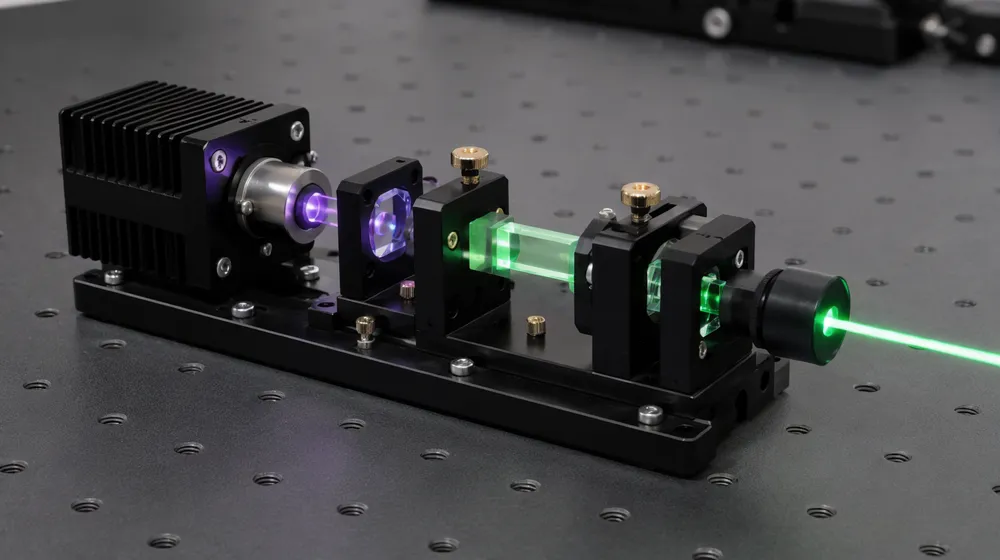
Strengths
- Sharpest, most defined beams through haze — visually superior for beam shows where the audience sees individual ray lines
- Tight TEM00 mode with low divergence
- Very clean single-wavelength output at 532nm
Trade-offs
- Temperature-sensitive — output power fluctuates below 10°C or above 40°C ambient
- 10–15 second warm-up time
- Higher warranty return rates at 200 mW tier (1.2% over 18 months)
Best for: Indoor DJ and entertainment venues where beam aesthetics are the priority. 50–150 mW DPSS models deliver the best visual quality per dollar.
Diode-Direct
200–300 mW modelsSemiconductor laser diodes output green directly without frequency conversion. Thermally more stable across a wider ambient range, faster warm-up time, and longer diode lifespan under thermal cycling.
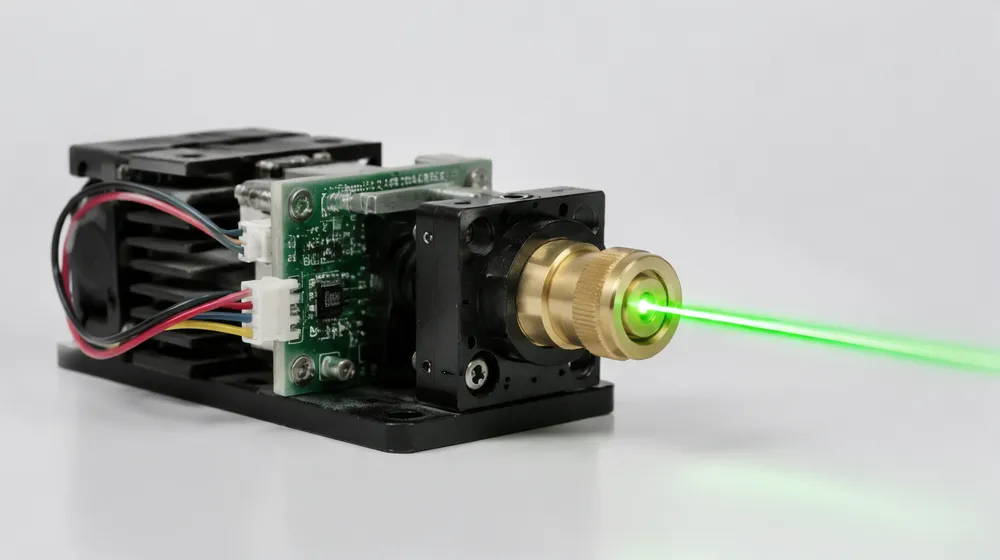
Strengths
- Thermally stable across a wider ambient range
- Under 2 seconds warm-up time (vs. 10–15s for DPSS)
- Longer diode lifespan under thermal cycling
- Lower cost per milliwatt above 200 mW — improves landed cost on higher-power SKUs
Trade-offs
- Beam profile slightly less refined than DPSS — acceptable for pattern projection and scan effects, slightly less pristine for tight aerial beam work
Best for: Outdoor events, rental fleets with mixed storage conditions, or tropical/desert climates. Spec diode-direct from 200 mW up.
200 mW Tier: Platform Transition (2024)
We transitioned our 200 mW model from DPSS to diode-direct in 2024 after field data showed lower warranty return rates on the diode-direct version — 0.4% vs 1.2% over 18 months. The DPSS 200 mW is still available for buyers who prioritize beam aesthetics over thermal robustness, but most distributors have moved to diode-direct at that power tier.
Your Stocking Decision
Indoor DJ / Entertainment Venues
50–150 mW DPSS models deliver the best visual quality per dollar. Superior beam aesthetics for controlled indoor environments.
Outdoor / Harsh Environments
Outdoor events, rental fleets with mixed storage conditions, or tropical/desert climates — spec diode-direct from 200 mW up.
Galvo Scanning and Pattern Consistency Across Your Batch
Green laser DJ lights are beam-and-pattern products — the galvanometer scanning system determines what your end user actually sees. We use closed-loop galvo actuators on all green laser models (no stepper motors in this line), running 15–20 KPPS depending on model tier.
Why Closed-Loop Matters
Closed-loop means position feedback on both X and Y mirrors. The galvo knows where the mirror actually is, not just where it was told to go. This eliminates pattern drift during extended operation — a common failure mode in open-loop systems where thermal expansion of the galvo coil causes progressive misalignment over a 4–6 hour show.
Your rental clients running these units for full event nights won't see pattern geometry degrade by hour five.
Scan Speed
15–20 KPPS
Feedback Type
X+Y closed-loop
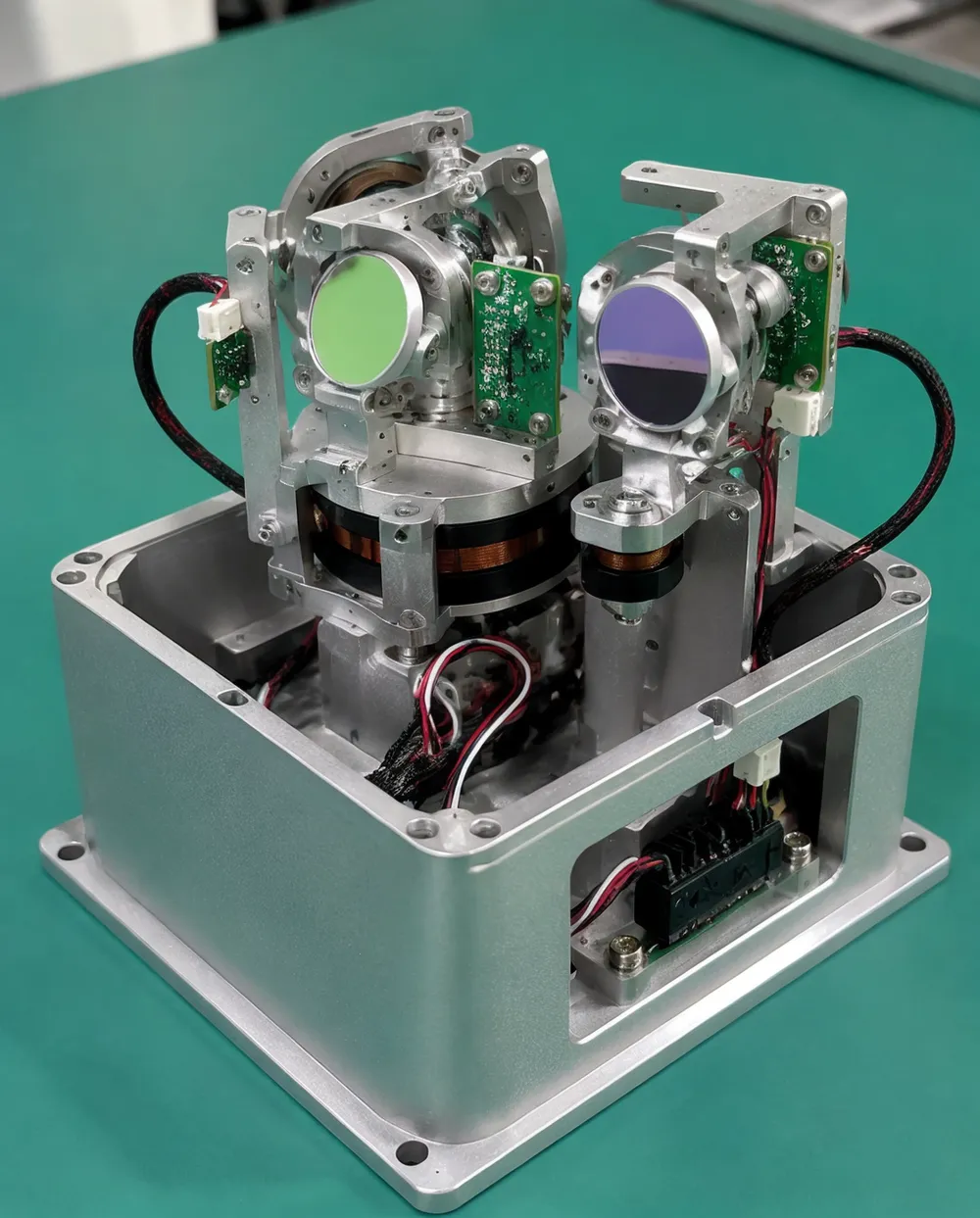
Production Calibration: ±0.3° Tolerance
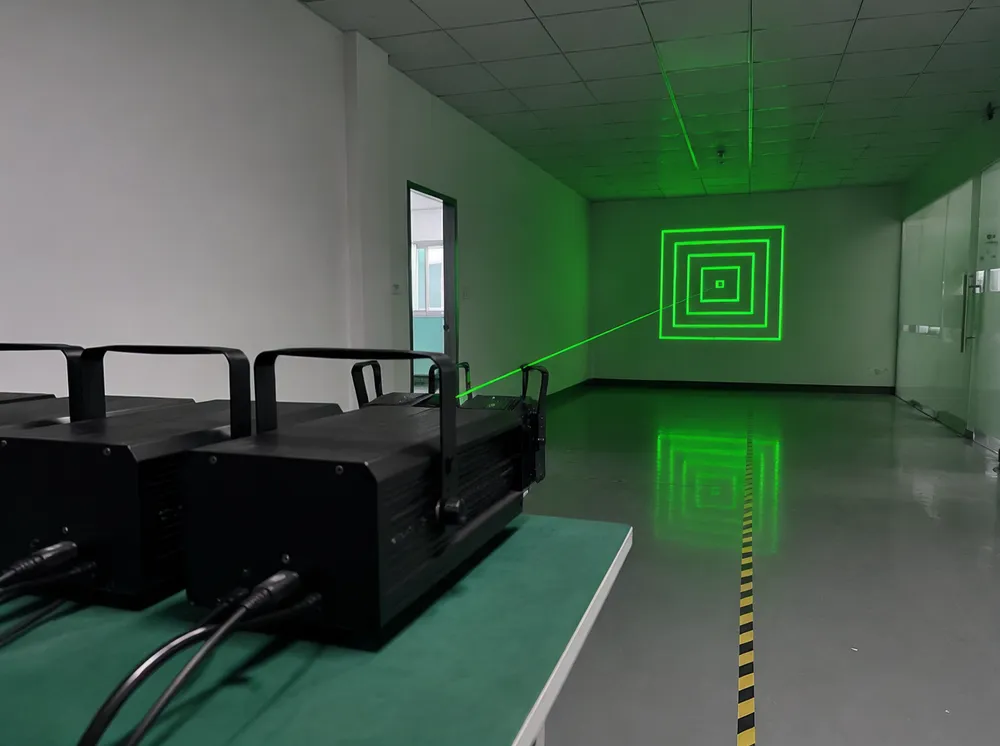
Pattern calibration during production uses a fixed-distance test wall with laser-etched reference grid. Every unit is adjusted so that at 5-meter throw, the standard test pattern (concentric squares) falls within ±0.3° of nominal across the full scan field.
When your buyer lines up four green laser units for a multi-fixture beam show, pattern alignment between units is close enough to look coordinated without individual unit tweaking.
2023 improvement: Tightened from ±0.5° to ±0.3° after feedback from a German rental company that was spending 20 minutes per gig aligning units. Now their techs plug in and go.
128
Factory-Programmed Patterns
64
User-Programmable Slots via DMX
OEM
Custom Pattern Set Loaded at Production
Need a custom pattern set for your brand?
For OEM buyers, we load your custom pattern set during production — no field programming required at your end.
Thermal Management That Protects Your Warranty Margin
The parent category page covers our thermal design philosophy across all DJ laser lights. For green laser DJ lights specifically, thermal management is more critical than RGB or red units because of how 532nm generation works.
DPSS Crystal Phase-Match Sensitivity
DPSS green modules contain a crystal assembly (Nd:YVO4 + KTP) that is phase-match-sensitive to temperature. If junction temperature climbs above the design window, the frequency-doubling efficiency drops — output power falls, and the beam may develop secondary wavelength artifacts visible as slight color shift.
This isn't catastrophic failure; it's gradual performance degradation that your end user notices as "the laser isn't as bright as it used to be."
Our DPSS Thermal Solution
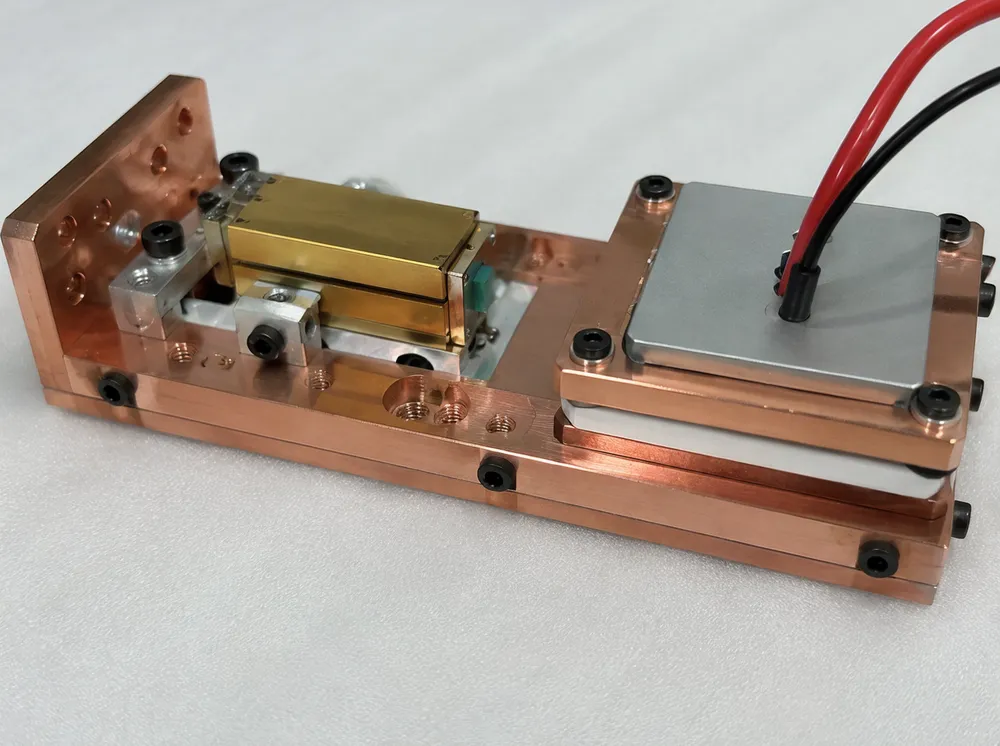
The crystal assembly sits on a copper sub-mount with thermoelectric cooling (TEC) on models above 100 mW. The TEC actively regulates crystal temperature within ±1°C of optimal phase-matching temperature regardless of ambient conditions up to 40°C. Below 100 mW, passive cooling with an oversized aluminum heatsink mass keeps the crystal within ±3°C — adequate for the lower thermal load.
Above 100 mW
±1°C
TEC active regulation
Below 100 mW
±3°C
Passive heatsink mass
Diode-Direct Thermal Design
Diode-direct models are simpler thermally — no crystal phase matching to maintain — but the semiconductor junction still degrades with excess heat.
Our heatsink geometry on diode-direct green units holds junction temperature below 35°C at full continuous output in 30°C ambient. That's 10°C below the manufacturer's rated maximum, which keeps the diode operating on the flat portion of its degradation curve.
48-Hour Aging Test Protocol
The 48-hour aging test verifies all of this before shipment. We measure output power at hour 0, 24, and 48. Any unit showing more than 2% power deviation gets pulled.
The category standard is 3% — we hold tighter on green because the single-wavelength output makes power fluctuation more noticeable to the end user than it would be in a multi-color fixture.
40°C
Max ambient operating (TEC models)
35°C
Junction temp at full CW (diode-direct)
48 hrs
Pre-shipment aging per unit
Market Segments Where Green Laser DJ Lights Sell Best
Each segment below represents a repeatable revenue channel for your distribution business — not a one-time sale, but a category your buyers restock on cycles.
Regulated Entertainment Markets
EU, Australia, Parts of Asia-Pacific
The primary volume driver. Venues operating under laser power restrictions need maximum visual impact within their licensed power class. Green at 532nm is the physics-optimal answer. Distributors serving these markets typically stock 100 mW and 150 mW DPSS models as their bread-and-butter SKU, with 50 mW for the smallest venues.
Mobile DJ Upgrade Cycle
Working DJs Replacing Older Units
Working DJs replacing older red or red-green units with single-color green for cleaner beam aesthetics. A mobile DJ typically owns 2–4 laser units and refreshes every 18–24 months. Your dealer or online store sells green lasers as a "next level" upgrade from basic red — higher perceived value, higher retail price point, but your wholesale cost is only marginally above red because the 532nm diode cost premium has compressed significantly since 2022.
House of Worship & Community Venues
Churches, Halls, School Auditoriums
Churches, community halls, and school auditoriums adding visual impact to events without the complexity or safety concerns of full RGB. Green single-color reads as high-tech but non-intimidating. Volunteer operators — not trained lighting technicians — run these units in sound-active or auto mode.
Architectural & Decorative Installation
Hotels, Restaurants, Event Spaces
Hotels, restaurants, event spaces using green laser beams as permanent or semi-permanent decorative elements. Green reads elegantly in high-end spaces — less "nightclub" than RGB, more "designed." These are project-based sales through lighting consultants and interior design firms, typically 6–20 units per installation.
Outdoor Event & Festival (Seasonal)
Longest Visible Throw Distance in Haze
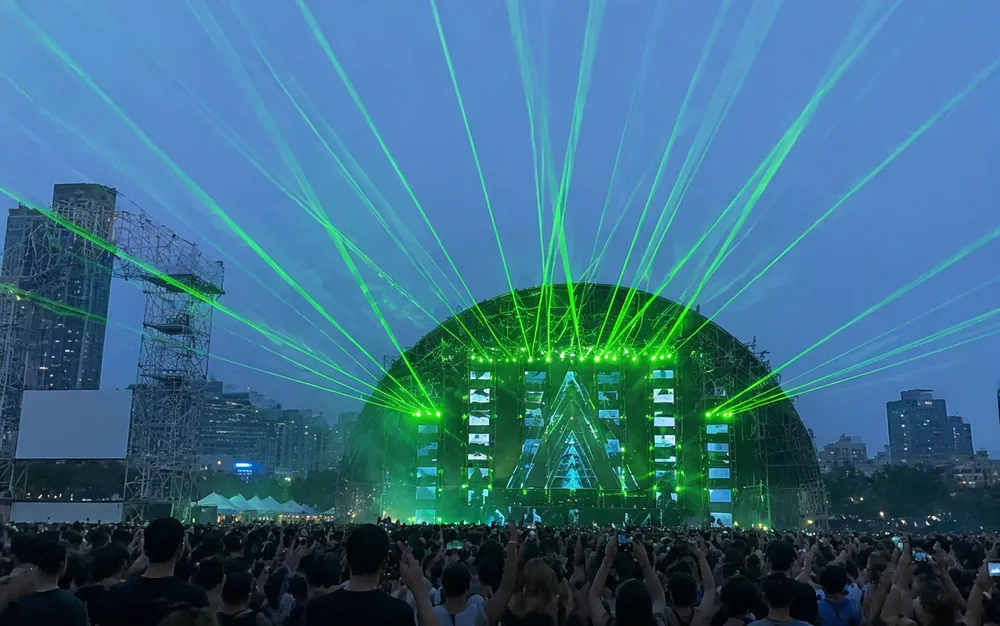
Green beams have the longest visible throw distance in haze and fog of any single color. Festival organizers and outdoor event companies use 200–300 mW green lasers for long-throw aerial beam effects. Seasonal demand — heavy in Q2–Q3 for Northern Hemisphere summer festival season.
If your market is event rental, this is a seasonal volume spike worth planning inventory for.
Tell us your target segment and we'll recommend power class and quantity tiers.
Get Segment-Specific RecommendationOEM Customization Specific to Green Laser DJ Lights
Beyond standard branding (your logo, packaging, firmware screen — available from 30 units), green laser units have product-specific customization options:
Power Class Selection
Choose from standard tiers (50/100/150/200/300 mW) or request intermediate power levels for markets with specific regulatory thresholds. We configure to match your target laser classification precisely.
Pattern Programming
Standard units ship with 128 factory patterns. OEM buyers can specify a custom pattern library: your logo projection, specific geometric sets tailored to your market (wedding-focused patterns for bridal entertainment distributors, church-appropriate imagery for worship AV suppliers). Custom patterns programmed during production at no additional unit cost above 100-unit orders.
Housing Color & Finish
Standard is black anodized aluminum. White housing available for architectural and worship installations where black stage equipment looks out of place. Custom RAL colors on orders above 200 units.
Control Interface Configuration
Standard DMX-512 + sound-active + auto. For integration buyers, we can add wireless DMX receiver (built-in or as a module bay), or configure specific DMX channel mapping to match your existing control ecosystem.
Regulatory Labeling
Laser safety labeling customized to your destination market's format requirements. CDRH-compliant labeling for US market, EN 60825 classification labels for EU, or your market-specific variant.
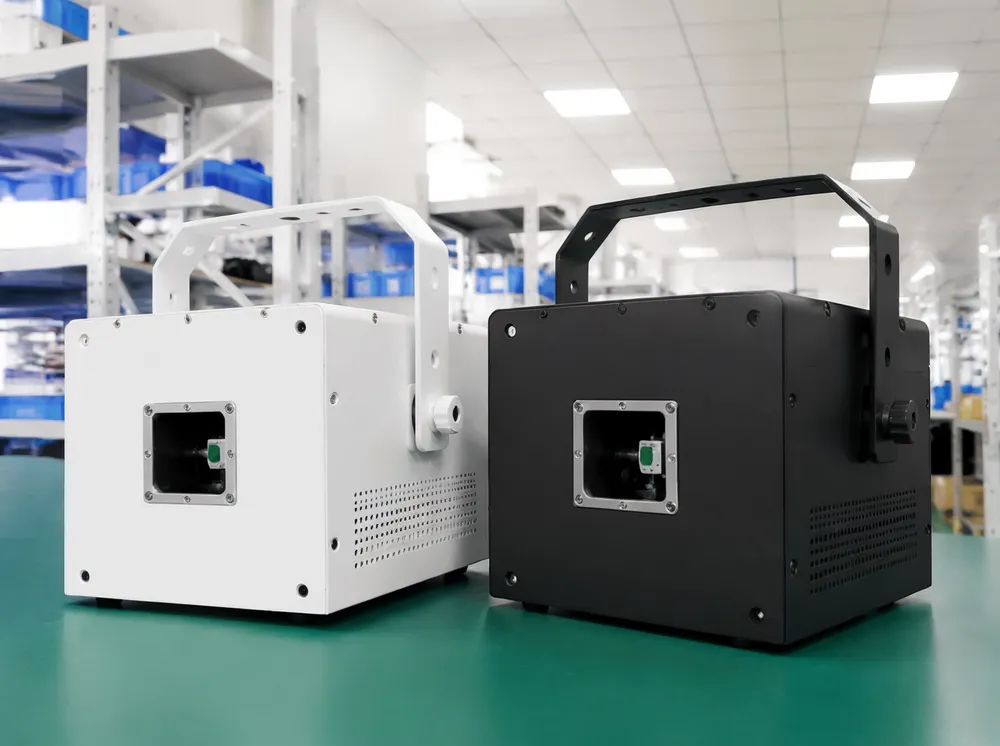
White and black housing options — custom RAL colors available on 200+ unit orders.
Real Example: UK Distributor Custom 80 mW Build
A UK distributor recently ordered 300 units with a custom 80 mW output — specifically to sit just below the UK's Class 3B threshold for easier venue licensing. Took us 12 days from spec confirmation to production samples. The flexibility to hit exact regulatory boundaries is something catalog products from trading companies can't offer.
Compliance and Regulatory Documentation for Your Import
Green laser DJ lights ship with complete regulatory documentation for major import markets:
CE Mark
Low Voltage Directive + EMC Directive — full test reports from accredited lab.
FCC Part 15
Electromagnetic compatibility for US import.
RoHS
Material compliance declaration covering all restricted substances.
EN 60825-1
Laser safety classification and labeling (European standard).
FDA/CDRH
For US-bound orders, we handle the laser product reporting requirements under 21 CFR 1040. Accession numbers filed and provided with your shipment documentation.
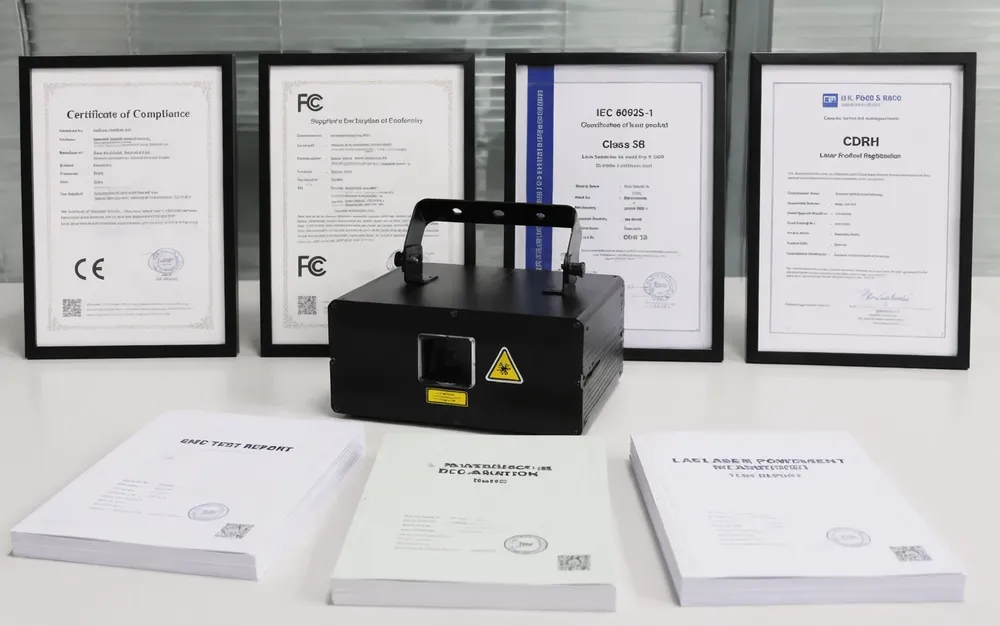
For Your EU Buyers
IEC 60825-1 classification is pre-applied — every unit ships with the correct class label (3B or 4, depending on power), aperture labels, and key-switch interlock on models above 100 mW. Your venue operator clients need this labeling for their laser safety officer sign-off.
24-Hour Documentation Response
We maintain active product files with all test reports. If your import customs requests supplementary documentation (EMC test data sheets, component material declarations, laser power measurement certificates), we provide them within 24 hours of request. No scrambling at the port.
Packaging and Container Efficiency for Green Laser DJ Lights
Green laser units are compact — most models are under 2 kg and fit a housing footprint of roughly 200mm × 150mm × 100mm. Container loading efficiency is high.
Container Loading Density
| Model Size | Units / 20GP | Units / 40HQ |
|---|---|---|
| 50–100 mW compact | ~2,800 | ~6,000 |
| 150–200 mW standard | ~2,200 | ~4,800 |
| 300 mW professional | ~1,600 | ~3,500 |
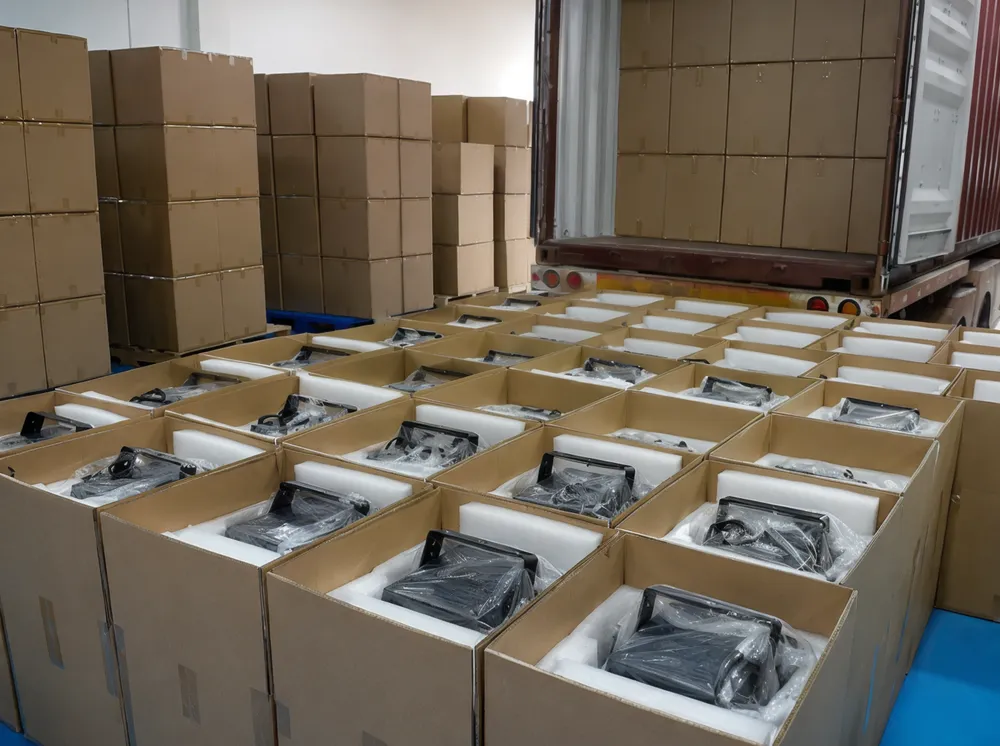
Dual-Density EPE Foam
Optics-inward orientation. Galvo assembly protected by aluminum housing mass acting as a natural shock buffer.
Galvo Transport Lock
Mirrors locked during packaging to prevent resonant vibration damage during ocean freight transit.
Damage Rate: <0.2%
Across our shipping history for green laser units. If a unit arrives with galvo misalignment (rare), field recalibration takes under 5 minutes with the included hex-key alignment tool — no return shipping required.
Custom Carton Labeling
Provide your barcode template, SKU numbering, and packing list layout — we replicate it exactly. Palletization configured for your container type and receiving dock setup.
How Green Laser DJ Lights Compare to Sibling Products
Choosing between green-only and other configurations in our laser lineup comes down to your buyer's application and your market's regulatory environment.
| Decision Factor | Green Laser DJ Lights | RGB Laser Projector | Professional DJ Laser |
|---|---|---|---|
| Visual impact per mW | Highest (532nm peak sensitivity) | Moderate (power split across 3 colors) | Moderate-high (multi-wavelength) |
| Regulatory simplicity | Easier — lower power achieves same visibility | More complex — higher total power needed | Moderate |
| Pattern versatility | Geometric + beam effects (single color) | Full color mixing, widest pattern variety | Multi-color patterns, DMX priority |
| Typical buyer | Regulated markets, worship, architectural | Clubs, KTV, high-end rental | Working DJs, rental fleets |
| Your margin profile | Healthy — perceived value exceeds cost | Highest unit margin in category | Volume anchor SKU |
| Unit cost to you | Lowest in category (single-diode config) | Highest (3 diode sources + combining optics) | Mid-range |
If your market is power-restricted
Green laser DJ lights are the clear choice — nothing else delivers comparable visibility per milliwatt. Lower power classification means faster import clearance and fewer compliance hurdles for your buyers.
If your buyers want color variety
Consider the RGB Laser Projector DJ Lights for the widest visual range, or the Professional DJ Laser Lights for multi-color with an emphasis on reliability.
If your buyers want minimal setup complexity
The LED Laser DJ Lights hybrid combines wash and laser in one housing — fewer fixtures, fewer cables, simpler rider fulfillment for your rental clients.
If price point drives your channel
Mini DJ Laser Lights serve the impulse-buy and entry-level segment at a lower cost tier — ideal for e-commerce channels and brick-and-mortar starter kits.
Frequently Asked Questions — Green Laser DJ Lights
What power class of green laser do I need for different venue sizes?
50 mW
Rooms under 80 m² with visible beams in light haze — bars, private party rooms, small churches.
100–150 mW
Mid-size venues (80–300 m²) — clubs, wedding halls, school auditoriums.
200–300 mW
Large venues and outdoor spaces above 300 m².
The 532nm wavelength gives you more perceived brightness per milliwatt than any other color, so you can spec one tier lower than you would for RGB and achieve equivalent visual impact.
DPSS or diode-direct green — which should I stock?
Stock DPSS (50–150 mW)
If your market is primarily indoor fixed installations and controlled-environment venues — beam quality is noticeably sharper.
Stock Diode-Direct (200 mW+)
If your buyers operate in hot climates, outdoor festivals, or rental environments where units experience temperature swings.
Most of our distributors carry DPSS at the lower tiers and diode-direct at the higher tiers — a natural split that covers both use cases.
How do I handle laser safety compliance for green laser products in my market?
Requirements vary by jurisdiction:
EN 60825-1 classification and labeling is mandatory — we apply this during production.
FDA/CDRH reporting is required for laser products — we file the paperwork and provide accession numbers with your shipment.
Products above Class 1 require state-level laser safety licensing for the venue operator.
We provide all documentation your buyers need for local compliance, but venue licensing is your end user's responsibility. If you're entering a new market and need guidance on which power class avoids the most regulatory friction, ask us — we can point you to the threshold that keeps things simple.
Why do some green lasers turn dim or shift color after months of use?
In DPSS units, the Nd:YVO₄ and KTP crystals degrade their phase-matching efficiency when repeatedly exposed to temperatures above their rated window. Poor thermal management accelerates this.
Our solution: TEC-stabilized crystal mounts (on models above 100 mW) maintain phase-match temperature within ±1°C, preventing the gradual output loss and color-shift artifacts that plague cheaper DPSS implementations.
Diode-direct units don't have this failure mode — their degradation pattern is straightforward junction wear, managed by keeping thermal headroom above rated limits.
What's the MOQ and lead time for green laser DJ lights?
Minimum Order Quantities
- •30 units/SKU for standard configurations
- •30 units for OEM branding (logo, packaging, firmware screen)
- •100 units for custom power classes or pattern libraries
Lead Times
- •Sample orders: 5–7 days
- •Production runs: 20–25 days
- •Custom configurations: +10–15 days for programming and verification
Next Step: Spec the Right Green Laser Configuration for Your Market
Send us your target market, regulatory environment, and expected order volume. We'll come back with a specific recommendation on power class, source technology (DPSS vs. diode-direct), and pattern configuration — plus a detailed quotation with tiered pricing based on your quantity.
If you're evaluating beam quality firsthand, we ship 1–2 unit samples within 7 days of order confirmation. Most buyers start there before committing to production volume.
Explore More DJ Laser Lights
Professional DJ Laser Lights
Full-power pro units for touring and install
RGB Laser Projector DJ Lights
Multi-color output for full-spectrum shows
Mini DJ Laser Lights
Compact form-factor for mobile DJs and small venues
Disco DJ Laser Lights
Classic disco-style beam effects and patterns
DJ Laser Bar Light
Linear array format for wide-coverage scanning
LED Laser DJ Lights
Hybrid LED + laser for versatile venue coverage